
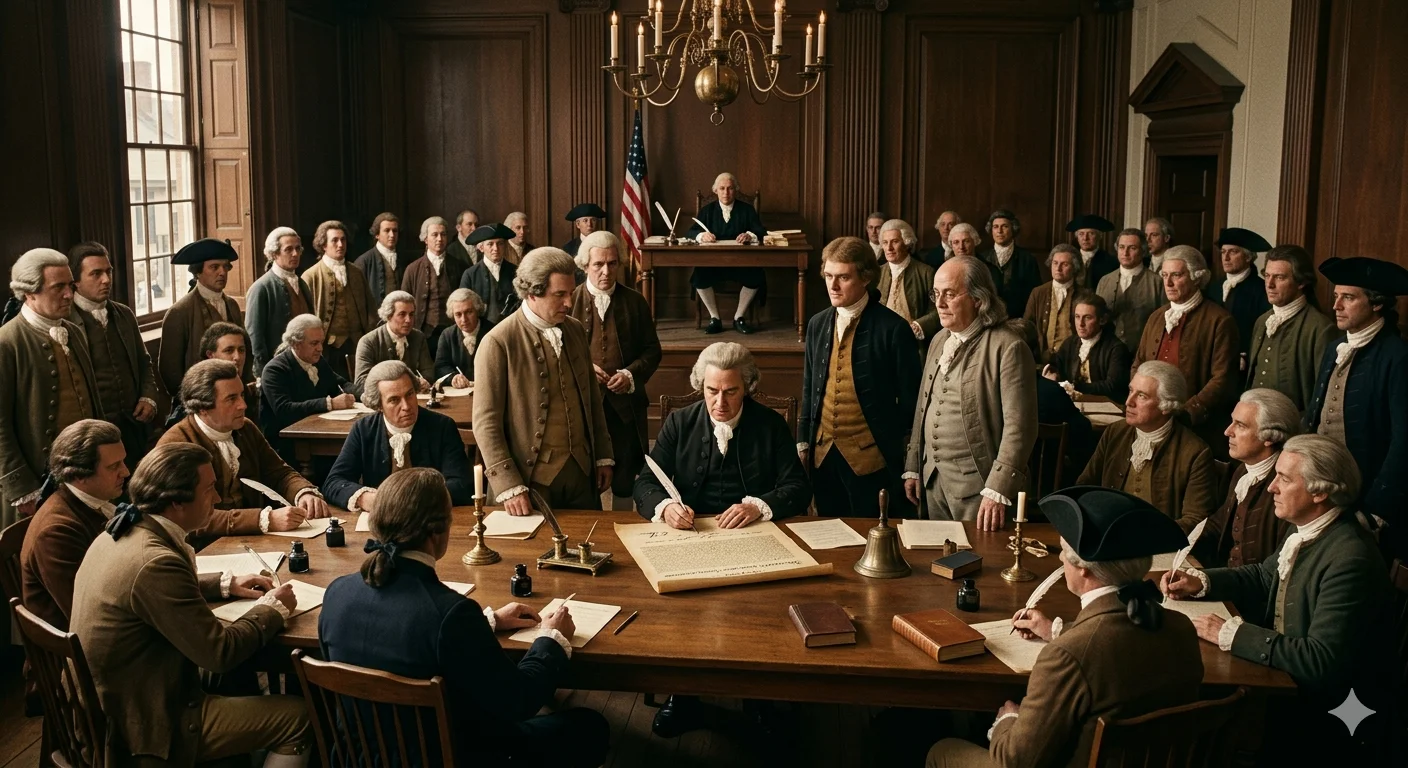
On August 2, 1776, in the assembly room of the Pennsylvania State House in Philadelphia, the president of the Continental Congress, John Hancock of Massachusetts, stepped forward and in a bold, deliberate hand signed his name to the engrossed parchment copy of the Declaration of Independence. His signature was placed in the center of the document, prominent and unmistakable, in keeping with his status as the presiding officer of the Congress. Forty-nine other delegates followed that day, signing their names in columns arranged by state from the northernmost, New Hampshire, to the southernmost, Georgia. Six more delegates would add their signatures in the weeks and months that followed.
The formal signing ceremony of August 2, 1776, is one of the most significant and least celebrated days in American history. Most Americans know July 4 as Independence Day, and rightly so: that was the date on which the Continental Congress adopted the Declaration of Independence, committing the thirteen colonies to separation from the British Empire. But the solemn act by which fifty-six individual men personally committed themselves to that declaration, placing their names on a document that made them traitors in the eyes of the Crown and subjected them to death by hanging if the British won the war, occurred nearly a month later. In signing, they were, as the document’s closing words declared, mutually pledging to each other their lives, their fortunes, and their sacred honor.
The Road to the Declaration: From Colonial Grievance to Revolutionary Break
The signing of August 2, 1776, was the culmination of a process that had been building for more than a decade. The relationship between the thirteen American colonies and the British Crown had been deteriorating since the early 1760s, when Britain, exhausted by the debt of the Seven Years’ War and facing the cost of defending its North American empire, began imposing new taxes and regulatory measures on the colonies. The Stamp Act of 1765, the Townshend Acts of 1767, and the Tea Act of 1773 each provoked colonial resistance that escalated in intensity. The Boston Tea Party of December 1773, in which colonists dumped an entire shipment of British East India Company tea into Boston Harbor, led to the Coercive Acts of 1774, which the colonists called the Intolerable Acts, and which closed the port of Boston, restricted Massachusetts self-government, and quartered British soldiers in private homes.
The First Continental Congress met in Philadelphia in September 1774 to coordinate the colonial response, and the Second Continental Congress convened in May 1775, shortly after the Battles of Lexington and Concord on April 19 had initiated armed conflict. By the time the Second Continental Congress gathered, war had already begun, but most delegates still hoped for reconciliation with Britain. The Olive Branch Petition of July 1775, which pleaded with King George III for a peaceful resolution, was rejected without reply. In August 1775, the King declared the colonies to be in a state of rebellion.
Through the winter of 1775 to 1776, opinion within the colonies shifted rapidly toward independence. Thomas Paine’s pamphlet Common Sense, published in January 1776, sold more than 100,000 copies in its first three months and made the case for complete independence in language accessible to ordinary readers, demolishing the arguments for continued loyalty to the Crown. Colony after colony began instructing its delegates to support independence. North Carolina explicitly authorized its delegates to vote for independence on April 12, 1776. Virginia instructed its delegates in May.
The Lee Resolution, the Committee of Five, and Thomas Jefferson’s Draft
On June 7, 1776, Richard Henry Lee of Virginia rose in the Continental Congress and introduced the resolution that would directly produce the Declaration: “Resolved, that these United Colonies are, and of right ought to be, free and independent States, that they are absolved from all allegiance to the British Crown, and that all political connection between them and the State of Great Britain is, and ought to be, totally dissolved.” John Adams of Massachusetts seconded the motion.
Several delegates were not yet authorized to vote for such a resolution, and Congress decided to delay the vote while simultaneously appointing a committee to draft the formal declaration of independence that would be needed to explain the decision to the world and to inspire both the American people and potential foreign allies. The Committee of Five was appointed on June 11, 1776, consisting of Thomas Jefferson of Virginia, John Adams of Massachusetts, Benjamin Franklin of Pennsylvania, Robert R. Livingston of New York, and Roger Sherman of Connecticut.
The committee delegated the actual writing to Jefferson, who was thirty-three years old and already respected within the Congress as a gifted prose stylist. Jefferson worked on the draft between June 11 and June 28, producing the document in a rented room on the second floor of a house on Market Street owned by a bricklayer named Jacob Graff. Adams and Franklin reviewed the draft and made changes, and the committee submitted it to Congress on June 28.
The Lee Resolution itself came to a vote on July 2, 1776, and passed with twelve colonies voting in favor and New York abstaining, having not yet received authorization from its state convention to vote. July 2 was therefore the date on which Congress actually voted to declare independence, a fact that led John Adams to predict that July 2 would be celebrated annually as a great American holiday. He was wrong about the date, but right about the celebration.
Congress then spent July 3 and most of July 4 debating and revising Jefferson’s draft. Approximately eighty changes were made to the text, including the elimination of a long passage condemning King George III for his role in the slave trade, which Jefferson had included but which was removed at the insistence of delegates from Georgia and South Carolina. The final text was approved on the afternoon of July 4, 1776.
July 4 and the Question of When the Declaration Was Actually Signed
The relationship between July 4 and the signing of the Declaration of Independence has been the source of persistent historical confusion. The signed parchment document is dated July 4, 1776, and Jefferson, Adams, and Franklin all wrote in their accounts that the Declaration was signed on that date. The official Journals of the Continental Congress, in their published form, contain an entry for July 4 stating that the Declaration was adopted and signed on that day, followed by a list of all 56 delegates whose signatures appear on the document.
The problem is that this account contains obvious errors. Several of the delegates listed as having signed on July 4 were not in Philadelphia on that date. Some had not yet even been elected to the Continental Congress as of July 4. Thomas McKean of Delaware, whose signature is among the 56, did not sign until January 1777. The New York delegation had abstained entirely on July 4 because it lacked authorization from Albany, and New York only officially endorsed the Declaration on July 9, 1776.
In 1796, delegate Thomas McKean stated flatly that “No person signed it on that day nor for many days after.” His account gained authority when the Secret Journals of Congress were published in 1821, revealing previously unpublished entries including a resolution of July 19, 1776, ordering that the Declaration “be fairly engrossed on parchment with the title and stile of ‘The unanimous declaration of the thirteen United States of America'” and that it “be signed by every member of Congress.” The reference to “unanimous” could now be included because New York had finally formally endorsed the Declaration on July 9.
The engrossing, the careful hand-lettered transcription of the text onto parchment, was carried out by Timothy Matlack, the assistant to Congress secretary Charles Thomson. Matlack was a Philadelphia Quaker and merchant who was also, notably, an accomplished penman. His work produced the parchment document that bears all 56 signatures and that now resides in the National Archives in Washington, D.C. The signing ceremony itself began on August 2, 1776.
The Wikipedia article on the signing of the United States Declaration of Independence provides the most comprehensive analysis of the historical debate over when delegates signed, the evidence from primary sources, and the positions of the various historians who have studied the question.
August 2, 1776: The Formal Signing Ceremony
When the delegates gathered on August 2, 1776, to sign the engrossed parchment, they were performing an act of considerable personal courage. The document they were signing had already been printed and distributed. Its text was already known to British authorities. But the names of its individual signers had not yet been made public. The names on the signed parchment would remain secret, officially at least, until January 18, 1777, when Congress authorized Mary Katherine Goddard, a Baltimore printer, to produce a printed broadside that for the first time included the signers’ names alongside the text.
John Hancock signed first and most prominently, his large signature placed in the center of the document below the text. According to tradition, Hancock remarked that he signed his name large enough for King George to read it without his spectacles, though the historical authenticity of this remark is uncertain. The other delegates signed in columns arranged by state delegation, moving geographically from north to south. Josiah Bartlett of New Hampshire signed first among the state delegations, and George Walton of Georgia signed last among those present on August 2.
Among those signing on August 2 were some of the most distinguished figures in American history. Benjamin Franklin, at seventy years old the oldest signer, had been one of the most celebrated intellects in the Atlantic world for decades, having achieved fame as a scientist, printer, writer, and diplomat. John Adams, who had been among the most effective advocates for independence within the Congress, signed alongside Franklin. Samuel Adams, his cousin and a veteran political agitator who had been a central figure in Boston’s resistance to British authority, was present. Roger Sherman of Connecticut, who had also served on the Committee of Five, added his signature. Edward Rutledge of South Carolina, at twenty-six the youngest signer, signed despite having initially opposed independence.
The diversity of occupations among the signers reflected the range of colonial society. They included lawyers, physicians, merchants, farmers, and planters. Most were educated and financially comfortable; many were genuinely wealthy. They ranged in age from Rutledge’s twenty-six years to Franklin’s seventy. They came from every corner of the thirteen colonies, from the fishing communities of New Hampshire to the rice and indigo plantations of South Carolina.
Those Who Did Not Sign: Refusals, Absences, and Late Additions
The story of the signing includes those who did not sign as well as those who did. Several delegates who had been present for the debates and the vote were absent on August 2 or chose not to add their names to the document.
John Dickinson of Pennsylvania, who had been one of the most eloquent colonial voices of the pre-war period and the author of the Letters from a Farmer in Pennsylvania, refused to sign. Dickinson had opposed the declaration not because he supported British rule but because he believed the colonies were not yet ready for independence and that more preparation was needed. He resigned from Congress rather than sign, but then immediately enlisted in the Continental Army to demonstrate his commitment to the American cause.
Robert R. Livingston of New York, who had served on the Committee of Five that drafted the Declaration and was one of its authors, never signed the document. He had been recalled to New York by his state government and was not present for either the July 4 vote or the August 2 signing. His absence from the list of signers has been noted as one of the great ironies of the Declaration’s history: one of its authors is not among those who signed it.
Several delegates who voted for independence on July 4 were also absent on August 2 for various reasons. General George Washington was with his army in the field and did not sign. Patrick Henry, who had been one of the most fiery advocates of American liberty, was serving as governor of Virginia and was not present. Five other generals, including John Sullivan and James Clinton, were also away on military duty.
The late signers filled in their signatures in the weeks and months after August 2. Richard Henry Lee, who had introduced the independence resolution in June, signed after August 2. George Wythe of Virginia, Elbridge Gerry of Massachusetts, Oliver Wolcott of Connecticut, Lewis Morris of New York, and Matthew Thornton of New Hampshire all added their names after the formal ceremony. Thomas McKean of Delaware, the last to sign, added his name sometime in January 1777. Thornton, whose name appears at the end of the New Hampshire signatures on the parchment, had to place his name outside the designated area for his state’s delegation because no space remained.
The National Archives milestone document page for the Declaration of Independence provides the official account of the document’s creation, engrossing, and signing, and describes the physical condition and current preservation of the signed parchment.
The Consequences of Signing: Lives, Fortunes, and Sacred Honor
The fifty-six men who signed the Declaration of Independence were not romanticized heroes divorced from practical reality. They understood with clarity what they were doing. By signing a document that declared the colonies to be free and independent states and accused King George III of a long list of specific tyrannies, they were formally committing treason against the Crown. If the British won the war, the signers faced prosecution, confiscation of their property, imprisonment, and potentially death.
Some signers did suffer serious consequences. Nine delegates died during the Revolutionary War, some from hardships directly connected to the conflict. Several had their homes destroyed or severely damaged by British forces. At least five delegates were captured by the British at various points in the war. Thomas Heyward Jr., Arthur Middleton, and Edward Rutledge of South Carolina were all captured during the fall of Charleston in 1780 and held as prisoners of war for nearly a year. Richard Stockton of New Jersey was captured by British forces in November 1776, imprisoned in New York, and subjected to harsh conditions that permanently damaged his health. He died in 1781, among the first signers to die after the signing.
The popular narrative that virtually all the signers lost everything is an exaggeration. Many, including Franklin, Adams, Sherman, and Jefferson himself, went on to distinguished careers and comfortable lives after independence was won. But the risks they accepted were genuine, and the declaration with which they closed their document was not mere rhetoric. They were pledging their lives, their fortunes, and their sacred honor at a moment when the outcome of the war was deeply uncertain.
The Britannica article on the Declaration of Independence covers the document’s philosophical foundations in Enlightenment thought, the arguments made for independence in its text, and the consequences of the declaration for the subsequent history of the United States and the world.
The Declaration of Independence has since become one of the most influential political documents in history. Its assertion that all men are created equal and endowed with unalienable rights including life, liberty, and the pursuit of happiness has inspired independence movements and democratic constitutions across the world. When 56 men signed their names to that parchment on August 2, 1776, and in the weeks that followed, they set in motion something that extended far beyond their thirteen colonies and their own lifetimes.