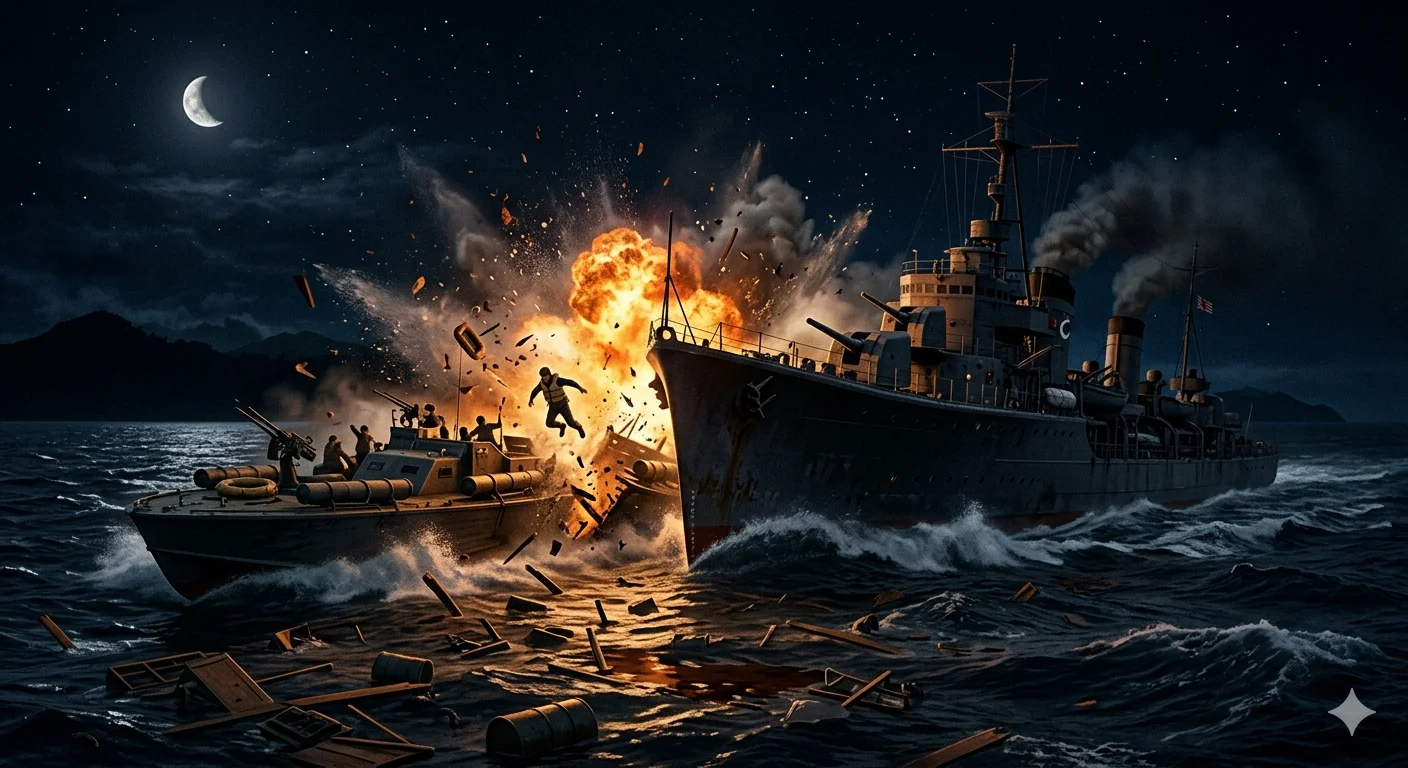
In the early hours of August 2, 1943, in the profound darkness of Blackett Strait in the Solomon Islands, a twenty-six-year-old naval lieutenant named John F. Kennedy stood in the cockpit of his eighty-foot patrol torpedo boat and watched a shape emerge from the blackness three hundred yards off his starboard bow. In the moonless, starless night, it took precious seconds to recognize what it was. By the time Kennedy and his crew understood that the shape was not another American PT boat but a Japanese destroyer advancing without running lights, there was no time to act. The destroyer, the Amagiri, struck PT-109 at approximately 2:30 in the morning, slicing through the patrol boat’s starboard side at a twenty-degree angle, cutting it nearly in two, and igniting a burst of flame from the ruptured fuel tanks.
The collision lasted only seconds. What it produced lasted the rest of Kennedy’s life, and in ways no one could have predicted that night in the darkness of the Pacific, it helped shape the presidency of the United States.
John F. Kennedy and His Road to the Pacific
John Fitzgerald Kennedy was born on May 29, 1917, in Brookline, Massachusetts, the second son of Joseph P. Kennedy Sr., the wealthy businessman and former United States Ambassador to the Court of St. James, and Rose Fitzgerald Kennedy. He grew up in a family of intense competitive drive and political ambition, attended Harvard University, and graduated in 1940. His senior thesis, published as the book Why England Slept, examined Britain’s failure to adequately prepare for war with Nazi Germany and demonstrated a serious analytical mind engaged with the major questions of international politics.
When the United States entered the Second World War after the Japanese attack on Pearl Harbor on December 7, 1941, Kennedy attempted to enlist. He was initially rejected by both the Army and the Navy due to a chronic back condition that had plagued him since a football injury at Harvard. His father, using his considerable connections, helped facilitate his eventual acceptance into the Navy. Kennedy was commissioned as an ensign and received training in intelligence work, but he lobbied persistently for sea duty, specifically for service on the small, fast patrol torpedo boats that were seeing action in the Pacific.
In April 1943, having completed PT boat training, Kennedy arrived at Tulagi in the southern Solomon Islands, then twenty-five years old. Fifteen days after his arrival, he took command of PT-109. The boat was not in good condition. Its three large Packard motors needed complete overhaul. The hull was fouled with marine growth. Kennedy and his crew, most of them as inexperienced as their young commander, worked through May getting the boat ready for active service. Kennedy was determined to prove he was not the privileged son of a millionaire ambassador getting easy treatment; he worked alongside his crew scraping and painting the hull.
The Tokyo Express and the Night of August 1 to 2, 1943
The strategic context of the PT-109 incident was the ongoing American campaign to push Japanese forces northward through the Solomon Islands. American forces had captured Guadalcanal and Tulagi, but the Japanese remained entrenched on islands further north, and they were conducting regular resupply missions along what American sailors called the Tokyo Express: convoys of Japanese destroyers that would race down from the major Japanese base at Rabaul in New Britain, drop supplies and troops at designated points in the islands, and race back north before daylight exposed them to American air attack.
The American response was to dispatch PT boats to intercept these convoys in the narrow, island-choked waters of the straits. On the night of August 1, 1943, Lieutenant Commander Thomas Warfield at the base on Lumbari Island received flash intelligence that the Tokyo Express was coming. He dispatched fifteen PT boats to intercept, organizing them into four groups. PT-109, under Lieutenant John F. Kennedy, was assigned to patrol Blackett Strait, south of Kolombangara Island, along with PT-162 and PT-169.
The operation was beset by problems from the start. The night was moonless and starless, reducing visibility to almost nothing. Communication between the PT boats was poor; some commanders had turned off their radios or were not monitoring communications closely in order to maintain the radio silence that base commanders had instructed. Kennedy’s boat was idling on a single engine, keeping its speed low to avoid the phosphorescent wake that a faster patrol boat created in the tropical water and that Japanese aircraft could spot from the air.
The actual encounter with the Tokyo Express had gone badly for the American side. Of the fifteen PT boats dispatched, most had fired their torpedoes at the Japanese destroyers without scoring hits. By the early hours of August 2, PT-109, PT-162, and PT-169 were among the last boats still on patrol, having been ordered by Commander Warfield to continue patrolling the area. The Japanese destroyers, having delivered their supplies and troops at the southern tip of Kolombangara, were returning north to Rabaul and were passing back through Blackett Strait.
The Collision: 2:30 a.m., August 2, 1943
At approximately 2:30 in the morning of August 2, PT-109 was idling in the darkness when the shape appeared three hundred yards off the starboard bow. Kennedy and his crew initially believed it might be another American PT boat, which would have been a reasonable assumption given the number of friendly vessels in the area. The correct identification came too late. Kennedy attempted to turn the boat to starboard to bring his torpedoes to bear, but PT-109 had less than ten seconds, and the single engine providing power could not maneuver the boat fast enough.
The Amagiri, a Japanese Fubuki-class destroyer displacing approximately 2,100 tons, was advancing at roughly 40 knots without running lights. PT-109 weighed approximately 48 tons. The physics of the collision were not complicated. The Amagiri struck PT-109 at a twenty-degree angle on the starboard side forward of the forward starboard torpedo tube, shearing off a piece of the boat and cutting it nearly in two. The impact scattered the crew. The ruptured fuel tanks ignited briefly in a burst of flame. The Amagiri, moving at speed, disappeared back into the darkness and fog within seconds, her crew unaware whether they had killed the Americans or not.
There has been historical disagreement about whether the collision was intentional or accidental. Lieutenant Commander Kohei Hanami, captain of the Amagiri, later claimed that he had intentionally turned hard to starboard to ram PT-109. But Captain Katsumori Yamashiro, the Commander of the 11th Destroyer Flotilla and Hanami’s superior officer, along with other Amagiri crewmembers, recalled Yamashiro ordering Hanami to turn hard to port to try to avoid hitting the torpedo boat, partly out of concern that hitting it might detonate its torpedoes and damage their own ship. The question of intentionality remained unresolved.
Two of PT-109’s crew of twelve were killed: Gunner’s Mate Second Class Andrew Jackson Kirksey and Motor Machinist’s Mate Harold Marney. They were never found, and were presumed killed instantly in the initial collision. Kirksey had been one of the more experienced members of the crew, a man who had grown convinced during the preceding weeks that he was going to die in the war and had unnerved his shipmates with his morbid predictions. He had been right. The remaining ten men survived the immediate collision, though several were injured.
The JFK Presidential Library account of John F. Kennedy and PT-109 provides the most comprehensive narrative of the collision and the subsequent days of survival, drawn from primary documents including the original Navy intelligence report drafted by Lieutenant Byron White, who would later serve on the United States Supreme Court.
Kennedy’s Leadership: Swimming for Survival
The immediate aftermath of the collision left PT-109’s stern section sinking and the forward section still floating but flooded. Kennedy, who had been thrown violently around the cockpit by the impact, managed to call out to his surviving crew. Several men had been knocked into the water. Engineer Patrick McMahon, who had been below decks in the engine room, had miraculously escaped from the sinking stern section but had been severely burned by the exploding fuel.
Fear that the wreck would ignite and explode drove Kennedy to initially order the men still on board to abandon ship. But the Amagiri’s wake had helped to disperse the burning fuel on the water’s surface, and when the fire began to subside, Kennedy sent the men back to what remained of the forward section. Working in the darkness and the water, Kennedy organized the survivors, gathering those who had been scattered across the surface and getting them back to the floating wreckage.
Kennedy swam out personally to retrieve McMahon and Charles Harris, both of whom were in the water and could not make it back on their own. He towed the badly burned McMahon back to the boat, gripping the strap of McMahon’s life vest in his teeth because his hands were needed for swimming. He alternately cajoled and berated an exhausted Harris to keep him moving through the water.
When it became clear that the floating wreck would eventually sink, Kennedy made the decision to lead his crew in a swim to the nearest island. The closest landfall was an island later identified as Plum Pudding Island, approximately three and a half miles away. On the morning of August 2, Kennedy led the swim. He again towed McMahon the entire distance, clenching the life vest strap in his teeth. The swim took several hours. Kennedy collapsed when he finally reached the island. The small spit of land offered shelter and coconuts for water, but it was too small to provide food, and it was surrounded by Japanese-occupied territory.
The Coconut Message and the Rescue
For the next five days, Kennedy led his crew in a desperate effort to survive and make contact with Allied forces. He explored neighboring islands by swimming through enemy-patrolled waters at night, looking for food, supplies, and any opportunity to signal American forces. The survival operation demanded physical endurance that was remarkable given the back injury Kennedy had been carrying since Harvard and that the collision had badly aggravated.
Kennedy moved his crew progressively to larger, more sheltered islands that offered better food in the form of coconuts and fresh water. On Naru Island, he and crewmember George Ross encountered two indigenous Solomon Islanders named Biuku Gasa and Eroni Kumana, who were working as scouts for the Allied coastwatcher network operating behind Japanese lines. These men proved to be the key to the crew’s rescue.
Kennedy carved a message into the surface of a green coconut shell. It read: “NAURO ISL COMMANDER / NATIVE KNOWS POSIT / HE CAN PILOT / 11 ALIVE NEED / SMALL BOAT / KENNEDY.” Biuku Gasa and Eroni Kumana paddled the message to the coastwatcher station at Gomu Island, where Lieutenant Arthur Reginald Evans received it. Evans already had intelligence that PT-109 survivors existed from a separate communication Kennedy had managed to send through a local named John Kari. Kennedy was brought by canoe, hidden under a pile of palm fronds to avoid Japanese observation, to Evans’s station.
Evans relayed the rescue coordinates to the PT boat base at Rendova. On the night of August 7, PT boats PT-157 and PT-171 came in to collect the survivors. Kennedy arranged a prearranged signal of four shots to identify himself. His revolver had only three rounds left, so he borrowed a rifle from Evans for the fourth shot. Standing in a canoe to fire the signal, Kennedy failed to anticipate the rifle’s recoil and was dumped into the water. Even the rescue had its complications.
All eleven surviving crew members were recovered. Kennedy was ultimately awarded the Navy and Marine Corps Medal for his leadership and the physical courage he demonstrated in saving his men, and a Purple Heart for the injuries he had sustained. Byron White, who was also a naval intelligence officer in the Pacific at the time, wrote the original Navy intelligence account of the sinking and the rescue.
The Debate Over PT-109 and Its Legacy
The official American press and the Kennedy family’s considerable public relations machinery transformed what was, from a strictly military perspective, a significant operational failure into a story of heroism. One military historian later described the PT boat operations on the night of August 1 to 2 as “the most screwed up PT boat action of World War II.” Fifteen American boats had been dispatched against a Japanese destroyer convoy. None of the destroyers had been sunk or even seriously damaged. PT-109 was the only American vessel lost. The radio communications failures and the operational confusion of that night were real and consequential.
Kennedy himself was not deceived by the heroic narrative that his father helped to build around the incident. He was deeply pained by the deaths of Kirksey and Marney, and he returned to duty with a recklessness that concerned fellow officers. He lobbied for dangerous assignments and was described as appearing determined to redeem himself and avenge his lost crewmen. He took command of a new, heavily armed patrol craft, PT-59, which had been converted for gunfire support missions, and participated in the rescue of Marines under fire on Choiseul Island in November 1943 before his back injury became so severe that he was finally removed from combat duty.
The Wikipedia article on PT-109 provides detailed accounts of the boat’s service history, the collision, the subsequent rescue, and the later discovery of the wreck’s forward section by explorer Robert Ballard.
The coconut shell that carried Kennedy’s rescue message was later lacquered and mounted on a wooden base. It sat on the desk of the Oval Office throughout Kennedy’s presidency, a permanent reminder of the night in the Pacific when his boat was sliced in two and he had swum for miles in enemy waters to bring his men home. Kennedy’s answer when asked how he had become a hero, “It was involuntary. They sank my boat,” was both a joke and a precise account of the mechanics of how wartime heroism was sometimes manufactured from catastrophe.
The National Archives article on PT-109 provides a scholarly examination of the primary source documentation of the event, including the original Navy intelligence report and the various accounts that have been written about it over the decades.
Kohei Hanami, the captain of the Amagiri who had rammed PT-109, did not become Kennedy’s enemy. Nine years after the collision, when Kennedy was running for the United States Senate, he located Hanami and wrote him a letter on September 15, 1952, expressing good wishes and hopes for long-term peace between Japan and the United States. When Kennedy was elected president in 1960, the surviving crew of the Amagiri sent him a congratulatory message. Both gestures reflected the particular quality that the PT-109 experience had given to John Kennedy’s understanding of war: a recognition that the enemy across the darkness were men like his own crew, that chance and confusion shaped survival and death, and that the dignity of those who had fought on both sides deserved respect long after the fighting ended.