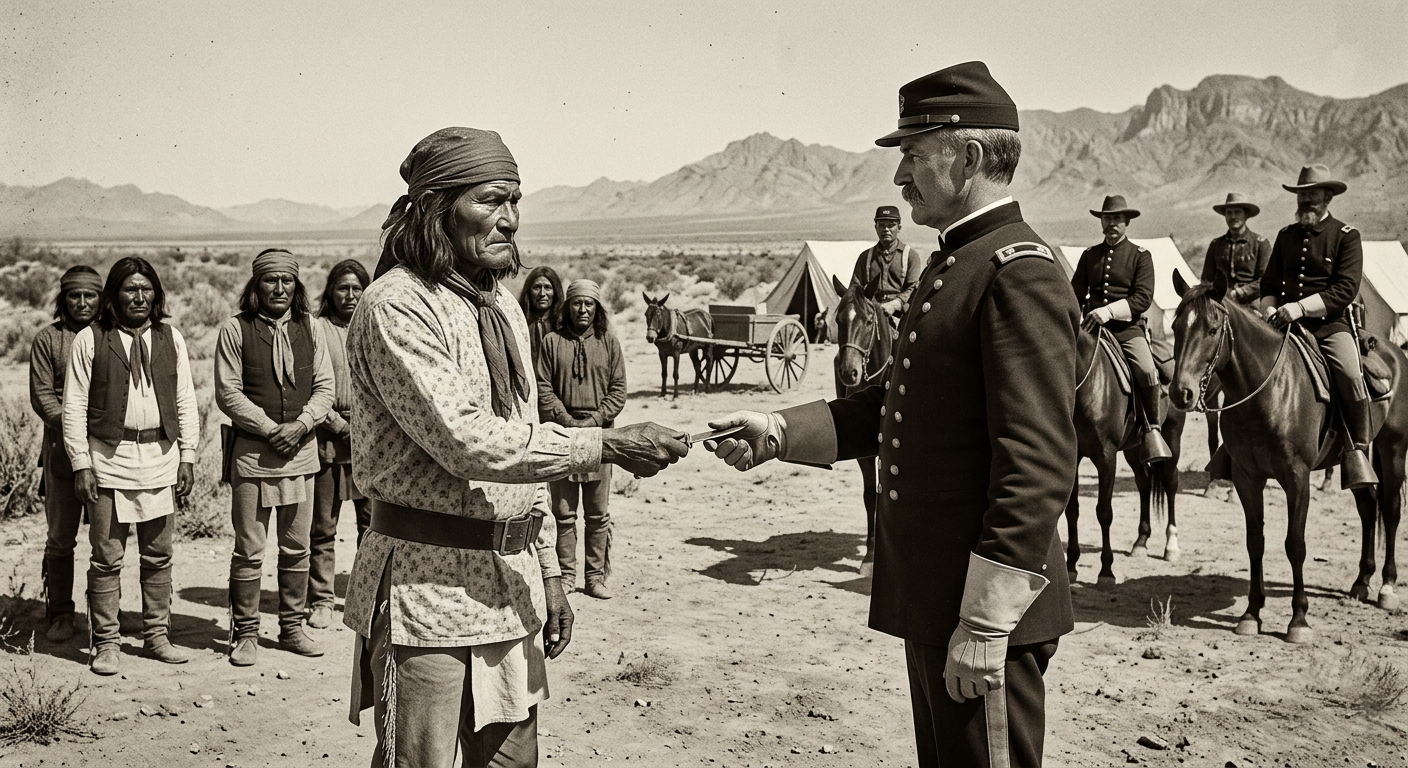
The Final Surrender of Apache Leader Geronimo to US Forces on September 4, 1886 — End of the Apache Wars
In the autumn of 1886, in a remote canyon straddling the border between Arizona and Mexico, a small and exhausted band of Apache men, women, and children made their way through rugged mountains toward a rendezvous with the man who had spent months hunting them. The band numbered thirty-eight people in total. They had been pursued across thousands of miles of desert and sierra, evading an army force that at its peak numbered more than five thousand soldiers, roughly one quarter of the entire United States Army, along with thousands of Mexican troops, Apache scouts, and civilian auxiliaries. They had not slept in one place for more than a day in over a year. They had eaten what the land gave them, sheltered in canyons and arroyos, and stayed alive through the kind of knowledge of terrain and survival that their people had developed over centuries of living in one of the most demanding landscapes on earth. Their leader was a man the Americans called Geronimo.
On September 4, 1886, at Skeleton Canyon in the Peloncillo Mountains of southeastern Arizona Territory, Geronimo formally surrendered to Brigadier General Nelson A. Miles of the United States Army. He was the last major Native American leader to formally capitulate to United States military authority, bringing to an end not merely his own decade-long resistance campaign but the entire era of armed conflict between the Apache people and the government of the United States. For most Americans at the time, the surrender was a moment of relief and triumph. For the Apache people, it was the beginning of a prolonged ordeal of imprisonment, displacement, and broken promises that would last for decades. And for history, it was the punctuation mark at the end of one of the most dramatic and haunting stories in the entire record of American westward expansion.
The Apache People Before the Wars: A Nation of the Desert Southwest
To understand the story of Geronimo’s surrender, it is essential to understand who the Apache were, where they came from, and what they were defending. The Apache are an Athabaskan-speaking people who are believed to have migrated southward from the subarctic regions of Canada and Alaska along the eastern face of the Rocky Mountains, eventually settling in the southwestern territories of what are today Arizona, New Mexico, and northern Mexico sometime around 1500 AD, and possibly earlier. The name Apache is itself a Spanish adaptation, possibly derived from a Zuni word meaning enemy or from a Yavapai word. The Apache people referred to themselves as Ndee or Dine, meaning the people.
The Apache did not constitute a single unified political entity but rather a constellation of related bands, each with its own territory, leadership, and distinct cultural characteristics. The principal Apache groups included the Chiricahua, who occupied the mountain ranges of southeastern Arizona and southwestern New Mexico and the adjacent Sierra Madre of northern Mexico; the Western Apache of central Arizona; the Mescalero of southern New Mexico; the Jicarilla of northern New Mexico; the Lipan of western Texas and eastern New Mexico; and the Kiowa-Apache of the southern plains. Among the Chiricahua themselves there were further divisions into bands: the Chokonen, the traditional band of the great chief Cochise who occupied the Chiricahua and Dragoon Mountains; the Chihenne or Warm Springs Apache of the Ojo Caliente region; the Bedonkohe of the Gila River headwaters region, which was Geronimo’s band; and the Nednhi, who ranged primarily in the Sierra Madre of Mexico.
Apache culture was built around small, mobile family groups called local groups or gotah, which moved seasonally across a defined territory, exploiting the resources of mountain, desert, and valley in a carefully calibrated annual cycle. The Apache were superb hunters, skilled gatherers of plant foods, accomplished warriors, and experienced traders. They raised horses and used them with extraordinary skill. They knew the land of the southwestern desert more intimately than any other people on earth, understanding water sources, mountain passes, ambush points, and escape routes that their enemies could not find on any map. This intimate knowledge of terrain was not merely a tactical advantage but a cultural identity: the land was not property to be owned but a living relationship to be maintained.
The Apache and the Spanish: Four Centuries of Conflict Before the Americans
By the time American soldiers first arrived in significant numbers in the Southwest following the Mexican-American War of 1846 to 1848, the Apache had already been fighting for their land and autonomy for more than two centuries. The Spanish colonial presence in northern Mexico and the borderlands of what would become New Mexico and Arizona had brought continuous pressure on Apache territory from the seventeenth century onward. Spanish colonists, missionaries, and soldiers attempted to settle Apache lands, convert Apache people to Catholicism, and bring them under the authority of the Spanish crown. The Apache response was persistent resistance, expressed primarily through raiding, which was both an economic necessity in a landscape that could not support large settled agricultural populations and a political statement of independence.
The relationship between the Apache and the Spanish and later Mexican authorities produced a cycle of raid and counter-raid, massacre and revenge, that persisted for generations and created a deep reservoir of mutual hostility. In 1835, the Mexican government placed a bounty on Apache scalps, offering cash payments to anyone who could produce the scalp of an Apache male above a certain age. This policy, which treated the Apache not as human beings but as vermin to be exterminated for pay, produced scalp-hunting expeditions that frequently targeted peaceful Apache groups as readily as hostile ones, since a Mexican official collecting the bounty had no reliable way to distinguish between the two. The Apache response to this extermination policy was intensified raiding and warfare that made much of northern Mexico dangerous for settlement throughout the mid-nineteenth century.
It was against this background of centuries of conflict, broken promises, and calculated violence that the story of Geronimo must be understood. When he became the figure that American history would remember as the most famous Apache warrior of the nineteenth century, he was not responding to some sudden or inexplicable impulse to violence. He was carrying forward a tradition of resistance that his people had maintained for generations against enemies who seemed to come in endless waves from the south, and later from the east, each more powerful than the last, each wanting the same thing: the land.
The Life of Goyahkla: Who Was Geronimo Before the Americans Named Him?
The man the world came to know as Geronimo was born in June 1829 in a canyon near the headwaters of the Gila River in what is now the state of New Mexico, which was then part of the Republic of Mexico, though the Apache disputed any Mexican claim to their territory. His birth name was Goyahkla, or Goyaale, a word in the Mescalero-Chiricahua Apache language that translates roughly as the one who yawns. He was born into the Bedonkohe band of the Apache, one of the groups within the larger Chiricahua Apache family. His grandfather Mahko had been chief of the Bedonkohe, and his father Taklishim was known as the gray one. His mother was named Juana. He had three brothers and four sisters.
Goyahkla grew up according to the traditional patterns of Apache youth, learning hunting, horsemanship, and warfare from experienced warriors in the community, developing the physical endurance and tactical instincts that Apache survival required. At approximately seventeen years of age, he was admitted to the warriors’ council of his band, the ceremony that marked his transition from boyhood to manhood and gave him the right to fight in battle and to marry. He soon married a young woman named Alope, from the Nednhi Chiricahua band, with whom he had three children. The couple appear to have been deeply attached to each other, and the family home was decorated with small animal figures that Alope made, toys for their children and ornaments for their dwelling.
He was not a hereditary chief. Apache leadership was not determined by bloodline alone but by demonstrated capacity in war and wisdom in counsel. A man could emerge as a war leader or a band leader based on his accomplishments, his reputation, and the voluntary loyalty of those who chose to follow him. Goyahkla also had a reputation as a shaman, a medicine man, someone who had received spiritual power, or medicine, from the divine force the Apache called Ussen, the Life Giver. This combination of physical courage, tactical brilliance, and spiritual authority would make him one of the most influential figures in Apache history. But all of that lay in the future. What destroyed the quiet domestic life of a young Apache husband and father, and set Goyahkla on the path to becoming Geronimo, occurred in the spring of 1851.
The Janos Massacre of 1851: The Event That Created Geronimo
On March 5, 1851, a company of approximately four hundred Mexican soldiers from the state of Sonora, commanded by Colonel Jose Maria Carrasco, attacked an Apache encampment outside the town of Janos in the northern Mexican state of Chihuahua. Janos was a location where Apache bands had traditionally conducted peaceful trade with Mexican merchants, and the encampment outside the town was a regular stopping point for groups traveling between their mountain ranges and the market. While the Apache men, including Goyahkla, were in town trading, Carrasco’s troops fell upon the camp where the women, children, and elderly had remained.
When the men returned from town, they found what Colonel Carrasco’s troops had left. Twenty-one women and children had been killed. Their bodies had been scalped, in keeping with the bounty system that rewarded Mexican soldiers with cash for Apache scalps. Among those murdered were Goyahkla’s aged mother, his wife Alope, and his three young children. Everything that had defined his domestic life, the woman he had married, the small painted figures she had made for their home, the children they had raised together, lay destroyed in the dust outside Janos.
The Apache survivors, shocked and without weapons since their firearms had been left at the camp and confiscated by the soldiers, could not retaliate immediately. They returned in silence to their homeland. Goyahkla later described returning to his home and finding everything that Alope had made and everything his children had played with. He burned it all, he wrote in his autobiography, along with his mother’s possessions and her dwelling. He had vowed vengeance upon the Mexican troopers who had wronged him, he recorded, and from that moment he was never again contented in the quiet home life he had known. From this day of grief and rage, Goyahkla’s trajectory as a warrior was set. He would pursue vengeance against Mexican soldiers and Mexican civilians with a ferocity that would define his public identity for the rest of his life.
It was in the course of his revenge campaigns against Mexico that Goyahkla acquired the name by which history would remember him. During a battle against Mexican troops, accounts agree that the Mexicans were heard calling out to Saint Jerome, San Jeronimo in Spanish, as Goyahkla attacked with extraordinary recklessness, repeatedly charging the enemy despite a hail of bullets, fighting with a knife when his other weapons were gone. Some historians attribute the name to the Mexican soldiers shouting Jeronimo in appeal to their patron saint for divine protection as this terrifying fighter came at them; others suggest it was the closest approximation Mexican soldiers could produce of Goyahkla’s own name. Whatever its precise origin, the Apache war leader accepted and embraced the Spanish name, and Geronimo it remained.
Mangas Coloradas, Cochise, and the Apache Alliance Against American Encroachment
In the years following the Janos massacre and the subsequent expansion of Geronimo’s raids against Mexican targets, the political landscape of the Southwest was transformed by the outcome of the Mexican-American War of 1846 to 1848. The Treaty of Guadalupe Hidalgo, signed on February 2, 1848, transferred the vast territory of northern Mexico, including Arizona, New Mexico, and California, to the United States. The Apache had not been consulted in this transaction. They had not been at war with the Americans, and many Apache leaders, including Mangas Coloradas, the great chief of the Mimbreno band of the Chiricahua, had actually expressed goodwill toward the Americans as fellow enemies of Mexico. The Gadsden Purchase of 1853 extended American territory further south, drawing the international border even deeper into traditional Apache lands.
For a brief period in the early 1850s, relations between the Chiricahua Apache and the arriving Americans were cautiously peaceful. The Apache generally preferred the Americans to the Mexicans, at least initially, and there was a period during which it appeared that some modus vivendi might be established. These hopes were shattered by a series of events in which American arrogance, incompetence, and bad faith destroyed the possibility of peaceful coexistence. The most consequential was the Bascom Affair of 1861, in which a young and inexperienced Army lieutenant named George Bascom accused Cochise, the great chief of the Chokonen band and one of the most respected Apache leaders, of a kidnapping he had not committed. When Cochise came to parley under a white flag, Bascom attempted to arrest him. Cochise escaped by cutting through the tent where he was being held, but six of his relatives were seized as hostages and subsequently executed. Cochise responded with war, and from 1861 until his death in 1874, the Apache Wars entered their most sustained and devastating phase.
Geronimo fought alongside both Mangas Coloradas and Cochise during this period. He participated in the major engagements of the early Apache Wars, including the Battle of Apache Pass in July 1862, where Cochise and Mangas Coloradas led an attack on a column of California Volunteers under General James Carleton. The use of howitzers by the Americans turned the battle against the Apache, and Mangas Coloradas was severely wounded. In 1863, Mangas Coloradas was lured into a parley with American troops under General Joseph West under false promises of safe conduct, captured, and then murdered by his guards during the night, his massive body mutilated and his head cut off and boiled so that his skull could be sent East for phrenological examination. The murder of Mangas Coloradas, one of the greatest Apache leaders of his generation, was a shattering blow to Apache morale and to any possibility of peaceful negotiation.
The San Carlos Reservation: Hell’s Forty Acres and the Birth of Resistance
The Apache Wars of the 1860s and 1870s were punctuated by periods of negotiation, treaty-making, and reservation assignment that successive American commanders attempted to use to pacify the Apache and end the cycle of raiding and retaliation. The most significant of these efforts was the establishment of the Chiricahua Reservation in 1872, created through negotiations between Cochise and the American Indian agent Tom Jeffords, who had earned Cochise’s trust through years of honest dealing, and Brigadier General Oliver O. Howard, who came to Arizona to negotiate peace. The Chiricahua Reservation encompassed the Chiricahua and Dragoon Mountains, the heart of the Chokonen homeland, and Cochise agreed to confine his people there in exchange for the right to remain in their ancestral territory with Jeffords as their agent.
This agreement, which had the potential to provide a workable basis for coexistence, collapsed after Cochise’s death in June 1874. Within two years, in 1876, the United States government abolished the Chiricahua Reservation and ordered all Apache to consolidate at the San Carlos Reservation in east-central Arizona. San Carlos was a location that the Apache universally regarded as unsuitable for human habitation. It sat on barren, sun-blasted flatlands at the confluence of the Gila and San Carlos rivers, a landscape so hostile that even American soldiers stationed there considered it a hardship posting. The Apache called it a land of rocks, rattlesnakes, and heat. It came to be known among contemporaries as Hell’s Forty Acres. Deprived of their mountain ranges, their traditional hunting and gathering grounds, and the freedom of movement that was fundamental to their way of life, confined on inadequate rations and under the supervision of agents who were frequently corrupt, incompetent, or both, the Apache at San Carlos were miserable.
In 1874, approximately four thousand Apache had been forcibly relocated to San Carlos. The government’s intention was to consolidate the management of these diverse and often mutually hostile bands in a single location where they could be administered efficiently and cheaply. In practice, it was a recipe for tension, resentment, and eventual explosion. Geronimo was among those relocated to San Carlos. He submitted initially, farming the barren soil as instructed and attempting to adapt to reservation life. But the constraints were too great, the rations too sparse, the oversight too arbitrary, and the abuses too numerous. Between 1876 and 1886, Geronimo broke out of the reservation four separate times, each escape leading to a campaign of pursuit that drew increasingly large numbers of American soldiers into the desert Southwest.
The Four Breakouts: A Decade of Pursuit and Resistance, 1876 to 1886
Geronimo’s first breakout from the San Carlos Reservation occurred in 1876, when he fled with a group of followers into Mexico’s Sierra Madre rather than submit to the consolidation order. He remained at large for several years before being persuaded to return. The second major breakout occurred in 1881, triggered in part by the killing of the Apache medicine man Nock-ay-det-klinne by American troops after he had attracted a large following among the reservation Apache with new religious dances that the military interpreted as preparation for an uprising. Geronimo fled again into Mexico and remained in the Sierra Madre until General George Crook negotiated his return in January 1884. The third breakout, in May 1885, was the one that would culminate in the famous surrender of September 1886.
On May 17, 1885, Geronimo and his fellow Apache leader Naiche, the son of Cochise and the last hereditary chief of the Chokonen Chiricahua, fled the San Carlos Reservation with a band that included approximately thirty-five men, eight boys, and one hundred and one women and children. The immediate trigger was a rumor, which had a basis in fact, that the authorities planned to arrest Geronimo and possibly hang him. Earlier that day there had been a confrontation at the reservation in which the Apache leaders had been confronted about violations of the ban on tizwin, the traditional Apache fermented corn drink. Geronimo had reportedly been drinking, the atmosphere was tense, and the combination of alcohol and justified fear for his safety prompted the decision to run.
The band crossed into Mexico and took refuge in the Sierra Madre, the rugged mountain range that had served as Apache sanctuary for generations because its deep canyons and complex terrain made it nearly impossible for outsiders to navigate. From the Sierra Madre, they conducted periodic raids into both Mexico and the United States, striking settlements on both sides of the border and retreating back into the mountains before effective pursuit could be organized. The raids were devastating to the communities they struck. In the last five months of Geronimo’s campaign, according to the governor of Sonora, his band killed somewhere between five hundred and six hundred Mexicans. American settlers in southern Arizona and New Mexico lived in genuine terror. Geronimo was simultaneously the most wanted fugitive in North America and the most famous Native American of his time, his name appearing in newspaper headlines across the country and around the world.
General George Crook and the First Surrender at Canon de Los Embudos, 1886
General George Crook was the most capable and most respected Apache campaigner in the United States Army. Crook had first been assigned to Arizona in the early 1870s and had achieved substantial success in reducing Apache resistance through a combination of relentless military pressure and pragmatic diplomacy. His most distinctive tactical innovation was the use of Apache scouts, enlisted from reservation Apache who, for a variety of reasons including resentment of specific hostile leaders, loyalty to the Americans, or simple material incentive, agreed to serve as trackers and fighters against the renegade bands. Crook believed that only Apache could catch Apache, and the record proved him largely right. His Apache scouts were the most effective tool in the Army’s pursuit of Geronimo, capable of tracking the band through terrain that would defeat any purely American force.
In November 1885, Crook launched a major expedition into the Sierra Madre in pursuit of Geronimo’s band. Captain Emmet Crawford commanded a force of Apache scouts that tracked the fugitives through the mountains of Chihuahua and Sonora. On January 9, 1886, Crawford located Geronimo’s camp. The Apache scouts attacked the next morning, capturing the band’s horse herd and camp equipment, leaving Geronimo’s people exhausted, demoralized, and without the means to sustain continued flight. The Apache agreed to negotiate.
Before the negotiations could conclude, however, a group of Mexican irregular troops arrived and, apparently mistaking Crawford’s Apache scouts for hostile Apache, opened fire. In the confused firefight that followed, Captain Emmet Crawford was shot and mortally wounded, dying from his injuries on January 18, 1886. It was a catastrophic loss of one of the Army’s finest officers and one of the most capable men in the Apache campaign. Lieutenant Marion Maus, taking command, continued the negotiations. Geronimo agreed to meet with General Crook himself.
The meeting took place at Canon de Los Embudos, the Canyon of the Funnels, in the Sierra Madre about eighty-six miles from Fort Bowie and approximately twenty miles south of the international border near the Sonora-Chihuahua boundary. The negotiations lasted three days, March 25 through 27, 1886. During those three days, a civilian photographer named Camillus Sidney Fly, who had traveled with Crook’s party, took approximately fifteen photographs of the assembled Apache and American participants, making approximately fifteen exposures on eight-by-ten inch glass negatives. These images, which Fly took on March 25 and 26, are the only known photographs ever taken of an American Indian who was still at war with the United States government. They show Geronimo, Naiche, and other Apache leaders and fighters in the field, armed and free.
At Canon de Los Embudos, Geronimo and Naiche agreed to surrender under terms that Crook negotiated. The terms were significant: the Apache would be exiled to the East for a period of two years, after which they would be permitted to return to Arizona with their families. The band began moving toward the border to comply. That night, however, a disaster occurred. A local bootlegger sold whiskey to members of Geronimo’s band, and in the drunken and anxious atmosphere that followed, someone told Geronimo that as soon as the Apache crossed the border, they would all be killed. Geronimo, Naiche, and approximately thirty-eight followers, men, women, and children, slipped away in the night and vanished back into the Sierra Madre. The remaining Apache under the leader Chihuahua continued to the border and surrendered as agreed.
Crook, furious at the escape and under intense pressure from Washington, exchanged a series of heated telegrams with General Philip Sheridan, who had been deeply skeptical of Crook’s approach of negotiating with Geronimo and using Apache scouts. On April 1, 1886, Crook sent a telegram asking to be relieved of his command, and Sheridan agreed. George Crook, the most effective Apache campaigner the Army had produced, was replaced by Brigadier General Nelson A. Miles, who arrived in Arizona on April 11, 1886, with a very different philosophy and a mandate to end the matter decisively.
General Nelson Miles and the Final Campaign: 5,000 Soldiers Against 38 Apaches
Nelson Appleton Miles was fifty-five years old when he took command of the Department of Arizona in April 1886, and he arrived with a reputation built on the successful conclusion of several major Indian campaigns in the northern plains. Miles had commanded troops in the campaign against Chief Joseph and the Nez Perce in 1877, had pursued Sitting Bull, and had generally demonstrated the ruthless efficiency and political ambition that characterized his military career. He was a driven, self-promoting officer who had won his rank through genuine military talent and equally genuine talent for taking credit. He immediately made clear that his approach would be fundamentally different from Crook’s.
Miles dismissed or sidelined the Apache scout system that had been the cornerstone of Crook’s strategy, at least initially, preferring to rely on large numbers of regular troops. He organized the most massive manhunt in the history of the Indian Wars. At the peak of the campaign, more than five thousand American soldiers, representing approximately one quarter of the entire United States Army, were deployed in the territory of southern Arizona and New Mexico in pursuit of Geronimo’s band of fewer than forty people. Three thousand additional Mexican soldiers were engaged south of the border. Miles established a network of thirty heliograph signal stations across the Arizona and New Mexico Territory, using mirrors to flash coded messages in sunlight across the desert, creating a communication system that allowed him to coordinate the movements of his dispersed forces in near real time. It was one of the most sophisticated military coordination systems deployed in any American military campaign to that point.
Despite all of this overwhelming force, Geronimo’s band evaded capture through the summer of 1886. The Sierra Madre was their fortress, its canyons and ridges as familiar to them as a man’s own house is to him, and no number of American soldiers could cover the terrain fast enough or know it well enough to pin down a group that moved with the fluid tactical intelligence of people who had lived in those mountains for generations. The campaign covered 1,645 miles of some of the most demanding terrain in North America. American troops were exhausted, demoralized, and plagued by heat, dehydration, and the psychological pressure of pursuing an enemy who was always just beyond reach. Geronimo’s band, though equally exhausted and steadily dwindling, refused to be caught.
Lieutenant Charles Gatewood and the Mission to Find Geronimo
By July 1886, it was becoming clear to Miles that pure military pursuit could not force Geronimo’s surrender. The band had shown that it could evade the largest military force the American frontier had ever assembled. What was needed was personal contact with Geronimo himself, and that required someone whom Geronimo knew and trusted. On July 13, 1886, Miles summoned Lieutenant Charles Bare Gatewood to his office in Albuquerque, New Mexico Territory, and gave him an assignment that most observers regarded as a suicide mission: take two Chiricahua Apache guides, find Geronimo somewhere in the mountains of Mexico, and persuade him to surrender.
Charles Gatewood was, in many respects, the most important man in the entire Geronimo story, though history has not treated him as generously as his role deserved. Born on April 5, 1853, in Woodstock, Virginia, Gatewood had graduated from the United States Military Academy at West Point and arrived in Arizona Territory as a young lieutenant in 1878. He had spent nearly a decade working with and alongside the Apache, learning their language, understanding their customs, and building a relationship of mutual respect with men like Geronimo that no other American officer had achieved. He was physically unimpressive, chronically ill with arthritis that had plagued him for years and would eventually kill him, and politically out of favor as a known associate of Crook rather than Miles. None of these disadvantages mattered. He was the one man in the American military whom Geronimo would actually listen to.
Gatewood set out from Fort Bowie with two Chiricahua guides named Martine and Kayitah, both of whom were related to members of Geronimo’s band and could move through the Sierra Madre without being mistaken for enemies by the Apache they were seeking. He also brought an interpreter and a few other soldiers. The group traveled deep into Mexico, ultimately joining Captain Henry Lawton’s command that had been conducting the relentless military pursuit that was, slowly and at enormous cost, wearing Geronimo’s band down. Lawton’s troops had been chasing Geronimo through the Mexican mountains since May, covering more than one thousand miles in blistering summer heat, and while they had not caught him, their continuous pressure had denied the Apache any rest, any opportunity to resupply, or any chance to rebuild their strength.
On August 25, 1886, Gatewood and a party of six men made contact with Geronimo’s band at a bend in the Bavispe River in the Teres Mountains of Mexico. The encounter was tense in the extreme. Gatewood had dismounted and removed his weapons, a gesture of good faith, and had distributed tobacco to the assembled Apache warriors. He passed out paper and the group smoked cigarettes together in the Apache tradition of beginning a council. Geronimo, who had been watching from concealment, eventually came forward. The two men knew each other. There was history between them, and whatever hostility Geronimo felt toward American soldiers in general, Gatewood was someone he recognized as a man of his word.
Gatewood delivered Miles’s terms, which were deliberately vague: Geronimo and his followers were to surrender as prisoners of war, and their fate would be determined by the President of the United States. There were no specific guarantees about what would happen to them. Gatewood also delivered a piece of information that Geronimo had not known: all of his friends and relatives, the entire surviving Chiricahua community that had remained on the reservation, had already been transported to Florida as prisoners of war. There was no community to return to in Arizona. His people were gone from the Southwest. Geronimo, who had been fighting, among other things, to preserve the possibility of returning to Apache territory, heard this news with shock. He is said to have sat for a long time in silence before responding.
The Negotiations at Skeleton Canyon: Geronimo Sets His Terms
Geronimo did not surrender immediately. Instead, he negotiated. He told Gatewood that if Gatewood would give his word that the band could meet General Miles safely, they would go to him and accept his terms. He then specified four conditions: first, Captain Lawton’s command would escort the Apache back to the United States and protect them from being attacked by either Mexican or American troops; second, both parties would have freedom of movement in the other’s camp; third, the Apache would retain their weapons until the actual moment of formal surrender; and fourth, Gatewood himself would march and sleep among the Apache, not with the American soldiers. These were not the terms of a defeated people but of warriors who would go willingly only if their dignity was respected. Gatewood accepted.
The chosen location for the formal surrender to General Miles was Skeleton Canyon, a remote canyon in the Peloncillo Mountains of southeastern Arizona Territory, approximately thirty-five miles north of the Mexican border. The group moved toward the canyon under Lawton’s escort, a tense journey during which Geronimo and Gatewood faced an incident that came close to ending the surrender before it happened. Lieutenant Abiel Smith and Second Lieutenant Leonard Wood, both of Lawton’s command, wanted to disarm the Apache immediately on the grounds that they were prisoners of war. Smith proposed a meeting with Geronimo’s warriors for this purpose. Gatewood, knowing that any attempt to disarm the Apache would be interpreted as preparation for murder and would scatter them back into Mexico, refused. When Smith persisted, Gatewood threatened in the plainest possible terms to shoot anyone who moved to interfere. Smith backed down. The moment passed. The column continued toward Arizona.
The party arrived at Skeleton Canyon on September 2, 1886. General Miles arrived at the canyon on September 3, and the final surrender negotiations took place over two days. Miles and Geronimo met face to face, with interpreters present. Miles, as many historians have documented, made promises that he either could not or chose not to keep. He promised Geronimo that after an indefinite exile in Florida, he and his followers would be permitted to return to their homeland in Arizona. He promised that the band’s families, already in Florida, would be reunited with the warriors. He spoke of the arrangement as a conditional surrender rather than an unconditional one, and Geronimo later claimed in his memoirs that he had surrendered on specific terms that were subsequently violated.
September 4, 1886: The Final Surrender at Skeleton Canyon
On the morning of September 4, 1886, Geronimo formally surrendered to General Nelson A. Miles at Skeleton Canyon in the Peloncillo Mountains of southeastern Arizona Territory. The band that surrendered with him numbered thirty-eight people: men, women, and children who had evaded the largest manhunt in American frontier history for more than a year. When Geronimo handed over his weapons, he was carrying a Winchester Model 1876 lever-action rifle with a silver-washed barrel and receiver, serial number 109450, a weapon that has been preserved and today is on display at the United States Military Academy at West Point, New York.
At the moment of surrender, Geronimo spoke. The precise words attributed to him vary between accounts, but the most frequently cited version records him saying: Once I moved about like the wind. Now I surrender to you, and that is all. Whether these exact words were spoken or are a later reconstruction, they capture something real about the moment: the acknowledgment of a man who had lived in total freedom, who had defined himself by his ability to move and to fight and to resist, that this freedom was ended. He was not simply accepting defeat in a tactical sense. He was accepting the permanent alteration of everything his life had been.
Naiche, the hereditary chief of the Chokonen Chiricahua and the son of Cochise, surrendered on the same day. His brother Natches, who had been in a nearby canyon mourning for a relative killed by Mexican soldiers, surrendered the following day, September 5. General Miles sent a telegram to Washington on September 5, 1886, announcing that the sixteen-month war with Geronimo and Naiche was finally over. The Apache Wars were at an end. Geronimo was transported by wagon to Fort Bowie, where he drank from Apache Spring for the last time; the same spring had been the site of fierce battles with Cochise’s warriors during the Battle of Apache Pass in 1862. From Fort Bowie, the journey into captivity began.
The debate about whether the surrender was conditional or unconditional began almost immediately and has never been fully resolved. General Oliver O. Howard, chief of the US Army Division of the Pacific, maintained that Geronimo’s surrender was accepted as that of a dangerous outlaw without condition. Howard’s account was challenged before the United States Senate. Geronimo himself repeatedly insisted in his memoirs, dictated to S. M. Barrett and published in 1906, that he had surrendered on specific terms that Miles had made and that the United States government had subsequently dishonored. The historical record supports Geronimo’s account: the promises that Miles made, whether or not they were authorized by Washington, were not kept.
The Broken Promises: Geronimo and the Apache in Captivity
The fate of Geronimo and his followers after the surrender was one of the most egregious betrayals of a surrendering party in American military history. Miles had promised a return to Arizona after a period of exile in Florida. What happened instead was a prolonged and brutal imprisonment, first in Florida, then in Alabama, and ultimately in Oklahoma, that lasted for twenty-seven years in the case of the Apache as a community, and for the rest of Geronimo’s life in his personal case.
On October 25, 1886, a train carrying sixteen Apache warriors arrived at the city of Pensacola, Florida, just three days before the Statue of Liberty, the worldwide symbol of freedom, was dedicated in New York Harbor. The warriors were taken to Fort Pickens, an old masonry fortress on a barrier island in Pensacola Bay, where they were put to hard labor. Geronimo’s family, who had already been transported to Florida, was held separately at Fort Marion near Saint Augustine, roughly four hundred miles away. The families were not reunited for months. When Geronimo, who had fought his entire life for his family, finally saw his wife and children after the separation, it was in a prison camp far from everything he had known.
The conditions at Fort Pickens were harsh. The Florida climate, humid and disease-ridden, was deeply hostile to people whose bodies had been shaped by the dry mountain air of the desert Southwest. Tuberculosis spread through the Apache prisoners with devastating effect. Children and adults alike sickened and died at alarming rates. Of the approximately five hundred Apache who were eventually held as prisoners of war in Florida, many died within the first two years of captivity. In 1887, Geronimo and the Fort Pickens warriors were transferred to join the main body of Apache at Fort Marion. In 1888, the entire group was transferred to Mount Vernon Barracks in Alabama, where conditions were somewhat better but tuberculosis continued to kill. The Chiricahua died at a rate far above any normal population in their years of Florida and Alabama imprisonment.
In 1894, the surviving Apache prisoners of war were transferred to the Fort Sill Military Reservation in what was then Oklahoma Territory, near the Comanche and Kiowa reservation. The move to Fort Sill provided somewhat better conditions: the climate was drier and healthier, the land was fertile enough to farm, and the Apache were given some degree of autonomy in managing their community life. Geronimo spent the remaining fifteen years of his life at Fort Sill. He farmed, raised livestock, and became, with deeply mixed emotions, a public figure. He never returned to Arizona. He never stopped asking to return to Arizona. The United States government consistently refused.
Geronimo as Celebrity Prisoner: World’s Fairs, Roosevelt’s Parade, and the Autobiography
One of the more extraordinary aspects of Geronimo’s life in captivity was the transformation of the most feared Apache warrior in American history into a public celebrity. While he remained legally a prisoner of war, which he would remain until his death, he was periodically permitted to leave Fort Sill under government supervision to appear at public events where Americans paid to see and photograph him. The government discovered that Geronimo’s celebrity had commercial value, and they capitalized on it while continuing to deny him the freedom he consistently requested.
In 1898, Geronimo was exhibited at the Trans-Mississippi and International Exposition in Omaha, Nebraska. In 1901, he appeared at the Pan-American Exposition in Buffalo, New York. In 1904, he attended the Louisiana Purchase Exposition, the World’s Fair held in Saint Louis, Missouri, where he was one of the most popular attractions. He sold photographs of himself, bows and arrows, and other handicrafts to visitors who paid for the novelty of meeting the living embodiment of the Apache resistance. He is reported to have worn a ten-gallon hat and sold his autograph, charging more for it than other celebrities at the fair because, as he apparently pointed out, he was the only Geronimo.
In 1905, Geronimo was invited to participate in the inaugural parade for President Theodore Roosevelt, riding on horseback through the streets of Washington, D.C. It was one of the most incongruous spectacles in American political history: the last major Native American resistance fighter, still technically a prisoner of war, riding in the celebration of a president who had overseen the consolidation of American continental power. Roosevelt, who appreciated a good story and recognized historical significance, allowed the appearance. Geronimo used the occasion to appeal directly to Roosevelt for permission to return to Arizona, delivering a written petition requesting that his people be allowed to return to their homeland. Roosevelt turned him down.
In 1905 and 1906, Geronimo dictated his autobiography to S. M. Barrett, a public school superintendent in Lawton, Oklahoma, who served as his interlocutor and transcribed his words through an interpreter. The resulting book, published in 1906 as Geronimo’s Story of His Life, though it carries Barrett’s editorial hand throughout, contains Geronimo’s own account of his childhood, the Janos massacre, the Apache Wars, and his years of resistance. It is one of the most remarkable documents in American literature, giving direct voice, through translation and transcription, to the perspective of the man whom American newspapers had called the worst Indian who ever lived. In it, Geronimo does not present himself as a monster or a savage. He presents himself as a man who was defending his home and his family, who trusted American officers who lied to him, and who accepted a peace that his captors then dishonored.
The Death of Geronimo at Fort Sill: February 17, 1909
On a cold February night in 1909, Geronimo, who was approximately eighty years old and had been in failing health for some time, was riding home from a trip to a nearby town when he fell from his horse and lay on the cold ground through the night before being found. He was taken to the hospital at Fort Sill, suffering from pneumonia. He died on February 17, 1909, still a prisoner of war of the United States government. He was buried in the Apache cemetery at Beef Creek on the Fort Sill reservation, surrounded by the graves of relatives and other Apache prisoners, unable to return to his beloved Arizona homeland even in death.
His death was reported across the United States and around the world. The man who had represented the last major resistance to American continental expansion was gone. Newspapers that had once called him a savage and a demon found, in the retrospect of his death, words that acknowledged his courage and his tragedy. The New York Times noted that he had been a remarkable man, and that the story of his life was one of extraordinary drama. In the years since his death, Geronimo’s reputation has only grown, his name becoming one of the most recognized in American history, invoked as a byword for bold defiance in contexts he never could have imagined.
The Apache prisoners of war at Fort Sill were not freed until 1913, twenty-seven years after the surrender at Skeleton Canyon. Even then, they were not permitted to return to Arizona, which had become a state in 1912 and whose Anglo-American population remained deeply hostile to any Apache presence. Instead, they were given the choice between remaining at Fort Sill on allotted land or accepting relocation to the Mescalero Apache Reservation in southern New Mexico. Approximately eighty-four people chose to remain in Oklahoma; approximately 187 chose the Mescalero reservation. The descendants of those who chose Oklahoma are today the Fort Sill Apache Tribe. The descendants of those who chose New Mexico are among the Mescalero Apache. There is no federally recognized Chiricahua Apache tribe with land in their ancestral Arizona homeland. In death and in displacement, Geronimo’s people never returned.
The Historical Significance of Geronimo’s Surrender: End of the Indian Wars and Legacy
The surrender of Geronimo on September 4, 1886 is universally recognized by historians as the symbolic end of the Indian Wars in the continental United States. This is not merely a dramatic framing. It reflects a genuine historical reality: Geronimo led the last major armed resistance by a Native American group to United States military authority in the lower forty-eight states. After September 4, 1886, there was no independent Native American military force anywhere in the contiguous United States. The entire territory of the lower forty-eight states was under effective American governmental control. The process that had begun with the first European landings in North America and had proceeded through three centuries of warfare, displacement, treaty-making, and treaty-breaking had reached its conclusion.
The military statistics of the final campaign against Geronimo make the historical significance even starker. A force of approximately five thousand American soldiers, three thousand Mexican soldiers, and hundreds of Apache scouts and civilian auxiliaries had been required to bring to surrender a band that at its maximum numbered thirty-eight people, many of them women and children. Geronimo never had more than fifty armed warriors at any point in his career. That an army of this scale was required to end the resistance of such a small force says less about any military inadequacy of the United States Army than it does about the extraordinary tactical skill of Geronimo and his followers, and the degree to which the terrain of the Sierra Madre provided them with advantages that compensated for every material disadvantage.
Geronimo himself offered, in his autobiography and in recorded conversations, a clear-eyed analysis of why the resistance ultimately failed. He did not blame cowardice or inferior fighting skill. He pointed to the simple arithmetic of numbers and resources. The Americans could replace every soldier who died or deserted or fell sick with ten more. They could provision those soldiers from an industrial economy that could supply unlimited quantities of food, weapons, and equipment. When one general failed, they sent another. When one strategy failed, they tried another. The Apache, by contrast, could not replace their dead. Every warrior killed, every woman who died in childbirth or from disease in the mountains, was irreplaceable. Constant pursuit meant constant attrition that could only flow one way. The outcome was never in doubt in the long run. What Geronimo and his band accomplished was to make the cost of that outcome extraordinarily high, and to demonstrate through the duration and intensity of their resistance that the suppression of the last Apache holdout required the deployment of a quarter of the entire United States Army.
The ethical dimensions of Geronimo’s story have been debated ever since. For many Americans in the late nineteenth century, Geronimo was simply a dangerous criminal and a savage whose raids had caused the deaths of innocent settlers. This view, while understandable from the perspective of those who lived in genuine terror of his attacks, ignores the historical context that produced the man. The Apache had not invaded anyone’s homeland. They were defending a territory they had occupied for centuries against an expansion that had been proceeding without their consent since the signing of the Treaty of Guadalupe Hidalgo. The reservations they were placed on were inadequate, the promises made to them were broken, the agents who supervised them were frequently dishonest, and the treatment they received at the hands of an American government that alternately wanted to exterminate them and assimilate them denied their humanity at every turn.
Geronimo’s legacy in the twenty-first century has become one of the most contested in Native American history. To many Apache people and Native Americans generally, he represents the highest expression of resistance to unjust occupation, a man who refused to accept the dispossession of his people even when refusal was militarily hopeless, a warrior who made the most powerful nation in the western hemisphere pay an enormous price for its conquest of the Southwest. To others, including some Apache people who cooperated with the United States and suffered consequences from his raids, his legacy is more complicated. The scouts who helped track him, men like Martine and Kayitah whose efforts made the final surrender possible, were rewarded by being sent to Florida as prisoners along with the very people they had helped capture, a betrayal that illustrates the cynicism with which the United States government treated all Apache, resistant and cooperative alike.
Key People, Dates, and Facts: Complete Historical Reference for Geronimo’s Surrender
Geronimo, whose Apache name was Goyahkla meaning one who yawns, was born in June 1829 near Turkey Creek, a tributary of the Gila River in present-day New Mexico, then claimed by Mexico. He was a member of the Bedonkohe band of the Chiricahua Apache. His grandfather Mahko had been chief of the Bedonkohe. His father was Taklishim and his mother was Juana. He married Alope from the Nednhi Chiricahua band at approximately age seventeen and had three children with her. On March 5, 1851, Colonel Jose Maria Carrasco led approximately four hundred Mexican soldiers in an attack on the Apache camp at Janos, Chihuahua, killing twenty-one women and children including Geronimo’s mother, wife, and three children. This event was the defining trauma of Geronimo’s life and the primary motivation for decades of raids against Mexican settlements. The name Geronimo was given to him by Mexican soldiers during a subsequent battle and is derived from Saint Jerome, Jeronimo in Spanish.
The principal Apache leaders who shaped the context of Geronimo’s resistance included Mangas Coloradas, chief of the Mimbreno Chiricahua, who was murdered under a flag of truce by American troops under General Joseph West in January 1863; Cochise, chief of the Chokonen Chiricahua, who fought the Americans from 1861 until negotiating peace in 1872 with Agent Tom Jeffords and General Oliver Howard, and who died in June 1874; Naiche, son of Cochise and the last hereditary chief of the Chokonen, who was Geronimo’s primary partner in the final resistance and who surrendered alongside him in 1886; and Victorio, chief of the Chihenne band, who led his own major campaign of resistance before being killed by Mexican troops in 1880. The key American military figures included General George Crook, who served two tours in Arizona and pioneered the use of Apache scouts; Brigadier General Nelson A. Miles, who replaced Crook in April 1886 and accepted the final surrender; Captain Emmet Crawford, who was killed by Mexican irregulars in January 1886 while conducting pursuit operations in Mexico; Captain Henry Lawton, whose relentless pursuit campaign through the summer of 1886 exhausted Geronimo’s band; and Lieutenant Charles Bare Gatewood, born April 5, 1853, in Woodstock, Virginia, who made the critical personal contact with Geronimo in August 1886 that made the surrender possible. Gatewood died of stomach cancer on May 20, 1896, at age forty-three, having been denied both promotion and the Medal of Honor to which his role entitled him.
The chronological record of the events leading to the surrender is as follows. In 1872, the Chiricahua Reservation was established through negotiations between Cochise, Tom Jeffords, and General Howard. In 1874, Cochise died and approximately four thousand Apache were forcibly relocated to San Carlos Reservation. Geronimo’s first breakout occurred in 1876. His second major breakout occurred in 1881. He was persuaded to return in January 1884. On May 17, 1885, Geronimo and Naiche fled the San Carlos Reservation with approximately one hundred and forty-four followers including thirty-five men, eight boys, and one hundred and one women and children. In January 1886, Captain Crawford located Geronimo’s camp in Mexico; Crawford was mortally wounded by Mexican irregulars on January 18, 1886. March 25 through 27, 1886, the Canon de Los Embudos negotiations took place with General Crook and photographer C. S. Fly. Geronimo agreed to surrender but escaped on March 28 after being warned he would be killed. On April 1, 1886, Crook resigned. General Miles assumed command on April 11, 1886. President Grover Cleveland is reported to have said he hoped nothing would prevent treating Geronimo as a prisoner of war, though he would much prefer to hang him. On July 13, 1886, Miles ordered Gatewood to find Geronimo in Mexico. On August 25, 1886, Gatewood made contact with Geronimo at the Bavispe River in Mexico with Apache guides Martine and Kayitah. The group arrived at Skeleton Canyon on September 2, 1886. Miles arrived at Skeleton Canyon on September 3. The formal surrender occurred on September 4, 1886. Naiche surrendered separately. On September 5, 1886, Miles sent his telegram to Washington confirming the end of the Apache Wars.
After the surrender, Geronimo was transported to Fort Bowie and then by train toward Florida. On October 25, 1886, he and sixteen warriors arrived at Fort Pickens in Pensacola, Florida. His family was held separately at Fort Marion near Saint Augustine. In 1887, the groups were reunited at Fort Marion. In 1888, the Apache were transferred to Mount Vernon Barracks in Alabama. In 1894, they were transferred to Fort Sill, Oklahoma Territory. In 1898, Geronimo appeared at the Trans-Mississippi Exposition in Omaha. In 1901, he appeared at the Pan-American Exposition in Buffalo. In 1904, he appeared at the Louisiana Purchase Exposition in Saint Louis. In 1905, he rode in President Theodore Roosevelt’s inaugural parade and personally petitioned Roosevelt to return to Arizona; Roosevelt refused. In 1906, his autobiography, Geronimo’s Story of His Life, was published, dictated to S. M. Barrett. Geronimo died on February 17, 1909, at Fort Sill of pneumonia, still a prisoner of war. He was buried in the Apache cemetery at Beef Creek, Fort Sill, Oklahoma. He never returned to Arizona. The Apache prisoners of war were finally freed in 1913, twenty-seven years after the surrender. The Winchester Model 1876 rifle serial number 109450 that Geronimo carried at the time of his surrender is preserved at the United States Military Academy at West Point, New York.