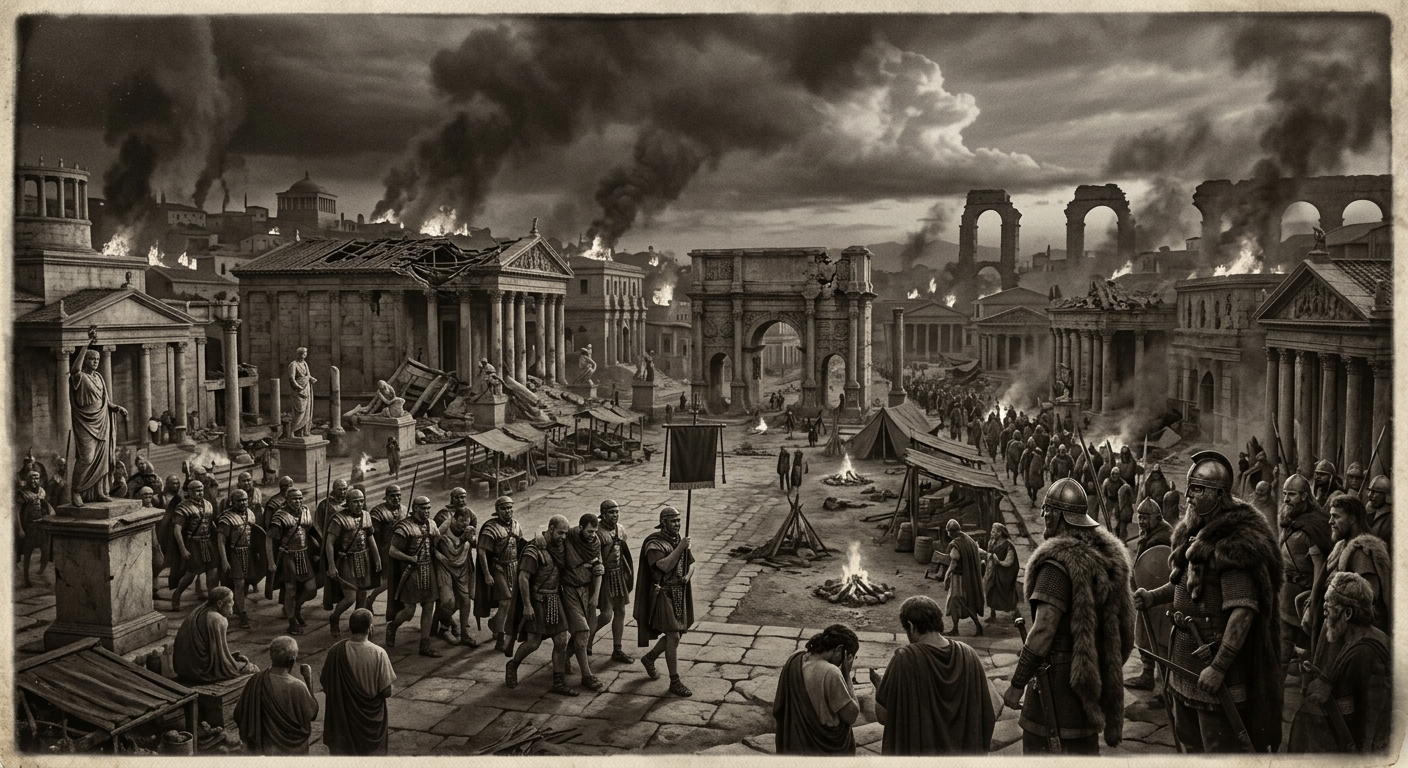
How Romulus Augustulus Was Deposed on September 4, 476 AD, Ending the Western Roman Empire
On the fourth day of September in the year 476 AD, a teenage boy was escorted from the imperial palace at Ravenna and sent into permanent exile. His name was Romulus Augustus, and for ten months he had carried the ancient title of Emperor of the Western Roman Empire. He was the son not of a great dynasty but of a general, placed on the throne as a puppet, never recognized by the Eastern Roman court in Constantinople, and now stripped of even that hollow dignity by a Germanic warlord named Odoacer, who had grown tired of promises and refused demands. Romulus Augustus was not killed. He was too young and too powerless to be worth killing. Odoacer gave him a pension and sent him to the Lucullan Villa in Campania, in the shadow of Mount Vesuvius, where he lived out an obscure life in comfortable irrelevance. The imperial insignia of the Western Roman Empire were packed up and dispatched to Constantinople.
With that, an institution that had endured for over five centuries, that had stretched its authority from the Atlantic coast of Spain to the deserts of Mesopotamia, from the sands of North Africa to the forests of northern Britain, and that had shaped the language, law, religion, and culture of half the known world, was formally extinguished. The Western Roman Empire was no more. The event that historians from Edward Gibbon onward have called the Fall of Rome had occurred. Yet as with all events of truly historic magnitude, what happened on September 4, 476 was not a sudden catastrophe but the final punctuation mark at the end of a very long sentence, a process of decline, fragmentation, and transformation that had been underway for centuries. To understand the deposition of Romulus Augustulus, one must understand everything that came before it.
The Roman Empire at Its Height: From Augustus to the Antonine Age
The Roman Empire in its greatest form was one of the most remarkable political achievements in human history. Founded in its republican phase as a city-state on the banks of the Tiber River in central Italy, Rome had, through eight centuries of conquest, diplomacy, and institutional innovation, constructed a dominion that encircled the entire Mediterranean Sea. At the height of its power during the reign of Emperor Trajan, who died in 117 AD, the empire stretched across approximately five million square kilometers, encompassing territories that today correspond to thirty modern nations. It governed a population estimated at between fifty and sixty million people, a third of the world’s total at the time.
The period from the accession of Augustus in 27 BC to the death of Marcus Aurelius in 180 AD, known to history as the Pax Romana, was the era of greatest Roman prosperity, stability, and cultural achievement. Augustus, born Gaius Octavius and later known as Gaius Julius Caesar Augustus, transformed the dying Roman Republic into an autocratic empire without entirely abandoning the republican forms. He became the first emperor, establishing a system of governance that would persist for centuries. Under his successors in the Julio-Claudian dynasty, and then under the five emperors of the Antonine dynasty, the empire maintained its frontiers, grew wealthy from trade, built roads and aqueducts that are still standing today, and produced literary, philosophical, and legal minds whose work remains foundational to Western civilization.
The Pax Romana was sustained by the extraordinary efficiency of the Roman legions, one of the finest military organizations the ancient world produced. The legions were not merely fighting forces; they were also engineers, surveyors, builders, and administrators who constructed the physical infrastructure of Roman civilization wherever they went. They built the roads that connected every corner of the empire to Rome. They built the walls that kept the barbarians at bay, most famously Hadrian’s Wall across northern Britain and the extensive Rhine-Danube frontier fortifications. They built the bridges, the aqueducts, the garrison towns that became the seeds of hundreds of future European cities, from London to Vienna to Cologne. As long as the legions held, Rome held.
The Beginning of the End: The Antonine Plague and the Severan Crisis
The first serious crack in the Pax Romana appeared during the reign of Marcus Aurelius, who ruled from 161 to 180 AD and is remembered both as a philosopher-emperor and as a man who spent the majority of his reign fighting defensive wars against Germanic tribes along the Danube frontier. The Antonine Plague, which swept through the empire beginning around 165 AD and persisted for years, killed between five and ten million people by most estimates, severely depleting the manpower available for both the legions and agricultural production. Marcus Aurelius managed to contain the military and political damage, but the plague revealed how dependent Roman stability was on the continued supply of healthy young men to fill the ranks of the army and till the fields that fed the empire.
The Severan dynasty that followed the Antonines, beginning with the capable if brutal Septimius Severus in 193 AD, stabilized the empire briefly but at significant cost. Severus dramatically increased military spending and deliberately raised soldiers’ pay, financing this through currency debasement, adding progressively less silver to the coinage and thus creating inflation. This precedent of debasing currency to fund military expenditure would be inherited by his successors and would prove catastrophic. Severus reportedly told his sons Caracalla and Geta on his deathbed to enrich the soldiers and despise all other men, a summary of his political philosophy that his sons enacted with grim fidelity. Caracalla, who murdered his brother Geta in 212 AD, granted Roman citizenship to virtually all free inhabitants of the empire, an act that historians have interpreted variously as an act of inclusion or a desperate fiscal measure to broaden the tax base. The Severan dynasty collapsed in 235 AD when the Emperor Severus Alexander was murdered by his own troops.
The Crisis of the Third Century: When the Empire Nearly Died, 235 to 284 AD
The fifty years between the assassination of Severus Alexander in 235 AD and the accession of Diocletian in 284 AD constitute the most severe systemic crisis the Roman Empire ever survived, and indeed many historians argue that the empire that emerged from this period was so fundamentally different from the one that entered it that the term Third Century Crisis is itself an understatement. In those five decades, the Roman state endured over twenty emperors, virtually all of whom came to power through military coup and most of whom died violently. The political historian Mikhail Rostovtzeff counted that in the period between 235 and 270 AD alone, more than fifty men claimed the imperial purple, most of them holding power for only months before being killed by rivals or their own troops. Civil war became the chronic condition of the state.
The internal chaos opened the frontiers to barbarian penetration on an unprecedented scale. Germanic confederations, most notably the Alemanni and the Franks in the west and the Goths on the Danube frontier, had coalesced into larger and more formidable political and military entities, capable of deeper and more sustained incursions into Roman territory. In the east, the newly established Sassanid Persian Empire under its dynasty of ambitious kings posed a threat that no previous eastern adversary had matched. In 260 AD, the catastrophic defeat and capture of Emperor Valerian by the Sassanid King Shapur I, the first time a Roman emperor had been taken prisoner in battle, sent shockwaves of demoralization through the entire empire. In the same year, the empire effectively fractured into three competing entities: the Gallic Empire in the northwest under the general Postumus, the Palmyrene Empire in the southeast under the remarkable Queen Zenobia, and the rump Roman state in Italy.
The Plague of Cyprian, which raged from approximately 249 to 262 AD, added biological catastrophe to political and military disaster. Contemporary sources described it as killing as many as five thousand people per day in the city of Rome alone at its peak. The city of Alexandria, one of the empire’s great urban centers, reportedly experienced a population decline of sixty-two percent. Farms were abandoned as agricultural workers died or fled, producing food shortages that fed into inflation and further debasement of currency. The silver content of the denarius, the main Roman silver coin, fell from approximately eighty-five percent silver at the beginning of the Severan dynasty to a mere five percent by the 260s, a debasement so severe that trade and commerce were severely disrupted throughout the western provinces.
The empire was ultimately reunited by a succession of capable soldier-emperors from the Illyrian military tradition, men who came from the tough Danubian provinces and had risen through genuine military merit rather than aristocratic birth. The Emperor Claudius Gothicus defeated a major Gothic invasion at the Battle of Naissus in 269 AD. Aurelian, who reigned from 270 to 275 AD, defeated the Palmyrene Empire and the Gallic Empire and reunified the Roman state by 274, earning the title Restorer of the World. Diocletian, who seized power in 284 and ruled until 305, undertook sweeping reforms of the military, the administration, and the currency that stabilized the empire, though at the price of a dramatically enlarged bureaucracy and a more overtly autocratic government. The Pax Romana was over, but the Roman Empire had survived, transformed.
Diocletian’s Division of the Empire and Constantine’s Transformation
Diocletian’s most consequential administrative innovation was the division of the empire into what became known as the Tetrarchy, the rule of four. Recognizing that no single man could effectively govern and defend an empire of such geographic extent while simultaneously managing its administration, Diocletian created a system with two senior emperors, each called Augustus, and two junior emperors, each called Caesar. He himself ruled from Nicomedia in Asia Minor, while his co-emperor Maximian governed the western provinces from Milan. This choice of capitals was telling: neither Diocletian nor Maximian ruled primarily from Rome, which was geographically inconvenient for the fast-moving military operations that constant frontier defense required. The Tetrarchy worked as long as Diocletian imposed his will upon it, but it collapsed almost immediately after his retirement in 305 AD, generating another round of civil war from which Constantine emerged as sole emperor in 324 AD.
Constantine the Great, who ruled from 306 to 337 AD, made two decisions whose consequences for the fate of the Roman Empire were immeasurable. The first was the formal adoption of Christianity, or more precisely the granting of imperial favor and resources to the Christian church, through the Edict of Milan in 313 AD. This transformed a persecuted minority religion into the empire’s favored faith, initiating a cultural revolution whose long-term effects on European civilization, for good and ill, can scarcely be overstated. The second decision was the establishment of a new imperial capital at the ancient Greek city of Byzantium on the Bosphorus, renamed Constantinople and consecrated in 330 AD. Constantinople was strategically placed at the crossroads of Europe and Asia, surrounded by water on three sides and easily defensible, close to the wealthy eastern provinces and the grain supplies of Egypt.
Constantine’s foundation of Constantinople had the long-term consequence of shifting the center of imperial gravity permanently eastward. The eastern provinces were wealthier than the west, more urbanized, more commercially active, and more culturally sophisticated. The Greek-speaking eastern cities continued the traditions of Hellenistic urban civilization while the Latin-speaking west, which had always been less densely populated and less economically developed outside of Italy, began to diverge more sharply. The separation was not immediately obvious: the empire remained legally unified under a single imperial structure for much of the fourth century. But the structural and cultural fault line between east and west, between the Greek-speaking Mediterranean world and the Latin-speaking Atlantic world, was deepening. When the empire was formally divided by the Emperor Theodosius I upon his death in 395 AD, giving the West to his younger son Honorius and the East to his older son Arcadius, it was the codification of a division that had been becoming more real every decade.
The Fifth Century Catastrophe: Barbarians, Huns, and the Disintegration of the West
The Western Roman Empire that Honorius inherited in 395 AD was already under severe strain. Its frontiers stretched thousands of kilometers and required constant military investment to maintain. Its tax base had been shrinking as wealthy landowners evaded taxation and as depopulated areas fell out of productive use. Its army was increasingly composed of foederati, barbarian troops who served under treaty arrangements, fighting for Rome in exchange for land grants and payment but maintaining their own tribal loyalties and leadership structures. The line between Roman soldier and barbarian auxiliary was blurring in ways that would have profound consequences for the empire’s ability to maintain central authority.
The catalyst that transformed an existing crisis into a terminal one was the arrival of the Huns from the Eurasian Steppe. The Huns were a nomadic warrior confederation from Central Asia whose ferocious cavalry tactics and seemingly limitless aggression had no precedent in the experience of the Germanic peoples who occupied the territories east of the Rhine and north of the Danube. When the Huns swept westward across the Pontic Steppe in the 370s AD, the Germanic peoples in their path had limited options: they could fight, be enslaved, or seek refuge inside the Roman Empire. The Visigoths, the western branch of the Gothic people, chose to seek Roman protection. In 376 AD, hundreds of thousands of Visigoths crossed the Danube River in the largest single mass migration of peoples the Roman frontier had yet experienced, fleeing the advancing Huns.
The treatment the Visigoths received at the hands of Roman officials proved catastrophic in its consequences. Roman border administrators, recognizing an opportunity for personal enrichment, systematically extorted the desperate refugees. They confiscated the Visigoths’ weapons, a requirement for settlement within Roman territory, but then, according to the contemporary historian Ammianus Marcellinus, forced starving Gothic families to trade their children into slavery in exchange for dog meat. This was not merely cruel; it was profoundly stupid, creating within Roman territory a mass of armed, desperate, and deeply aggrieved men with nothing to lose. In 378 AD, the Visigoths rose in revolt. At the Battle of Adrianople, fought on August 9, 378 AD in the province of Thrace, they annihilated a Roman army and killed the Eastern Emperor Valens. It was one of the most catastrophic military defeats in Roman history.
Stilicho, Alaric, and the First Sack of Rome in 410 AD
The shock of Adrianople was eventually managed by the Emperor Theodosius I, who negotiated a settlement with the Visigoths in 382 AD, allowing them to settle as semi-autonomous foederati within the Balkans. But the fundamental problem of an army that was increasingly composed of groups whose primary loyalty was to their tribal leaders rather than to the Roman state had not been solved; it had merely been deferred. After the division of the empire at Theodosius’s death in 395, the Western Empire passed into the hands of the ten-year-old Emperor Honorius, effective power residing with the brilliant half-Vandal general Flavius Stilicho, who served as magister militum, or Master of Soldiers, and effectively governed in the young emperor’s name.
Stilicho was among the most capable military commanders Rome produced in its final century. He repelled Visigothic invasions of Italy in 401 and 402, defeating the Visigoth king Alaric on both occasions. He fought off attacks by the Ostrogoths and defended the Rhine frontier. But his position at court was always politically precarious, resented by the Roman senatorial aristocracy who viewed a half-barbarian general as an illegitimate wielder of Roman power, and undermined by the paranoid and ineffectual Honorius. In 408 AD, court intrigues convinced Honorius that Stilicho was plotting to place his own son on the Eastern throne. Stilicho was arrested and executed. With him died whatever prospect remained of a competent defense of the Western Empire against the gathering storm.
Within months of Stilicho’s execution, the Visigoths under Alaric, having been denied the permanent territorial settlement and official recognition they had long sought and having been maneuvered by Byzantine court politics into an impossible position, invaded Italy for the third time. Rome itself, which had not been breached by a foreign enemy since the Gauls had sacked it in 390 BC, more than eight centuries before, was besieged twice and ransomed before the final catastrophe. On the night of August 24, 410 AD, Alaric’s Visigoths passed through the Salarian Gate and sacked the city of Rome. They spent three days pillaging the city, though as Arian Christians they spared the churches of Saint Peter and Saint Paul and avoided the worst excesses of indiscriminate massacre. Pagan temples were looted, the old Senate House was burned, and vast quantities of treasure were removed. Honorius’s sister Galla Placidia was taken hostage. The psychological shock was immense. Saint Jerome, writing from Bethlehem, expressed the disbelief of the educated Roman world: the city that had conquered the world had been conquered.
Alaric died of illness in southern Italy shortly after the sack, leaving his brother-in-law Ataulf to lead the Visigoths out of Italy and eventually into Gaul and then Spain, where they established the Visigothic Kingdom. The sack of Rome in 410, while devastating symbolically, did not immediately end the Western Empire. The real damage was structural. The loss of North Africa, Rome’s breadbasket, to the Vandals under their king Gaiseric between 429 and 439 AD was far more economically damaging. North Africa had supplied the grain that fed Rome and much of the western Mediterranean. Its loss deprived the Western Empire of the tax revenues and agricultural production that were the material foundation of its power. Gaiseric’s Vandals then used their North African base to dominate western Mediterranean trade routes, raiding coastal cities and disrupting commerce throughout the western provinces.
Attila the Hun and the Final Disruption of the Western Empire
The most famous barbarian leader of the fifth century was Attila the Hun, who ruled the vast Hun Empire from approximately 434 to 453 AD. Attila, who was known to his Roman contemporaries as the Scourge of God, unified the diverse Hun tribal confederations into a single military power of terrifying effectiveness and used this force to extract enormous tribute payments from both the Eastern and Western Roman Empires. When tribute payments from Constantinople were interrupted, Attila devastated the Balkans in a series of raids in 441 and 447 AD. He then turned his attention westward.
In 451 AD, Attila invaded Gaul with an enormous army. He was met at the Battle of the Catalaunian Plains, also known as the Battle of Chalons, by a combined Roman-Visigothic force commanded by the Roman general Flavius Aetius, who had spent years cultivating a personal relationship with Attila’s court and who was, by most assessments, the last genuinely capable military commander the Western Empire produced. The battle was one of the largest of late antiquity and resulted in a tactical halt to Attila’s advance. But Aetius’s victory in Gaul did not destroy Attila’s power. The following year, in 452 AD, Attila invaded Italy directly, sacking the cities of Aquileia, Padua, Verona, and Milan before being persuaded to turn back, reportedly in part through the personal intervention of Pope Leo I, who met him at the Po River. The precise reasons for Attila’s withdrawal from Italy remain debated by historians, with disease and logistical difficulties probably playing as significant a role as papal diplomacy.
Attila died in 453 AD on the night of his wedding, reportedly of a hemorrhage. His death triggered the immediate collapse of the Hun Empire as his sons fought over the succession and the Germanic peoples who had been under Hunnic domination reasserted their independence in a decisive battle at the River Nedao in 454 AD. The political landscape of central and eastern Europe was thrown into renewed flux, with streams of displaced peoples again pressing against the Roman frontiers. Aetius himself had already been murdered in 454 AD by the Emperor Valentinian III, who feared his general’s power. The historian Sidonius Apollinaris wrote that Valentinian had cut off his right hand with his left. Valentinian was in turn murdered by soldiers loyal to Aetius within a year.
The Vandal Sack of 455 AD and the Age of Ricimer
In 455 AD, Rome was sacked for the second time, and this time the looting was more thorough. The Vandal king Gaiseric, regarding himself as released from treaty obligations by the murder of Emperor Valentinian III and the subsequent usurpation by the general Petronius Maximus, sailed from Carthage with a fleet and landed in Italy. Petronius Maximus was murdered by his own citizens as he tried to flee. Gaiseric entered Rome unopposed on June 2, 455 AD, and his forces systematically plundered the city for fourteen days, a devastation far more complete than Alaric’s three-day raid forty-five years earlier. They stripped bronze from the roof of the Capitoline Temple of Jupiter, carried off the treasures of the imperial palace, and removed the golden treasures of the Temple of Jerusalem that had been displayed in Rome since the emperor Vespasian brought them from Judaea in 70 AD. Pope Leo I negotiated against massacre and arson but could not prevent the looting.
The two decades following the Vandal sack of 455 AD were characterized by the phenomenon of the powerbroker general, most vividly exemplified by the part-Suevian, part-Visigothic general Ricimer, who served as magister militum from roughly 456 to 472 AD. Ricimer occupied a position of genuine paradox: as the grandson of a Visigoth king, he was legally ineligible to hold the imperial title himself, since Roman custom prohibited men of barbarian birth from becoming emperor. Yet he wielded real power while emperors reigned nominally above him. Over the course of his sixteen-year ascendancy, Ricimer made and unmade no fewer than five Western emperors, choosing figures who would serve his purposes and disposing of them when they ceased to do so. Libius Severus, his puppet of choice from 461 to 465, was widely believed to have been poisoned by Ricimer when he became inconvenient. The Emperor Anthemius, sent from Constantinople in 467 AD in an attempt to reinvigorate western resistance to the Vandals, was executed by Ricimer in 472 after an open war between the general and the emperor within the city of Rome itself.
The only one of Ricimer’s choices who showed genuine capacity was the Emperor Majorian, who ruled from 457 to 461 AD and undertook a vigorous program of administrative and military reform. Majorian rebuilt the imperial armies, restored tax collection, and assembled a substantial fleet for a planned invasion of the Vandal kingdom in North Africa. Gaiseric, learning of the fleet’s assembly, destroyed it before it could sail through a surprise attack. The failure of the North African expedition fatally undermined Majorian’s position, and Ricimer had him arrested and executed in August 461. With Majorian died the last serious Western attempt to reverse the military and territorial losses of the preceding decades. The political historian Edward Gibbon, writing in the eighteenth century, regarded Majorian as the last emperor of the West who showed the qualities of a true Roman ruler.
The Final Decade: Orestes, Julius Nepos, and the Stage Set for 476 AD
By the 470s AD, the Western Roman Empire had been reduced to a rump state consisting essentially of Italy and a few fragments of peripheral territory. Gaul had been divided among the Visigoths, the Burgundians, and the Franks. Spain was predominantly under Visigothic control. Britain had been abandoned by Roman administration since approximately 410 AD. North Africa was firmly in Vandal hands. The Danube frontier was no longer a Roman frontier in any meaningful sense. The Western emperor sat in Ravenna, the fortified city in the Po Delta that had served as the imperial capital since Emperor Honorius relocated there in 402 AD, its marshes and canals offering natural protection from land attack and its harbor ensuring supply by sea even when the surrounding land was under enemy control.
In 474 AD, the Eastern Emperor Zeno, who had succeeded the brief reign of Leo II, appointed Julius Nepos as the Western Emperor. Julius Nepos was a capable administrator and a man of genuine talent, the nephew of the eastern empress and thus someone with real connections to legitimate imperial power. He attempted to establish competent government in what remained of the Western Empire and conducted reasonable negotiations with the surrounding Germanic kingdoms. In 475 AD, however, Julius Nepos was overthrown in a coup by his own general, the Master of Soldiers Orestes.
Orestes was a fascinating figure in his own right, a Roman aristocrat from Pannonia who had spent years in the service of Attila the Hun, serving as a secretary and diplomat at the court of the Scourge of God, before returning to Roman service after Attila’s death. He had risen through the military hierarchy with evident competence and had acquired real power within the western military establishment. When he deposed Julius Nepos in August 475, Nepos fled to Dalmatia, the province on the eastern Adriatic coast, where he continued to claim the imperial title in exile and where he remained recognized as the legitimate Western emperor by the Eastern court in Constantinople. Orestes thus faced a situation in which the Western emperor he had deposed was still alive and still, in the eyes of Constantinople, the legitimate ruler.
Rather than take the imperial title for himself, Orestes made a decision that completed the hollowing-out of the Western imperial office. He crowned his own young son emperor, giving him the throne on October 31, 475 AD. The boy’s name was Romulus, and he was renamed Augustus, so that the last emperor of the Western Roman Empire bore, through what an ironic coincidence of history, the names of both the founder of Rome and the founder of the Roman Empire. His contemporaries and subsequent historians would use the diminutive Augustulus, meaning little Augustus, to distinguish him from the great Augustus, a derisive nickname that perfectly captured the pathos of the office.
Romulus Augustulus: The Boy Who Was the Last Emperor of Western Rome
Romulus Augustus, born approximately between 460 and 465 AD, came to the imperial throne as a minor, almost certainly a young teenager, placed there by his father Orestes as a figurehead behind whom the real magister militum could exercise actual power. Throughout his ten-month reign, Romulus played no independent political role of any significance that can be documented. There are no known laws, edicts, or inscriptions of substance that bear his name and reflect genuine imperial initiative. He was, in the precise phrase used by the Eastern Roman writer Malchus, who observed these events from Constantinople, the helpless Augustulus. The Eastern Emperor Zeno refused to recognize Romulus as a legitimate emperor at all, given that Julius Nepos still claimed the title from Dalmatia and had been validly appointed by Zeno’s predecessor Leo I.
The crisis that ended Romulus’s reign originated not in any act of his own but in the failure of his father Orestes to manage the expectations and demands of the barbarian foederati who constituted the military muscle on which the Western government depended for its existence. The western army in Italy by 476 AD was composed primarily of Germanic barbarian troops, mainly Herules, Scirians, Turcilingians, and other groups who had been settled in Italy under treaty arrangements as auxiliary forces. These men had been fighting for the Western Empire but had not, unlike their counterparts who served permanently in the Roman military, received the allocation of Italian land that was the standard reward for long military service. They demanded that Orestes grant them one-third of the Italian landholdings for permanent settlement, the standard arrangement that had been made with other barbarian groups settled in Gaul and Spain.
Orestes refused. Whether his refusal was based on the political impossibility of alienating the Italian senatorial aristocracy by confiscating their estates, on a judgment that granting the demand would set a precedent that would ultimately dissolve what remained of Roman Italy, or simply on arrogance and miscalculation, is not recorded. What is recorded is the result. The foederati, denied their demanded land, found a leader in the person of Odoacer, one of the senior commanders within the western military establishment, and rose in revolt.
Odoacer: The Man Who Ended the Western Empire
Odoacer, born approximately in 433 AD, was a figure who embodied the complexity of the late Roman world, a man who was simultaneously Roman and barbarian, an insider and an outsider, a destroyer of the old order and a preserver of its essential institutions. His father was Edeco, sometimes spelled Edico or Edecon, a man of apparently Hunnic origin who had served at the court of Attila as a senior official and had later married into the Germanic tribe of the Scirians, becoming a Scirian prince. This made Odoacer ethnically mixed in ways that were characteristic of the fifth-century frontier world, where generations of intermarriage, military service, and cultural exchange had produced men who defied simple ethnic categorization. Odoacer himself has been described at various points by ancient sources as a Scirian, a Heruclian, a Rugian, and simply as a barbarian, reflecting the confusion and the fluidity of ethnic identity in the period.
Odoacer had come to Italy as a young man seeking military employment, a path that the late Roman Empire made straightforwardly available to any man who could fight. According to a hagiographic account in the Life of Saint Severinus, Odoacer visited the holy man at Noricum around 461 AD during his journey to Italy. The account describes him as very tall and fur-clad, a striking figure even among warriors. Severinus allegedly told the young barbarian to go to Italy, where he would become a great man. Whether or not this exchange occurred as recorded, Odoacer did go to Italy and did join the imperial guard in Rome. He rose through the military ranks, participated in Ricimer’s capture of Rome in 472 AD, and by 475 had become head of the barbarian foederati forces in Italy under the command of Orestes.
On August 23, 476 AD, Odoacer was proclaimed king by his soldiers. Five days later, on August 28, he defeated and captured Orestes at the Battle of Ticinum, the modern city of Pavia. Orestes was executed without delay. Odoacer then moved on Ravenna, where Romulus Augustus resided in the imperial palace. During the fighting around Ravenna, Orestes’s brother Paulus was killed. On September 4, 476 AD, Odoacer entered Ravenna and the imperial capital was his. Romulus Augustus was compelled to appear before the Roman Senate and formally abdicate the Western imperial throne, making, in the account given by the Eastern Roman historian Malchus, a speech in which he himself declared that the Roman Empire henceforth required only a single emperor, ruling from Constantinople.
The Abdication and Its Immediate Consequences
The Roman Senate, which had been Odoacer’s political ally throughout the crisis, wrote to Constantinople requesting that the Eastern Emperor Zeno formally reunite the empire under his rule with Odoacer serving as his governor or viceroy in Italy. Zeno’s response was diplomatically complex and revealing of the political realities of 476. He pointed out that Julius Nepos, his legitimate appointee, was still alive in Dalmatia and still claimed the Western throne. He urged Odoacer to recognize Nepos. At the same time, Zeno was unwilling to use force to actually restore Nepos, and he accepted the practical reality of Odoacer’s control. He granted Odoacer the title of Patricius, the highest rank available to a non-imperial figure, and accepted the gift of the Western imperial insignia. In return, Odoacer swore nominal allegiance to Constantinople, ruling Italy as a subordinate of the Eastern emperor in theory while exercising complete independence in practice.
Romulus Augustus himself was treated with a remarkable degree of clemency, given the norms of fifth-century political violence. He was too young and too obviously powerless to represent a serious threat, and perhaps Odoacer also recognized that killing a boy emperor would have been gratuitously brutal in a way that could damage his own reputation with the Roman senatorial class whose cooperation he needed. Odoacer sent him to comfortable exile at the Lucullan Villa in Campania, the region around the Bay of Naples, with an annual pension reported to have been six thousand solidi. The Lucullan Villa was a large estate on the promontory of Misenum, a place of considerable natural beauty. Romulus Augustus lived there in what can only be described as comfortable obscurity for an indeterminate period; letters addressed to him indicate he was still alive as late as around 507 to 511 AD, making him one of the longest-lived figures of the entire late imperial period. Julius Nepos, the other claimant to the Western throne, survived in Dalmatia until 480 AD, when he was murdered by his own retainers.
Odoacer’s Kingdom of Italy: What Replaced the Western Empire
Odoacer governed Italy from 476 to 493 AD with what Edward Gibbon described as prudence and humanity, a judgment that reflects the genuine pragmatism of his administration. He did not declare himself a Roman emperor. He did not attempt to recreate the imperial structure. He styled himself king, a title that accurately reflected the reality of his authority and that did not pretend to the universal claims of the Roman imperial title. He distributed land to his followers, fulfilling the promise that Orestes had refused to make, but did so in a manner that generated surprisingly little resistance from the Italian landholding class, perhaps because the actual confiscation was less severe than feared.
Odoacer maintained the Roman administrative structure of Italy almost entirely intact. The Senate continued to function. Roman law continued to be applied. Roman officials continued to hold administrative positions. Latin continued to be used in governance and correspondence. Odoacer himself styled his chancery documents and official communications in conformity with Roman administrative tradition, using Roman titles and Roman formulas. He was an Arian Christian, belonging to the same branch of Christianity as most of the Germanic peoples of the period, but he rarely interfered in the affairs of the Roman Catholic church, which governed its own affairs and continued to develop its theological and institutional structures without significant disruption from Odoacer’s government.
The reign of Odoacer came to a violent end in 493 AD when the Ostrogoth king Theodoric the Great invaded Italy at the invitation of the Eastern Emperor Zeno, who wished to remove the increasingly independent Odoacer and replace him with a more reliable client. Theodoric had been raised partly as a hostage in Constantinople, was personally known to Zeno, and was the leader of the most powerful Germanic group then on the Balkan frontier. He invaded Italy in 489 AD and after four years of fighting, during which Odoacer was repeatedly defeated but refused to surrender from his refuge in the impregnable marshland fortress of Ravenna, a peace agreement was finally negotiated in 493. The two kings agreed to rule jointly. Theodoric then invited Odoacer to a banquet and killed him with his own hands, in an act of treachery that Odoacer apparently recognized too late. Theodoric established the Ostrogothic Kingdom of Italy, which governed the peninsula until the Byzantine Emperor Justinian launched his costly reconquest campaign in 535 AD.
Why Did the Western Roman Empire Fall? The Great Historical Debate
The question of why the Western Roman Empire fell has been debated by historians for as long as history has been written, and perhaps no question in the entire field of historical inquiry has attracted more scholarly attention or generated more competing explanations. Edward Gibbon, whose monumental six-volume The History of the Decline and Fall of the Roman Empire was published between 1776 and 1789, established the terms of the debate that have framed it ever since. Gibbon identified two central factors: the military pressure of the barbarian invasions and the transformative effects of Christianity on Roman civic culture and martial values. He argued that Christian otherworldliness had undermined the Roman virtue of public service and the willingness to die in defense of the state. This thesis, while influential, has been largely rejected by modern scholarship, which regards Gibbon’s anti-Christian bias as distorting his analysis.
Modern historians have advanced a wide variety of explanations, each capturing some aspect of a phenomenon too complex to be reduced to a single cause. Military historians have emphasized the structural changes in the Roman army, particularly the increasing reliance on barbarian foederati who had no deep loyalty to the Roman state and whose commanders were increasingly the real wielders of power behind a facade of imperial authority. Economic historians have focused on the long-term consequences of currency debasement, inflation, agricultural decline, and the disruption of Mediterranean trade networks, particularly after the Vandal seizure of North Africa. Political historians have stressed the chronic problem of imperial succession, the absence of any reliable mechanism for transferring power peacefully that generated endemic civil war and political instability. Demographic historians have emphasized the catastrophic mortality of the Antonine and Cypriot plagues and their long-term consequences for the labor supply on which both agricultural production and military recruitment depended.
Climate historians, drawing on increasingly sophisticated paleoclimatic data, have pointed to the Late Antique Little Ice Age and periods of drought and agricultural instability as contributing factors to the demographic and economic weakening of the western provinces. Sociologists of empire have argued that the Roman Empire became, in a fundamental sense, too expensive for its own population to support: the cost of maintaining the frontier defenses, the bureaucracy, and the military establishment consumed an increasing share of a slowly declining economic output, leaving less and less for the productive investment and population growth that would have sustained the system. An influential recent formulation by scholars including Peter Heather and Bryan Ward-Perkins places primary emphasis on the role of the Hunnic irruption as an external shock that overwhelmed a system that was functioning imperfectly but would likely have continued to function for much longer without that disruption.
The historians who emphasize transformation over collapse, most notably the tradition associated with Peter Brown and the concept of Late Antiquity, challenge the narrative of fall altogether. They argue that what happened in the fifth century was not primarily a catastrophe but a transformation, a gradual metamorphosis of Roman culture and institutions into the medieval world, in which Roman law, Latin language, Christian religion, and urban administrative traditions survived and were transmitted to the Germanic kingdoms that inherited Roman territory. On this view, calling what happened in 476 a fall is to impose a dramatic narrative structure on a gradual process of change that was in many ways continuous with what came before. Most historians today take a position somewhere between these poles, acknowledging both the genuine catastrophic elements of the fifth century collapse, particularly its terrible human costs in terms of violence, mortality, and economic disruption, and the substantial continuities of culture, religion, and law that bridged the ancient and medieval worlds.
The Eastern Roman Empire: Why Byzantium Survived for Another Thousand Years
The most immediate counter-argument to any explanation of the Western Roman collapse that focuses exclusively on internal Roman weaknesses is the survival of the Eastern Roman Empire for nearly a thousand years after 476. The Eastern Empire, whose capital Constantinople would not fall until 1453 AD when the Ottoman Sultan Mehmed II conquered it, outlasted the Western Empire by precisely 977 years. Its survival and eventual flourishing, in the form of what historians call the Byzantine Empire, raises the obvious question: if Roman weakness caused the Western collapse, why did the wealthier, larger, and more populous Eastern Empire survive?
Part of the answer lies in geography. Constantinople, positioned on a narrow peninsula at the confluence of the Bosphorus and the Sea of Marmara, was one of the most naturally defensible urban positions in the ancient world. The Theodosian Walls, constructed in the early fifth century and consisting of a triple line of walls, towers, and moats stretching across the peninsula, made the city effectively impregnable to the military technologies of the ancient and early medieval world. Constantinople was never taken by storm in the first nine centuries of its existence as a Christian Roman capital. The wealth it concentrated and the prestige it projected made it the center of gravity of eastern Mediterranean commerce and culture.
Part of the answer also lies in the direction of barbarian pressure. The various Germanic peoples who broke up the Western Empire were pushed westward by the Huns, and the geography of the migration routes channeled them toward Gaul, Spain, North Africa, and Italy. The Eastern Empire suffered severely from Gothic raids and Hunnic depredations, but its richer cities and better fortifications allowed it to endure these pressures in ways the thinner and less defended western provinces could not. The Eastern Empire was also more fiscally capable: it maintained a stronger tax administration, a more diversified and commercially active economy, and a professional military establishment that, while not immune to barbarian infiltration, retained more coherent command structures than the fragmented western forces of the late fifth century.
The Eastern Empire experienced its own moment of near-miraculous recovery under the Emperor Justinian I, who ruled from 527 to 565 AD, and his brilliant general Belisarius. Justinian reconquered North Africa from the Vandals between 533 and 534 AD, reconquered Italy from the Ostrogoths in a devastatingly costly campaign lasting from 535 to 554 AD, and recovered portions of Spain from the Visigoths. For a moment, it appeared that the Roman Empire might genuinely reunite. But Justinian’s reconquests proved financially ruinous and militarily unsustainable. Italy was so devastated by decades of warfare, plague, and economic disruption during the Byzantine reconquest that when the Lombards invaded from the north in 568 AD, barely fourteen years after the official end of the Gothic War, Byzantine resistance collapsed rapidly and most of the peninsula was lost again. The Eastern Empire retained a presence in Italy for centuries, in the form of the Exarchate of Ravenna, but the dream of restoring the united Roman Empire was definitively over.
The Legacy of the Western Roman Empire: How Rome’s Fall Shaped the Medieval and Modern World
The fall of the Western Roman Empire was not a simple ending but a complex transformation that shaped everything that followed it in European history. The successor kingdoms that divided the former Western Empire among themselves were not alien implants but deeply Romanized entities, ruled by Germanic elites who had spent generations in Roman military service, who converted to Christianity, who adopted Latin as their administrative language, who maintained Roman law alongside their own Germanic legal traditions, and who genuinely considered themselves the heirs and continuators of Roman civilization rather than its destroyers. The Visigothic Kingdom of Spain, the Frankish Kingdom of Gaul, the Burgundian Kingdom of the Rhone Valley, and the Ostrogothic Kingdom of Italy all preserved substantial Roman institutions and cultural practices.
The Roman Catholic Church, which had been growing in institutional strength and organizational sophistication throughout the late imperial period, emerged from the collapse of western political authority as the most powerful and coherent institution in the Latin West. The bishops of Rome, who gradually claimed the primacy among all bishops that would eventually be formalized as the Papacy, inherited much of the prestige and some of the administrative capacity of the old imperial government. The Church preserved Latin literacy, maintained the great libraries of classical learning, trained administrators who could read and write in a world where literacy was becoming rare, and provided the institutional framework within which European civilization gradually rebuilt itself during what used to be called the Dark Ages, now understood more precisely as the Early Medieval period.
Roman law, perhaps the most enduring of all Rome’s contributions to world civilization, survived the political collapse and was eventually codified under Justinian in the Corpus Juris Civilis of 529 to 534 AD, which became the foundation of virtually every legal system in continental Europe, as well as the canon law of the Catholic Church. The legal concepts developed by Roman jurists, including property rights, contract law, the distinction between public and private law, and the principle that law should be applied consistently and impartially, are still recognizable in the legal systems of France, Germany, Spain, Italy, and most of Latin America today. The United States legal system, grounded in English common law which itself was influenced by Roman jurisprudence, also bears the imprint of Rome.
The Latin language, though it fragmented over centuries into the Romance languages, French, Spanish, Portuguese, Italian, and Romanian, never entirely disappeared. It remained the language of the Church, of scholarship, of diplomacy, and of science in Europe for over a thousand years after Rome’s fall, binding together an educated European class across political boundaries. Medieval scholars read Virgil and Cicero, Livy and Tacitus, in the original. The Renaissance of the fourteenth and fifteenth centuries was, in significant part, a rediscovery and reappropriation of classical Roman and Greek texts that had been preserved, often precariously, through the centuries of the early medieval period.
The Holy Roman Empire, established by Charlemagne in 800 AD when Pope Leo III crowned him as Roman Emperor in Saint Peter’s Basilica, was an explicit attempt to resurrect the Western Roman imperial tradition. Charlemagne himself regarded his coronation as a restoration of the legitimate imperial dignity, not as the creation of a new institution. The Holy Roman Empire, which persisted in various forms until its dissolution by Napoleon in 1806, was the longest-lasting of many subsequent attempts to claim the Roman imperial mantle. The very word Caesar, which gave us the titles Kaiser in German and Tsar in Russian, survived as the generic term for supreme ruler across European languages for fifteen centuries after the last emperor named Caesar ruled in Rome.
Edward Gibbon and the Historiography of Rome’s Fall
No account of the Fall of Western Rome is complete without acknowledging Edward Gibbon’s foundational role in shaping how educated people have thought about it for two and a half centuries. Gibbon, an eighteenth-century English historian, published The History of the Decline and Fall of the Roman Empire in six volumes between 1776 and 1789, a work of such enormous scope, literary elegance, and analytical ambition that it has never been superseded as a cultural monument, even as its specific historical judgments have been revised or refuted on almost every page by subsequent scholarship. Gibbon traced the decline of Rome from what he considered its golden age under the Antonines, and he identified the deposition of Romulus Augustulus in 476 as the conventional endpoint of a process he dated to the reign of Marcus Aurelius beginning in 161 AD, a decline of three centuries.
Gibbon’s influence established 476 as the canonical date for the Fall of Rome in popular consciousness, though historians have always acknowledged that this choice involves a degree of arbitrariness. The date of 476 is useful precisely because it is concrete, dramatic, and clear: a specific emperor deposed on a specific day. But as historians including Arnold Toynbee, Henri Pirenne, Peter Brown, and many others have argued, the real story is far more gradual and complex. Other dates have been proposed as equally or more valid markers of Rome’s end: the Crisis of the Third Century beginning in 235, the Battle of Adrianople in 378, the sack of Rome in 410, the Vandal conquest of North Africa in 439, the death of Aetius in 454, or even the fall of Constantinople in 1453. The choice of date depends on what one means by Rome, and the question of what Rome meant, and means, has itself been a subject of sustained historical and cultural debate for centuries.
Key People, Dates, and Facts: The Fall of Western Rome — A Complete Historical Reference
The following provides a comprehensive reference to the key people, dates, and events from the foundation of Rome through the deposition of Romulus Augustulus and its aftermath. Rome was traditionally founded in 753 BC by Romulus, the mythological first king. The Roman Republic was established in 509 BC following the expulsion of the last king, Tarquinius Superbus. Julius Caesar was assassinated on March 15, 44 BC, triggering the final civil wars of the Republic. Augustus, born Gaius Octavius, became Rome’s first emperor in 27 BC and established the Principate, ruling until 14 AD. The Pax Romana, the era of greatest Roman peace and prosperity, lasted from 27 BC to approximately 180 AD.
Marcus Aurelius, the philosopher-emperor and author of the Meditations, ruled from 161 to 180 AD. The Antonine Plague devastated the empire from approximately 165 to 180 AD. Commodus, whose incompetent and erratic rule followed his father Marcus Aurelius, was assassinated in 192 AD, ending the Antonine dynasty. Septimius Severus, founder of the Severan dynasty, ruled from 193 to 211 AD and began systematic currency debasement. The Emperor Severus Alexander was murdered by his own troops in 235 AD, initiating the Crisis of the Third Century. Emperor Valerian was captured by the Sassanid King Shapur I in 260 AD, the first Roman emperor taken prisoner in battle. Emperor Gallienus ruled 253 to 268 AD during the worst of the military crisis. Emperor Aurelian, the Restorer of the World, reunified the empire between 270 and 274 AD. Diocletian, who ruled from 284 to 305 AD, established the Tetrarchy and undertook sweeping administrative and military reforms.
Constantine the Great ruled from 306 to 337 AD, issued the Edict of Milan granting toleration to Christians in 313 AD, and founded Constantinople in 330 AD. The Council of Nicaea, convened by Constantine in 325 AD, established the Nicene Creed as the standard of Christian orthodoxy. The Visigoths crossed the Danube seeking refuge from the Huns in 376 AD. The Battle of Adrianople on August 9, 378 AD, ended in the deaths of Eastern Emperor Valens and the annihilation of a Roman army by the Visigoths. Theodosius I, who ruled 379 to 395 AD, was the last emperor to rule a united Roman Empire. At his death in 395 AD, the empire was formally divided, with Honorius receiving the West and Arcadius the East. Honorius transferred the Western capital from Milan to Ravenna in 402 AD. Stilicho, half-Vandal general and effective ruler of the Western Empire, was executed on Honorius’s orders in 408 AD.
Alaric, king of the Visigoths, sacked Rome on August 24, 410 AD, the first sack in over eight centuries. Alaric died in southern Italy shortly after the sack. Attila became king of the Huns around 434 AD and died in 453 AD. The Battle of the Catalaunian Plains in 451 AD, where the Roman general Aetius defeated Attila’s invasion of Gaul, was one of the largest battles of late antiquity. Gaiseric, king of the Vandals, conquered North Africa between 429 and 439 AD and sacked Rome on June 2, 455 AD, for fourteen days. The Emperor Valentinian III was murdered in 455 AD. Ricimer, the part-Visigothic, part-Suevian general and kingmaker, dominated Western imperial politics from 456 to 472 AD, making and unmaking emperors at will. Emperor Majorian, the last capable ruler of the Western Empire, was deposed and executed by Ricimer in 461 AD. Julius Nepos was appointed Western Emperor by the Eastern court in 474 AD and deposed by Orestes in August 475 AD, fleeing to Dalmatia.
Orestes, a Roman aristocrat who had served at Attila’s court, became Master of Soldiers and deposed Julius Nepos in 475 AD. He crowned his son Romulus Augustus as Western Emperor on October 31, 475 AD. Romulus Augustus, nicknamed Augustulus, meaning little Augustus, became the last emperor of the Western Roman Empire at approximately age fourteen or fifteen. Odoacer, born approximately 433 AD, son of the Hunnic official Edeco, rose to command the barbarian foederati of Italy. The barbarian foederati demanded one-third of Italian land for settlement; Orestes refused. Odoacer was proclaimed king by his troops on August 23, 476 AD. Orestes was defeated and executed at Ticinum on August 28, 476 AD. Ravenna fell to Odoacer on or about September 4, 476 AD. Romulus Augustus abdicated before the Roman Senate and was sent into exile at the Lucullan Villa in Campania with a pension of six thousand solidi annually. The Western imperial insignia were sent to Constantinople. Eastern Emperor Zeno granted Odoacer the title of Patricius and accepted the situation. Julius Nepos was murdered by retainers in Dalmatia in 480 AD. Odoacer ruled Italy until 493 AD, when he was killed by Ostrogothic king Theodoric the Great. Romulus Augustulus appears to have survived until approximately 507 to 511 AD, making him one of the longest-lived figures of the period. The Eastern Roman Empire survived until the fall of Constantinople on May 29, 1453 AD, when Sultan Mehmed II conquered the city, ending the last remnant of the Roman state.