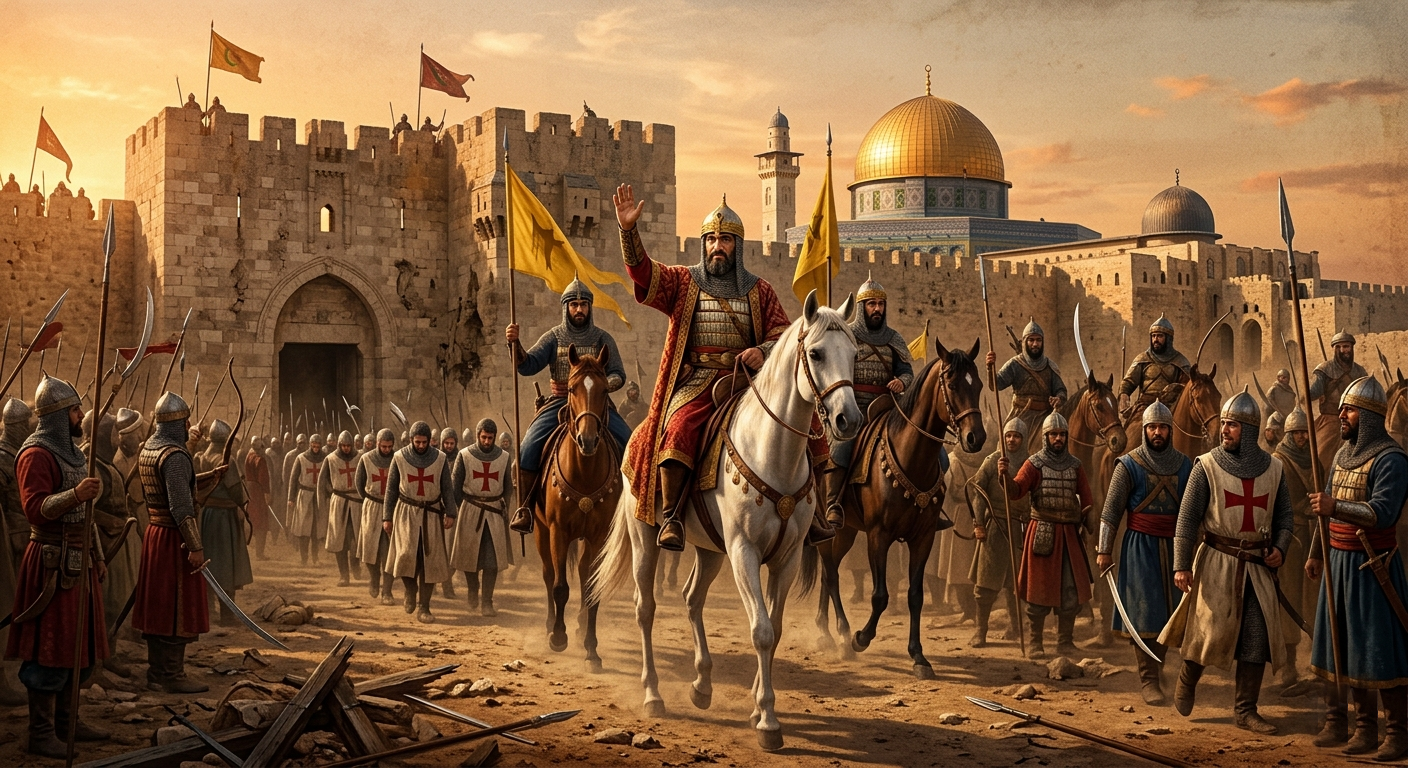
On Friday, October 2, 1187, the city of Jerusalem surrendered to Saladin, the Sultan of Egypt and Syria, ending eighty-eight years of Crusader Christian control over the holiest city in Christendom. The surrender was negotiated by Balian of Ibelin, the highest-ranking Crusader knight still free after the catastrophic defeat at the Battle of Hattin three months earlier. Saladin’s forces entered the city through the Gate of David, which the Crusaders called the Tower of David, and the green and gold banner of the Ayyubid sultanate rose over the city that Christians, Jews, and Muslims all regarded as sacred ground.
The contrast with 1099, when the forces of the First Crusade had captured Jerusalem in an orgy of violence that left the streets running with the blood of Muslims and Jews, was stark and deliberate. Saladin had initially sworn to take the city by force and kill every Christian in it, in retaliation for what the Crusaders had done eighty-eight years earlier. He chose instead to negotiate. The Christians who could pay a ransom were freed and permitted to leave. Those who could not were enslaved or left to the generosity of Saladin’s own treasury. The holy sites of Islam were purified with rose water and restored to Muslim worship. The Church of the Holy Sepulchre, Christendom’s most sacred church, was left in Christian hands. Saladin’s behavior at Jerusalem became one of the most celebrated acts of chivalrous mercy in medieval history, preserved in both Islamic and Christian sources, and it cemented his reputation as the most admired Muslim ruler of the medieval world.
Saladin: The Kurdish Sultan Who United the Muslim World
The man who recaptured Jerusalem was born Salah al-Din Yusuf ibn Ayyub in approximately 1137 or 1138 in Tikrit, in what is now Iraq. His family was of Kurdish descent, and both his father Ayyub and his uncle Shirkuh were elite military commanders in the service of Imad al-Din Zangi, the powerful ruler who governed northern Syria. Saladin grew up in Damascus and rose through the military hierarchy with impressive speed, accompanying his uncle Shirkuh on a military expedition to Egypt in 1164 in service of the Zengid ruler Nur al-Din.
The Egypt expedition proved transformative. When his uncle Shirkuh died in 1169, Saladin succeeded him as commander of the Syrian forces in Egypt and was simultaneously appointed vizier of the crumbling Fatimid Caliphate that still nominally ruled the country. After the death of the last Fatimid caliph in 1171, Saladin became the effective ruler of Egypt and moved to restore Sunni Islam as the dominant religious force, replacing the Shia administration of the Fatimids. When Nur al-Din died in 1174, Saladin launched the campaign that would make him the dominant figure in the Islamic world: he captured Damascus, Aleppo, and Mosul from rival Muslim rulers, unifying Egypt and Syria under a single authority for the first time in a generation.
His strategic vision was clear from the beginning. The Crusader states, four Christian polities established in the aftermath of the First Crusade, occupied the Mediterranean coastline and the Jordan River valley in a chain of fortified territory that cut the Islamic world in two, separating Egypt from Syria and Arabia. As long as the Crusaders held Jerusalem and their string of fortified cities and castles, the Islamic world was divided. Saladin’s goal, around which he built his entire political and military program, was to encircle the Crusader states with Muslim-controlled territory, cut off their connections to reinforcement from Europe, and then crush them from multiple directions.
By the mid-1180s, Saladin controlled the southern and eastern flanks of the Crusader states completely, surrounding three sides of the Kingdom of Jerusalem with his own territory. He had already demonstrated in numerous raids and engagements that Crusader heavy cavalry was not invincible and that a large, well-supplied, and motivated Muslim army could defeat the Franks, as the Crusaders from Western Europe were known, in open battle.
The Crusader Kingdom in Crisis: Internal Division and Raynald of Chatillon’s Betrayal
The Kingdom of Jerusalem that Saladin aimed to destroy in 1187 was simultaneously one of the most formidable and one of the most internally divided polities in the medieval world. It had survived for nearly a century against repeated Muslim military pressure through the combination of strategic fortifications, the military orders of the Knights Templar and Knights Hospitaller, and the periodic arrival of reinforcements from Europe. But by 1187, the kingdom was consuming itself with factional politics.
The central dispute divided the kingdom into two factions. One, associated with Raymond III, Count of Tripoli, favored a cautious defensive strategy and generally preferred to avoid direct military confrontation with Saladin unless conditions were extremely favorable. Raymond had lived in the Levant his entire life, spoke Arabic fluently, and understood that the kingdom’s long-term survival depended on avoiding catastrophic military defeat, not on bold offensive action. The other faction, centered on the newcomers who had arrived recently from Europe and on figures like the ambitious Raynald of Chatillon, lord of the Transjordan, favored aggressive action and viewed accommodation with Saladin as cowardice or worse.
The trigger for the 1187 campaign was provided by Raynald of Chatillon. In 1185, Saladin had concluded a truce with the Crusader states while he dealt with political problems in the eastern parts of his empire. The truce was supposed to suspend hostilities for four years. In 1187, Raynald raided a Muslim Hajj caravan crossing his territory, killing many pilgrims and capturing the rest, including, according to some accounts, members of Saladin’s own family. The caravan had appealed to Raynald to honor the truce. He refused and reportedly insulted the Prophet Muhammad in the process. When Saladin demanded that the captives be released and the goods returned, Raynald refused again. King Guy of Lusignan, the husband of Queen Sibylla and king consort of Jerusalem, was too weak politically to compel Raynald’s compliance. Saladin swore a personal oath to kill Raynald himself.
The Wikipedia article on Saladin provides the full political and military biography of the sultan, from his Kurdish origins and Egyptian career through his unification of the Muslim Near East and the campaigns that culminated in the capture of Jerusalem.
July 4, 1187: The Battle of Hattin and the Destruction of the Crusader Army
On May 1, 1187, Saladin’s forces inflicted a serious defeat on a Crusader raiding party at the Springs of Cresson, killing a significant number of Templar and Hospitaller knights. It was a warning of what was coming. In late May, Saladin assembled the largest army he had ever commanded, approximately 40,000 men including 12,000 regular cavalry, on the Golan Heights, and inspected them at Tell-Ashtara before crossing the Jordan River on June 30.
His strategic move was designed to force the Crusaders into exactly the kind of battle they most needed to avoid. He attacked Tiberias on the western shore of the Sea of Galilee, capturing the city and beginning a siege of its citadel where Raymond III’s wife Eschiva was sheltering with her garrison. News reached the Crusader army, assembled at the Springs of Saffuriya under King Guy, that Tiberias was under attack and Raymond’s wife was besieged. Raymond himself counseled strongly against marching to Tiberias. He understood that Saladin was baiting a trap, that the route to Tiberias led through waterless country, and that Saladin’s cavalry could harass and weaken the Crusader army throughout the march without any risk to themselves. He said that he was willing to sacrifice his own wife and castle to prevent the mistake of marching into Saladin’s trap.
King Guy initially agreed. The council of war on the evening of July 3 concluded that the army should remain at Saffuriya. But that night, Gerard de Ridefort, Grand Master of the Templars, approached Guy privately and convinced him that retreating from Tiberias was cowardly and dishonoring. Guy reversed his decision. The Crusader army, approximately 20,000 strong including 1,200 heavily armored cavalry knights, marched out from the Springs of Saffuriya early on the morning of July 4, 1187.
The march to Tiberias crossed dry, waterless terrain in the July heat of the Holy Land, with Saladin’s light cavalry swarming around the flanks and rear, setting fire to the dry scrub to make the heat worse, and shooting arrows into the column continuously. The infantry, desperate for water, began to break formation. By the evening of July 3, the army had halted far short of Tiberias and Saladin had completely encircled them.
On the morning of July 4, the Crusaders attempted to march toward a spring at the village of Hattin. Saladin’s forces attacked from all sides simultaneously. The infantry broke and fled toward the nearby hills called the Horns of Hattin, volcanic outcrops named for their shape, and could not be brought back into formation. The cavalry fought desperately but could not break through the encircling Muslim forces. The True Cross, Christianity’s most sacred military relic carried into battle by the Bishop of Acre, was captured during the fighting. By afternoon, the Crusader army had ceased to exist as a fighting force. King Guy of Lusignan was captured. Raymond III of Tripoli escaped with a small force but died of pleurisy later the same year. Most of the knights who survived were taken prisoner.
Saladin personally executed Raynald of Chatillon, fulfilling his oath. He spared King Guy and most of the noble prisoners, but ordered the execution of virtually all captured Templars and Hospitallers, considering the military orders the most dangerous fighters of the Crusader forces. Only Gerard de Ridefort, the Templar Grand Master, survived because his ransom value was considered too high to waste. Approximately 200 knights out of the entire Crusader cavalry escaped the battle.
The Britannica article on the Battle of Hattin describes the full military sequence of the engagement, the strategic deception Saladin employed, and the immediate military consequences that opened the Holy Land to reconquest.
The Summer of 1187: The Fall of the Crusader Cities
The destruction of the Crusader army at Hattin left the entire kingdom defenseless. Saladin understood the moment and moved with extraordinary speed. Within weeks of Hattin, his forces swept through the cities and fortresses of the Kingdom of Jerusalem, most of which surrendered without significant resistance because the soldiers who would have defended them were dead or imprisoned.
By mid-September, Saladin had captured Acre, Nablus, Jaffa, Toron, Sidon, Beirut, and Ascalon. The city of Tiberias, whose siege had triggered the whole campaign, had fallen immediately after Hattin. Caesarea, Nazareth, and Bethlehem followed. Fifty-two towns and fortifications fell to Saladin’s forces in the weeks after Hattin. The only significant city to resist was Tyre, which survived because Conrad of Montferrat arrived by ship from Constantinople just as Saladin’s forces were approaching and organized an effective defense. The surviving Crusaders, along with thousands of refugees, concentrated at Tyre.
Jerusalem itself was crowded with refugees from the fallen cities and had only a handful of trained soldiers to defend its walls. The city was in the care of Queen Sibylla, the Latin Patriarch Heraclius of Jerusalem, and Balian of Ibelin, the lord of Ramla and Nablus. Balian had originally been traveling south to retrieve his wife Maria Comnena and their family from Jerusalem when he passed through Saladin’s camp and asked safe conduct through Muslim territory. Saladin gave his personal word that Balian could travel to Jerusalem and take his family out, on condition that Balian stay only one night in the city and bear no arms against him. When Balian arrived in Jerusalem and found the city panicking with no other leader of military competence available, the Patriarch and the people begged him to stay and organize the defense. He sent a message to Saladin explaining the impossible position he was in, asking release from his oath. Saladin, in a remarkable display of his characteristic generosity, released Balian from his word and allowed him to take command of Jerusalem’s defense.
The Siege of Jerusalem: From September 20 to October 2, 1187
Saladin’s forces arrived before Jerusalem on September 20, 1187. The city’s defenders included perhaps 14 knights and a large number of civilians, refugees, and priests who had taken up arms out of desperation. Balian knighted every squire and every noble’s son of suitable age in the city to give the defense some semblance of professional military organization. The total defensive force was vastly outnumbered.
For the first six days, Saladin’s army attacked the western walls, near the Tower of David. The defenders repulsed each assault, and Saladin’s forces suffered significant casualties from the archery and missile weapons along the walls. On September 26, Saladin shifted his entire camp to the eastern side of the city, positioning his forces on the Mount of Olives where there was no major gate from which the defenders could sally out to counterattack. His siege engines, catapults, mangonels, petraries, and Greek fire projectors pounded the walls of the eastern approaches continuously. On September 29, a section of the wall near the Church of the Holy Sepulchre was mined and collapsed. Saladin’s forces poured forward to exploit the breach, but the defenders managed to hold them at the gap in desperate hand-to-hand fighting, preventing a breakthrough while being unable to push the attackers away.
With the wall breached and the defenders unable to repair it, Balian rode out on the last day of September to negotiate with Saladin. Saladin’s initial response was that he had sworn to take the city by force and would only accept unconditional surrender. Balian’s counter-threat was extraordinary: he told Saladin that if no terms were offered, the defenders would kill every Muslim hostage in the city, estimated at 5,000 people, destroy the holy sites of Islam including the Dome of the Rock and the al-Aqsa Mosque, slaughter their own families, and burn every treasure and building in Jerusalem before dying in a final battle. Saladin consulted his council and accepted the necessity of terms.
The agreement allowed the civilian population to leave in exchange for a ransom: ten gold dinars for men, five for women, and two for children. Those who could not pay would be enslaved. Balian argued that the number of poor refugees who could not pay was enormous, perhaps 20,000 people. Saladin agreed that 7,000 of them could be freed collectively for a total payment of 30,000 dinars from the treasury that King Henry II of England had deposited in Jerusalem in penance for the murder of Archbishop Thomas Becket, money that Henry himself had never arrived to spend.
On October 2, 1187, Balian formally surrendered the city. Saladin kept strict order over his troops and prevented the kind of massacre and looting that had accompanied the Crusader conquest in 1099. The freed inhabitants marched out in three columns: the Templars and Hospitallers led the first two, with Balian and Patriarch Heraclius leading the third. Heraclius was permitted to take church treasures and reliquaries with him, a decision that scandalized the Muslim chronicler Imad al-Din al-Isfahani.
The World History Encyclopedia article on the Siege of Jerusalem in 1187 describes the negotiations between Balian and Saladin, the ransom arrangements, and the contrast between the peaceful Ayyubid capture and the violent Crusader conquest of 1099.
What Happened in Jerusalem After the Surrender
Inside Jerusalem, Saladin moved immediately to restore the city’s Islamic character. Muslim holy sites that had been repurposed during the Crusader occupation were purified with rose water and restored to their original uses. The al-Aqsa Mosque, which the Crusaders had used as a royal palace and a stable for the Knights Templar, was restored as a mosque. The Dome of the Rock, which the Crusaders had used as a Christian church called the Templum Domini, had its gold cross removed from its roof and restored to Islamic use. Saladin had a minbar, a carved wooden pulpit, installed in the al-Aqsa Mosque, one that Nur al-Din had commissioned years earlier in anticipation of exactly this moment of reconquest.
The Church of the Holy Sepulchre, the holiest site in Christendom, was not destroyed or converted. Saladin permitted it to remain in Christian hands, allowing Eastern Orthodox and other Eastern Christian pilgrims to visit freely, while Western Catholic pilgrims who wished to enter were required to pay a fee. Control of Christian affairs in the city was transferred to the Patriarch of Constantinople. The generosity and relative tolerance of this settlement was widely praised by contemporaries and has been recognized by historians across the centuries since.
The Third Crusade and Saladin’s Legacy
The news of Jerusalem’s fall reached Europe with devastating force. According to one medieval chronicler, Pope Urban III died of shock upon hearing of the defeat at Hattin. His successor Pope Gregory VIII issued the papal bull Audita tremendi on October 29, 1187, calling for a new crusade even before he had received official confirmation of Jerusalem’s fall. The Saladin tithe, a tax of one-tenth of income and property, was levied in England and France to finance the new crusade.
The Third Crusade, launched in 1189 and led by three European kings, Emperor Frederick I Barbarossa of the Holy Roman Empire, King Philip II Augustus of France, and King Richard I of England, known as the Lionheart, was the Christian world’s response to Saladin’s victories. Barbarossa drowned in a river crossing in Anatolia before reaching the Holy Land. Philip and Richard together recaptured Acre in 1191 after a long siege. Richard’s military genius won the Battle of Arsuf and several other engagements. But Jerusalem itself was never retaken by the Third Crusade. Richard approached the city twice but withdrew both times, concluding that he could not hold it even if he captured it. In September 1192, Saladin and Richard negotiated the Treaty of Jaffa, which left Jerusalem in Muslim hands but guaranteed safe passage for Christian pilgrims to visit the holy sites.
Saladin died on March 4, 1193, in Damascus, approximately five months after the Treaty of Jaffa. He was approximately fifty-five or fifty-six years old, exhausted by decades of nearly continuous campaigning. According to his biographer Baha al-Din ibn Shaddad, he had given away so much of his personal wealth to supporters and charitable causes that his treasury contained only a single Tyrian gold coin and forty-seven dirhams of silver at his death, not enough to pay for his funeral.
The History.com profile of Saladin covers the full arc of his life from Tikrit to Damascus, his military and diplomatic genius, and the reasons why he became one of the most admired figures in medieval history among both Muslim and Christian contemporaries.
The capture of Jerusalem on October 2, 1187, was the central event of Saladin’s extraordinary life and the pivot point of the Crusades. It ended nearly a century of Christian control over a city sacred to three world religions, demonstrated that the Crusader states were not permanent features of the political landscape, and inspired the Third Crusade that would partially define the relationship between the Islamic world and Christendom for the following century. Saladin’s decision to show mercy to Jerusalem’s population, so different from the violence of 1099, has shaped his reputation across the eight centuries since as the chivalrous adversary who defeated the Crusaders at their most powerful while remaining more honorable in victory than they had been.