
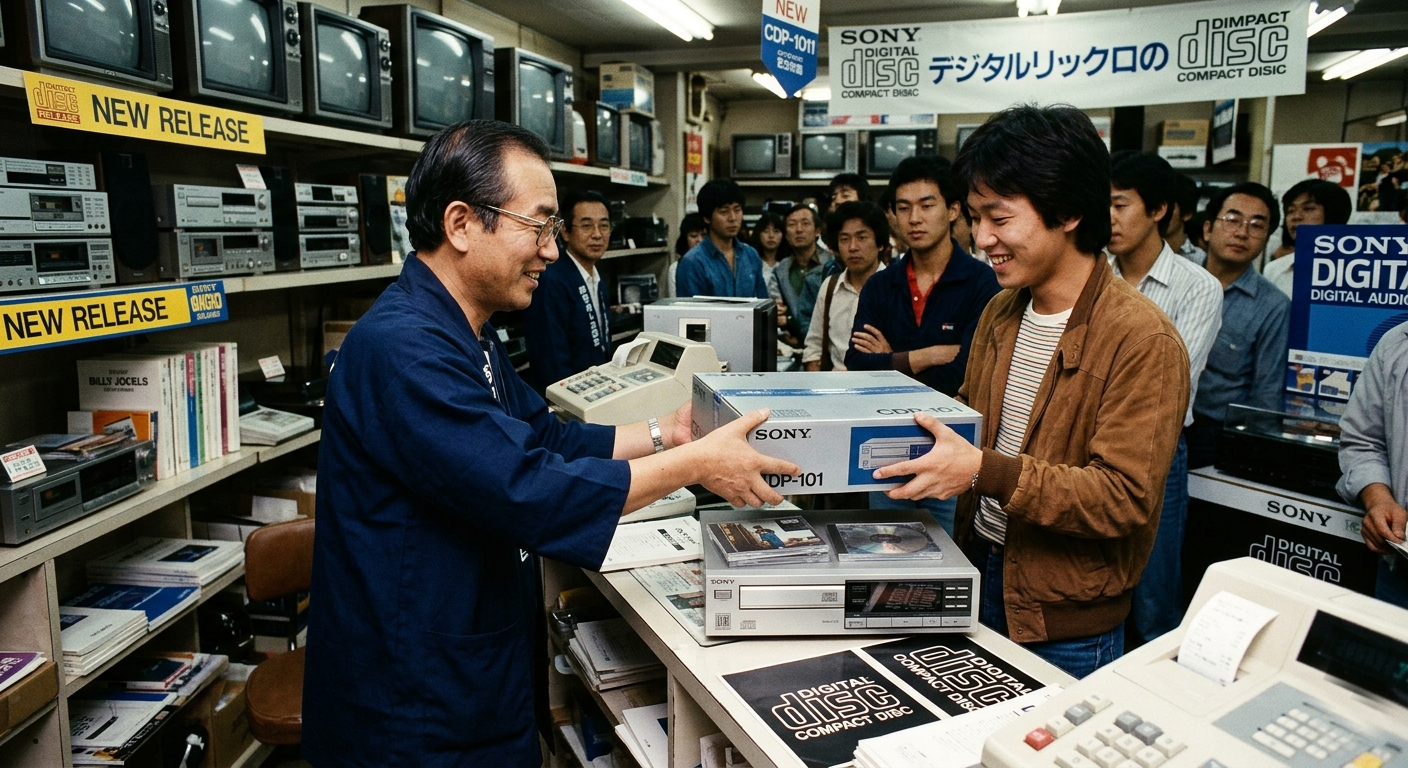
On October 1, 1982, Sony Corporation placed the world’s first commercially available compact disc player on sale in Japan. The device was called the CDP-101, and it carried a price tag of 168,000 yen, approximately $730 in American dollars at the time, or the equivalent of around $2,400 in today’s money. Alongside the player, Sony and CBS/Sony simultaneously released a catalog of approximately fifty compact disc titles, the first commercially available music on the new digital optical format. On that same day, in a single product launch, the recorded music industry crossed a threshold from which it would never return. The era of analog audio, of vinyl records pressed with grooves that a needle traced to produce sound, of cassette tapes coated with magnetic particles, had not yet ended, but its ending had begun.
The Sony CDP-101 was not merely a new product. It was the opening statement of a technological transformation that would reshape how music was stored, sold, and heard around the world. Within a decade, the compact disc overtook both vinyl and cassette as the dominant commercial music format. Within two decades, it had generated trillions of dollars in music industry revenue. And its successor formats, DVD, Blu-ray, and the optical disc technologies of the digital video era, all grew directly from the technical foundation that Sony and its partner Philips had built and that the CDP-101 first brought to consumers.
The Background: Why Analog Audio Needed a Digital Successor
To understand what the CDP-101 represented, it helps to understand what it was replacing and why replacement was desirable.
The vinyl long-playing record, introduced by Columbia Records in 1948, had been the dominant format for album-length music since the early 1950s. The LP was a remarkable invention in its way: twelve inches of polyvinyl chloride pressed with microscopic spiral grooves that encoded music as continuous physical waveforms, played back by a needle that vibrated in the groove and transmitted those vibrations to an amplifier. The LP at its best, played on a quality turntable with a well-maintained stylus, could produce audio of genuinely impressive fidelity. But it had inherent limitations that consumers accepted because they had no alternative. Every time a record was played, the needle contact introduced microscopic wear. Dust accumulated in the grooves. The surface produced a low-level background hiss. Records scratched, warped in heat, and over time degraded in sound quality. Cassette tapes were more portable but suffered from even more pronounced limitations in fidelity, with tape hiss, limited frequency response, and physical fragility.
Engineers at Sony and elsewhere had been working on digital audio recording since the early 1970s. Digital audio represented a fundamentally different approach: instead of storing sound as a physical analog of the original waveform, digital systems sampled the audio signal thousands of times per second, converted each sample into a binary number, and stored those numbers as a sequence of data. Playback reversed the process, reading the stored data and reconstructing the audio. The key advantages were enormous: digital storage had no inherent noise, did not degrade with repeated playback, and could in principle reproduce audio with a precision and dynamic range that no analog format could match.
Sony’s engineers had been developing digital studio recording equipment through the 1970s, and the company had built practical professional digital recording systems that were being used by leading record producers by the end of that decade. The challenge was moving from the professional studio, where equipment costing tens of thousands of dollars was acceptable, to the consumer home, where the price had to be accessible and the equipment had to be both compact and reliable.
Sony, Philips, and the Development of the Compact Disc Standard
The compact disc format was the product of one of the most consequential industrial collaborations in the history of consumer electronics. Sony and Philips, two companies with complementary expertise and sometimes competing interests, agreed in 1979 to jointly develop a digital audio disc for the consumer market.
Philips brought to the partnership its expertise in optical disc technology and laser engineering. The company had developed the LaserDisc format for video in the early 1970s and had years of experience working with the semiconductor laser and optical reading systems that would be essential to any practical disc-reading consumer product. Sony brought its expertise in digital audio processing, its professional PCM digital recording systems, and its manufacturing capabilities.
The partnership also carried seeds of technical disagreement. Philips had already developed a 14-bit digital-to-analog converter for the new format, which would have been less expensive to manufacture. Sony’s engineers pushed back hard. They argued that 14-bit audio would produce a format technically inferior to what was achievable, and they were also motivated by a practical concern: Philips’s existing 14-bit DAC would allow Philips to bring its player to market faster if the 14-bit standard was adopted. Sony insisted on 16-bit encoding, and the 16-bit standard was adopted, giving the compact disc a dynamic range of approximately 96 decibels, far exceeding anything an LP or cassette could produce.
The two companies also agreed on several other technical parameters that defined the CD format as it still exists today. The sampling rate was set at 44.1 kHz, meaning that the audio was sampled 44,100 times per second, a rate chosen because it was already being used in Sony’s professional digital recording systems. The disc diameter was set at 120 millimeters, approximately 4.7 inches. The playing time was standardized to accommodate 74 minutes of audio on one side. A popular story, which has been repeated so often that its accuracy is difficult to verify, claims that the 74-minute capacity was specifically chosen to accommodate Beethoven’s Ninth Symphony in its entirety without interruption, a choice reportedly at the insistence of Norio Ohga, a Sony executive who was also a classically trained opera singer and baritone. Whether or not this story is precisely accurate, the 74-minute capacity became the standard.
The technical specifications were published as a joint document in 1980. In the world of consumer electronics standardization, this document became known as the Red Book, named for the color of its cover, and it defined the Compact Disc Digital Audio standard that all subsequent CD players and discs would implement.
The Wikipedia article on the compact disc covers the full history of the format’s development, the technical collaboration between Sony and Philips, and the adoption of the Red Book standard that defined the CD for decades.
Norio Ohga, Toshitada Doi, and the Engineering Behind the CDP-101
The men most directly responsible for making the CDP-101 a reality were among the most important figures in Sony’s history.
Norio Ohga had joined Sony in 1954 after his personal letter of complaint about the audio quality of Sony tape recorders reached the desk of Sony’s founder Masaru Ibuka, who was so impressed by Ohga’s critical ear and his detailed technical observations that he hired him. Ohga rose through Sony’s management to become one of its most powerful executives, eventually serving as president and then chairman of the company. His insistence on the 74-minute playing capacity and his championship of the CD project within Sony’s leadership were critical to the format’s success. He later said, with characteristic directness, that the compact disc was his single most important contribution to Sony and to the music industry.
Toshitada Doi was the engineering leader most directly responsible for designing the CDP-101. He led the team that translated the CD format specification into an actual consumer product, solving the practical challenges of building a device that could reliably read microscopic pits on a spinning disc using a laser, convert the digital data back into audio, and do so at a price that, while expensive, was within reach of audiophile consumers. The CDP-101 contained 34 chips, making it one of the most complex consumer devices of its era, and its 16-bit DAC was designed and manufactured entirely by Sony in-house.
Nobuyuki Idei, who headed Sony’s Audio Division, chose the model designation “CDP-101.” The number 101 was not random: in binary notation, 101 equals the decimal number 5. Idei intended the name to position the player as a solid, mid-range product on a scale from one to ten, neither a bottom-tier entry-level device nor an ultimate flagship, but a reliable, capable machine aimed at serious music listeners. The choice reflected Sony’s understanding of who would initially buy a $730 music player in 1982: not the mass market, but audiophiles and early adopters prepared to pay a premium for genuinely superior sound quality.
The CDP-101 and Its Technical Innovations
The Sony CDP-101 introduced several design features that became standard across the entire subsequent history of CD player design.
The most immediately visible was the horizontal motorized tray-loading system. Sony’s marketing team called it “Linear Skate Disc Loading,” and it became the universal method for disc insertion in all subsequent CD players, as opposed to the top-loading mechanism that Philips used in its competing CD-100 player. The horizontal tray, which slid out at the press of a button, accepted the disc and retracted smoothly into the player, became so associated with CD players in general that it was later adopted for DVD and Blu-ray players and has continued in use for more than four decades.
The CDP-101’s front panel featured a vacuum fluorescent display that showed track number and playing time, an infrared receiver for the included remote control unit, and playback control buttons. The included RM-101 remote control allowed wireless operation from several meters away, a feature that was considered quite sophisticated in 1982. The device also incorporated an Automatic Music Sensor for precise track cueing, allowing users to skip to specific tracks with greater speed and accuracy than competing designs.
One aspect of the CDP-101’s design became a minor legend in audio circles: it had no “Stop” button. The function of stopping playback and returning the laser mechanism to its home position was performed by a “Reset” button, which also initialized the electronics. This quirk was a reflection of the machine’s innovative nature: its designers were creating conventions that did not yet exist, making choices that subsequent products would refine.
The CDP-101 also contained what Sony called an Anti Shock system, a feature designed to prevent playback interruption when the player was subjected to mild vibration. This feature would become increasingly important as portable CD players were developed in subsequent years.
Technically, the CDP-101 delivered performance that was genuinely transformative compared to any consumer audio format then available. Its frequency response extended from 5 Hz to 20 kHz, covering the full range of human hearing. Total harmonic distortion at 1 kHz measured 0.004 percent, compared to approximately 0.5 to 1.0 percent for a typical turntable and cartridge combination. The dynamic range exceeded 90 decibels. The signal-to-noise ratio was similarly extraordinary. In the language of listening, the CDP-101 reproduced music with a clarity, a silence between the notes, and a freedom from surface noise that analog formats could not approach.
The Sony CDP-101 entry in Hi-Fi Hall of Fame provides the detailed technical analysis of the player’s design, its engineering innovations, and its place in the broader history of high-fidelity audio equipment.
The First CDs: Billy Joel, ABBA, and the Launch Catalog
When the CDP-101 went on sale on October 1, 1982, it launched alongside a catalog of approximately fifty compact disc titles that CBS/Sony had prepared for the new format. The question of which album was the very first CD has been debated since the format launched, and the answer depends on which “first” is being defined.
Billy Joel’s 52nd Street carried the catalog number 35DP-1, placing it first in CBS/Sony’s early CD numbering series. Sony also prominently featured the album in promotional photography for the CDP-101 player, which cemented its reputation in many accounts as the “first CD.” But the format launched with a catalog of roughly fifty simultaneous releases, not a single album. Among the other titles available on that October 1 launch day were recordings by ABBA, the Japanese pop artist Eiichi Otaki, classical recordings, jazz releases, and international rock albums. The manufacturing of these discs had begun weeks before the player went on sale, with the PolyGram pressing plant in Langenhagen, West Germany, producing discs in August 1982 while validating the new optical replication process. CBS/Sony’s manufacturing facility in Shizuoka Prefecture was simultaneously producing the discs sold in Japan.
The initial CD catalog was heavily weighted toward audiophile favorites: classical orchestral recordings that would showcase the format’s dynamic range, jazz recordings with extensive dynamic contrast, and vocal recordings where clarity and freedom from surface noise would be immediately apparent. The strategy was deliberate. Sony needed to demonstrate to skeptical consumers that the CD delivered an audibly superior experience that justified its cost premium.
Japan First, Then the World: The Global Rollout of 1982 and 1983
The decision to launch the CDP-101 in Japan first, rather than simultaneously worldwide, was driven by Philips’s situation. Philips had been scheduled to launch its competing CD-100 player alongside Sony’s CDP-101, with a coordinated global introduction planned. When Philips was unable to meet the agreed deadline, Sony faced a choice: delay its own launch to wait for Philips, or proceed in Japan alone. Sony chose to proceed, but agreed to delay the worldwide launch of the CD format by approximately six months to give Philips time to complete its CD-100.
The joint announcement of the CD format’s commercial introduction had been made on August 31, 1982, in Tokyo, by Sony, Philips, CBS/Sony, and PolyGram together. This announcement confirmed that the first commercial CD products would be available in Japan in autumn 1982, with the worldwide launch following in spring 1983. The Philips CD-100 reached markets in November 1982, slightly behind the CDP-101, and notably, early Philips CD-100 players contained some components manufactured by Sony, a practical acknowledgment of Sony’s more advanced state of component manufacturing readiness.
The worldwide launch of the CD format proceeded in March 1983, when the CDP-101 became available in the United States and Europe at the equivalent price converted to local currencies. Other Japanese electronics manufacturers including Pioneer, Toshiba, and Marantz quickly introduced competing CD players, validating the format through competition and beginning the process of driving prices down through volume production.
The Britannica article on the compact disc covers the history of the CD format from its development through its commercial launch, the role of Sony and Philips as co-developers, and the format’s subsequent dominance of the recorded music industry through the 1990s.
The Industry Response: Resistance, Adoption, and the CD’s Triumph
The record industry’s initial response to the compact disc had not been enthusiastic. When Sony and Philips first approached major record labels about the new format in the late 1970s, the labels were deeply reluctant. They had recently invested heavily in the LP infrastructure and were concerned about the cost of remastering their catalogs for digital production. They worried that consumers would not pay the premium price that CDs required, around $20 per album compared to $8 for an LP, and they feared that the CD’s reputedly perfect reproducibility might damage the market for replacement copies of worn records.
These concerns proved unfounded. Consumers responded to the CD’s audibly superior quality, its durability, its convenience, and its random-access track selection with remarkable enthusiasm. By 1983, the year after the CDP-101’s launch, CD players were being sold in many countries and the catalog of available titles was expanding rapidly. By 1988, for the first time, CD sales in the United States exceeded LP sales. By 1991, cassettes were also being outsold by CDs. The format that Sony and Philips had launched with 50 titles in Japan in October 1982 had, within a decade, become the dominant medium for recorded music globally.
Sony’s 1984 introduction of the Discman, a portable CD player slightly larger than a CD itself, extended the format’s reach into everyday mobile listening. Albums specifically designed to exploit the CD’s extended dynamic range and lack of surface noise, most notably Dire Straits’ Brothers in Arms in 1985, became not just musical records but demonstrations of what digital audio could sound like, driving further CD player adoption among music enthusiasts who heard them.
The History.com article on the invention and impact of the compact disc traces the development of the CD from its origins in Sony and Philips research through its commercial triumph and its eventual transition from dominant format to legacy technology.
The Legacy of October 1, 1982: A Format That Changed Everything
The CDP-101 that went on sale in Japan on October 1, 1982, cost 168,000 yen and weighed approximately 5.6 kilograms. It was the size of a large book, required a dedicated shelf in a home audio system, and produced sound that audiophiles of the time described as either revelatory or sterile, depending on their loyalties to analog warmth. It had no stop button. It cost as much as a month’s rent in many Japanese cities. It was manufactured in a limited initial production run and sold primarily to early adopters and audio enthusiasts.
But the principle it embodied was irresistible. Digital audio, stored on an indestructible optical disc and read by a laser with no physical contact and therefore no wear, was a categorically better way to deliver recorded music to consumers than anything the industry had offered before. The CDP-101 made that principle concrete, commercial, and real.
Every CD player manufactured in the four decades since October 1, 1982, every DVD player and Blu-ray player and optical disc drive in every personal computer, every digital jukebox and music server that accepted discs, every car stereo with a disc slot, every CD released by every artist in every country in the world, traces its commercial ancestry to the Sony CDP-101 and the fifty albums that launched alongside it in Japanese record stores on that October morning.
The format itself has now entered the kind of nostalgic twilight that vinyl long preceded it through: streaming audio has replaced the disc as the dominant delivery mechanism for recorded music, and CD players are increasingly collectors’ items and niche products rather than universal household appliances. But the digital audio standard that the CDP-101 first implemented, 16-bit audio sampled at 44.1 kHz, remains the bedrock specification of digital music distribution to this day.