
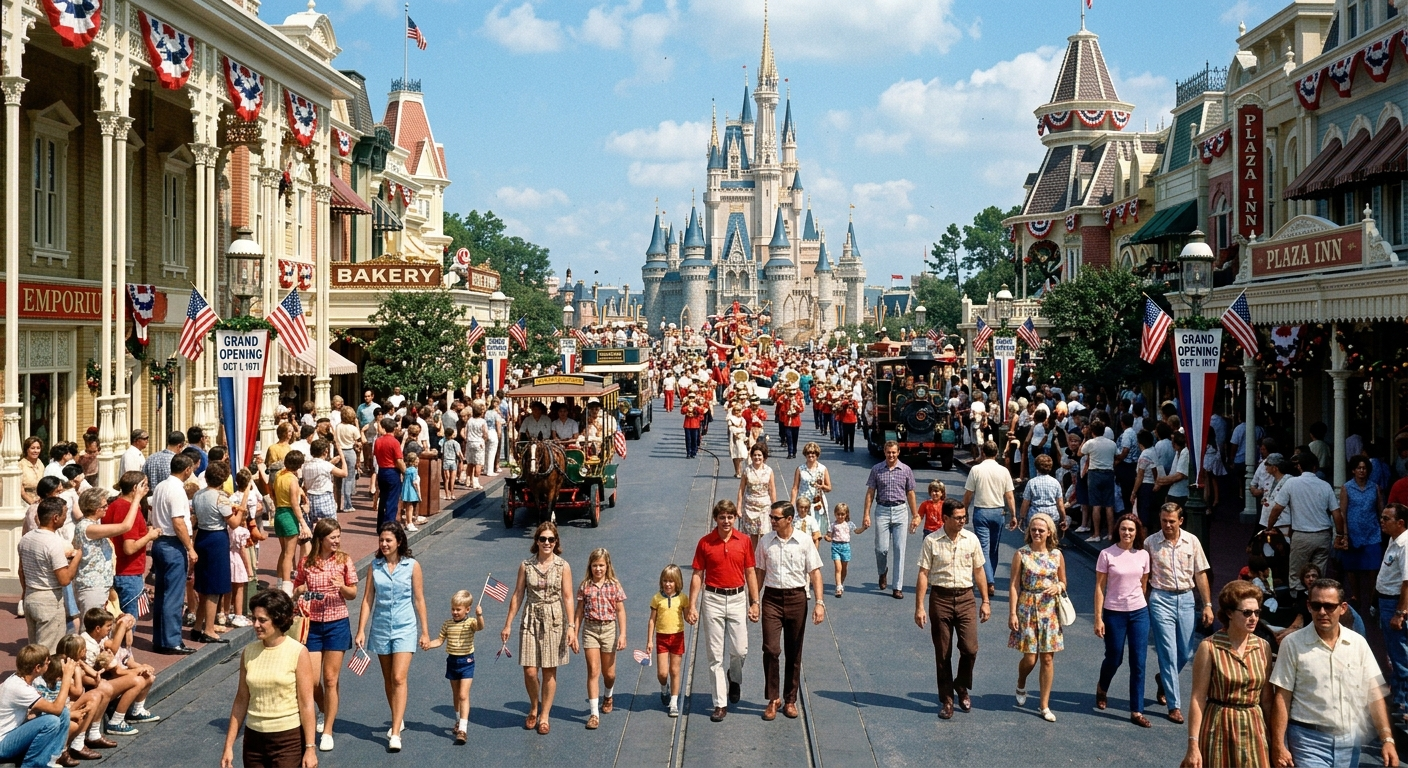
On the morning of October 1, 1971, a family from Lakeland, Florida named the Windsors became the very first guests to walk through the turnstiles of the Magic Kingdom at Walt Disney World. William Windsor, his wife Marty, and their two sons Jay and Lee had slept overnight in their car at a nearby roadside rest area to ensure their place in history. As they entered through one of the fourteen turnstiles, Mickey Mouse himself was there to greet them and lead them into the park. The Disney Dixieland band played “It’s a Hot Time in the Old Town Tonight,” reporters swarmed the family with cameras and questions, and the Windsor family rode down Main Street USA in an antique fire engine alongside Debbie Dane, Walt Disney World’s first official Ambassador.
The total number of guests who joined the Windsors that opening day was approximately 10,000. It was a deliberately modest beginning for the most ambitious theme park project in the history of entertainment. The park had been staffed with 5,500 cast members. Some analysts had predicted opening day crowds of 200,000 or more. The Florida Highway Patrol had issued a statement warning that as many as 300,000 people might try to be among the first to enter. Instead, 10,000 people arrived on a weekday morning in October, walked into a world that had cost more than $400 million to build, and experienced something that no one alive had ever seen before.
Walt Disney’s Vision: Learning from Disneyland’s Limitations
The story of Walt Disney World begins not in Florida but in California, and not in triumph but in frustration. When Disneyland opened in Anaheim on July 17, 1955, it was a revolutionary concept that proved almost immediately successful. But success at Disneyland created its own problems. Walt Disney had purchased only 160 acres for the Anaheim park, and the businesses that sprang up around its borders, the cheap motels, souvenir shops, and fast-food stands, created an environment that Disney considered a desecration of the experience he intended his guests to have. The moment a visitor stepped outside the park gates, they stepped back into exactly the commercial vulgarity that the park was supposed to provide an escape from.
Walt Disney was determined that his second park would not repeat this mistake. Beginning as early as 1959, he directed his staff to search for an East Coast location where he could acquire enough land to control the entire environment around the park. His benchmark was not Disneyland’s 160 acres but something vastly larger: a property that would allow him to build not just a theme park but a complete planned environment that he could govern entirely, creating what he called the Experimental Prototype Community of Tomorrow, or EPCOT, an actual functioning city of the future that would be the most radical element of his Florida vision.
When he examined the data about Disneyland’s visitors in the late 1950s, he also noted something strategically important: only 2 percent of Disneyland’s visitors came from east of the Mississippi River. The eastern United States, and specifically the corridor running from New England down through the mid-Atlantic states and into the Southeast, represented an enormous potential audience that his California park was simply not reaching. An East Coast park, positioned in a state with good weather that could operate year-round, would tap this audience and transform the scale of Disney’s business.
The Secret Land Purchases and the Florida Press Conference of 1965
Beginning in 1964, the Disney organization began secretly purchasing land in central Florida. The secrecy was essential. If land sellers discovered that Disney was the buyer, prices would immediately skyrocket. Disney therefore purchased through a network of dummy corporations with names like M.T. Lott Real Estate and Tomahawk Properties, acquiring parcels of orange groves, scrubland, and swamp in multiple separate transactions. His first choice of location had actually been near Sanford, Florida, but the local community had rejected the initial approaches.
The operation almost unraveled in October 1965, when Orlando Sentinel reporter Emily Bavar visited Disneyland during its tenth anniversary and asked Walt Disney directly whether he was behind the recent land purchases in central Florida. Disney, by her account, looked as if she had thrown a bucket of cold water in his face before denying the story. But Bavar’s research was thorough and her instincts were correct. She published her prediction on October 21, 1965, and it spread rapidly. Disney, faced with the exposure of his plans before the land acquisition was complete, asked Florida Governor Haydon Burns to confirm the story publicly and moved the formal announcement forward. Governor Burns called a press conference in Orlando and introduced Walt Disney to Florida, calling the project “the greatest attraction in the history of Florida.”
The official announcement followed on November 15, 1965, with Walt Disney joining Burns in Orlando. By this point, Disney had accumulated approximately 27,500 acres of central Florida, making it the largest private land purchase of its kind in American history. A family named Demetree had been among the sellers, and their descendant recalled years later that her father had been kept entirely in the dark about who the buyer was. When the news broke in the Orlando Sentinel, he reportedly said: “I’ll be damned. It’s Disney.”
Florida’s legislature gave Disney something no private entertainment company had ever received before or has received since: the power of an independent governmental body over its own land. The Reedy Creek Improvement District, created by legislation signed by Florida Governor Claude R. Kirk Jr. on May 12, 1967, gave Disney the authority to build its own roads, drainage systems, and utilities, and essentially exempted the property from county and state land-use regulations. Disney could build its own power plants, its own fire department, its own water treatment systems, and its own transportation infrastructure without seeking approval from any outside authority. This extraordinary political arrangement, which Disney lobbied Florida’s legislature to provide, gave the company the environmental control that Walt Disney had identified as essential to his vision from the very beginning.
Walt Disney’s Death and Roy Disney’s Determination
The most poignant dimension of Walt Disney World’s story is that the man whose vision created it never saw it open. Walt Disney died on December 15, 1966, from lung cancer complications, less than a year after his public announcement of the Florida project and after visiting the construction site only twice. He was sixty-five years old. His death left the most ambitious project in entertainment history without its creator, and many inside the Disney company feared it would never be completed.
Roy Oliver Disney, Walt’s older brother by eight years and the financial and business mind behind the Walt Disney Company, had been planning to retire. Instead, he postponed retirement and made finishing his brother’s Florida project the purpose of the remaining years of his life. His statement to the WED Enterprises staff that designed Disney’s parks was direct and unambiguous: “We’re going to finish the Florida park, and we’re going to do it just the way Walt wanted it.” Roy also insisted that the park be called Walt Disney World rather than simply Disney World, to ensure that his brother’s name would remain permanently attached to the project that Walt had created but not lived to see.
Roy hired Brigadier General William “Joe” Potter, a retired Army engineer who had directed the massive infrastructure construction for the 1964 World’s Fair in New York, to oversee the vast engineering challenges of the Florida construction. Potter managed a carefully designed drainage and water management system across the property that used a network of canals to control the Florida wetlands, an approach that environmental advocates later acknowledged was remarkably progressive for its time in preserving natural wetland areas.
Construction began in earnest in 1967 and reached its peak intensity between 1969 and 1971, with approximately 9,000 workers on site at various points. The engineering challenges were unprecedented. The entire underground utility infrastructure of the Magic Kingdom was built first, creating a network of tunnels called utilidors that ran beneath the park at ground level, with the actual park built above on an elevated platform. This system allowed cast members to move invisibly between different areas of the park, and allowed for the delivery of food, waste removal, and utility maintenance entirely out of guests’ sight. It was a solution to a specific problem, namely how to maintain the themed environments of each “land” without guests seeing Frontierland’s cowboys walk through Tomorrowland to reach their shift, that became one of the most copied ideas in theme park design worldwide.
The Wikipedia article on Walt Disney World covers the full history of the resort from its conception through the land acquisition, the Reedy Creek Improvement District, and the construction challenges that General Potter and his team solved to make opening day possible.
October 1, 1971: Opening Day and What Guests Found
The 10,000 guests who entered Magic Kingdom on opening day encountered a park of approximately 107 acres featuring six themed lands: Main Street USA, Adventureland, Frontierland, Liberty Square, Fantasyland, and Tomorrowland. The centerpiece that dominated the park’s visual identity was Cinderella Castle, rising 189 feet above the end of Main Street, a fanciful interpretation of a European medieval castle that was significantly more elaborate than the Sleeping Beauty Castle at Disneyland and has become one of the most recognized structures in the world.
Among the original attractions were the Haunted Mansion, the Jungle Cruise, Pirates of the Caribbean, It’s a Small World, Space Mountain’s predecessor attractions in Tomorrowland, the Walt Disney World Railroad, the Country Bear Jamboree, the Hall of Presidents, Mr. Toad’s Wild Ride, and 20,000 Leagues Under the Sea. In total, twenty-three attractions were available to guests on opening day. An adult admission ticket cost $3.50, which did not include rides. In keeping with the Disneyland-derived ticketing system, individual rides required separate tickets, with the most popular “E-ticket” attractions costing an additional 90 cents each. Dining was available throughout the park, and even a meal inside Cinderella Castle, in the form of a roast beef sandwich, could be purchased for $4.25.
The contemporary hotel attached to the resort by the monorail system was the Contemporary Resort, a distinctive A-frame structure built using an innovative system in which the room modules were prefabricated elsewhere and then inserted into the steel frame of the building using cranes. The Polynesian Village Resort also opened with the park, both hotels built by U.S. Steel. Roy Disney made a last-minute decision to buy out U.S. Steel’s ownership interest and have Disney operate the hotels directly, a decision that locked in Disney’s control over the complete on-site guest experience.
The grand opening celebration was not actually held on October 1, 1971. The soft opening on that date was deliberately understated, chosen to fall on a weekday in the offseason specifically to limit attendance and allow any operational problems to be identified and addressed before the full public arrived. The official grand opening ceremony took place on October 25, 1971, featuring a parade down Main Street attended by celebrities including Bob Hope, Julie Andrews, Rock Hudson, Jonathan Winters, Annette Funicello, and Fred MacMurray. Roy Disney presided over these ceremonies, the culmination of the project to which he had devoted the final years of his life. He died less than three months later, on December 20, 1971.
The History.com article on Walt Disney World’s opening covers the opening day in detail, including Roy Disney’s dedication speech in which he spoke of his brother’s vision and his own determination to honor it.
The Impact on Orlando, Florida, and the Theme Park Industry
The opening of Walt Disney World transformed Orlando from a small Florida city dependent on the citrus industry and the new space industry at Cape Canaveral into one of the most visited tourist destinations on earth. The year before Walt Disney World opened, Orlando International Airport handled fewer than a million passengers. Within a decade of the opening, that number had multiplied many times over. Hotels, restaurants, shopping centers, and service businesses proliferated across the entire region, creating an economic transformation of central Florida that has continued for more than fifty years.
The theme park industry itself was permanently reshaped. As Professor Jim Lewison noted in the resort’s fiftieth-anniversary coverage, “Just as the 1955 opening of Disneyland convinced other entrepreneurs that theme parks were a good investment, the opening of Walt Disney World in 1971 led to another spurt of theme park building in the USA.” Kings Island in Ohio opened in 1972. Carowinds on the North Carolina-South Carolina border opened in 1973. Six Flags Great Adventure in New Jersey opened in 1974. Kings Dominion and Busch Gardens in Virginia opened in 1975. Every one of these parks was built in direct response to the commercial proof of concept that Walt Disney World provided.
Disney itself continued to expand the Florida property rapidly. Eleven new attractions had been added to the Magic Kingdom by 1975. Space Mountain, which became one of the park’s most beloved attractions, opened in 1975. The Contemporary Resort and Polynesian Village were joined by a dozen more hotels before the end of the decade. The Fort Wilderness Resort and Campground, providing camping accommodation unique among major theme park destinations, offered guests an entirely different kind of Disney experience.
Epcot, Walt Disney’s original concept for the Florida property as a functioning city of the future, was reimagined and opened on October 1, 1982, exactly eleven years after the Magic Kingdom. Rather than a habitable city as Walt had envisioned, the Epcot that opened was a permanent world’s fair with two sections: Future World, exploring technological innovation through themed pavilions and attractions, and World Showcase, featuring cultural and culinary representations of eleven nations around a central lagoon. Disney-MGM Studios, later renamed Hollywood Studios, opened in 1989. Disney’s Animal Kingdom opened in 1998. Two water parks, Typhoon Lagoon in 1989 and Blizzard Beach in 1995, added further recreational options.
The Britannica article on Walt Disney World describes the resort’s development from the original Magic Kingdom through the expansion into a four-park, multi-hotel complex that now employs more than 77,000 people and receives approximately 58 million visitors each year.
Roy Disney’s Final Gift and the Legacy of October 1, 1971
The morning of October 25, 1971, when Roy Disney stood before the crowd for the grand opening ceremony, he gave a dedication speech that became one of the most moving statements in Disney history. He spoke of his brother Walt, who had conceived everything that his guests were experiencing that day. “Walt Disney World is a tribute to the philosophy and life of Walter Elias Disney,” Roy told the crowd, “and to the talents, the dedication, and the loyalty of the entire Disney organization that made Walt’s dream come true.”
Roy was seventy-eight years old. He had spent his career in his younger brother’s shadow, the financial realist who made possible the creative dreams that Walt generated. He had been Walter Disney’s partner from the company’s very beginning in 1923. He had provided the business discipline and the financial management without which Walt’s artistry and vision would have remained unrealized. And when Walt died in 1966, Roy had done the most important thing he ever did for his brother: he saw the dream through to completion. He died on December 20, 1971, fifty-six days after presiding over the opening ceremony, his work finally done.
The world that opened on October 1, 1971, has grown far beyond what Walt Disney imagined and far beyond what Roy Disney lived to see. Walt Disney World today covers approximately 27,000 acres, contains four theme parks, two water parks, thirty-one Disney-owned hotels, more than 300 dining locations, four golf courses, a professional sports complex, and a vast entertainment and shopping district. It employs more than 77,000 people, making it the largest single-site employer in the United States. It receives approximately 58 million visitors each year, making it the most visited theme park resort on earth.
The NPR documentary account of Walt Disney World’s first fifty years examines how central Florida was transformed by the resort’s arrival and how Disney’s vision for an East Coast park became not merely a commercial success but an institution embedded in American cultural life.
On October 1, 1971, a family from Lakeland slept in their car to be first through the gates. The Disney Dixieland band played. Ten thousand people walked into a world that had cost more than $400 million to build and that Walter Disney had died five years earlier dreaming of. Half a century later, those 10,000 guests look like the beginning of something that has no obvious ending, a place that has welcomed more than a billion visitors since that opening morning and shows no sign of dimming the ambition and imagination that a man in Anaheim, California, first conceived when he was frustrated by the souvenir shops outside his park’s walls.