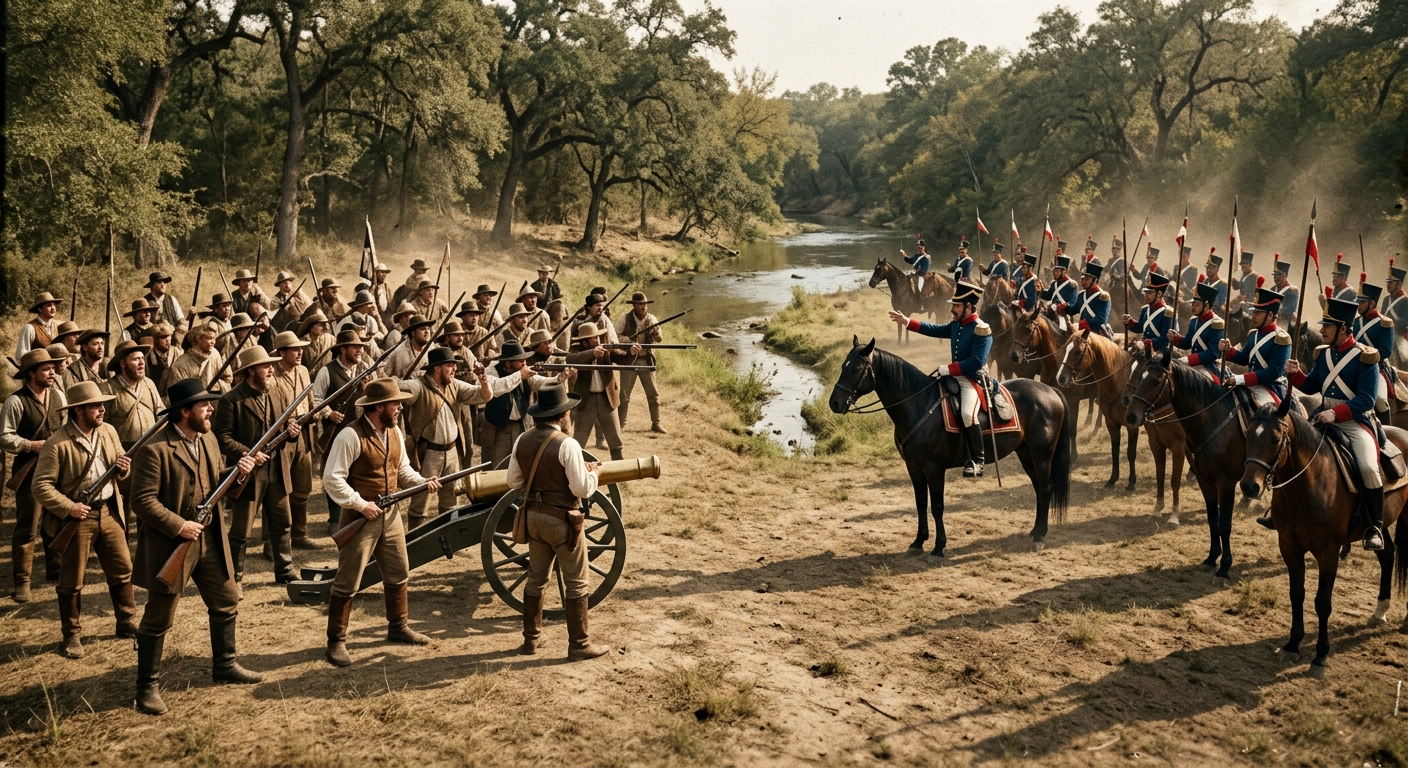
Before dawn on October 2, 1835, a thick autumn fog settled over the banks of the Guadalupe River near the small settlement of Gonzales in Mexican Texas. Through that fog, approximately 150 Texian settlers moved quietly into position, approaching the camp where around 100 Mexican soldiers under Lieutenant Francisco de Castañeda had been waiting since the previous day. The Texians had dug up a small bronze cannon from the peach orchard where they had buried it to hide it from the soldiers, mounted it on a makeshift wagon, loaded it with scrap iron and chains cut into pieces to serve as shot, and aimed it at the Mexican camp. Above it flew a white flag made from a woman’s dress, bearing a roughly painted black cannon and four words that would become the defining motto of the Texas Revolution: “Come and Take It.”
In the heavy fog, neither side could see much of anything. The Texians fired the cannon, its blast echoing across the riverbank and through the surrounding countryside. The Mexicans returned fire. After what contemporaries described as several hours of confused and largely ineffective skirmishing, Lieutenant Castañeda assessed his situation. He had been ordered to retrieve the cannon without provoking an armed confrontation if possible, his force was outnumbered by men who knew the terrain and whose determination to resist was now unmistakably clear, and the cannon he had been sent to retrieve had just been fired at his troops. He ordered a withdrawal and his dragoons retreated toward San Antonio de Bexar. The Texians kept their cannon. The Texas Revolution had begun.
Mexican Texas in 1835: The Road to Gonzales
The conflict that erupted at the Guadalupe River on October 2, 1835, was the product of a decade of escalating tensions between the Anglo-American settlers who had come to Texas in large numbers and the Mexican government they had legally joined but never fully accepted.
Texas had been part of the Spanish empire and then, after Mexican independence in 1821, part of the new Mexican nation. But the vast territory that Mexico called Tejas was only sparsely populated by Mexican settlers, numbering perhaps 3,000 to 4,000 by the early 1820s. The Mexican government, hoping to populate the territory and create a buffer against American expansion from the north and east, had implemented a liberal immigration policy that invited Anglo-American settlers to come as legal Mexican citizens under the colonization system. The primary agent of this migration was Stephen Fuller Austin, the son of Moses Austin whose land grant from the colonial Mexican government had been confirmed after his father’s death. Austin guided more than 25,000 Anglo-American immigrants into Texas between the early 1820s and the mid-1830s, creating the most heavily populated American immigrant community in Mexican territory anywhere.
These immigrants legally became Mexican citizens. They were supposed to convert to Catholicism, learn Spanish, and integrate into Mexican civic life. In practice, they continued to speak English almost exclusively, maintained their Protestant religious traditions, built schools that taught in English, and traded primarily with the United States rather than with Mexico City. The cultural and economic integration that the Mexican government had envisioned did not occur, and the political integration that would have followed from it did not occur either.
Through the late 1820s and early 1830s, tensions built over a series of specific grievances. The Mexican government in 1829 abolished slavery, which threatened the economic model of the cotton-growing Anglo settlers who had brought enslaved workers with them from the American South. The Law of April 6, 1830, suspended further immigration from the United States, imposed new customs duties, and placed military garrisons in Texas in an attempt to reassert central government control. Mexican authorities also required that commercial goods be purchased from Mexican traders rather than imported from the United States. The settlers regarded these measures as violations of the agreement under which they had come to Texas and as evidence that the Mexican government intended to reduce their autonomy.
Antonio Lopez de Santa Anna and the Constitutional Crisis of 1835
The event that transformed the accumulated grievances of the Anglo-Texan settlers into revolutionary action was the political transformation of Mexico in 1835 under President Antonio Lopez de Santa Anna.
Santa Anna was one of the most remarkable and most destructive political figures in Mexican history, a man who served as president of Mexico eleven separate times over nearly three decades and who led the country into a series of military disasters. In 1835, Santa Anna was still in the first phase of his political career and was consolidating his authority. He dissolved the Mexican Congress, abolished the federalist Constitution of 1824 that had established the rights of Mexico’s individual states and territories, and reorganized Mexico as a centralist republic in which all meaningful power was concentrated in the national executive rather than distributed to local governments.
The Constitution of 1824 had been important to the Anglo-Texan settlers. Under that constitution, Texas had operated with a degree of local autonomy that suited their situation and protected their interests. The replacement of the federalist constitution with a centralist system meant the elimination of that autonomy and the imposition of direct control from Mexico City by a government in which they had no representation and whose policies they already regarded with deep suspicion. Moreover, many of the Mexican settlers in Texas, the Tejano population, also opposed Santa Anna’s centralist turn. The Tejano federalists who joined the Texas Revolution were not fighting for Anglo-American interests but for the restoration of the constitutional framework that Santa Anna had abolished.
Recognizing that the Anglo-Texan settlers would be likely to use the constitutional crisis as a pretext for rebellion, Santa Anna ordered the Mexican military to begin disarming the settlers wherever possible. He dispatched his brother-in-law, General Martin Perfecto de Cos, with approximately 500 soldiers to Texas to reinforce the military presence and ensure compliance.
The Cannon That Started a Revolution
At the center of the events of October 2, 1835, was a small bronze six-pounder cannon, not a particularly impressive weapon by any military standard. Its origin was practical rather than political. In 1826, a Comanche raid had burned Gonzales to the ground. When Green DeWitt, a veteran of the War of 1812 who had received an empresario land grant to settle families in the area, rebuilt the colony, he recognized that the settlers needed a means of defending themselves against further raids. In 1831, he petitioned Ramon Musquiz, the political chief for the Department of Bexar, for a small cannon for the colony’s defense. The cannon provided was technically “spiked,” meaning a steel spike had been driven through its touch hole to prevent it from being fired, a precaution that in practice the settlers eventually found a way to work around.
The cannon sat in Gonzales for four years, largely forgotten. When the political climate shifted dramatically in 1835 and Santa Anna’s orders to disarm the settlers reached Colonel Domingo de Ugartechea, the military commander for all Mexican troops in Texas, the cannon at Gonzales became a specific target. In early September 1835, Ugartechea dispatched a corporal and five enlisted men to retrieve it. The Gonzales settlers refused, and in an act of considerable boldness, actually arrested and held the Mexican soldiers as a demonstration of defiance. Ugartechea then sent a more substantial force.
On September 27, 1835, a detachment of 100 dragoons of the Segunda Compania Volante de San Carlos de Alamo de Parras rode out from San Antonio de Bexar under Lieutenant Francisco de Castañeda, carrying official orders for Alcalde Andrew Ponton to surrender the cannon. Ugartechea had specifically instructed Castañeda to avoid an armed confrontation if at all possible. His mission was retrieval through legitimate authority, not combat.
The colonists had no intention of cooperating. Andrew Ponton was conveniently “out of town” when the Mexican soldiers arrived at the flooded Guadalupe River crossing on September 29. The remaining settlers engaged the soldiers in a series of evasive conversations, stalling for time while urgent messengers rode to neighboring communities to call for reinforcements. Stephen Austin, Texas’s most respected leader and the man who had brought thousands of settlers to the territory, sent word urging the communities to respond. He was careful to advise that Texians should remain on the defensive, as any unprovoked attack might limit American sympathy and support if war officially began.
The Wikipedia article on the Battle of Gonzales provides the detailed military account of the skirmish, the movements of both forces in the days before October 2, and the broader political context that gave the small cannon its revolutionary significance.
The Come and Take It Flag and the Settlers’ Vote for War
While the Mexican soldiers waited on one side of the swollen Guadalupe River, Gonzales became the gathering point for settlers from across the surrounding communities. Within two days of the Mexican force’s arrival, approximately 140 Texians had reached Gonzales, drawn by the messenger network and by the shared determination not to yield to the demand for disarmament.
The colonists retrieved the buried cannon from the peach orchard and mounted it on a wagon frame. They loaded it with whatever metal they could find: scrap iron, pieces of cut chain, anything that could be packed into the barrel and projected toward an enemy. Two cannons were ultimately used in the battle, the disputed bronze six-pounder and a smaller Spanish esmeril iron cannon of about one-pound caliber. Both were primitive weapons, but their symbolic value far exceeded their military capability.
The flag that the settlers made has become one of the most celebrated objects in Texas history. According to local tradition, the white battle flag was fashioned from a dress belonging to Naomi DeWitt, with her daughter Evaline DeWitt assisting in its creation. A black star and a crude image of the cannon were painted on the white fabric, and beneath the cannon ran the defiant challenge: “Come and Take It.” The phrase was reportedly inspired by the ancient Spartan response at the Battle of Thermopylae, where King Leonidas had reportedly answered Persian demands to surrender his weapons with the words “Molon Labe,” meaning “Come and take them.” Whether the Gonzales settlers were consciously invoking this classical precedent or simply finding the most direct expression of their defiance, the phrase captured a spirit of resistance that resonated immediately and has endured ever since.
On October 1, 1835, the assembled Texian volunteers held a vote. The question before them was direct: would they initiate a fight with the Mexican soldiers or continue to stall? They voted to attack. Colonel John Henry Moore was elected to command the assembled force, and plans were made for a pre-dawn movement against Castañeda’s camp.
October 2, 1835: The First Shots of the Texas Revolution
In the early hours of October 2, 1835, with the Come and Take It flag flying above their improvised artillery, approximately 150 Texians moved through the fog toward the Mexican camp located at Ezekiel Williams’ farm, approximately seven miles upriver from Gonzales. The heavy fog that covered the Guadalupe River that morning was both a tactical challenge and a practical equalizer: neither side could see clearly, and the combat that followed had the confused, noisy, and largely inconclusive character that fog-shrouded battlefield encounters frequently produce.
The Texians fired the cannon, packed with its load of scrap iron. The boom rolled across the river valley and through the surrounding countryside. Mexican soldiers, startled by the attack, returned fire with their muskets. The exchange continued for what witnesses later described as several hours, though the actual intensity of the fighting was limited by the poor visibility. Casualties were minimal on both sides. Contemporary accounts give the Mexican casualties as one soldier killed and possibly one or two more wounded. The Texian casualties included no deaths; the most serious injury sustained by a Texian was reportedly a bloody nose suffered when a volunteer fell from his horse.
When the fog began to lift, Castañeda held a brief parley with John Henry Moore. He asked why the Texians had attacked. Moore’s reply was significant: they were fighting for the cannon and for the Constitution of 1824. Castañeda’s response was even more significant: he told Moore that he himself was also against Santa Anna’s new centralist government. He had been given orders he disagreed with by a government whose actions he opposed. But he was a soldier, and his orders were clear. He withdrew his force toward San Antonio de Bexar, leaving the cannon, the flag, and the initiative in Texian hands.
The History.com account of the Battle of Gonzales describes the battle as the moment when “the growing tensions between Mexico and Texas erupted into violence,” drawing the parallel to Lexington and Concord that contemporaries immediately recognized.
Aftermath: From Gonzales to San Antonio and the Birth of the Texas Army
News of the Gonzales skirmish spread across Texas and across the United States with remarkable speed. American newspapers quickly adopted the comparison that was most accessible to their readers, calling Gonzales “the Lexington of Texas,” drawing the explicit parallel to the first shots of the American Revolution fired at Lexington and Concord in April 1775. The comparison was apt in structural terms: both were small skirmishes with limited military significance that marked an irreversible break between a colonial population and the government that claimed authority over them.
Gonzales immediately became a rallying point. Volunteers from across Texas and from neighboring American states began converging on the settlement. The New Orleans Greys, two companies of American volunteers totaling more than 100 men, organized in front of St. Louis Cathedral in New Orleans in October 1835 and marched to join the Texas forces within days of each other. Men arrived from Mississippi, Alabama, Louisiana, and other Southern states, some motivated by genuine political sympathy for the Texian cause, others by the prospect of adventure, land, or simply a fight worth having.
On October 11, 1835, the assembled Texian volunteers unanimously elected Stephen F. Austin as their commander, despite his acknowledged lack of military training. Austin’s authority in Texas was moral and political rather than military: he was the most respected leader the settlers had, the man who had brought most of them to the territory and who commanded broader loyalty than any military figure. The following day, Austin led his growing army on a march northward toward San Antonio de Bexar, where General Martin Perfecto de Cos had established himself with several hundred Mexican soldiers.
The Texas State Historical Association’s Handbook of Texas entry on the Battle of Gonzales provides the authoritative scholarly account of the battle and its place in the broader narrative of the Texas Revolution, covering the political and military developments from October 1835 through the final battles of the revolution.
The Siege of San Antonio de Bexar that followed in October and November 1835 ended with Cos’s surrender in December, driving the last Mexican regular forces from Texas. But the peace was brief. Santa Anna himself, furious at the humiliation of his brother-in-law’s defeat, assembled a large army and marched north in the winter of 1835 and 1836, determined to crush the rebellion in person. His campaign produced the most famous single event of the Texas Revolution: the siege and fall of the Alamo on March 6, 1836, where approximately 189 Texian and volunteer defenders held the old San Antonio mission for thirteen days against thousands of Mexican soldiers before being killed to the last man. The defenders included James Bowie, Davy Crockett, and William Barret Travis, whose last letter from the Alamo appealing for reinforcements became one of the great documents of Texas independence.
The Revolution that had begun with a foggy skirmish over a small cannon reached its climax on April 21, 1836, at the Battle of San Jacinto, where Sam Houston led the Texian army in a surprise attack against Santa Anna’s own force, routing the Mexicans in eighteen minutes and capturing Santa Anna himself the following day. Under the treaties signed by the captured Santa Anna, Mexico recognized Texas as an independent republic. The Republic of Texas was born.
The Legacy of Come and Take It: A Phrase That Defined a Revolution
The Battle of Gonzales lasted perhaps three hours and produced perhaps one confirmed death. It involved fewer than 300 men on both sides and was decided by the withdrawal of a force that had not really been defeated but had simply concluded that its mission was impossible. By any conventional military measure, it was not a battle at all. It was a skirmish between a handful of frontiersmen and a small detachment of dragoons over the possession of a small, battered, barely functional cannon.
And yet its significance was total and permanent. The vote on October 1 to initiate the fight, the loading of the cannon with scrap metal, the raising of the Come and Take It flag, and the first shot fired through the morning fog on October 2 marked the moment when the Anglo-American settlers of Mexican Texas decided that accommodation with Santa Anna’s centralist government was impossible and that armed resistance was the only remaining option. That decision, made by 140 volunteers gathered in a small river town, set in motion a chain of events that created the Republic of Texas in 1836 and eventually led to Texas’s annexation by the United States in 1845, which in turn triggered the Mexican-American War and the acquisition of enormous territories that shaped the geography of the modern American Southwest.
The Britannica account of the Texas Revolution and its origins places the Battle of Gonzales within the full arc of the revolution, tracing the causes from Mexico’s colonization policy and Stephen Austin’s empresario grants through the constitutional crisis of 1835 and the battles of the Alamo and San Jacinto that concluded the fighting.
The Come and Take It flag, according to local tradition made from a wedding dress and painted with defiant words by a settler’s wife and daughter, became one of the most enduring symbols of Texas identity. The phrase itself migrated from its specific context into a broader cultural vocabulary of defiance and resistance. Gonzales still holds a Come and Take It celebration annually on the weekend nearest October 2, commemorating the morning when a group of outnumbered frontiersmen pointed a cannon loaded with scrap iron into a fog and decided that this was the moment to fight. They were right.