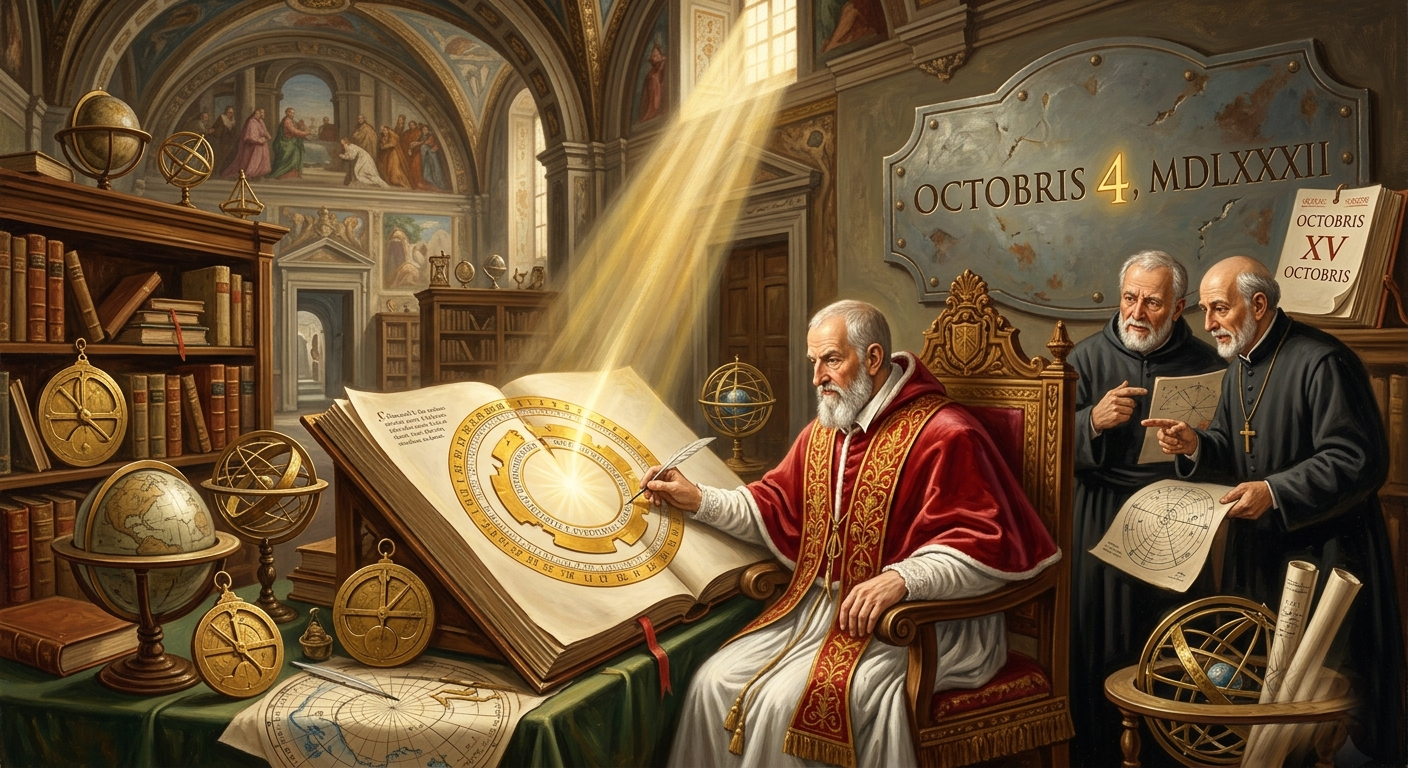
On the night of October 4, 1582, millions of people across Catholic Europe went to sleep in one world and woke up in another. The citizens of Spain, Portugal, Poland, and most of Italy closed their eyes on Thursday, October 4, and opened them on Friday, October 15. Ten days had vanished from history, not through any mystery or miracle, but through the deliberate action of one of the most consequential administrative decisions in the history of Western civilization. Pope Gregory XIII, born Ugo Boncompagni, had decreed that the calendar that governed the lives of all Christian people would be corrected, corrected in a single sweeping act that removed ten accumulated days of error and established a new system for measuring time so accurate that it remains the global civil calendar to this day.
The reform that took effect on October 4 to 15, 1582, had been nearly two decades in the making. Its roots went deeper still, into a problem that had been growing quietly for centuries: the Julian calendar, introduced by Julius Caesar in 46 BC and used throughout the Christian world for over 1,600 years, was not quite accurate enough. Its small daily error had accumulated across the centuries into a gap that was creating genuine theological and astronomical problems, and by the sixteenth century, those problems could no longer be ignored.
What Was the Julian Calendar and Why Did It Need Reform?
The Julian calendar that Rome had bequeathed to Christian Europe calculated the solar year as exactly 365.25 days. This was remarkably close to accurate, but the actual tropical year, the time it takes the Earth to complete one orbit around the Sun and return to the same seasonal position, is approximately 365.2422 days. The difference was just over eleven minutes per year.
Eleven minutes sounds trivial. Over a century, it amounted to approximately one day. Over a millennium, it accumulated into nearly eight days. By the sixteenth century, the Julian calendar had drifted approximately ten days behind the actual solar year. This meant that the vernal equinox, the moment when the Sun crosses the celestial equator heading northward and day and night are of equal length, was occurring on approximately March 11 rather than March 21, the date on which the First Council of Nicaea had fixed it in 325 AD.
The drift of the equinox created a crisis not merely of astronomy but of theology, because the date of Easter was calculated in relationship to the vernal equinox. Easter, the most sacred date in the Christian year, was supposed to fall on the first Sunday after the first full moon after the vernal equinox. If the equinox had shifted, then the calculated date of Easter had shifted with it, and the Church was celebrating its most important observance on the wrong date. This was not an abstract problem for medieval and Renaissance Christians who believed the proper observance of liturgical time to be a serious religious obligation.
The Council of Trent, Luigi Lilio, and the Plan for Reform
The problem of the calendar was not new to the sixteenth century. Various proposals for reform had been made as far back as the thirteenth century, and Roger Bacon had presented a memorandum on the subject to Pope Clement IV in 1267. But the institutional will to implement a reform had been lacking, partly because any correction would require removing days from the calendar, and the legal, commercial, and social disruption of such an adjustment was genuinely daunting.
The Council of Trent, the great reforming council of the Catholic Church that met intermittently from 1545 to 1563, passed a decree in its 1562 to 1563 session calling on the Pope to reform the calendar. This formal mandate gave institutional momentum to reform efforts that had previously been merely academic. When Ugo Boncompagni was elected as Pope Gregory XIII on May 13, 1572, he inherited this mandate and made its fulfillment one of the priorities of his pontificate.
The mathematical and astronomical work that made the reform possible was primarily the achievement of Luigi Lilio, also known as Aloysius Lilius, an Italian physician, astronomer, philosopher, and chronologist from the commune of Ciro in the province of Crotone, in the Calabria region of Italy. Lilio had studied medicine and astronomy in Naples and eventually settled in Verona, where he died before his proposed calendar reform was fully implemented. His brother Antonio Lilio presented his work to the commission that Gregory had established, and it was Lilio’s proposal that formed the basis of the reform ultimately adopted.
Lilio’s solution addressed both the accumulated drift and the prevention of future drift. For the accumulated drift, he proposed removing ten days from the calendar in a single correction, bringing the vernal equinox back to March 21 where the Council of Nicaea had placed it. For the prevention of future drift, he proposed a refined rule for leap years. The Julian calendar had made every year divisible by four a leap year. Lilio proposed that century years, years ending in 00, would be leap years only if divisible by 400. Under this rule, 1600 and 2000 would be leap years, but 1700, 1800, and 1900 would not be. This adjustment reduced the average calendar year from 365.25 days to 365.2425 days, much closer to the actual solar year of 365.2422 days.
Christopher Clavius and the Commission That Built the New Calendar
Pope Gregory XIII appointed a commission to review and refine Lilio’s proposal. The leading figure of this commission was Christopher Clavius, a German-born Jesuit mathematician and astronomer who taught at the Collegio Romano in Rome and was sometimes called the “Euclid of the sixteenth century.” Clavius’s contribution was primarily in the implementation and defence of the reform rather than in its fundamental design, but his role was crucial in two ways. First, he preferred that the correction take place in a single sweeping move rather than gradually across many years, a preference that prevailed and that gave the reform its distinctive character. Second, after the reform was promulgated, Clavius spent years defending it against critics, publishing a comprehensive explanation of the reform in 1603 titled Romani calendarii a Gregorio XIII P. M. restituti explicatio.
The commission also included Pedro Chacon, a Spanish humanist and historian, and Antonio Lilio, Luigi Lilio’s brother, who presented his late brother’s original manuscript. The commission’s recommendations were presented to Gregory XIII and were promulgated in the papal bull Inter gravissimas, meaning “Among the gravest,” which Gregory signed on February 24, 1582.
The Wikipedia article on the Gregorian calendar provides the comprehensive technical description of the calendar’s design, the mathematical basis for the new leap year rules, and the full history of the reform’s adoption across different countries over the three and a half centuries following 1582.
The Papal Bull Inter Gravissimas and the October 1582 Correction
Inter gravissimas, issued on February 24, 1582, was one of the most consequential administrative documents in the history of Western civilization. It decreed that ten days would be removed from October 1582, so that Thursday October 4 would be immediately followed by Friday October 15. It decreed the new leap year rule. And it established new rules for calculating the date of Easter based on revised astronomical tables.
The choice of October for the correction was deliberate and practical. The Church had chosen a month with relatively few major feast days, minimizing the disruption caused by religious observances being shifted. The Feast of St. Francis of Assisi on October 4, 1582, was the last day of the old Julian calendar. The next day, which would have been October 5 under the old system, was October 15 under the new one. The weekly cycle continued uninterrupted: October 4 was a Thursday, and October 15 was a Friday.
The pastoral and practical implications were significant. Contracts, legal agreements, feast days, and agricultural practices were all organized around the calendar. A month with a population that had been told to pay rent on October 10 suddenly found that date disappearing from the calendar. Some populations responded with genuine alarm. According to historical accounts, much of the populace in affected territories bitterly opposed the reform, fearing it was an attempt by landlords to cheat them out of a week and a half’s rent. The Spanish Inquisition’s records note cases of resistance to the new calendar in some rural communities.
Which Catholic Countries First Adopted the Gregorian Calendar?
Despite the disruption and some resistance, the Catholic countries of Europe moved quickly to implement the reform. Spain, Portugal, Poland-Lithuania, and most of the Italian states were the first to adopt, making the change in October 1582 in compliance with the papal bull. Their citizens were the ones who went to bed on October 4 and woke on October 15. France made the transition somewhat later, skipping ten days in December 1582, when Sunday December 9 was followed by Monday December 20.
The Dutch province of Brabant and the States General adopted the new calendar on December 25, 1582. The provinces forming the Southern Netherlands (modern Belgium), except the Duchy of Brabant, adopted it on January 1, 1583. The province of Holland adopted it on January 12, 1583. The seven Catholic Swiss cantons adopted the new calendar in January 1584. Austria followed in 1583. Bohemia and Moravia made the change in January 1584. Hungary adopted the Gregorian calendar in 1587.
The overseas possessions of Spain and Portugal, which spanned two continents, also adopted the new calendar simultaneously with or shortly after their European metropoles. This meant that the Gregorian calendar was immediately applied across the Spanish Empire, from Peru to Mexico to the Philippines, making it a truly global calendar reform even in its first year.
The Britannica article on the Gregorian calendar covers the technical details of the calendar’s design, the full list of countries and dates of adoption, and the progressive spread of the Gregorian system from Catholic Europe to the rest of the world across the following centuries.
Why Did Protestant and Orthodox Countries Refuse to Adopt the New Calendar?
The resistance of Protestant and Orthodox countries to the Gregorian calendar was immediate, substantial, and in some cases lasted for centuries. The objection was not primarily astronomical but theological and political. Protestant leaders did not accept papal authority and were not inclined to receive a calendar reform from the Bishop of Rome, regardless of its scientific merits. Some Protestant thinkers genuinely feared the new calendar was part of a plot to return Protestant Europe to the Catholic fold.
In England, Queen Elizabeth I and her privy council had actually looked favorably upon calendar reform, but the virulent opposition of the Anglican bishops caused her to permit the matter to drop. One bishop argued that the Pope was “undoubtedly the fourth great beast of Daniel,” making cooperation with any papal initiative theologically unacceptable. John Dee, the geographer and mathematician who served as scientific adviser to Elizabeth, devised his own more scientifically precise calendar reform, but it never gained official support or adoption.
The result was a situation of genuine practical complexity across Europe. Catholic travelers crossing from Spain into Protestant territory would arrive eleven days earlier on the local calendar than on their own. Protestants traveling in the other direction would jump eleven days forward. Dates in international correspondence had to be specified as “Old Style” or “New Style” to be unambiguous. Astronomers and diplomats dealing across religious boundaries faced constant calendrical confusion for 170 years.
The Gradual Spread of the Gregorian Calendar Across the World
The Protestant regions of Germany and the Netherlands eventually adopted the Gregorian calendar in 1700 to 1701, by which point the Julian calendar had drifted one additional day behind the Gregorian, requiring an eleven-day correction rather than the original ten. Denmark and Norway made the same change at the same time. Sweden attempted a gradual transition beginning in 1700, but the plan was disrupted by the Second Northern War. Sweden then briefly had its own unique calendar, one day ahead of the Julian and ten days behind the Gregorian, before King Charles XII restored the Julian calendar by adding a second leap day, February 30, in 1712. Sweden finally adopted the Gregorian calendar in 1753, skipping eleven days between February 17 and March 1.
Great Britain and its American colonies adopted the Gregorian calendar on September 14, 1752, when Wednesday September 2 was immediately followed by Thursday September 14, requiring the dropping of eleven days. The change generated protests from some British citizens who felt cheated of eleven days of their lives, and the slogan “Give us our eleven days” reportedly appeared in some political contexts, though the historical evidence for widespread riots is disputed. George Washington, among other colonists, was born on February 11, 1731, under the Julian calendar but subsequently observed his birthday on February 22 under the Gregorian, a date still observed as a federal holiday.
Japan adopted the Gregorian calendar in 1873 as part of the Meiji modernization program. China adopted it in 1912. The Soviet Union adopted it in 1918 after the Bolshevik Revolution, when January 31, 1918, was followed by February 14. Greece was the last major European country to adopt the Gregorian calendar, making the change in 1923, by which point the Julian calendar had drifted thirteen days behind the Gregorian. The Russian Orthodox Church still follows the Julian calendar for religious purposes, which is why Russian Orthodox Christmas falls on January 7 rather than December 25 of the Gregorian calendar.
The History.com account of the Gregorian calendar’s introduction in 1582 covers the initial adoption of the new calendar in Catholic Europe, the resistance of Protestant and Orthodox countries, and the centuries-long process by which the Gregorian system became the universal civil calendar.
Pope Gregory XIII: The Man Behind the Calendar
The Pope who gave the Gregorian calendar its name was born Ugo Boncompagni in Bologna on January 7, 1502. He studied law at the University of Bologna, where he graduated in 1530 and subsequently taught jurisprudence for several years. His students included notable future figures including Cardinals Alexander Farnese, Reginald Pole, and Charles Borromeo. He entered the service of the Church and rose through a series of diplomatic and legal positions before being elected Pope on May 13, 1572, as successor to Pope Pius V.
Gregory XIII was a capable and energetic administrator whose pontificate is associated with several significant achievements beyond the calendar reform. He was a generous patron of the Society of Jesus, the Jesuits, and significantly expanded the Colleggio Romano, the Jesuit college in Rome, which was eventually renamed the Pontifical Gregorian University in his honor. He established numerous seminaries for training priests, beginning with the German College at Rome. He gave official status to the Congregation of the Oratory, founded by Saint Philip Neri, in 1575.
In the calendar reform, he saw both a practical necessity and an affirmation of the Catholic Church’s continuing responsibility for the organization of Christian time. The reform demonstrated that the papacy could still mobilize the intellectual resources of Europe to solve problems of universal significance. Gregory XIII died on April 10, 1585, three years after signing the bull that bore his name, and was buried in St. Peter’s Basilica. The calendar he reformed has now been used continuously for over four centuries, making it one of the most durable administrative achievements in human history.
The Legacy of the Gregorian Calendar Reform
The Gregorian calendar’s legacy extends far beyond its technical correction of the Julian system. It represents one of the most successful examples in history of a scientific reform being implemented at a civilizational scale through institutional authority, a reminder that the practical management of time is always simultaneously a scientific, political, and cultural challenge.
The calendar adopted on October 4 to 15, 1582, remains the international civil calendar to this day. Every government, every business, every international organization, and the vast majority of individuals on earth use the Gregorian calendar to organize the dates of their lives. The United Nations uses it. International aviation and maritime communication use it. Stock exchanges, treaty dates, and birth certificates use it. The 11-second-per-year discrepancy between the Gregorian calendar and the actual tropical year will not require another correction for approximately 7,700 years.
The Britannica account of the ten days that vanished from October 1582 tells the human story of how the reform was experienced by those who lived through it, the confusion it caused across confessional boundaries, and the gradual but ultimately total adoption of Gregory’s calendar by a world whose timekeeping had been permanently transformed by one papal decree issued on a February morning in Rome in 1582.
The citizens of Spain, Portugal, Poland, and Italy who went to bed on October 4, 1582, and woke up on October 15 did not know they were participating in the beginning of a transition that would take another three and a half centuries to complete. They only knew that ten days had disappeared. What replaced those ten days was a calendar that, after four centuries, still tells the world what day it is.