
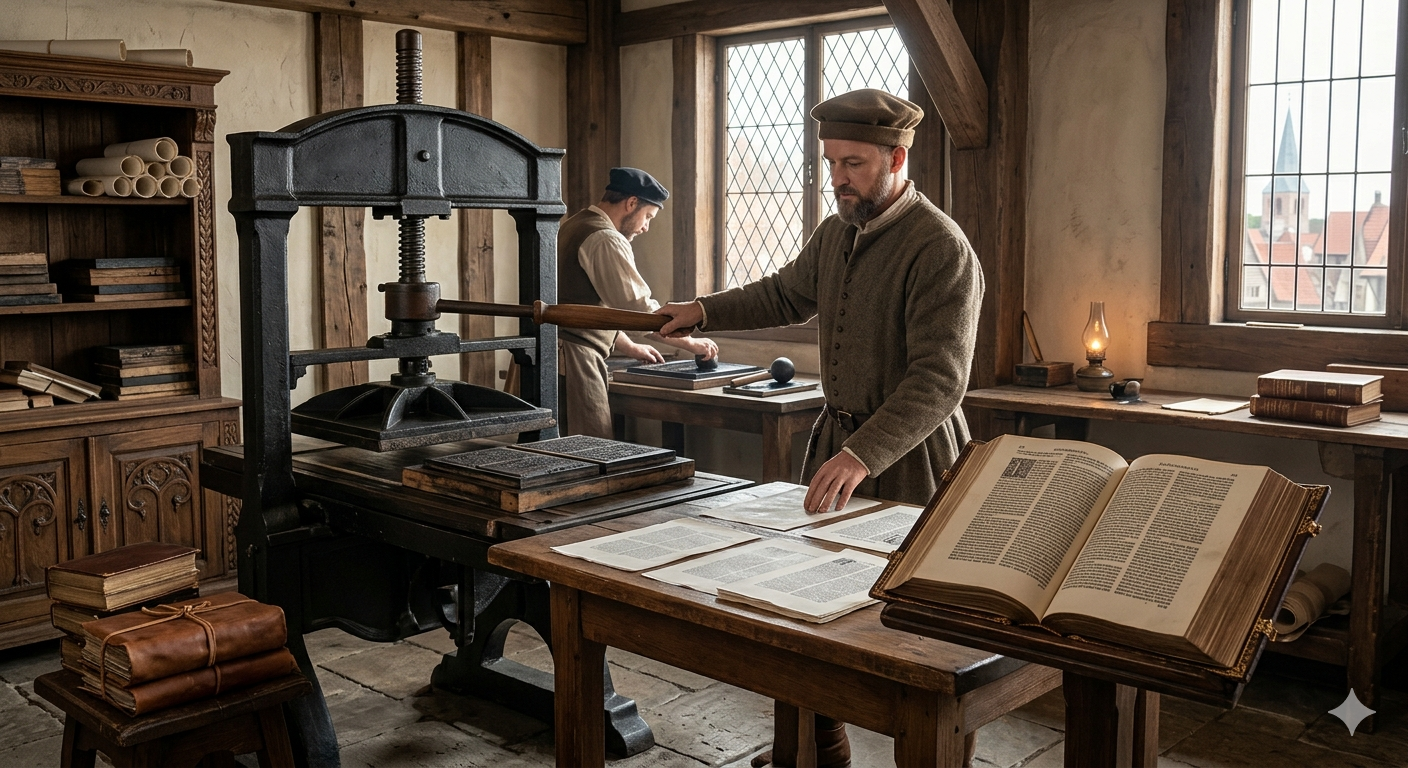
On October 4, 1535, the printing of the first complete English Bible was finished. The man responsible was Miles Coverdale, a Yorkshire-born priest and scholar who had fled England to escape persecution for his Protestant beliefs. The book he produced in continental Europe, known to history as the Coverdale Bible, contained both the Old Testament and the New Testament in English for the first time in print, a complete and readable Bible that any literate English speaker could hold in their hands and read for themselves. It was dedicated to King Henry VIII of England and carried a gracious, carefully worded preface designed to win royal approval for a work that, just years earlier, would have been considered heresy.
The printing of the complete English Bible in 1535 was not merely a religious event. It was a cultural, political, and literary revolution. For centuries, the Bible in Western Europe had existed almost exclusively in Latin, the language of the Catholic Church, accessible only to clergy and scholars. Ordinary people heard Scripture read to them by priests in a language most did not understand. The idea of translating the Bible into the common tongue had been suppressed by the Church for generations, and those who had attempted it had faced imprisonment, exile, and death. That this first complete printed English Bible existed at all was the result of decades of courageous and dangerous work by a small group of scholars, most of them exiles, who believed that every person had the right to read the Word of God in their own language.
Who Was Miles Coverdale and What Were His Qualifications for This Task?
Miles Coverdale was born in 1488 in the village of Coverdale in the North Riding of Yorkshire. He was educated at Cambridge University, where he studied under Robert Barnes, a prior of the Augustinian Friary who would later become one of the most prominent Protestant reformers in England. Coverdale was ordained as a priest in 1514 at Norwich and became a member of the Augustinian order. His exposure to the new ideas of the Protestant Reformation, flowing into England from the continent during the 1520s, transformed his religious outlook and eventually placed him in serious danger.
In 1526, Coverdale assisted in the defense of Robert Barnes when Barnes was tried for heresy at a public disputation in London. Barnes recanted to avoid burning but later returned to Protestant advocacy and was eventually burned at the stake in 1540. Seeing the fate of his mentor and fearing his own arrest, Coverdale fled England and went to the continent, settling eventually in Antwerp in the Spanish Netherlands, which was the center of Protestant publishing in northern Europe and the city from which William Tyndale was operating his own translation project.
Coverdale’s qualifications for Bible translation were significant but notably different from those of Tyndale. Where Tyndale was a brilliant linguist, fluent in Hebrew, Greek, Latin, German, Italian, Spanish, French, and English, Coverdale was primarily a skilled writer and editor whose strengths lay in his command of the English language and his ability to render complex theological ideas in clear, accessible prose. He was not proficient in Hebrew or Greek and made no pretense of working from the original languages. Instead, as he acknowledged openly in his preface, he drew on five sources: two Latin translations, one German translation, and the existing English work of Tyndale himself. What he brought to the task was an ear for English prose of extraordinary quality, and the literary beauty of his translations endured in English religious life for centuries.
William Tyndale: The Martyr Whose Work Made the Coverdale Bible Possible
No account of the first complete printed English Bible can begin with Coverdale without first understanding the larger story of William Tyndale, the scholar whose dangerous years of work provided the foundation on which Coverdale built.
William Tyndale was born around 1494 in Gloucestershire, England. He studied at both Oxford and Cambridge, becoming one of the most gifted linguists of his generation, fluent in eight languages. He was converted to the reformist theology coming from Martin Luther’s Germany and conceived the ambition of translating the entire Bible into English from the original Hebrew and Greek texts. When he approached Cuthbert Tunstall, the Bishop of London, for permission and patronage to undertake the translation in England, Tunstall refused. Tyndale resolved to do the work in exile.
He traveled to Germany in 1524, met Martin Luther in Wittenberg, and began his translation of the New Testament in Hamburg. The printing was done in Cologne and Worms beginning in 1525. Copies of the Tyndale New Testament were smuggled into England hidden in bales of cloth, tucked inside barrels of wheat, and concealed in other merchandise. The Church authorities in England, led by Tunstall and Thomas More, Lord Chancellor of England, bought up copies specifically to burn them. Tyndale’s associate Miles remarked with dark wit that the bishops’ purchases had helped finance further printings.
Tyndale continued his work in Antwerp through the late 1520s and early 1530s, publishing the Pentateuch in 1530, Jonah in 1531, and a revised New Testament in 1534. He had translated portions of the historical books of the Old Testament as well, though these were not published in his lifetime. Henry Phillips, a young Englishman who had squandered his family’s money and was working as an informant for Catholic authorities, befriended Tyndale in Antwerp, gained his trust, and on the morning of May 21, 1535, arranged for Tyndale’s arrest outside the English House where he had been living. Tyndale was taken to Vilvoorde Castle near Brussels, imprisoned, tried for heresy, and on October 6, 1536, was strangled and then burned at the stake. His last words, witnessed by those present, were a prayer: “Lord, open the King of England’s eyes.”
The Wikipedia article on William Tyndale covers his scholarly background, his translation methods drawing from Greek and Hebrew originals, the smuggling of his New Testaments into England, his arrest and execution, and the lasting influence of his linguistic innovations on subsequent English Bible translations and the English language itself.
How Coverdale Completed the Bible: Sources, Method, and the Patronage of Cromwell
By the time Tyndale was arrested in May 1535, Coverdale had already been working for some time on completing the portions of the Bible that Tyndale had not yet translated. Coverdale had settled in Antwerp, where he had met and worked with Tyndale and was familiar with his translation methods and his texts. He had the backing and financial support of Jacob van Meteren, an Antwerp merchant and patron of Protestant scholarship, and the political encouragement of Thomas Cromwell, Henry VIII’s chief minister, who was eager to see an English Bible produced and who understood the political value of such a publication for the King’s break with Rome.
Coverdale’s method was openly acknowledged in his preface. He drew on Tyndale’s already translated books: the New Testament in the revised 1534 edition, the Pentateuch, and Jonah. For the books of the Old Testament that Tyndale had not published, Coverdale worked primarily from two German sources: Martin Luther’s German Bible, which had been published between 1522 and 1534, and the Zurich Bible of 1524 to 1529, a Swiss-German translation associated with the reformer Ulrich Zwingli. He also used two Latin versions: the Latin Vulgate, the Catholic Church’s official Latin Bible, and a more recent Latin translation of the Old Testament by Sante Pagninus, published in 1528. He drew on all five of these sources simultaneously, comparing their renderings and choosing the phrasing that seemed most clear and natural in English.
The result of this comparative approach was a Bible that was not a direct translation from the original languages but was a learned synthesis of the best available scholarly work, filtered through Coverdale’s remarkable English prose style. His skill as a writer produced phrases that embedded themselves permanently in the English religious vocabulary. “The valley of the shadow of death” from Psalm 23 is Coverdale’s phrase, introduced in this 1535 Bible and preserved in the King James Version of 1611. “Loving-kindness” is another Coverdale coinage, his rendering of the Hebrew concept of hesed, that entered the English language through his translation.
October 4, 1535: The Completion of Printing and the Dedication to Henry VIII
The printing of the Coverdale Bible was completed on October 4, 1535. The place of printing has been the subject of scholarly debate for centuries, with the most convincing evidence now pointing to Antwerp rather than the earlier widely accepted claim of Zurich. The printer was almost certainly Marten de Keyser, one of the most important Protestant printers in Antwerp, working with the financial support of Jacob van Meteren. The printing was completed while Tyndale, who had provided much of its raw material, was imprisoned at Vilvoorde Castle less than thirty miles away.
The Bible was dedicated to Henry VIII in terms of considerable political shrewdness. Coverdale knew that royal approval was essential for any English Bible to circulate freely in England, and he crafted his dedication carefully to present the translation as a work of loyal service to the King rather than a challenge to royal religious authority. He emphasized that his Bible excluded the controversial marginal notes that Tyndale had included in his New Testament, notes that drew attention to discrepancies between Scripture and Catholic teaching and that the authorities had found particularly objectionable. By presenting the Bible as a clean text without inflammatory commentary, Coverdale made it much harder for Henry to object to the work.
Henry VIII’s willingness to tolerate the Coverdale Bible in 1535 rested on the specific religious and political situation of that year. Henry had broken definitively with the Pope in Rome in 1534, establishing himself as the Supreme Head of the Church of England through the Act of Supremacy. Having rejected papal authority, Henry was in a politically awkward position regarding a Bible that his own Archbishop of Canterbury, Thomas Cranmer, had been arguing should be made available in English. The Canterbury Convocation had actually petitioned Henry in 1534 to authorize an English Bible translation. Coverdale’s dedication arrived at exactly the right moment to take advantage of this shift in the political climate.
The Britannica account of the Coverdale Bible and the history of English Bible translation places the 1535 printing in its full context of Reformation-era Bible translation, explaining Coverdale’s relationship to Tyndale’s work and the political environment that made the first complete English Bible possible.
What the Coverdale Bible Contained and Why Its Arrangement Was Revolutionary
The Coverdale Bible was physically imposing, printed in folio format with woodcut illustrations decorating its pages. Its title page displayed an elaborate woodcut showing Moses and Aaron presenting the Ten Commandments, with King Henry VIII enthroned below distributing the Word of God to his bishops and nobles. The image was carefully designed to reinforce the political message: the King as the proper authority for Christian worship in England, replacing the Pope.
The Bible was divided into six sections that established the organizational pattern all subsequent Protestant English Bibles would follow. The five books of Moses, the Pentateuch, came first. The historical books from Joshua through Esther followed. The poetic and wisdom books from Job through the Song of Solomon, which Coverdale called “Solomon’s Balettes,” came third. The Prophets occupied the fourth section. The fifth section, crucially, gathered all the Apocryphal books together into a separate appendix, labeled “Apocrypha, the books and treatises which among the fathers of old are not reckoned to be of like authority with the other books of the Bible, neither are they found in the canon of the Hebrew.” This treatment of the Apocrypha, following Luther’s example, established the Protestant practice of separating these books from the canonical text rather than including them throughout, a distinction from the Catholic tradition that remains to the present day. The New Testament concluded the volume.
The Psalter of the Coverdale Bible had an extraordinarily long afterlife in English religious practice. Coverdale’s translation of the Psalms, which remained his most celebrated prose achievement, was incorporated into the Anglican Book of Common Prayer from 1662 onward and has been retained in virtually unchanged form in subsequent Prayer Book revisions in England, Ireland, the United States, and Canada. English speakers who have attended Anglican or Episcopalian services have been hearing Coverdale’s prose in the Psalms for more than four and a half centuries.
The Succession of English Bibles That Followed: Matthew, the Great Bible, and Beyond
The Coverdale Bible of 1535, though enormously important as the first complete printed English Bible, was only the beginning of a rapid succession of English Bible translations in the following decades. In 1537, John Rogers, a friend of Tyndale who had managed to obtain Tyndale’s unpublished Old Testament manuscripts before his execution, published a Bible under the pseudonym “Thomas Matthew,” combining Tyndale’s original translations with Coverdale’s work for the sections Tyndale had not completed. This Matthew Bible represented a fuller expression of Tyndale’s original vision and was the first English Bible actually printed in England, published by Richard Grafton and Edward Whitchurch in London.
Henry VIII’s principal adviser Thomas Cromwell then commissioned Coverdale himself to revise and expand the Matthew Bible into a large-format edition suitable for placing in churches. This Great Bible, so called because of its considerable physical size, was published in 1539. Henry VIII ordered a copy to be placed in every parish church in England, making it the first Bible officially authorized by the Crown for public reading. Its preface was written by Thomas Cranmer, the Archbishop of Canterbury, which is why later versions were sometimes called Cranmer’s Bible.
The Geneva Bible of 1560, produced by English Protestant scholars who had fled to Geneva during the reign of Catholic Queen Mary, was the Bible that became most popular with English Protestants of the late sixteenth century, including the Puritans who would later settle in New England. The Geneva Bible was the translation Shakespeare read, the translation used by John Bunyan, and the Bible brought to America on the Mayflower. The King James Bible of 1611, commissioned by King James I of England and produced by a committee of forty-seven scholars working in six companies over seven years, drew heavily on Tyndale’s original work, and scholars have estimated that approximately eighty-three percent of the King James New Testament preserves Tyndale’s original phrasing.
The History.com account of the Tyndale Bible and the history of the English Bible traces the direct line of influence from Tyndale’s first complete New Testament through Coverdale’s complete Bible to the King James Version, showing how each subsequent translation built on the work of its predecessors.
The Legacy of October 4, 1535: What the First Complete English Bible Meant for History
The completion of the first printed English Bible on October 4, 1535, transformed the relationship between ordinary English people and the Christian faith. Within a generation, English men and women could own, read, and discuss the entire Bible in their own language. The consequences were immense.
The availability of the Bible in English was one of the central engines of the English Reformation, enabling ordinary people to compare what they read in Scripture with what they heard from their priests and what the Church taught. It contributed to the Puritan movement that would reshape English politics in the seventeenth century, produce the English Civil War, and eventually give rise to the constitutional democracy that England became. It shaped the English language itself, contributing hundreds of phrases and idioms that remain current to this day.
The Wikipedia article on the Coverdale Bible covers the full publication history of the 1535 text, its relationship to Tyndale’s translations, the development of the Coverdale Psalter that remained in Anglican worship for centuries, and the subsequent editions and revisions of Coverdale’s work through the Great Bible of 1539.
William Tyndale, strangled and burned at the stake a year after the Bible he had helped to create was printed, had prayed with his last breath that the King of England’s eyes would be opened. Within months of his death, Henry VIII licensed the Matthew Bible and ordered the Great Bible placed in every English church. The prayer had been answered in ways Tyndale could not have imagined on the morning he was arrested. And the complete Bible in English, completed by his friend and colleague Miles Coverdale on October 4, 1535, became the foundation on which every subsequent English translation was built.