
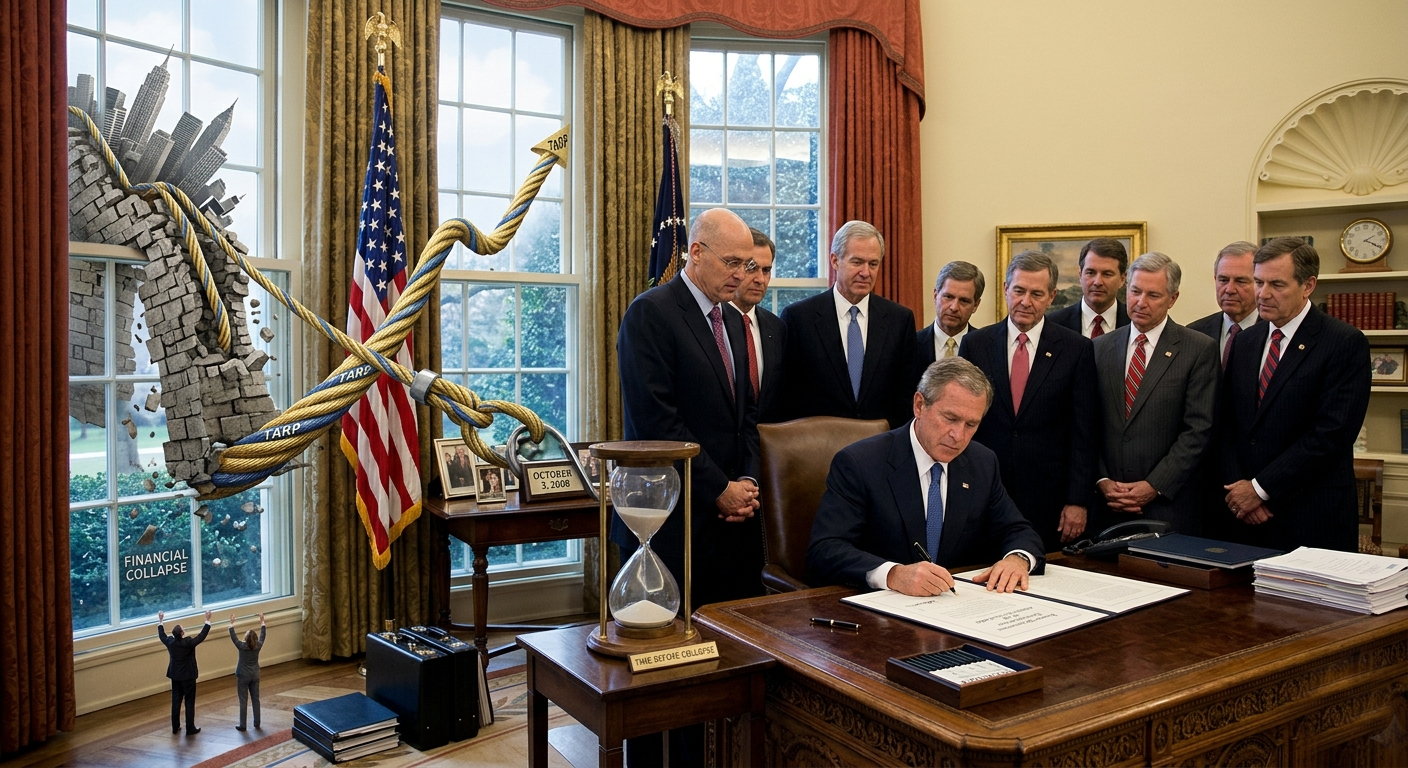
On the morning of October 3, 2008, President George W. Bush signed the Emergency Economic Stabilization Act of 2008 into law at the White House. The signing, conducted quickly and without ceremony given the gravity and urgency of the moment, authorized the United States Treasury to spend up to $700 billion to stabilize the American financial system. It created the Troubled Asset Relief Program, known universally as TARP, the largest government intervention in the American economy since the New Deal programs of the 1930s. The nation was, as the Treasury Department later described it, “on the edge of falling into a second Great Depression.”
The bill Bush signed that Friday morning had not been easily obtained. It had been proposed only fifteen days earlier, had initially failed a dramatic House vote that sent markets into freefall, had been revised and passed through the Senate before coming back to the House, and had ultimately passed over the objections of members of both parties who considered it a taxpayer-funded bailout of the Wall Street institutions whose recklessness had created the crisis in the first place. Whether it was a rescue or a bailout depended largely on who was paying the bill and who was receiving the benefit, and the answer to that question shaped American political debate for years afterward.
What Was the 2008 Financial Crisis That Made TARP Necessary?
The financial crisis that TARP was designed to address had been building for years before it exploded in the autumn of 2008. Its roots lay in the housing market and the financial instruments that Wall Street had constructed from it during the early years of the twenty-first century.
Through the late 1990s and early 2000s, extraordinarily low interest rates following the dot-com collapse and the September 11 attacks had pushed capital into the housing market, driving home prices to historic highs. Lenders, competing for market share and operating under the assumption that home prices would never fall, had progressively relaxed their credit standards and extended mortgages to borrowers who had little realistic prospect of repaying them in any scenario except continued price appreciation. These were the subprime mortgages whose eventual failure would trigger the crisis.
Wall Street firms had purchased these mortgages from the lenders who originated them, bundled them into complex securities called mortgage-backed securities and collateralized debt obligations, and sold them to investors around the world. Rating agencies, including Moody’s, Standard and Poor’s, and Fitch Ratings, had given many of these instruments their highest investment-grade ratings despite the dubious quality of the underlying loans. Insurance giant American International Group, AIG, had sold enormous quantities of credit default swaps, effectively insurance against mortgage security defaults, without maintaining any capital reserves to cover potential payouts. The system had become an edifice of interconnected financial bets in which nearly every major institution was exposed to every other major institution, and in which the failure of any one of them threatened to pull all the others down.
The first serious crack appeared in August 2007, when the markets for asset-backed securities suddenly froze. The Federal Reserve, under Chairman Ben Bernanke, took emergency measures to provide liquidity, and markets temporarily stabilized. But the underlying losses continued to accumulate throughout 2007 and into 2008. Countrywide Financial, the nation’s largest mortgage lender, was acquired by Bank of America in a distress sale. Bear Stearns, the investment bank whose hedge funds had been among the first major casualties of the mortgage collapse, was rescued in March 2008 in a deal brokered by the Federal Reserve, in which JPMorgan Chase acquired Bear Stearns at effectively zero, with the Federal Reserve guaranteeing approximately $29 billion in Bear Stearns’s toxic assets.
The Cascade of September 2008: Lehman, AIG, and the System at the Brink
The defining catastrophe of the crisis arrived in September 2008. On September 7, the federal government seized Fannie Mae and Freddie Mac, the two government-sponsored enterprises that together owned or guaranteed approximately half of the outstanding mortgage debt in the United States. The two institutions had been rendered insolvent by their exposure to the declining mortgage market. Their seizure put taxpayers on the hook for their combined liabilities but prevented the immediate collapse of the mortgage finance market.
One week later, on September 15, 2008, the investment bank Lehman Brothers filed for bankruptcy, the largest bankruptcy filing in American history. The Bush administration and the Federal Reserve had decided not to rescue Lehman as they had rescued Bear Stearns, believing that the markets had had six months to prepare for the possibility of Lehman’s failure. This calculation proved catastrophically wrong. Lehman’s bankruptcy triggered immediate panic across global financial markets. Money market funds, which millions of Americans considered as safe as bank accounts, began experiencing runs as one fund “broke the buck,” meaning its value fell below $1 per share, for the first time since 1994. The commercial paper market, through which companies borrowed short-term funds to meet payroll and operational costs, froze almost entirely. The credit markets that kept the ordinary economy functioning had effectively stopped working.
On the same day as Lehman’s bankruptcy filing, the Federal Reserve authorized an emergency $85 billion loan to AIG, the insurance giant, to prevent its immediate collapse. AIG had written $441 billion worth of credit default swaps on mortgage-related securities and had no means to pay them. Its failure would have instantaneously bankrupted dozens of major financial institutions worldwide who had purchased its insurance against mortgage losses. AIG was effectively nationalized in the rescue, with the government taking approximately 79.9 percent of its equity.
Treasury Secretary Henry Paulson, a former chairman of Goldman Sachs who had been serving in the Bush administration since 2006, watched these events unfold with a mixture of urgency and dread. He had been working since the beginning of the year on contingency plans for various scenarios of financial deterioration. By mid-September 2008, the contingencies had run out. The system was failing in real time.
Henry Paulson, Ben Bernanke, and the Proposal for $700 Billion
On September 18, 2008, Paulson and Federal Reserve Chairman Ben Bernanke attended an emergency meeting at the Capitol with congressional leaders from both parties. The meeting has been described by participants as one of the most alarming gatherings in modern American political history. Bernanke, an academic economist who had spent his career studying the Great Depression, told the assembled legislators flatly that if Congress did not act within days to authorize a massive government intervention, the United States would be in the most severe financial collapse since the 1930s by the following week.
Senator Christopher Dodd of Connecticut, the Democratic chairman of the Senate Banking Committee, later recalled: “When you listened to him describe it, you gulped.” Senator Harry Reid of Nevada, the Democratic Majority Leader, said that after the meeting “we had no idea what to do.” Republican Senator Mitch McConnell of Kentucky was equally alarmed. The bipartisan shock of that meeting was the political foundation on which the TARP legislation was subsequently built.
Paulson, working through the weekend of September 20 and 21, produced a three-page legislative proposal that was stark in its simplicity and its demands. It asked Congress to authorize the Treasury Secretary to spend up to $700 billion to purchase troubled assets from financial institutions. It contained almost no oversight provisions. It included a provision stating that the Secretary’s decisions could not be reviewed by any court or any government agency. It was, as critics immediately pointed out, a request for essentially unlimited financial power with no accountability.
The original Paulson proposal was submitted to Congress on September 20. The reaction from members of both parties was immediately hostile. Representative Barney Frank of Massachusetts, the Democratic chairman of the House Financial Services Committee, and Senator Dodd began negotiations with Paulson to add oversight provisions, executive compensation restrictions, and protections for taxpayers. The negotiations were intense and the timeline was impossibly compressed.
The Wikipedia article on the Emergency Economic Stabilization Act of 2008 provides the complete legislative history of the TARP bill, including the original three-page Paulson proposal, the negotiations over oversight provisions, and the full vote tallies in both chambers.
The First House Vote: September 29 and the Largest Stock Market Drop in History
The revised TARP bill came to the House floor for a vote on September 29, 2008. Speaker Nancy Pelosi and Republican House Minority Leader John Boehner had worked to secure the votes needed for passage, and the leadership of both parties publicly supported the bill. The vote was expected to pass.
It failed. The final vote was 228 against to 205 in favor, with both parties splitting substantially. Sixty percent of Democrats voted yes and 33 percent of Republicans voted yes. A majority of House Republicans voted against a bill proposed by a Republican administration, citing constituent anger at what they characterized as a bailout of Wall Street at the expense of Main Street. The rejection was stunning.
The stock market’s response was immediate and devastating. The Dow Jones Industrial Average fell 777.68 points on September 29, 2008, the largest single-day point decline in the Dow’s history to that point. Nearly $1.2 trillion in market value was wiped out in a single session. The markets were telling Congress with brutal clarity what they thought of the legislative failure.
The collapse in stock prices generated intense pressure on the legislators who had voted against the bill to reconsider. Constituent calls, which had been running heavily against the bill before the vote, began to shift as voters watched their retirement accounts and investment portfolios lose value in real time. The financial data continued to be alarming: credit markets remained frozen, and the practical consequences for ordinary businesses trying to make payroll or secure routine financing were becoming acute.
The Senate Revision and Final Passage on October 3, 2008
The Senate took up the revised bill on October 1, adding several provisions to improve its political palatability. The revised bill included a temporary increase in FDIC insurance coverage for bank deposits from $100,000 to $250,000, which addressed the real concern of ordinary depositors that their savings were at risk. It included provisions extending certain tax credits. And it maintained the oversight structures that Dodd and Frank had insisted upon, including the Financial Stability Oversight Board and the Congressional Oversight Panel.
The Senate passed the revised bill on October 1 by a vote of 74 to 25, with strong bipartisan support. The House then took up the Senate-passed version. The same legislators who had voted against the original bill two days earlier now faced a market already in severe decline and a revised version that included additional taxpayer protections. The revised bill passed the House 263 to 171, a reversal significant enough to send it to the president.
Bush signed the Emergency Economic Stabilization Act of 2008 on the afternoon of October 3, 2008, creating the $700 billion TARP program. Treasury Secretary Paulson was authorized to begin spending immediately. Within two weeks, Paulson had decided that the most effective immediate deployment of the first tranche of funds would be direct capital injections into the major banks rather than the troubled asset purchases the program had originally been designed around. On October 14, nine of the largest American banks, including Citigroup, JPMorgan Chase, Bank of America, Goldman Sachs, Morgan Stanley, Wells Fargo, Merrill Lynch, Bank of New York Mellon, and State Street, received a total of $125 billion in capital injections in exchange for preferred stock, whether they wanted the capital or not.
The History.com article on the Troubled Asset Relief Program covers the creation of TARP under the Emergency Economic Stabilization Act, the deployment of funds across the banking system, the auto industry bailout, and the program’s eventual repayment by most major recipients.
What TARP Funded: Banks, Auto Companies, and the Mortgage Market
The $700 billion authorized by the Emergency Economic Stabilization Act was not all deployed in the same way. Paulson’s initial capital injections into the major banks, known as the Capital Purchase Program, put $204.9 billion into hundreds of banks of various sizes. The logic was that injecting capital directly into banks would restore their ability to lend, which would in turn restore the flow of credit to the broader economy.
TARP funds also went to the automobile industry. General Motors and Chrysler, both facing imminent bankruptcy as the recession devastated auto sales and the credit crisis blocked their access to routine financing, received TARP funding in December 2008 under Bush and then received additional support under the incoming Obama administration. GM ultimately received approximately $49.5 billion in total TARP funding. Chrysler received approximately $12.5 billion. The auto industry bailout was bitterly controversial, attacked by free-market conservatives as a precedent-shattering government intervention in private markets, but both companies survived, restructured under bankruptcy protection in 2009, and eventually repaid most of their government assistance.
AIG, which had received the initial $85 billion Federal Reserve loan, ultimately received a total of approximately $182 billion from TARP and other government programs, the largest single company rescue in American history. The political toxicity of the AIG bailout intensified in March 2009 when it became known that AIG had paid $165 million in contractually obligated bonuses to employees of the financial products division that had written the credit default swaps at the center of the crisis. The bonuses triggered a firestorm of public outrage and congressional hearings.
The homeowner component of TARP, the Making Home Affordable Program, attempted to address the foreclosure crisis that had been the underlying cause of the financial collapse. The program fell far short of its original targets, modifying approximately 1.7 million mortgages rather than the 3 to 4 million originally projected, and critics argued that the government’s response to the crisis was far more effective at rescuing financial institutions than at helping ordinary homeowners who had lost their homes.
Did TARP Work and What Did It Cost Taxpayers?
The question of whether TARP worked is one of the most contested in modern economic policy. The basic case for the program’s success rests on two facts: the financial system did not collapse in 2008 and 2009 in the manner that Bernanke and Paulson had feared, and most of the TARP funds were repaid.
As of December 2014, the Treasury Department reported that TARP had received back approximately $441.7 billion of the $426.4 billion actually disbursed under the program, meaning that TARP had actually generated a modest net gain for taxpayers when interest and dividend payments were included. The banking component was particularly successful in generating returns: the banks that received capital injections paid back their TARP funds with interest, and the government’s preferred stock positions generated additional returns. The auto industry repayments were less complete, with the government ultimately taking a loss on its General Motors investment when it sold its equity stake below what it had paid.
The more fundamental criticism of TARP was not financial but distributional. The program was extraordinarily effective at preventing the collapse of large financial institutions but far less effective at alleviating the recession’s impact on ordinary Americans. Unemployment continued to rise after TARP was signed, reaching 10 percent in October 2009. Millions of families lost their homes to foreclosure despite the mortgage modification programs that TARP funded. The executives at the institutions TARP rescued received large compensation packages at the same time that millions of their fellow citizens were losing jobs and savings.
The Britannica article on the Emergency Economic Stabilization Act of 2008 covers the full scope of the EESA’s provisions, the deployment of TARP funds across different program categories, and the long-term assessment of the legislation’s effectiveness in preventing a complete financial collapse.
The Political Legacy of TARP and the Rise of the Tea Party
TARP’s political consequences were as significant as its economic ones. The anger that many Americans felt at seeing the government use public money to rescue the institutions whose irresponsibility had created the crisis generated a political energy that found its expression in the Tea Party movement of 2009 and 2010. The sense that the government had protected Wall Street while leaving Main Street to struggle was a powerful populist grievance that shaped American politics for the remainder of the Obama administration and beyond.
TARP also contributed to a broader reassessment of financial regulation. The Dodd-Frank Wall Street Reform and Consumer Protection Act, signed by President Obama in July 2010, was the most comprehensive revision of American financial regulation since the Great Depression. It created the Consumer Financial Protection Bureau, established a framework for handling the failure of large financial institutions without triggering systemic collapse, increased capital requirements for banks, and imposed new restrictions on the risky trading practices that had contributed to the crisis. The act was named for Barney Frank and Christopher Dodd, the same legislators who had negotiated the oversight provisions of the original TARP legislation.
The Federal Reserve’s historical account of the 2008 financial crisis and TARP explains the mechanisms by which the financial crisis spread through the banking system, the role of Paulson and Bernanke in designing the government’s response, and the specific programs through which TARP funds were deployed to stabilize credit markets and prevent institutional failure.
When President Bush signed the Emergency Economic Stabilization Act on October 3, 2008, he was making a decision that violated virtually every instinct of the free-market conservative tradition his party represented. He did it because the alternative, as his Treasury Secretary and the Chairman of the Federal Reserve had told the leaders of Congress on September 18, was a financial catastrophe that could not be reversed once it began. The debate about whether TARP was the right tool, whether it was fairly administered, and whether its benefits reached the right people will continue as long as Americans think seriously about the relationship between government, finance, and democracy. What is not seriously debated is that the financial system did not collapse in 2008, and that the Emergency Economic Stabilization Act was among the central reasons why.