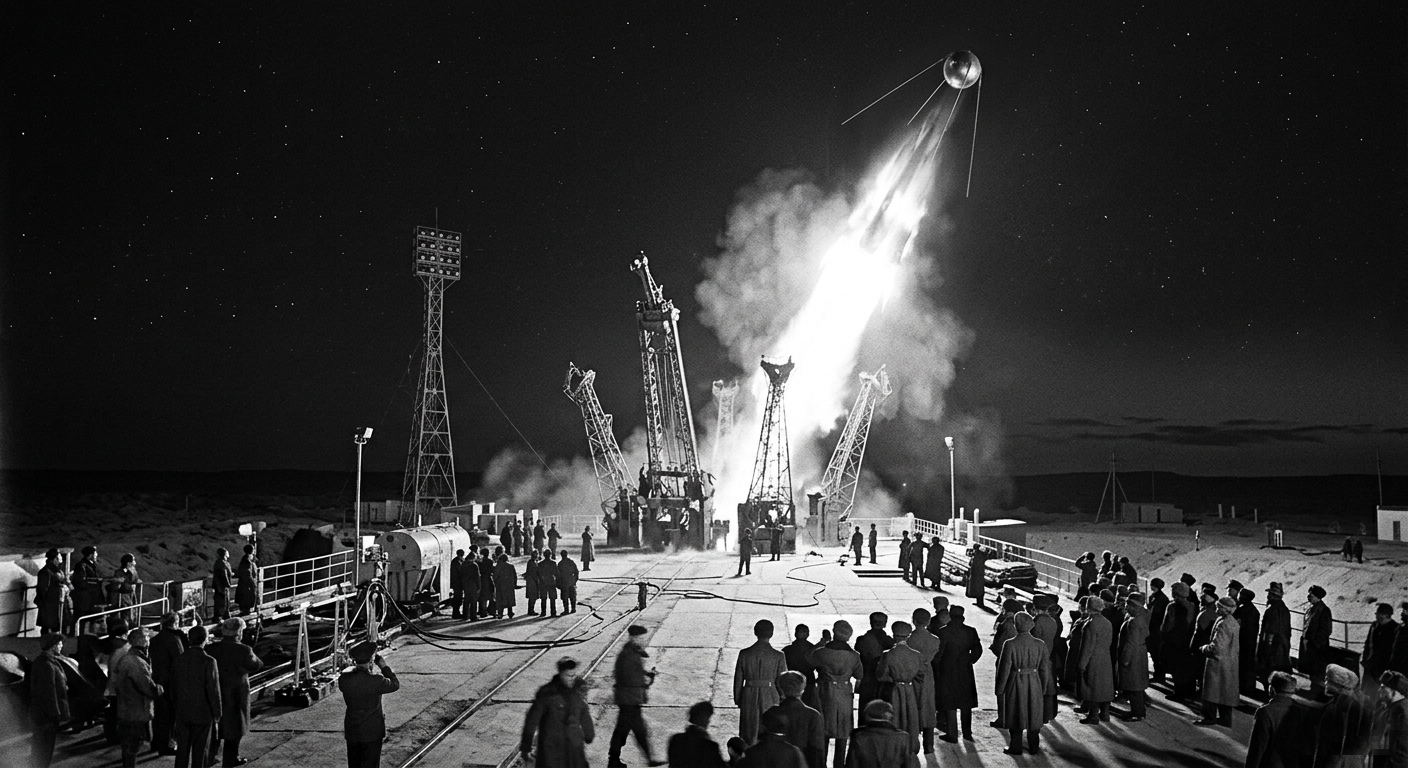
At 10:29 p.m. Moscow time on October 4, 1957, a Soviet R-7 rocket roared off its launchpad at the Tyuratam launch site in the Kazakh Republic and began accelerating toward orbit. Strapped to its nose was a polished metal sphere roughly the size of a beach ball, 58 centimeters in diameter, weighing 83.6 kilograms, fitted with four trailing radio antennas and two small radio transmitters. Within minutes, the object separated from the rocket’s upper stage and became the first human-made object to orbit the Earth. The Soviet state news agency TASS announced the achievement hours later. The satellite was called Sputnik 1, from the Russian word “sputnik” meaning “fellow traveler” or “travel companion.”
The beeping signal that Sputnik transmitted, a simple rhythmic pulse at 20.005 and 40.002 megahertz, could be picked up by amateur radio operators around the world. Within hours of the announcement, people across the globe were pointing their antennas at the sky and listening. The sound that came back was simple and strange and entirely new: proof that something built by human hands was circling the planet above them. The world had entered the Space Age, and it had entered it under a Soviet flag. The political, military, scientific, and cultural consequences would define the decade that followed.
The Cold War Context That Made Sputnik Inevitable
Sputnik 1 did not arrive without warning. It was the product of a specific Cold War competition and a specific moment in the development of both Soviet and American rocketry, and both superpowers had publicly announced their intentions to launch artificial satellites before either had accomplished it.
The context was the International Geophysical Year, a multinational scientific collaboration declared by the International Council of Scientific Unions to run from July 1, 1957, through December 31, 1958. The IGY was organized around the study of Earth’s environment and upper atmosphere during a period of high solar activity, and the council had specifically called for the launch of artificial satellites to map the Earth’s surface during this period. In July 1955, President Dwight D. Eisenhower announced through his press secretary that the United States would launch an artificial satellite during the IGY. Four days later, Soviet physicist Leonid Sedov announced that the Soviet Union would do the same.
The competition this created was not merely scientific but profoundly ideological. Both superpowers understood that whoever launched the first satellite would claim a propaganda victory of incalculable value, demonstrating to the world that their system of government, their economic model, and their scientific culture produced superior technological results. The Soviet Union, which the United States had consistently characterized as a technologically backward society, had everything to gain by being first. The United States, which had assumed its own technological superiority as a given, had everything to lose if it was not.
Sergei Korolev: The Secret Genius Behind the Soviet Space Program
The man who designed Sputnik and directed its launch was one of the most consequential scientists of the twentieth century, and almost no one outside the Soviet Union knew his name. Sergei Pavlovich Korolev was born on January 12, 1907, in Zhitomir, in what is now Ukraine. He was fascinated by flight from childhood and had been building gliders and conducting rocket experiments since the 1930s.
Stalin’s paranoia had interrupted Korolev’s career with brutal force. In 1938, he was arrested on false charges during the Great Terror, sentenced to death, and then the sentence was commuted to eight years in a Siberian labor camp. He survived by a combination of physical resilience, political luck, and the peculiar Soviet habit of continuing to exploit talented engineers even while imprisoning them. He worked in a sharashka, a prison design bureau, under aircraft designer Andrei Tupolev. He was released in 1944 and rehabilitated.
By the late 1940s, Korolev was the chief designer of OKB-1, the Soviet rocket design bureau, and was directing the development of the R-7 ballistic missile, the world’s first intercontinental ballistic missile capable of delivering a nuclear warhead to American territory. Korolev’s identity was classified as a state secret for the entirety of his active career. In official communications, he was referred to only as “the Chief Designer.” His name was not revealed to the outside world until after his death from colon cancer on January 14, 1966.
It was Korolev who recognized that the R-7 rocket, whose testing was nearing completion in 1957, was also capable of placing a satellite into Earth orbit. He had been lobbying Soviet leadership since the early 1950s for permission to attempt this, and when the IGY provided the political context for doing so, he moved with the speed and decisiveness that characterized his greatest achievements.
The original Soviet satellite plan had been ambitious to the point of delay. The intended first satellite, designated Object D, was planned to be a sophisticated scientific instrument weighing between 1,000 and 1,400 kilograms and carrying 200 to 300 kilograms of scientific equipment. By early 1957, it was clear that Object D would not be ready before the end of the year, and American satellite development had reached a point where Korolev feared the United States might launch first. He proposed a much simpler satellite instead.
The Wikipedia article on Sputnik 1 provides the detailed technical and historical account of the satellite’s design, the development of the R-7 rocket, Korolev’s role in planning the mission, and the precise orbital parameters that the satellite achieved after launch.
Object PS: The Simple Satellite That Changed History
In February 1957, the Council of Ministers of the USSR approved Korolev’s proposal for a much simpler satellite, designated Object PS, where PS stood for “prosteishiy sputnik” or “elementary satellite.” The new design was the essence of engineering minimalism: a highly polished aluminum sphere with a diameter of 58 centimeters, weighing 83.6 kilograms, fitted with four trailing radio antennas. Inside were two radio transmitters, silver-zinc batteries to power them, a thermal control system, and pressure sensors to detect any micrometeorite impacts. There were no scientific instruments beyond the radio transmitters and basic environmental sensors. The entire purpose was simple: to orbit Earth, to announce itself to the world with its beeping signal, and to prove that it was possible.
The R-7 rocket that launched Sputnik had experienced several catastrophic failures during its development in the early months of 1957, but a final successful test flight in August 1957 cleared the way for the satellite launch. The R-7 that carried Sputnik was designated the 8K71PS, and its large core stage, 26 meters long and weighing 7.5 tonnes, also reached Earth orbit. Because the core stage was highly reflective and far larger than the satellite itself, most observers who tracked the satellite visually were actually watching the rocket stage trailing in the satellite’s wake rather than the much smaller sphere.
Sputnik’s orbit was elliptical, with an apogee of approximately 940 kilometers and a perigee of approximately 230 kilometers. It completed each orbit in approximately 96 to 98 minutes. From the ground, it appeared as a moving point of light in the night sky, visible with binoculars or even, at favorable times, briefly to the naked eye. The satellite’s radio signal, the characteristic “beep-beep” that operators worldwide were already monitoring, was strong enough to be received by amateur radio equipment. The signal also provided genuine scientific data about the density of the upper atmosphere, allowing scientists to measure the rate at which atmospheric drag was affecting the orbit.
How the World Reacted: Shock, Fear, and Fascination
The Soviet Union announced Sputnik’s launch officially on October 5, with a brief statement from TASS on October 4, and the international reaction was immediate and multidimensional. Soviet citizens were encouraged by state media to go outside at night and watch for Sputnik passing overhead, and to tune in to its signal on their radios. The achievement was presented as proof of the superiority of Soviet science and the Soviet system over Western capitalism. General Secretary Nikita Khrushchev, who had initially expressed relatively little excitement about the satellite until he understood its propaganda value, quickly embraced it as a triumph and pressed Korolev to prepare another launch as soon as possible, ideally to coincide with the fortieth anniversary of the October Revolution on November 7, 1957.
In the United States, the public reaction was a mixture of shock, awe, and alarm. The shock arose from the gap between what Americans had been told and what had happened. Official government and media messaging had consistently characterized the Soviet Union as a technologically backward society. The fact that the Soviets had launched an Earth-orbiting satellite before the United States demolished this narrative at a single stroke. Sputnik was not merely ten times heavier than the first planned American satellite. It had been launched first, by a nation that Americans had assumed was decades behind them in science and engineering.
The alarm arose from the military implications. A rocket capable of placing a satellite in orbit was also capable of delivering a nuclear warhead to any city on Earth. The United States had known intellectually that the Soviet Union was developing intercontinental ballistic missiles, but the successful launch of Sputnik demonstrated this capability in the most public and irrefutable manner possible. Every time the satellite passed over American territory, it was a demonstration of the reach of Soviet rocketry, and it passed over American territory several times each day.
President Eisenhower held a press conference on October 9, attempting to calm public anxiety. He downplayed Sputnik’s significance, insisting that the United States remained technologically competitive and that the Soviet satellite posed no direct military threat to American security. His composure was genuine: Eisenhower had been receiving intelligence from the U-2 spy plane program that gave him confidence in the actual state of Soviet missile development, and he knew that Soviet capabilities were not as advanced as Khrushchev’s boasting implied. But Eisenhower’s calm reassurances were widely perceived as unconvincing, and public and congressional anxiety continued to mount.
The NASA historical account of Sputnik and the dawn of the Space Age traces the specific events of October 4, 1957, through the American response and the establishment of NASA, showing how a single satellite launch transformed both the American space program and the broader Cold War competition.
Sputnik’s Technical Achievement and Scientific Contribution
Beyond its political and military implications, Sputnik 1 made genuine scientific contributions despite the simplicity of its design. The satellite’s radio signals allowed scientists on the ground to study the density and composition of the upper atmosphere by measuring how atmospheric drag was gradually changing the satellite’s orbit. The data it provided helped establish a clearer picture of the ionosphere’s properties.
The satellite’s batteries ran out on October 26, 1957, after 326 orbits and 21 days of operation. Although the signal had ceased, Sputnik itself continued orbiting silently for another two and a half months. On January 4, 1958, three months after launch, the satellite reentered Earth’s atmosphere and burned up, having completed 1,440 orbits and traveled approximately 70 million kilometers. The R-7 core stage that had carried it to orbit remained in a slightly higher orbit until December 2, 1957.
Sputnik 1 had demonstrated several things of lasting scientific importance: that a rocket could achieve orbital velocity, that a satellite could survive the thermal and mechanical conditions of space long enough to perform meaningful operations, that radio communication with an orbital satellite was technically feasible, and that the orbital trajectory would remain predictable over time. These demonstrations, basic as they may seem in retrospect, were the foundation on which everything that followed in the Space Age was built.
The American Response: From Vanguard Failure to Explorer and NASA
The American response to Sputnik was both immediate and, in the short term, embarrassing. The United States had been developing its own satellite program under the Vanguard project, managed by the Naval Research Laboratory. In December 1957, in an attempt to demonstrate American space capability as soon as possible, the Navy rushed a Vanguard rocket to the launchpad. On December 6, 1957, the rocket lifted approximately four feet off the launchpad before its engine failed. The rocket collapsed back onto the pad and exploded in a fireball. The satellite, thrown clear of the explosion, beeped plaintively from the ground next to the wreckage. International press coverage of the “Flopnik” or “Kaputnik” disaster added to American humiliation.
The American breakthrough came on January 31, 1958, when the Army Ballistic Missile Agency under Wernher von Braun launched Explorer 1, the first successful American satellite. Explorer 1 was significantly smaller than Sputnik, but it carried real scientific instruments and made an important discovery: the radiation belts surrounding Earth that were subsequently named the Van Allen radiation belts for physicist James Van Allen, who had designed Explorer 1’s scientific payload. Explorer 1’s discovery demonstrated that even modest satellites could produce significant scientific results.
One of the most significant institutional responses to Sputnik was the creation of the National Aeronautics and Space Administration. Congress passed the National Aeronautics and Space Act, and President Eisenhower signed it into law on July 29, 1958. NASA formally began operations on October 1, 1958, absorbing the National Advisory Committee for Aeronautics and beginning the organization of America’s civilian space program.
The Britannica article on Sputnik’s launch and significance provides the comprehensive account of the satellite’s technical specifications, the Soviet space program’s development under Korolev, and the full series of Sputnik missions that followed the original launch.
Sputnik 2, Laika, and the Acceleration of the Space Race
Less than a month after Sputnik 1’s launch, Khrushchev’s pressure on Korolev to produce another achievement had its result. On November 3, 1957, the Soviet Union launched Sputnik 2, which carried a far more dramatic payload than its predecessor: a live dog named Laika, a stray found on the streets of Moscow, became the first living creature to orbit the Earth.
Laika’s mission had been planned in extraordinary haste. Korolev and his team had approximately four weeks between the Sputnik 1 launch and the intended launch date. The life support system was designed to sustain Laika for approximately seven days, but engineers had not developed a system to return her to Earth. Laika’s fate was known from the beginning: she would die in orbit. Recent analysis of the mission suggests Laika likely survived only a few hours after reaching orbit before the thermal control system’s failure caused the spacecraft’s internal temperature to become fatally high. The Soviet government did not reveal this information for decades, claiming for years that Laika had survived for several days before being humanely euthanized.
Sputnik 2 weighed 1,121 pounds, more than six times the weight of Sputnik 1, and its launch confirmed that the Soviet Union’s space capabilities were not a one-time achievement. The American public’s anxiety, which had been partially calmed by Sputnik 1’s simple beeping, intensified again at the demonstration that the Soviets could launch a satellite capable of carrying living organisms, and by implication, humans.
The National Defense Education Act and Sputnik’s Impact on American Society
Sputnik’s impact on the United States extended far beyond the space program itself. In the year following the launch, the country underwent a fundamental reassessment of its educational system and its scientific priorities that produced institutional changes lasting for decades.
Congress passed the National Defense Education Act in 1958, authorizing the largest federal investment in education in American history to that point. The act provided funding for mathematics, science, and foreign language education at every level from elementary school through graduate school, including scholarships, fellowships, and loans for students in these fields. The explicit connection between educational investment and national defense, embedded in the act’s title, reflected the lesson that Sputnik had most forcefully taught: that the competition between the superpowers would be decided by scientists and engineers, and that America needed more of them.
The act also sparked a fundamental reform of mathematics and science curriculum in American schools. The New Math curriculum reforms and new science curricula developed by university scientists and funded by the National Science Foundation in the late 1950s and early 1960s were direct responses to the perceived gap between American and Soviet science education that Sputnik had exposed. The sense that American children needed to learn more and learn harder to compete with Soviet scientists drove educational policy for a generation.
The fear of a “missile gap” between American and Soviet nuclear arsenals, which Khrushchev deliberately cultivated in his public statements through the late 1950s, shaped American defense policy and became a significant factor in the 1960 presidential election, in which John F. Kennedy effectively ran against the Eisenhower administration’s record of alleged complacency in the face of Soviet military advances. Kennedy’s election victory carried the Space Race to its most dramatic phase, culminating in his 1961 commitment to land Americans on the Moon before the end of the decade.
The History.com article on the Sputnik launch and the beginning of the Space Race covers the October 4, 1957 launch in detail, American public reaction, the Vanguard failure, and the sequence of events that led from Sputnik to the Apollo program and the Moon landings.
The Long Shadow of October 4, 1957
The satellite that Korolev’s team launched on October 4, 1957, circled the Earth 1,440 times before burning up in the atmosphere. Its signal lasted twenty-one days. The entire mission, from liftoff to reentry, occupied three months. But its consequences have lasted far longer.
Sputnik 1 opened the Space Age, the era in which human civilization extended its presence beyond the atmosphere and began developing the capacity to operate in space. Every artificial satellite in orbit today, including the thousands used for communications, navigation, weather forecasting, and military surveillance, descends directly from the sphere of polished aluminum that Korolev’s team built in the summer of 1957. GPS navigation, satellite television, global weather forecasting, and the International Space Station are among the direct descendants of the beeping sphere that caught the world off guard on an October night in 1957.
Sputnik also inaugurated the Space Race that drove both superpowers to extraordinary achievements in the following decade. The Soviet Union launched the first human into space when Yuri Gagarin orbited the Earth on April 12, 1961. Eight years after Sputnik, on July 20, 1969, Americans Neil Armstrong and Buzz Aldrin became the first humans to walk on the Moon. The entire trajectory from Sputnik’s beep to Armstrong’s bootprint in the lunar dust was compressed into barely twelve years, driven by a competition that no one had planned and that both sides conducted with a speed and intensity that the absence of competition might never have produced.