At 5:30 in the afternoon on October 4, 1965, a Douglas DC-8 aircraft bearing the livery of Alitalia and decorated inside with chartreuse velvet touched down at John F. Kennedy International Airport in New York City. As the plane came to a stop, the door opened and a white-robed figure descended the stairs. Pope Paul VI had arrived in the United States, becoming the first Roman Catholic pontiff ever to set foot on American soil and the first to visit the Western Hemisphere. Standing at the foot of the stairs, he spread his arms wide and announced to the television cameras and reporters assembled to greet him: “Greetings to you, America. The first pope to set foot on your land blesses you with all his heart.”
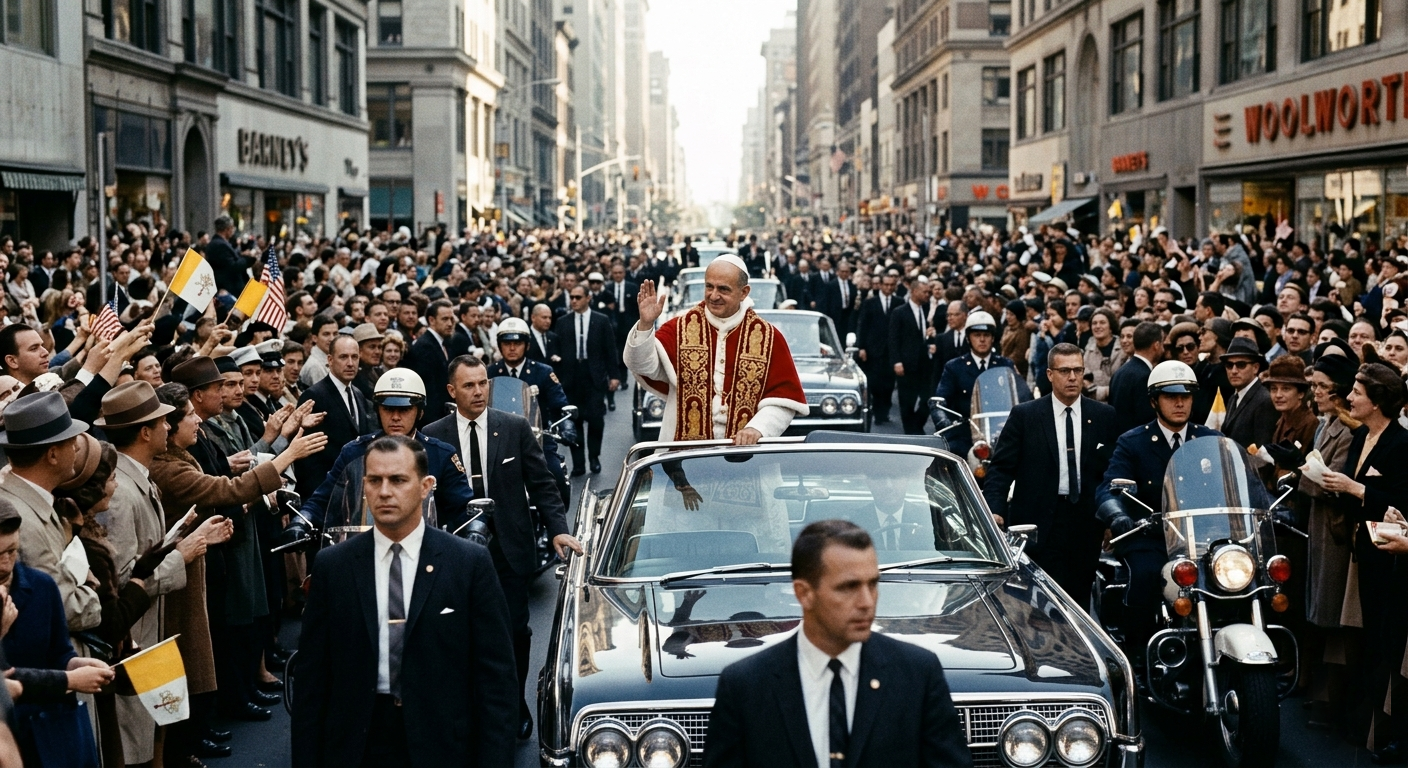
The visit lasted fourteen hours. In those fourteen hours, Paul VI traveled through the streets of Manhattan before millions of onlookers, addressed the United Nations General Assembly, met with President Lyndon B. Johnson, visited St. Patrick’s Cathedral, celebrated Mass before 100,000 people at Yankee Stadium, and stopped at the Vatican pavilion at the 1964 New York World’s Fair in Flushing Meadows. An estimated four million people saw him in person along his route. An additional 100 million Americans watched the visit on television, in a production shared by the three major television networks, ABC, CBS, and NBC. What had once been unimaginable, a pope in America, had become one of the most watched events in the history of American broadcasting.
Who Was Pope Paul VI and What Led Him to Travel the World?
Pope Paul VI was born Giovanni Battista Enrico Antonio Maria Montini on September 26, 1897, in Concesio, a small town in the province of Brescia in the Lombardy region of northern Italy. His father, Giorgio Montini, was a journalist and a member of the Italian parliament who worked with Catholic political movements. His mother, Giuditta Alghisi, came from a noble family in Verolavecchia. Giovanni grew up in a household with deep roots in Italian Catholic intellectual life.
He was ordained to the priesthood in 1920 and entered the Vatican diplomatic service, working for decades in the Secretariat of State before serving as Archbishop of Milan from 1954 to 1963. He was elected as the 262nd pope on June 21, 1963, following the death of Pope John XXIII, taking the name Paul VI. He continued and completed the Second Vatican Council, which John XXIII had convened and which brought sweeping reforms to the Catholic Church, and he implemented its conclusions in ways that reshaped the liturgy, the Church’s relationship with other faiths, and its engagement with contemporary political issues.
Paul VI was also a pope with an extraordinary willingness to travel, earning the nickname “the Pilgrim Pope.” He was the first pope to leave Italy since Pope Pius VII had done so unwillingly in 1809, when Napoleon transported him to France as a prisoner. Paul VI chose travel as an expression of the Church’s outward-facing mission. He visited the Holy Land in January 1964, meeting Ecumenical Patriarch Athenagoras I of Constantinople in Jerusalem in a landmark encounter between the Roman Catholic and Eastern Orthodox churches. He visited India in November 1964. He would go on to visit Africa, the Philippines, Australia, and many other destinations, making him the most traveled pope in history to that point.
Why America in 1965: The United Nations, Vietnam, and the Context of Crisis
The purpose of Pope Paul VI’s American visit was not primarily religious. He had been invited to address the United Nations General Assembly by U Thant, the Burmese diplomat who served as the third Secretary-General of the United Nations from 1961 to 1971. The invitation came at a moment of genuine international anxiety, with the Cold War at a peak of tension and specific regional conflicts threatening to escalate.
The India-Pakistan War of 1965 had broken out in August, just weeks before the papal visit, and was still ongoing when Paul VI arrived in New York. The war had been sparked by competing claims over Kashmir and had already produced significant casualties. The United States was involved militarily in Vietnam, with American troop numbers having escalated dramatically through 1965, and antiwar sentiment within the United States was beginning to grow into an organized movement. The specter of nuclear confrontation between the United States and the Soviet Union remained a constant background anxiety for every political leader and institution of the era.
The choice of October 4 as the date for the visit carried a deliberate symbolic dimension. October 4 is the feast day of Saint Francis of Assisi, the thirteenth-century Italian friar whose life embodied radical poverty, simplicity, and devotion to peace. San Francisco, the city on the American Pacific coast, had been named after Saint Francis, and the United Nations had been born in San Francisco in 1945. By choosing Saint Francis’s feast day for his address to the United Nations, Paul VI embedded in the visit’s structure a continuous meditation on the theme of peace that ran from the medieval Italian saint to the birth of the postwar international order to the specific military crises of 1965.
The Challenge of Planning: No Diplomatic Relations and an Unprecedented Security Operation
The 1965 papal visit presented the United States government with an extraordinary logistical and political challenge. The United States had no formal diplomatic relations with the Holy See, the government of Vatican City. Many Americans, reflecting a tradition of Protestant wariness about Catholic influence, believed that establishing diplomatic relations with the Vatican would constitute a violation of the constitutional separation of church and state. President Kennedy, the first Catholic president, had been careful to emphasize his personal independence from Vatican direction. With no formal diplomatic channel between Washington and Rome, the practical arrangements for a state-level visit had to be improvised.
The New York City Police Department alone deployed 18,000 officers along the papal route through Manhattan, at an overtime cost of one million dollars, equivalent to approximately ten million dollars in contemporary terms. Additional security was provided by the New York State Police, the United States Secret Service, the private Pinkerton detective agency, and the security forces of the United States State Department and the United Nations. Police helicopters patrolled the skies above the route. Frogmen were stationed underwater beneath the bridges along the planned motorcade path. Buildings along the route were swept by security teams. Shops near St. Patrick’s Cathedral boarded up their windows as a precaution against the surging crowds.
For the papal motorcade, Ford Motor Company and the coachbuilder Lehmann-Peterson modified a 1964 Lincoln Continental limousine to create what was in effect the first American “popemobile.” The vehicle was twenty-one feet long and featured a large open section in the rear with a black vinyl throne that could be raised or lowered electronically, with interior lighting to make the seated pope visible to spectators even in dimming afternoon light. Television and radio crews were stationed along the route, with the three television networks pooling their production resources to ensure continuous coverage.
The Wikipedia article on the 1965 visit by Pope Paul VI to the United States provides the comprehensive account of the visit’s preparation, the papal itinerary, the security arrangements, and the public response, including the full text of the pope’s United Nations address.
October 4, 1965: Fourteen Historic Hours in New York City
After landing at Kennedy Airport, where U Thant met him on the tarmac as the representative of the United Nations, Paul VI was driven into Manhattan in the specially prepared Lincoln Continental. The motorcade moved through Harlem, where parochial school children waved papal flags that had been distributed beforehand. LIFE magazine later described the crowd that turned out along the route as four million strong, while other sources cited figures ranging from one million to five million. Whatever the precise count, the streets of New York were lined for miles with people straining to catch a glimpse of the first pope on American soil.
The motorcade moved down Fifth Avenue past St. Patrick’s Cathedral, the great Gothic Revival church that served as the seat of Cardinal Francis Spellman, the Archbishop of New York. The streets around the Cathedral were packed with tens of thousands of people. Paul VI entered the Cathedral and delivered a blessing to Cardinal Spellman, who was then seventy-six years old and had been Archbishop of New York since 1939. Spellman was among the most powerful figures in American Catholicism and had been instrumental in facilitating the visit’s arrangements on the American Catholic side.
From St. Patrick’s, the papal motorcade continued to the Waldorf-Astoria hotel on Park Avenue, where President Lyndon B. Johnson was waiting. The meeting between the president and the pope lasted forty-six minutes, described by LIFE magazine as “46 amiable minutes” in a small sitting room on the 35th floor of the Waldorf Towers. Johnson, who was simultaneously trying to manage the escalating American involvement in Vietnam, the legislative program of the Great Society, and the political fallout of various domestic crises, met the pope through interpreters for what both sides described as a substantive discussion of world peace.
The United Nations Speech: “No More War, Never Again War”
The central event of the day was Paul VI’s address to the United Nations General Assembly, the first time a reigning pope had spoken before that body. The UN building, completed in 1952 on the East Side of Manhattan, was then barely thirteen years old, and the organization it housed was itself a fragile new experiment in international governance. Paul VI delivered his speech in French, the traditional diplomatic language of the era.
The speech was the most important papal statement on international peace and war since the Papacy had begun engaging systematically with modern political issues. Paul VI invoked the memory of John F. Kennedy, who had been assassinated less than two years earlier and whose 1963 statement “Mankind must put an end to war or war will put an end to mankind” he quoted directly. The most memorable phrase from the address, translated from the French, was the passage in which he declared: “No more war, never again war. Peace, it is peace that must guide the destinies of people and of all mankind.”
The pope called explicitly for negotiated peace in all current conflicts. He urged reconciliation between the United States and China, implying his support for China’s admission to the United Nations, though the body subsequently rejected Chinese membership for the fifteenth consecutive time. He spoke about poverty, about nuclear weapons, about the obligations of wealthy nations to developing ones, and about the unique capacity of international institutions to provide a framework for resolving disputes without violence. The speech was simultaneously a statement of Catholic social teaching and a plea to the world’s political leaders at a moment when the decisions they were making had the potential to produce catastrophic consequences.
The Britannica article on Pope Paul VI covers his pontificate’s engagement with political affairs, his United Nations speech, and the broader context of his papacy’s effort to position the Catholic Church as a voice of peace and reconciliation in the Cold War world.
Yankee Stadium: Mass Before 100,000 and the Sermon of Peace
From the United Nations, Paul VI was driven to Yankee Stadium in the Bronx, where approximately 100,000 people had gathered for an outdoor Mass. The stadium, home to the New York Yankees baseball team and one of the most famous sports venues in the world, had been transformed for the occasion into a sacred space on a scale that few American Catholics had ever witnessed.
The Mass was celebrated in the late afternoon as the October sun descended over the Bronx. Paul VI preached a sermon that extended the themes of his United Nations address into explicitly theological territory, calling on Catholics and all people of faith to commit themselves to the cause of peace. He spoke about the obligations of the strong toward the weak, about the spiritual dimensions of poverty, and about the vision of human dignity that Catholic social teaching placed at the center of political life. The crowd of 100,000 inside the stadium was matched by the tens of millions watching on television, and the combination of the setting, the occasion, and the historical moment gave the Mass an emotional resonance that remained in the memories of those who witnessed it for decades.
After the Mass at Yankee Stadium, Paul VI’s motorcade traveled to Flushing Meadows in Queens, site of the 1964 New York World’s Fair, where the Vatican had maintained a pavilion featuring Michelangelo’s Pieta, the marble sculpture depicting the Virgin Mary holding the body of Christ that had been transported from St. Peter’s Basilica in Rome for the Fair. Paul VI visited the pavilion and viewed the sculpture before returning to Kennedy Airport.
At approximately 11:30 p.m., fourteen hours after his arrival, Paul VI boarded his Alitalia DC-8 and departed for Rome. The first papal visit to the United States was over.
The Diplomatic Complications and the 45 Million American Catholics
The absence of formal diplomatic relations between the United States and the Holy See created an uncomfortable asymmetry around the visit. The Vatican was a sovereign state and Paul VI a head of state, but the American government could not formally receive him as such without triggering the church-state controversy that formal recognition of Vatican diplomatic status would have provoked. The meeting with President Johnson at the Waldorf, rather than at the White House, was in part a deliberate choice to keep the encounter out of official Washington and reduce the formal diplomatic character of the meeting.
President Johnson had his own complicated reasons for welcoming the visit. His administration was under growing pressure over Vietnam, and the Pope’s presence and message of peace created at least an optic of American engagement with the cause of ending the conflict. The forty-six-minute Waldorf meeting allowed Johnson to associate himself publicly with the papal peace mission without fully endorsing any specific diplomatic initiative that the Pope might have proposed in private.
For the approximately forty-five million American Catholics, whom Newsweek estimated at the time, the visit was an occasion of profound significance. American Catholics had spent decades navigating a culture in which their faith was viewed by many Protestant Americans as incompatible with democratic values and American identity. The anti-Catholic sentiment that had swirled around John F. Kennedy’s 1960 presidential campaign, and that Kennedy had addressed directly in his famous speech to the Houston Ministers’ Conference, had not entirely dissipated by 1965. The sight of the pope walking through the streets of New York, celebrated by millions and received by the president of the United States, was a powerful affirmation of the legitimacy and belonging of Catholic Americans in the national community.
Cardinal Spellman, Bishop Fulton Sheen, and the American Catholic Establishment
Two figures of American Catholicism played significant roles in the visit beyond their ceremonial appearances. Cardinal Francis Spellman, the Archbishop of New York, was the most powerful Catholic churchman in the United States and the central figure in making the visit practically possible from the American side. Spellman had maintained close relationships with successive popes and American presidents, and his extensive network of political and institutional connections was essential to the visit’s organization. The papal blessing he received at St. Patrick’s Cathedral was a public acknowledgment of his central role.
Bishop Fulton J. Sheen, who had achieved fame through his television program “Life Is Worth Living” in the 1950s and was at this point serving as the Auxiliary Bishop of New York, provided commentary for CBS Television’s coverage of the papal visit. Sheen was one of the most recognizable Catholic voices in America and his presence as a television commentator helped bridge the visit’s extraordinary visual spectacle with a theological interpretation accessible to a mass audience.
The History.com account of Pope Paul VI’s visit to the United States covers the full itinerary of the visit, the historical significance of the papal address to the United Nations, and the broader diplomatic and religious context in which the first papal visit to America took place.
The Legacy of October 4, 1965: How One Day Changed American Catholicism and Papal Diplomacy
The fourteen-hour visit of Pope Paul VI to New York on October 4, 1965, permanently altered both the nature of the papacy and the place of Catholic identity in American life. By successfully completing the first papal visit to the United States, Paul VI demonstrated that popes could engage directly with the world’s most powerful democracy without compromising either their spiritual authority or their political independence.
The visit established a template that subsequent popes followed. Pope John Paul II made seven visits to the United States between 1979 and 1999, beginning with a celebrated White House visit in 1979 that made him the first pope to enter that building. Pope Benedict XVI visited in 2008. Pope Francis visited in 2015, visiting Washington, New York, and Philadelphia, fifty years after Paul VI’s pioneer journey. By 2015, as TIME magazine observed, a papal visit to the United States had come to occur “at least once a decade,” a transformation from the complete impossibility it had represented before 1965.
In the early 1980s, approximately fifteen years after the visit, the United States established formal diplomatic relations with the Holy See, resolving the awkward institutional asymmetry that had complicated the 1965 arrangements. President Ronald Reagan normalized relations in 1984, completing a process that Paul VI’s visit had helped to make conceivable.
The speech Paul VI delivered at the United Nations on October 4, 1965, has remained one of the most cited papal addresses in modern history. Its declaration that “no more war, never again war” has been quoted in the context of every major international conflict since. It established the United Nations as a legitimate forum for papal engagement with international politics, a relationship that subsequent popes have maintained and deepened.
At Kennedy Airport, as he prepared to depart on the evening of October 4, Paul VI spoke briefly with reporters. He described his fourteen hours in New York as among the most significant of his pontificate. Standing at the foot of the stairs before ascending to his plane, the Pilgrim Pope looked back at the city he had spent a day transforming and was transformed by, and departed for Rome, leaving America forever altered by the presence of the first pope who had come to bless it.