
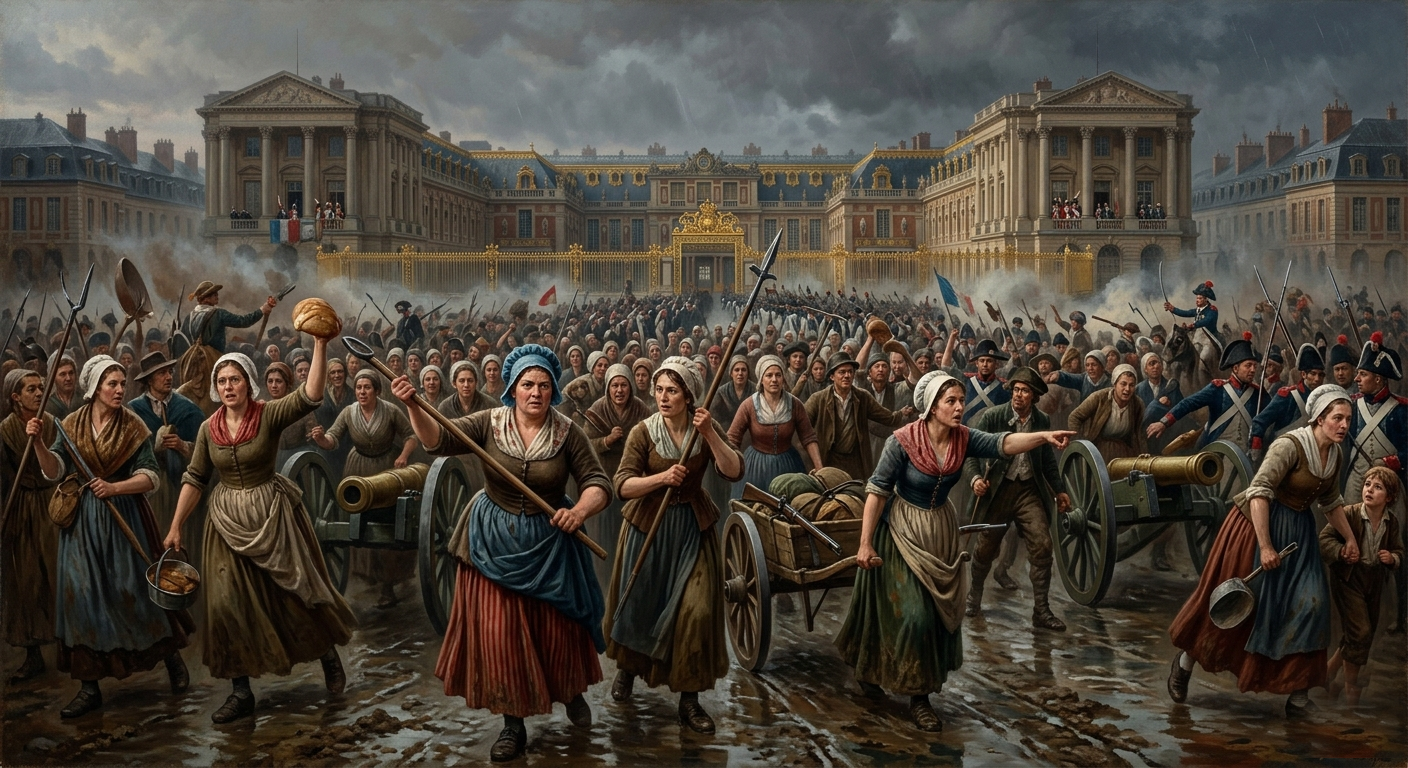
On the morning of October 5, 1789, the market women of Paris had reached their limit. For months they had watched bread prices rise to levels that made feeding their families nearly impossible. By 1789, typical Parisian laborers were spending between 70 and 90 percent of their wages on bread alone, compared with roughly half their wages earlier in the century. The harvest had been adequate that year, but grain was still scarce in the capital, and rumors had spread widely that merchants and aristocrats were deliberately hoarding food to weaken and pacify the starving population. Then, just days before, news had arrived from Versailles of a royal banquet at which officers had trampled the revolutionary tricolor cockade and sung songs praising a captive king. The combination was too much to endure.
Women who had gathered that morning at the Paris marketplace known as Les Halles began beating drums and ringing the tocsin, the emergency bell used to summon citizens in times of crisis. From the marketplace, the crowd moved to the Hotel de Ville, the Paris city hall, where they ransacked the building looking for food and weapons. They found neither in the quantities they needed, but they found muskets and pikes, and they found in their own collective fury a direction. They would march to Versailles. They would demand bread from the king himself. And they would bring the royal family back to Paris where the people could watch them.
What followed over the next two days, October 5 and 6, 1789, was one of the most remarkable and consequential mass political actions in the history of the French Revolution. The Women’s March on Versailles, also known as the October Days or the October March, transformed the revolution, stripped the monarchy of its remaining dignity and independence, and forced King Louis XVI and his family from the Palace of Versailles to Paris, where they would remain as effective prisoners of the revolutionary movement until their eventual imprisonment and execution.
What Was France Like in 1789 That Made the Women’s March Possible?
To understand the Women’s March on Versailles, it is necessary to understand the France that produced it. The Ancien Regime, the old order of absolute monarchy, aristocratic privilege, and ecclesiastical power, had been dying for decades under the weight of fiscal catastrophe and social contradiction.
Louis XVI had come to the throne in 1774 knowing that France was in financial crisis. The cost of France’s wars, including its support for the American Revolution, had pushed the national debt to unsustainable levels. Attempts at fiscal reform had been blocked repeatedly by the nobility and the parlements, the regional judicial and legislative bodies that resisted any change to the tax exemptions that privilege had secured for them. By 1789, France was effectively bankrupt and Louis had been forced to call the Estates-General, a representative assembly that had not met since 1614, to address the financial emergency.
The Estates-General met in May 1789 and almost immediately fractured along lines of class and interest. The Third Estate, representing 97 percent of France’s population but holding only one-third of the votes, declared itself the National Assembly in June 1789 and began the process of drafting a new constitution. The king responded with vacillation and covert military preparations. On July 14, the people of Paris stormed the Bastille prison in a defiant act that destroyed the symbol of royal arbitrary power and demonstrated that the common people of France were willing to use violence to defend their revolution.
In August 1789, the National Constituent Assembly abolished feudalism in an overnight session that eliminated the legal privileges of the nobility and the church, and issued the Declaration of the Rights of Man and of the Citizen, the foundational document of French revolutionary ideology. These were stunning political achievements. But they did not put bread on anyone’s table, and as the summer of 1789 turned to autumn, the price of bread remained catastrophically high and Paris remained tense with hunger and rage.
What Were the Immediate Triggers That Started the March on October 5?
The march that began on October 5, 1789, was not entirely spontaneous, though it drew on spontaneous mass anger. Revolutionary speakers at the Palais-Royal, the public garden and entertainment complex owned by Louis Philippe II, Duke of Orleans, had been calling for a march on Versailles since August, arguing that the king and the obstructionist members of the Assembly needed to be confronted directly. The Marquis de Saint-Huruge had been among the most vocal advocates for such a march. The idea was widely discussed and widely desired, but the specific trigger waited for the right provocation.
That provocation arrived in early October. On October 1, 1789, troops of the Flanders Regiment arrived at Versailles as reinforcements for the palace guard, and in celebration of their arrival, the officers of the royal household held a banquet in the Opera hall of the Palace of Versailles. The royal family briefly attended. In Parisian newspapers and pamphlets, particularly in Jean-Paul Marat’s influential publication L’Ami du Peuple, the event was reported as nothing short of an aristocratic orgy. Accounts claimed that drunken officers had stamped on the tricolor cockades of the revolution and declared their loyalty to the white cockade of the House of Bourbon. Whether the accounts were entirely accurate or dramatically embellished, they produced exactly the outrage that revolutionary propagandists hoped they would.
The combination of the bread crisis and the banquet reports was the final trigger. When women gathered at the Paris marketplace on the morning of October 5 and began venting their fury, the revolutionary political energy that had been building for weeks found a vessel. Stanislas-Marie Maillard, a twenty-six-year-old national guardsman who had distinguished himself during the storming of the Bastille, found himself swept up in the movement and became its unlikely organizer. He tried initially to dissuade the women from marching but quickly recognized that the tide could not be turned. He agreed to lead them instead.
Who Were the Women and How Many Marched?
The women of the October March came primarily from the working poor of Paris. They were fishwives, market vendors, laundresses, and other women who spent their days in the public spaces of the city where economic misery and political discussion were equally constant presences. Estimates of the crowd that departed Paris range from 6,000 to 10,000 people, with the most commonly cited figure being approximately 7,000 women. Men joined the march as well, though the women deliberately excluded men at certain points, insisting that this was their march and their moment.
The march covered approximately 12 miles from Paris to Versailles. The October weather was cold and rainy, and the road was muddy and miserable. The marchers carried a variety of weapons: pikes, pitchforks, kitchen implements, and the muskets and cannons they had seized from the Hotel de Ville and from the arsenal at the Paris city hall. They marched for several hours, singing revolutionary songs and chanting demands for bread and the king’s presence in Paris.
The procession was joined along the way by additional numbers from the towns and villages through which it passed. By the time it reached Versailles, the crowd was enormous, wet, exhausted, and furiously angry. The king, who had been hunting at Meudon when news of the march arrived, returned to the palace. The gates of Versailles were shut. Marie Antoinette, who had been walking at the Trianon estate, rushed back to her apartments. The palace prepared, inadequately, for the confrontation that was coming.
Maillard, as the march’s organizer and leader, represented the crowd’s demands when they arrived at the National Constituent Assembly, which was meeting in Versailles. He spoke of the need for bread and demanded that the Assembly address the food crisis. Maximilien Robespierre, not yet a national figure but already developing his reputation as a defender of the poor, addressed the crowd and earned the lasting goodwill of the market women of Paris with his eloquent support for their cause.
The Wikipedia article on the Women’s March on Versailles provides the comprehensive account of the march’s origins, the roles of Maillard and Robespierre, the violence at the palace, and the forced royal departure to Paris that concluded the October Days.
The Confrontation at Versailles: Meeting the King and the Night of Violence
At Versailles, the crowd demanded to see King Louis XVI. A delegation of six women was selected to meet with the king directly. The spokesperson chosen was Pierrette Chabry, a seventeen-year-old girl selected for her youth, her polite manner of speech, and what observers described as her “virtuous appearance.” Chabry must have been overwhelmed by the circumstances, because she fainted at Louis’s feet when she entered the royal presence.
Louis, who was often more effective in personal encounters than in political ones, responded with paternal benevolence. He ordered smelling salts to be brought and helped Chabry up himself. He then promised the delegation that he would order grain from the royal stores sent to Paris immediately, with more food to follow. For some in the crowd, including Maillard himself, this promise was sufficient, and they began to return to Paris. But for the majority of the marchers, a royal promise about food was not enough. They wanted the king to move to Paris. They wanted the Declaration of the Rights of Man to be ratified without further qualification. And many of them wanted much more than that.
The night of October 5 to 6 was one of the most dangerous moments of the entire early revolution. As the crowd waited at Versailles, the Marquis de Lafayette arrived from Paris with the National Guard, an enormous force of approximately 20,000 men that had marched from Paris behind the crowd. Lafayette, who was both a hero of the American Revolution and the commander of the National Guard, had been delayed and had followed the crowd rather than led it. His presence gave the situation a degree of military structure, but it could not completely contain the fury of the crowd.
In the early morning hours of October 6, a portion of the crowd broke through a poorly guarded side gate of the palace and penetrated into the royal apartments. Palace guards were killed and their heads cut off and mounted on pikes. The bodyguards who had been at the October 1 banquet were specific targets of crowd rage. Marie Antoinette, woken by the sounds of violence, fled through a secret passage to the king’s apartments, reaching them only moments before the crowd broke into her bedchamber. An angry mob literally chased Marie Antoinette through the palace corridors, finding her rooms only minutes after she had fled. The queen later said that she had never been so close to death.
Lafayette worked frantically through the chaos to restore order. He went to the king’s apartments and persuaded Louis that the only way to satisfy the crowd peacefully was to appear on the palace balcony and agree to return to Paris. Lafayette also persuaded Marie Antoinette to appear before the crowd, an act of extraordinary personal courage given the mood of the mob.
How Did Louis XVI Respond to the Crowd and What Did Marie Antoinette Do?
When Louis appeared on the balcony of the palace and announced that he would return to Paris with his family, the crowd greeted him with cries of “Vive le roi!” (Long live the king!). He wore the revolutionary tricolor cockade, a symbolic gesture of acceptance of the revolution’s legitimacy. Lafayette further delighted the crowd by placing a tricolor cockade on the cap of the king’s nearest bodyguard, a theatrical demonstration of the National Guard’s alignment with revolutionary ideals.
The crowd then demanded to see Marie Antoinette, who was the target of much of the march’s political hatred. She was widely blamed for the financial extravagance of the court, despised for her Austrian origins (France and Austria had been enemies for generations, and she was seen as a foreign influence at the heart of French government), and was the specific target of numerous scandalous pamphlets that had been circulating for years. Some accounts claimed that crowds chanted for her execution as she appeared on the balcony.
Yet what followed was one of the most remarkable moments of the October Days. Marie Antoinette appeared alone on the balcony, her children having been removed from her side at the crowd’s insistence, and stood before the armed and hostile crowd with her hands placed over her chest and her head bowed. Lafayette, in a gesture of perfectly calibrated political theater, knelt and kissed her hand before the crowd. The crowd, which had been preparing for regicide or at the very least violent humiliation, hesitated and then responded with hushed reverence. Some even cheered. The queen’s bravery in that moment, standing unarmed and alone before a crowd that had just been chasing her through her own palace, produced an unexpected outpouring of sympathy.
The World History Encyclopedia article on the Women’s March on Versailles provides the full account of the royal family’s encounter with the delegation and the dramatic events of the night of October 5 to 6, including the killing of the palace guards, the queen’s narrow escape, and Lafayette’s role in managing the confrontation.
October 6, 1789: The Royal Family’s Forced Return to Paris
On the afternoon of October 6, 1789, the royal family left Versailles for the last time as its inhabitants. The procession that made its way back to Paris was one of the strangest spectacles of the French Revolution. The royal carriage was surrounded by tens of thousands of people. The crowd had grown to an estimated sixty thousand people by the time the return journey began, and the nine-hour trip to Paris had a quality that mixed celebration with menace.
National Guards led the way with bayonets fixed, some with loaves of bread stuck on the tips as symbols of the march’s purpose and victory. Market women rode astride the captured cannons, singing revolutionary songs. The crowd chanted that they were bringing back the “baker, the baker’s wife, and the baker’s little apprentice,” referring to the king, queen, and the young Dauphin Louis-Joseph, expressing both the crude hope that the food crisis would now be solved and the darker awareness that the royal family was essentially their captive. Some marchers carried pikes bearing the severed heads of the Versailles guards who had been killed the night before.
As Louis XVI left Versailles, he reportedly told the Count of Gouvernet, whom he was leaving in command of the National Guard at the palace: “You are in charge here. Please try to save my poor Versailles.” He still believed, at that moment, that the court might return. He was wrong. The Palace of Versailles, which Louis XIV had built as the supreme expression of absolute royal power, was already being boarded up. As historian Simon Schama observed, “Versailles had already become a museum.” It has been one ever since.
The royal family was installed at the Tuileries Palace in Paris, where they remained under the surveillance of the revolution. The National Constituent Assembly followed the king to Paris within two weeks, settling into the Salle du Manège near the Tuileries. The fifty-six monarchist deputies who refused to make the journey largely withdrew from politics, their absence further strengthening the hand of the revolutionary faction.
What Were the Consequences of the Women’s March on Versailles?
The consequences of the October Days were profound and far-reaching for the French Revolution and for the monarchy’s fate. The most immediate consequence was the end of Versailles as a royal capital. Louis XVI never lived at Versailles again. The physical separation of the court from the vast, isolated palace complex that had insulated it from popular pressure meant that the king was now constantly visible to and surrounded by the revolutionary city of Paris.
The second major consequence was the dramatic weakening of the monarchist faction in the National Constituent Assembly. With fifty-six monarchist deputies refusing to move to Paris and effectively withdrawing from politics, the Assembly became significantly more radical in its composition. The pace of revolutionary reform accelerated. The constitution that was eventually completed and signed in 1791 established France as a constitutional monarchy in which the king held very limited executive power. Louis XVI signed it, having no real alternative.
The third consequence was the elevation of Robespierre’s political profile. His impassioned defense of the march during the Assembly session at which it was debated gave him heroic status among the market women of Paris, the poissardes, and burnished his reputation as the tribune of the poor. His later rise to become the dominant figure of the Committee of Public Safety and the architect of the Terror was directly facilitated by the reputation he built in October 1789.
The History.com article on the Women’s March on Versailles covers the march’s place in the broader narrative of the French Revolution, including its significance as a demonstration of women’s political power and its consequences for the French monarchy’s relationship with the revolutionary government.
Why Does the Women’s March on Versailles Matter in History?
The Women’s March on Versailles matters for several reasons that extend beyond the immediate political consequences it produced. It was, first and most obviously, one of the most dramatic demonstrations of women’s political agency in an era when women had no formal political rights anywhere in the Western world. The women who marched on October 5, 1789, did not have the right to vote, the right to stand for election, or any formal role in the political process. They exercised power anyway, through collective action, physical presence, and the willingness to risk their lives in pursuit of their demands.
The march also illustrates the relationship between subsistence and politics that runs through the entire history of the French Revolution. The women who marched were not primarily driven by abstract principles of liberty and equality, though they were not indifferent to those principles either. They were driven by hunger, by the daily terror of not being able to feed their children, and by the rage that came from watching the rich eat lavishly at Versailles while they scrabbled for bread in the markets of Paris. When they brought the king back to Paris, they were making a statement that the ruler of France had a responsibility to feed its people, and that the people would enforce that responsibility with their bodies if necessary.
The march also accelerated the radicalization of the revolution by demonstrating the power of direct popular action. It showed that a determined crowd could achieve through physical presence and the threat of violence what months of legislative debate had failed to accomplish. This lesson was not lost on subsequent revolutionary actors, and the memory of October 1789 haunted the moderate elements of the revolution who feared that every political crisis might escalate into another October Days.
The Women’s March on Versailles was both the beginning of the end for the French monarchy and the clearest early demonstration of women’s capacity to change history. The market women who marched through the October rain to confront a king in his palace and who brought him back to Paris at the end of a nine-hour procession did not know they were changing the world. They knew they needed bread. What they got, along with the food promises and the royal capitulation, was a place in history as the women who turned the French Revolution from a legislative process into a genuine popular revolution.