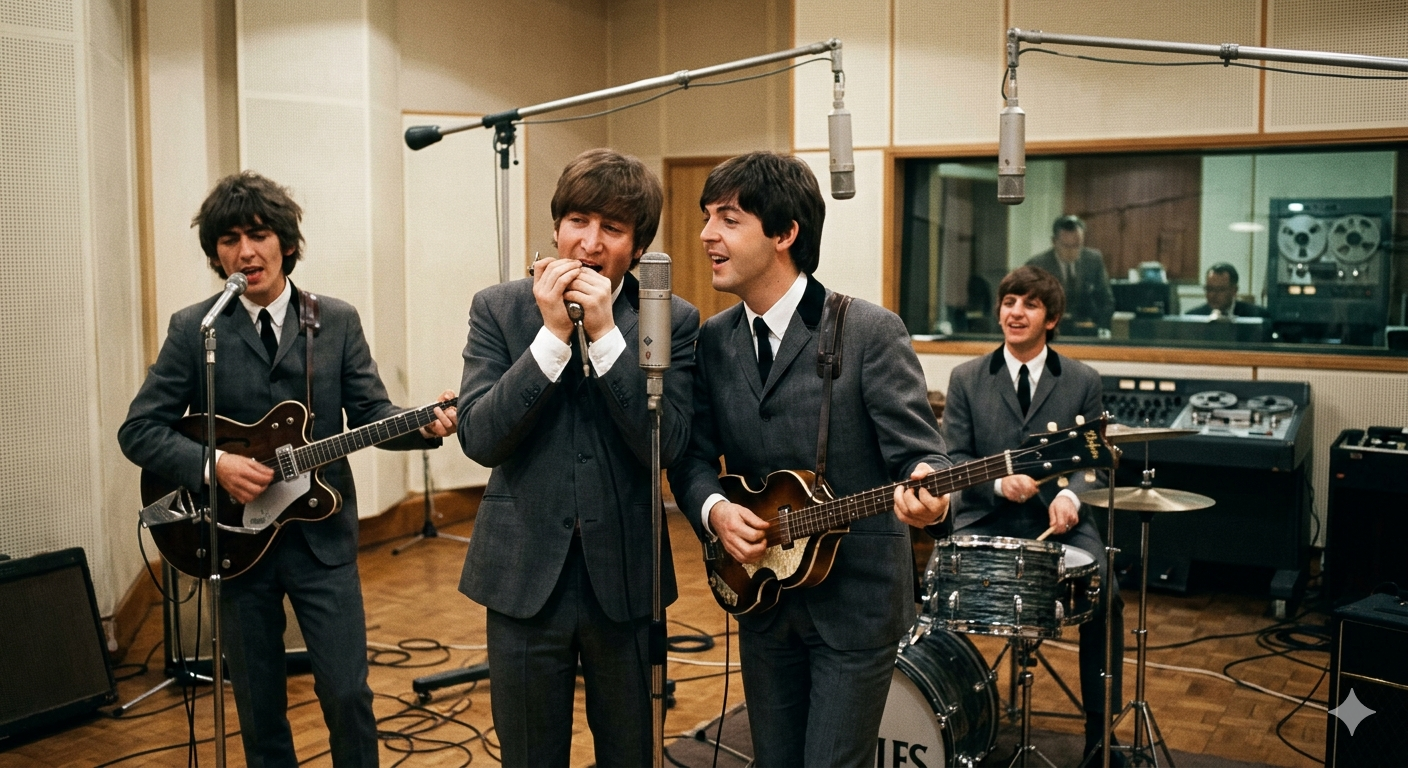
On the evening of Friday, October 5, 1962, Radio Luxembourg, broadcasting to Britain on 208 meters on the medium wave band with the most powerful signal in popular music radio, played a new song. It was raw, direct, and built around a harmonica hook that was impossible to forget. The singers sang the word “love” twenty-three times in under two minutes. Within a week, the song was in record shops across England. Within two years, it was number one in America. The song was “Love Me Do.” The band was the Beatles. And the world, as producer George Martin would later say, had changed.
The release of “Love Me Do” as the Beatles’ debut single on October 5, 1962, is one of those rare moments in cultural history that functions as a genuine dividing line. Not because the song itself was revolutionary by any technical measure, it was not, but because of what it represented and what it set in motion. Four young men from Liverpool, who had spent years playing in Hamburg clubs and Merseyside dance halls, who had been turned down by Decca Records, who had argued with their record producer about which song to release as their first, had finally gotten their record out. The next decade of music would be largely defined by what happened after.
Who Were the Beatles Before Love Me Do: The Liverpool and Hamburg Years
The four men who recorded “Love Me Do” had already spent years earning their craft in conditions that most aspiring musicians today would find unimaginable. John Winston Lennon was born on October 9, 1940, in Liverpool, England. James Paul McCartney was born on June 18, 1942, also in Liverpool. George Harrison was born on February 25, 1943, in Wavertree, Liverpool. Richard Starkey, known universally as Ringo Starr, was born on July 7, 1940, in the Dingle district of Liverpool.
Lennon and McCartney had met on July 6, 1957, at a church fete in Woolton, Liverpool, where Lennon’s skiffle group the Quarrymen was performing. McCartney, fifteen years old to Lennon’s sixteen, played “Twenty Flight Rock” and impressed Lennon enough to be invited to join the group. George Harrison joined shortly after, initially resisted by Lennon because of his young age, eventually admitted because his guitar skills were too good to pass up. The three of them, plus a revolving cast of other members, played under various names before settling on the Beatles by 1960.
Their Hamburg period was transformational. Between 1960 and 1963, the Beatles made multiple extended residencies in Hamburg, West Germany, playing eight-hour shifts at clubs like the Indra, the Kaiserkeller, and the Star-Club before audiences that demanded relentless energy. The Hamburg shows built the Beatles into one of the tightest live bands in Britain. Pete Best had been their drummer since August 1960, selected partly because he owned a drum kit. It was in Hamburg that the Beatles developed the raw, powerful performance style that would come through on “Love Me Do,” and it was in Hamburg that they began working their own original material into sets that had previously consisted almost entirely of covers.
The Song Itself: How Paul McCartney Wrote Love Me Do as a Teenager
“Love Me Do” was not written in the run-up to the band’s EMI audition. It was written years before the Beatles existed in their final form. Paul McCartney had begun sketching the song around 1957 or 1958 while skipping school at the age of fifteen or sixteen. John Lennon later confirmed this origin clearly: “‘Love Me Do’ is Paul’s song. He had the song around, in Hamburg, even, way, way before we were songwriters.” Lennon acknowledged that he may have contributed something to the middle eight section, the passage beginning with “Someone to love,” but expressed uncertainty about the extent of his contribution.
McCartney and Lennon, in their early days as collaborators, had developed the habit of writing their songs in a school notebook and labeling every piece “Another Lennon-McCartney Original” at the top of the page, a charmingly optimistic declaration of professional identity at a time when neither was remotely famous. “Love Me Do” was among the songs that emerged from these early writing sessions, simple in structure, built around a repetitive title phrase, and featuring a harmonica part that McCartney later acknowledged was inspired by the harmonica playing of American folk and blues musicians he had been listening to.
The song’s great innovation, such as it was, lay in its directness and its American influences at a time when most British pop music was stilted, polished, and mediated through layers of professional songwriting and orchestral arrangement. The Beatles at this stage were heavily influenced by American rock and roll, rhythm and blues, and early Motown: Chuck Berry, Little Richard, Ray Charles, the Everly Brothers, and Buddy Holly. “Love Me Do” carried those American influences into a British context with a simplicity and sincerity that made it stand out from the smooth, produced pop that dominated British radio in 1962.
The Beatles Bible article on Love Me Do provides the detailed recording history of the song across its three officially released versions, the personnel for each session, and the circumstances that led to three different drummers appearing on three different recordings of the same song.
Brian Epstein, the Decca Audition, and the Road to EMI
Before “Love Me Do” could become the Beatles’ debut single, the band had to navigate a series of obstacles that might easily have ended their recording career before it began.
Brian Epstein was a twenty-seven-year-old record shop manager in Liverpool when he first encountered the Beatles at the Cavern Club in November 1961. Epstein ran the North End Music Stores record department of his family’s furniture shop and had been asked by customers about a local band who had a record out. Intrigued, he went to see the Beatles perform and was overwhelmed by the experience. By January 1962, he had become their manager, replacing the informal arrangements that had previously governed their business affairs with his own combination of professional presentation, personal commitment, and unstoppable persistence on their behalf.
Epstein’s most important act in the period before “Love Me Do” was securing the audition at Decca Records in London. On January 1, 1962, the Beatles traveled down to London to audition for Decca’s artists and repertoire executive Mike Smith. They played fifteen songs including “Love Me Do.” Smith passed the tapes to his superior, Decca executive Dick Rowe, who made the decision that became the most cited error in the history of the record industry: he turned the Beatles down, explaining through intermediaries that guitar groups were on the way out. Decca signed Brian Poole and the Tremeloes instead, on the grounds that having a London-based act would be more practical for the label. Rowe would become known forever afterward as “the man who turned down the Beatles.”
Epstein did not give up. He approached virtually every major British label with the Decca audition tape and was rejected by all of them. Finally, in a stroke of luck that he would later describe as being in the right place at the right time, he was passed along to George Martin, a thirty-six-year-old producer and head of the Parlophone label, which was the comedy and light entertainment arm of the EMI group and not primarily associated with rock and roll. Martin agreed to give the Beatles an audition on June 6, 1962.
The Three Recording Sessions and the Three Drummers Behind Love Me Do
The recording history of “Love Me Do” is one of the most unusual in pop music, involving three separate sessions, three different drummers, and a production decision that was not definitively settled until years after the song was released.
The first session took place on June 6, 1962, at EMI Studios on Abbey Road in London. This session served both as the Beatles’ formal audition for Parlophone and as a recording session. Pete Best played drums. George Martin, who initially presented the Beatles with a Mitch Murray song called “How Do You Do It?” that he wanted them to record as their first single, allowed them to play their own material, and they performed “Love Me Do” among other songs. Martin was not particularly impressed with Best’s drumming, finding it lacking in the precision and reliability he expected from studio recording. He decided to offer the band a provisional recording contract but reserved the right to use session musicians for their recordings.
In August 1962, the Beatles made the most significant personnel decision of their career. Pete Best was dismissed from the band and replaced by Ringo Starr, who was at the time playing with Rory Storm and the Hurricanes and whom all four musicians had known and admired since their Hamburg days. The precise reasons for Best’s dismissal have been debated ever since. John Lennon said that Best was “a great lad, but a lousy drummer.” Paul McCartney has suggested that the chemistry was never quite right. George Harrison was reportedly most enthusiastic about bringing Ringo in. Brian Epstein delivered the news to Best, who was devastated.
When the Beatles returned to Abbey Road on September 4, 1962, Ringo was behind the drum kit. They ran through “Love Me Do” approximately fifteen times in what became a full day’s recording session. The version that resulted from this session, featuring Ringo on drums and Lennon’s harmonica prominently in the mix, is the version that was released as the debut single. George Martin was still not entirely happy with the drum sound, however, and when the band returned on September 11, he brought in session drummer Andy White to handle the drum part while relegating Ringo to playing tambourine. Ringo was, as he later expressed in the Beatles Anthology, “devastated”: “I was devastated that George had his doubts about me. I came down ready to roll and heard, ‘We’ve got a professional drummer.’ He has apologized several times since, has old George, but it was devastating. I hated the bugger for years. I still don’t let him off the hook.”
The Andy White version, which includes tambourine, was placed on the Beatles’ debut album Please Please Me in 1963 and became the most widely distributed version of the song. The Ringo version, identifiable by the absence of tambourine, was the one that appeared on the original UK single release on October 5, 1962. The Pete Best version, recorded on June 6, was not officially released until 1995, when it appeared on the Anthology 1 compilation album.
The Rolling Stone retrospective on Love Me Do at its fiftieth anniversary covers the circumstances of the recording sessions, the Pete Best dismissal, Ringo’s response to being replaced in the studio by Andy White, and the song’s chart performance in Britain and eventual American success.
October 5, 1962: The Release and Its Reception
The debut single was released on the Parlophone label with catalogue number R 4949. The A-side was “Love Me Do” and the B-side was “P.S. I Love You,” another Lennon-McCartney original. The decision to release two original compositions as both the A and B sides of a debut single was unusual for the period, when most new acts were encouraged to record proven material that had already succeeded for other artists. George Martin had initially insisted on “How Do You Do It?” but eventually relented after the Beatles argued persistently for recording their own songs.
An early pressing run of 250 advance copies sent to radio stations and press outlets carried a misprint, identifying the songwriter as “McArtney” rather than “McCartney.” This error was corrected before the general release. It remains a highly valuable item for Beatles memorabilia collectors.
The chart performance was modest by the standards of what would follow. “Love Me Do” reached number seventeen on the UK singles chart by December 1962, a respectable showing for a debut single from an unknown band but not a spectacular one. In the week of its release, The Tornadoes were at number one in the UK with the instrumental “Telstar” while The Four Seasons topped the American charts with “Sherry.” Rumors have persisted for decades that Brian Epstein purchased up to 10,000 copies of the single from his own record shop to boost its chart position. Epstein denied this while he was alive, but several Beatles insiders later acknowledged that some manipulation of the figures likely occurred. The single’s strongest sales were concentrated in the Liverpool area, where the band already had a devoted following from years of club performances.
George Martin, surprised by the song’s chart performance given his private doubts about its commercial appeal, recognized that the modest success represented sufficient market validation to continue developing the band. He offered them proper studio time to record an album, and the Beatles’ relationship with Abbey Road, and with Martin himself, deepened rapidly from that point.
The Wikipedia article on Love Me Do covers the chart history of the song in the UK and internationally, the three different versions and their release histories, the circumstances of the Andy White session, and the song’s eventual US chart success in 1964 as the fourth of six Beatles songs to reach number one in America in a single year.
What the World Looked Like When Love Me Do Was Released
To appreciate what the Beatles were doing in October 1962, it helps to understand the musical landscape into which “Love Me Do” arrived. The British charts in late 1962 were dominated by a combination of American acts, homegrown pop performers who worked within the established industry model of manager-songwriter-artist hierarchy, and novelty items. British pop music of the early 1960s was largely organized around impresarios and publishers who provided their artists with material rather than expecting them to write it. The idea that a band would insist on recording their own original compositions, and would argue down their record producer to get the chance, was genuinely unusual.
The Rolling Stones, who would become the Beatles’ closest rivals for cultural dominance of the decade, had only just formed at this point and were at this very moment playing to fewer than two hundred people at a hotel in Surrey. The Who had not yet formed their final lineup. Bruce Springsteen, who would one day be compared to the Beatles as a figure of transformative significance in American rock, had just turned thirteen and had recently bought his first guitar.
The world of October 1962 was also the world of the Cuban Missile Crisis, the thirteen days in October 1962 when the United States and the Soviet Union came as close as they ever would to nuclear war. The British public, like the American, was living under an umbrella of Cold War anxiety that would shape the decade’s culture in ways that pop music would both reflect and, in the Beatles’ case, partially transform.
From Love Me Do to Beatlemania: How a Number 17 Hit Changed Everything
“Love Me Do” peaked at seventeen, a number that says nothing about its ultimate significance. Its real impact was institutional rather than commercial. The single was enough to convince EMI that the Beatles were worth investing in. It gave the band access to recording time that they had previously been denied. It allowed them to demonstrate, in the studio and in the market, that they could write and record competitive original material. Most importantly, it unlocked the relationship with George Martin that would prove to be one of the most productive producer-artist partnerships in the history of recorded music.
The speed of what followed was dizzying. “Please Please Me,” the Beatles’ second single, was released in January 1963 and reached number one. Their first album, also called Please Please Me, was recorded in a single marathon session of approximately ten hours on February 11, 1963, and released in March. It went to number one in the UK and stayed there for thirty weeks. By the end of 1963, Beatlemania had swept Britain with a force that the press struggled to describe with any word other than hysteria.
The American breakthrough came in early 1964. “I Want to Hold Your Hand” was released in the United States on January 26, 1964, and reached number one within two weeks. The Beatles appeared on The Ed Sullivan Show on February 9, 1964, watched by approximately 73 million Americans in what remained the largest television audience in history at that time. “Love Me Do” was re-released in America on the Tollie label on April 27, 1964, and reached number one, becoming the fourth of six consecutive Beatles number one singles in America in a single calendar year, an achievement that no act has matched before or since.
The Britannica account of the Beatles’ musical career and their global cultural impact traces the full arc of the group’s development from their Liverpool origins through their Hamburg years, the Parlophone signing, the release of “Love Me Do,” and the decade of musical achievement that followed, establishing the Beatles as the most influential band in the history of popular music.
The Ringo Starr version of “Love Me Do,” recorded in a day at Abbey Road on September 4, 1962, three weeks before the single’s release, had been preceded by years of playing in Liverpool and Hamburg, by a crucial audition that almost didn’t happen, by a firing that changed the band’s chemistry, and by a young songwriter skipping school in Liverpool to write what would become the first chapter in one of the greatest stories in the history of popular culture. When Radio Luxembourg played it on the evening of October 5, 1962, the world, as George Martin said, had changed. Most of the people who heard it that night had no idea yet how much.