
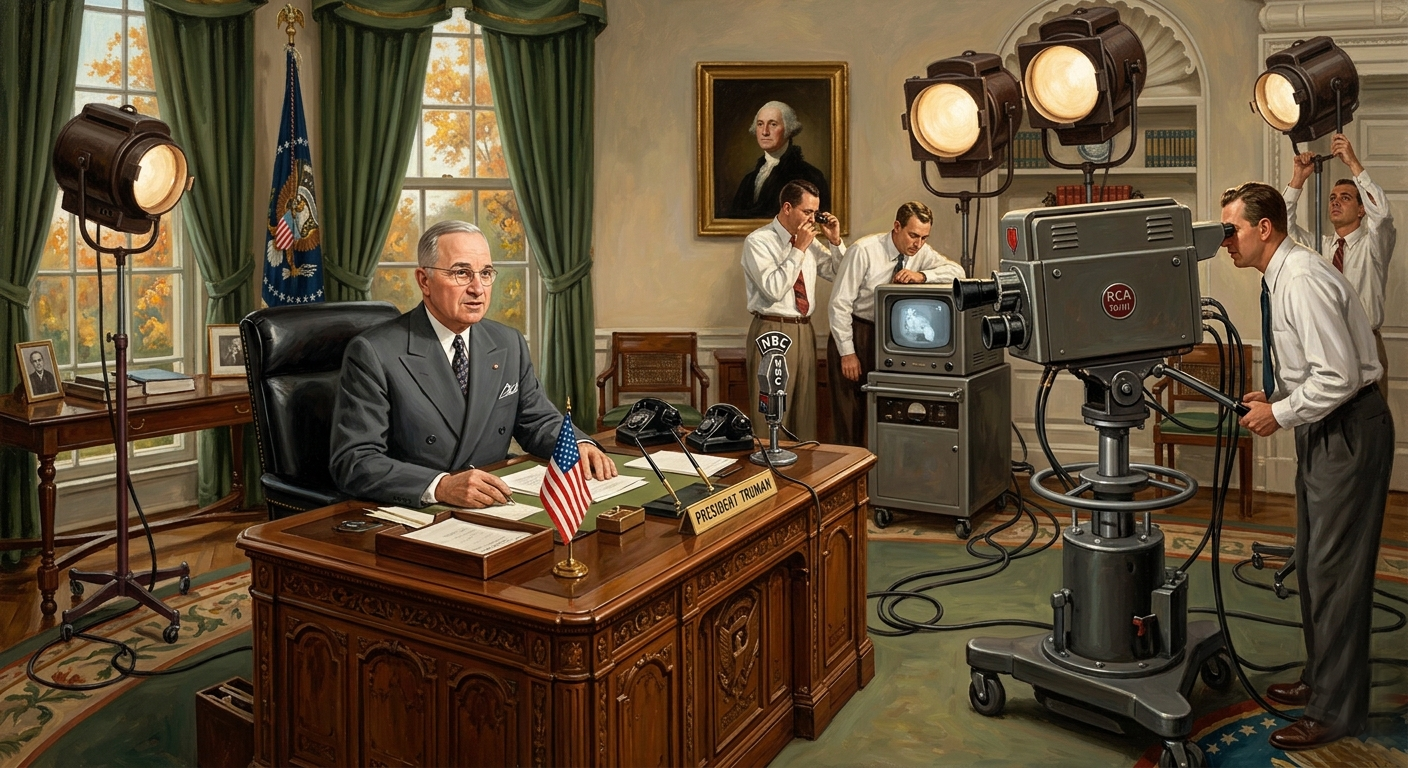
At 10:50 in the evening on Sunday, October 5, 1947, President Harry S. Truman walked to a lectern in the Diplomatic Reception Room of the White House, faced the large, unfamiliar eye of a television camera, and began to speak. He was addressing a food crisis in Europe that threatened to undermine everything the Allied nations had sacrificed to achieve in the Second World War. He was also doing something else that night, something he may not have fully grasped in the moment but that would transform the relationship between American presidents and the American people for generations to come. He was making history in two directions at once: asking his fellow citizens to make personal sacrifices in service of a larger cause, and inaugurating the age of the televised presidency.
The address that Truman delivered from the White House on October 5, 1947, was the first televised presidential address ever broadcast from that building. It lasted approximately twelve minutes. It was watched by a tiny fraction of the American public, since only about 44,000 television sets existed in American homes at the time, most of them concentrated in the major cities of the East Coast. Yet the moment it represented, the first time a sitting president had appeared in American living rooms through the medium of television, signaled the beginning of a transformation in political communication whose full consequences would take decades to unfold and whose legacy is still very much alive today.
Who Was Harry Truman and Why Was He Addressing the Nation in 1947?
Harry S. Truman was born on May 8, 1884, in Lamar, Missouri. He had served as a county official in Missouri, a United States senator, and then briefly as Franklin Roosevelt’s Vice President before Roosevelt’s death on April 12, 1945, propelled him to the presidency without warning, preparation, or the benefit of having been briefed on the most sensitive secrets of the administration he was inheriting, including the existence of the atomic bomb.
Truman had guided the country through the final months of World War Two, making the agonizing decision to use atomic weapons against Japan, presiding over the surrender of both Germany and Japan, and navigating the extraordinarily complex transition from wartime to peacetime that followed. By 1947, his administration was grappling with what he and his advisers recognized as an unprecedented challenge in American foreign policy: how to manage the postwar order in a world where the Soviet Union was expanding its influence and where Western Europe, physically devastated by six years of war, was struggling to recover.
Europe in 1947 was a continent in crisis on multiple levels simultaneously. Its infrastructure had been shattered by years of bombing, ground combat, and deliberate destruction. Millions of people were displaced or homeless. Agricultural production had collapsed. The winter of 1946 to 1947 had been one of the harshest in recorded European history, destroying crops and cutting off coal supplies. By the autumn of 1947, with another winter approaching, significant parts of Western Europe faced the genuine prospect of mass starvation. Nations that had been America’s allies in the war were in danger of economic and social collapse, creating conditions in which communist parties, particularly strong in France and Italy, might win power through democratic elections or through civil unrest.
The European Food Crisis and the Citizens Food Committee
The context for Truman’s first televised address was a specific and urgent humanitarian problem. In the late summer and early autumn of 1947, reports from Europe made clear that the continent’s food situation had become critical. Grain supplies were depleted. The United States, as the world’s leading agricultural producer and the one major power whose domestic infrastructure had emerged from the war intact, was the only country positioned to provide the food aid that Europe desperately needed.
Truman had established the Citizens Food Committee in September 1947 to coordinate American voluntary conservation efforts and to build public awareness of the European famine. He chose Charles Luckman as the committee’s chairman. Luckman was a prominent businessman who had served as president of Lever Brothers, the consumer goods company, and who brought to the role both executive competence and national name recognition. Secretary of State George C. Marshall, whose own proposal for comprehensive European economic reconstruction was being developed simultaneously, had expressed the stakes of food assistance in stark terms: “Food from the United States would deter the march of hunger, cold and collapse, not only enabling Europe to recover its economic stability but also contributing to the resolution of a crisis that could mean the difference between the failure or attainment of world peace and security.”
The Citizens Food Committee had already been making its case to the American public through conventional media channels, including print advertisements, radio broadcasts, and public events. The committee’s October 5 broadcast, to which Truman’s televised address was the concluding element, represented both the culmination of this public education campaign and a significant escalation in the tools being used to reach the American public.
The History.com account of Truman’s first televised presidential address covers the October 5, 1947 broadcast, its political context in the postwar European food crisis, and Truman’s role in establishing the precedent of presidential television communication that all his successors would inherit.
Television in America in 1947: A Medium at Its Very Beginning
The significance of Truman’s October 5 address can only be appreciated against an understanding of how nascent television technology was in the autumn of 1947. The medium had been under development since the 1920s and 1930s, and experimental broadcasts had been occurring since before the war. But commercial television broadcasting had been suspended during the Second World War as resources and industrial capacity were redirected toward the war effort. When commercial broadcasting resumed after the war’s end, television began expanding rapidly, but it was still enormously expensive and available to only a fraction of the American household.
Of the approximately 44,000 television sets in American homes in October 1947, most were located in the New York metropolitan area, Washington D.C., Philadelphia, Boston, and other major eastern cities connected to the nascent broadcast infrastructure. Nationally, radio remained the dominant medium through which Americans received presidential communications and news. The familiar Philco and RCA radios that sat in American living rooms and kitchens had been the primary connection between ordinary citizens and their political leaders throughout the New Deal and the Second World War. President Franklin D. Roosevelt had understood this perfectly: his fireside chat radio addresses, beginning in 1933, had represented the definitive use of the radio medium to create intimacy and connection between a president and the public.
Roosevelt had actually appeared on television before Truman, in a limited and specific sense. On April 30, 1939, Roosevelt delivered a speech at the opening of the New York World’s Fair in Flushing, Queens, and that address was broadcast on television. But the broadcast was received only on the special demonstration television sets installed at the World’s Fair grounds themselves and at Radio City Music Hall in Manhattan. It was essentially a laboratory demonstration of the technology rather than a genuine broadcast to a home audience. Roosevelt subsequently made no further use of television, preferring the radio medium with which he was comfortable and which he had used to such extraordinary effect. His disability, the paralysis from polio that required him to use a wheelchair, also made him reluctant to appear in visual media in ways that might draw attention to physical limitations he carefully concealed.
Truman faced no such personal constraints, and his administration recognized more clearly than Roosevelt’s had that the postwar expansion of commercial television represented a new dimension of political communication that a forward-looking presidency needed to engage.
The Setup at the White House and the Technical Challenges of the Broadcast
The technical preparation for Truman’s October 5, 1947 broadcast was itself an undertaking of considerable complexity. Television cameras in 1947 were enormous and required powerful lighting equipment to produce usable pictures. The network crews and their equipment had to be installed in the Diplomatic Reception Room of the White House, an oval room on the ground floor of the Executive Mansion that opened onto the South Lawn. The room was chosen for its accessibility and its adequate size to accommodate both the cameras and their attendant lighting.
Charles Luckman of the Citizens Food Committee stood beside Truman during the broadcast, a visible symbol of the civic partnership the administration was presenting to the public. The cameras of the time required significantly more light than the natural ambient levels of even well-lit rooms, so the Diplomatic Reception Room was blazingly lit for the occasion. Multiple cameras, likely two or three given the practices of the period, were positioned to allow for different angles.
The address was broadcast on what networks were operating in Washington at the time. NBC and other networks carried the broadcast to the limited television audience that existed in the cities with television infrastructure. The overwhelming majority of Americans who saw any presidential address that night did so through the radio broadcast that accompanied the television feed, or through the newsreels that would appear in movie theaters in the following days.
An NBC technician named Hubert Chain had the foresight to capture the broadcast using an early form of kinescope technology, which involved pointing a film camera at a television monitor and recording the broadcast as it was displayed. This improvised recording method was the standard approach to preserving live television in an era before videotape existed. It is because of Chain’s action that a three-minute excerpt of Truman’s October 5 address survives in the Harry S. Truman Presidential Library today, making it viewable to historians and interested citizens three-quarters of a century after the broadcast. Without that single technician’s initiative, the first televised White House address would exist only in written records and the memories of those who watched it.
The Harry S. Truman Presidential Library’s documentation of the first televised White House address preserves the photographic record of the broadcast’s technical setup, including the cameras, the lighting, and the positioning of Truman and Luckman in the Diplomatic Reception Room.
What Truman Said: The Message of October 5, 1947
The content of Truman’s first televised White House address was both pragmatic and morally serious. He opened with a direct description of the European situation: “The situation in Europe is grim and forbidding as winter approaches. The tragedy of hunger is a stark reality.” He then explained the connection between American grain consumption and Europe’s survival, arguing that if Americans consumed more grain than they produced domestically, there would be insufficient surplus to share with hungry Europeans.
Truman made specific, actionable requests of the American people. He asked farmers and distillers to reduce their grain use voluntarily, directing what grain they used toward the most essential purposes. He asked ordinary American citizens to forgo meat on Tuesdays and to skip eggs and poultry on Thursdays. He asked everyone to save one slice of bread per day, a small individual sacrifice that in aggregate across a nation of 145 million people would constitute a meaningful contribution to European food supplies.
The appeal was explicitly moral in its framing. Truman described the conservation program as “a contribution to a just and lasting peace” and expressed confidence in the American character: “I am confident we will have the support of every American.” He connected the immediate food crisis to the broader challenge of postwar reconstruction and the effort, which would formally take shape as the Marshall Plan in the following year, to prevent Western Europe’s economic collapse and its associated political consequences.
The reaction to the speech was modest in scale but enthusiastic in tone among those who heard it. Two letters from the relatively small television audience reached the Truman archives. One was from Judge Jed Johnson, who wrote that he had watched with his wife and son on NBC in New York and gave his full support to the food program. Truman wrote back personally: “I am glad you had a chance to listen to me through television. I would like very much to be able to see myself that way so I could make corrections of errors in appearance.”
The Historical Context: The Truman Doctrine, the Marshall Plan, and Postwar Foreign Policy
The October 5, 1947 broadcast did not occur in a foreign policy vacuum. It was the public communication component of a broader strategic vision that Truman and his advisers had been developing throughout 1947, one of the most consequential years in American foreign policy history.
In March 1947, Truman had addressed a joint session of Congress to propose what became known as the Truman Doctrine: a commitment to providing military and economic assistance to countries threatened by Soviet-backed communist insurgency, explicitly identified in the speech as Greece and Turkey. The Truman Doctrine represented a formal departure from the prewar American tradition of non-involvement in European affairs and established the framework of containment that would define American foreign policy for the next four decades of the Cold War.
Secretary of State George C. Marshall had delivered his own landmark speech at Harvard University in June 1947, proposing a comprehensive program of American economic assistance to help European nations rebuild their economies after the devastation of war. The Marshall Plan, as it came to be known, was simultaneously a humanitarian program, an economic recovery initiative, and a geopolitical strategy designed to prevent the conditions of poverty and desperation that might make communist parties electorally attractive in Western Europe’s democracies.
Truman’s October 5 food conservation address was a direct complement to the Marshall Plan: if the United States was to send substantial food supplies to Europe as part of the reconstruction effort, it made sense to ask Americans to consume less domestically, both to increase available surpluses and to demonstrate that the sacrifice of war had not been entirely forgotten. The Citizens Food Committee program that Charles Luckman was chairing represented the voluntary civic mobilization that the administration hoped would make the difference.
The Britannica article on Harry S. Truman’s presidency and foreign policy covers the full sweep of Truman’s foreign policy vision, from the Truman Doctrine through the Marshall Plan and the formation of NATO, placing the October 1947 food conservation broadcast in its full strategic context.
The Legacy: How Truman’s Television Address Changed Presidential Communication
Truman’s October 5, 1947 broadcast was not immediately transformative in practical terms, since so few Americans could receive it. But it established a precedent that every subsequent administration built upon, and the trajectory of that building transformed American political life.
Truman himself made subsequent use of television throughout his remaining time in office. His 1949 inauguration address was televised, reaching a substantially larger audience as more Americans acquired television sets. He made the medium available to his successors with the understanding, ahead of his time, that it represented the future of political communication. In 1948, he was also the first presidential candidate to broadcast a paid political advertisement, another precedent that became a permanent feature of American electoral politics.
The decisive moment in presidential television history came not with Truman but with the Kennedy-Nixon debates of September and October 1960, in which the visual contrast between a telegenic John F. Kennedy and a perspiring, uncomfortable Richard Nixon demonstrated with complete clarity that television had become the central medium of American politics. Those who heard the debates on radio believed Nixon had won. Those who watched on television believed Kennedy had won. The medium had become determinative.
But Kennedy’s mastery, Nixon’s awkwardness, Reagan’s warmth, and every subsequent president’s carefully managed television presence all trace their lineage back to the evening of October 5, 1947, when Harry Truman stood in the Diplomatic Reception Room of the White House, faced an unfamiliar camera, and became the first president to speak directly to Americans through their television screens in their own homes.
The Wikipedia article on the history of televised presidential addresses tracks the evolution of presidential television communication from Truman’s 1947 address through the Kennedy-Nixon debates, the Nixon resignation, and the contemporary era of social media supplementing and competing with broadcast television as the medium of presidential communication.
The food conservation program Truman promoted on October 5, 1947 was short-lived as a specific measure. The Marshall Plan’s comprehensive economic assistance to Europe proved far more effective in addressing the underlying crisis than voluntary meat-free Tuesdays and reduced bread consumption. But the medium through which Truman asked Americans to make those small sacrifices proved to be the more durable legacy. Television was in 44,000 American homes in October 1947. By 1960, it was in 90 percent of them. By 1970, it was virtually universal. The president who had first appeared in those homes, asking citizens to eat a little less so that Europeans could survive the winter, had set in motion something whose scale he could not have imagined, and whose influence on American democracy, for better and for worse, continues to the present day.