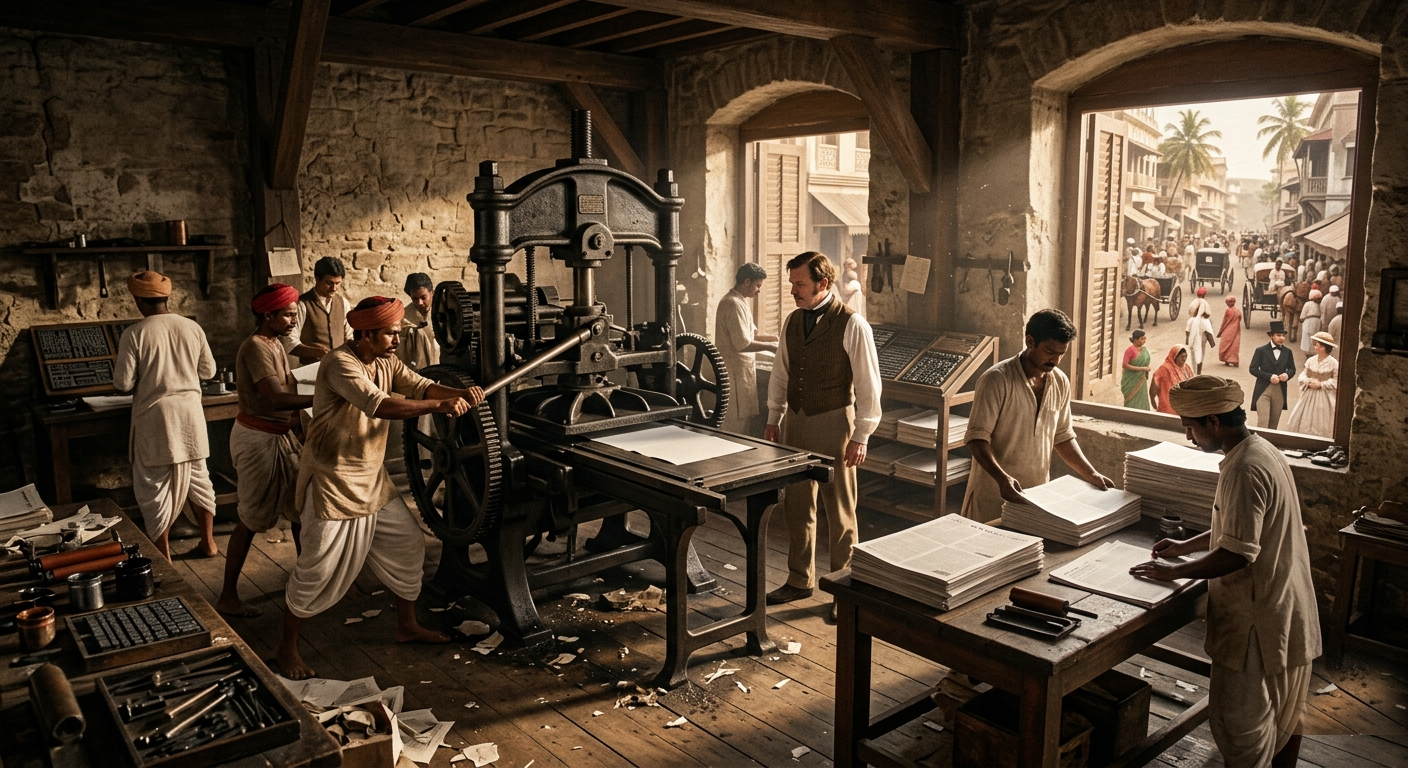
On November 3, 1838, a new newspaper rolled off the presses in Bombay, the bustling commercial capital of British India on the western coast of the subcontinent. It was called The Bombay Times and Journal of Commerce, and it was published twice a week, on Wednesdays and Saturdays. Its first editor was J.E. Brennan, a retired Irish doctor who also served as secretary of the Bombay Chamber of Commerce. Its ownership rested with a British syndicate of eleven commercial firms who saw a business opportunity in providing news and commercial intelligence to the growing community of British traders, merchants, and officials who had made Bombay their home under the expanding reach of the East India Company.
The newspaper that began in this modest fashion on November 3, 1838, would eventually become The Times of India, today the world’s largest selling English-language daily newspaper. Its journey from colonial trade bulletin to national institution across nearly two centuries reflects the entire arc of modern Indian history: British imperial commerce, the independence movement, the creation of the Republic, and the digital transformation of the twenty-first century media landscape. When Lord Curzon, the Viceroy of India, called it “the leading paper in Asia” at the beginning of the twentieth century, he was acknowledging an institution that had grown far beyond anyone’s expectations on that first Wednesday morning in 1838.
Colonial Bombay in 1838: The World Into Which the Bombay Times Was Born
To understand the founding of The Bombay Times and Journal of Commerce, it is essential to understand the Bombay of 1838. The city was the headquarters of the Bombay Presidency, one of the three principal administrative divisions of British India under the East India Company. It was a city of remarkable commercial energy, positioned at the intersection of trade routes connecting Britain with the Persian Gulf, East Africa, and the broader Indian Ocean world. The Mughal Empire had by 1838 contracted to little more than the ceremonial presence of the aged Emperor Bahadur Shah Zafar in Delhi, and British power was expanding rapidly across the subcontinent.
The seven islands that would eventually be joined through land reclamation projects to form modern Mumbai had not yet been fully consolidated. The railway that would connect Bombay to the interior of India was still fifteen years in the future: the first Indian railway line would open between Bombay and Thane in 1853. The cotton textile mills that would transform Bombay into a major industrial city were still being established. But the commercial infrastructure of the colonial port, the counting houses, the shipping firms, the import-export merchants, and the professional class of British officials and lawyers who served the Company, was already substantial and growing.
The legal environment that made a free English-language press possible in Bombay had been created three years earlier. In 1835, Lord Charles Metcalfe, the acting Governor-General of India, had steered through a landmark piece of press legislation known as Metcalfe’s Act, which removed the licensing requirements that had previously restricted the establishment of newspapers in India. Metcalfe earned the gratitude of Indian journalists across generations for this act, which opened the door to independent newspapers of every political and commercial variety. The founding of The Bombay Times three years later was a direct consequence of the freedom Metcalfe’s Act had created.
The paper was launched under the direction of Raobahadur Narayan Dinanath Velkar, a Maharashtrian social reformer who brought not only commercial acumen but also a genuine sense of social purpose to the newspaper’s founding. Velkar’s involvement with the new publication signaled from the outset that it would not be purely a mouthpiece for British commercial interests, though that was its primary original audience. In the first edition, editor J.E. Brennan wrote about the need for education among the people of India, “whose capacity for improvement is inferior to that of no one elsewhere but were victims of ignorance and delusion,” a statement that mixed paternalistic colonial attitudes with a genuine reformist impulse characteristic of the liberal wing of British colonial administration.
J.E. Brennan and George Buist: The Paper’s Early Editors
The first editor of The Bombay Times and Journal of Commerce, J.E. Brennan, combined his journalistic role with his position as secretary of the Bombay Chamber of Commerce, a combination that perfectly illustrated the newspaper’s original character as a publication dedicated simultaneously to news and commerce. Brennan edited the paper through its earliest months but died in 1839, barely a year after the first issue, leaving the young publication in need of new leadership.
His successor was George Buist, who would guide the paper through a significant period of its early development and preside over one of its most important milestones. Buist held decidedly pro-British editorial views and was resistant to any criticism of the colonial administration or its policies. Under his editorship, the paper’s content reflected a perspective wholly aligned with the priorities of British Bombay: commercial news, shipping intelligence, information about events in Britain and Europe, and coverage of colonial administration and military operations.
It was during Buist’s tenure that The Bombay Times and Journal of Commerce made its first great transformation. By 1850, the demand for news among Bombay’s growing population had expanded sufficiently to sustain a daily publication. Buist oversaw the paper’s conversion from its twice-weekly format to a daily newspaper in 1850, a change that fundamentally altered both the paper’s character and its commercial viability. A daily newspaper occupies a different place in public life from a semi-weekly one. It becomes part of the rhythm of daily existence in a way that a twice-weekly publication cannot.
The paper’s exclusively pro-British editorial line created tensions within its shareholder base. Fardoonji Naoroji, a Parsi shareholder who was part of the small but influential community of Parsi merchants who had become a crucial bridge between British commercial Bombay and Indian society, pressed Buist to adopt a more balanced approach, particularly in the context of the Indian Rebellion of 1857, the great uprising against Company rule that began in Meerut and spread rapidly across northern India. Buist refused to modify either his editorial policy or his independence from shareholder pressure. After a shareholders’ meeting in which his position was challenged, he was removed and replaced by an editor who would transform the newspaper far more completely than anyone had anticipated.
Robert Knight and the Transformation into The Times of India
The appointment of Robert Knight as editor in the late 1850s marked the most consequential turning point in the newspaper’s nineteenth-century history. Knight was born in 1825 and would live until 1892, and his two decades of association with the paper defined its character and national ambition in ways that reverberate to the present day.
Knight was a journalist of genuine vision and remarkable energy. He brought to the editorship a commitment to press freedom and editorial independence that made him a constant opponent of the powerful interests, governmental, commercial, and cultural, that sought to shape or intimidate the press. He is described by distinguished journalist Dileep Padgaonkar, himself an editor of the Times of India during the period 1988 to 1994, as “one of the most inspiring figures in Indian journalism during the 19th century.” That judgment was earned through a series of bold editorial and commercial decisions that transformed a colonial trade publication into a newspaper with genuinely national aspirations.
In 1860, Knight bought out the Indian shareholders’ interests in the paper and took direct control. The following year, in 1861, he executed a bold consolidation. He merged The Bombay Times and Standard with its rival The Bombay Telegraph and Courier, creating a paper with greater resources, wider circulation, and the institutional strength to pursue Knight’s vision of what Indian journalism could become. On September 28, 1861, he renamed the consolidated newspaper The Times of India, giving it a title that declared its ambitions as clearly as possible. The name was an explicit echo of The Times of London, the great newspaper that had set the standard for nineteenth-century journalism across the English-speaking world.
Knight also launched what became the first news wire service in India, transmitting Times dispatches to papers across the country and serving as the Indian agent for the Reuters news service, which had been founded in London in 1851. The creation of this news distribution infrastructure gave The Times of India a national reach and influence beyond anything its Bombay origins could have provided. Knight fought for press freedom with the same determination he brought to his commercial and editorial decisions, regularly resisting government attempts to suppress coverage of inconvenient facts and challenging business and cultural leaders who sought favorable coverage through advertising or social pressure.
The Wikipedia article on The Times of India documents the complete editorial and ownership history of the newspaper from its 1838 founding through its transformation by Robert Knight and its subsequent passage through multiple owners to its current position as India’s most widely read English-language paper.
Bennett, Coleman and Co.: The Ownership That Shaped Modern TOI
By the later nineteenth century, The Times of India had become a substantial institution. The paper employed more than 800 people and had a significant circulation in both India and Europe, where the British diaspora and those with commercial or political interests in the subcontinent read it as their primary source of Indian news.
The ownership that would define the Times of India for the following century was established in 1892, when an English journalist named Thomas Jewell Bennett and his partner Frank Morris Coleman acquired the newspaper through a new joint stock company they established for the purpose: Bennett, Coleman and Co. Ltd. The company name has been associated with the Times of India ever since, even as ownership of Bennett, Coleman and Co. passed through several hands over the following decades.
Frank Morris Coleman’s life ended tragically in 1915 when he drowned in the sinking of the SS Persia, the ocean liner that was torpedoed by a German submarine on December 30, 1915, while traveling in the Mediterranean. The loss of one of the founding partners of the modern ownership structure added a poignant chapter to the institutional history of one of journalism’s great enterprises.
Sir Stanley Reed edited the Times of India from 1907 until 1924, a period of seventeen years during which the paper’s reputation for serious national coverage reached its pre-Independence peak. Reed corresponded with and received communications from major figures of India including Mahatma Gandhi, whose freedom movement would increasingly define the political context within which the paper operated. The relationship between the Times of India and the independence movement was inevitably complex: as a newspaper established by and initially for the British colonial community, it occupied an ambiguous position in a country moving toward the end of British rule.
The Britannica article on The Times of India covers the paper’s development from its colonial origins through its post-independence transformation into a genuinely Indian national newspaper, including its reputation for accuracy, avoidance of sensationalism, and serious international coverage that made it a newspaper of record in independent India.
The Path to Indian Ownership and the Emergency Defiance
In 1946, on the eve of Indian independence, the British owners of Bennett, Coleman and Co. sold the company to Ramkrishna Dalmia, a prominent Indian industrialist. The transfer of ownership to Indian hands reflected both the commercial pragmatism of the British owners, who understood that their position in an independent India would be untenable, and the broader movement of assets from British to Indian control in the final years of the Raj. Indian independence came on August 15, 1947, less than a year after the change of ownership. For the first time, The Times of India was an Indian newspaper reporting on an Indian nation.
The Dalmia-Jain group’s ownership of Bennett, Coleman and Co. ran into serious difficulties in the early 1960s. Shanti Prasad Jain, a key figure in the group’s leadership, was imprisoned for selling newsprint on the black market. The Vivian Bose Commission, which investigated the Dalmia-Jain group’s business affairs, found evidence of serious financial wrongdoing. On August 28, 1969, the Bombay High Court under Justice J.L. Nain ordered the disbanding of the existing board of Bennett, Coleman and Co. and the constitution of a new board under government supervision, placing the Times of India under partial government control during one of the most turbulent periods of Indian democratic history.
That turbulence reached its most dramatic expression on June 26, 1975, the day after Prime Minister Indira Gandhi declared the Emergency, the 21-month period of authoritarian rule during which civil liberties were suspended, the press was censored, and political opponents were imprisoned. The Bombay edition of the Times of India carried a notice in its obituary column that read: “D.E.M. O’Cracy, beloved husband of T.Ruth, father of L.I.Bertie, brother of Faith, Hope and Justice expired on 25 June.” The wordplay, concealing the announcement of democracy’s death within the conventions of an obituary notice, was one of the most celebrated acts of press defiance in modern Indian history. It demonstrated that the Times of India, even under difficult ownership circumstances, maintained its commitment to the values of independent journalism that Robert Knight had established more than a century earlier.
Ownership was eventually returned to the Jain family in 1976 when the Government transferred control to Ashok Kumar Jain, son of the imprisoned Shanti Prasad Jain. The Sahu Jain family, represented in recent decades by brothers Vineet Jain and Samir Jain, has continued to control Bennett, Coleman and Co. into the twenty-first century, with the company splitting its broadcast and print properties between the two brothers in May 2023.
The Times of India in the Modern Era: World’s Largest English Daily
The post-independence decades saw The Times of India grow from a primarily Bombay-focused publication into a truly national newspaper with editions across India’s major cities. The Delhi edition was established to serve the national capital. Editions in Calcutta, Ahmedabad, Bangalore, Hyderabad, Chennai, Pune, and numerous other cities extended the paper’s reach across the subcontinent.
The Times Group, as Bennett, Coleman and Co. came to be known, expanded its media presence far beyond print. The Economic Times, focused on business and financial news, became one of India’s most influential newspapers. Maharashtra Times served Marathi-language readers. The group launched television channels including Times Now, the radio network Radio Mirchi, and magazines including Filmfare and Femina, building one of India’s largest media conglomerates.
The paper’s editorial evolution after independence reflected both the pressures of its complex ownership history and the genuine journalistic ambitions of successive editors. Its reputation for accuracy, its avoidance of sensationalism, and its serious coverage of international affairs gave it the character of a newspaper of record, the publication to which readers, politicians, and diplomats turned for reliable information about what was happening in India and the world. In 1991, the BBC ranked the Times of India among the world’s six best newspapers, an endorsement that confirmed its standing as one of the great newspapers in the English language.
The History.com overview of global newspaper history places the founding of papers like The Times of India in the broader context of the nineteenth-century expansion of newspaper publishing enabled by the steam press, telegraph, and the growth of literate urban populations across the British Empire.
In the digital age, the Times of India moved aggressively online, becoming one of the most visited news websites in the world. The Reuters Institute for the Study of Journalism rated it in 2021 as the most trusted news brand among English-speaking online news users in India, a remarkable endorsement for a publication that had begun 183 years earlier as a commercial bulletin for British merchants in Bombay.
The newspaper that J.E. Brennan edited from a desk in colonial Bombay on that Wednesday morning in November 1838, when the Mughal Empire still lingered in Delhi and the Indian Railways had not yet been imagined, had become something none of its British founding syndicate could have foreseen: a genuinely Indian institution, the most widely read English-language newspaper on earth, and a record of the most consequential two centuries in the history of the subcontinent it had been created to serve.