
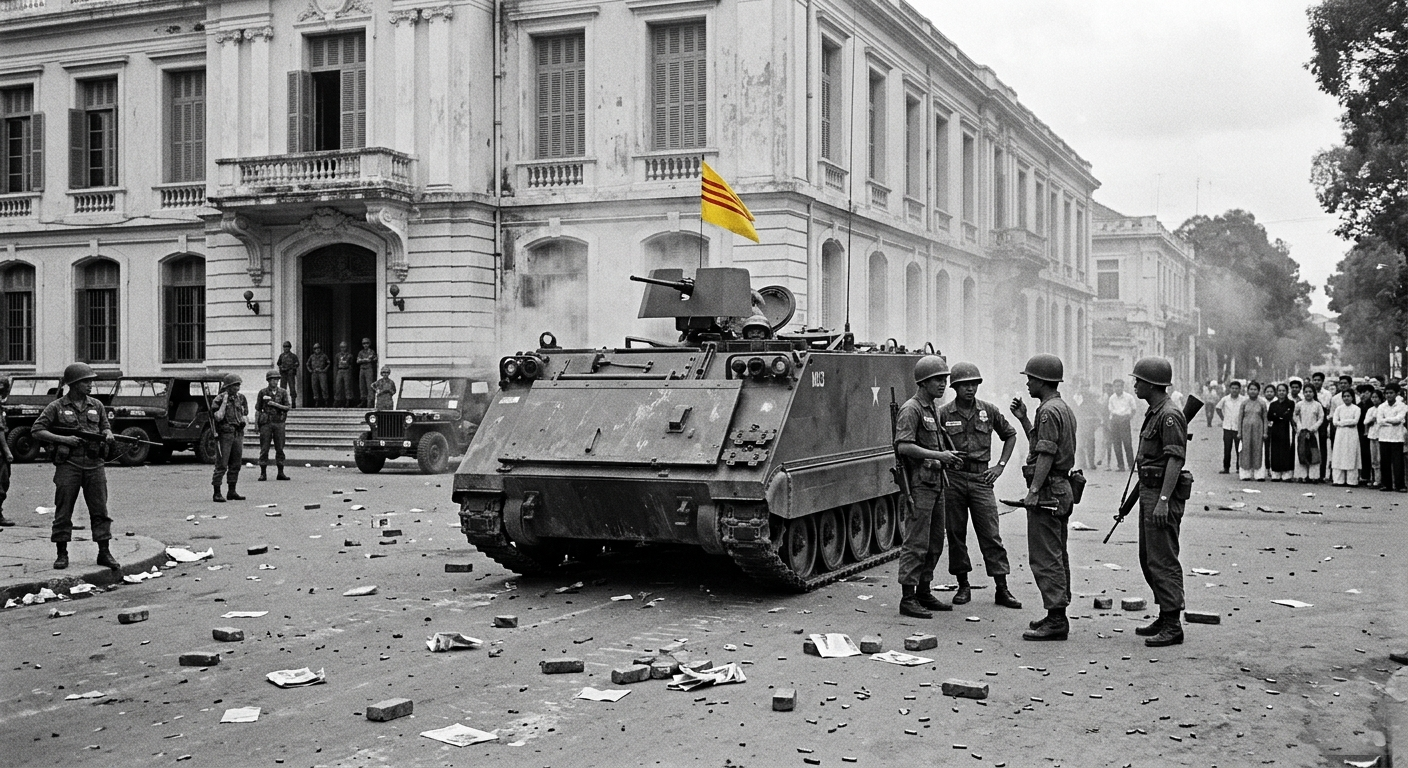
Shortly after midnight on November 2, 1963, CIA officer Lucien Conein received a message at his post in Saigon. Ngo Dinh Diem, the president of South Vietnam, and his brother and political adviser Ngo Dinh Nhu were dead. They had been captured a few hours earlier in a Catholic church in the Cholon district of Saigon after escaping from the besieged presidential palace, loaded into an armored personnel carrier, and shot at close range. The official story sent to Washington described the deaths as suicide. No one in the Kennedy administration believed it. President John F. Kennedy, when he was shown the cable the next morning by National Security Council aide Michael Forrestal, went pale and left the room. Secretary of State Dean Rusk and Secretary of Defense Robert McNamara were described as visibly shaken.
The assassination of Ngo Dinh Diem on November 2, 1963, was the culmination of a political crisis that had consumed South Vietnam and American foreign policy throughout 1963. It removed a leader who had governed South Vietnam since its creation, replaced him with a military junta of uncertain competence, and set in motion a spiral of political instability that would drag the United States ever deeper into the Vietnam War. Twenty days later, John F. Kennedy himself would be dead in Dallas, leaving his successors to manage the consequences of a policy decision that had already gone badly wrong.
Ngo Dinh Diem: The Man Who Built South Vietnam
Ngo Dinh Diem was born on January 3, 1901, in Quang Binh province in northern Vietnam, into one of the most prominent Catholic families in a country where Catholics were a minority. His father, Ngo Dinh Kha, was a high-ranking mandarin who had served Emperor Thanh Thai during the French colonial era. Diem was educated at French-language Catholic schools, considered entering the priesthood like his elder brother Ngo Dinh Thuc who would become an Archbishop, but chose instead the path of colonial administration. He rose rapidly, becoming governor of Binh Thuan Province in 1929 and Interior Minister to Emperor Bao Dai in 1933, a position he resigned the same year in protest at French refusal to grant Vietnam any genuine administrative autonomy.
After his resignation, Diem spent years in voluntary exile from government, establishing his reputation as an incorruptible Vietnamese nationalist who opposed both French colonialism and Communist insurgency with equal conviction. He spent several years living in the United States and Europe in the early 1950s, lobbying Catholic and political contacts for support and cultivating relationships with influential Americans including Cardinal Francis Spellman of New York and Massachusetts Senator John F. Kennedy. When the French colonial order collapsed with the military defeat at Dien Bien Phu in May 1954, and the Geneva Accords of July 1954 divided Vietnam at the 17th parallel into a Communist North and a non-Communist South, Bao Dai asked Diem to return as Prime Minister of the newly designated State of Vietnam.
Diem returned in July 1954, backed by the Eisenhower administration’s decision to support South Vietnam as a bulwark against the spread of Communism in Southeast Asia. He consolidated power with remarkable speed, defeating rival political and religious factions including the Binh Xuyen criminal organization and the Cao Dai and Hoa Hao religious sects. In October 1955, in a heavily manipulated referendum that produced an implausible 98.2 percent majority, Diem deposed Bao Dai, proclaimed himself president of the newly created Republic of Vietnam, and established what would prove to be a deeply personal and increasingly authoritarian style of rule.
Diem’s government was a family enterprise. His younger brother Ngo Dinh Nhu served as his political adviser, ran the Can Lao Party that functioned as the regime’s ideological backbone, and controlled the secret police with methods that included torture and assassination. Nhu’s wife, Tran Le Xuan, known universally as Madame Nhu, served as South Vietnam’s de facto First Lady and spokesperson, combining beauty and intelligence with a ferocity of temperament that generated international attention. Another brother, Ngo Dinh Can, effectively governed the central Vietnamese city of Hue as a personal fief. A third brother, Ngo Dinh Thuc, was the Catholic Archbishop of Hue. The Ngo family’s grip on power was total, personal, and explicitly Catholic in a country where Buddhists constituted between 70 and 90 percent of the population.
Religious Discrimination, the Buddhist Crisis, and the Self-Immolation That Shocked the World
The religious tensions that ultimately destroyed the Diem regime had been building for years. Catholic public servants and army officers were promoted on the basis of religious preference. Government contracts, American economic assistance, business favors, and tax concessions were preferentially awarded to Catholics. The Catholic Church was the largest private landowner in the country, and its holdings were exempt from land reform. In the countryside, Catholics were effectively exempt from the corvee labor obligations that burdened the majority Buddhist rural population.
The crisis erupted publicly in May 1963, when a law against the flying of religious flags was selectively enforced for the first time. The Buddhist flag was banned from display on Vesak, the birthday of the Buddha and the holiest day in the Buddhist calendar, while the Vatican flag flew freely nearby to celebrate the anniversary of the consecration of Archbishop Ngo Dinh Thuc, Diem’s own brother. When Buddhists defied the ban in the ancient imperial capital of Hue and gathered in public protest, government forces opened fire. Nine Buddhists died in what became known as the Hue Phat Dan shooting.
Rather than conciliate, the Diem government escalated. Diem blamed the killings on the Viet Cong rather than his own forces, refused to take responsibility, and rejected Buddhist demands for religious equality. The protests spread from Hue to Saigon. On June 11, 1963, at a Saigon intersection, the Buddhist monk Thich Quang Duc sat down in the lotus position, was doused in gasoline by two fellow monks, and lit himself on fire. He burned to death without moving or crying out. The photograph taken by AP journalist Malcolm Browne of the burning monk circled the globe within hours. President Kennedy, seeing the photograph, said it was “the most horrifying, saddening photograph I have ever seen.”
Madame Nhu’s response to the self-immolation was to describe it publicly as a “barbecue.” Her husband Ngo Dinh Nhu spoke of monks being “fried” with imported gasoline and said he would “clap hands” at another such protest. These statements, broadcast across the world, destroyed whatever remained of the Diem government’s international credibility. Through the summer of 1963, three more Buddhist monks and a nun immolated themselves. American officials privately concluded that the Diem government was unsalvageable as a partner in fighting the Viet Cong insurgency.
The American Decision: Cable 243, Henry Cabot Lodge, and the Kennedy Administration
The Kennedy administration’s response to the Buddhist crisis was divided and ultimately decisive. Some officials, including Ambassador Frederick Nolting, argued that Diem, for all his faults, was the most capable anticommunist leader available in South Vietnam and that withdrawing American support would create chaos more dangerous than Diem’s authoritarianism. General Paul Harkins, the commander of US military assistance in Vietnam, held similar views. Others, including Assistant Secretary of State Roger Hilsman and Presidential Adviser Michael Forrestal, concluded that Diem had become a liability whose brutality was alienating the South Vietnamese public and making the war against the Viet Cong unwinnable.
On August 21, 1963, Nhu’s Special Forces raided Buddhist pagodas across South Vietnam, arresting hundreds of monks, damaging sacred buildings, and causing deaths estimated in the dozens. The pagoda raids occurred while Diem was away from the capital. Many American officials initially believed the regular military had carried out the raids, but when it became clear that Nhu’s forces were responsible, it convinced the Kennedy administration that Nhu was effectively running the government and that his continued presence made reform impossible.
Three days later, on August 24, 1963, with President Kennedy and several senior officials away from Washington, a cable designated DEPTEL 243 was drafted by Roger Hilsman, Michael Forrestal, and Under Secretary of State George Ball and dispatched to the new US Ambassador Henry Cabot Lodge Jr., who had replaced Frederick Nolting in Saigon. The cable, which became known simply as Cable 243, instructed Lodge that if Diem refused to remove Nhu from power, “we must face the possibility that Diem himself cannot be preserved.” It authorized Lodge to inform South Vietnamese generals that the United States would not oppose a change in government. Lodge was told to tell the generals that the United States was “prepared to accept the obvious implication that we can no longer support Diem.”
Cable 243 effectively signaled that the Kennedy administration would not block a military coup against Diem. When Kennedy and his absent senior officials returned to Washington and reviewed the cable, there was disagreement about whether it had been authorized appropriately, but it was not rescinded. Historian John W. Newman described Cable 243 as the document “which set a course for the eventual coup in Vietnam.” Kennedy himself, recorded in secretly taped White House conversations, acknowledged that the situation in Saigon might require “doing something about Diem,” even while expressing reluctance about the implications.
The JFK Presidential Library’s account of Vietnam, Diem, and the Buddhist Crisis provides the most authoritative account of how the Kennedy administration’s relationship with Diem deteriorated through 1963 and how Cable 243 set in motion the events that led to the coup.
The Coup Plotters: General Duong Van Minh and the Military Conspiracy
The military officers who organized the coup against Diem had been discussing the possibility for months before the Buddhist crisis gave them both the motivation and the American encouragement they needed to proceed. General Duong Van Minh, known as “Big Minh” because of his imposing physical stature, was the senior figure in the coup and became the president of South Vietnam after Diem’s death. General Tran Van Don, another key plotter, served as the principal liaison between the conspirators and CIA operative Lucien Conein.
Conein was a colorful figure who had served with the OSS in Vietnam during the Second World War and had deep personal relationships with the South Vietnamese military going back almost two decades. He served as the operational link between the American intelligence community and the coup plotters, attending planning meetings and keeping Ambassador Lodge informed of the conspirators’ intentions and progress. His relationship with Tran Van Don was the channel through which the coup was monitored and encouraged.
Also involved were General Le Van Kim, who handled strategic planning, General Tran Thien Khiem, General Nguyen Khanh who would later seize power himself, and Colonel Le Quang Tung, the commander of Nhu’s Special Forces who was arrested and executed by the plotters on the first day of the coup before he could rally his forces to Diem’s defense.
On October 5, 1963, Conein met with Minh and delivered the message that the United States would not attempt to thwart a coup and would recognize a successor government if the coup was successful. The CIA supplied the generals with approximately $42,000 to reward military units that joined the coup. The plotters set the date for November 1, 1963, a public holiday when many loyal officers would be away from their posts.
November 1 to 2, 1963: The Coup and the Assassination
The coup began at 1:30 in the afternoon on November 1, 1963, when rebel military units moved on key installations across Saigon. General Le Quang Tung was arrested and killed. The Joint General Staff headquarters fell to the rebels. Naval vessels on the Saigon River were seized. At 4:30 in the afternoon, the generals broadcast a proclamation over national radio: “The day the people have been waiting for has come. For eight years, the people of Vietnam have suffered under the rotten, nepotic Diem regime, but now the armed forces have come to their rescue.”
Diem and Nhu were in the Gia Long Palace, now surrounded by rebel forces. Diem called Ambassador Lodge and asked what the American position was. Lodge replied that he had heard shots and was not in a position to know what was happening, a response of notable diplomatic evasiveness that communicated, without stating, that the United States was not going to intervene. Diem tried to negotiate, offering concessions and seeking time for loyal forces to arrive. He kept the rebels talking through the night of November 1, all the while quietly arranging to escape.
Shortly before midnight, Diem and Nhu slipped out of the palace through a tunnel and were driven by loyalist officers to a safe house in the Cholon district, the Chinese quarter of Saigon, where they took refuge at the home of a Chinese businessman named Ma Tuyen. From this location, Diem and Nhu maintained radio contact with the rebel generals, letting them believe the brothers were still in the palace. They also reached out to various loyalists and to foreign embassies seeking safe passage.
On the morning of November 2, realizing their position was hopeless, Diem telephoned the rebel headquarters and offered to surrender. He and Nhu were found at Saint Francis Xavier Catholic Church in Cholon, where they had taken refuge. An armored personnel carrier was sent to collect them. General Nguyen Van Xuan, a captain, and Major Duong Hieu Nghia were in the vehicle when it arrived. During the short drive to the Joint General Staff headquarters, both Diem and Nhu were shot at close range. Nhu was also stabbed multiple times. Both men died in the armored personnel carrier. When General Duong Van Minh’s aide, Captain Nguyen Van Nhung, arrived at the Joint General Staff headquarters and reported “mission accomplished,” it was announced to the world that the Ngo brothers had committed suicide.
The Wikipedia article on the arrest and assassination of Ngo Dinh Diem provides the most detailed account of the final hours of Diem and Nhu, the movements of the armored personnel carrier, and the conflicting accounts of who gave the order for the killings.
Kennedy’s Reaction and the Question of American Responsibility
When Michael Forrestal brought news of Diem’s death to the White House Cabinet Room on the morning of November 2, Kennedy’s reaction was witnessed by multiple people. He was visibly shocked, stood abruptly, and left the room. General Maxwell Taylor, the Chairman of the Joint Chiefs of Staff, described Kennedy as “absolutely shocked” and “deeply troubled.” Kennedy recorded in his diary that he felt “a strong, overwhelming feeling of guilt” and described the events as particularly shameful given that Diem had served his country for twenty years.
The administration’s public position was that the United States had no prior knowledge of or participation in the planning of the coup. This was plainly false. Kennedy had been told by Lodge in early November that the coup would likely occur on November 1. Cable 243 had explicitly signaled American acquiescence in regime change. Conein had met with the generals regularly, relayed American support, and provided operational funding. The CIA’s involvement was not publicly acknowledged for years.
The killings created a serious political and moral problem for the Kennedy administration that was compounded three weeks later when Kennedy himself was assassinated on November 22, 1963. The new president, Lyndon B. Johnson, was privately furious about the Diem coup and later told the journalist Stanley Karnow that it was “the worst mistake we ever made,” because it destabilized the South Vietnamese government and drew the United States into an ever-deeper commitment to support whoever succeeded Diem. Nixon would later echo this view, blaming the coup for creating the conditions that required American combat troops to be sent to Vietnam in 1965.
The Political Chaos That Followed and the Escalation of American Involvement
The military government that replaced Diem proved everything the Kennedy administration had feared and more. General Duong Van Minh became president, dissolved the National Assembly, and suspended the constitution. His government lasted less than three months before it was overthrown in a bloodless coup by General Nguyen Khanh on January 30, 1964. Khanh’s government was itself unstable, facing further coup attempts and political upheaval through 1964 and 1965.
The succession of weak and unstable governments that followed Diem’s death confirmed what the administration had most feared: that Diem, for all his authoritarianism and brutal incompetence in managing political dissent, had been the only figure capable of holding South Vietnam together through personal authority. North Vietnamese leaders had predicted this outcome with accuracy. The official North Vietnamese newspaper noted that in overthrowing Diem, “the US imperialists have themselves destroyed the political bases they had built up for years.”
The Britannica article on Ngo Dinh Diem covers his full political career from his rise under Emperor Bao Dai through his American-backed presidency and the Buddhist crisis that ended it, placing his assassination in the context of the Vietnam War’s escalation under his successors.
By 1965, Lyndon Johnson had concluded that no South Vietnamese government was capable of defeating the Viet Cong without direct American military support, and he authorized the deployment of American combat troops to Vietnam, beginning the full-scale American military engagement that would last until 1975 and cost more than 58,000 American and millions of Vietnamese lives. The road to that escalation ran through the armored personnel carrier in Cholon on November 2, 1963, where the president the United States had built, supported, grown frustrated with, and ultimately helped to overthrow was killed by the generals who replaced him.
Ngo Dinh Diem was buried in an unmarked grave in Saigon, attended only by a small number of loyal officers. His brother Nhu was buried beside him. When South Vietnam fell to North Vietnam in April 1975, both graves were destroyed. The man who had been South Vietnam’s first and longest-serving president left no memorial in the country he had governed for nine years.