
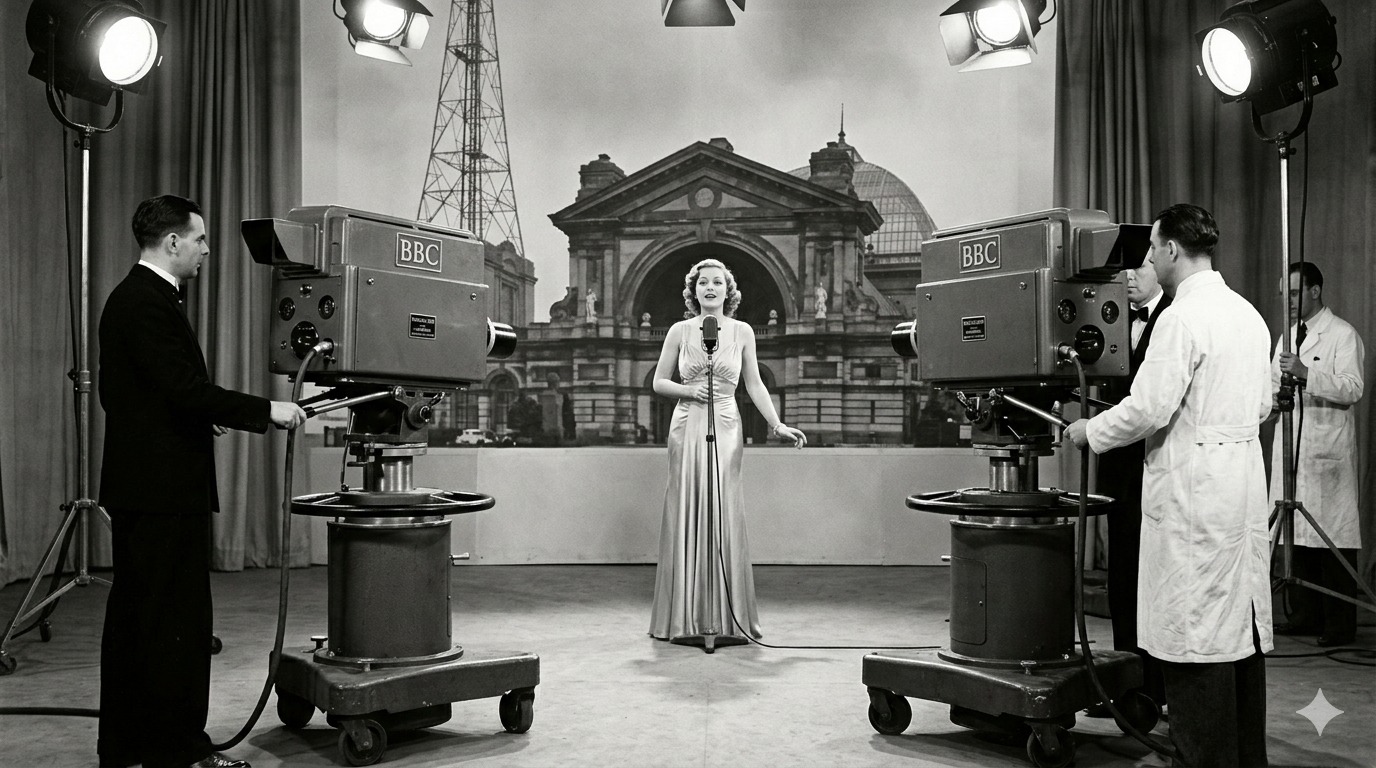
At precisely 3:00 in the afternoon on November 2, 1936, the British Broadcasting Corporation launched the world’s first regularly scheduled high-definition television service from Alexandra Palace, a converted Edwardian entertainment complex perched on a hill overlooking north London. The opening ceremony began with formal speeches in a studio so darkened by technical requirements that the announcer, Leslie Mitchell, had to memorize his opening lines because he could not read from a script in the gloom. He introduced a handful of dignitaries who gave commemorative addresses, and then television proper began. A variety programme followed, featuring singer Adele Dixon who performed a specially written song, the comedy duo Buck and Bubbles becoming the first Black performers in television history, the Chinese jugglers Loo Foh, and a short Movietone newsreel. Two hours later, at 5:00 p.m., the service went off the air.
That modest two-hour debut, reaching an audience of perhaps a few hundred people with television sets in the greater London area, was the beginning of one of the most transformative communications technologies in human history. The BBC Television Service that launched on November 2, 1936, was not simply another experimental broadcast. It was the world’s first regularly scheduled, publicly available, high-definition television service, the moment at which television moved from laboratory curiosity to an ongoing public institution. Everything that followed, from the evening news to live sports coverage to the modern streaming era, traces its origins to that afternoon at Alexandra Palace.
John Logie Baird and the Long Road to Television
The story of the BBC Television Service does not begin on November 2, 1936. It begins more than a decade earlier, in a small workshop above a shop on Frith Street in Soho, London, where a Scottish inventor named John Logie Baird was attempting to do something that most of the scientific establishment considered impossible: transmit a live moving image by wireless.
Baird was born in 1888 in Helensburgh, Scotland, the son of a Church of Scotland minister. He had been fascinated by electricity and communications since childhood, had attempted various commercial ventures with limited success, and had turned to television research in the early 1920s with the obsessive focus of a man who believed he was pursuing something genuinely important. Working with crude materials, including hatboxes, darning needles, bicycle lamp lenses, and a tea chest, he built primitive scanning devices that formed images through mechanical means, using a spinning disc with holes punched in a spiral pattern to scan a subject and transmit the resulting electrical signals.
On January 26, 1926, Baird gave a public demonstration of his system to members of the Royal Institution at his Soho laboratory, transmitting images of a ventriloquist’s dummy named Stooky Bill between rooms. The images were crude, flickering, and low in resolution, but they moved, and the witnesses who saw them understood they had seen something genuinely new. Baird had demonstrated the first true television system before a public audience, a milestone that established his claim to be the inventor of television even though the technology he used would ultimately be superseded.
In April 1925, he had demonstrated his system at Selfridges in Oxford Street, drawing hundreds of curious visitors to examine what the papers called the “seeing machine.” Following further demonstrations, Baird lobbied for access to BBC broadcasting infrastructure, and after considerable resistance from the Corporation, which was skeptical of the technology’s quality and wary of diverting resources from radio, he was allowed to use the BBC’s London transmitter 2LO for experimental broadcasts beginning on September 30, 1929. The BBC, then still finding its identity as a public broadcaster under the fierce leadership of its first Director-General John Reith, was entering the television age reluctantly.
The BBC Under John Reith and the Decision to Build a Television Service
The BBC had been established as the British Broadcasting Company in November 1922 and transformed into the British Broadcasting Corporation by Royal Charter on January 1, 1927, under the direct influence of John Charles Walsham Reith, its founding managing director and first Director-General. Reith was a formidable and autocratic figure who had shaped the BBC into an institution devoted to what he called public service broadcasting, a philosophy combining information, education, and entertainment delivered with serious intent and high standards. He was famously ambivalent about television: he reportedly described the medium as a “potential social menace of the first magnitude” and compared its social impact to “smallpox, bubonic plague, and the Black Death.”
Despite Reith’s reservations, the Corporation could not ignore the growing public and political interest in television. Baird’s experimental 30-line broadcasts via the BBC’s transmitter attracted coverage and interest throughout the early 1930s. In May 1934, the British government, acting through the General Post Office which then held responsibility for broadcasting regulation, established a formal committee to investigate the development of a public television service. The committee, chaired by Lord Selsdon and known as the Selsdon Committee, was tasked with examining all available television systems and recommending the best path forward.
The Selsdon Committee’s report, published in January 1935, was decisive. It recommended that the BBC should build a high-definition television service, defined at the time as any system producing 240 lines or more, and that this service should be developed in competition between two systems: the mechanical scanning system developed by the Baird Television Company and the fully electronic system developed by Electric and Musical Industries, known as EMI, which had entered a partnership with the Marconi Company and become Marconi-EMI. Alexandra Palace, a large Victorian and Edwardian public entertainment venue on a hill in north London that had fallen into disuse, was selected as the transmission site because its elevation gave the transmitter the best possible coverage over the London area.
The Two Systems: Baird vs. Marconi-EMI and the Technology Race
The competition between the Baird system and the Marconi-EMI system that was built into the BBC Television Service from its beginning was one of the defining technological contests of the 1930s, and its outcome shaped the direction of global television for decades.
John Logie Baird’s system was built on the mechanical scanning principle he had pioneered through the 1920s. By 1936 his team, operating under Technical Director Captain A.G.D. West, had developed an “intermediate film system” that operated at 240 lines and used film as an intermediate medium to capture and transmit images. The system involved filming live scenes on 35mm film, processing the film almost instantly in a continuous chemical bath, and then scanning the developed film electronically for transmission. It was an elaborate, ingenious, and ultimately cumbersome solution to the limitations of Baird’s mechanical approach.
Marconi-EMI, by contrast, had developed a fully electronic system using the Emitron camera tube, an electronic device that captured images directly without any mechanical or film intermediary. The Emitron was related to the Iconoscope developed by Vladimir Zworykin at RCA in the United States, and Marconi-EMI had worked with RCA to develop its technology. Their system operated at 405 lines, nearly double the resolution of the Baird system, and the Emitron cameras were more flexible and easier to operate, allowing camera operators to move and pan in ways that Baird’s fixed cameras could not.
EMI’s chief television researcher was Isaac Shoenberg, a Russian-born engineer of exceptional talent who had previously worked for the Gramophone Company and who drove the development of the 405-line standard with methodical precision. His team included Alan Dower Blumlein, one of the most gifted engineers in British history, who made fundamental contributions to stereo sound and television scanning and whose work formed the technical core of the Marconi-EMI submission. The 405-line system that Shoenberg and Blumlein’s team developed at EMI’s Hayes laboratory became the global benchmark for electronic television.
The detailed technical history of how the BBC evaluated and ultimately chose between these two competing television systems is covered in the Wikipedia article on the BBC Television Service, which documents the Selsdon Committee process, the trial period, and the final decision to adopt the Marconi-EMI standard.
November 2, 1936: The Opening Day of Regular Television Broadcasting
The BBC Television Service launched at 3:00 p.m. on November 2, 1936. The question of which system would broadcast first had been decided by a coin toss. The Baird Company won the toss, meaning that their intermediate film system would present the opening ceremony and first programme. Marconi-EMI repeated the identical programme later that afternoon, giving both systems an equal first day.
The opening of the Baird broadcast was presented by announcer Leslie Mitchell from the Baird spotlight studio, a pitch-dark room in which a scanning light was passed across the presenter’s face to be picked up by photocells. The darkness required for the scanning process meant that presenters could not read scripts. The studio conditions were described by those who worked in them as demanding and often uncomfortable. Joan Miller, a Canadian actress who served as the Switchboard Girl for the production, was cued to camera by a wire attached to her ankles that gave her a mild electric shock when she was due to appear on screen.
The variety programme that followed the opening speeches included Adele Dixon, who performed a song written especially for the occasion. Buck and Bubbles, the American comedy and dance duo, became, according to Guinness World Records, the first Black performers to appear on television. The Chinese juggling act of Loo Foh completed the live entertainment, and a British Movietone newsreel closed the first day’s broadcasting.
The service was available for two hours per day from its launch, broadcast Monday to Saturday between 3:00 and 4:00 in the afternoon and between 9:00 and 10:00 in the evening. It could be received within a 25-mile radius of the Alexandra Palace transmitter. Television sets were expensive items beyond the reach of ordinary households, and the number of viewers at the service’s launch is estimated at no more than a few hundred, rising to perhaps a few thousand as set ownership gradually increased over the following months. The sets available to early viewers produced images on screens measuring around nine inches diagonally, in black and white, and required careful antenna alignment to receive properly.
The Coin Toss Result, the Crystal Palace Fire, and the End of the Baird System
The alternating weekly competition between the Baird and Marconi-EMI systems continued as planned through November and December 1936, but events would soon bring it to an abrupt and decisive conclusion.
On November 30, 1936, a catastrophic fire destroyed much of the Crystal Palace in south London, the great iron and glass exhibition hall built for the Great Exhibition of 1851 that had been re-erected in Sydenham. The Crystal Palace fire also destroyed significant portions of the Baird research facilities and equipment stored on the site, wiping out years of development work. The timing, coming just four weeks after the launch of the television service, was disastrous for the Baird Company’s competitive position.
The comparison between the two systems in operation had already been telling a clear story. The Baird intermediate film system was technically demanding, inflexible, and required elaborate processing equipment that made spontaneous or live outdoor broadcasting essentially impossible. The Marconi-EMI Emitron cameras were portable enough to be taken outside, flexible in operation, and capable of significantly higher image quality. Television critics and BBC engineers alike found the Marconi-EMI picture consistently superior.
In February 1937, the BBC announced its decision to discontinue the Baird system and adopt the Marconi-EMI 405-line standard exclusively. The decision ended John Logie Baird’s formal involvement with the BBC television service that he had in many ways made possible. He continued to work on television technology until his death in 1946, demonstrating color television as early as 1938 and high-definition stereoscopic television in 1941, but he was never again directly involved in the British broadcasting infrastructure. His contribution to making television real had been decisive; his system had been superseded by better technology.
The Britannica article on John Logie Baird covers his pioneering demonstrations of the 1920s, his collaboration with the BBC during the experimental years, and the fate of his mechanical television system after the Marconi-EMI standard was adopted for the BBC Television Service in 1937.
Programming, Early Viewers, and the Television Audience of 1936 to 1939
Between November 1936 and September 1939, the BBC Television Service produced an ambitious and eclectic range of programming that demonstrated the medium’s potential even at its earliest stage. The series Picture Page, which launched during the trial period before the service’s official opening and continued as a regular feature afterward, offered a variety of short segments hosted by a presenter who would speak with performers, celebrities, and ordinary people. It established the talk-show format that television would develop extensively in later decades.
Drama was an early priority. The BBC produced original television plays and adapted theatrical works for the small screen, working within the significant constraints imposed by the small studio space, the demanding lighting requirements, and the limited mobility of both performers and cameras. Outside broadcasts, once the Emitron cameras made them technically feasible, brought the Oxford and Cambridge Boat Race, tennis from Wimbledon, and cricket from Lord’s Cricket Ground to television viewers for the first time. The coronation procession of King George VI on May 12, 1937, brought an estimated 50,000 viewers to screens across the London area, demonstrating television’s power as a medium for major public events.
By 1938, the number of television sets in use had grown to approximately 3,000. By the outbreak of war in September 1939, estimates suggest between 20,000 and 25,000 homes in the London area had television sets. These figures were small by any later standard, but they represented a genuine if modest audience for a technology that had existed as a public service for less than three years.
The War Shutdown and the Resumption of Broadcasting in 1946
On September 1, 1939, as German forces invaded Poland and Britain prepared to enter the Second World War, the BBC Television Service was abruptly shut down. The transmissions ceased in the middle of a Mickey Mouse cartoon. The official reason given was that the television transmitter could be used by German aircraft as a navigational beacon, potentially guiding bombers toward London. The Alexandra Palace transmitters were decommissioned, the studios were requisitioned, and the BBC’s television staff were largely transferred to other wartime duties.
The television service remained off the air for nearly seven years. When it resumed on June 7, 1946, the announcer Jasmine Bligh picked up from exactly where the service had stopped, saying with characteristic BBC understatement, “Good afternoon, everybody. How are you? Do you remember me, Jasmine Bligh?” The same Mickey Mouse cartoon that had been interrupted in 1939 was broadcast again, and then regular programming resumed.
The post-war resumption occurred in a different world. Television set manufacturing, which had been halted during the war, restarted with renewed energy. The coronation of Queen Elizabeth II on June 2, 1953, which was broadcast live on the BBC and watched by an estimated 27 million viewers in Britain, approximately 56 percent of the adult population, was the moment television crossed from minority interest to genuinely mass medium. More people watched the coronation on television than listened to it on radio, a symbolic handover of the most important cultural medium in British life.
The History.com overview of the BBC’s founding and early history provides context for the BBC Television Service’s place in the broader development of television technology worldwide, from Baird’s early experiments through the post-war explosion of television ownership that transformed British and American society.
The BBC Television Service that launched on November 2, 1936, in a converted palace on a north London hill, with two hours of programming and a handful of viewers, became the foundation on which the modern television industry was built. The 405-line standard it established served British broadcasting until 1985. The public service model of television it embodied influenced broadcasters across the world. The programming traditions it developed, from outside broadcasts of live events to television drama to news journalism, became the conventions through which television shaped culture, politics, and daily life in the twentieth century and beyond. EMI technician E.B. White captured the stakes as television was launching when he wrote: “We shall discover a new and unbearable disturbance of the modern peace, or a saving radiance in the sky. We shall stand or fall by television.” The fall, when it came, was into the arms of an audience that would never let go.