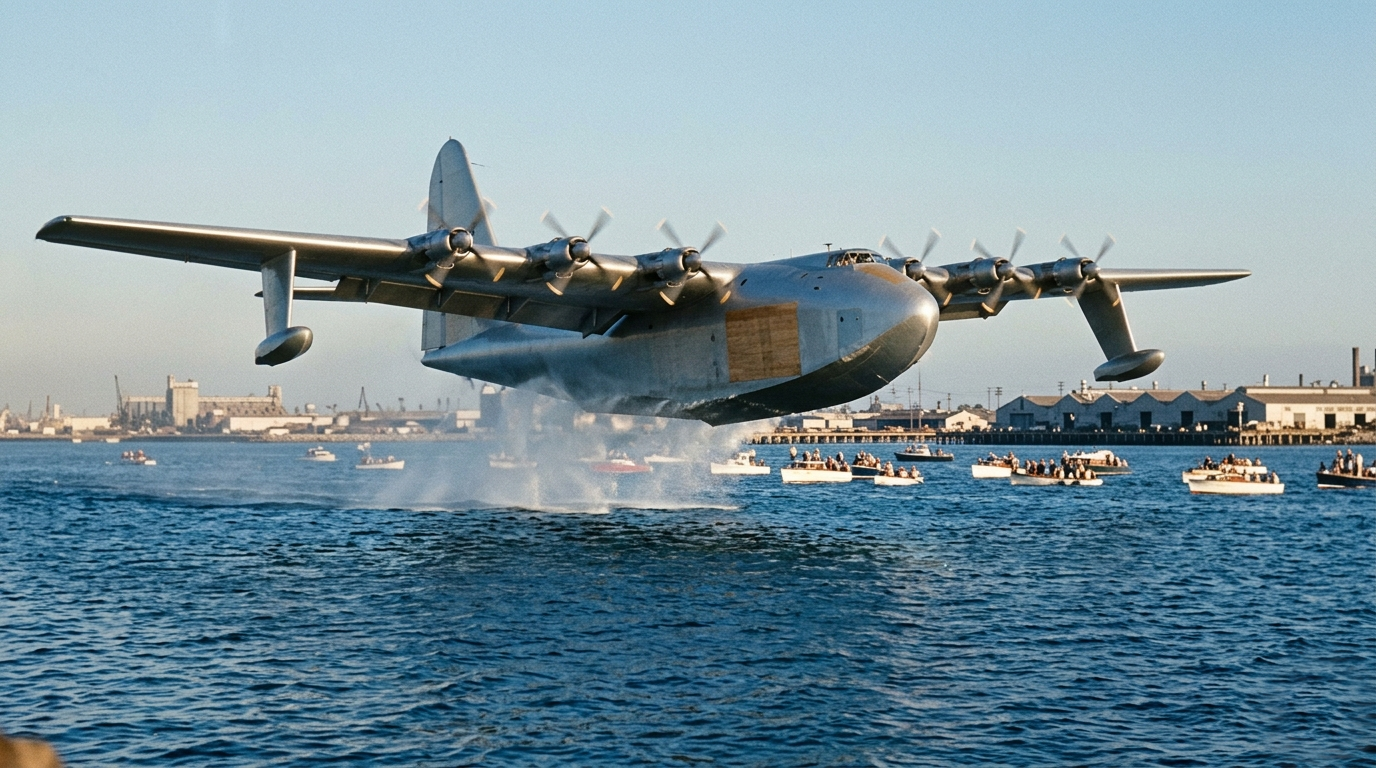
Shortly after 2:00 in the afternoon on November 2, 1947, the Hughes H-4 Hercules eased across the surface of Long Beach Harbor, California, in what was supposed to be a routine taxi test. Howard Hughes sat at the controls of the largest flying boat ever built, surrounded by a flight crew of thirty-six men, with dozens of journalists and government officials watching from boats and the harbor dock. The enormous aircraft accelerated across the water for the third time that afternoon. And then, without warning, Hughes pulled back on the controls. The H-4 Hercules lifted off the surface of the harbor, climbed to approximately 70 feet, and flew for roughly one mile before settling gently back onto the water.
The flight lasted between 26 seconds and one minute depending on which account you trust. It covered less distance than a freeway off-ramp. The aircraft never flew again. But in those few seconds, Howard Hughes had vindicated years of work, $23 million in development costs, a congressional investigation into his financial dealings, and his own fierce pride. The Spruce Goose, as the press had mockingly dubbed the aircraft, had proved it could fly. The question of whether it should have been built in the first place was a different matter entirely.
Howard Hughes: Aviator, Filmmaker, and the Man Who Dreamed Too Big
To understand the Spruce Goose, it is necessary to understand the man who built it. Howard Robard Hughes Jr. was born on December 24, 1905, in Humble, Texas, the son of Howard Hughes Sr., who had made a considerable fortune through the Hughes Tool Company, which manufactured an innovative rotary drill bit that dominated the oil drilling industry. When Howard Sr. died in 1924, his eighteen-year-old son inherited control of the company, became an emancipated minor to take legal control of his estate, and within a few years had used his oil fortune to launch himself into two of the most glamorous industries of the twentieth century: Hollywood filmmaking and aviation.
Hughes directed the celebrated World War I aerial epic Hell’s Angels in 1930, which remains famous for its spectacular aerial sequences filmed with actual aircraft. He founded the Hughes Aircraft Company in 1932 and spent the following decade building and personally flying aircraft of his own design, setting multiple world air speed records. In 1935, he set a new land-plane speed record of 352 miles per hour in the Hughes H-1 Racer. In 1937, he broke the transcontinental flight-time record. In 1938, he flew around the world in a record three days, nineteen hours, and fourteen minutes, returning to New York to a ticker-tape parade that rivaled those given to Charles Lindbergh. He won the Harmon Trophy in both 1936 and 1938, the Collier Trophy in 1938, and the Congressional Gold Medal in 1939.
Hughes was also the majority stockholder of Trans World Airlines, which he had acquired and built into a major international carrier, making him a powerful figure in both the aviation industry and in Washington. His combination of technical genius, enormous wealth, personal courage as a pilot, and relentless ambition made him one of the most celebrated figures in American public life. He was also, by the mid-1940s, showing signs of the obsessive compulsive disorder and increasing psychological eccentricity that would consume his later decades.
The Wartime Crisis and Henry Kaiser’s Vision for a Flying Transport
The specific project that became the Spruce Goose was born from a genuine and urgent wartime crisis. In 1942, German U-boats were inflicting devastating losses on Allied shipping in the Atlantic Ocean. By July 1942, an estimated 681 Allied ships had been sunk in just seven months. The United States and its allies were struggling to maintain the supply lines of men, material, and equipment that sustained the war effort. Conventional surface transport across the Atlantic was dangerous and increasingly costly in lives and ships.
Henry Kaiser was one of the great American industrialists of the war era. An Oakland-based aluminum magnate and shipbuilder who had become famous for building Liberty Ships at an unprecedented pace through his Richmond shipyards, Kaiser had an instinct for massive logistical projects. He conceived the idea of building a gigantic flying transport that could carry troops and supplies across the Atlantic at altitude, above the reach of U-boats and their torpedoes. Kaiser lacked the engineering and aviation expertise to design such an aircraft himself, so he turned to his friend Howard Hughes, whose Hughes Aircraft Company had both the technical capability and the imagination to attempt the project.
In 1942, the War Production Board contracted with the newly formed Kaiser-Hughes Company to build three prototypes of what was designated the HK-1 Hercules, a massive flying boat intended to carry 750 passengers or equivalent cargo loads across the Atlantic. President Franklin D. Roosevelt personally overrode the objections of military experts who opposed the project on the grounds that it would divert resources from higher-priority programs, authorizing the project against their advice. The government’s contribution to the development cost was a contract for $18 million, though the actual total cost would eventually reach approximately $23 million, with Hughes personally absorbing the overruns.
The project’s most famous constraint was also its most distinctive characteristic. Wartime restrictions on aluminum and other strategic metals meant that the aircraft had to be built from alternative materials. Hughes chose to build the H-4 from birchwood laminated with plastic and covered with fabric, a technique called Duramold that had been developed for aircraft production and that produced a structure of remarkable rigidity and strength. The decision gave the aircraft its defining material identity, and though critics mockingly called it the Spruce Goose, the aircraft was almost entirely birch, not spruce.
The Technical Specifications: The Largest Flying Boat Ever Built
The Hughes H-4 Hercules was, by any measure, an extraordinary machine. Its wingspan measured 319 feet, or approximately 97 meters, making it the longest wingspan of any aircraft ever built at the time. That record stood until 2019, when the Stratolaunch model 351 rocket-launching aircraft surpassed it with a 385-foot wingspan. The H-4 Hercules remains the largest flying boat ever built and the heaviest wooden aircraft ever flown. It was eight stories tall, weighed over 300,000 pounds fully loaded, and was powered by eight Pratt and Whitney R-4360 Wasp Major radial engines, each an extraordinary 28-cylinder, air-cooled behemoth producing 3,000 horsepower. With all eight engines running, the aircraft was capable of generating 24,000 horsepower, more than any aircraft of its time.
The interior of the aircraft was designed to accommodate 750 fully equipped troops or two Sherman tanks and an equivalent weight of additional cargo. The fuselage was divided into upper and lower decks with sufficient headroom to move about comfortably. The flight deck, set high above the fuselage in the distinctive flying boat style, provided the pilot and flight crew with an extraordinary view of the surroundings. The aircraft required a crew of thirty-six to operate fully.
The construction was carried out at Hughes’s facility in Westchester, California. Henry Kaiser had dropped out of the project early, in 1944, when the delays and costs became evident and when it was clear the aircraft would not be completed in a timeframe relevant to the war it was designed to serve. Hughes continued alone, driven by a combination of pride, personal commitment to the engineering challenge, and the contractual obligations he had accepted.
The Wikipedia article on the Hughes H-4 Hercules provides the complete technical specifications of the aircraft, the detailed construction history, and the full account of the November 2, 1947 flight and its aftermath.
The Senate Investigation: Owen Brewster, Pan Am, and the Political Battle of 1947
By the time the war ended in 1945, the H-4 Hercules had consumed $23 million and had not yet flown. The political climate in Washington had turned hostile to large wartime contracts that had produced no delivered aircraft, and Hughes’s powerful enemies in Congress saw an opportunity to damage both his business interests and his reputation.
Senator Owen Brewster of Maine chaired the Senate War Investigating Committee and launched an investigation into the H-4 Hercules project and a second Hughes aircraft program, the XF-11 reconnaissance aircraft. The committee charged that Hughes had wasted government funds, misused the development contracts, and failed to deliver the aircraft that had been paid for. The investigation was formally about government contract oversight, but Hughes and his allies alleged that the real motivation was considerably more personal and commercial.
Hughes publicly charged that Brewster was acting as a political instrument of Juan Trippe, the president of Pan American World Airways. Hughes’s Trans World Airlines competed directly with Pan Am on international routes, and Hughes alleged that Brewster had personally approached him and offered to end the Senate investigation if Hughes would agree to merge TWA with Pan Am, effectively eliminating his major competitor. When Hughes refused, Brewster’s investigation intensified.
The Senate hearings in August 1947 were among the most dramatic public spectacles of the post-war era. Hughes flew to Washington personally, piloting his own aircraft to the capital, and testified before the committee in an appearance that transfixed the nation. He turned the tables on his accusers with such effectiveness that by the time the hearings ended, Brewster’s reputation had suffered more damage than Hughes’s. The committee disbanded without issuing a formal report. Hughes emerged in public opinion as the underdog who had taken on a corrupt political establishment and won. He returned to California with his credibility restored and his determination to fly the H-4 Hercules apparently hardened into an immovable personal commitment.
November 2, 1947: The Flight That Silenced the Critics
The Senate hearings had placed enormous pressure on Hughes to demonstrate that the H-4 Hercules was a genuinely capable aircraft rather than an expensive folly. On November 2, 1947, with the committee’s scrutiny fresh in public memory, Hughes took the H-4 to Long Beach Harbor for what were publicly described as taxi tests. A large crowd of journalists, government observers, and harbor spectators had gathered expecting nothing more dramatic than to watch the enormous aircraft move across the water.
Hughes conducted two taxi runs across the harbor without incident. On the third run, he increased the throttle to higher power settings than he had used before, accelerating the aircraft to takeoff speed. And then, as the H-4 lifted off the water and climbed to approximately 70 feet above the harbor surface, the onlookers realized they were witnessing something that many of them had been told was impossible.
The accounts of the flight’s exact duration and distance vary among sources. The most conservative estimates put it at 26 seconds covering roughly half a mile at 80 miles per hour. More generous accounts describe a flight of approximately one minute covering nearly one mile at an altitude of 70 feet. Hughes later told reporters that the flight had not been planned in advance as an unannounced demonstation. Whatever the precise details, the aircraft had flown, its eight engines had performed, and it had demonstrated that a 300,000-pound wooden flying boat could indeed become airborne and be controlled in flight by a skilled pilot.
The reaction was immediate. Supporters celebrated the flight as a vindication of both the concept and the engineering. Critics who had dismissed the aircraft as technically unfeasible were forced to concede that it flew. Hughes himself was characteristically understated in his public comments, presenting the flight as a natural development of the day’s testing program rather than the culmination of five years of effort and $23 million in development costs.
The History.com account of the Spruce Goose flight covers the events of November 2, 1947, in detail, including the political context of the Senate investigation that made the flight both necessary and politically significant.
Why the Spruce Goose Never Flew Again
Despite the success of the November 2 flight, the Hughes H-4 Hercules never took to the air a second time. Several converging factors made a second flight both practically difficult and financially pointless.
The most fundamental problem was that the aircraft’s original purpose had evaporated. The war it was designed to serve had ended in August 1945, more than two years before the H-4 flew. The immediate postwar years saw rapid advances in land-based long-range transport aircraft, including the Lockheed Constellation and the Boeing 377 Stratocruiser, which were both more practical and less expensive to operate than the enormous flying boat. The massive logistical justification that had driven the project, the need to carry troops and supplies across the Atlantic beyond the reach of U-boats, had entirely disappeared.
Critics also raised technical concerns about the aircraft’s structural limitations. Some engineers argued that the birchwood construction, however innovative, could not provide the sustained structural integrity required for regular long-distance operations, that the aircraft was too large and too delicate for the commercial rigors of scheduled service, and that the cost per seat mile would be completely uncompetitive with land-based alternatives. The H-4 had proved it could fly. Whether it could fly economically, reliably, and repeatedly was a different question that Hughes chose not to answer.
Hughes, however, refused to dismantle the aircraft or allow it to be scrapped. He maintained the H-4 Hercules in a temperature-controlled hangar at Long Beach Harbor at a reported cost of approximately one million dollars per year, keeping it fully operational and ready to fly. He employed a small crew of maintenance specialists who kept the engines, the wood structure, and the mechanical systems in condition. This continued for more than thirty years, until Hughes’s death in 1976. It was an act of personal conviction, stubbornness, and perhaps sentiment that sustained one of the great engineering artifacts of the twentieth century against all economic logic.
Legacy, Preservation, and the Spruce Goose Today
After Howard Hughes died on April 5, 1976, aboard an aircraft en route from Acapulco to Houston at the age of seventy, the future of the H-4 Hercules became uncertain. The Aero Club of Southern California reached an agreement with the Summa Corporation, Hughes’s holding company, to keep the aircraft on public display in Long Beach near the Queen Mary ocean liner. It was exhibited there for many years as a major tourist attraction, drawing hundreds of thousands of visitors who could walk through the lower deck and appreciate the extraordinary scale of the wooden giant.
In 1992, the Evergreen Aviation and Space Museum in McMinnville, Oregon, acquired the H-4 Hercules and transported it there in sections for permanent display. It was reassembled and became the centerpiece of the museum’s collection, housed in a purpose-built structure large enough to display the aircraft with its full wingspan. The museum, founded by Evergreen International Aviation chairman Delford Smith, was specifically designed around the aircraft, which is now known formally as the Evergreen Aviation and Space Museum and houses the original H-4 Hercules as its primary attraction.
The Britannica entry on Howard Hughes covers his full career from Texas oil heir through Hollywood filmmaker, record-setting aviator, and defense contractor, including the Senate hearings and the single flight of the H-4 Hercules that defined the public memory of his most ambitious project.
The legacy of the Spruce Goose extends beyond its single brief flight. It was the largest aircraft in the world at the time it flew, and it remained the largest flying boat in history. The engineering challenges it overcame in building a 319-foot wooden aircraft powered by eight of the most powerful piston engines ever made represented genuine accomplishments of materials science, aeronautical engineering, and manufacturing organization. Martin Scorsese’s 2004 biographical film The Aviator, starring Leonardo DiCaprio as Hughes and Alan Alda as Senator Brewster, brought the story of the H-4 Hercules and the Senate hearings to a new generation of audiences and won five Academy Awards.
For one mile of the sky above Long Beach Harbor on November 2, 1947, Howard Hughes had proved what no one else had been willing to attempt: that a 300,000-pound wooden flying boat with a wingspan longer than a football field could be lifted into the air, controlled in flight, and returned safely to the water. In the aviation industry, proving a thing works, even once, is not nothing. But the Spruce Goose was never built to prove a point. It was built to win a war. By the time it flew, that war was two years over, and no one needed it anymore.