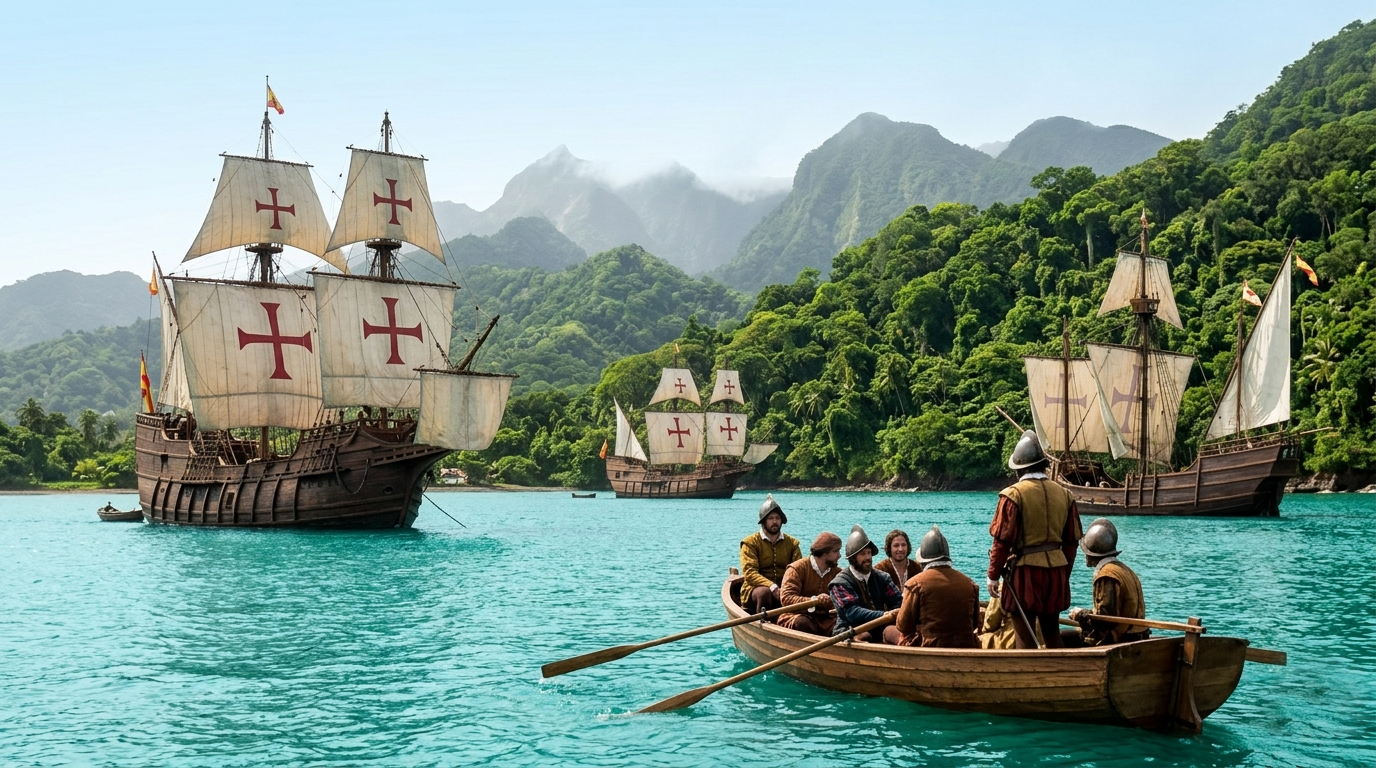
On the morning of November 3, 1493, a lookout aboard one of seventeen Spanish ships spotted land rising steeply from the Caribbean Sea. The fleet had been at sea for twenty-one days since leaving the Canary Islands, sailing on a more southerly course than Christopher Columbus had taken on his first voyage two years earlier. The island the sailors saw before them rose sharply from the water, covered in dense tropical forest that ran almost to the shoreline. Columbus named it Dominica, from the Latin dies dominica, meaning the Lord’s Day, because Sunday was the day on which it was sighted. The island had another name already, one given to it by the people who had lived there for centuries: Waitukubuli, meaning “tall is her body,” a reference to its dramatic mountain ridges that are among the highest in the Lesser Antilles.
The discovery of Dominica on November 3, 1493, was the first landfall of Columbus’s second voyage to the Americas, and it marked the beginning of the most ambitious European expedition to the New World that had yet been attempted. Where the first voyage had been a small-scale exploratory mission with three ships and ninety men, the second came with seventeen ships, approximately 1,200 to 1,500 men, a deliberate colonization agenda, a contingent of Catholic missionaries, and a mandate from the Spanish Crown to establish permanent settlements in the territories Columbus had claimed. Dominica was the door through which that vast and consequential enterprise entered the Caribbean.
The First Voyage’s Success and the Political Pressure for a Second
The second voyage that brought Columbus to Dominica was the product of the extraordinary reception his return from the first voyage had generated at the Spanish court. Columbus had arrived back in Palos, Spain, on March 15, 1493, after an absence of seven and a half months, carrying with him samples of gold, exotic plants including the previously unknown tobacco and pineapple, parrots, cotton, and a small number of Taino people he had taken from the islands he had visited. He traveled to Barcelona, where King Ferdinand II of Aragon and Queen Isabella I of Castile received him in a formal audience that acknowledged the magnitude of what he claimed to have found.
Columbus presented his case with characteristic skill and self-promotion. He argued that he had reached islands in the vicinity of Asia, that the lands he had found were rich in resources and populated by peoples who would be receptive to Christian conversion, and that permanent Spanish settlement was both possible and urgently necessary to secure the Spanish claim against potential Portuguese encroachment. The monarchs were persuaded. The Treaty of Tordesillas, signed with Portugal in June 1494 and dividing the non-European world between the two powers along a meridian 370 leagues west of the Cape Verde Islands, would formalize the division, but the planning for the second voyage was already underway before the treaty was concluded.
Columbus was appointed Admiral of the Ocean Sea, Viceroy and Governor of the Indies, titles that granted him extraordinary authority over any lands he might discover and claimed to make him the supreme civil and military ruler of the new territories. He departed from Cadiz on September 25, 1493, leading the largest fleet that had yet crossed the Atlantic. The seventeen ships carried colonists, soldiers, horses, cattle, pigs, seeds, and agricultural tools. Twelve priests, including Father Bernal Buil, who had been appointed by Pope Alexander VI as the spiritual authority for the expedition, sailed with the fleet to begin the work of converting the indigenous peoples of the Caribbean to Christianity.
Planning the Second Voyage and the Route to Dominica
Columbus had learned from the first voyage that the trade winds in the central Atlantic blow reliably westward toward the Caribbean in the latitude band between approximately fifteen and twenty-five degrees north. On his first voyage, he had sailed from the Canary Islands at a latitude of about twenty-eight degrees north, which had brought him to the Bahamas in the northwestern Caribbean. For the second voyage, he deliberately took a more southerly route from the Canaries, aiming to reach the Lesser Antilles, the chain of smaller islands that forms the eastern boundary of the Caribbean Sea, islands that the Taino people he had brought back from the first voyage had told him were inhabited by the Carib people.
The fleet stopped at Gomera in the Canary Islands and departed from there on October 13, 1493. The crossing of the Atlantic took twenty-one days, a remarkably fast passage given the size of the fleet. During the crossing, Columbus maintained discipline among his officers and crew, organized the fleet into a tight formation, and navigated using his practiced system of dead reckoning combined with celestial observation. The fleet arrived at the Lesser Antilles in the early hours of November 3, 1493, sighting land at approximately three in the morning.
The island they first saw was Dominica. Columbus ordered the fleet to stand off until daylight before approaching the coast, allowing his officers and the members of the expedition to see clearly what they had found. As the sun rose on November 3, the crew of seventeen ships observed an island of extraordinary natural beauty and formidable terrain. The volcanic mountains of Dominica rise to nearly 5,000 feet, covered in rainforest that remains among the most intact in the Caribbean. The island’s topography, which made it difficult to land on much of its coastline, contributed to an account in some sources suggesting that Columbus was unable to make a landing on Dominica itself, sailing on to anchor instead at the nearby islands of Marie-Galante, which he named Santa Maria la Galante, and then Guadeloupe.
The Indigenous Peoples of Dominica: Kalinago, Arawak, and the World Columbus Encountered
When Columbus sighted Dominica on November 3, 1493, the island was inhabited by the Kalinago people, also known historically as the Island Caribs, who had settled in the Caribbean from approximately 1000 AD, migrating northward through the island chain from South America. The Kalinago were not the first people on Dominica. Before them, the Arawak people had inhabited the island for centuries, and before the Arawaks, an even older people called the Ortoiroids had arrived on Dominica around 2100 BC, originating from South America. These Ortoiroid hunter-gatherers had relied heavily on the sea, with shellfish forming a major part of their diet. They are believed to have populated the island until approximately 400 BC.
The Kalinago had given Dominica its own name, Waitukubuli, and had built a society based on fishing, agriculture, and long-distance canoe travel between the islands of the Lesser Antilles. They were skilled seafarers and warriors who had resisted the pressure of neighboring peoples. Their canoes, large enough to hold dozens of paddlers, were capable of making ocean voyages across the open Caribbean, and the Kalinago’s ability to project military force across the island chain had made them the dominant people of the eastern Caribbean by the time Columbus arrived.
The physician Diego Alvarez Chanca, who sailed with the second voyage as the expedition’s doctor and who wrote a detailed letter to the municipal council of Seville describing the voyage, provided one of the earliest European accounts of the Carib people. His letter described finding on Guadeloupe, which the fleet reached shortly after sighting Dominica, evidence of Carib raids on other islands. He wrote that the Caribs took captives from neighboring islands, particularly women, describing in stark terms the conditions in which they were held. His account was shaped by the assumptions and prejudices of a fifteenth-century Spanish observer and by the Spanish colonial project’s need to characterize the Carib people as hostile and savage in order to justify the warfare and enslavement that would follow, but it provides an invaluable if imperfect window into the world Columbus’s fleet encountered.
The Kalinago themselves called the island’s discoverer’s people something they had never seen before: men in giant wooden houses that floated on the sea. Whatever apprehension or curiosity they felt on November 3, 1493, they had good reason to feel. The world that was arriving from the sea would transform and devastate their society over the following century, though the Kalinago of Dominica would mount a resistance to European colonization far more sustained and effective than most Caribbean peoples managed.
The Wikipedia article on the history of Dominica provides a thorough account of the pre-Columbian peoples of the island, the circumstances of Columbus’s sighting on November 3, 1493, and the subsequent history of European attempts to colonize a territory whose indigenous people resisted with remarkable persistence.
Columbus Names the Island and Sails On: The Fleet’s First Days in the Lesser Antilles
Columbus did not linger at Dominica. The island’s steep and forested coastline offered few obvious landing sites, and the expedition’s primary mission was to press westward toward Hispaniola, where Columbus had left approximately forty men at the settlement of La Navidad during his first voyage and where he expected to find them waiting. He named the island Dominica, sailed on to Marie-Galante, and then proceeded to Guadeloupe, where the expedition made its first extended landfall in the Caribbean. On Guadeloupe, the crew found Carib villages, evidence of the raids described by Dr. Chanca, and several captive women from other islands who were brought aboard the Spanish ships. Columbus liberated these women and continued the fleet’s westward progress.
From Guadeloupe, the fleet moved through the northern Lesser Antilles, naming islands as it went: Montserrat, Antigua, Saint Kitts, Nevis, and what Columbus called the Virgin Islands after Saint Ursula and her eleven thousand virgin martyrs. He reached Puerto Rico, which he named San Juan Bautista, on November 19, 1493, and landed on its southwestern coast. The island was inhabited by Taino people, and the expedition’s contacts there were generally peaceful. From Puerto Rico, the fleet sailed west to Hispaniola, arriving on November 22, 1493, to find that the settlement of La Navidad had been burned and that all forty men Columbus had left behind were dead.
The destruction of La Navidad, apparently the result of conflicts between the Spanish settlers and the local Taino under the chief Caonabo, shattered the optimistic vision Columbus had presented to Ferdinand and Isabella. He pressed on regardless, establishing a new settlement he called La Isabela on the northern coast of Hispaniola, which became the first permanent European settlement in the Americas, though it struggled with disease, supply shortages, and conflict with the indigenous population. Columbus spent the next two and a half years on Hispaniola and the surrounding islands, exploring Cuba, Jamaica, and the southern coast of Cuba, before returning to Spain in June 1496.
The Long Resistance: Why Dominica Remained Independent for Two Centuries
The most remarkable consequence of Columbus’s sighting of Dominica on November 3, 1493, was what did not follow from it: the Spanish made no serious attempt to colonize Dominica itself. The island’s terrain, which made it difficult to approach and nearly impossible to occupy against the resistance of a determined local population, combined with the Kalinago’s exceptional military capability and willingness to fight, made Dominica a formidable obstacle for European colonization.
The Spanish Crown formally abandoned its claims to Dominica in the Treaty of Madrid in 1494, designating the island as Carib territory and discouraging settlement there. Throughout the sixteenth century, Dominica served primarily as a watering and provisioning stop for Spanish ships on their Atlantic crossings, a use the Kalinago tolerated because it brought trade opportunities. The Kalinago of Dominica successfully repelled multiple attempted European settlements during this period, killing or driving off settlers from Spain, France, and England.
It was the English who finally achieved a foothold on Dominica in the 1630s, establishing a settlement that the Kalinago tolerated but did not accept. France and England would fight over Dominica throughout the seventeenth and eighteenth centuries, with the island changing hands multiple times, until the Treaty of Paris in 1763 awarded it to Britain. It became a British Crown Colony in 1763, achieved associated statehood in 1967, and became an independent republic within the Commonwealth on November 3, 1978, exactly 485 years to the day after Columbus had sighted it from his flagship.
The Britannica article on the history and people of Dominica covers the island’s pre-Columbian history, the circumstances of its discovery, the long Kalinago resistance to European colonization, and the process by which Dominica eventually came under British administration and achieved independence.
Columbus’s Second Voyage in Context: What the Discovery of Dominica Meant
The second voyage on which Columbus discovered Dominica stands as the most ambitious of his four Atlantic crossings and the one with the most immediate practical consequences. Where the first voyage had been primarily about proving that a westward route across the Atlantic was navigable, the second was explicitly about colonization, resource extraction, and the establishment of permanent Spanish authority over the territories that Ferdinand and Isabella had been granted by the papal bull Inter caetera issued by Pope Alexander VI in May 1493.
Columbus himself was at the height of his prestige and authority when he led the fleet that sighted Dominica on November 3, 1493. He had the titles, the ships, the men, and the mandate to establish a Spanish empire in the New World. The seventeen ships that stretched across the Caribbean horizon on that November morning represented an investment of royal confidence that Columbus never fully managed to justify. His governance of the colony on Hispaniola was troubled by disputes with the settlers, his relationships with the indigenous people were exploitative and often brutal, and by the time he returned to Spain in 1496, complaints about his administration had already reached the ears of Ferdinand and Isabella.
The History.com account of Columbus’s second voyage places the discovery of Dominica and the subsequent islands of the Lesser Antilles in the broader context of Columbus’s four voyages and the Spanish colonization of the Caribbean that followed, including the eventual fate of the indigenous peoples whose islands he was the first European to name.
Columbus made his third voyage in 1498, during which he reached the South American mainland near present-day Venezuela, and his fourth and final voyage in 1502 to 1504, during which he explored the coasts of Central America. He died in Valladolid, Spain, on May 20, 1506, at approximately fifty-four years of age, still insisting that the lands he had found were outliers of Asia rather than an entirely new continent. The island he had named Dominica on a November Sunday more than a decade earlier retained its name, retained a significant portion of its indigenous Kalinago population, and in 1978 became the only Caribbean nation to achieve independence on the anniversary of its European discovery.
Dominica today remains the most forested island in the Caribbean, the least developed in terms of conventional tourism, and the home of the Kalinago Territory, a reserve on the island’s northeastern coast where approximately three thousand descendants of the people Columbus’s fleet first observed in November 1493 continue to live. The island that Columbus saw rising from the sea on the Lord’s Day, and that the Kalinago had called “tall is her body,” is still tall, still forested, and still inhabited by people whose ancestors were there long before the seventeen ships arrived.