Who Was Anne Frank? A Life That Began in Frankfurt and Ended in Bergen-Belsen
Annelies Marie Frank was born on June 12, 1929, in Frankfurt am Main, Germany, the second daughter of Otto Heinrich Frank and Edith Frank, née Holländer. Her older sister, Margot Betti Frank, had been born three years earlier, on February 16, 1926. The Frank family were assimilated German Jews of bourgeois background: Otto Frank came from an upper-middle-class German-Jewish family in Frankfurt, where the Franks had lived for generations, and Edith was the daughter of a wealthy industrialist from Aachen. The family lived comfortably in Frankfurt, where Anne was known in her early years as a lively, sociable, and curious child. The world into which she was born, however, was one already shuddering with instability — the Weimar Republic of the late 1920s battered by economic catastrophe, political extremism, and rising antisemitism.
The political transformation that would destroy Anne Frank’s world was set in motion on January 30, 1933, when Adolf Hitler was appointed Chancellor of Germany. He was thirty-three days short of his forty-fourth birthday. Anne was three years old. Within months, the Nazi regime had begun its programme of systematic discrimination against Germany’s Jewish population — removing Jews from civil service positions, orchestrating the nationwide boycott of Jewish businesses in April 1933, and establishing the first concentration camp at Dachau, Bavaria, in March of that year. Otto Frank, reading the trajectory of events with clear eyes, began making arrangements to leave Germany. He had business connections in the Netherlands through his work in the spice and pectin trade, and in the summer of 1933 he moved to Amsterdam to establish a new company, Opekta, which sold pectin — a gelling agent used in jam-making. Edith and Margot followed him to Amsterdam in December 1933, and Anne, who had been staying with her grandmother in Aachen, joined the family in February 1934. She was four and a half years old. It was the last stable and relatively safe chapter of her childhood.
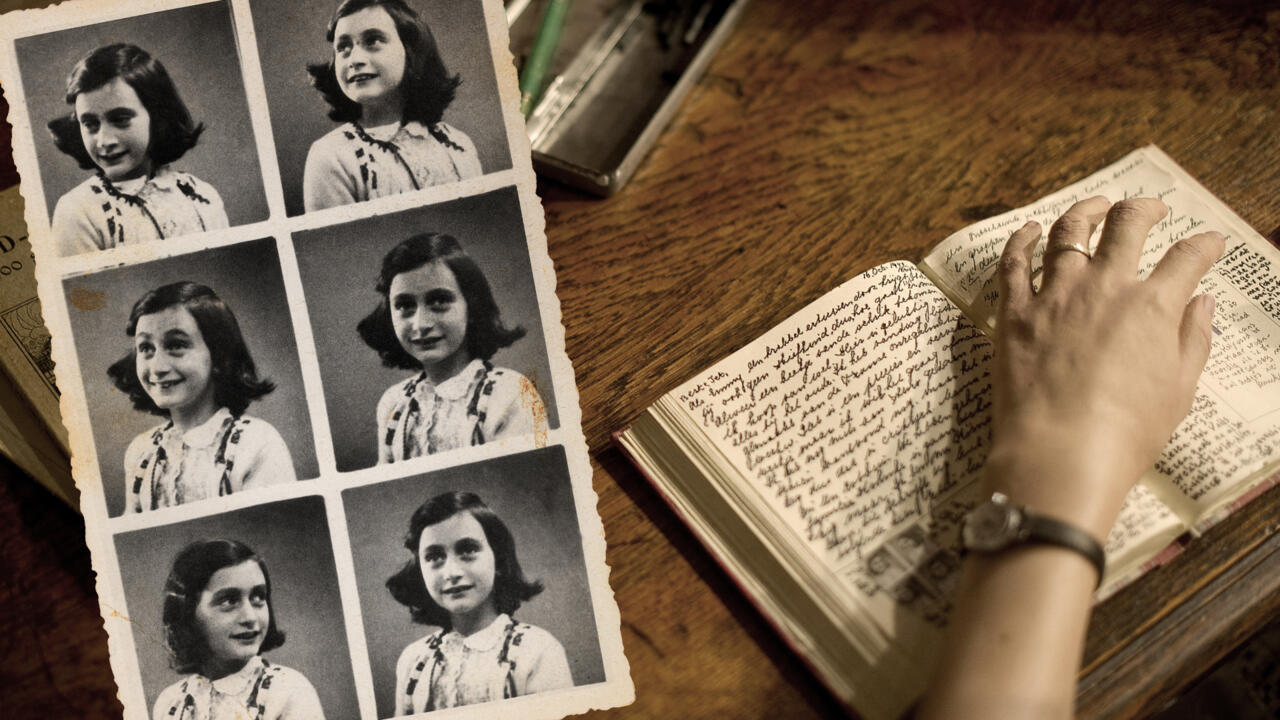
In Amsterdam, Anne attended a Montessori school on the Niersstraat, where she thrived among her classmates. She made friends easily, was known for her wit and her love of talking, and developed an early passion for film stars and collecting picture postcards. She learned Dutch quickly and absorbed herself fully in the life of the city’s Jewish neighbourhood of Merwedeplein in Amsterdam South. A photograph from 1940 shows her smiling at the camera outside her school — a happy, bright-eyed girl whose life gives no outward sign of the catastrophe gathering around her. In May 1940, German forces invaded and occupied the Netherlands, and everything began to change with accelerating speed. New anti-Jewish regulations were introduced with methodical regularity: Jews were required to register with the authorities, to wear a yellow star in public, to surrender their bicycles, to use only Jewish butchers and grocers, to be indoors by eight in the evening, to swim only in Jewish pools, to visit only Jewish sports facilities. Anne was required to transfer from her Montessori school to the Jewish Lyceum, which she attended from 1941 alongside her sister Margot. In January 1941, Anne also lost her German citizenship, which had already been stripped of its meaning under Nazi race laws, and became stateless — a person belonging to no country, protected by no government.
The Decision to Hide: July 6, 1942 and the Entry into the Secret Annex
On June 12, 1942, Anne Frank turned thirteen years old. Among her birthday gifts was a small red-and-white plaid diary, which she had chosen herself from a bookshop window and which her father had purchased for her. That same day, she began writing in it: I hope I will be able to confide everything to you, as I have never been able to confide in anyone, and I hope you will be a great source of comfort and support. She could not have known that the diary would become one of the most consequential documents of the twentieth century, but she had a precocious sense of herself as a writer and of her writing as something worth preserving.
The catalyst for the family’s entry into hiding came on July 5, 1942, when sixteen-year-old Margot received a call-up notice from the Central Office for Jewish Emigration, ordering her to report for deportation to a labour camp in Germany. The Frank family had been preparing for this possibility. Since the spring of 1942, Otto Frank had been converting the upper floors of his office building at Prinsengracht 263 in Amsterdam — the canal-side premises of his Opekta and Pectacon businesses — into a concealed living space for the family. The space, which Anne would name the Secret Annex or Achterhuis in her diary, was located behind a movable bookcase in the upper rear portion of the building, consisting of a series of rooms on the second and third floors that opened onto a shared back garden. The windows were blacked out with paper. The toilet could not be flushed during the day hours when the building’s regular employees were working below.
On the morning of July 6, 1942, wearing multiple layers of clothing because they could not carry luggage conspicuously in the rain, Otto, Edith, and Anne walked through the streets of Amsterdam to Prinsengracht 263. Margot had gone ahead earlier by bicycle, guided by one of the helpers. The Frank family were not alone in the Secret Annex for long. On July 13, they were joined by Hermann van Pels, born in 1898 in Gehrde, Germany; his wife Auguste, born in 1900 in Schoorl, Netherlands; and their fifteen-year-old son Peter. In November 1942, the group of seven was expanded to eight when Fritz Pfeffer, a fifty-three-year-old Jewish dentist from Giessen, Germany, who was engaged to a Dutch woman named Charlotte Kaletta, moved into the Annex as well. Eight people shared a confined space of perhaps fifty square metres for more than two years, unable to venture outside, dependent entirely on a small circle of trusted helpers for everything: food, news, clothing, medicine, and books.
The helpers who sustained the eight residents of the Secret Annex were ordinary Dutch citizens who chose to act with extraordinary courage. The most prominent among them was Miep Gies, born Hermine Santrouschitz on February 15, 1909, in Vienna, who had come to the Netherlands as a child and had worked for Otto Frank since 1933. She later wrote that she helped the Franks because it was the right thing to do, that I was not a hero, I was just a person who was given an opportunity to be helpful. Johannes Kleiman, born in 1896, was a long-time business associate of Otto’s who managed the company’s finances. Victor Kugler, born in 1900 in Hohenelbe, Bohemia, managed the company’s day-to-day operations and presented the public face of the business to the outside world. Bep Voskuijl, born in 1919 as Hermine Voskuijl, was a young secretary who brought supplies and news to the Annex with remarkable regularity. Her father, Johannes Voskuijl, was the warehouse manager who had constructed the bookcase that concealed the entrance to the Annex. Miep’s husband, Jan Gies, born in 1905, also participated in procuring food and other necessities. These five individuals risked their lives every day for more than two years, knowing that discovery would mean arrest, deportation, and almost certain death.
Two Years in Hiding: The Diary, the Inner Life of the Secret Annex, and Anne’s Development as a Writer
During the twenty-five months of hiding that began on July 6, 1942 and ended on August 4, 1944, Anne Frank wrote with remarkable consistency and with growing sophistication. She filled her original red-and-white diary and then continued into additional notebooks and loose sheets of paper, producing a body of writing that documented not just the practical circumstances of life in hiding but her interior life with a depth and acuity that astonished those who read it after the war. She wrote about her family with honesty and sometimes painful candour — she found her relationship with her mother, Edith, difficult and often expressed frustration and resentment toward her in terms she later regretted and tried to revise. She described her growing friendship with Peter van Pels with a mixture of romantic infatuation and disappointment. She wrote about her ambitions for the future, her desire to become a journalist or a writer, her conviction that she had something important to say.
In March 1944, a radio broadcast from Gerrit Bolkestein, the Dutch Education Minister in exile, reached the Secret Annex on the illegal radio the residents used to follow the progress of the war. Bolkestein announced that after the liberation, he intended to collect diaries and letters written during the occupation, to preserve the authentic record of what ordinary Dutch people had experienced under German rule. Anne was galvanised. She immediately began revising and rewriting her diary, transforming her original entries into a coherent narrative she titled Het Achterhuis — The Secret Annex — and composing what became known as the B version of the diary, intended for potential publication after the war. She gave fictional names to the people around her: the van Pels family became the van Daan family, Fritz Pfeffer became Albert Dussel, and the helpers retained versions of their own names. She edited for clarity and style, added context, and removed some of the more private passages. She wrote with a consciousness of audience and posterity that suggests a writer far beyond her years.
The physical and psychological conditions of hiding took a relentless toll on all eight residents. They could not make noise above a whisper during business hours. They could not open the blacked-out windows. They could not go outside for any reason. Fresh air, sunlight, exercise, and the simple freedom of movement were denied to them for more than two years. The psychological strain was enormous: eight people of varied ages, personalities, and temperaments confined in a small space with no outlet for frustration or tension. Arguments were frequent. The fear of discovery was constant and pervasive. Anne documented in her diary several incidents that brought discovery terrifyingly close — a break-in at the warehouse below, a conversation overheard from outside — and recorded in visceral terms the terror that each such incident produced. In one diary entry she wrote: I know I am not safe, I am afraid of cells and concentration camps. Yet through all of this, she also wrote about hope, about the conviction that the war would end, about the Allied landings at Normandy in June 1944, which she described with unmistakable elation as the beginning of the end.
Her last diary entry was dated August 1, 1944. In it, she reflected with characteristic self-awareness on the contradiction between the outer Anne — vivacious, quick-witted, somewhat theatrical — and the inner Anne — more serious, more vulnerable, more complex. She wrote that she was trying to find a way to become what she was inside. Three days later, the diary was interrupted forever.
August 4, 1944: The Raid on Prinsengracht 263 and the End of the Secret Annex
Friday, August 4, 1944 was a warm and sunny summer day in Amsterdam. For the residents of the Secret Annex, it was the 761st day of their confinement — more than two years since Anne and her family had first slipped through the concealed entrance behind the bookcase. The city beyond their blacked-out windows was still occupied, the Allied advance through France following the Normandy landings had not yet reached the Netherlands, and liberation seemed tantalizingly close yet still uncertain. In the morning hours, the helpers were at their desks in the office below, engaged in the ordinary business of running a company under occupation.
At some time between half past ten and eleven in the morning, an arrest team of the Sicherheitspolizei und Sicherheitsdienst — the SS Security Police and Security Service — arrived at the building at Prinsengracht 263. The unit was led by SS-Hauptscharführer Karl Josef Silberbauer, an Austrian-born officer of the Security Police. He was accompanied by several Dutch officers serving under the German occupiers. At the warehouse on the ground floor, they encountered an employee who directed them upstairs to the office. Miep Gies was among the office staff. She later recalled: A short man came in, holding a revolver that was pointed at me. The officers moved through the office and eventually reached the bookcase. The movable bookcase was opened, and the concealed staircase behind it was revealed.
The arrest was swift. All eight residents of the Secret Annex — Otto Frank, Edith Frank, Anne Frank, Margot Frank, Hermann van Pels, Auguste van Pels, Peter van Pels, and Fritz Pfeffer — were taken into custody. Two helpers, Johannes Kleiman and Victor Kugler, were also arrested. Miep Gies and Bep Voskuijl were questioned but not detained. An SS man who went through the Annex picked up a portfolio belonging to Otto Frank and asked whether it contained jewels. When Otto said it contained only papers, the officer threw the papers on the floor and walked away with silverware and a candlestick. Among the papers now scattered across the floor of the Annex were Anne Frank’s diary entries and notebooks. Otto Frank later recalled: If he had taken the diary with him, no one would ever have heard of my daughter.
How the Secret Annex came to be discovered remains one of the most debated historical questions associated with Anne Frank’s story. For decades, the standard narrative assumed that an informant had telephoned the Security Police with a tip about the hiding place. Multiple suspects have been investigated over the years. The man Otto Frank himself most suspected was Willem van Maaren, a warehouse employee who had aroused Anne’s suspicion in her diary in September 1943. Other names have been proposed: Lena Hartog, the wife of a warehouse worker; Nelly Voskuijl, the sister of helper Bep; Tonny Ahlers, a Dutch Nazi sympathiser with prior connections to Otto Frank; Ans van Dijk, a Jewish woman who had already betrayed at least 145 other Jewish people in hiding; and, most controversially, in a 2022 book, Arnold van den Bergh, a Jewish notary and member of the Amsterdam Jewish Council. This last theory, promoted by former FBI agent Vince Pankoke and journalist Rosemary Sullivan, was strongly challenged by a team of scholars at the Netherlands Institute for War Documentation.
A 2016 investigation by the Anne Frank House’s senior researcher Gertjan Broek introduced a significant alternative possibility: that the raid may not have been triggered by a tip-off at all. Broek noted that the Security Police unit involved was primarily concerned with economic fraud, not with tracking down Jews in hiding, and that the building at Prinsengracht was engaged in various illegal activities including black-market food procurement for eight mouths. The two-hour duration of the search was longer than typical for rounding up betrayed Jews, suggesting the officers may have been investigating fraud and stumbled upon the hidden occupants as a secondary discovery. The Anne Frank House’s official conclusion remains that the last word about that fateful summer day has not yet been said. The identity of any betrayer — if there was a betrayer — has never been definitively established.
From Amsterdam to Auschwitz: The Frank Family’s Journey Through the Nazi Camp System
Following their arrest, the eight residents of the Secret Annex were taken first to the SD detention centre at the Weteringschans and then to the Huis van Bewaring, the Amsterdam prison, where they were held for several days. Johannes Kleiman and Victor Kugler were taken to a different detention facility. From Amsterdam, the eight were transferred to the Westerbork transit camp in the north of the Netherlands — the same transit camp through which the vast majority of Dutch Jews had passed on their way to the killing centres in the east. Anne, Margot, Otto, Edith, and the others spent approximately a month at Westerbork. Witnesses described the Frank family as holding themselves with quiet dignity in the transit camp’s circumstances of degradation. Anne was observed picking up caterpillars and other insects to examine — a small, characteristic detail that speaks to the vitality of her curiosity even under those conditions.
On the evening of September 2, 1944, the 1,019 prisoners in what would prove to be the last transport from Westerbork to Auschwitz-Birkenau in German-occupied Poland were loaded into the darkness of sealed cattle cars. Among them were all eight residents of the former Secret Annex. The journey took three days, in conditions of severe overcrowding, without adequate food, water, or sanitation. The train arrived at Auschwitz-Birkenau in the early hours of September 5, 1944. The Auschwitz complex was at that point the largest and most lethal killing installation in the Nazi system, with more than a million people having already been murdered there, predominantly by gassing in the purpose-built extermination facilities at Birkenau.
On the platform, the 1,019 passengers were subjected to a selection conducted by SS doctors. Those deemed fit for forced labour were admitted into the camp; those deemed unfit — all children under fifteen, the elderly, the infirm, pregnant women, mothers with young children — were directed immediately to the gas chambers, where they were murdered within hours of their arrival. Of the 1,019 people on that transport, 549 — including all children younger than fifteen — were killed immediately. Men and women were separated. Otto Frank was taken from his family and never saw his wife or daughters again. Anne and Margot, both of whom were above the minimum age for selection, were admitted into the women’s camp at Birkenau.
In Auschwitz, Anne and Margot were tattooed with identification numbers — a dehumanising routine that converted each prisoner into a numerical designation. They were put to work in the vast labour system of the camp complex, which included factories, farms, and construction projects operated through slave labour for the German war economy. Their mother, Edith, remained in Auschwitz-Birkenau as Soviet forces advanced from the east. On January 6, 1945, unable to eat because of illness, Edith Frank died of hunger and exhaustion in the women’s infirmary at Auschwitz. She was forty-four years old. Soviet forces liberated Auschwitz on January 27, 1945, finding Otto Frank among the approximately 7,000 prisoners who had been left behind when the SS evacuated the camp on January 18. Otto survived and began the long journey home.
Bergen-Belsen: The Death Camp Without Gas Chambers That Killed Tens of Thousands
Bergen-Belsen was located in Lower Saxony, in what is now the German state of Lower Saxony, about 11 miles north of the town of Celle and south of the small villages of Bergen and Belsen from which it took its name. German military authorities had established a prisoner-of-war camp at the site in 1940, initially housing captured Soviet and French soldiers. In April 1943, the SS Economic-Administration Main Office, which administered the concentration camp system, took over a portion of the site and converted it into what was initially designated a Residence Camp — a holding facility for Jews who might be exchanged for German nationals held by the Allies, or for foreign currency. This peculiar status gave Bergen-Belsen a somewhat different character from the extermination centres of the east: it had no gas chambers, no crematoria operating at the scale of Auschwitz, no organised programme of industrial murder. Instead, as Holocaust survivor Anita Lasker-Wallfisch later recalled, people simply perished. There was no need for gas chambers. You just died of disease, of starvation.
Through 1943 and into 1944, the camp held various categories of prisoners: Jews with foreign passports who were potential exchange candidates, prisoners from other camps, and, increasingly from late 1944, the victims of death marches and evacuation transports from concentration camps further east that were being emptied as the Soviet advance accelerated. In April 1943, SS-Hauptsturmführer Adolf Haas became the first commandant of Bergen-Belsen. In December 1944 he was replaced by SS-Hauptsturmführer Josef Kramer — a man who had previously served as commandant of the Birkenau compound at Auschwitz, where he had directly overseen mass extermination. Kramer’s arrival at Bergen-Belsen coincided with a catastrophic deterioration in the camp’s conditions. He became known to survivors as the Beast of Belsen. His policies included depriving starving prisoners of food and instituting regular beatings, behaviour that accelerated the camp’s transformation from a relatively unusual detention facility into a scene of mass death from starvation and disease.
The camp’s population exploded in the final months of the war. From approximately 7,300 prisoners in July 1944, the number rose to 22,000 by February 1945 and to approximately 55,000 by March 1945, as transports and death marches from camps across occupied Europe delivered their human cargo to a facility with no means of feeding, housing, or caring for even a fraction of this number. Tents were erected on the grounds when the barracks overflowed. The water supply deteriorated and then ceased to function reliably. Food rations were cut and cut again, and on some days there was nothing to eat at all. Typhus, which is spread by body lice and flourishes in conditions of filth and crowding, reached epidemic proportions from January 1945 onward. Dysentery, tuberculosis, and starvation also killed vast numbers. The crematorium could not process the volume of corpses, and bodies accumulated in piles across the camp grounds. In the month of March 1945 alone, more than 18,000 people died at Bergen-Belsen. More than 37,000 died between May 1943 and April 15, 1945. In total, approximately 50,000 to 70,000 people died in the Bergen-Belsen camp complex.
Anne and Margot Frank Arrive at Bergen-Belsen: November 1944 and the Final Weeks
On or around November 1, 1944 — sources give the date of November 1 or November 3 — Anne Frank and her sister Margot were transferred from Auschwitz-Birkenau to Bergen-Belsen by train, in a sealed cattle car. Their mother Edith was left behind in Auschwitz. The two sisters arrived at Bergen-Belsen at a moment when its overcrowding and deteriorating conditions were already severe, and when Josef Kramer’s brutal command was beginning to accelerate the catastrophe. Ruth Wiener, a fellow prisoner who knew Margot from the Jewish Lyceum in Amsterdam, recorded in her diary on December 20, 1944: Anne and Margot Frank in the other camp — a contemporary document confirming that both sisters were present at Bergen-Belsen and providing the only surviving written record of their presence there.
Anne also encountered, at Bergen-Belsen, two friends from her Amsterdam childhood who happened to be imprisoned in a different section of the camp: Hanneli Goslar, known as Lies, who had been one of Anne’s closest friends from school and who is mentioned frequently in the diary, and Nanette Blitz, another former classmate. Hanneli had been held in the camp’s Sternlager since early 1944. Nanette had been moved to the same part of the camp as Anne in December 1944. The two women met Anne at the barbed wire fence that separated their sections of the camp, and their descriptions of what they saw constitute among the most devastating eyewitness accounts of Anne’s final months.
Hanneli Goslar met Anne at the fence in late January or early February 1945. She could not see Anne clearly in the darkness — they met in the shadows of the camp — and Anne could not see Hanneli, but they spoke across the wire. Hanneli later recalled that Anne told her that her parents were both dead, not knowing that her father Otto was in fact still alive at Auschwitz. Anne’s despair was total and unmasked: she told Hanneli she had nothing anymore, that she had no one. Nanette Blitz described Anne at their meeting as bald, emaciated and shivering, unable to bear wearing her clothes because they were crawling with lice. She was no more than a skeleton by then, Nanette recalled decades later. Yet Anne told both friends that she hoped to write a book based on her diary when the war was over. Even in extremis, she had not abandoned the ambition that had driven her to revise and prepare her writing for potential publication.
Another survivor, Gena Turgel, who worked in the camp hospital and later told the British newspaper The Sun about her experiences, recalled that Anne’s bed was around the corner from hers and that Anne was delirious, burning up with fever. She described bringing Anne water to wash with. Turgel’s account of the mortality rate captures the scale of the catastrophe that Bergen-Belsen had become in its final months: The people were dying like flies — in the hundreds. Reports used to come in — 500 people who died. Three hundred? We said: Thank God, only 300.
The Death of Margot and Anne Frank: February 1945 and the Question of the Exact Date
Anne and Margot Frank died in the Bergen-Belsen concentration camp in February 1945 — or possibly in very early March. The exact date of their deaths is unknown and has been the subject of significant scholarly investigation. The uncertainty arises because Bergen-Belsen kept inadequate records, because the Nazis destroyed much of the documentary evidence of the camp’s operation before it was liberated, and because the witnesses who survived and could speak to what they observed were themselves ill, disoriented, and unable to remember precise dates.
The sequence of their deaths appears to have been as follows. Margot Frank fell ill first with typhus, developing visible symptoms sometime before February 7, 1945, the date on which several witnesses who had observed her condition were transferred away from Bergen-Belsen to another facility. The disease — typhus, caused by the bacterium Rickettsia prowazekii, which is transmitted through the bites of infected body lice — progresses from fever and headache to extreme physical prostration over approximately twelve days. According to witnesses, Margot was so weakened by illness that she fell from her bunk, and the shock of the fall killed her. Anne, who had been nursing her sister in their last days together, survived Margot by a short period — witnesses reported that Anne died within a day or two of her sister.
For decades following the liberation, the officially accepted date of Anne Frank’s death was March 31, 1945 — a date chosen by Dutch authorities for legal purposes, specifically to allow Otto Frank to establish certificates of inheritance for his daughters under Dutch probate law, which required an officially established date of death. The Dutch Red Cross had interviewed survivors who estimated that Anne died sometime in March, and the authorities chose the last day of that month. Similarly, March 27, 1945 was set as the official date of Margot’s death. These dates placed both sisters’ deaths approximately two weeks before the liberation of Bergen-Belsen by British forces on April 15, 1945 — a circumstance that carried particular poignancy, since it suggested the sisters had come so close to survival.
In 2015, researchers at the Anne Frank House published a detailed investigation into the question of the date of death, using eyewitness testimonies, camp archives, diaries of other prisoners, and records from the Bergen-Belsen Memorial, the Dutch Red Cross, and the International Tracing Service. The study was co-authored by historical researcher Erika Prins and concluded that the Frank sisters almost certainly died in February 1945, not March. The key evidence was that witnesses who observed typhus symptoms in both Anne and Margot — including Nanette Blitz, Hanneli Goslar, Rachel van Amerongen, and Annelore Daniel — reported these observations from before February 7, 1945, the date on which Rachel and Annelore were transferred to Raguhn for forced labour. Given that typhus typically kills within approximately twelve days of the first symptoms appearing, and given that both sisters were already severely weakened when they arrived at Bergen-Belsen, it was highly unlikely that either could have survived until the end of March. The official date of death therefore appears to be incorrect, and the Anne Frank House now places Anne’s death in February 1945, with the precise date unknown. In the words of a fellow prisoner, Rachel van Amerongen, who had been in the same barracks: One day, they just weren’t there anymore.
The Liberation of Bergen-Belsen and the Fate of the Other Secret Annex Inhabitants
British Army units of the 11th Armoured Division liberated Bergen-Belsen on April 15, 1945, finding a scene of almost incomprehensible horror. Approximately 55,000 emaciated, severely ill prisoners were still alive in the camp — or alive in a clinical sense, though many were beyond recovery. Thousands of unburied corpses lay scattered across the camp grounds. The soldiers and war correspondents who arrived with the liberation forces were experienced in the realities of war but were profoundly and permanently affected by what they encountered. The BBC correspondent Richard Dimbleby filed his report from the camp on April 17, delivering an account that was so extreme his editors initially refused to broadcast it, believing it could not be accurate. Dimbleby insisted on its accuracy and the broadcast eventually went out, introducing the British public to the reality of Bergen-Belsen with extraordinary force.
British forces worked urgently to save the survivors. Medical personnel arrived in large numbers. But the scale of the malnutrition and disease was so severe that more than 13,000 of the liberated prisoners died in the weeks following liberation, their bodies unable to recover even with medical care. To control the spread of typhus, the British forces eventually burned down the entire camp. Anne and Margot were not among the survivors. They had died weeks before liberation. Their bodies were buried in one of the mass graves that the British forces found on the camp grounds and were later marked with a memorial plaque that stands at Bergen-Belsen today.
Of the eight people who had shared the Secret Annex, only one survived the war: Otto Frank, who had been liberated at Auschwitz on January 27, 1945. He returned to Amsterdam by a long journey through Odessa, Marseille, and then the Netherlands, arriving at the home of helpers Jan and Miep Gies on the evening of June 3, 1945. Of the others: Edith Frank had died at Auschwitz on January 6, 1945. Hermann van Pels was believed to have been killed in the gas chambers of Auschwitz, probably in late October or early November 1944. Auguste van Pels was transferred from camp to camp — Auschwitz, Bergen-Belsen, Buchenwald, and Theresienstadt — and died in April or May 1945, in unknown circumstances, probably between Buchenwald and Theresienstadt. Peter van Pels, seventeen years old when the Annex was discovered, had survived Auschwitz and was on a death march when the war ended. He died on May 5, 1945, at the Mauthausen concentration camp in Austria — the very day that the camp was liberated by American forces, and also the day Germany surrendered. He was eighteen years old. Fritz Pfeffer was transferred from Auschwitz to the Neuengamme concentration camp and died there on December 20, 1944. The helpers who had sustained the eight for more than two years: Miep Gies, Jan Gies, Bep Voskuijl, and Victor Kugler all survived the war. Johannes Kleiman was released from prison in September 1944 on health grounds and survived.
Otto Frank Receives the Diary: The Story of How Anne’s Words Were Saved and Published
When Miep Gies and Bep Voskuijl returned to the Secret Annex in the hours after the arrest on August 4, 1944, they found Anne’s diary papers and notebooks scattered across the floor of the Annex — discarded by the SS officers who had ransacked the space looking for valuables. Miep gathered the papers and took them to her office below, where she locked them in a desk drawer. She did not read them. She intended to return them to Anne when the war was over. For months, she kept them without knowing whether Anne was alive or dead.
When Otto Frank returned to Amsterdam in June 1945 and learned from witnesses that both his daughters had died in Bergen-Belsen, Miep Gies retrieved the papers from her drawer and placed them in front of him. Here is your daughter Anne’s legacy to you, she said. Otto was deeply moved. As he read through his daughter’s words, he experienced a revelation that he described with remarkable candour: the Anne who appeared in the diary was very different from the daughter he had lost. He had had no idea of the depth of her thoughts and feelings. He had not truly known her. The diary was both a gift and a grief: it restored to him a daughter he had never fully understood, in the very act of confirming that she was gone.
Otto Frank began to share the diary with friends and family members, and increasingly to consider publication. He compiled a version of the text from Anne’s two written versions — the original diary (version A) and Anne’s own revised version (version B), which she had edited for potential publication — and made additional editorial decisions, including the removal of some passages that he felt were too private or might cause pain to people still living. After facing initial rejections from publishers who believed the reading public was not ready to confront the realities of the Holocaust, Otto eventually found a Dutch publisher, Contact Publishing, whose owner, G.P. de Jong, agreed to publish the diary. Het Achterhuis — The Secret Annex — was published in Dutch on June 25, 1947, in an initial print run of 3,036 copies. Otto Frank fulfilled his daughter’s wish to be a published author, though she would never know it.
The diary’s journey from a small Dutch edition to a worldwide phenomenon took several years and was accelerated at each stage by the efforts of specific individuals. An American edition titled Anne Frank: The Diary of a Young Girl was published in 1952 by Doubleday, translated by B.M. Mooyaart-Doubleday. It sold modestly until a Broadway adaptation by Frances Goodrich and Albert Hackett premiered on October 5, 1955, to enormous success. The play ran for 717 performances on Broadway and won both the Tony Award for Best Play and the Pulitzer Prize for Drama in 1956. The theatrical adaptation — which emphasised the universally accessible dimensions of Anne’s story, her adolescent struggles, her hope, and her famous statement that she still believed people were really good at heart — transformed the diary from a powerful but relatively specialist work of Holocaust testimony into a global phenomenon. Sales exploded. By the 1960s, the diary had been translated into dozens of languages and was selling millions of copies.
The Content and Character of the Diary: What Anne Frank Actually Wrote
Anne Frank’s diary spans a period from June 12, 1942 — her thirteenth birthday, when she received the diary as a gift — to August 1, 1944, three days before the arrest. The entries vary enormously in content, tone, and length, reflecting the full range of a young person’s inner life under conditions of extreme stress. Many entries are devoted to the practicalities of life in hiding: the logistics of food procurement, the personalities and habits of the Annex’s inhabitants, the passing of the months and seasons inferred from the limited information that came in through the radio and through the helpers’ reports. But the diary is most remarkable for the passages in which Anne reflects on her own character, her relationships, her feelings, and her understanding of the world.
Anne wrote with striking honesty about her difficult relationship with her mother, Edith, finding her unsympathetic and emotionally distant. She idealised her father, Otto, and their relationship is tender and central throughout the diary. She described her growing attachment to Peter van Pels — the teenage boy with whom she shared a cramped space for two years — with a combination of romantic feeling and clear-eyed assessment of his limitations. She wrote about her body, her sexuality, and her developing sense of herself as a woman with a frankness unusual for a girl of her time and circumstances. She wrote brilliantly and humorously about the minor irritations of communal life: the particular habits and infuriating mannerisms of each member of the group, the petty conflicts over food and noise and space.
She also wrote with remarkable philosophical depth about the nature of hope, faith, identity, and humanity. The passage most widely quoted from the diary — I still believe, in spite of everything, that people are really good at heart — is sometimes taken out of context in ways that sentimentalise her writing, stripping it of the full weight of the circumstances in which it was produced. Read in full context, the passage is not naive optimism but a conscious, hard-won affirmation of faith against the evidence of a world that was trying to destroy her. Anne was acutely aware of the Holocaust being perpetrated around her and of her own vulnerability. She knew what concentration camps were. She was not innocent of the worst, but she was determined not to be reduced to bitterness by it. This determination is one of the most profound and moving aspects of the diary.
The diary also contains the seeds of what might have become an important literary career. Anne wrote short stories, started a novel, and composed essays and reflections on a range of subjects during her time in hiding. She had talent, ambition, and a clear understanding of herself as a writer. I know I can write, she told her diary in April 1944. The diary itself — particularly the revised B version — shows a writer in the process of consciously shaping her material, editing for effect and clarity. She understood the difference between a private document and a public one and was actively working to transform the former into the latter. She died at fifteen.
The Anne Frank House and the Making of a Global Symbol
The hiding place at Prinsengracht 263 in Amsterdam was opened as a museum on May 3, 1960, under the name the Anne Frank House. Otto Frank was closely involved in the creation of the museum and remained so until his death on August 19, 1980, in Basel, Switzerland, where he had lived with his second wife, Elfriede Geiringer-Markovits, whom he had married in 1953. She was herself an Auschwitz survivor and the stepmother of Eva Schloss, who later became known as Anne Frank’s posthumous stepsister. In his will, Otto left the original diary manuscripts to the Netherlands State Institute for War Documentation, and the copyright to the Anne Frank Fund in Basel, which he had established to manage the diary’s royalties and his daughter’s legacy.
The Anne Frank House in Amsterdam became one of the most visited cultural sites in the Netherlands, attracting more than one million visitors per year in the years before the COVID-19 pandemic and consistently among the most visited attractions in the country. Long queues form outside its modest canal-side façade daily. Visitors pass through the office space where the helpers worked, through the movable bookcase that concealed the entrance, and into the rooms where Anne and her family hid — rooms that have been deliberately left unfurnished, as they were found after the war, to convey the emptiness of absence rather than a reconstruction of daily life. Film posters that Anne had pinned to the wall of her room are still visible. The view from the window over the back garden, which Anne described as her only glimpse of nature during the years in hiding, can still be seen.
The diary itself has, in the decades since its first publication, sold more than 30 million copies and been translated into more than 70 languages. It is required reading in school curricula across dozens of countries and has become perhaps the single most widely read work of non-fiction about the Holocaust. The play and the 1959 film adaptation, as well as the numerous subsequent theatrical and cinematic works based on Anne’s story, have introduced her to audiences who might not have encountered the original text. In 1999, Time magazine included her in its list of the 100 most important people of the twentieth century. Schools, parks, streets, and public buildings around the world bear her name.
Anne Frank as a Symbol of the Holocaust: The Weight and Complexity of Her Legacy
Anne Frank’s status as the most famous individual victim of the Holocaust carries an enormous weight of significance — and of complexity. She has become, as the United States Holocaust Memorial Museum has stated, a symbol for the lost promise of the more than one million Jewish children who were murdered in the Holocaust. Her story provides a human face, a specific personality, and an intimate voice to a catastrophe whose full scale — six million Jewish dead, and approximately five million others — is too vast for most minds to fully comprehend. The diary personalises the impersonal and makes the historical immediate.
But historians and critics have also noted the risks that accompany this status. The Anne Frank known to most readers is the Anne of the diary — the girl still in hiding, still alive, still writing, still capable of hope. The diary ends before the arrest, before Auschwitz, before Bergen-Belsen. It does not show the systematic dehumanisation of the concentration camp, the extermination machinery of Birkenau, or the anonymous mass death of the camp in which she died. As a result, Anne’s story can be received as a narrative of hope and resilience — the inspiring story of a girl who kept faith with humanity — without fully confronting the fact that it is also a narrative of murder, that Anne Frank was killed by a deliberate, organised programme of racial genocide, and that her story is representative not of an exceptional fate but of the fate of millions.
Otto Frank’s editorial decisions in preparing the diary for publication shaped the Anne Frank known to the world in ways that have been both celebrated and criticised. He removed the most sexually explicit passages, the sharpest expressions of Anne’s anger toward her mother, and some of the most pointed comments about the behaviour of the Annex’s other occupants. A new, less edited critical edition was published by the Netherlands State Institute for War Documentation in 1986, and a substantially fuller English translation appeared in 1995, nearly a third longer than the original published version, restoring material that Otto had excluded. This fuller Anne — more complex, more angry, more sexually aware, more conflicted — is closer to the writer who actually composed the diary than the figure that the original publication presented.
Questions of ownership, authenticity, and representation have also generated ongoing controversy. The Anne Frank Fund in Basel, which controls the copyright, and the Anne Frank House in Amsterdam, which administers the museum and educational programmes, have not always agreed on how to balance commercial interests with historical responsibility. Holocaust deniers have attempted to claim the diary is a forgery — a claim comprehensively refuted by multiple forensic investigations confirming the authenticity of the paper, ink, and handwriting. The ongoing battles over Anne Frank’s legacy reflect the difficulty, and the necessity, of keeping the memory of the Holocaust alive and honest across generations that have no personal connection to the events it describes.
The Holocaust Context: Anne Frank Among Six Million Jewish Dead
Anne Frank’s story is profound and moving on its own terms, but its deepest significance lies in what it represents: the systematic murder of approximately six million Jewish men, women, and children across German-occupied Europe between 1941 and 1945, in what is known as the Holocaust, or in Hebrew, the Shoah — the catastrophe. Anne Frank was one of approximately one million Jewish children who were killed. She was one of the estimated 75 percent of Dutch Jews who did not survive the occupation, a death rate among the highest of any occupied western country. Of the approximately 160,000 Jews who had lived in the Netherlands at the time of the German invasion in May 1940, fewer than 40,000 survived the war. Of the approximately 30,000 Dutch Jews who went into hiding, around 12,000 — including Anne, Margot, and all but one of the Annex’s other inhabitants — were discovered and deported.
The Bergen-Belsen in which Anne Frank died was not an extermination centre in the technical sense — it did not have gas chambers or an organised killing programme like Auschwitz-Birkenau, Treblinka, Belzec, Sobibor, or Chelmno. But it was a place of mass death nonetheless, its tens of thousands of victims killed by the deliberate combination of starvation, disease, exposure, and physical violence that resulted from the Nazi regime’s calculated decision to provide no adequate food, medicine, water, or shelter to human beings in its custody. The distinction between being killed by gas and being killed by typhus in a filthy, overcrowded camp with no food or medical care is a distinction without a moral difference. The people who died at Bergen-Belsen were killed by the Nazi state as surely as those murdered in the gas chambers.
The camp was liberated on April 15, 1945, by troops of the British 11th Armoured Division. Had Anne and Margot survived until that date, they would have been free. The 2015 research by the Anne Frank House historians, which revised the date of death from late March to February 1945, means that the sisters likely died approximately ten to twelve weeks before liberation, not two weeks as the earlier official dates had suggested. Historian Erika Prins, whose voice trailed off when she noted this revision in an interview with The Guardian, captured the particular cruelty of this finding: when you say they died at the end of March, she said, it gives you a feeling that they died just before liberation. So maybe if they’d lived two more weeks… Well, that’s not true anymore.
The Enduring Legacy of Anne Frank: Memory, Education, and What She Continues to Mean
More than eighty years after her death in Bergen-Belsen, Anne Frank remains one of the most widely recognised names in the world and the most famous individual victim of the Holocaust. Her diary has introduced the realities of Nazi persecution to generations of readers across every inhabited continent, in more than 70 languages, across every imaginable cultural context. The building at Prinsengracht 263 in Amsterdam, where she hid for twenty-five months, receives more than a million visitors per year and has become one of the most significant sites of Holocaust memory in Europe. She has been the subject of plays, films, novels, graphic novels, operas, musical compositions, visual art, and countless works of scholarship, journalism, and creative writing. She has been invoked as a symbol of childhood innocence, Jewish identity, human rights, adolescent hope, the Holocaust, resistance to oppression, and the power of writing.
The educational impact of the diary has been incalculable. For millions of young readers, The Diary of a Young Girl is the entry point to understanding what the Holocaust was — not as an abstract historical event characterised by unimaginable numbers, but as a lived experience of specific human beings who had names and personalities and hopes and fears and families. Anne’s diary does what statistics cannot: it makes the murder of a child comprehensible, individual, and irreversible. I know I can write, Anne told her diary in April 1944. She was right. She could write. And the world, reading her, knows it.
The famous line from the diary — I still believe, in spite of everything, that people are really good at heart — has been celebrated, quoted, inscribed on memorials, and debated by scholars for eight decades. It is the line that many people know even if they have never read the diary itself. It is, in one sense, a statement that the circumstances of Anne Frank’s death can be said to have refuted: people are not all good at heart, and the people who killed her were not good. But in another and more important sense, the line is not a description of the world as it is, but an affirmation of the world as it might be, made by a fifteen-year-old girl in conditions of extreme darkness, as a conscious act of will against the evidence before her. It is an act of resistance. And it is one of the most powerful things written in the twentieth century, from a notebook scattered on a floor in Amsterdam, by a child who deserved to live.