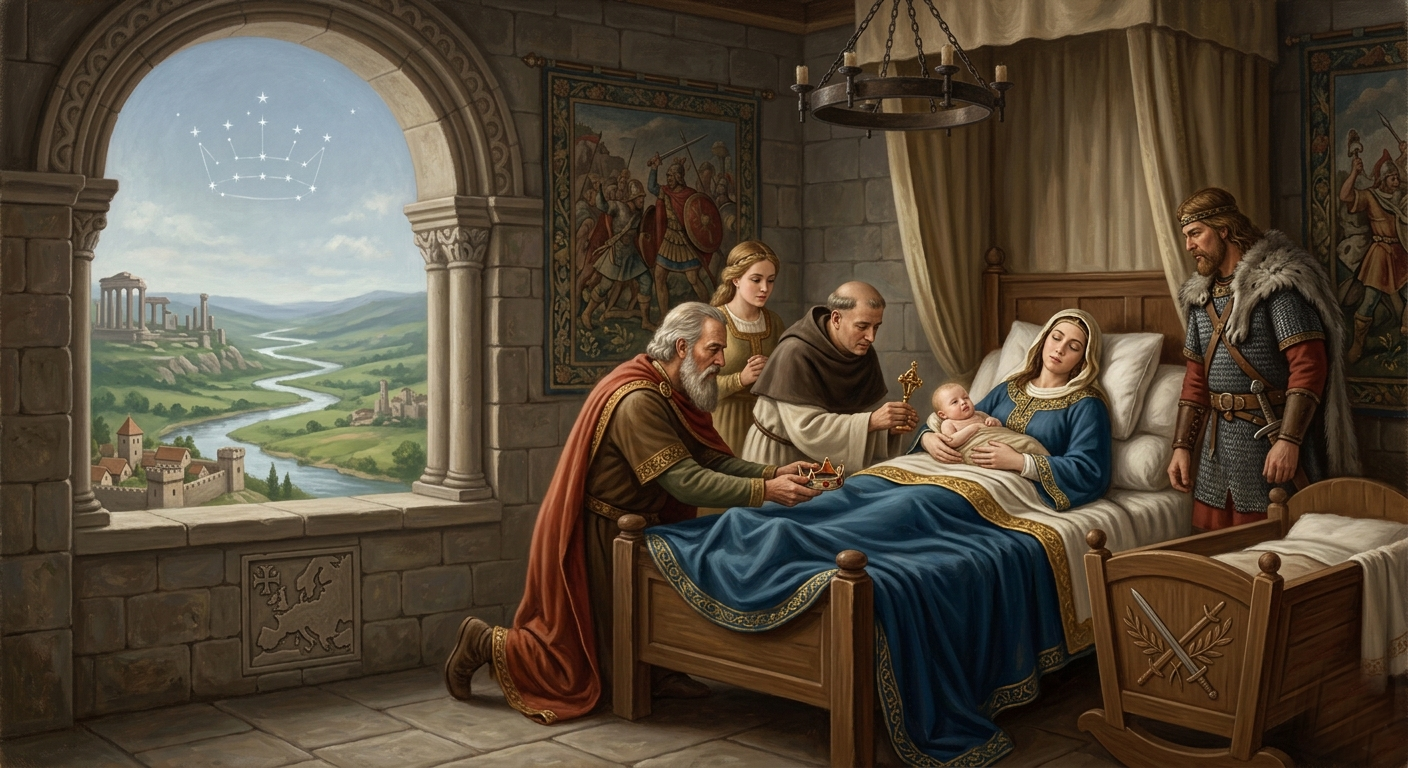
In the spring of 748 AD — most likely on April 2, according to the commemorative tradition preserved at Lorsch Abbey since the mid-ninth century — a child came into the world within the Frankish kingdom whose life would reshape the map, culture, religion, and political identity of Western Europe more profoundly than almost any other single human being in recorded history. His given name was Charles. He would grow up to be known across the continent and across centuries as Charlemagne—from the Latin Carolus Magnus, meaning Charles the Great—a title that was bestowed not as empty flattery but as the most straightforward description available for a man whose achievements seemed to stretch the limits of what was possible in the early medieval world. King of the Franks, King of the Lombards, first Emperor of the Romans since the fall of the Western Roman Empire in 476 AD: these were only the formal titles. In truth, Charlemagne was the founder of the idea of Europe itself.
The birth of this child to Pepin the Short and Bertrada of Laon in the heartland of the Frankish kingdom in the eighth century was an event of incalculable historical consequence — not because anyone at the time recognized it as such, but because of what the child became. This article examines that birth in full context: who his parents were, what world he entered, how the dynasty that produced him had risen to power, what Charlemagne went on to achieve in a reign of more than forty-six years, and why, more than twelve centuries after his death, his name remains synonymous with the very concept of a unified European civilization.
The Debate Over Charlemagne’s Exact Birth Date: April 2, 742 or 748 AD?
Few questions in medieval historical scholarship have generated more sustained debate than the seemingly simple one of when, precisely, Charlemagne was born. The traditional date most widely cited in older encyclopedias and general histories — April 2, 742 AD — turns out, upon close examination of the primary sources, to be unreliable. It was not drawn from a contemporary record of the birth itself but was calculated backward from the age attributed to Charlemagne at his death in 814 AD, which his biographer Einhard estimated as approximately 72 years. That kind of reverse calculation, reliant on an approximate age estimate made after the fact, is precisely the sort of evidence that medieval historians have learned to treat with caution.
The Annales Petaviani, a Frankish chronicle, provides a different date: April 1, 747 AD. This date has its own problems, however. April 1, 747 AD fell on Easter Sunday, and the birth of a future emperor on the holiest day of the Christian year is exactly the kind of coincidence that would have prompted immediate and widespread comment in the chronicles of the time. No such comment is recorded, leading scholars to suspect that the Easter birthday may have been a retrospective pious fiction inserted to honor Charlemagne’s memory rather than a reliable report of his actual birth. The German historian Matthias Becher, building on the earlier work of Karl Ferdinand Werner, identified a further complication: the Frankish annalists of the period recorded the start of the new year from Easter rather than from January 1. Under that calendar system, “April 1, 747” in the annalist’s notation would actually correspond to April 2, 748, in the modern calendar.
The result of this careful scholarly analysis, which now represents the consensus of modern academic opinion, is that Charlemagne was most likely born on April 2, 748 AD. The date of April 2 has independent support from the commemorative tradition at Lorsch Abbey, which observed Charlemagne’s birthday on that date from at least the mid-ninth century onward and which scholars regard as a genuine and credible memorial record. Wikipedia’s current entry on Charlemagne, reflecting the scholarly consensus, gives his birth date as April 2, 748. Encyclopaedia Britannica lists the birth as “747?” acknowledging the uncertainty, while noting that 747 or 748 are more likely than the traditional 742. The Catholic Encyclopedia, representing an older tradition, retains April 2, 742. For the purposes of this article, the most probable date of April 2, 748 AD, is treated as the best current scholarly estimate, with the caveat that absolute certainty is impossible given the fragmentary nature of eighth-century documentation.
Where Was Charlemagne Born? The Unresolved Mystery of His Birthplace
The question of where Charlemagne was born is, if anything, even less resolvable than the question of when. No contemporary document records his place of birth, and the royal court of the Franks was a traveling institution — it moved regularly between palaces and estates throughout the Frankish kingdom as the king and his household consumed the resources of each location in turn. Charlemagne could therefore have been born at any one of a number of places where his mother Bertrada happened to be in the spring of 748 AD.
Several locations have been proposed over the centuries by historians and local traditions. Herstal, near Liège in modern-day Belgium, was the ancestral seat of the Carolingian family — the very name “Pepin of Herstal,” Charlemagne’s great-grandfather, reflects the family’s roots in this region — and has a strong traditional claim. The nearby villa of Jupille, where Charlemagne reportedly went to live when he was about seven years old at his father’s estate, appears as a birthplace candidate in numerous history books, partly because the association of a medieval ruler with a particular place of childhood was often later confused with or merged into a claim of that place as birthplace. Aachen, which Charlemagne would later make his imperial capital and where he spent most of the latter decades of his life, has also been claimed as his birthplace, though largely on the basis of the city’s later centrality to his reign rather than any documentary evidence about 748 AD. Other suggestions include Quierzy, Vaires-sur-Marne, Prüm, Düren, and Gauting.
The New World Encyclopedia notes that the best guesses for birthplace include Herstal or Jupille, both close to Liège, in the region of modern Belgium, from which both the Merovingian and Carolingian families historically originated. This region — Austrasia, the eastern heartland of the Frankish kingdom — is almost certainly the general area of his birth, but the specific location cannot be determined with confidence. The honest answer is that Charlemagne was born somewhere in the Frankish kingdom, almost certainly in Austrasia, probably in the vicinity of what is now Belgium or the western Rhineland, on a day in early April 748 AD. Beyond that, the sources fall silent.
The Frankish World at the Time of Charlemagne’s Birth: Power, Religion, and the Ghost of Rome
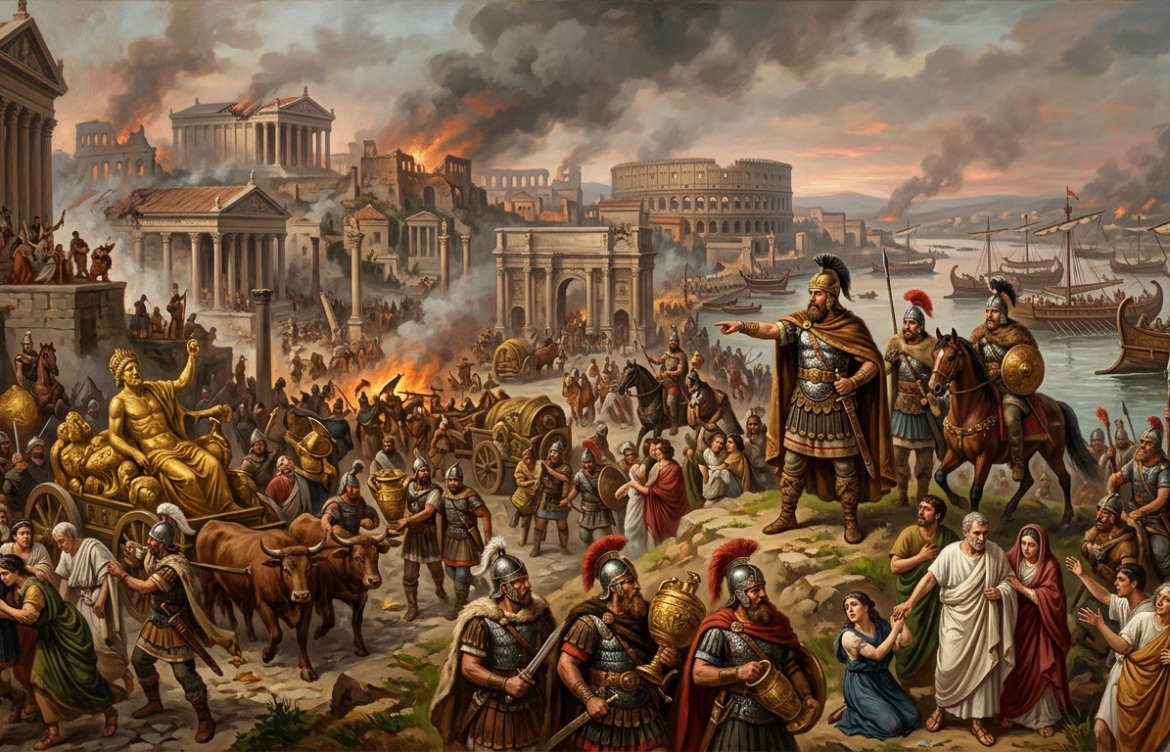
The world into which Charlemagne was born in 748 AD was one shaped by the long shadow of a civilization that had collapsed nearly three centuries earlier. The Western Roman Empire, which had governed the vast territories stretching from Britain to North Africa and from Spain to the borders of Mesopotamia under a single political authority, had formally ended in 476 AD when the Germanic chieftain Odoacer deposed the last Western emperor, Romulus Augustulus. What followed was not an instant catastrophe but a slow, painful transformation in which the former Roman provinces were reorganized into a patchwork of Germanic kingdoms, each developing its own legal codes, political structures, and cultural identities while retaining varying degrees of continuity with the Roman civilization they had inherited.
By 748 AD, the most powerful of these successor kingdoms was unquestionably the Frankish kingdom, which had grown from its origins in the Rhine delta region to dominate most of what is now France, Belgium, the Netherlands, and western Germany. The Franks had a particular advantage over other Germanic kingdoms: under their great king Clovis I, who died in 511 AD, they had converted to Roman Christianity — not the Arian form of Christianity followed by most other Germanic peoples, but the version of the faith endorsed by the bishop of Rome. This made the Franks the natural allies of the papacy and gave them a religious legitimacy that their rivals lacked.
The political structure of the Frankish kingdom in 748 AD was, however, in a transitional state. For several generations, real power had been exercised not by the Frankish kings themselves — who had degenerated into the rois fainéants, the “do-nothing kings” — but by the Mayors of the Palace, high officials who governed in the king’s name. Charlemagne’s own grandfather, Charles Martel, had been the most celebrated Mayor of the Palace in Frankish history. In 732 AD, just sixteen years before Charlemagne’s birth, Charles Martel had led the Frankish forces to victory at the Battle of Tours, halting a Muslim raiding army’s northward advance into Western Europe and ensuring that the Frankish kingdom — and with it, Latin Christianity — would remain the dominant power in the West. This victory burnished the Carolingian family’s prestige enormously and established them, in the eyes of contemporaries and of posterity, as the defenders of Christendom.
The other great power shaping the world of 748 AD was the Islamic caliphate. Since the death of the Prophet Muhammad in 632 AD, Islam had expanded with extraordinary speed across the Arabian Peninsula, the Middle East, North Africa, Persia, and into the Iberian Peninsula, which had been conquered from its Visigothic rulers between 711 and 718 AD. The Umayyad Caliphate controlled the whole of what is now Spain and Portugal, and it was the northward expansion of this caliphate into Gaul that Charles Martel had stopped at Tours. The world of Charlemagne’s birth was thus defined by a three-way contest among Latin Christendom — represented by the Frankish kingdom and the papacy — the Eastern Roman or Byzantine Empire centered on Constantinople, and the Islamic world. Charlemagne’s life’s work would be to reshape that contest decisively in favor of the Latin Christian West.
Pepin the Short: The Father Who Made the Empire Possible
At the time of Charlemagne’s birth in 748 AD, his father Pepin — known to history as Pepin the Short or Pepin III — was still serving as Mayor of the Palace under the nominal sovereignty of Childeric III, the last Merovingian king of the Franks. But Pepin was a man of extraordinary political intelligence and ambition who was already laying the groundwork for what would become one of the most decisive acts of dynastic revolution in medieval history. The situation he faced was an increasingly obvious absurdity: he was the most powerful man in the Frankish kingdom in every meaningful sense, yet he did not hold the title of king. The Merovingian dynasty, despite its centuries of declining effectiveness, still commanded enough traditional reverence among the Franks that simply deposing it without sanction from a higher authority would have been dangerously destabilizing.
Pepin solved this problem with a stroke of political genius. In 750 AD, he sent ambassadors to Pope Zacharias in Rome with a carefully formulated question: was it right for a man who held no real power to bear the title of king, while the man who actually exercised all power went without that title? Pope Zacharias, recognizing both the logic of the argument and the advantage to the papacy of having a powerful and capable Frankish king as its protector, ruled in Pepin’s favor. With papal endorsement secured, Pepin acted in 751 AD. Childeric III, the last Merovingian king, was deposed and consigned to a monastery, his long hair — the traditional symbol of Merovingian royal authority — ritually cut off. Pepin was crowned King of the Franks, becoming the first king of what would later be called the Carolingian dynasty.
The year after Charlemagne’s birth, in 754 AD, Pepin received extraordinary further validation of his new dynasty’s sacred legitimacy when Pope Stephen II — who had succeeded Zacharias in 752 and was facing a grave threat from the Lombards in Italy — made the unprecedented journey from Rome to the Frankish kingdom to seek Pepin’s personal protection. Stephen anointed Pepin as King of the Franks with holy oil, in a ceremony explicitly modeled on the Old Testament practice of anointing Israel’s kings, and reportedly forbade the Franks ever to choose a king from any family other than the Carolingians. He also anointed Pepin’s young sons Charles and Carloman. The young Charles — the future Charlemagne — was reportedly sent by his father to escort the pope on the final stages of his journey to the Frankish court, a symbolic act that introduced the boy, while still barely old enough to walk steadily, to the world of papal-Frankish high politics in which he would spend his adult life.
Pepin fulfilled his commitment to the pope with force. He campaigned in Italy in 755 and 756 AD, decisively defeating the Lombards and forcing them to return territories they had seized from Rome. In the famous Donation of Pepin in 756 AD, he transferred to the papacy a block of territory across central Italy that became the nucleus of the Papal States — the territories under direct papal sovereignty that would persist, in various forms, until 1870 AD. This act, which created the foundation of the medieval papacy’s temporal power, was one of the most consequential political gifts in European history, and it was made by Charlemagne’s father during the first decade of Charlemagne’s life. When Pepin died on September 24, 768 AD, at Saint-Denis, he left behind a kingdom that was the dominant power in Western Europe and a dynasty that was bound to the papacy by ties of mutual interest and sacred obligation that his son would inherit, deepen, and ultimately transform.
Bertrada of Laon: Charlemagne’s Mother and Her Influence on His Early Years
Bertrada of Laon, Charlemagne’s mother, is a figure who deserves considerably more historical attention than she typically receives. She was the daughter of Charibert, Count of Laon, and she was, by all accounts, a woman of intelligence, political acumen, and formidable personal character. Whether she was formally married to Pepin at the time of Charlemagne’s birth has been a matter of scholarly debate — some sources suggest the marriage came later, after the birth of both Charles and his younger brother Carloman — and if the formal marriage had not yet taken place, Charlemagne may technically have entered the world in a state of illegitimacy, though this appears not to have affected his standing with his father or his eventual claim to the throne.
Bertrada appears in the historical record as an active and influential figure in the early years of Charlemagne’s reign. When Pepin died in 768 AD and the kingdom was divided between his two sons, it was Bertrada who worked behind the scenes to try to maintain good relations between the brothers and to prevent the fraternal conflict that Frankish inheritance custom so often generated. She also played a direct role in the diplomatic marriage of Charlemagne to a daughter of the Lombard king Desiderius — a union that Bertrada apparently arranged as part of a broader effort to reduce tensions between the Frankish kingdom and the Lombards — though Charlemagne dissolved the marriage after approximately a year, apparently on his own initiative. Bertrada lived until 783 AD, surviving long enough to see her son become not just the sole King of the Franks but the conqueror of the Lombard kingdom and a figure already recognized as the dominant ruler in Western Europe. She was buried at the Abbey of Choisy-au-Bac.
The Question of Charlemagne’s Legitimacy at Birth and the Significance of His Carolingian Heritage
The historical uncertainty about whether Pepin and Bertrada were formally married at the time of Charlemagne’s birth touches on one of the more intriguing aspects of the early life of history’s most celebrated medieval emperor. In the Frankish society of the eighth century, the distinction between legitimate and illegitimate birth was not always as absolute as it would become in later medieval canon law. Informal unions — known in Frankish legal tradition as friedelehe, a form of recognized secondary marriage — were common among the aristocracy, and children born of such unions were not necessarily excluded from inheritance, especially if the father subsequently acknowledged them and elevated the mother’s status through formal marriage.
Whatever the precise circumstances of his parents’ union in 748 AD, Charlemagne was clearly and fully acknowledged as the eldest son of Pepin and the primary heir to the Frankish kingdom. He was raised at his father’s court, was anointed alongside his brother Carloman by Pope Stephen II during the papal visit to the Frankish kingdom, and was treated from his earliest years as a prince in active preparation for power. The question of his birth’s precise legal status was never, during his lifetime, raised as a challenge to his authority. His Carolingian heritage — descending from Pepin of Herstal through Charles Martel to Pepin the Short — was itself a dynasty of warriors and administrators who had spent three generations proving that effective power mattered more than hereditary title, and this pragmatic tradition served Charlemagne well.
Charlemagne’s Childhood and Education at the Frankish Court
Almost nothing is known with certainty about Charlemagne’s childhood. His biographer, Einhard, who knew the emperor personally and admired him deeply, admitted with characteristic honesty that he had no information about Charlemagne’s youth and that no one he consulted could tell him anything reliable about those years. The Frankish annals of the period contain only the occasional passing reference to Charles as a young child at his father’s court. What can be inferred from the later character and accomplishments of the adult Charlemagne, and from general knowledge of how Frankish aristocratic children were educated, is that his upbringing combined practical physical training with religious instruction and early exposure to the political and diplomatic world of his father’s court.
The future emperor’s earliest education was religious in character. The Catholic Encyclopedia and other sources indicate that Charlemagne received religious training from his mother Bertrada and from Fulrad, the Abbot of Saint-Denis — the great abbey north of Paris that was the most prestigious religious institution in the Frankish kingdom and the burial place of the Frankish kings. Through Fulrad, who was a close confidant of Pepin the Short and one of the most important ecclesiastical figures in the kingdom, the young Charles was introduced to the world of the Frankish Church and the relationship between ecclesiastical and royal power that would shape his entire reign. He learned to read Latin — though, famously and to his evident frustration, he never mastered the skill of writing it, having begun to try too late in life — and he studied the liberal arts, including grammar, rhetoric, and arithmetic, subjects that would later be at the heart of the educational reforms he promoted throughout his empire.
Physically, young Charles was trained in the martial and equestrian arts appropriate to a Frankish prince. He learned to ride, to hunt, and to handle weapons — skills that the adult Charlemagne maintained with passionate enthusiasm throughout his life. Einhard records that he loved swimming so much that he was partly attracted to Aachen as his imperial capital because of the warmth of its natural springs, where he swam regularly. He was famously energetic, physically imposing, and possessed of seemingly inexhaustible vigor well into middle age. The formation of these qualities began in childhood at his father’s court, where practical preparation for leadership was the primary educational goal.
Charlemagne’s first documented appearance in the historical record — beyond his birth — comes in late 753 or early 754 AD, when he was approximately five or six years old. His father sent him to meet and escort Pope Stephen II, who was traveling through the Frankish kingdom to seek Pepin’s military protection against the Lombards. Charlemagne traveled some three miles from the court to greet the pope with a ceremonial reception — a small act, perhaps, but a symbolically meaningful one for a child who would spend his adult life navigating the relationship between Frankish royal power and the authority of Rome. He was anointed with holy oil alongside his father and brother during the pope’s visit, formally marking all three as sacred figures under the protection and blessing of the Church.
The Carolingian Dynasty: Charles Martel, Pepin of Herstal, and the Family Line That Produced an Emperor
To fully understand the significance of Charlemagne’s birth, it is necessary to trace the dynastic line that produced him. The Carolingian dynasty — named retrospectively after Carolus Magnus, Charlemagne himself, whose name became so closely identified with the dynasty that it absorbed all other members into its identity — did not emerge suddenly. It was the product of more than a century of patient, ruthless, and often brilliant political and military activity by a family that rose from the aristocracy of Austrasia to become the de facto rulers of the entire Frankish world before finally claiming the royal title for themselves.
The founder of the dynasty’s power was Pepin of Herstal, Charlemagne’s great-grandfather, who served as Mayor of the Palace from around 680 until his death in 714 AD. Pepin of Herstal consolidated Carolingian control over the Frankish kingdom after years of internal conflict, defeating rival Frankish factions and reunifying the kingdom under his effective authority. His illegitimate son, Charles Martel — Charlemagne’s grandfather — succeeded him and became the dominant figure in Frankish politics for nearly three decades. Charles Martel is remembered primarily for his victory at the Battle of Tours in 732 AD, but he was also a brilliant military innovator who reorganized the Frankish army, introduced the heavily armored cavalry that would become the foundation of medieval knighthood, and conquered or subdued Frisia, Thuringia, Bavaria, and Alemannia. He did all of this without ever holding the title of king — he was simply Mayor of the Palace — but the reality of his power was unmistakable to everyone, including Pope Gregory III, who appealed to him for help against the Lombards even though Charles ultimately did not intervene. When Charles Martel died in 741 AD, he left behind a family whose power and prestige made the ceremonial fiction of Merovingian kingship almost impossible to maintain.
It was Charles Martel’s son Pepin the Short — Charlemagne’s father — who finally converted this de facto royal power into the formal title of king. As described above, Pepin accomplished this with papal endorsement in 751 AD, deposing the last Merovingian king Childeric III and establishing the Carolingian dynasty as the rightful royal house of the Franks. By the time Charlemagne was born, his family had been the effective rulers of the Frankish kingdom for three generations and the formal kings for less than three years. He was born at the precise moment when the transformation from power to legitimate authority had just been completed — a child of a dynasty at the height of its energy and confidence, standing at the threshold of its greatest achievements.
Charlemagne Becomes Sole King of the Franks: The Death of Carloman and the Start of an Era
When Pepin the Short died on September 24, 768 AD, the Frankish kingdom was divided between his two sons in accordance with Frankish custom: Charlemagne received Austrasia, Neustria, and other northern territories, while his younger brother Carloman I received Burgundy, Alemannia, Alsace, Provence, and parts of Septimania and Aquitaine. The two brothers were approximately twenty years old and seventeen years old respectively, and neither had yet had the opportunity to demonstrate the qualities of leadership on which their future authority would depend. The division of the kingdom, while custom-driven, was geographically awkward and politically fragile, and the relationship between the brothers deteriorated almost immediately.
The most significant early test of the fraternal partnership came in 769 AD, when a rebellion broke out in Aquitaine under Hunald II, the Duke of Aquitaine, who sought to recover the duchy’s independence from Frankish overlordship. Charlemagne responded by leading a military campaign into Aquitaine, marching his forces to Bordeaux and establishing a fort at Fronsac. He sought military support from his brother Carloman, who refused to provide it — a refusal that Charlemagne regarded as a direct act of bad faith and that Einhard described as motivated by jealousy. Charlemagne succeeded in suppressing the Aquitaine revolt on his own, capturing Hunald and bringing the duchy back under Frankish control, but the episode deepened the antagonism between the brothers and raised the specter of outright conflict between the two halves of the divided kingdom.
The crisis was resolved not by war but by death. On December 4, 771 AD, Carloman died suddenly, leaving Charlemagne as the sole King of the Franks at approximately twenty-three years of age. The cause of death is not recorded with certainty. Charlemagne moved with characteristic decisiveness: he immediately absorbed his brother’s territories, forcing Carloman’s widow Gerberga to flee with her children to the court of the Lombard king Desiderius — the very king whose daughter Charlemagne had recently married and divorced, a fact that made the Lombard court a natural refuge for those hostile to Charlemagne’s growing power. He simultaneously ended his short marriage to Desiderius’s daughter, for reasons the sources do not fully explain, and married Hildegard, daughter of Count Gerold, a powerful Frankish magnate from his brother’s former territories. From the winter of 771 AD onward, Charlemagne was master of the entire Frankish kingdom, and the stage was set for the extraordinary campaigns and achievements that would define his reign.
The Military Genius of Charlemagne: Conquests That Doubled the Frankish Kingdom
The forty-six years of Charlemagne’s reign as King of the Franks and, from 800 AD, as Emperor of the Romans, were characterized by an almost unbroken series of military campaigns that progressively expanded Frankish dominion to encompass most of Western and Central Europe. By the time of his death in 814 AD, Charlemagne had doubled the size of the Frankish kingdom inherited from his father, creating an empire that stretched from the North Sea to central Italy, from the Atlantic coast of France to the Elbe River in Germany, from the Spanish March south of the Pyrenees to the plains of Hungary. No ruler in Western Europe had governed so large a territory since the emperors of Rome.
The conquest of the Lombard kingdom in northern Italy in 773 and 774 AD was among Charlemagne’s first and most decisive military achievements. Responding to the appeal of Pope Adrian I, who had succeeded Stephen II in 772 AD, Charlemagne led a Frankish army across the Alps and besieged the Lombard capital of Pavia. The Lombard king Desiderius — who had sheltered Carloman’s widow and children and whose daughter Charlemagne had divorced — surrendered after several months, and Charlemagne deposed him, sending him to a monastery in France, and took for himself the title of King of the Lombards. He visited Rome, where he was ceremonially received by Pope Adrian and renewed the Frankish commitment to protect the Papal States established by the Donation of Pepin. The absorption of the Lombard kingdom was, as historians have noted, without precedent in the early medieval world — one independent kingdom had been swallowed entirely by another.
The Saxon Wars, which occupied Charlemagne intermittently for more than thirty years from 772 to 804 AD, were the most protracted and costly campaigns of his reign. The Saxons were a Germanic people who inhabited the territories of northwestern Germany between the Rhine and the Elbe. They were pagans who resisted both Frankish political authority and Christianization with fierce determination, repeatedly submitting after Frankish military victories and then rising again in rebellion when opportunity allowed. Charlemagne’s response escalated from military force to forced mass baptism to deportation. In 782 AD at the Massacre of Verden, he reportedly ordered the execution of some 4,500 Saxon captives — a deed that drew criticism even from some within his own court. Eventually, through decades of relentless pressure that included the forcible resettlement of Saxon populations throughout the Frankish kingdom, the Saxons were subdued and incorporated into the Carolingian empire by 804 AD.
Beyond Italy and Saxony, Charlemagne campaigned against the Avars — a nomadic people from Central Asia who had settled in the Danube basin — in the 790s, destroying their confederation and capturing enormous quantities of accumulated treasure that were redistributed throughout the empire. He defeated Duke Tassilo III of Bavaria in 788 AD, absorbing the last independent Germanic duchy into his empire. In Spain, his campaign of 778 AD ended in catastrophe at the Battle of Roncevaux Pass, where the Frankish rearguard was ambushed and destroyed by Basque fighters in the Pyrenean passes — an event later immortalized in the great epic poem The Song of Roland. Despite this defeat, Charlemagne eventually established the Spanish March, a buffer zone of Frankish-controlled territory south of the Pyrenees, and in 801 AD his son Louis captured Barcelona, extending Carolingian authority into the Iberian Peninsula.
The Christmas Day Coronation of 800 AD: When the Child Born in 748 Became Emperor of the Romans
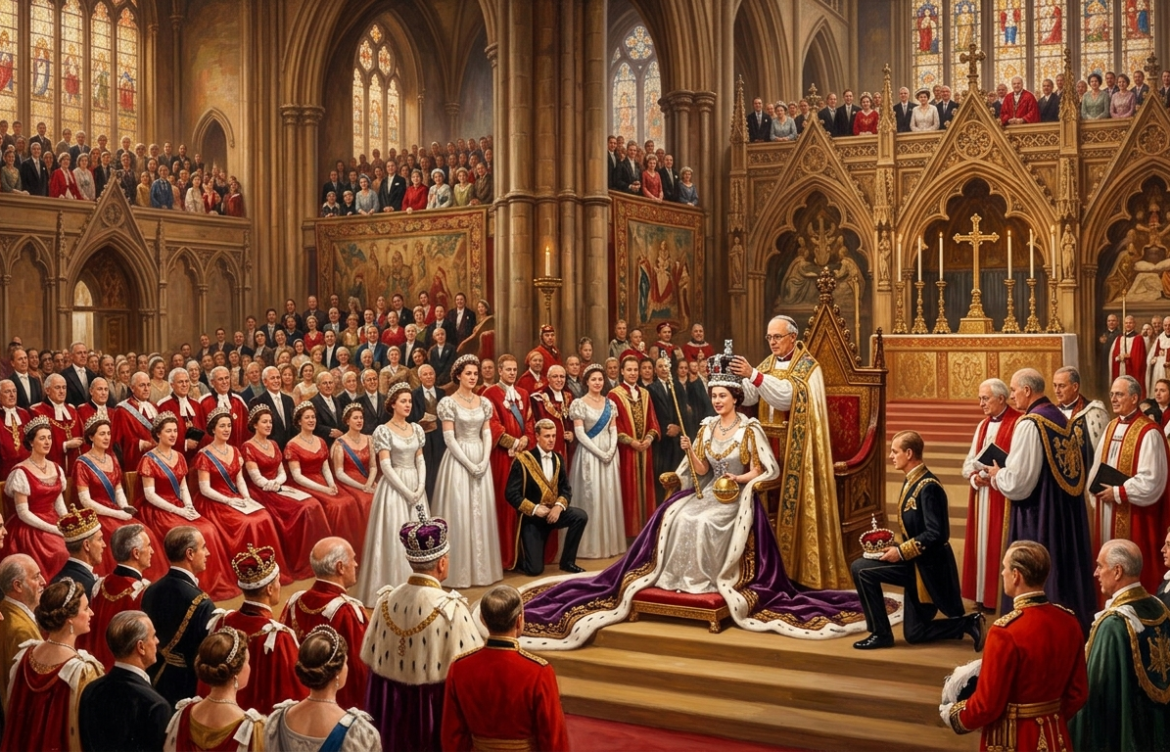
The most dramatic and symbolically resonant event of Charlemagne’s reign — indeed, one of the most consequential single events in the history of medieval Europe — occurred on Christmas Day, December 25, 800 AD, in the Basilica of Saint Peter in Rome. Pope Leo III, who had been physically attacked by his Roman enemies in April 799 AD in an attempt to blind him and cut out his tongue and had fled to Charlemagne’s court seeking protection, presided over a solemn Christmas Mass. As Charlemagne knelt in prayer before the altar, Leo suddenly placed an imperial crown upon his head and proclaimed him Imperator Romanorum — Emperor of the Romans. The assembled clergy and Roman people responded with three ceremonial acclamations: “Charles Augustus, crowned by God, great and peace-giving emperor of the Romans, life and victory!”
The boy born in the Frankish heartland in 748 AD, son of a man who had not yet even been king when he entered the world, had been crowned the first Western emperor since the deposition of Romulus Augustulus more than three centuries earlier. The gap between his birth and his coronation was fifty-two years. In that half-century, the child of Pepin the Short and Bertrada of Laon had become the most powerful ruler in the Western world. Whether Charlemagne had anticipated or even planned the coronation — his biographer Einhard famously wrote that the emperor claimed he would not have entered the church if he had known what Leo intended — is a matter of ongoing scholarly debate. Modern historians generally believe that the coronation was at least partly pre-arranged, noting that an imperial crown was visible in the church when Charlemagne arrived and that a man of his intelligence could hardly have failed to draw the obvious conclusion.
The significance of the coronation extended far beyond the personal prestige it conferred on Charlemagne himself. It revived the Western Roman imperial title that had been dormant since 476 AD, implicitly asserting that the Latin Christian West — guided by Frankish military power and Roman ecclesiastical authority — was the legitimate heir to the tradition of Rome. It established a precedent, ultimately deeply contested, that the papacy had the authority to crown emperors, a claim that would generate centuries of conflict between the papacy and the successors of Charlemagne. And it created the institutional concept — later refined and perpetuated by the Holy Roman Empire — that a divinely sanctioned Christian emperor stood over and unified the political community of Latin Christendom. The coronation of 800 AD was, in the deepest sense, the culmination of everything that had been set in motion by the birth in 748 AD.
The Carolingian Renaissance: How the Birth of Charlemagne Eventually Gave Europe Its First Cultural Revival
Among all the achievements of Charlemagne’s reign, the one that historians have most consistently judged to be the most enduring in its effects is the sweeping program of educational and cultural renewal known as the Carolingian Renaissance. The word Renaissance — rebirth — was chosen advisedly by the historians who coined the term, for what Charlemagne and his court undertook was a conscious and deliberate effort to revive the learning, scholarship, and culture of classical antiquity, filtered through the lens of Christian faith and directed toward the practical goals of better governance and a more educated and effective Church.
The intellectual center of the Carolingian Renaissance was the Palace School at Aachen, which Charlemagne established and which he placed under the direction of Alcuin of York, an Anglo-Saxon monk from the famous school at York in Northumbria who came to Charlemagne’s court around 782 AD. Alcuin was widely regarded as the greatest scholar of his age, and under his leadership the Palace School educated not only the children of the Frankish nobility — including Charlemagne’s own sons and daughters — but also adult members of the court. The curriculum was built on the seven liberal arts: the trivium of grammar, rhetoric, and logic, and the quadrivium of arithmetic, geometry, music, and astronomy. Charlemagne himself participated actively in the scholarly life of his court, studying Latin, attempting to learn Greek, and struggling — to his frustration — to master the skill of writing in his adult years. He gave himself and his courtiers classical scholarly nicknames: he was “David,” after the biblical king-scholar; Alcuin was “Flaccus,” after Horace; Einhard was “Beseleel,” after the craftsman of the Tabernacle.
The most practically significant and lasting product of the Carolingian Renaissance was the development and standardization of Carolingian minuscule, a clear and consistent script created in the scriptoria of Charlemagne’s empire to replace the many incompatible regional writing systems that had developed across Europe since the fall of Rome. Carolingian minuscule was easier to write, easier to read, and more uniform across different regions than any preceding system. It was adopted in monasteries and chanceries throughout the empire and became the basis from which Renaissance humanists of the fifteenth century later developed the lowercase letterforms that underlie the typefaces in use throughout the Western world today. Every lowercase letter in this sentence descends directly from the scriptorial revolution initiated in Charlemagne’s court.
Charlemagne’s educational decree, the Admonitio Generalis of 789 AD, called on every monastery and cathedral church in the empire to establish schools that would teach reading, writing, singing, arithmetic, grammar, and correct knowledge of the liturgy and Scriptures. The goal was partly practical — to create a better-educated clergy capable of administering the sacraments correctly and serving as the administrative backbone of the empire — but the broader effects were transformative. The monasteries of the Carolingian world became centers of manuscript production on a scale previously unknown in the post-Roman West. Monks copied classical Latin texts — Virgil, Cicero, Ovid, Suetonius, and many others — as well as theological and patristic writings, often working from deteriorating exemplars that would have been lost within a generation if not copied. It is estimated that approximately 90 percent of the ancient Roman works that survive today exist because they were copied in Carolingian scriptoria during the decades of Charlemagne’s reign and the generation that followed.
Charlemagne as Administrator and Lawgiver: Governing an Empire Born of a Single Child’s Destiny
The man born in the Frankish heartland in 748 AD became not only the greatest military commander and the most energetic patron of learning of his age, but also one of the most capable and systematic administrators in the history of medieval Europe. Governing an empire that stretched across most of Western and Central Europe, encompassing dozens of different peoples with different languages, laws, and traditions, required far more than military force. It required the creation of institutional structures capable of projecting royal authority into distant corners of a vast territory, translating the emperor’s will into local reality, and maintaining a degree of legal and administrative coherence across a political entity that had never existed in this form before.
The cornerstone of Charlemagne’s administrative system was the reformed institution of the missi dominici — royal envoys dispatched in pairs (one cleric and one layman) to defined regions of the empire. The missi traveled their assigned circuits, hearing legal complaints, administering justice, monitoring the conduct of local counts and bishops, and reporting back to the emperor on conditions in their territories. The capitulary of 802 AD, issued in the aftermath of the imperial coronation, significantly expanded and systematized the missi system, making it the principal mechanism by which the emperor exercised oversight of an empire too large for any individual to personally supervise.
Charlemagne issued hundreds of capitularies — royal legislative decrees that constituted the most ambitious body of lawmaking in the West since the decline of Roman imperial legislation. These decrees governed the conduct of monasteries, the duties of bishops, the responsibilities of counts, the proper celebration of religious festivals, the management of royal estates, the regulation of markets and money, and dozens of other aspects of public and private life throughout the empire. He ordered the writing-down of the traditional oral law codes of the Germanic peoples under his rule — the Saxons, the Thuringians, the Frisians — who had previously transmitted their legal customs only through oral tradition. He revised and supplemented the Lombard and Frankish legal codes. This massive legislative program, unprecedented in its scope for the early medieval world, reflected Charlemagne’s conviction that good, written law was essential to the Christian empire he was trying to build.
Among his other administrative and economic innovations, Charlemagne created a new monetary standard — the livre carolinienne — and established accounting principles, laws governing money lending, and government regulation of prices and weights and measures. He pursued infrastructure projects including the remarkable Fossa Carolina, a canal intended to connect the Rhine and Danube rivers and thereby link the North Sea with the Black Sea, opening trade routes between the Atlantic coast and the Byzantine world. The canal was never completed — the engineers encountered ground conditions that defeated the technology of the age — but its ambition speaks eloquently to the scale of Charlemagne’s vision for his empire.
Charlemagne’s Wives, Children, and Personal Character: The Man Behind the Legend
The personal life of Charlemagne was as vigorously and sometimes recklessly conducted as his public career. He had at least four official wives over the course of his life, as well as several long-term relationships with partners outside of formal marriage — a pattern entirely consonant with aristocratic Frankish custom but occasionally in tension with the Christian moral standards he simultaneously championed for his subjects. His first wife, a daughter of the Lombard king Desiderius whose name is not recorded with certainty in the sources, was married in 770 AD at the urging of his mother Bertrada and divorced approximately a year later, an act that poisoned his relationship with Desiderius and contributed to the Lombard war that followed.
His second and most deeply valued wife was Hildegard, daughter of Count Gerold of Swabia, whom he married in 771 AD immediately after the divorce from Desiderius’s daughter. Hildegard bore Charlemagne seven or eight children, including three sons — Charles, Carloman (who was renamed Pepin by Pope Adrian I during his baptism in Rome in 781 AD), and Louis — and several daughters who became close companions of their father throughout his life. Hildegard died in April 783 AD, reportedly after childbirth, and Charlemagne is said to have grieved deeply at her loss. Within months he married Fastrada, daughter of a Frankish count, and after Fastrada’s death in 794 AD he married Luitgard of Alamannia, who died in 800 AD. After Luitgard’s death Charlemagne did not remarry but maintained several long-term relationships with women he acknowledged and whose children he raised alongside his legitimate heirs.
In total, Charlemagne fathered at least eighteen children — possibly more — and was by all accounts a devoted and engaged parent. Einhard records that he insisted on being personally present at his children’s meals and that he took them with him on his travels as often as possible. His devotion to his daughters was so intense that he refused to allow any of them to marry during his lifetime, keeping them permanently at court — a decision that led, perhaps predictably, to various unofficial relationships and several illegitimate grandchildren. One son, Pepin the Hunchback, born to an early partner before his formal marriages, was involved in a conspiracy against his father in 792 AD and was sent to the monastery of Prüm as punishment, where he remained until his death. Of the legitimate sons, only Louis — Louis the Pious — survived his father and inherited the empire.
Einhard’s description of Charlemagne’s physical appearance has become one of the most celebrated passages in medieval biographical literature. He was tall — exceptionally so for his era, with modern analysis of his skeletal remains confirming a height of approximately 1.84 meters, about six feet — with a thick neck, a large belly in his later years, large and lively eyes, a slightly long nose, and hair that was fair and abundant. He dressed simply, in traditional Frankish clothing: a linen shirt and trousers, a tunic edged with silk, and stockings, covered in cold weather by a coat of otter or marten fur. He was contemptuous of foreign fashions and wore them only on ceremonial occasions. He ate moderately — Einhard emphasizes he was particularly fond of roasted meat — and was constitutionally resistant to his doctors’ advice, which famously recommended boiled rather than roasted meat for the sake of his health in later life. He swam regularly and hunted with great enthusiasm throughout his life. He was a man of powerful, concentrated presence — commanding in appearance, quick in judgment, and possessed of an energy that astonished those around him.
The Death of Charlemagne on January 28, 814 AD: The End of the Man, the Beginning of the Legend
In the autumn of 813 AD, Charlemagne — knowing himself to be failing — called his surviving son Louis to Aachen and, in a ceremony before the assembled magnates of the empire, crowned him co-emperor with his own hands. It was a deliberate and carefully staged succession, designed to avoid the kind of dynastic conflict that had so often attended Frankish royal deaths, and it was the last great administrative act of a man who had spent his life building institutions intended to outlast him. The ceremony also represented a subtle but significant assertion of imperial independence: Charlemagne crowned his own son without the involvement of the pope, implicitly rejecting the precedent set by his own coronation in 800 AD that the papacy had the authority to confer the imperial title.
Charlemagne became seriously ill in the late autumn of 813 AD, spending his final months in prayer, fasting, and study of the Gospels. He developed pleurisy — inflammation of the membrane surrounding the lungs — and was confined to bed for the last seven days of his life. He died at approximately nine in the morning on January 28, 814 AD, in Aachen, his imperial capital. He was approximately sixty-six years old. Einhard records his last words as a verse from the Gospel of Luke: “Into your hands, Lord, I commend my spirit.” His body was prepared by his daughters and palace officials and buried that same day in the Palatine Chapel at Aachen — the magnificent octagonal chapel, modeled on the Byzantine Church of San Vitale in Ravenna, that he had built as the centerpiece of his palace complex and that survives today as part of Aachen Cathedral, designated a UNESCO World Heritage Site in 1978.
In 1165 AD, Holy Roman Emperor Frederick Barbarossa arranged for Charlemagne’s canonization as a saint — a politically motivated act intended to strengthen the prestige of the imperial title by associating it with the holiness of its greatest holder. The Catholic Church does not formally recognize this canonization, regarding it as a local or informal one rather than a papal declaration, but a cult of Charlemagne centered on Aachen persisted through the Middle Ages and into the modern period, his feast day observed on January 28. In 2014, a scientific analysis of skeletal remains preserved in the famous Karlsschrein — the golden reliquary shrine at Aachen Cathedral, commissioned by Emperor Frederick II in 1215 to house Charlemagne’s bones — confirmed that the remains were those of a singularly tall, large-framed man who died in his late sixties or early seventies and who had bony deposits in his knee and heel consistent with the arthritis and limp that medieval sources attribute to Charlemagne in his final years.
The Legacy of Charlemagne’s Birth: How One Life Shaped a Continent for a Thousand Years
The French and German nations both trace their institutional origins to Charlemagne, and with good reason. The Treaty of Verdun of 843 AD, which divided the Carolingian empire among his three grandsons, created the political units from which France and Germany eventually emerged. West Francia, ruled by Charles the Bald, was the nucleus of the French kingdom. East Francia, ruled by Louis the German, was the nucleus of the German kingdom. The very languages spoken in France and Germany today are the descendants of the regional dialects that Carolingian administrative practice helped codify and preserve. The boundaries of many modern European nations, dioceses, and administrative units trace their origins to decisions made in Charlemagne’s chancery. The structure of the Catholic Church in Western Europe, the relationship between secular and religious authority, the concept of the emperor as the protector of Christendom — all of these were shaped in their medieval forms by the reign of the man born in 748 AD.
The Holy Roman Empire, which endured in various forms from the coronation of Otto the Great in 962 AD until Napoleon dissolved it in 1806 AD, drew its fundamental concept and its primary legitimating mythology from Charlemagne’s coronation in 800 AD. Every Holy Roman Emperor for nearly a thousand years claimed to be the successor and heir of Charlemagne. The coronation at Aachen, in Charlemagne’s own chapel, was a standard element of imperial accession ceremonies, chosen precisely because of its association with the founder of the imperial tradition. Four of the five Ottonian emperors who established the Holy Roman Empire in its enduring form were crowned in Charlemagne’s palace chapel, deliberately invoking the Carolingian precedent to legitimize their own authority.
The Charlemagne Prize — Karlspreis in German — established by the city of Aachen in 1950 and awarded annually to individuals who have made outstanding contributions to European unity and cooperation, is perhaps the most tangible modern recognition of Charlemagne’s foundational role in the European idea. Recipients have included Winston Churchill (1955), Konrad Adenauer (1954), Robert Schuman (1958), Jean Monnet (1953), Pope John Paul II (1004), Angela Merkel (2008), Pope Francis (2016), and Emmanuel Macron (2018). The award explicitly acknowledges that the project of European integration undertaken after the Second World War — the project that gave rise to the European Union, to the euro, to the Schengen Area of open borders, to the common market — is in its deepest intellectual and historical roots a Carolingian project, tracing its lineage to the vision of a unified Christian Europe that Charlemagne embodied and pursued.
Perhaps the most remarkable statistic in the entire legacy of Charlemagne is a genealogical one. The medieval geneticist and statistician Joseph Chang has demonstrated mathematically that every person of predominantly European ancestry alive today is almost certainly a direct descendant of Charlemagne. Given the number of children Charlemagne fathered, the fertility of the Carolingian dynasty over subsequent generations, and the mathematics of exponential ancestry, virtually every European can trace at least one — and in most cases many — direct genetic lines back to the man born on April 2, 748 AD. The birth of Charlemagne was not merely a historical event. It was, in a very literal biological sense, an event in the ancestry of every European person alive today.
Conclusion: The Child Who Was Born to Change the World
On April 2, 748 AD — or thereabouts, in a place that cannot with certainty be named, to a father who was not yet king and a mother whose formal marital status at the time of his birth remains debated — a child was born who would grow up to be King of the Franks, King of the Lombards, Emperor of the Romans, patron of learning, architect of European civilization, and the most consequential ruler of the Early Middle Ages. He was given the name Charles. History gave him the additional name Great.
The birth of Charlemagne was the birth of medieval Europe as we understand it. Without him, the fragmented post-Roman West might have remained fragmented for centuries longer. Without his military campaigns, Saxon Germany might not have been Christianized, the Lombard threat to Rome might not have been eliminated, and the papacy might not have survived as the institution it became. Without his coronation in 800 AD, the concept of a Western Christian empire — with all its implications for the political theology of the Middle Ages — might never have been formalized. Without his educational reforms, the classical heritage of Rome might have been lost beyond recovery. Without his administrative innovations, the institutional foundations of the French and German states might have taken a different and less coherent form.
None of this was written into the stars on the day of his birth. It was made by the choices, campaigns, and convictions of a man who happened to be born with extraordinary gifts at an extraordinary moment in history, to a family whose generations of accumulated power and prestige placed him in the position to use those gifts on the grandest possible scale. The birth of Charlemagne was, in the most literal sense, the beginning of Europe.