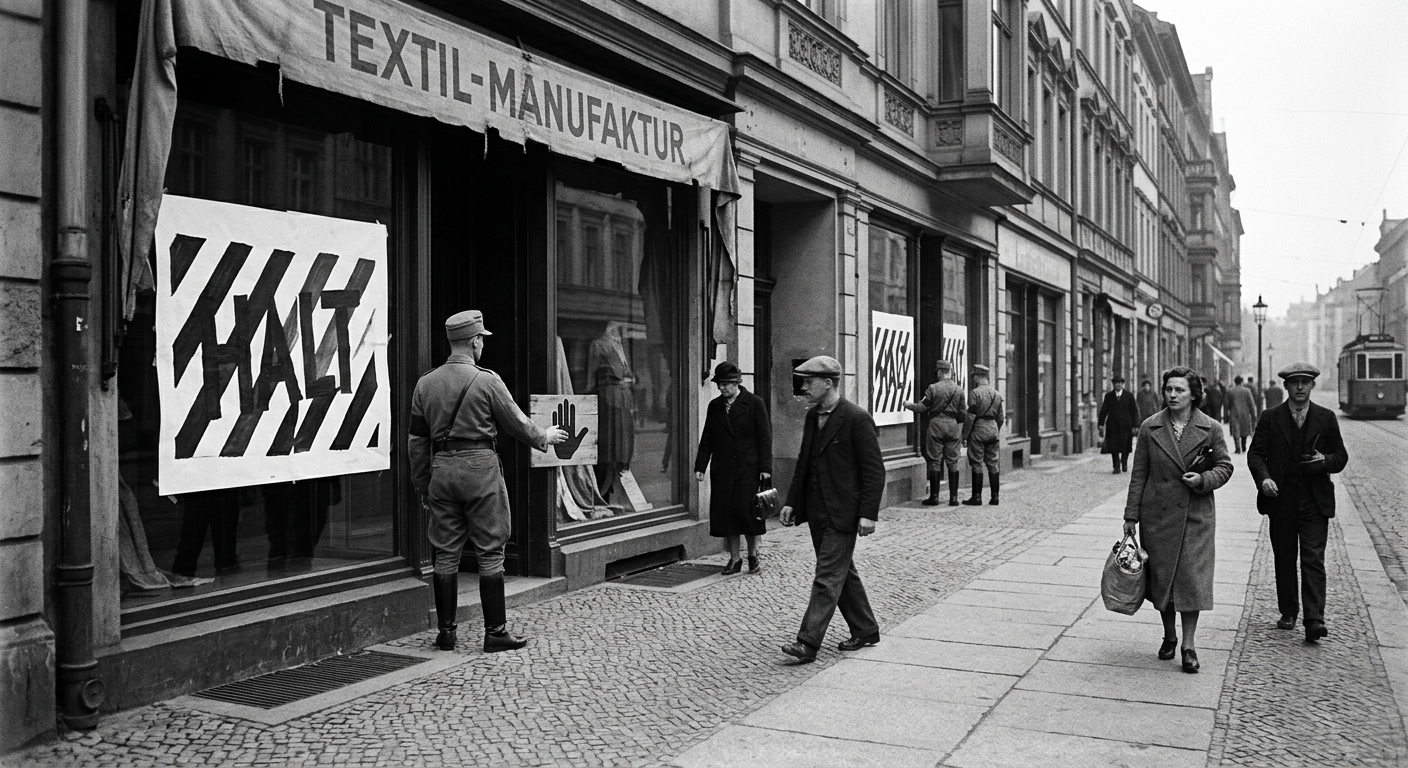
On the morning of April 1, 1933, a Saturday, Germany woke up to a chilling new reality. Across the length and breadth of the country, uniformed members of the Sturmabteilung — the SA, or Storm Troopers — took up positions outside Jewish-owned shops, offices, banks, medical practices, and law firms. Armed with placards reading “Germans! Defend yourselves! Don’t buy from Jews!” and “Kauf nicht bei Juden!”, they blocked doorways, painted the Star of David in yellow and black across thousands of storefronts, and physically intimidated anyone who dared to enter. At exactly 10:00 in the morning, the Nazi Party’s first nationwide, state-sponsored, and officially organized boycott of Jewish businesses began — an act that would echo through history as a defining opening act of one of the most systematic campaigns of persecution the world has ever witnessed.
This single day — April 1, 1933 — holds enormous historical significance not merely because of what occurred on that Saturday, but because of what it signaled: the transformation of private antisemitic hatred into official state policy. Germany’s approximately 600,000 Jewish citizens, who made up less than one percent of the total population, were now targets of a government that had decided to use the machinery of the state to exclude, humiliate, and ultimately destroy them. The boycott of April 1, 1933 was the first major, coordinated anti-Jewish action taken by the Nazi regime, and it laid the ideological and structural groundwork for every act of persecution that followed — from the Nuremberg Laws of 1935 to the horrors of the Holocaust.
Who Were the Jews of Germany in 1933?
To understand the magnitude of what happened on April 1, 1933, one must first understand the community that was targeted. In 1933, roughly 600,000 Jews lived in Germany, a nation of over 60 million people. They were, by every meaningful measure, deeply integrated into German society. More than 100,000 German Jews had served in the German army during the First World War, and many had been decorated for bravery and sacrifice on the battlefield. Jews taught at Germany’s most prestigious universities, led major institutions, and contributed enormously to the intellectual and cultural life of the nation. Of the 38 Nobel Prizes won by German writers and scientists between 1905 and 1936, an extraordinary 14 went to Jewish individuals.
Jewish Germans held important positions in government, in business, in medicine, in law, and in the arts. Intermarriage between Jews and non-Jews was becoming increasingly common. Many Jewish families had lived in Germany for generations and considered themselves Germans first and Jews second. They spoke the German language, celebrated German culture, and regarded Germany as their homeland in every sense of the word. The confidence with which most German Jews approached their future in 1933, just weeks before Hitler came to power, was not born of naivety but of lived experience. Nothing in their history had prepared them for what was about to be done to them.
Adolf Hitler’s Rise to Power and the Immediate Threat to Jewish Life
On January 30, 1933, Adolf Hitler was appointed Chancellor of Germany by President Paul von Hindenburg. The appointment of Hitler and his National Socialist German Workers’ Party (NSDAP) to the highest office in Germany was a seismic event, not only for the country but for Jews across Europe and the world. Antisemitism had always been a central pillar of Nazi ideology. Hitler had written extensively about his hatred of Jews in Mein Kampf, and the Nazi Party’s platform had long called for the exclusion of Jews from German national life. Now, for the first time, the party held the reins of state power.
Within days of Hitler’s appointment, the violence began. Members of the SA, the paramilitary wing of the Nazi Party, launched a campaign of attacks against Jewish-owned department stores in German cities. Jewish lawyers and judges were physically prevented from reaching the courts. In some instances, the SA created improvised detention facilities where prominent Jewish anti-Nazis were held. Local police, not yet fully under Nazi control, attempted without success to stop some of these attacks. The message being sent was unmistakable: the new regime intended to make good on its promises to strip Jews of their place in German society, by force if necessary.
By March 1933, the Nazis had also won a large number of seats in the German parliament, the Reichstag, further consolidating their political grip. The Enabling Act of March 23, 1933, effectively granted Hitler dictatorial powers, allowing him to enact laws without the approval of the Reichstag. The constitutional framework of the Weimar Republic was being dismantled piece by piece, and with it, whatever legal protections Jewish citizens might have hoped to rely upon.
The International Response: American Jews and the Anti-Nazi Boycott of March 1933
Word of the Nazi attacks on Jews spread rapidly beyond Germany’s borders, and Jewish communities around the world reacted with alarm. In the United States, Jewish organizations scrambled to formulate a response. Representatives of the American Jewish Committee, B’nai B’rith, and the American Jewish Congress met in New York to assess the situation. Initially, there was significant disagreement about what course of action to take. Many leaders feared that organized public protests in America would further endanger the position of Jews still living in Germany by giving the Nazis a pretext to claim that German Jews were orchestrating foreign attacks on the new government.
However, as the unrelenting Nazi attacks on Jews in Germany continued through February and into March 1933, the American Jewish Congress changed course. On March 12, 1933, the organization resolved to hold a mass protest rally at Madison Square Garden in New York City. A week later, it convened an emergency conference attended by approximately 1,500 representatives of various Jewish organizations. At a contentious four-hour meeting held at the Hotel Astor on March 20, 1933, the assembled delegates debated the merits and risks of a public boycott of German goods. J. George Fredman, commander-in-chief of the Jewish War Veterans, was among the most vocal advocates for an economic boycott, stating forcefully that German economic interests must be made to feel the cost of the regime’s persecution of Jews.
On March 27, 1933, a massive rally was held at Madison Square Garden in New York City with an overflow crowd of 55,000 people inside and outside the arena. Parallel events were held simultaneously in Baltimore, Boston, Chicago, Cleveland, Philadelphia, and more than 70 other locations across the country, with the proceedings at the New York rally broadcast around the world. Speakers at Madison Square Garden included American Federation of Labor president William Green, Senator Robert F. Wagner, former Governor of New York Al Smith, and numerous Christian clergymen who joined Jewish leaders in calling for an end to Nazi persecution. Rabbi Moses S. Margolies, the spiritual leader of Manhattan’s Congregation Kehilath Jeshurun, rose from his sickbed to address the crowd. Rabbi Stephen S. Wise, one of the most prominent American Jewish leaders of the era, also spoke, declaring the protest a moral imperative regardless of its practical consequences.
The Anti-Nazi boycott that emerged from this period — backed by the American Jewish Congress, the American League for Defense of Jewish Rights, B’nai B’rith, the Jewish Labor Committee, and the Jewish War Veterans — formally began in March 1933 and continued until the United States entered the war following Pearl Harbor on December 7, 1941. In Britain, the movement to boycott German goods found support among many, though it was opposed by the conservative Board of Deputies of British Jews. The right-wing British newspaper the Daily Express ran a headline on March 24, 1933, stating that “Judea Declares War on Germany” — an inflammatory characterization that the Nazi propaganda apparatus would exploit to justify its own retaliatory measures.
Joseph Goebbels and the Nazi Decision to Launch a Counterboycott
The Nazi regime watched the international protests and boycott movement with mounting fury. Joseph Goebbels, who had established the Nazi Ministry of Propaganda and Public Enlightenment, was particularly enraged. On March 31, 1933, Goebbels announced to the Nazi party newspaper that “world Jewry” had ruined the reputation of the German people, and declared that a campaign of “sharp countermeasures” would be taken against the Jews of Germany in response. The logic Goebbels put forward was deliberately inverted and dishonest: he framed the planned boycott of Jewish businesses not as aggression but as defense — a justified German response to what the Nazis called Greuelpropaganda, or “atrocity propaganda,” which they alleged was being spread by German and foreign Jews through the international press to damage the new regime’s reputation.
Goebbels announced a one-day boycott of all Jewish businesses in Germany to take place on Saturday, April 1, 1933. He issued a conditional threat alongside the announcement: if, after the one-day boycott, the foreign press stopped publishing what he called false charges against the Nazis, there would be no further boycott of Jewish businesses. If the international Jewish attacks on the Nazi regime continued, however, Goebbels warned that the boycott would be resumed until, in his own chilling words, “German Jewry has been annihilated.” The announcement left no room for doubt about the regime’s ultimate intentions, even at this early stage.
Julius Streicher and the Organization of the April 1 Boycott
The man tasked by Hitler and the Nazi leadership with organizing the boycott was Julius Streicher (born February 12, 1885), the Gauleiter — or regional party leader — of Franconia and one of the most virulent antisemites in the entire Nazi movement. Streicher had been publishing the fiercely antisemitic tabloid newspaper Der Stürmer since 1923, a publication that featured crude cartoons, pseudoscientific articles, and content depicting Jews in the most dehumanizing terms imaginable. By 1935, Der Stürmer would reach a circulation of approximately 600,000 copies, and public display cases known as Stürmerkästen installed in towns across Germany made its vile content accessible to any passerby.
Streicher was appointed chairman of the newly formed Central Committee to Repulse Jewish Atrocity and Boycott Agitation — formally known in German as the Zentralkomitee zur Abwehr der jüdischen Greuel- und Boykotthetze. This committee, announced on March 29, 1933, included among its members Heinrich Himmler (Reich Führer of the SS), Hans Frank (head of the National Socialist Jurists’ League), Robert Ley, Dr. Gerhard Wagner (head of the National Socialist League of Physicians), and other senior figures of the Nazi apparatus. The formation of this committee made clear that the boycott was not a spontaneous act of popular anger but a deliberately planned, state-directed operation.
On March 31, 1933, the evening before the boycott, the NSDAP held mass meetings across the Reich to propagandize the German population. Gauleiters, district leaders (Kreisleiter), and local party leaders (Ortsgruppenleiter) agitated against Jews and what they termed the “Jewish economy.” All Nazi Party members were required to attend these meetings. Streicher’s Central Committee published detailed orders on March 31, 1933, spelling out exactly how the boycott was to be conducted at every level — from the largest cities to the smallest villages. The orders established Action Committees in every local branch and organizational section of the NSDAP. These committees were responsible for implementing the boycott and ensuring it covered Jewish shops, Jewish goods, Jewish doctors, and Jewish lawyers without exception.
The committee’s orders stated explicitly that the boycott was to reach “right into the smallest peasant village in order to strike particularly at Jewish traders in the countryside.” The documents also noted, with calculated cynicism rather than humanitarian concern, that no violence was to be employed against Jews during the boycott — not because the committee cared about their safety, but because, as one document explained, if no violence were employed, Jewish employers would have no grounds for dismissing employees and refusing wages. The committee also declared that any business property that had been transferred to non-Jewish figureheads to circumvent the boycott was still to be considered Jewish for the purposes of the action.
The Day of the Boycott: April 1, 1933 — What Happened Across Germany
At precisely 10:00 in the morning on Saturday, April 1, 1933, the boycott began simultaneously across all of Germany. Paramilitary members of the SA (Sturmabteilung), the SS (Schutzstaffel), the Stahlhelm, and the Hitler Youth took up their assigned posts in front of Jewish-owned department stores, retail establishments, banks, doctors’ offices, and law firms. Signs were posted with slogans such as “Don’t buy from Jews!” The Star of David was painted in yellow and black across thousands of doors and windows. Propaganda Ministry officials and local Nazi functionaries looked to identify and shame any German citizens who attempted to ignore the boycott and continued using Jewish stores and services.
Despite the official orders against violence, numerous incidents of looting, property destruction, and physical assault on Jewish business owners were reported throughout the day. SA activists mistreated Jews, daubed Jewish businesses with antisemitic graffiti, and smashed the windows of Jewish homes and offices. In cities such as Berlin, Cologne, Nuremberg, and Munich, the scenes of uniformed Nazis barring entry to Jewish establishments and humiliating Jewish citizens in public were witnessed by thousands. Some Jewish store owners, like Heinrich Katz in Darmstadt — who ran a shoe and leather goods shop with his wife Sally — found themselves powerless as SA men blocked the entrance to their livelihoods. Katz would later receive a handwritten note from SA Troop Leader Wagner, dated April 25, 1933, ordering that actions against him were to stop — a rare personal intervention that did little to protect him in the years ahead. By 1934, his revenue had been cut in half, and by 1935 he had emigrated to Palestine.
The timing of the boycott on a Saturday added a particular layer of complexity: Saturday was the Jewish Sabbath, and many Jewish-owned businesses were already closed for religious observance, which meant that in some places the visual impact of the boycott was diminished because there were no open stores for SA men to stand in front of. Nonetheless, the symbolic and psychological weight of the action was unmistakable. For Jewish Germans, the sight of their own government mobilizing uniformed forces to mark out their shops and drive away their customers was a traumatic, potentially decisive signal about the future.
The national boycott unofficially wound down by the evening of April 1, and was formally placed on hold. As the German population continued to use Jewish businesses during the break that followed, it became apparent that the action had not achieved the kind of public enthusiasm the Nazi leadership had hoped for. Many ordinary Germans simply went about their shopping as usual, choosing practical necessity over ideological compliance. On April 4, 1933, Hitler ordered all boycott actions to cease, and on April 4 the boycott was officially declared over, having been deemed by the regime to have fulfilled its purpose — a face-saving conclusion to an action that had generated significant international criticism.
Why the Boycott Failed to Achieve Its Immediate Goals — and Why It Succeeded in What Truly Mattered
Measured by the Nazi regime’s stated objectives, the April 1 boycott was largely a failure. It lasted only one day. It took place on a Saturday, when many Jewish businesses were already closed. Large numbers of ordinary Germans continued to patronize Jewish-owned stores and seek the services of Jewish doctors and lawyers, either out of personal loyalty, indifference to Nazi ideology, or simple pragmatism. The foreign press condemned the action, generating exactly the kind of negative international coverage the Nazis claimed to be countering. Major American newspapers published detailed reports of the boycott, fueling further criticism of Nazi Germany. German pharmaceutical companies, which had significant Jewish ownership and management, were particularly hard hit by the international anti-German boycott that the April 1 action helped to intensify.
Yet to evaluate the boycott purely on the basis of its immediate commercial impact is to miss its true historical significance. The boycott of April 1, 1933 was the first state-sponsored attack on Jews within Germany. It was the moment when private antisemitic hatred became official government policy and was executed through the organized machinery of the Nazi state. It marked what the United States Holocaust Memorial Museum has described as the beginning of a nationwide campaign by the Nazi Party against the entire German Jewish population. As the Anne Frank House has noted, for the first time, the Nazis showed clearly that they wanted to make life impossible for the Jews — not merely through private prejudice but through state action. That signal, once sent, could not be unsent.
Immediate Legal Consequences: The Law for the Restoration of the Professional Civil Service (April 7, 1933)
Just one week after the boycott, on April 7, 1933, the Nazi government passed the Law for the Restoration of the Professional Civil Service (Gesetz zur Wiederherstellung des Berufsbeamtentums). This law restricted employment in the civil service to “Aryans,” effectively meaning that Jews could no longer serve as teachers, professors, judges, or in other government positions. Most Jewish government workers, including teachers in public schools and universities, were fired. Doctors followed closely behind. The same day, the Law on the Admission to the Legal Profession was passed, forbidding the admission of Jews to the bar. The speed with which these laws followed the boycott — a mere seven days — underscores the degree to which the April 1 action had been planned as the opening move in a larger legislative campaign rather than an isolated incident.
An amendment published on April 11, 1933, clarified who was to be considered non-Aryan: “A person is to be considered non-Aryan if he is descended from non-Aryan, especially Jewish, parents or grandparents. It is enough for one parent or grandparent to be non-Aryan.” This legal definition — broad, racially determined, and deliberately vague enough to ensnare as many people as possible — would become the template for subsequent antisemitic legislation. It is worth noting that an intervention by German President Paul von Hindenburg secured an exemption for Jewish employees who had fought for Germany in World War I, or whose father or son had died in the war, or who had been employed by the government prior to the war. These exemptions, however, would be stripped away with the enactment of the Nuremberg Laws in September 1935.
April 1933 also saw further legislation restricting the number of Jewish students at German schools and universities, with a quota of 1.5 percent imposed on the admission of non-Aryans to public schools and universities. Further laws sharply curtailed Jewish activity in the medical and legal professions. The city of Berlin forbade Jewish lawyers and notaries to work on legal matters. The mayor of Munich forbade Jewish doctors from treating non-Jewish patients. The Bavarian Interior Ministry denied admission of Jewish students to medical school. Throughout 1933 and 1934, Jewish businesses were denied access to markets, forbidden to advertise in newspapers, and deprived of access to government contracts. The scope and pace of legal discrimination expanded rapidly in the months following the boycott.
The Escalating Campaign: From Boycott to Aryanization, 1933–1938
The economic persecution of German Jews that began with the April 1 boycott did not end when the official action concluded. It deepened and broadened over the course of the following years, transforming from a single-day public event into a sustained, systemic campaign to strip Jews of their economic existence. German businesses — particularly large organizations like banks, insurance companies, and industrial firms such as Siemens — increasingly refused to employ Jews. Hotels, restaurants, and cafes banned Jews from entering. The resort island of Borkum banned Jews anywhere on the island. In July 1933, the Denaturalization Law revoked the citizenship of naturalized Jews and other “undesirables.” In October 1933, the Law on Editors banned Jews from editorial positions in the press.
The process known as Aryanization — the systematic transfer of Jewish-owned businesses to non-Jewish Germans at prices officially fixed well below market value — intensified steadily throughout the 1930s. Jews were required to register their domestic and foreign property and assets, creating a prelude to the gradual expropriation of their material wealth by the state. Jewish-owned businesses were pressured to dismiss Jewish workers and managers. From April 1933 to April 1938, Aryanization effectively reduced the number of Jewish-owned businesses in Germany by approximately two-thirds. By the spring of 1939, the vast majority of Jewish-owned businesses in Germany had been transferred into Aryan hands, often at a fraction of their true value. Former middle-class or wealthy business owners were forced into menial employment to support their families, and many were unable to find any work at all.
The Nuremberg Laws of 1935: Institutionalizing Racial Persecution
The legislative arc that began with the April 1, 1933 boycott reached one of its most consequential expressions on September 15, 1935, when the Nazi regime announced the Nuremberg Laws at the annual Nuremberg party rally. These two pieces of legislation — the Reich Citizenship Law and the Law for the Protection of German Blood and German Honor — represented a fundamental transformation of the Jewish community’s legal and social position in Germany. The Nuremberg Laws stripped all Jews of their German citizenship, regardless of where they were born or how many generations their family had lived in Germany. Jews were now defined not by religious belief but by ancestral lineage, with anyone who had three or four Jewish grandparents classified as a full Jew, and those with one or two Jewish grandparents classified as Mischlinge, or part-Jewish.
The Nuremberg Laws also prohibited marriage and sexual relations between Jews and those of German blood. People convicted of violating these marriage laws were imprisoned and, from March 1938 onward, were often re-arrested by the Gestapo and sent to concentration camps. Social and commercial contact between Jews and non-Jews declined sharply. A Jewish quota of one percent was introduced for university attendance. Jewish men would later be required to add the middle name “Israel” to their identity documents, and Jewish women the name “Sarah.” By 1938, all German Jews would have their passports marked with a large “J.” Each of these measures traced a direct line back to the first, foundational act of state-sponsored exclusion: the boycott of April 1, 1933.
Kristallnacht and the Path to the Holocaust: How the Boycott Set the Precedent
The trajectory from the April 1, 1933 boycott to the Holocaust is not a straight line, but it is a discernible one. Each act of persecution built upon the last, normalizing the exclusion of Jews from German society and desensitizing the German population to ever more extreme measures. By the time Kristallnacht — the Night of Broken Glass, or the November Pogrom — erupted on the night of November 9 and 10, 1938, the ground had been systematically prepared by years of escalating state-sponsored antisemitism. During Kristallnacht, more than 250 synagogues were destroyed, countless Jewish businesses and homes were vandalized and burned, 91 people were murdered, and approximately 30,000 Jewish men were sent to Dachau, Buchenwald, Sachsenhausen, and other concentration camps.
After the invasion of Poland in September 1939, the Nazi occupiers forced Jews into ghettos and completely banned them from public life. As the Second World War continued and Nazi control spread across Europe, the regime turned to genocide. The Holocaust — the deliberate, organized, state-sponsored persecution and murder of approximately six million Jewish people — was the ultimate and catastrophic destination of a journey that had begun with acts of economic exclusion, propaganda, and official persecution. The April 1, 1933 boycott was, in the words of scholarly consensus, the first step of state-sponsored persecution that ultimately led to the Holocaust.
The International Anti-Nazi Boycott: Impact, Limitations, and the Haavara Agreement
While the Nazi regime was implementing its boycott of Jewish businesses within Germany, the international Jewish-led anti-Nazi boycott of German goods was having a measurable economic impact. By July 1933, the boycott had forced the resignation of the board of the Hamburg America Line, a major German shipping company. German imports to the United States were reduced by nearly a quarter compared with the prior year. Joseph Goebbels himself expressed that the economic consequences of the international boycott were a cause for “much concern” at the first Nuremberg party rally that August. German pharmaceutical companies were particularly affected — nearly two-thirds of the 652 practicing Jewish doctors in Mandatory Palestine stopped prescribing German medicines.
However, the effectiveness of the anti-Nazi boycott was complicated by competing interests within the Jewish world itself. At the same time that American and international Jewish organizations were pushing for a boycott, Zionist organizations were brokering the Haavara Agreement with Germany — a transfer arrangement that opened trade in exchange for facilitating the emigration of German Jews to Palestine. Under the Haavara Agreement, when German Jewish emigrants arrived in Palestine, they would receive a portion of their capital in the form of German goods and the rest in currency. The arrangement served both parties in different ways: for the Nazis, it dramatically increased German Jewish emigration, fulfilling a central goal of their ideological platform; for Zionists, it enabled the transfer of significant Jewish capital from Germany to Palestine, helping to build the foundations of what would become the State of Israel. By the time the Second World War began, tens of thousands of Germans had emigrated to Palestine under the Haavara Agreement, and more than 35 million dollars’ worth of Jewish capital had been transferred.
The international boycott ultimately did nothing to deter the Nazis from their course. As Rabbi Stephen S. Wise had acknowledged, however, the boycott was a moral imperative regardless of its practical limitations. It was a declaration that the world’s Jewish communities would not be silent in the face of persecution, and it kept international attention focused on what was happening inside Germany at a time when many governments preferred to look away.
Julius Streicher’s Later Role and His Trial at Nuremberg
Julius Streicher, the man who had organized the April 1, 1933 boycott, continued his campaign of antisemitic agitation throughout the following years. His newspaper Der Stürmer reached its highest circulation point in 1938, and his publishing house produced a wide range of antisemitic materials, including children’s books such as Der Giftpilz (The Poisonous Mushroom), which were designed to indoctrinate German youth with racial hatred from an early age. Public display cases installed in towns across Germany made Der Stürmer’s content inescapable in daily life.
By 1940, Streicher had lost credibility within Nazi party circles and was removed from his position as Gauleiter of Franconia following investigations into personal misconduct. He continued, however, to edit and distribute Der Stürmer until the end of the war. After Germany’s defeat, Streicher was among the 24 leading German officials indicted before the International Military Tribunal at Nuremberg, which commenced its proceedings on October 18, 1945. Streicher was charged under Count Four — crimes against humanity — for his systematic incitement to the persecution, murder, and extermination of Jews through his control and publication of Der Stürmer from 1923 to 1945. His case established a significant legal precedent for holding propagandists accountable for incitement as a form of crime against humanity when their work was linked to ensuing atrocities. Julius Streicher was found guilty and executed by hanging on October 16, 1946.
The Role of Propaganda in Making the Boycott Possible
The April 1, 1933 boycott did not emerge from a vacuum. It was made possible by decades of accumulated antisemitic propaganda that had been woven into German cultural and political life, and by the specific machinery of Nazi propaganda that had been building since the early 1920s. Since 1923, Julius Streicher had been publishing Der Stürmer, embedding antisemitic imagery and ideas into the daily lives of millions of Germans. Anti-Semitism and racism had become a normalized part of public campaigns and school teachings under the Weimar Republic’s tolerant — critics would say permissively passive — cultural environment.
The Nazi propaganda apparatus had, from the very beginning of Hitler’s political career, blamed Jews for Germany’s defeat in the First World War, for the punitive conditions of the Treaty of Versailles, for inflation, and for the economic depression that had devastated ordinary German families throughout the late 1920s and early 1930s. By the time Hitler was appointed Chancellor in January 1933, a significant portion of the German population had been primed to accept — or at least not to actively resist — measures targeting Jews. The boycott of April 1, 1933 was simultaneously a product of this propaganda and a powerful new act of propaganda in its own right: a visible, public, state-sanctioned declaration that Jews were enemies of Germany, to be shunned, isolated, and driven out.
The German Population’s Reaction: Compliance, Resistance, and Indifference
One of the most revealing aspects of the April 1, 1933 boycott is the response — or lack thereof — of the broader German population. The boycott largely failed to attract public enthusiasm. Many individual Germans continued to shop in Jewish-owned stores and seek the services of Jewish professionals, defying both the letter and spirit of the regime’s instructions. The Propaganda Ministry had anticipated this possibility and specifically assigned Nazi functionaries to identify and shame Germans who ignored the boycott, but the scale of non-compliance was significant enough that it contributed to the regime’s decision to end the action after one day.
This is not to suggest that most Germans actively opposed the boycott or that they stood in solidarity with their Jewish neighbors. The historical record is more complicated and, in many ways, more troubling. Many Germans were indifferent — motivated not by moral objection but by habit, economic self-interest, or personal relationships. Many Germans who continued using Jewish businesses did so not as a political statement but because those businesses were convenient, affordable, or familiar. Active, principled resistance to Nazi antisemitism on the part of non-Jewish Germans was, with significant and admirable individual exceptions, relatively rare. The machinery of persecution did not require enthusiastic popular participation — it required only that people look away.
Historical Memory and the Significance of April 1, 1933 Today
More than nine decades after the events of April 1, 1933, the Nazi boycott of Jewish businesses retains its power as one of the most instructive episodes in modern history. It demonstrates with terrible clarity how quickly and efficiently a modern state can mobilize its institutions, its laws, its media, and its paramilitary forces to target and persecute a minority group. It shows how economic exclusion can serve as both a practical tool of persecution and a powerful symbolic instrument of dehumanization — marking people as different, dangerous, and outside the bounds of the national community.
The boycott also illustrates the danger of treating early acts of persecution as isolated or manageable incidents. In the weeks and months following April 1, 1933, there were voices — within Germany and abroad, within the Jewish community itself — that urged caution, accommodation, or a wait-and-see approach. The Central Jewish Association of Germany even issued a statement suggesting that the Hitler regime was unaware of the threatening situation and that German citizens would not allow excesses against the Jews. History rendered a devastating verdict on that optimism. The boycott was not an aberration or an improvised outburst. It was the opening move in a carefully planned, ideologically driven campaign that would ultimately consume the lives of six million Jewish people.
Major institutions of Holocaust memory and scholarship — including the United States Holocaust Memorial Museum, Yad Vashem in Jerusalem, and the Anne Frank House in Amsterdam — have preserved extensive documentation of the April 1, 1933 boycott, including photographs, contemporaneous newspaper accounts, official Nazi documents, and personal testimonies from those who witnessed or experienced it. These records ensure that the events of that Saturday morning remain part of the world’s historical consciousness, a reminder of where hatred, when empowered by the state, can lead.
Conclusion: A Single Day With a Century-Long Shadow
The Nazi boycott of Jewish businesses on April 1, 1933 lasted only one day. In a narrow commercial sense, it achieved little. Many shops remained closed due to the Sabbath. Many Germans continued to patronize Jewish businesses. The international press condemned the action. The regime, unable to sustain public enthusiasm, ended the boycott and declared victory. By the ordinary metrics of a political campaign, it was a limited success at best.
But history is not always measured by immediate outcomes. The April 1, 1933 boycott was significant not for what it accomplished on that single Saturday morning, but for what it announced, what it normalized, and what it enabled in the years that followed. It was the moment when the private antisemitism of the Nazi ideology became the official policy of the German state. It was the moment when the Star of David was first painted on Jewish storefronts by agents of the government — an act that would, within a decade, become the mark stitched onto Jewish clothing in the ghettos and concentration camps of Nazi-occupied Europe. It was the beginning of a process of economic, legal, social, and ultimately physical extermination that would claim six million lives.
The story of the Jewish boycott — and the Nazi counterboycott that followed — is a story about the fragility of civil society, the speed with which democratic institutions can be dismantled, and the catastrophic cost of indifference in the face of state-sponsored hatred. It is a story that history demands we remember, study, and never allow to be forgotten.