On April 10, 1871, in Brooklyn, New York, a sixty-one-year-old showman who had already lived several remarkable careers in a single lifetime launched what would become the most famous circus in the history of the world. The occasion was the opening of P.T. Barnum’s Grand Traveling Museum, Menagerie, Caravan, and Circus. The man behind it was Phineas Taylor Barnum.
Barnum had been a lottery agent, a newspaper publisher, a museum owner, a promoter, a politician, and a self-proclaimed “Prince of Humbugs.” He had made fortunes and lost fortunes. He had presented the world with hoaxes and genuine wonders in roughly equal measure, and had gotten very rich from both. He was, by 1871, one of the most famous people in the United States. He had not been in the circus business for a single day of his life.
None of that mattered once the wheels of the circus started turning. Within six months, the show had turned a profit of more than one million dollars. Within a decade, it was the largest spectacle traveling America. The name PT Barnum would become permanently synonymous with the circus in a way that outlasted everything else he ever did.
Phineas Taylor Barnum: The Making of a Showman
Phineas Taylor Barnum was born on July 5, 1810, in Bethel, Connecticut, the son of Philo Barnum, an innkeeper, tailor, and storekeeper, and his wife Irene Taylor. He was named after his maternal grandfather, Phineas Taylor, a Whig legislator, landowner, justice of the peace, and committed practical joker whose love of a good prank and clever scheme left a deep impression on the boy.
Barnum’s childhood was comfortable enough until his father died in 1826, when Phineas was fifteen. He took work immediately as a clerk in a country store to help support his mother and younger siblings. By his early twenties, he had tried a variety of occupations, working as a grocery clerk, a lottery agent, and eventually the publisher of a small weekly newspaper in Bethel called the Herald of Freedom. The paper’s editorial boldness earned him three libel suits and a stint of sixty days in jail, experiences he met with characteristic good humor. Upon his release, he was met by a parade and a coach drawn by six horses.
In 1829, at nineteen years old, Barnum married Charity Hallett, a twenty-one-year-old woman from Bethel. They would remain married for forty-four years and have four daughters: Caroline, Helen, Frances, and Pauline. Their third daughter, Frances, died just before her second birthday. After Charity’s death in 1873, Barnum married Nancy Fish, the twenty-four-year-old daughter of his close friend John Fish, when he was sixty-four years old.
Barnum moved to New York City in 1834, initially working as a shopkeeper. His transformation from merchant to showman came the following year when he encountered his first exhibit.
From Joice Heth to Barnum’s American Museum: The Early Showman Years
In 1835, Barnum learned of a woman named Joice Heth, an elderly, blind, and nearly paralyzed African American woman whose handlers were exhibiting her in Philadelphia on the claim that she was 161 years old and had been the nurse of George Washington as an infant. The documentation supporting this claim was fabricated. Barnum knew the claim was almost certainly false. He bought the right to exhibit her for $1,000, borrowed half that sum to complete the purchase, and proceeded to build one of the most successful publicity campaigns of his early career around the spectacle of her advanced age. He generated $1,500 per week.
When Heth died in February 1836, Barnum hosted a live public autopsy conducted by surgeon David L. Rogers before more than 1,500 paying audience members at fifty cents apiece. The autopsy determined she was approximately eighty years old. The episode launched Barnum’s career in show business and established his philosophy: the public would pay generously to be amazed, even if the amazement rested on a foundation that everyone half-suspected to be fabricated.
In 1841, Barnum purchased John Scudder’s American Museum in lower Manhattan, a five-story marble building filled with conventional exhibits, and transformed it into one of the most popular attractions in American history. Barnum’s American Museum was equal parts natural history collection, theatrical venue, freak show, and carnival of the unusual. He displayed genuine curiosities alongside deliberate fabrications with equal promotional enthusiasm.
The Feejee Mermaid was one of his most notorious exhibits: a grotesque object constructed by sewing the dried upper body of a small monkey to the tail of a fish, displayed in a case as an authentic preserved specimen of a genuine mermaid. Barnum surrounded it with scientific-looking documentation and press coverage questioning its authenticity, which only increased public fascination. Between 1842 and 1868, Barnum’s American Museum attracted an estimated 82 million visitors, among them Charles Dickens, Henry James, and the Prince of Wales.
The museum’s most celebrated human exhibit was Charles Sherwood Stratton of Bridgeport, Connecticut. Barnum discovered Stratton in 1842, when the boy was four years old, stood 25 inches tall, and weighed fifteen pounds. Stratton had stopped growing at six months of age. Barnum trained him to sing, dance, perform impersonations, and charm an audience, then introduced him to the world as “General Tom Thumb, a dwarf of eleven years of age, just arrived from England.” Stratton, promoted as British rather than American to exploit the public’s fascination with exotic European attractions, became Barnum’s most profitable exhibit and remained associated with the showman for decades. Together, Barnum and Stratton toured Europe and were received by Queen Victoria of England and King Louis-Philippe of France.
Jenny Lind and the Art of Making Stars
By 1850, Barnum had moved from exhibiting curiosities to promoting genuine artistic talent, and he demonstrated the same promotional genius in this arena as in any other. He had heard of Jenny Lind, a Swedish soprano known across Europe as the “Swedish Nightingale,” while touring abroad with Tom Thumb. Lind was at the peak of her European fame, beloved by Queen Victoria and regarded as one of the greatest voices of the century. Barnum had never heard her sing a single note. He offered her $1,000 per performance for 150 performances, plus all expenses, paid entirely in advance.
To finance the arrangement, Barnum mortgaged his museum and his home and borrowed heavily from friends. He persuaded a Philadelphia minister that Lind’s wholesome reputation would be a moral benefit to American audiences, and the minister lent him the final $6,000 he needed. Then Barnum unleashed a publicity campaign of a scale America had never seen for a musical performer. By the time Lind’s ship, the S.S. Atlantic, arrived in New York harbor on September 1, 1850, approximately 40,000 people were waiting at the docks. The press coined the phrase “Lind mania.”
Lind’s opening concert at Castle Garden on September 11, 1850, before an audience of 5,000, was a complete triumph. The ninety-three-concert tour earned Barnum four times his investment and more than $500,000 in profits. It also established the model of the modern celebrity promotional tour.
The Museums Burn and Barnum Retires: Setting the Stage for the Circus
Despite his extraordinary success, Barnum suffered catastrophic losses in the 1850s and 1860s. He invested more than $500,000 in the Jerome Clock Company, a reckless venture that collapsed into bankruptcy and left him nearly ruined. He recovered through relentless public lecturing on the theme of “The Art of Money-Getting” and through the continuing revenues of his museum and promotional activities.
In July 1865, Barnum’s American Museum burned to the ground in a massive fire. Barnum rebuilt at a nearby location, but a second fire destroyed that museum in March 1868. He abandoned the museum business entirely. By 1870, Barnum was sixty years old, wealthy again, politically active, and by his own account ready to retire from show business. He had served two terms in the Connecticut state legislature as a Republican for Fairfield, had spoken before the legislature in 1865 on the ratification of the Thirteenth Amendment abolishing slavery, and had been elected mayor of Bridgeport, Connecticut in 1875. He was friends with Abraham Lincoln, Queen Victoria, and Mark Twain.
Retirement did not suit him. Into this space of restless semi-retirement came two men with a proposal that would define the final chapter of his career.
April 10, 1871: The Birth of the Greatest Show on Earth
William Cameron Coup and Dan Castello were veteran circus men. Coup, born in 1837, was a skilled organizer and logistician who had worked in circuses since his youth. Castello was an accomplished ringmaster and performer. Together, they had founded the Great Circus and Egyptian Caravan in Delavan, Wisconsin in 1867. By 1870, they had built a solid operation but recognized that what they needed to take it to the next level was a name that could command national attention and fill arenas in every city in America.
That name was Barnum. Coup and Castello approached him in 1870 with a proposal to collaborate on an enormous circus venture, asking him to lend his name, promotional expertise, and financial backing to the show they had already created. Barnum was initially skeptical of the circus as a form of entertainment, having spent his career in museums and concert halls. But his instinct for spectacle was irresistible and his desire to “totally eclipse all other exhibitions in the world” was undiminished.
He agreed. The three partners set about building something no American circus had yet attempted: a show on a scale so vast that it would be unmistakable, impossible to ignore, and unlike anything the public had experienced before.
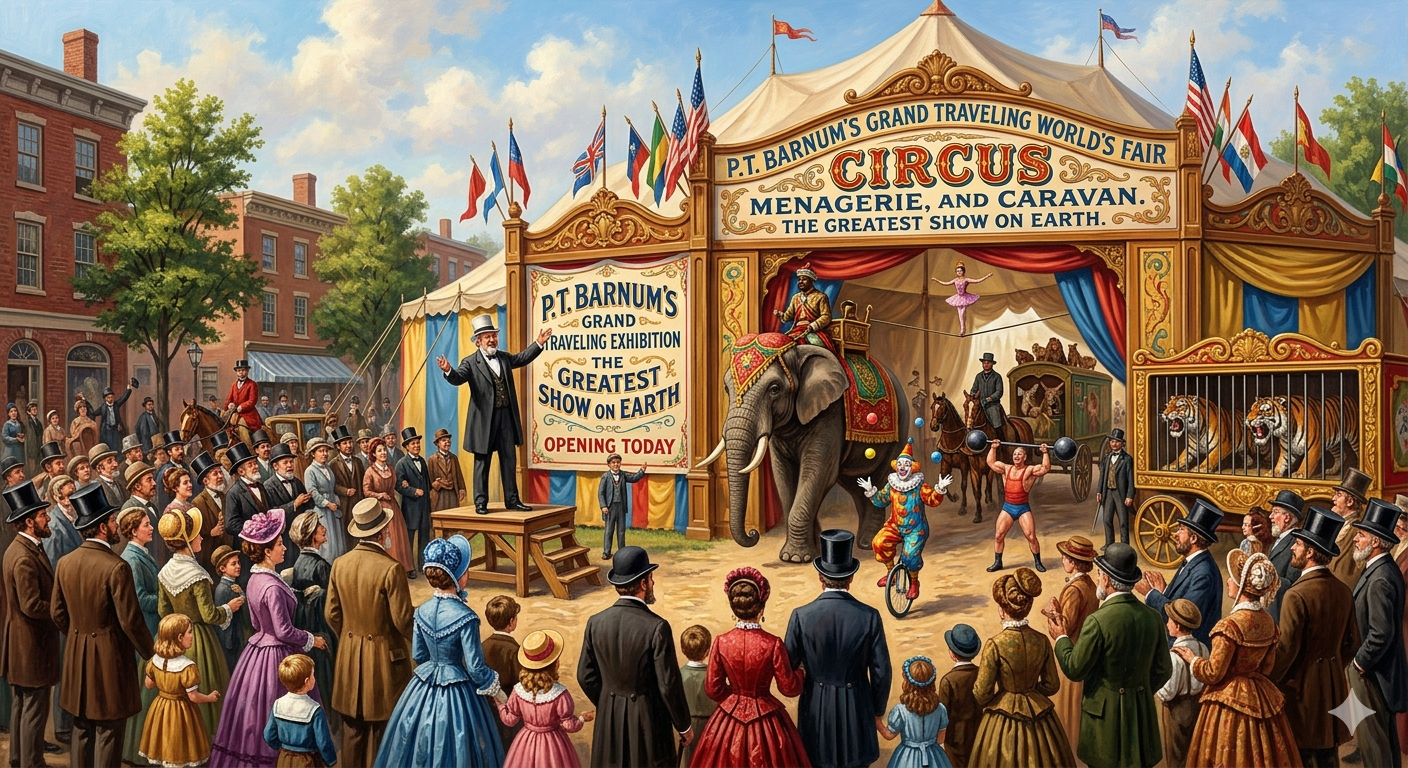
On April 10, 1871, the opening day, “P.T. Barnum’s Grand Traveling Museum, Menagerie, Caravan, and Circus” opened in Brooklyn, New York. The show combined the elements of a museum, a menagerie of exotic animals, a variety performance, a concert hall, and a circus under a single enormous tent. Barnum himself described it as potentially “the Greatest Show on Earth,” a phrase that would shortly become the official name of the enterprise and the most famous marketing slogan in circus history.
The show was an immediate sensation. Enormous crowds flocked to every performance. Within six months, the circus had generated profits exceeding one million dollars. Barnum’s genius for publicity, his network of contacts, and his name alone drew audiences who had never been to a circus and who regarded seeing the great Barnum’s show as a civic and cultural experience rather than merely an evening’s entertainment. Everywhere the circus traveled, a “Barnum Day” was declared.
The Barnum Museum in Bridgeport, Connecticut maintains a detailed record of Barnum’s showmanship and the founding of his circus enterprise, accessible at the Barnum Museum’s history of PT Barnum.
William Cameron Coup and the Railroad Circus Revolution
While Barnum’s name and promotional genius were the public face of the new enterprise, much of the organizational revolution that made the circus viable on a national scale was the work of William Cameron Coup. Coup recognized that the fundamental limitation of all previous American circuses was transportation. Traveling by horse-drawn wagons over unpaved roads limited how far a circus could go, how quickly it could move between cities, and how large it could become before the logistical complexity overwhelmed its profitability.
Coup designed a new system for transporting the circus entirely by railroad. He developed specially engineered flatcars joined by “crossover” metal plates, and a pulley-and-rope system that allowed fully loaded circus wagons to be rolled on and off the train with unprecedented efficiency. This made it possible for the circus to move hundreds of miles overnight, set up in a new city within hours of arrival, perform two shows in a single day, and then break down and move again before dawn.
The railroad circus model transformed the economics of the entertainment industry. Where a horse-and-wagon circus could visit perhaps a few dozen towns in a season, the Barnum railroad circus could reach hundreds of cities and towns across the full width of the country. By 1872, Barnum’s circus was traveling in more than sixty rail cars and could accommodate twenty thousand spectators per show.
That same year, the growing popularity of the circus created a practical problem. The single circus ring, forty-two feet in diameter, could not expand without requiring every performing animal to be retrained. Rather than retrain the animals, Coup added a second ring. A third ring followed soon after. The three-ring circus, which became the defining format of American spectacle entertainment for the next century, was born not from an artistic vision but from the logistical solution to an overflow audience.
James Bailey, Jumbo, and the Creation of Barnum and Bailey
By 1880, Barnum had a serious competitor. James Anthony Bailey had built the Cooper and Bailey Circus into a powerful operation and, in a direct challenge to Barnum, brought his show to Bridgeport, Connecticut, Barnum’s own hometown. Bailey’s circus outsold Barnum’s by a margin of two dollars to every one dollar Barnum generated. Rather than continue competing, Barnum recognized what his rival represented.
“I had at last met showmen worthy of my steel,” Barnum wrote. The two groups agreed to merge their shows on March 28, 1881. The combined enterprise, initially given the unwieldy name “P.T. Barnum’s Greatest Show on Earth, and the Great London Circus, Sanger’s Royal British Menagerie and the Grand International Allied Shows United,” was mercifully shortened to “Barnum and Bailey’s Circus.” Bailey brought operational genius to match Barnum’s promotional genius.
One of their greatest joint achievements was the acquisition of Jumbo, an African elephant from the Royal Zoological Gardens in London, in 1882. Jumbo was the largest elephant in captivity and one of the most beloved animals in England. When Barnum purchased him, the British public was outraged. Members of Parliament protested. Queen Victoria expressed her displeasure. The press campaign against the sale was enormous, and Barnum used every word of it to publicize his new acquisition before Jumbo had set foot in America. By the time Jumbo arrived in the United States, he was already the most famous animal in the world. He became the greatest single attraction in the history of the Barnum circus. After Jumbo’s death in 1885, struck by a freight train in Ontario, Canada, Barnum donated his taxidermied remains to Tufts University, where he served on the board of trustees.
Britannica’s entry on Ringling Bros. and Barnum and Bailey Circus provides extensive coverage of the full history of the enterprise that Barnum launched in 1871, available at the Britannica entry on Ringling Bros. and Barnum and Bailey Circus.
PT Barnum’s Legacy: From “The Greatest Show on Earth” to a Cultural Institution
Barnum died on April 7, 1891, at his home in Bridgeport, Connecticut, at the age of eighty. A few weeks before his death, he had given permission to a New York newspaper to print his obituary in advance so that he could read it himself. On his deathbed, he reportedly asked about the circus’s box office receipts for the day. He was buried at Mountain Grove Cemetery in Bridgeport, a cemetery he had helped design himself.
James Bailey continued managing the circus after Barnum’s death, touring Europe and the United States with a production that had grown to 28 rail cars, 1,000 employees, five rings, and elaborate animated floats. After Bailey’s death in 1906, the Ringling Brothers, who had built their own competing circus empire with seven siblings working in concert, purchased the Barnum and Bailey Circus in 1907. The two circuses merged in 1919 to form the Ringling Brothers and Barnum and Bailey Combined Shows, a single enterprise that became the dominant circus in American life for the remainder of the twentieth century.
The circus Barnum launched on April 10, 1871, traveled in some form until May 21, 2017, when the final performance of Ringling Brothers and Barnum and Bailey Circus ended at Nassau Veterans Memorial Coliseum in Uniondale, New York, after 146 years of continuous operation. The enterprise that Barnum began at the age of sixty-one, with two veteran circus managers who had persuaded him to abandon retirement, had outlasted him by 126 years.
The phrase Barnum coined for his circus, “The Greatest Show on Earth,” is still recognized as one of the most enduring slogans in American entertainment history. It was the phrase of a man who had spent his entire life understanding that the American public’s appetite for spectacle, wonder, and the pleasantly unbelievable was essentially unlimited. Barnum did not invent the circus. He transformed it into something that a nation of twenty million became a nation of one hundred million watching together, and in doing so created the template for mass entertainment that every spectacle from Hollywood to the Super Bowl has followed ever since.
The Encyclopedia Britannica’s biography of PT Barnum covers his complete life and legacy from his birth in 1810 to the founding of his circus empire, available at the Britannica biography of PT Barnum.