What Was the Anschluss? Defining the Event That Erased Austria from the Map of Europe
The Anschluss — a German word meaning joining, connection, or fusion — was the annexation of the Federal State of Austria into the German Third Reich on March 12 and 13, 1938. With a single act of political coercion backed by the looming threat of military force, Adolf Hitler achieved what had been the central ambition of his political life since he first articulated it in his 1925 autobiography and political manifesto Mein Kampf: the absorption of Austria, his country of birth, into a Greater German Reich. German-Austria must return to the great German motherland, Hitler had written, not because of economic considerations of any sort. Common blood belongs in a common Reich. Thirteen years after those words were published, and five years after he became Chancellor of Germany, Hitler made them a reality.
The Anschluss was the first territorial annexation committed by Nazi Germany and the first outright violation of European borders since Hitler had come to power in January 1933. It violated the Treaty of Versailles of 1919 and the Treaty of Saint-Germain-en-Laye, which had explicitly forbidden the union of Germany and Austria after the First World War, recognising such a union as a potential threat to the balance of power in Europe. It was accomplished not through open warfare but through a calculated combination of political infiltration, intimidation, propaganda, diplomatic isolation, and finally the credible threat of military invasion. The Western powers — Britain, France, and the United States — protested but did nothing to reverse it. The Anschluss demonstrated to Hitler that his methods worked, emboldened him to pursue the dismemberment of Czechoslovakia within months, and set in motion the chain of events that would lead to the Second World War.
In the aftermath of the annexation, Austria ceased to exist as an independent nation. Its name, Österreich, was banned from public use. The country was renamed Ostmark — the Eastern March — and its provinces were reorganised and renamed to erase any institutional memory of Austrian statehood. The Austrian army was dissolved and incorporated into the Wehrmacht. The Austrian government was dissolved. Austrian Jews, numbering approximately 192,000 at the time of the annexation and concentrated predominantly in Vienna, were subjected immediately to the same discriminatory laws that had been applied to Jews in Germany since 1933, and then swiftly subjected to unprecedented violence that exceeded in its savagery what had been experienced in Germany itself. The consequences for Austria’s Jewish population, and for the broader European Jewish community, would prove catastrophic.
Austria After the First World War: The Origins of Anschluss Sentiment and the Treaty of Saint-Germain
To understand the Anschluss of 1938, it is essential to understand the Austria that preceded it — a country created by defeat, diminishment, and identity crisis. Before 1918, Austria had been the western, German-speaking heart of the vast Austro-Hungarian Empire, a multi-ethnic polity of 51 million people spanning much of central Europe and ruled by the Habsburg dynasty for six centuries. The First World War destroyed that empire. By the armistice of November 1918, Austria-Hungary had ceased to exist. Its constituent nations — Czechoslovakia, Yugoslavia, Hungary, Poland, and others — declared independence or were absorbed into neighbouring states. What remained was a tiny German-speaking rump state of approximately 6.7 million people, occupying roughly 84,000 square kilometres, politically and economically unviable in the eyes of many of its own citizens and of the international community.
The provisional Austrian National Assembly declared, on November 12, 1918, that German-Austria was a constituent part of the German Republic. The desire for union with Germany — Anschluss — was at that moment genuinely widespread among Austrians across the political spectrum, driven not by Nazi ideology, which had not yet coalesced, but by a practical recognition that the new Austrian state lacked the economic foundations to sustain itself and by a conviction that the German-speaking peoples of central Europe belonged together. The victorious Allied powers, however, refused to permit the union. The Treaty of Saint-Germain-en-Laye, signed in September 1919, and the Treaty of Versailles, signed in June of the same year, both explicitly forbade the political union of Austria and Germany. Austria was additionally required to give up territories it had claimed, including the German-speaking South Tyrol, which was assigned to Italy. The use of the country’s own chosen name, German-Austria, was prohibited; the country was simply to be called Austria.
Throughout the 1920s and into the 1930s, Austria was economically fragile, politically polarised, and constitutionally volatile. By the early 1930s, the country had descended into open political violence between its two dominant armed factions: the Social Democrats, who controlled Vienna and maintained their own paramilitary force, the Schutzbund, and the Christian Social conservatives, who dominated the federal government and maintained their own paramilitary, the Heimwehr. The Austrian Nazi Party — the NSDAP — was a third and growing force, receiving increasing support and direction from Berlin as Hitler consolidated his own power in Germany from January 1933 onward.
Engelbert Dollfuss and the Austrian Authoritarian State: The Fatherland Front Against Both Left and Right
On March 4, 1933, Chancellor Engelbert Dollfuss used a procedural incident in the Austrian Parliament to suspend parliamentary government and rule by emergency decree. Born in 1892 in Texing, Lower Austria, Dollfuss was a short, physically unimposing man — he stood barely five feet tall — who was nonetheless a tenacious political operator. He had risen through the Christian Social Party to become Chancellor in May 1932. Confronting the triple threat of Social Democratic opposition, Nazi agitation, and German pressure, Dollfuss chose to dissolve the democratic institutions of Austrian republicanism rather than risk losing power to either of his adversaries. In May 1934, he promulgated a new authoritarian constitution and established the Fatherland Front — Vaterländische Front — as the sole legal political movement in Austria, an Austrofascist state modelled loosely on Mussolini’s Italy.
Dollfuss initially found protection for his authoritarian Austria in an unlikely place: Benito Mussolini’s Italy, which in the early 1930s regarded an independent Austria as a useful buffer state between Italy and an increasingly powerful Nazi Germany. Mussolini had little ideological objection to Dollfuss’s regime — it was, in many respects, a variant of the fascism Mussolini himself practiced — and Italy provided diplomatic backing for Austrian independence as well as military threats in the direction of Germany. In February 1934, Dollfuss used the Austrian army to suppress the Social Democrats in a brief but brutal civil war, shelling the vast Karl-Marx-Hof workers’ housing complex in Vienna and killing hundreds of people. This crushing of the Austrian left eliminated one potential source of organised resistance to both Nazi infiltration and German pressure, with consequences that would prove fatal to Austrian independence four years later.
On July 25, 1934, a group of Austrian Nazis, acting with the approval and logistical support of Hitler’s government in Berlin, attempted a coup d’état. They seized the Austrian State Broadcasting Corporation and the Federal Chancellery. During the occupation of the Chancellery, Dollfuss was shot twice and left to bleed to death without medical attention over the course of several hours, dying at approximately four in the afternoon. The coup failed: the Austrian army and security forces, encouraged by Mussolini’s deployment of Italian troops to the Brenner Pass and his personal telegram demanding that Austria’s independence be maintained, suppressed the uprising within days. The leading Austrian Nazi conspirators either fled to Germany or were executed. But the assassination of Engelbert Dollfuss marked a decisive escalation: Nazi Germany had attempted to seize Austria by direct violent action, and while it had failed, the ambition had been unmistakably declared.
Kurt Schuschnigg and the Diplomatic Tightrope: Austria’s Final Years of Independence, 1934–1938
The successor to Dollfuss was Kurt Alois von Schuschnigg, born on December 14, 1897, in Riva del Garda — then part of the Austro-Hungarian Empire, now northern Italy — into a military family. Schuschnigg had trained as a lawyer and risen through the Christian Social Party, serving as Minister of Justice before becoming chancellor on July 29, 1934, the day after Dollfuss’s murder. He would maintain that position through the most difficult years of Austria’s interwar existence, ultimately presiding over the country’s absorption into the Third Reich before being arrested and interned in a series of concentration camps, surviving to be liberated by American troops in 1945.
Schuschnigg faced an almost impossible diplomatic situation. He maintained the Fatherland Front dictatorship and the structures of Dollfuss’s authoritarian state, but he was deeply aware that Austria’s position was becoming progressively more dangerous. The keystone of Austrian independence had been Italian protection, but as the 1930s progressed, the strategic calculus shifted. Mussolini’s invasion of Ethiopia in October 1935 brought him into conflict with Britain and France, driving him toward Germany. The formation of the Berlin-Rome Axis in October 1936 formalized this alignment. The subsequent signing of the Anti-Comintern Pact in November 1936 by Germany, Italy, and Japan deepened the relationship further. By early 1936, Schuschnigg told Mussolini privately that his country had to reach an agreement with Germany. As Albert Speer later recalled, Hitler spoke of his gratitude to Mussolini for giving his consent to the invasion of Austria: Hitler said he would remain eternally grateful to the Duce for that.
On July 11, 1936, Schuschnigg signed the Austro-German Agreement with Germany’s ambassador to Vienna, Franz von Papen. Under its terms, Austria declared itself a German state and agreed to follow Germany’s lead in foreign policy. Germany promised to respect Austrian sovereignty. A secret protocol committed Schuschnigg to releasing imprisoned Nazis and incorporating representatives of the so-called national opposition — a euphemism for Nazi sympathisers — into Austrian political life. The agreement fatally compromised Austrian independence without providing any meaningful protection. Its most significant immediate consequence was the appointment of Arthur Seyss-Inquart, a pro-Nazi Austrian lawyer, to a consultative role that gave the Austrian Nazi movement a direct line of communication into the Austrian government. Having lost Italian protection and made concessions to Germany, Schuschnigg found himself increasingly isolated, managing a slow retreat rather than a coherent defence.
The Berchtesgaden Meeting of February 12, 1938: Hitler’s Ultimatum and Schuschnigg’s Capitulation
The decisive confrontation that made the Anschluss inevitable came on February 12, 1938, when Schuschnigg was summoned to meet Hitler at the Berghof — Hitler’s private mountain retreat near Berchtesgaden in Bavaria, close to the Austrian border. The meeting had been arranged by Franz von Papen, Germany’s ambassador to Austria, who presented it to Schuschnigg as an opportunity to smooth tensions between the two countries. Schuschnigg prepared carefully, compiling a list of the concessions he was already making to Austrian Nazis in the hope of demonstrating goodwill. What he encountered instead was something far more threatening.
When Schuschnigg arrived at the Berghof, Hitler launched immediately into an aggressive tirade about Austrian obstruction and treachery, denouncing the entire history of Austria as an enemy of Germany and accusing Schuschnigg personally of sabotaging German national interests. Three senior German generals — Field Marshal Wilhelm Keitel and two others — were conspicuously present at the meeting, their presence designed to communicate military threat without the need for explicit statement. As Schuschnigg later testified at the Nuremberg Trials, Hitler threatened him repeatedly with an immediate invasion. Hitler told him: I have only to give an order, and in one single night all your ridiculous defences will be blown to pieces. Schuschnigg responded by noting that Austria was not alone in the world and that such a step would probably mean war, to which Hitler replied dismissively.
The document presented to Schuschnigg for his signature amounted to a near-total surrender of Austrian sovereignty. Its principal demands were: that Arthur Seyss-Inquart, the 45-year-old Austrian Nazi and former Minister of Justice, be immediately appointed as Minister of the Interior and Security — giving him control of the entire Austrian police force; that a pro-Nazi economist, Dr. Hans Fischböck, be named as Minister of Finance to prepare for economic integration with Germany; that an exchange of 100 officers between the Austrian and German armies be established, embedding German military influence in Austria’s command structure; that all Nazis imprisoned by the Austrian government receive immediate amnesty and reinstatement to their former positions; and that Austria coordinate its foreign and military policies with Germany’s. In return, Hitler would publicly reaffirm his recognition of Austrian sovereignty — a commitment that events would within weeks prove entirely worthless.
Schuschnigg signed. He had no real choice. The entire staging of the Berchtesgaden meeting — the generals, the tirade, the take-it-or-leave-it document — had been a masterclass in intimidation by a man who had refined such techniques in the years of his political rise. Sir Nevile Henderson, the British ambassador to Germany, recorded in his cable to London that the meeting had effectively ended Austrian autonomy. Schuschnigg later described the three-day aftermath, during which his government was given to formally implement the agreement, as a period of agonising argument that ended in total submission. Seyss-Inquart was appointed Minister of the Interior on February 15. The amnesty for imprisoned Nazis was implemented, releasing political prisoners who immediately resumed their destabilising activities. The concessions provided precisely the Trojan horse that Hitler needed inside the Austrian government.
Schuschnigg’s Plebiscite Gamble: March 9, 1938 and the Last Attempt to Save Austria
For several weeks after the Berchtesgaden capitulation, Schuschnigg attempted to salvage some semblance of Austrian independence while implementing the agreement’s demands. On February 24, 1938, speaking before an invited audience at the Austrian Parliament, Schuschnigg delivered a defiant speech, declaring Austria the better German state and closing with the rallying cry: Until death — red, white, red — the colours of the Austrian flag. The speech was theatrically effective but politically hollow, made to an unelected audience under a government that had already given up control of its own police force.
Faced with the accelerating infiltration of Austrian institutions by Nazi sympathisers operating under Seyss-Inquart, and aware that Hitler was receiving intelligence reports suggesting that Austrian public opinion, while not uniformly enthusiastic about annexation, was not uniformly hostile either, Schuschnigg decided on a dramatic gamble. On March 9, 1938, he publicly announced that a national plebiscite on the question of Austrian independence would be held on Sunday, March 13. The question put to voters was carefully crafted: Are you in favour of a free and German, independent and social, for a Christian and united Austria? For peace and work and the equality of all who profess the Volk and Fatherland? Schuschnigg also stipulated that the minimum voting age would be 24, a provision designed to exclude younger Austrians who were more likely to support union with Germany.
Schuschnigg predicted that 65 percent of Austrians would vote in favour of independence. Hitler was furious. His entire strategy for Austria had been predicated on managing the political environment carefully enough to achieve annexation without a democratic rebuff. A clear Austrian vote for independence would have severely damaged Germany’s international position and potentially reinvigorated whatever capacity for resistance Britain and France retained. Hitler immediately began planning to prevent the vote from taking place. He activated military planning and directed his Austrian agents to create the conditions for maximum pressure on Schuschnigg in the hours that followed.
March 11, 1938: The Day Austria Died — Ultimatums, Resignation, and the End of Independence
The events of March 11, 1938 unfolded with a controlled, deliberate ferocity that left Austrian independence no avenue of survival. The day began with Hermann Göring — the president of the Reichstag and one of the most powerful figures in the Nazi hierarchy — conducting a remarkable series of telephone calls from Berlin to Vienna, essentially managing the political destruction of Austrian independence in real time. Göring issued a series of escalating demands, each backed by the explicit threat of German military invasion.
First came the demand that the plebiscite be cancelled. Schuschnigg, who had already been told by British Foreign Secretary Lord Halifax that Britain would offer no support to Austria, and who had similarly been informed that France was in the midst of a ministerial crisis that left it without a functioning government, informed Seyss-Inquart at noon on March 11 that the plebiscite would be cancelled. He hoped this concession would satisfy Hitler. It did not. A second demand was immediately issued: Schuschnigg must resign as Chancellor. And a third: Austrian President Wilhelm Miklas must appoint Seyss-Inquart as the new Chancellor of Austria. These demands were transmitted through the telephone calls orchestrated by Göring, with Seyss-Inquart serving as the compliant intermediary.
President Wilhelm Miklas, born in 1872 and a career politician of the old Austrian republic, refused for hours to appoint Seyss-Inquart. He contacted the British, French, and Italian governments seeking support. None came. Mussolini did not even take the call. As night fell on March 11, at 7:47 in the evening, Schuschnigg delivered a radio address broadcast throughout Austria. Speaking with visible emotion, he announced his resignation, stating that he was yielding to force and instructing the Austrian military not to resist German troops if they crossed the border, in order, as he put it, to avoid the shedding of fraternal blood — Bruderblut. He signed off with the traditional Austrian patriotic greeting: God protect Austria.
Shortly after midnight on the morning of March 12, President Miklas, having exhausted every avenue of appeal and facing complete diplomatic isolation, reluctantly appointed Seyss-Inquart as Chancellor of Austria. At 8:45 in the evening of March 11, Hitler, tired of waiting for the political formalities to be resolved, had already ordered the German 8th Army to cross the border at dawn regardless. Hermann Göring dictated a telegram to the German Embassy in Vienna that he wanted attributed to Seyss-Inquart — a message in which the new Austrian Chancellor supposedly requested German military assistance to restore order — to provide a veneer of legality for the invasion. Seyss-Inquart never sent this telegram. When he reached Göring on the telephone after being sworn in as Chancellor, he protested against the occupation. The telegram was forwarded to Hitler by State Secretary Wilhelm Keppler without Seyss-Inquart’s approval, and Hitler issued the formal invasion order.
The German Army Crosses the Border: March 12, 1938 and Hitler’s Triumphal Return to Austria
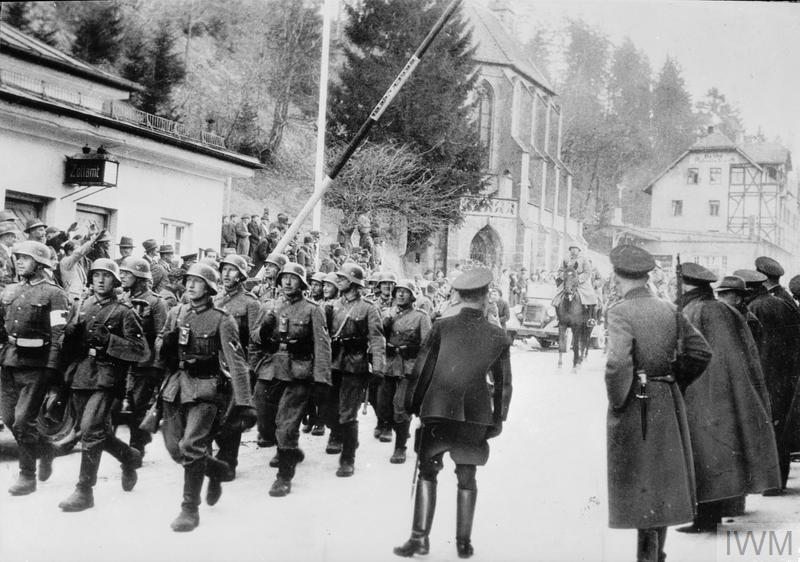
In the early hours of Saturday, March 12, 1938, approximately 65,000 soldiers of the German Wehrmacht — including infantry, armoured vehicles, and motorised units of the 8th Army — crossed the border into Austria at multiple points. They were not met with armed resistance. Schuschnigg had ordered the Austrian military to stand aside, and the Austrian army obeyed. What the German soldiers encountered instead was, in many places, a reception that stunned even those who had expected a friendly welcome. In cities such as Linz, Salzburg, Graz, and ultimately Vienna itself, soldiers were met by crowds throwing flowers, cheering from windows, offering food and drinks, and raising Nazi salutes. Austrian Nazis and their sympathisers poured into the streets, having waited years for this moment.
Within minutes of Schuschnigg’s resignation address the previous evening, swastika armbands and flags had appeared across Vienna. Austrian Nazis took over government buildings, flew Nazi flags from public offices, and conducted torchlight parades through the streets. Austrian members of the SA and SS — who had been operating illegally in Austria for years — now emerged openly, wearing their uniforms without fear. The transformation was immediate and total: one moment Austria was an authoritarian but nominally independent state; the next, it was a territory occupied by a foreign power with the apparent enthusiastic consent of a large portion of its population.
Hitler himself crossed the border at his birthplace, Braunau am Inn, in the afternoon of March 12. He had been born in this small Austrian border town on April 20, 1889, and had spent his early years in Linz. His return was choreographed as a triumphal homecoming. At Linz, where Hitler had attended school and which he had always regarded as his spiritual home more than Vienna, an enormous crowd greeted him. It was here, in Linz on the evening of March 12, that Hitler made his decision to proceed immediately to full annexation rather than the phased political integration that had originally been planned. The crowd’s reception, the ease of the military occupation, and the complete failure of any foreign power to intervene convinced him that the moment was right. He later recalled listening to Anton Bruckner’s Seventh Symphony that evening and saying: How can anyone say that Austria is not German? Is there anything more German than our old pure Austrianness?
On March 13, 1938, the Law on the Reunification of Austria with the German Reich was formally proclaimed. Seyss-Inquart, in his capacity as Chancellor, signed the document on behalf of Austria. President Miklas refused to give the law his presidential assent and resigned rather than do so; Seyss-Inquart, succeeding to the presidency, signed in Miklas’s name. The same law was simultaneously adopted by the Reich Cabinet in Berlin, signed by Hitler, Göring, Wilhelm Frick, Joachim von Ribbentrop, and Rudolf Hess. Austria ceased to exist as an independent state. On March 15, Hitler delivered a speech in Vienna’s Heldenplatz — the Square of Heroes — to approximately 200,000 cheering people, declaring that the oldest eastern province of the German people would be, from that point on, the newest bastion of the German Reich. He described the completion of the Anschluss as his greatest accomplishment.
The April 10 Plebiscite: A 99.7 Percent Vote and the Question of Austrian Consent
To provide democratic legitimacy to the annexation, a plebiscite was held across the enlarged German Reich — including the now-absorbed Austria — on April 10, 1938. Voters were asked: Are you in agreement with the reunification of Austria with the German Reich that was enacted on the 13th of March 1938, and do you vote for the party of our leader Adolf Hitler? The question was framed so as to combine two separate issues — retrospective approval of the annexation and support for the Nazi Party — into a single yes-or-no choice. The ballot was not secret in any meaningful sense: voters cast their votes under the observation of local Nazi officials, and significant social and professional pressure was brought to bear on those who might consider voting no. Jews, political opponents, and others deemed undesirable were excluded from voting entirely.
The official result, announced by the German authorities, claimed that 99.08 percent of eligible voters in Austria had participated and that 99.75 percent had voted yes. The broader Reich plebiscite recorded a similarly implausible result of 99.7 percent approval. These figures were transparently the product of a controlled process rather than a genuine expression of democratic will. The Austrian historian Alfred D. Low has argued that in 1938 there was majority support for Austrian independence, not for annexation. Political scientist Eric Voegelin, who fled Austria shortly after the Anschluss, stated that there was not much doubt that in 1938 a majority of Austrians did not favour union with Germany. The genuine degree of Austrian enthusiasm for the Anschluss was, in reality, a complex phenomenon. Many Austrians were relieved at the end of political instability. Many had absorbed years of Nazi propaganda and genuinely embraced the idea of a unified German nation. Many others feared the consequences of dissent and conformed outwardly while privately rejecting the annexation. And many — perhaps a majority, as the cancelled Schuschnigg plebiscite suggests — would have voted for independence had they been given a genuinely free and secret ballot.
The enthusiasm that was visible on the streets of Vienna and Linz in March 1938 was real for a significant portion of the Austrian population, particularly among younger Austrians, the lower middle class, and those who had been persuaded by Nazi propaganda and by Hitler’s apparent economic success in restoring German prosperity. As historian Evan Burr Bukey noted, many Austrians welcomed the Anschluss out of relief that bloodshed had been avoided, satisfaction that the humiliations of 1918 had been overcome, hope for economic improvement, and — Bukey states with remarkable clarity — because millions of people welcomed the Anschluss as a chance to put an end to what they called the Jewish Question. The antisemitic violence that followed was perpetrated by Austrian Nazis and their accomplices, not primarily by German invaders.
The Immediate Terror: Jews, Political Opponents, and the Explosion of Violence in Vienna
The Anschluss triggered an immediate and savage outpouring of violence against Austria’s Jewish population and against political opponents of the Nazi regime. The speed and ferocity of the persecution shocked even observers who had watched the gradual escalation of anti-Jewish discrimination in Germany since 1933. In Germany, the Nuremberg Laws had been introduced in 1935, two years after Hitler came to power. In Austria, the same laws were applied within weeks, and in the interval between the annexation and their formal application, spontaneous violence filled the void.
In the days and weeks following the annexation, Austrian Nazis and their civilian accomplices subjected Vienna’s Jewish population to systematic humiliation and violence. Jewish men and women were forced into the streets to scrub pro-independence slogans from pavements and public squares — often on their knees, using bare hands or toothbrushes, with crowds jeering and photographing them. Jewish actresses from the Theater in der Josefstadt were forced by SA men to clean public toilets. In one particularly grotesque episode, a group of Jews was rounded up at the Prater, Vienna’s famous amusement park, and forced to eat grass on all fours. Jewish faculty at the Medical University of Vienna were summarily dismissed. Jewish shops were attacked and plundered. Within two weeks of the annexation, more than 200 Viennese Jews had taken their own lives. The speed and intensity of the persecution led the Nazi regime to adopt Vienna’s methods — what became known as the Wiener Modell, or Viennese model — as the template for the expulsion of Jews from all German-controlled territories.
The Nuremberg Laws were formally extended to Austria in May 1938. From that point, Austrian Jews were subject to the full range of discriminatory legislation that had been applied in Germany: exclusion from virtually all professions, prohibition on attending schools and universities, requirements to register property, and eventually the requirement to wear the yellow Star of David in public from September 1941. In August 1938, the Central Office for Jewish Emigration was established in Vienna under the leadership of SS officer Adolf Eichmann, who would later become notorious as the chief logistical architect of the Holocaust. Eichmann’s Vienna office developed the mechanisms of forced emigration — stripping Jews of their assets while simultaneously requiring them to pay the Reich Flight Tax — that would serve as the model for the Nazis’ broader campaign of expulsion across occupied Europe. Among the Jewish Viennese who managed to flee was Sigmund Freud, the founder of psychoanalysis, who left for London in June 1938 at the age of 82, having been persuaded to depart by his daughter Anna after his home and clinic were raided by the Gestapo.
The November 1938 pogrom known as Kristallnacht — the Night of Broken Glass — proved particularly devastating in Vienna, where antisemitism was demonstrated to be more virulent and widely embedded than in many parts of Germany. Every synagogue and prayer house in Vienna was destroyed or ransacked. The only survivor was the Stadttempel — Vienna’s main synagogue — spared solely because its location in a dense residential district meant that burning it would have destroyed surrounding non-Jewish property. More than 6,000 Jews were arrested overnight during Kristallnacht in Austria, the majority subsequently deported to Dachau concentration camp. By the end of 1941, approximately 130,000 Viennese Jews had fled into exile, many of them to the United States, leaving behind all their property and paying enormous exit taxes. Of the more than 65,000 Viennese Jews who were eventually deported to concentration camps, fewer than 2,000 survived. In total, an estimated 65,000 to 70,000 Austrian Jews — nearly 40 percent of the Jewish population at the time of the Anschluss — were murdered in the Holocaust.
Key Figures in the Anschluss: From Hitler and Göring to Seyss-Inquart, Schuschnigg, and Miklas
Adolf Hitler, born in Braunau am Inn, Austria, on April 20, 1889, had lived the first 25 years of his life in Austria, in Linz and then in Vienna. His years in Vienna between approximately 1908 and 1913 had been formative in the development of his political worldview, particularly his virulent antisemitism, which he attributed in part to the intellectual and social environment of the Austro-Hungarian capital. His longing to see German-speaking Austria unified with Germany under German nationalist leadership predated Nazism as an organised political movement and was, in an important sense, among the most personally felt of all his political objectives. When his troops crossed the Austrian border on March 12, 1938, Hitler wept.
Hermann Göring, born in Rosenheim, Bavaria, on January 12, 1893, was the second-highest-ranking figure in the Nazi hierarchy and played the most direct operational role in engineering the Anschluss from the German side. It was Göring who orchestrated the sequence of demands delivered to Vienna on March 11, who dictated the fraudulent telegram attributed to Seyss-Inquart, and who most aggressively pushed for the immediate military invasion rather than the more cautious, phased approach that some elements of the German military and diplomatic establishment preferred. The Nuremberg Tribunal later found Göring specifically guilty in connection with the invasion of Austria as part of the broader charge of crimes against peace.
Arthur Seyss-Inquart, born on July 22, 1892, in Stannern, Moravia — today Stonařov in the Czech Republic — was the Austrian Nazi lawyer and politician who served as the domestic vehicle for the Anschluss. His appointment as Minister of the Interior in February 1938 had given Nazi sympathisers control of the Austrian police. His appointment as Chancellor on the night of March 11 to 12, 1938 gave the annexation a nominal appearance of Austrian agency. He did not send the telegram Göring wanted him to send, but he did sign the law abolishing Austria as an independent state. After the Anschluss, Seyss-Inquart served as Reichsstatthalter — Reich Governor — of Austria until 1939, then as Reich Commissioner for the German-occupied Netherlands from 1940 to 1945, where he oversaw the deportation and murder of the Dutch Jewish population. He was tried at Nuremberg, found guilty of war crimes and crimes against humanity, sentenced to death, and hanged on October 16, 1946.
Franz von Papen, born on October 29, 1879, served as Germany’s Special Ambassador to Vienna and played a crucial behind-the-scenes role in arranging the Berchtesgaden meeting, managing the communications between Berlin and Vienna throughout the crisis, and providing the diplomatic packaging that gave the annexation an appearance of negotiation rather than pure aggression. He was among the defendants at Nuremberg but was acquitted, a verdict that many historians have found difficult to justify given the documentary evidence of his involvement.
Wilhelm Miklas, born on October 15, 1872, served as the Austrian Federal President from 1928 until the Anschluss. His refusal to appoint Seyss-Inquart until the early hours of March 12, sustained through hours of telephone pressure from Göring and German agents, represented the last institutional resistance of the Austrian republic. When the annexation law was presented for his signature on March 13, he refused and resigned rather than give it his endorsement. He was subsequently placed under house arrest and later released. His behaviour in the final hours of Austrian independence stands as one of the more dignified episodes in an otherwise dishonourable proceeding.
Kurt Schuschnigg survived the war. After being placed under house arrest in Vienna immediately following the annexation, he was transferred to Gestapo custody, held in solitary confinement at a succession of locations including Sachsenhausen and Dachau concentration camps, and was liberated by advancing American forces in May 1945 near Innsbruck. After the war, he emigrated to the United States, became a professor of political science at Saint Louis University in Missouri, and ultimately returned to Austria, where he died in Mutters, Tirol, on November 18, 1977. He spent much of his postwar life reflecting on the choices that had led to Austria’s annexation, and he consistently argued that he had done what he could to preserve Austrian independence against impossible odds.
The International Response: Appeasement, Indifference, and the Failure of Collective Security
The international response to the Anschluss was, with one exception, a uniform combination of verbal protest and practical inaction. Britain and France, the two powers most capable of applying meaningful pressure on Germany, had both effectively signalled in advance that they would not intervene to preserve Austrian independence. British Foreign Secretary Lord Halifax had told Hitler in November 1937 that Britain would not oppose changes to the European order in Austria, Czechoslovakia, or Danzig, provided those changes were made peacefully. When Schuschnigg secretly sought British support in the final days before the annexation, he was told that Britain could offer no assistance. When the invasion came, Prime Minister Neville Chamberlain told the House of Commons that nothing could have arrested what had actually happened in Austria unless Britain and other countries had been prepared to use force — and Britain was not prepared to use force. France, in the midst of a ministerial crisis, had no functioning government on the day of the annexation.
The United States, operating under the banner of official neutrality, followed the British and French lead in protests and appeasement. The Soviet Union called on the Western powers to stop further German aggression and suggested that the Anschluss be referred to the League of Nations — an institution that had already demonstrated its complete impotence in the face of Hitler’s treaty violations in the Rhineland and Germany’s rearmament. Italy, the power that had most forcefully blocked Hitler’s 1934 coup attempt, was by March 1938 so thoroughly aligned with Germany through the Rome-Berlin Axis that Mussolini’s neutrality was a foregone conclusion. Hitler sent Mussolini a personal letter thanking him; Mussolini replied that he thanked Hitler for the communication and asked that Hitler not forget that in the final instance what mattered was blood.
The government of Mexico was the single exception to the international consensus of acceptance. Mexico lodged a formal protest with the Secretary-General of the League of Nations, rejecting the legitimacy of the annexation on the grounds that it violated international law and the principle of national self-determination. The protest was entirely futile in practical terms, but it stands as a lonely historical record of principled dissent against an act of naked aggression that the rest of the world chose to accept as an accomplished fact.
Winston Churchill, speaking in the House of Commons on March 14, 1938, provided the sharpest and most prophetic assessment of what the international community’s passivity meant. He described the Anschluss as a programme of aggression, nicely calculated and timed, unfolding stage by stage. He warned that if the cause of peace is to be sustained, it must be sustained by a combination of forces which are deeply rooted in the will of the peoples and not by a policy of submission and surrender. His warnings went unheeded. The Anschluss emboldened Hitler to immediately turn his attention to Czechoslovakia, and specifically to the German-speaking Sudetenland. The Munich Agreement of September 30, 1938 — in which Britain, France, and Italy agreed to allow Hitler to dismember Czechoslovakia — followed directly from the lesson that the Anschluss had taught: that the Western powers would not fight.
Austria as Ostmark: The Erasure of a Nation and Its Incorporation into the Third Reich
Following the formal annexation, the systematic obliteration of Austrian national identity was carried out with bureaucratic thoroughness. The name Österreich was banned from official and public use. The country was renamed Ostmark — a name with medieval connotations evoking the eastern march of the Germanic Holy Roman Empire. Austria’s provinces were reorganised and renamed to emphasise their identity as German lands rather than Austrian ones: Upper Austria and Lower Austria became Upper Danube and Lower Danube. Styria became a Reichsgau, as did Carinthia, Salzburg, Tirol-Vorarlberg, and Vienna.
The Austrian Army, which had complied with Schuschnigg’s order not to resist the German invasion, was formally dissolved and its personnel absorbed into the Wehrmacht. Austria’s gold reserves and foreign currency holdings, estimated to be substantial, were seized by the German Reich. The Austrian National Bank was incorporated into the Reichsbank. Austrian industries were transferred into the German war economy. Hitler’s chief architect and later armaments minister Albert Speer noted that Hitler was additionally attracted to occupying Austria because the Anschluss would give him access to new resources including manpower for the military, raw materials, and a large quantity of cash and gold. The Austrian working population — engineers, miners, factory workers, and eventually millions of drafted soldiers — were integrated into the Reich’s expanding war machine.
The Austrian Catholic Church’s response to the Anschluss was initially accommodating in a way that the Vatican found alarming. Cardinal Theodor Innitzer, Archbishop of Vienna, issued a statement on March 27, 1938 welcoming the Anschluss and instructing Austrian Catholics to support the new order. He even signed the statement with the words Heil Hitler. The Vatican was furious. Pope Pius XI publicly criticised Innitzer and forced him to retract. Vatican Radio broadcast a vehement denunciation of the Anschluss. The Vatican newspaper L’Osservatore Romano condemned Nazism and forbade Catholics from supporting the annexation. Innitzer himself eventually found the courage to speak out more directly: on October 7, 1938, he told thousands of young Catholics that Jesus is your only leader, a statement that provoked members of the Hitler Youth to ransack the Cardinal’s palace the following day.
Austrian Participation in Nazi Crimes: The Uncomfortable History of Overrepresentation
One of the most uncomfortable historical truths about the Anschluss and its aftermath is that Austrians were not merely victims of Nazi Germany but active and disproportionate participants in Nazi crimes. This reality was suppressed for decades after the war under what historians call the Austria victim theory — the claim, embedded in the 1943 Moscow Declaration, that Austria was the first victim of Nazi aggression — which allowed postwar Austria to avoid the same reckoning with its Nazi past that Germany undertook. It was a convenient fiction that served the political interests of the postwar Austrian republic but did a profound injustice to the historical record.
The evidence of disproportionate Austrian participation in Nazi crimes is substantial and well-documented. Approximately 800,000 Austrians were drafted into the Wehrmacht, and another 150,000 served in the Waffen-SS — the elite military force of the Nazi Party that was directly involved in the mass murder of Jews and civilians across occupied Europe. Austria represented approximately 8 percent of the population of the Greater German Reich but provided a vastly higher proportion of the personnel who carried out the Holocaust. Adolf Eichmann, the SS officer who organised the logistics of the deportation of European Jews to extermination camps, was Austrian. Ernst Kaltenbrunner, who succeeded Reinhard Heydrich as head of the Reich Security Main Office and was one of the principal architects of the Holocaust, was Austrian. Rudolf Höss, the commandant of Auschwitz, was German, but many of his subordinates were Austrian. Historical analysis has estimated that Austrians were responsible for roughly one-third of all deaths in the Holocaust despite comprising a far smaller fraction of the Reich’s population.
The antisemitic violence that erupted in Vienna in March 1938 was not imported from Germany. It was perpetrated by Austrians. The pograms that immediately followed the annexation were organised not by German agents but by Austrian Nazis and their civilian accomplices. Vienna had a long tradition of political antisemitism that predated Hitler: Karl Lueger, Vienna’s mayor from 1897 to 1910, had won power on an explicitly antisemitic platform, and the city’s cultural and intellectual life in the early twentieth century had been suffused with antisemitic hostility alongside its extraordinary Jewish cultural contribution. Hitler himself had acknowledged that his virulent antisemitism had been formed and consolidated during his years in Vienna. Austria was not simply a country that was forced into Nazi crimes by German occupation; it was a country with its own indigenous history of antisemitism and political extremism that made it fertile ground for the Nazis and complicit in their crimes.
The Legacy of the Anschluss: Austria’s Postwar Reckoning, Restoration, and Historical Memory
Austria was liberated from Nazi rule by Allied forces in April and May 1945, with the Soviet Army entering Vienna on April 13. The country was divided into four Allied occupation zones — American, British, French, and Soviet — and remained occupied until 1955. The Moscow Declaration of October 1943, issued by Britain, the United States, and the Soviet Union, had described Austria as the first victim of Hitlerite aggression and committed the Allies to restoring Austrian independence after the war. This declaration proved both a political gift and a historical distortion for postwar Austria.
The Austrian State Treaty of May 15, 1955 restored full Austrian sovereignty, committed Austria to permanent neutrality, prohibited any future Anschluss, and required Austria to pay no war reparations — because Austria, as a victim state, was not legally responsible for Germany’s wartime actions. This framework allowed postwar Austria to build its democratic institutions with remarkable speed and stability, but it came at the cost of a wilful amnesia about the country’s role in the Nazi era. For decades, Austrian schoolbooks either ignored or minimised Austrian participation in the Anschluss and the Holocaust, attributing all criminality to German occupiers. The political parties that governed Austria in the postwar decades included numerous former Nazis and Nazi sympathisers in their ranks, and no serious accounting of Austrian complicity was demanded.
The Waldheim Affair of 1986 cracked open the carefully maintained mythology. Kurt Waldheim, an Austrian diplomat and former Secretary-General of the United Nations who was elected President of Austria in 1986, was revealed to have served as a Wehrmacht intelligence officer in the Balkans during the war, during a period when Nazi atrocities against civilians and partisans were carried out in the area where he was stationed. Waldheim denied knowledge of any crimes, but the controversy forced Austria into a public debate about its wartime past that had been largely avoided for forty years. Chancellor Franz Vranitzky, acknowledging the historical reckoning that had been postponed, stated in 1991 that many Austrians had participated in the repression and persecution of the Jews and of other victims of the Nazi regime, and expressed the Austrian government’s moral co-responsibility for the suffering.
Today, the Anschluss is commemorated each year on March 13 in Austria, recognised as a day of reflection and mourning rather than celebration. Vienna’s Heldenplatz, where Hitler addressed 200,000 cheering crowds in 1938, is now the site of annual memorial ceremonies. Austrian historians, educators, and public institutions have made substantial progress in confronting the reality of Austrian participation in Nazi crimes and in integrating that history into the national narrative. The Austrian National Fund and the General Settlement Fund have provided restitution to victims and their heirs, though the process of material restitution for property stolen from Austrian Jews has been slow, incomplete, and in many cases inadequate.
The Anschluss of March 1938 remains one of the most consequential events of the twentieth century, not merely for what it did to Austria’s Jews and to Austria’s identity, but for what it told Adolf Hitler — and the world — about the will and capacity of liberal democracies to resist aggression when tested. It was the moment at which the price of appeasement was paid, not in Poland or France or Britain, but in Austria, by Austrian Jews scrubbing pavements on their knees while their neighbours cheered, and by a nation erased from the map and forced to forget, for decades, what it had truly been and what it had truly done.