On March 13, 1881, one of the most consequential acts of political violence in nineteenth-century European history unfolded on the snow-lined streets of Saint Petersburg, Russia. Tsar Alexander II, the Emperor of Russia, King of Poland, and Grand Duke of Finland, was killed by a bomb thrown by a member of the revolutionary organization known as Narodnaya Volya, or the People’s Will. The assassination sent shockwaves across the Russian Empire and the wider world, ending the life of a ruler who had spent decades attempting to modernize and reform one of the most complex empires on earth. Ironically, on the very day he was murdered, Alexander II had signed a document that would have taken Russia a meaningful step toward constitutional governance. His death closed that door and opened a new era of repression, reaction, and revolutionary ferment that would ultimately shape the course of the twentieth century.
The killing of Alexander II was not a spontaneous act of rage but the culmination of a long, carefully planned conspiracy involving dozens of revolutionaries, multiple failed attempts over several years, and a level of organizational sophistication unprecedented in the history of political violence. To understand why this assassination happened, why it succeeded after so many prior failures, and what it meant for Russia and the world, one must trace the life of the man who was killed, the forces that sought to kill him, and the lasting consequences that followed.
Who Was Tsar Alexander II? The Reformer on the Throne
Alexander II was born on April 29, 1818, in Moscow, Russia, the eldest son of Grand Duke Nikolay Pavlovich, who would later become Emperor Nicholas I, and his wife Alexandra Fyodorovna, formerly Princess Charlotte of Prussia. From birth, Alexander was destined for the throne, and his education reflected that destiny. His most influential tutor was the poet Vasily Zhukovsky, a humanitarian liberal and romantic thinker who instilled in the young Alexander a sense of compassion and social responsibility that would define his reign, even if he could never fully escape the authoritarian instincts inherited from his formidable father.
Alexander ascended to the throne on March 2, 1855, following the death of Nicholas I, inheriting a Russia in crisis. The country was mired in the Crimean War against Britain, France, and the Ottoman Empire, a conflict that was exposing the severe military and economic weaknesses of the Russian state. The war ended with the humiliating Treaty of Paris in 1856, which imposed harsh terms on Russia and made clear that the empire could not compete with modernized Western powers without fundamental structural change. This reality became the driving force behind Alexander’s reformist agenda.
Alexander II’s most celebrated achievement was the Emancipation Reform of 1861, by which he officially abolished serfdom across the Russian Empire. For centuries, the vast majority of Russia’s peasant population had been bound to the land and to the landowners who controlled them, unable to leave, unable to own property, and subject to sale and physical punishment at the whim of their masters. The Marshal of the Nobility of Tver had once described the Russian system as one giant mechanism of institutionalized wrongdoing elevated to the level of state policy. Alexander’s Edict of Emancipation freed approximately twenty-three million serfs, earning him the title of the Tsar Liberator, which became his most enduring historical epithet.
Beyond emancipation, Alexander II pursued an ambitious program of modernization. He overhauled the Russian judicial system in 1864, creating independent courts, trial by jury, and the separation of the judiciary from the executive, drawing heavily from French legal models. He introduced the zemstvo system of local self-government in rural areas and later in major cities. He reformed the military and the navy in 1874, introduced universal military conscription, and relaxed laws on censorship and the press. Under his reign, Russia’s railway network expanded from fewer than 600 miles at the time of his coronation to approximately 14,000 miles by the time of his death, transforming the economic landscape of the empire and stimulating industrial development, banking, and commerce.
Despite these reforms, Alexander II was not a constitutionalist at heart. He believed in autocratic rule and consistently resisted demands for a parliamentary government or an elected legislature. When revolutionary unrest began to grow in the 1860s and 1870s, he responded with waves of repression that paradoxically deepened the radicalism of his opponents. It was this contradictory nature, a reformer who shrank from full reform, a liberalizer who turned to repression, that made his reign both historically significant and politically turbulent.
The Rise of Revolutionary Terror in Russia
The roots of the revolutionary movement that would eventually kill Alexander II stretched back into the 1860s, when the emancipation of the serfs, rather than pacifying social tensions, unleashed a torrent of new grievances. The newly freed peasants received land, but the terms were punishing. They were required to pay redemption payments over decades for land that many felt had always belonged to them by right. The promised liberation felt, to many, like a different kind of bondage. Meanwhile, a generation of young, educated Russians, drawn from the nobility, the intelligentsia, and the expanding middle class, grew impatient with the pace of political change and increasingly receptive to radical ideas.
In the early 1870s, a movement known as Narodnichestvo, or Populism, swept through Russia’s universities and intellectual circles. Thousands of young Russians, inspired by a romantic belief in the revolutionary potential of the peasantry, went to the countryside in what became known as the movement to the people, or v narod. They hoped to educate the peasants, stir their political consciousness, and lay the groundwork for a social revolution. The results were deeply discouraging. Peasants were suspicious, conservative, and often turned the young radicals over to the police. The tsarist authorities arrested more than eight thousand narodniks in 1874 alone, with 770 interrogated and criminal cases opened against 265 of them. The three-year investigation that followed destroyed the lives and health of many detainees.
The failure of peaceful propaganda radicalized a portion of the movement. By the late 1870s, a faction of committed revolutionaries concluded that direct action against the state was the only viable path forward. In 1876, the organization Zemlya i Volya, meaning Land and Liberty, was formed to coordinate revolutionary activity. It combined propaganda work with a willingness to use defensive and retaliatory violence. A landmark moment came in January 1878, when Land and Liberty member Vera Zasulich shot and wounded Fyodor Trepov, the military governor of Saint Petersburg, in retaliation for his having ordered the flogging of a radical prisoner. Her subsequent acquittal by a jury outraged the government and inspired the revolutionary movement.
By 1879, Zemlya i Volya had split irreconcilably over the question of political violence. One faction, led by Georgy Plekhanov, rejected terrorism and advocated for building a mass revolutionary movement through education and organization. This group eventually evolved into Russia’s first Marxist organization. The other faction, committed to the direct use of terror as a weapon against the autocracy, reconstituted itself in August 1879 as Narodnaya Volya, the People’s Will. This new organization would become the most feared and consequential revolutionary group in nineteenth-century Russia, and the instrument of Alexander II’s death.
Narodnaya Volya: The Organization That Sentenced a Tsar to Death
Narodnaya Volya was unlike any revolutionary organization that had preceded it in Russia. It was centrally organized, ideologically coherent, and ruthlessly committed to its stated goal of overthrowing the tsarist autocracy through political violence. At its core was a self-selecting Executive Committee that made all major strategic decisions. The committee was small, numbering fewer than fifty members across its six-year existence, but its influence and the terror it inspired far exceeded its actual size. At its peak around 1881, Narodnaya Volya had approximately five hundred registered members and a far larger network of sympathizers estimated in the thousands.
The Executive Committee included some of the most remarkable and driven individuals in the Russian revolutionary tradition. Andrei Zhelyabov, born in 1851 to a serf family in Crimea, was the chief organizer of the plot to kill Alexander II. A compelling orator and tactical genius, Zhelyabov had been radicalized by his experiences as a student and his deep conviction that no meaningful reform would come from the autocratic state without external compulsion. Sophia Perovskaya, born in 1853 to a noble family and the daughter of a former governor of Saint Petersburg, became the operational commander of the assassination on the day it took place. Her transformation from privileged daughter of the establishment to revolutionary commander is one of the most dramatic biographical arcs of the period.
Other key members of the Executive Committee included Alexander Mikhailov, the organizational mastermind who built and maintained the group’s security apparatus; Nikolai Kibalchich, a talented chemist who designed and fabricated the bombs used in the assassination; Hesya Helfman, who maintained a safe house in Saint Petersburg used by the conspirators; and Vera Figner, who would survive the assassination and continue revolutionary work in southern Russia before her capture in 1883. Nikolai Rysakov and Ignacy Hryniewiecki were the two bombers who carried out the final attack.
On August 25 and 26, 1879, on the anniversary of Alexander II’s coronation, the twenty-two-member Executive Committee formally resolved to assassinate the Tsar. Their justification was ideological: they argued that killing the supreme representative of autocratic oppression would precipitate a popular revolution and create the conditions for a democratic, socialist reorganization of Russia. They formally sentenced Alexander II to death, and over the following year and a half, they made his execution the primary focus of all their resources and energy.
Five Failed Attempts: A History of Near Misses Before the Killing Blow
The assassination of March 13, 1881, was the sixth attempt on Alexander II’s life. The preceding five failures illuminate both the persistence of the revolutionary movement and the extraordinary chain of fortune that had kept the Tsar alive for so long.
The first attempt occurred on April 4, 1866, when Dmitry Karakozov, a twenty-six-year-old radical, emerged from a crowd gathered near the Summer Garden in Saint Petersburg and fired a pistol at the Emperor as he walked toward his carriage. The shot missed because Osip Komissarov, a twenty-eight-year-old peasant who worked as a hatmaker’s apprentice, happened to jostle Karakozov’s arm at the critical moment. Komissarov became an instant national hero and was ennobled by the grateful Tsar. Karakozov was arrested, tried, and hanged.
The second attempt came in May 1867, when Alexander II was visiting Paris to attend the World Fair. While riding in a carriage with his sons, Vladimir and Alexander, and French Emperor Napoleon III, after leaving the Longchamp Racecourse, a twenty-one-year-old Polish nationalist named Anton Berezovsky ran up to the carriage and fired a pistol. Berezovsky’s gun exploded in his hand, wounding him and deflecting the bullet into one of the horses rather than the Tsar. Berezovsky was immediately captured by bystanders. He testified that he had acted in the name of Polish liberation, referring to the brutal Russian suppression of the 1863 Polish uprising.
The third attempt took place on April 2, 1879, in Saint Petersburg. Emperor Alexander II had the habit, inherited from his father Nicholas I, of taking daily walks near the Winter Palace without a heavy guard. Alexander Soloviev, a thirty-two-year-old nobleman and former civil servant who had joined the revolutionary group Zemlya i Volya, spotted the Tsar on one of these unguarded walks near the Moika Embankment and opened fire from a distance of about twelve steps. The first shot missed and the Emperor ran, making him possibly the first Russian ruler in history to be seen fleeing on foot from an attacker. Soloviev fired four more shots as Alexander ran, all of which missed. Soloviev was captured, tried, and publicly hanged in Saint Petersburg.
The fourth attempt, in November and December of 1879, was organized by the newly formed Narodnaya Volya and represented a dramatic escalation in the sophistication of the assassination plots. The group planted bombs along three possible routes of the Tsar’s train traveling from Livadia in Crimea to Moscow. One of the three explosions was successfully detonated, but it destroyed the wrong train car, a luggage wagon that preceded the imperial car, and Alexander escaped unharmed.
The fifth attempt, on February 5, 1880, was perhaps the most audacious. Stepan Khalturin, a member of Narodnaya Volya, had managed to obtain employment as a carpenter in the maintenance team of the Winter Palace. Over several months, he smuggled small quantities of dynamite into the palace, accumulating a cache beneath the dining room. He set a timed charge designed to explode at the moment the Tsar and his family would be seated for dinner. The explosion killed eleven people and wounded thirty others, and it caused the lights of the Winter Palace to flicker as the blast ripped through the guards’ resting room. However, dinner had been delayed by the late arrival of Alexander’s nephew, the Prince of Bulgaria, so the imperial family was not yet in the dining room when the bomb detonated.
After this last, nearly successful attempt, Tsar Alexander II appointed Count Mikhail Loris-Melikov as the head of a Supreme Executive Commission with sweeping powers to both suppress the revolutionaries and pursue political reforms that might defuse the broader social tensions feeding the movement. Loris-Melikov pursued a dual strategy of targeted repression and liberal overture that showed real promise. By early 1881, he had prepared a plan for consultative legislative commissions that would include indirectly elected representatives, a modest but symbolically significant step toward constitutionalism. The Tsar agreed, and on the morning of March 13, 1881, he signed the document. Hours later, he was dead.
The Day of the Assassination: March 13, 1881, Saint Petersburg
The morning of Sunday, March 13, 1881, began for Tsar Alexander II in apparent normalcy. He attended church services with the Imperial Family at the Winter Palace, as was customary on Sundays. Before departing for his afternoon engagements, his wife, Catherine Dolgorukova, whom he had secretly married in 1880 following the death of his first wife, Empress Maria Alexandrovna, begged him not to follow his usual route home because of reports of possible terrorist threats. He promised to return via the Catherine Canal Embankment instead.
The conspirators of Narodnaya Volya had spent weeks preparing for this day. Their chief organizer, Andrei Zhelyabov, had been monitoring the Tsar’s routines for months and had devised a layered plan designed to ensure success even if individual elements failed. The group had rented a cheese shop at 56 Malaya Sadovaya Street, under cover of which they dug a tunnel beneath the roadway and laid a mine packed with explosives. If the Tsar’s carriage passed that way, the mine would be detonated. As a backup, four bomb-throwers were to be stationed along the street to attack after the explosion, or on their own if the mine failed. A further backup plan involved bombers stationed along the Catherine Canal Embankment in case the Tsar avoided Malaya Sadovaya altogether.
However, on the very eve of the planned operation, a significant blow struck the conspirators. Andrei Zhelyabov, the mastermind of the plot, was arrested by the Okhrana, the tsarist secret police, on the night of February 28 to March 1. Despite his capture, Zhelyabov defiantly told his interrogators that nothing they could do would save the life of the Tsar. With Zhelyabov imprisoned, operational command of the assassination fell to Sophia Perovskaya, who stepped forward with remarkable composure and clarity of purpose.
After attending the military maneuvers at the Mikhailovsky Manege in the early afternoon, Alexander II decided to pay a brief visit to his cousin, Grand Duchess Catherine Mikhailovna, who lived nearby. This detour proved fateful in two ways. First, it altered his route enough that his carriage turned onto Bolshaya Italyanskaya Street rather than Malaya Sadovaya, thus avoiding the mine entirely. Second, the extra time gave the bomb-throwers along the Catherine Canal Embankment enough time to reach their positions on foot.
Sophia Perovskaya had anticipated this possibility. Seeing that the Tsar’s carriage was avoiding the mined street, she gave the pre-arranged signal, taking out a handkerchief and blowing her nose, to redirect the bombers to the Catherine Canal Embankment, the most logical alternate route. With one exception, a conspirator named Mikhailov who missed his position, the four bomb-throwers took up their stations along the canal.
At approximately 2:15 in the afternoon, the Tsar’s carriage was making its way along the Catherine Canal Embankment when it encountered the first bomber, Nikolai Rysakov, a nineteen-year-old student. Rysakov was carrying a bomb wrapped in a handkerchief. When Perovskaya gave the signal, Rysakov threw the bomb under the Tsar’s carriage. The explosion was powerful enough to damage the carriage and wound a Cossack escort guard named Alexander Maleichev, who died later that day, as well as injuring several other members of the escort. However, Alexander II himself was unharmed. Rysakov was captured almost immediately by the police.
What followed in the next crucial minutes sealed Alexander’s fate. Despite the pleading of his coachman and the offer of Police Chief Dvorzhitsky to drive him back to the palace in a sleigh, the Tsar chose to step out of his damaged carriage. He wanted to see the captured bomber, survey the damage, and express concern for the wounded. To the anxious inquiries of those around him, Alexander replied, in words that would become grimly famous, that he was untouched, thank God. He was on the verge of stepping into the police chief’s sleigh when the second bomber, Ignacy Hryniewiecki, a twenty-five-year-old Polish student, pushed through the gathering crowd and threw his bomb directly at the Tsar’s feet.
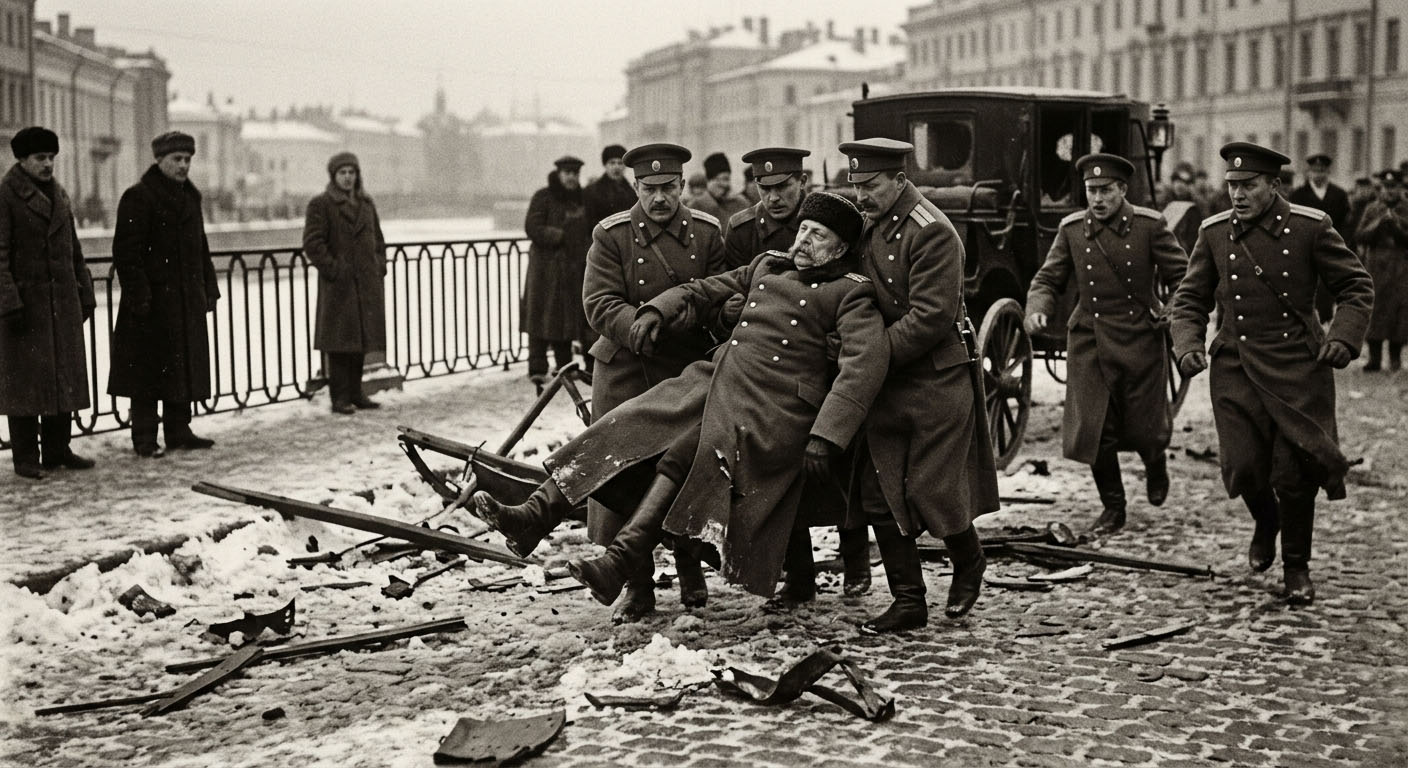
The second explosion was catastrophic. It ripped through the air at point-blank range, shattering both the Tsar’s legs, tearing open his abdomen, and leaving over twenty severe wounds on his body. Hryniewiecki himself was mortally wounded by the blast and died in a prison hospital later that day, never having revealed his true identity to his captors. He was identified only posthumously. Several bystanders were also badly wounded in the explosion.
Alexander II lay bleeding in the snow of the canal embankment, surrounded by the chaos of the aftermath. His son, the future Alexander III, and his grandson, the future Nicholas II, who was thirteen years old at the time, were among those who witnessed the dying Emperor being carried away. His wife Catherine Dolgorukova, still wearing bloodied clothes, threw herself on his body at the Winter Palace, where he was rushed for treatment. Historians have since noted that had Alexander been taken immediately to the nearby military hospital, surgeons might have been able to stem the bleeding and save his life. Instead, following the Emperor’s own instruction, he was treated at the Winter Palace, where the medical resources and conditions were inadequate for wounds of such severity. For forty-five minutes, the Imperial Family and gathered courtiers watched as his life ebbed away. At 3:35 in the afternoon, Tsar Alexander II died.
The Conspirators: Arrest, Trial, and Execution
The arrest of Nikolai Rysakov at the scene of the crime proved to be the first domino in the rapid unraveling of the Narodnaya Volya network in Saint Petersburg. Under interrogation, Rysakov provided information that implicated other participants and allowed the police to identify and raid the group’s headquarters. On March 15, two days after the assassination, police raided the safe house where Hesya Helfman resided. She was arrested. Nikolai Sablin, who was also present, fired several shots at the officers and then turned his weapon on himself to avoid capture. Another conspirator, Alexander Mikhailov, was captured in the same building the following day after a brief gunfight.
Sophia Perovskaya was apprehended by the tsarist police on March 22. Nikolai Kibalchich, the bomb-maker who had designed the weapons used in the assassination, was captured on March 29. Ivan Yemelyanov was arrested on April 14. Together with Andrei Zhelyabov, who was already in custody, these individuals were tried before the Special Tribunal of the Ruling Senate as state criminals between March 26 and 29, 1881. The trial was swift and its outcome preordained. All six were sentenced to death by hanging.
The executions were carried out on April 15, 1881, in Saint Petersburg. Zhelyabov, Perovskaya, Kibalchich, Mikhailov, and Rysakov were hanged before an enormous crowd. Sophia Perovskaya thus became the first woman in Russian history to be executed for a political crime. She faced the gallows without apparent fear. Andrei Zhelyabov, who had requested to be tried together with his comrades despite already being in custody, went to his death as he had lived, defiantly committed to his cause. Nikolai Kibalchich, while awaiting execution, spent his final days writing a technical paper proposing a rocket-powered flying machine, a document later claimed by some to be one of the earliest theoretical explorations of jet propulsion.
In the case of Hesya Helfman, her execution was deferred because she was pregnant. Alexander III later commuted her death sentence to indefinite katorga, or forced labor in Siberia. She died in 1882 from complications following the birth of her child. The fate of Ivan Yemelyanov was imprisonment in the Schlüsselburg Fortress, where he spent decades in isolation before eventually being released.
Alexander III and the Reversal of Reform: The Political Consequences of Regicide
The assassination of Alexander II had consequences that extended far beyond the death of a single ruler. His son and successor, Alexander III, drew exactly the opposite conclusions from his father’s murder than the assassins had intended. Rather than being intimidated into granting constitutional reforms, Alexander III used the assassination as justification for an immediate and sweeping reversal of his father’s liberalizing tendencies. On April 29, 1881, just over six weeks after the assassination, Alexander III issued his Manifesto of Unshakeable Autocracy, which declared his intention to maintain and strengthen the autocratic power of the Romanov dynasty and to resist any compromise with constitutionalism.
The political advisor most influential in shaping Alexander III’s response was Konstantin Pobedonostsev, the Tsar’s former tutor and a deeply conservative ideologue who served as Procurator of the Holy Synod, effectively the lay head of the Russian Orthodox Church. Pobedonostsev detested liberalism and constitutionalism, arguing that parliamentary government was a great lie of our time and that Russia’s strength lay in its Orthodox faith, national identity, and autocratic order. His influence over Alexander III was profound and enduring.
Under Alexander III, the zemstvo institutions of local self-government were stripped of much of their authority. The judicial reforms of 1864 were partially undone. Press censorship was tightened. The powers of the university rectors were curtailed and student political activity was suppressed. The Okhrana, the political police force that Loris-Melikov had established as a counterterrorism unit, was vastly expanded and given sweeping powers to arrest, surveil, and exile suspected dissidents. Between 1881 and 1884, more than ten thousand people were repressed for revolutionary activity. Alexander III’s coronation did not take place until May 1883, more than two years after his accession to the throne, because of security concerns following the assassination.
The assassination also had devastating consequences for Russia’s Jewish population. In the months following the killing, a wave of violent pogroms swept across southern Russia and Ukraine. Anti-Jewish sentiment was deliberately stoked by those who blamed Jewish influence in radical circles for the Tsar’s death, a charge that was both historically inaccurate and politically convenient. The May Laws of 1882, enacted under Alexander III, imposed severe restrictions on Jewish residency, education, and economic activity throughout the empire. These policies of organized state antisemitism intensified Jewish emigration from Russia and contributed to the conditions that would eventually produce the mass migration of Eastern European Jews to Western Europe and America.
The Loris-Melikov Constitution that Alexander II had signed on the morning of his assassination was never implemented. Alexander III, swayed by Pobedonostsev and other conservatives, rejected it outright. The proposals were later described by historians as potentially the germ of constitutional development in Russia. Their rejection foreclosed what might have been a path toward gradual political evolution and instead locked Russia into another three decades of autocratic repression, punctuated by the failed revolution of 1905, before the final collapse of the Romanov dynasty in February 1917.
The Church of the Savior on Spilled Blood: Memory and Commemoration
The site of Alexander II’s assassination on the Catherine Canal Embankment in Saint Petersburg was marked almost immediately by a small chapel. Construction of a permanent memorial church began in 1883, two years after the killing, on the exact spot where the Emperor’s blood had stained the snow. The Church of the Resurrection of Christ, universally known as the Church of the Savior on Spilled Blood, was completed in 1907 after twenty-four years of construction and became one of the most visually striking buildings in Russia. Its colorful onion domes and elaborate exterior mosaic decoration, drawing on the architectural traditions of medieval Russian church building, stand in striking contrast to the neoclassical European streetscape of Saint Petersburg around it. The interior contains the preserved section of the original cobblestones and iron railing from the spot where the Tsar fell, enshrined within the church as a permanent memorial to the moment of his death.
Alexander II was buried in the Peter and Paul Cathedral within the Peter and Paul Fortress in Saint Petersburg, alongside his first wife, Empress Maria Alexandrovna, who had died in 1880. His morganatic second wife, Catherine Dolgorukova, who had taken the title of Princess Yurievskaya after their secret marriage, was not given a state role in the mourning ceremonies, reflecting the complexity of his personal life and the tensions his later years had introduced into the imperial family.
The Long Shadow of March 13: How the Assassination Changed Russia and the World
Historians have long debated what might have happened had Alexander II lived. The Loris-Melikov plan represented a genuine, if modest, opening toward representative government. Had it been implemented, it might have established a precedent and a mechanism for incremental political reform that could have altered Russia’s trajectory. Alexander III’s categorical rejection of any such path, justified by the assassination, instead sent Russia down a road of intensifying repression and revolutionary radicalization that led with a certain logic to the convulsions of 1905 and ultimately to the revolutions of 1917.
The assassination of Alexander II is also significant in the broader history of political terrorism. Historians and scholars of terrorism have noted that the events of March 13, 1881 represent one of the earliest instances of what can be called a suicide bombing in the modern sense. The bomb carried by Ignacy Hryniewiecki weighed only about five pounds and had a blast radius that essentially guaranteed the death of the thrower as well as the target. The assassins had recognized that the only way to ensure the Tsar’s death was to detonate the device at extremely close range, accepting their own deaths as the price of success. This logic of sacrificial political violence, the attacker who accepts death as the instrument of the attack’s effectiveness, would become a defining feature of twentieth-century terrorism.
Narodnaya Volya itself did not long outlast its greatest victory. The execution of its key leaders in April 1881 created a leadership vacuum that proved impossible to fill. The tsarist security apparatus, galvanized by the assassination, hunted the surviving members of the organization with renewed ferocity. Between 1881 and 1884, the crackdown on the People’s Will decimated its membership and shattered its organizational capacity. In 1883, a member of the Executive Committee named Sergey Degayev, operating as a double agent for the Okhrana, betrayed his comrades to the authorities, delivering a final blow to the organization. By the mid-1880s, Narodnaya Volya had effectively ceased to exist as a functioning entity.
Yet its ideas and its example did not die with it. The organization had demonstrated, for the first time in Russian history, that a small, disciplined, conspiratorial group could reach the highest levels of state power through terrorist violence. This lesson was absorbed by subsequent generations of Russian revolutionaries, including the Socialist Revolutionary Party, which organized the assassination campaigns of the early twentieth century, and, more distantly, by the Bolsheviks under Vladimir Lenin, whose older brother Alexander Ulyanov was hanged in 1887 for his participation in a new People’s Will plot to assassinate Alexander III. Lenin himself acknowledged the influence of his brother’s death on his own radicalization.
The broader global impact of the assassination was also considerable. The successful killing of a major European monarch by a revolutionary organization inspired anarchist and nihilist movements across Europe and beyond, contributing to what became a wave of political assassinations in the late nineteenth and early twentieth centuries. The assassinations of U.S. President James Garfield in 1881, French President Sadi Carnot in 1894, Empress Elisabeth of Austria in 1898, King Umberto I of Italy in 1900, and most fatefully, Archduke Franz Ferdinand of Austria in 1914, can all be connected, through a chain of ideological influence and political inspiration, to the events on the Catherine Canal Embankment on March 13, 1881.
Alexander II’s Legacy: The Tsar Liberator in Historical Memory
The historical reputation of Alexander II has always been a complicated one, shaped by the tensions at the heart of his reign. He was, by any measure, the most consequential reforming Tsar in Russian history. The emancipation of the serfs in 1861 was a transformation of the social order of an entire civilization, comparable in its scope and moral significance to the abolition of slavery in the United States in the same era. His legal, military, educational, and economic reforms genuinely modernized Russia and created new possibilities for social advancement and civic life. Monuments to Alexander II were erected across the territories of the former Russian Empire, including in Sofia, Bulgaria, where he was remembered as the liberator who helped end Ottoman rule over the Bulgarian people during the Russo-Turkish War of 1877 to 1878.
Yet historians have also consistently noted the limits and contradictions of his liberalism. He emancipated the serfs but saddled them with redemption payments that kept many in effective economic bondage for decades. He reformed the judiciary but was unwilling to create an elected legislature. He relaxed censorship but responded to political challenge with periodic bouts of severe repression. The British historian W. E. Mosse, one of the leading scholars of Alexander’s reign, described him as a great historical figure without being a great man, suggesting that what he accomplished was historically more important than the personal qualities he brought to its accomplishment.
The most painful irony of his death is perhaps the most enduring fact about it. On the very morning he was killed, Alexander II had signed a document that could have changed the course of Russian history. Whether the Loris-Melikov plan would actually have led to genuine constitutional government is debated by historians. But the possibility was real, and the assassination extinguished it. The men and women who killed Alexander II in the name of freedom and the people’s will instead delivered Russia into the hands of Alexander III, who was determined to grant the people neither freedom nor a will of their own. In the grim arithmetic of historical consequence, the assassination of the Tsar Liberator accelerated, rather than prevented, the catastrophes that would eventually consume the Romanov dynasty and transform Russia beyond recognition.
Key Facts at a Glance
Date of Assassination: March 13, 1881 (March 1 by the Julian calendar then used in Russia)
Location: Catherine Canal Embankment, Saint Petersburg, Russia
Perpetrating Organization: Narodnaya Volya (People’s Will)
First Bomber: Nikolai Rysakov (survived; later arrested, tried, and hanged on April 15, 1881)
Fatal Bomber: Ignacy Hryniewiecki (died from blast wounds the same day, March 13, 1881)
Chief Organizer: Andrei Zhelyabov (arrested February 28, 1881; hanged April 15, 1881)
Operational Commander on the Day: Sophia Perovskaya (hanged April 15, 1881)
Alexander II’s Reign: March 2, 1855 – March 13, 1881
Successor: Alexander III (reigned 1881–1894)
Burial Site: Peter and Paul Cathedral, Saint Petersburg
Memorial: Church of the Savior on Spilled Blood, built 1883–1907 at the assassination site