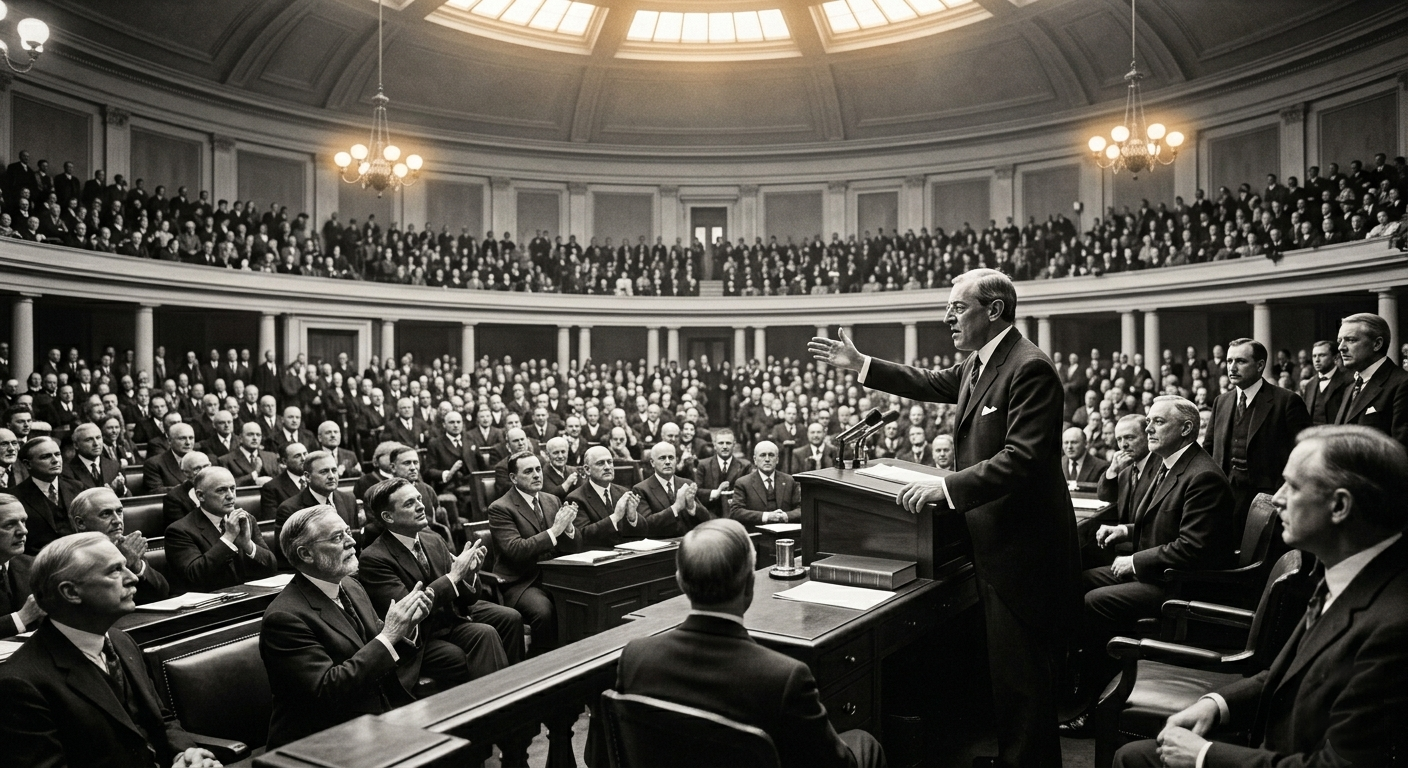
On the evening of April 2, 1917, President Woodrow Wilson stood before a special joint session of Congress in the chamber of the House of Representatives and delivered one of the most consequential speeches in American history. Speaking to a packed hall that included senators, representatives, members of the Supreme Court, cabinet secretaries, and foreign diplomats, Wilson asked Congress to formally declare war on the Imperial German Government and bring the United States into the Great War that had consumed Europe for nearly three years. It was a moment Wilson had spent years trying to avoid. He had built his entire political identity around keeping America at peace, had won reelection in 1916 on the campaign slogan ‘He kept us out of war,’ and had worked tirelessly — and unsuccessfully — to broker a negotiated end to the European conflict. Now, standing before the assembled Congress with cavalry escorts and soldiers guarding the Capitol building against feared anarchist attacks, Wilson made the reluctant, agonizing case that neutrality was no longer possible.
The speech Wilson delivered that evening — roughly 3,400 words in length, written alone in the White House study over the preceding weekend, shown before delivery only to his wife Edith Wilson and his personal adviser Colonel Edward House — was not a triumphant call to arms. It was the statement of a man who recognized the awful weight of what he was asking his country to do. ‘It is a fearful thing,’ Wilson told the assembled Congress and the nation, ‘to lead this great peaceful people into war, into the most terrible and disastrous of all wars, civilization itself seeming to be in the balance.’ Yet he concluded that the right was more precious than peace, and that the United States had no honorable choice but to enter the conflict. Four days later, Congress voted overwhelmingly to grant his request. At 1:11 p.m. on April 6, 1917, Wilson signed the declaration of war, and the United States officially became a belligerent in the First World War. The world, and America’s place in it, would never be the same.
The World at War in 1914: Europe’s Catastrophe and Wilson’s Declaration of American Neutrality
To understand the full significance of Wilson’s April 2, 1917 war message, it is essential to begin where the story truly starts: the summer of 1914, when a cascade of treaty obligations, imperial rivalries, nationalist passions, and catastrophic miscalculations drew the major European powers into the most destructive conflict in human history to that point. The assassination of Archduke Franz Ferdinand, heir to the throne of the Austro-Hungarian Empire, and his wife Sophie by Bosnian Serb nationalist Gavrilo Princip in Sarajevo on June 28, 1914, set in motion a chain of ultimatums, mobilizations, and declarations of war that within six weeks had engulfed virtually all of Europe. By early August 1914, Germany, Austria-Hungary, and the Ottoman Empire faced Britain, France, Russia, and Serbia in a conflict that would ultimately kill an estimated seventeen million people.
President Woodrow Wilson responded to the outbreak of European war with an immediate declaration of American neutrality. On August 4, 1914, Wilson issued a proclamation of neutrality, and on August 19 he addressed the American people directly, urging them to be ‘impartial in thought as well as in action’ and to remain ‘neutral in fact as well as in name.’ Wilson’s neutrality was rooted in both pragmatic and ideological conviction. Pragmatically, the United States had large immigrant populations with ties to virtually every belligerent nation — German-Americans, Irish-Americans hostile to Britain, Austro-Hungarian immigrants, and others — and Wilson feared that any alignment would fracture American social cohesion. Ideologically, Wilson believed that only a neutral America could play the role of honest broker in eventual peace negotiations, and that only a ‘peace without victory’ — a settlement that did not humiliate the defeated parties — could produce a durable postwar order.
Wilson’s neutrality was, however, immediately complicated by economic and practical realities. Britain, which maintained the dominant naval force in the Atlantic, imposed a sweeping blockade on Germany that intercepted American merchant ships bound for German ports, seized contraband goods, and forced neutral vessels to divert to British ports for inspection. This was a genuine violation of international law and neutral rights as the United States understood them, and it caused significant friction between Washington and London. But German submarine warfare would prove far more provocative in its consequences, partly because it killed people directly and in horrifying fashion, and partly because the moral optics of drowning civilians were far worse than the economic inconvenience of seized cargo.
The Sinking of the Lusitania, May 7, 1915: The Atrocity That First Shook American Neutrality
The event that first fundamentally shook American public confidence in neutrality — and that laid the emotional groundwork for the ultimate decision to go to war — occurred on May 7, 1915, when a German U-boat torpedoed and sank the British ocean liner RMS Lusitania off the coast of Ireland. Of the 1,959 passengers and crew on board, 1,198 were killed, including 128 American citizens. The Lusitania sank in just eighteen minutes, leaving survivors clinging to debris in the cold Atlantic. The attack shocked and enraged American public opinion. The Lusitania was not a warship — it was a civilian passenger liner, and the German submarine had attacked it without warning, in direct violation of the traditional rules of naval warfare that required warning before attack and provision for the safety of civilian passengers and crew.
President Wilson responded to the Lusitania sinking with strongly worded diplomatic protests to Berlin, demanding that Germany abandon unrestricted submarine warfare and acknowledge its obligation to protect neutral lives. In his notes to the German government, Wilson asserted American rights as a neutral to travel on the high seas and warned that the United States would hold Germany strictly accountable for any further violations. His former Secretary of State, William Jennings Bryan, who was deeply committed to pacifism and feared Wilson’s notes would draw the country into war, resigned from the cabinet in June 1915 rather than sign the second Lusitania protest note. Bryan’s resignation placed Robert Lansing, a more legally minded and less pacifistic diplomat, in charge of the State Department. Wilson’s insistence on American neutral rights was uncompromising in principle while still stopping well short of a war ultimatum.
Germany partially accommodated American pressure. Following the sinking of another British liner, the Arabic, in August 1915, which killed two Americans, the German government issued what became known as the Arabic Pledge, promising that submarines would not sink passenger liners without warning and without provision for the safety of those on board. Wilson claimed a diplomatic victory, but the underlying tension between German submarine strategy and American neutral rights remained unresolved. The Lusitania episode had established the emotional and moral framework within which all subsequent German submarine actions would be judged by the American public: Germany was willing to drown innocent civilians, including American men, women, and children, in pursuit of its military objectives.
The Sussex Pledge of 1916 and Germany’s Broken Promise: Building the Case for War
The fragile accommodation reached in the Arabic Pledge did not hold. In March 1916, a German submarine attacked and severely damaged the French passenger ferry Sussex as it crossed the English Channel, injuring several Americans. The Sussex attack prompted Wilson to deliver his strongest ultimatum to Germany yet: if Germany did not immediately abandon its current methods of submarine warfare, the United States would have no choice but to sever diplomatic relations. The threat was significant — severing diplomatic relations was widely understood as a penultimate step toward war — and it worked, at least temporarily.
On May 4, 1916, Germany issued the Sussex Pledge, a formal commitment that submarines would not attack merchant or passenger ships without warning and without making provision for the safety of those on board, even in the war zones around the British Isles. The Sussex Pledge gave Wilson a genuine, if provisional, victory. It demonstrated that American diplomatic pressure could constrain German submarine operations, and it removed the immediate threat of an incident that might force the United States into the war. Wilson used the pledge as a political asset in his 1916 reelection campaign, presenting himself as the president who had stood up to Germany while keeping America at peace.
The problem with the Sussex Pledge was that it was always conditional on Germany’s calculation of its own strategic interests. The German military leadership — particularly the Naval High Command and the army commanders Generals Paul von Hindenburg and Erich Ludendorff, who had assumed effective control of German war strategy after August 1916 — regarded unrestricted submarine warfare as potentially decisive in defeating Britain. Their strategic calculus was brutal but clear: if German U-boats could sink enough shipping to starve Britain of food and raw materials, Britain would be forced to sue for peace within months, before the United States could potentially enter the war and make a military difference. German Chancellor Theobald von Bethmann-Hollweg opposed this reasoning, warning that resuming unrestricted submarine warfare would almost certainly draw the United States into the war on the Allied side. His warnings were overruled.
The 1916 Presidential Election and Wilson’s ‘He Kept Us Out of War’ Mandate
The November 1916 presidential election provides crucial context for understanding the political constraints under which Wilson operated as he moved toward his April 1917 war message. Wilson ran for reelection against Republican challenger Charles Evans Hughes, a former Supreme Court Justice and Governor of New York, in one of the closest elections in American history. Wilson won, but only narrowly, carrying the Electoral College 277 to 254, with the decisive margin coming from Western states whose voters were strongly anti-war. The Democratic Party’s campaign slogan — ‘He kept us out of war’ — was not Wilson’s own formulation, but it was the message that resonated most powerfully with the American electorate, particularly women in the Western states where women had already won the right to vote.
Wilson’s reelection on a peace platform placed him in an excruciating political position when Germany announced its intention to resume unrestricted submarine warfare in early 1917. He had been given a mandate to keep America at peace. Millions of voters had supported him precisely because they trusted him not to take the country into the European carnage. Asking Congress for a war declaration just months after his reelection required Wilson to explain not only why war had become necessary but also why the circumstances had changed fundamentally enough to justify reversing the course on which he had campaigned. The Germans, by their actions in early 1917, gave him the material for that explanation — material so stark and damaging to Germany’s reputation that even the most committed American neutralists were forced to reconsider.
Germany Resumes Unrestricted Submarine Warfare, February 1, 1917: The Decision That Made War Inevitable
On January 9, 1917, at a secret conference at Pless Castle in Silesia (now Pszczyna, Poland), Kaiser Wilhelm II of Germany met with his military and political leadership to make the fateful decision to resume unrestricted submarine warfare. Present at the conference were Chief of the Imperial Naval Staff Admiral Henning von Holtzendorff, who had argued in a detailed memorandum that unrestricted submarine warfare could force Britain to sue for peace within five months; Field Marshal Paul von Hindenburg and General Erich Ludendorff, who controlled German military strategy; and Chancellor Theobald von Bethmann-Hollweg, who opposed the decision and predicted, accurately, that it would bring the United States into the war. Kaiser Wilhelm II authorized the resumption of unrestricted submarine warfare, overruling Bethmann-Hollweg’s objections. February 1, 1917 was selected as the start date.
On January 31, 1917, German Ambassador to the United States Count Johann von Bernstorff delivered a formal diplomatic note to U.S. Secretary of State Robert Lansing announcing Germany’s intention to resume unrestricted submarine warfare effective the following day. The note declared that starting February 1, German submarines would sink without warning all vessels — belligerent or neutral, passenger or merchant — found in designated war zones around Britain, France, Italy, and the Eastern Mediterranean. This was a direct and deliberate violation of the Sussex Pledge. Wilson was stunned. He had staked his diplomatic credibility on the pledge, had argued to the American people that firm diplomacy could restrain Germany, and had won reelection in part on that argument. Germany had now made his position untenable.
President Wilson went before Congress on February 3, 1917, to announce that he had severed diplomatic relations with Germany — expelling von Bernstorff from the country and recalling the American ambassador from Berlin. This was a grave step, widely understood as a near-certain precursor to war. But Wilson still held back from requesting a declaration of war, because he hoped against hope that Germany might reconsider, and because he did not yet have the full weight of public opinion behind a war declaration. He told Congress that only ‘actual overt acts’ against American ships and lives would force his hand. The Germans proceeded to provide precisely those acts. Between February and early April 1917, German U-boats sank nine American merchant ships and killed forty-three seamen, including thirteen American citizens.
The Zimmermann Telegram: Germany’s Plot to Bring Mexico Into War Against the United States
If the resumption of unrestricted submarine warfare was the primary cause of American entry into the First World War, the Zimmermann Telegram was the accelerant that transformed public outrage into an overwhelming demand for war. The telegram was sent on January 17, 1917, by Arthur Zimmermann, the German Foreign Secretary (Staatssekretär des Auswärtigen Amtes), to Heinrich von Eckardt, the German Minister to Mexico. It was transmitted through the German Embassy in Washington, using American telegraph cables that Wilson had permitted Germany to use for diplomatic communications — a trust Germany now spectacularly betrayed.
The telegram’s contents were extraordinary. Zimmermann proposed that if the United States entered the war against Germany, Germany would form a military alliance with Mexico, offering Mexico generous financial support and an understanding that Mexico would reconquer the territory lost in the Mexican-American War — specifically Texas, New Mexico, and Arizona. Zimmermann also suggested that Mexico might invite Japan to join the proposed alliance. The telegram read, in decoded form: ‘We intend to begin on the first of February unrestricted submarine warfare. We shall endeavor in spite of this to keep the United States of America neutral. In the event of this not succeeding, we make Mexico a proposal of alliance on the following basis: make war together, make peace together, generous financial support, and an understanding on our part that Mexico is to reconquer the lost territory in Texas, New Mexico, and Arizona.’
The telegram was intercepted and decoded by British Naval Intelligence, specifically the codebreakers working in a section of the Admiralty known as Room 40, which had been systematically decoding German diplomatic communications since obtaining German naval codebooks in 1914. British Foreign Secretary Arthur James Balfour presented the decoded telegram to American Ambassador to Great Britain Walter Hines Page in London on February 24, 1917. Page immediately recognized its explosive significance and relayed it to Washington. Wilson received the telegram on February 26. After verifying its authenticity — a challenge since revealing it would expose the British codebreaking operation — the Wilson administration released the Zimmermann Telegram to the American press on March 1, 1917.
The public reaction was precisely what both the British and Wilson had hoped. Americans were outraged. The telegram revealed that Germany was not merely fighting a European war but was actively conspiring to incite an attack on the continental United States by its southern neighbor, offering American territory as the prize. Some skeptics initially suspected the telegram was a British forgery designed to manipulate America into the war. That argument was demolished on March 29, 1917, when Arthur Zimmermann himself gave a speech in the German Reichstag in which he confirmed the telegram’s authenticity. The Zimmermann Telegram has been described by historians as perhaps Britain’s greatest intelligence coup of the First World War. Combined with the ongoing German submarine attacks on American ships, it created an atmosphere in which Wilson’s request for a war declaration would receive overwhelming public and congressional support.
Russia’s February Revolution, March 1917: How the Tsar’s Abdication Made the War a Crusade for Democracy
One additional development in the weeks before Wilson’s war message provided an important rhetorical opportunity for framing American entry into the war in the most favorable moral terms. On March 15, 1917, Tsar Nicholas II of Russia abdicated the throne following the February Revolution, which had erupted in Petrograd amid mass food shortages, military exhaustion, and popular fury at the incompetence and brutality of the tsarist regime. The Tsar’s abdication brought to power a Provisional Government that promised to establish a parliamentary democracy and continue the war against Germany.
This development was enormously significant for Wilson’s framing of the case for war. Before the Russian Revolution, the Allied powers — Britain, France, and Russia — included one of the most brutally autocratic regimes in Europe. The moral argument that the Allies were fighting for democracy and freedom had been undermined by the presence of the tsarist empire in their coalition. With the Tsar gone and a democratic provisional government in his place, Wilson could now argue with greater credibility that the Allied cause was genuinely a democratic cause — a struggle of free peoples against autocratic empires. This framing became central to Wilson’s April 2 speech and to his broader justification for American belligerency. Tsar Nicholas II’s abdication, as the Teaching American History project notes, ‘further inspired Wilson’s hope that democracy would triumph over autocracy to create a peaceful future.’
Writing the War Message: Wilson Alone in the White House Study, March 31 to April 1, 1917
As the cumulative weight of German provocations mounted through February and March 1917 — submarines sinking American ships, the Zimmermann Telegram’s revelation, the ongoing loss of American lives — Wilson convened his cabinet on March 20, 1917, to discuss the situation. Every member of the cabinet expressed support for asking Congress for a declaration of war. Wilson called Congress into special session on April 2. The date of the war message was set.
In the days before the speech, Wilson was reported to be physically and emotionally strained. He agonized over the decision with an intensity that those close to him described as almost unbearable. He had spent nearly three years as a peace president, had argued with passionate conviction that neutrality served America’s highest interests, and had genuinely believed — perhaps naively — that firm but peaceful diplomacy could restrain Germany’s worst impulses. Now he was about to ask young Americans to die in a European war, and he had to explain not only why it was necessary but why it was right. He spent the weekend of March 31 and April 1 drafting the speech himself, working in the second-floor study of the White House, refusing the assistance of speechwriters. When the speech was done, he shared it with only two people before delivering it: his wife Edith Bolling Wilson, whom he had married in December 1915 after the death of his first wife Ellen, and his trusted personal adviser Colonel Edward House. No one else in the government knew, as Wilson arrived at the Capitol on the evening of April 2, whether he intended to ask for war or for further restraint.
April 2, 1917: Wilson Delivers the War Message Before a Joint Session of Congress
The atmosphere in Washington on the evening of April 2, 1917 was electric with tension and anticipation. The Capitol building was guarded by cavalry and infantry soldiers, reflecting fears of anarchist or anti-war violence. Inside the House chamber, every seat was filled — senators, representatives, Supreme Court justices, the diplomatic corps, members of the cabinet, and invited guests all crowded into the hall. When Wilson entered at approximately 8:30 in the evening, he was met with sustained applause. Chief Justice Edward Douglass White, a Confederate veteran who had fought against the Union in the Civil War, was reportedly seen wiping tears from his eyes as Wilson spoke.
Wilson began the speech by recounting Germany’s January 31 announcement of unrestricted submarine warfare and its implications for neutral shipping. He described in measured but damning detail what the German policy meant in practice: ‘Vessels of every kind, whatever their flag, their character, their cargo, their destination, their errand, have been ruthlessly sent to the bottom without warning and without thought of help or mercy for those on board, the vessels of friendly neutrals along with those of belligerents.’ He characterized this as not merely an attack on neutral rights but as an assault on humanity itself: ‘The present German submarine warfare against commerce is a warfare against mankind. It is a war against all nations.’ He catalogued the specific provocations — the breaking of the Sussex Pledge, the sinking of American merchant ships, the loss of American lives.
Wilson then turned to the Zimmermann Telegram, citing without explicitly naming it ‘the intercepted note to the German Minister in Mexico City’ as ‘eloquent evidence’ of Germany’s hostile purpose toward the United States. He argued that in the face of a government that conducted its foreign policy through such methods — secret plots, broken pledges, unrestricted killing — there could be ‘no assured security for the democratic Governments of the world.’ The German government, Wilson declared, was not merely an opponent in a conventional diplomatic dispute but a ‘natural foe to liberty.’
The speech reached its most powerful and enduring passage when Wilson articulated the moral justification for American belligerency that transcended narrow national interest. It was here that he delivered the words that would define not only his presidency but America’s self-conception as a world power for the next century. ‘The world must be made safe for democracy,’ Wilson declared. ‘Its peace must be planted upon the tested foundations of political liberty. We have no selfish ends to serve. We desire no conquest, no dominion. We seek no indemnities for ourselves, no material compensation for the sacrifices we shall freely make. We are but one of the champions of the rights of mankind.’ He framed the coming American sacrifice as a selfless act on behalf of universal human freedom, distinguishing it sharply from the territorial and imperial ambitions that he argued had driven the European powers into the war.
Wilson concluded with an acknowledgment of the gravity of what he was asking. ‘It is a distressing and oppressive duty, Gentlemen of the Congress,’ he said, ‘which I have performed in thus addressing you. There are, it may be, many months of fiery trial and sacrifice ahead of us.’ He then delivered perhaps the most emotionally honest line in the speech: ‘It is a fearful thing to lead this great peaceful people into war, into the most terrible and disastrous of all wars, civilization itself seeming to be in the balance.’ And then, in the final passage, he rose to resolve: ‘But the right is more precious than peace, and we shall fight for the things which we have always carried nearest to our hearts — for democracy, for the right of those who submit to authority to have a voice in their own governments, for the rights and liberties of small nations, for a universal dominion of right by such a concert of free peoples as shall bring peace and safety to all nations and make the world itself at last free.’
The speech was received with tremendous applause in the chamber. Wilson himself, according to accounts from those present, returned to the White House in a somber mood. He reportedly said to his secretary Joseph Tumulty afterward: ‘My message today was a message of death for our young men. How strange it seems to applaud that.’
The Senate Vote, April 4, 1917: The Debate and the Voices of Opposition
The Senate took up the war resolution on April 4, 1917. Before the vote, the chamber heard extensive debate, most notably a long, impassioned speech in opposition by Senator Robert M. La Follette of Wisconsin, the leader of the progressive Republican wing and one of the most principled dissenters in the history of the American Senate. La Follette argued that Wilson had failed to distinguish between the rights Germany had violated and the equally problematic behavior of Britain, whose naval blockade of Germany also flouted international law and neutral rights. He questioned whether the sinking of American ships in German-declared war zones was fundamentally different in moral principle from the British mining of international waters. ‘You cannot distinguish between the principles which allowed England to mine a large area of the Atlantic Ocean and the North Sea in order to shut in Germany,’ La Follette argued, ‘and the principle on which Germany by her submarines seeks to destroy all shipping which enters the war zone which she has laid out around the British Isles.’
La Follette also raised the fundamental democratic objection to the war: that the American people, if given a direct referendum on the question, would vote against it. He argued that Wilson’s election on a peace platform constituted a mandate against war that the president was now betraying. La Follette’s speech was extraordinarily courageous — he spoke in the full knowledge that popular sentiment had turned sharply against Germany, that he would be vilified in the press, and that opposing the war would effectively end his presidential ambitions. His courage proved to be exactly what he feared: the press savaged him, and he was censured by the Wisconsin legislature, though history would treat him more kindly.
The Senate voted on April 4, 1917. The result was 82 votes in favor of the war declaration and 6 against — an overwhelming majority that nonetheless included several notable dissenters. The six senators who voted against were: Republican Asle Gronna of North Dakota, Republican Robert M. La Follette of Wisconsin, Republican George W. Norris of Nebraska, Democrat Harry Lane of Oregon, Democrat William J. Stone of Missouri, and Democrat James K. Vardaman of Mississippi. Forty-four Democratic senators and thirty-eight Republican senators voted in favor. Seven Democrats and one Republican did not vote. The Senate vote was decisive and rapid; the more complex and contested debate would occur in the House of Representatives.
The House Vote, April 6, 1917 at 3 a.m.: The Final Declaration and Jeannette Rankin’s Historic Dissent
The House of Representatives took up the war resolution on April 5 and 6, 1917, in a debate that extended through the night. The chamber was deeply divided in ways that the Senate was not, with significant pockets of opposition concentrated in the Midwest, the Mountain West, and among German-American constituencies throughout the country. The debate was extensive and often passionate, with opponents arguing that the United States was being drawn into a European quarrel that was not America’s business, that Wilson had not exhausted all diplomatic options, and that the costs in American lives and treasure would be enormous with no clear guarantee of the outcome Wilson was promising.
At 3 a.m. on April 6, 1917, the House of Representatives voted. The final tally was 373 in favor of the war declaration and 50 against, with 8 members not voting. The margin was overwhelming — more than seven to one — but the fifty negative votes were a significant minority by historical standards for a war declaration. Among the dissenters were several members who would suffer significant political consequences for their votes. Among the most notable was Claude Kitchin of North Carolina, the House Majority Leader, who voted against the war despite his leadership position in Wilson’s own Democratic Party.
The most historically resonant dissenting vote came from Representative Jeannette Rankin of Montana, a Republican who had taken her seat in Congress just weeks earlier, in January 1917, as the first woman ever elected to the United States House of Representatives. Rankin, a committed pacifist and women’s suffrage activist, voted against the war declaration and reportedly stated, when her name was called, ‘I want to stand by my country, but I cannot vote for war. I vote no.’ Rankin was weeping when she cast her vote, and her position drew both fierce criticism and quiet admiration. She would go on to vote against another war declaration on December 8, 1941 — the only member of Congress to vote against both declarations of war — making her the sole legislator to oppose both American entries into world wars.
Immediately after the House resolution passed, it was signed by House Speaker Champ Clark of Missouri. Approximately nine hours later, at 12:14 p.m. on April 6, Vice President Thomas R. Marshall signed the resolution. Less than an hour after that, at 1:11 p.m. on April 6, 1917, President Woodrow Wilson signed the declaration of war against the Imperial German Government. The United States was officially at war. It was only the fourth time in American history that Congress had formally declared war; the previous occasions were the War of 1812, the Mexican-American War of 1846, and the Spanish-American War of 1898.
Key Stakeholders in the Wilson War Message: The People Who Shaped America’s Entry Into World War I
The events leading to Wilson’s war message and the subsequent congressional vote involved a remarkably wide cast of political, military, and diplomatic figures whose decisions shaped the outcome. President Woodrow Wilson himself (born December 28, 1856, in Staunton, Virginia) was the 28th President of the United States, a former president of Princeton University and Governor of New Jersey, a deeply religious Presbyterian who approached international affairs with a moralistic framework that sometimes alienated more pragmatic allies and opponents alike. His Secretary of State Robert Lansing, who had replaced the pacifist William Jennings Bryan in June 1915, supported the war decision and provided legal and diplomatic counsel throughout the crisis period of 1916 and 1917. Colonel Edward M. House, Wilson’s most trusted personal adviser, served as a back-channel diplomat and confidant who had made multiple trips to Europe before the war seeking to facilitate peace negotiations.
On the German side, the key decision-makers included Kaiser Wilhelm II, the German emperor who authorized the resumption of unrestricted submarine warfare on January 10, 1917; Chancellor Theobald von Bethmann-Hollweg, who opposed the decision and predicted with accuracy that it would bring America into the war, and who was effectively marginalized by the military leadership; Admiral Henning von Holtzendorff, whose memorandum arguing that unrestricted submarine warfare could defeat Britain within five months provided the strategic rationale for the decision; and Arthur Zimmermann, the German Foreign Secretary whose telegram to Mexico became one of the most notorious diplomatic blunders in history. Count Johann von Bernstorff, the German Ambassador to the United States, had worked for years to maintain German-American relations and desperately opposed the decision to resume unrestricted submarine warfare, knowing it would end his mission and likely trigger American belligerency.
On the British side, Foreign Secretary Arthur James Balfour played the crucial role of presenting the decoded Zimmermann Telegram to American Ambassador Walter Hines Page, understanding that its revelation would accelerate American entry into the war. The anonymous codebreakers of Room 40 — the Admiralty’s intelligence section — performed what many historians have called the most consequential act of intelligence work in the war by intercepting, decoding, and transmitting the telegram. In the United States Congress, Senator Henry Cabot Lodge of Massachusetts led the pro-war Republicans who supported Wilson’s request, while Senator La Follette and the six senators who voted against the declaration represented the principled anti-war minority. Representative Jeannette Rankin’s dissenting vote added a historic dimension to the congressional record that would resonate across both world wars.
America Mobilizes for War: The Selective Service Act, the CPI, and the Home Front After April 1917
With the declaration of war signed on April 6, 1917, the Wilson administration turned to the enormous task of mobilizing a nation for large-scale industrial warfare. The United States in April 1917 had a regular army of only approximately 128,000 men — utterly inadequate for the scale of commitment that the European war required. Wilson initially hoped that voluntary enlistment would provide sufficient troops, but it quickly became apparent that the scale of manpower needed could only be met through conscription. On May 18, 1917, Wilson signed the Selective Service Act, establishing a military draft system that would ultimately register approximately 24 million men and induct approximately 2.8 million into the armed forces. The first draft lottery was held on July 20, 1917.
Wilson also established a comprehensive propaganda operation to build public support for the war and maintain civilian morale. On April 13, 1917, just one week after the declaration of war, he created the Committee on Public Information (CPI) under the direction of journalist and progressive activist George Creel. The CPI organized a nationwide campaign of pro-war messaging that included pamphlets, films, posters, and most innovatively the ‘Four Minute Men’ — a network of approximately 75,000 trained volunteers who gave short patriotic speeches in movie theaters, churches, and public gatherings across the country during the interval between film reels, urging Americans to buy war bonds and support the national effort.
Wilson appointed Herbert Hoover — a successful mining engineer and humanitarian who had organized massive food relief operations in occupied Belgium before American entry into the war — to head the newly created Food Administration. Hoover’s Food Administration promoted voluntary conservation of food to ensure adequate supplies for American troops and Allied nations, encouraging ‘Wheatless Mondays,’ ‘Meatless Tuesdays,’ and other conservation measures. The Food Administration also took symbolic aim at German cultural associations, renaming some German-derived foods: sauerkraut became ‘liberty cabbage’ and hamburgers became ‘liberty sandwiches’ in some corners of the patriotic American food landscape.
The Legacy of Wilson’s War Message: ‘The World Must Be Made Safe for Democracy’ and Its Enduring Impact
Wilson’s April 2, 1917 war message and the declaration of war that followed transformed the United States from a reluctant observer of the European catastrophe into the decisive participant that would ultimately determine its outcome. The infusion of American troops, food, financial credit, and industrial production into the Allied war effort — combined with the devastating effects of the British naval blockade on Germany — contributed decisively to the German decision to seek an armistice on November 11, 1918. When the guns fell silent on the Western Front, the United States had deployed approximately 2 million soldiers to France under the command of General John J. Pershing, and approximately 116,000 of them had died.
Wilson led the American delegation to the Paris Peace Conference in 1919, where he championed his Fourteen Points — a comprehensive program for a just and lasting peace that included the establishment of an international organization, the League of Nations, to prevent future wars. The Treaty of Versailles, signed on June 28, 1919, incorporated Wilson’s League of Nations but also imposed punishing reparations and territorial losses on Germany that Wilson himself recognized as harsh. The treaty’s terms and the League of Nations became enormously controversial at home, and the United States Senate ultimately refused to ratify the treaty, keeping America out of the League that Wilson had fought so hard to create. The defeat broke Wilson’s health — he suffered a severe stroke in October 1919 while on a national speaking tour to build public support for the treaty — and he never fully recovered.
The phrase ‘The world must be made safe for democracy,’ which Wilson delivered in his April 2, 1917 address, became one of the most quoted and debated sentences in American political history. It was celebrated at the time as a statement of noble purpose and has since been criticized as a statement of imperial overreach — an assertion that the United States had the right and the obligation to reshape the world according to its own political values. Historians have debated for a century whether Wilson’s idealistic framing of American entry into the First World War was a genuine expression of democratic principle or a rationalization of geopolitical self-interest dressed in the language of universal values. What is beyond debate is that the words, and the war they announced, fundamentally changed the United States’ relationship with the world. After April 6, 1917, America could no longer imagine itself as a nation apart from the global order; it was, from that moment, a world power with global obligations and global entanglements that no subsequent generation would entirely escape.
The Wilson War Message of April 2, 1917 stands as one of the pivotal documents in American history — a speech written by a tormented, morally serious president at a moment of maximum historical pressure, delivered to a nation that did not fully want to go to war but was being driven there by the relentless logic of events. The German submarines that sank American ships, the secret telegram that proposed giving American territory to Mexico, the broken pledges and the drowning civilians — all of it combined to make Wilson’s reluctant argument for war the only argument that the American democratic system could accept. ‘It is a fearful thing,’ Wilson said, ‘to lead this great peaceful people into war.’ That it was. And it changed everything.