How the Arkansas National Guard Blocked Nine Black Students at Little Rock Central High School — and How America Changed
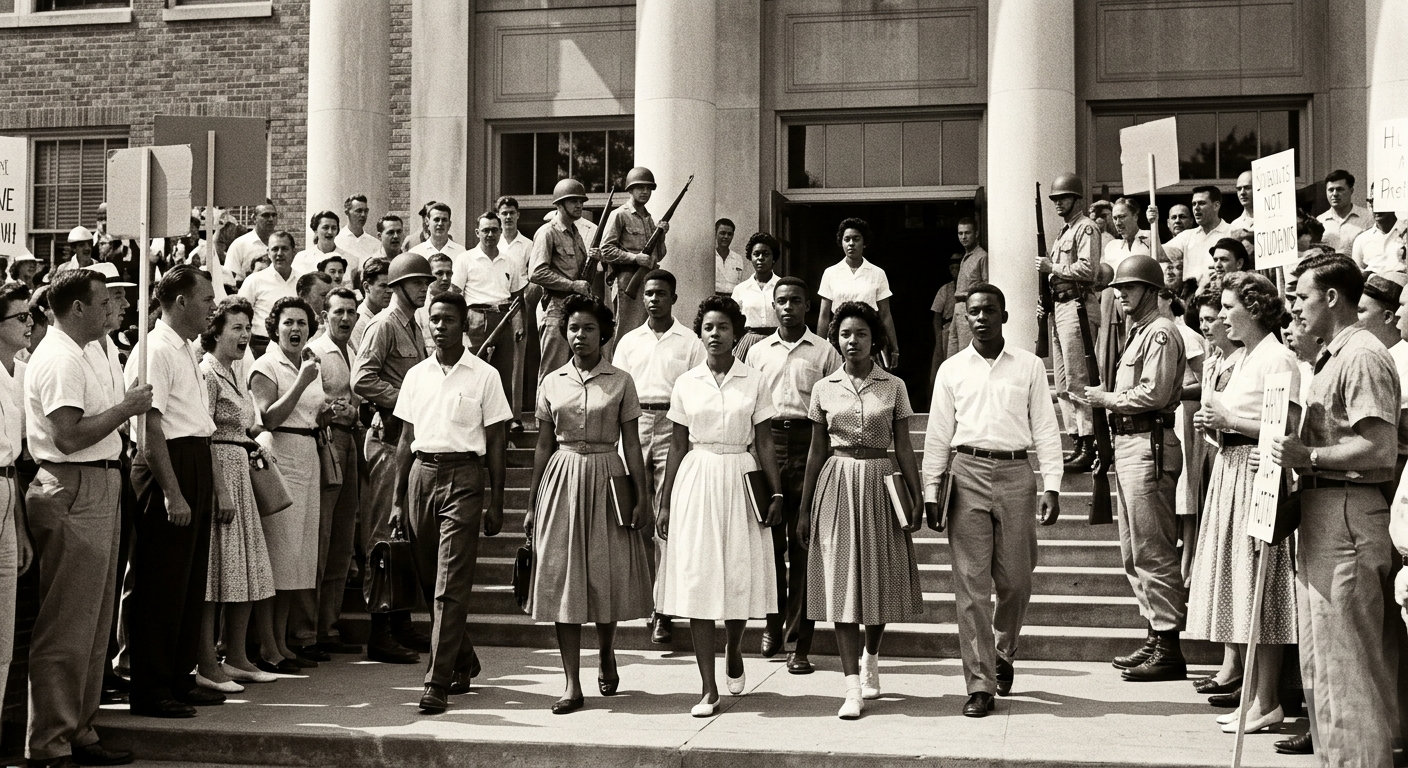
On the morning of September 4, 1957, fifteen-year-old Elizabeth Eckford dressed carefully in a black-and-white skirt she had made herself and walked alone through the streets of Little Rock, Arkansas, toward Central High School. She had not received word of the carpool arrangement organized by Daisy Bates, the president of the Arkansas NAACP, because her family had no telephone. So she arrived alone, carrying her school books, to find a scene she had not been prepared for. Hundreds of white adults and teenagers had gathered outside the school, screaming racial slurs and threats. Arkansas National Guard soldiers, their rifles at the ready, formed a line blocking the school entrance. When Elizabeth tried to walk through the line to enter the building, a guardsman blocked her with his rifle. She turned away, looking for any face in the crowd that showed compassion, and found none. An old woman appeared to have a kind face, and Elizabeth looked to her for reassurance. Then the woman spat on her.
Elizabeth Eckford sat down at a bus stop and waited. The crowd pressed around her, jeering and threatening. A white journalist named Benjamin Fine from The New York Times sat beside her and tried to calm her with the only words that came to him, telling her not to let them see her cry. A white woman named Grace Lorch intervened to shield her from the crowd until a bus arrived to take her away from the school she had the legal right to attend. The image of Elizabeth Eckford walking alone through that crowd, composed and straight-backed under assault, would become one of the most iconic photographs in the history of the American civil rights movement and one of the most devastating indictments of racial hatred ever captured on film.
The events of September 4, 1957, and the weeks that followed, became known as the Little Rock Crisis. Nine African American teenagers, careful chosen for academic excellence and personal fortitude, sought nothing more than to exercise a right the Supreme Court of the United States had established three years earlier: the right to attend the same public schools as their white neighbors. What they encountered instead was a governor who deployed his state’s military force against them, a mob that threatened their lives, a political establishment that prioritized electoral calculation over constitutional obligation, and eventually a president who was compelled, reluctantly but decisively, to send a combat unit of the United States Army to enforce the law. The Little Rock Nine, as they became known, changed America, not by force of arms or political power but by the courage of nine young people who refused to be turned away.
Separate and Unequal: The Legal Foundation of American School Segregation Before 1954
To understand the significance of what happened in Little Rock in 1957, it is necessary to understand the legal architecture that had sustained racial segregation in American education for more than half a century before the Supreme Court dismantled it. The foundation of that architecture was the Supreme Court’s 1896 decision in Plessy v. Ferguson, which upheld a Louisiana law requiring separate railway cars for Black and white passengers. The court’s majority opinion established the doctrine of separate but equal, holding that racial separation did not in itself constitute a violation of the Fourteenth Amendment’s guarantee of equal protection under the law, provided that the separate facilities were materially equal. This doctrine was rapidly applied to schools, and throughout the South and in many northern states, dual school systems were established and maintained by law, with separate schools for Black children and white children that were separate in virtually every way but equal in virtually none.
The practical reality of segregated education in the South was one of deep, systematic, and deliberate inequality. Black schools consistently received less funding per pupil than white schools, employed teachers paid at lower rates, operated in older and more dilapidated buildings, used outdated textbooks handed down from white schools, and lacked the laboratories, libraries, gymnasiums, and other facilities that white schools provided. These material disparities were compounded by the psychological damage identified by researchers like the psychologist Kenneth Clark, whose famous doll experiments demonstrated that Black children in segregated schools internalized feelings of inferiority from the condition of their education. Separate was not equal. It had never been equal. The Supreme Court’s separate but equal doctrine had provided legal cover for a system of educational deprivation that was, in its cumulative effects, a form of institutionalized racial oppression.
The Jim Crow laws that sustained this system extended far beyond schools. They governed where Black citizens could eat, drink, sleep, work, travel, worship, vote, and be buried. They created a comprehensive social order in which Black Americans were subordinate in every dimension of public life, enforced not merely by law but by the threat and frequent reality of racial violence. Lynching had claimed thousands of lives across the South between Reconstruction and the mid-twentieth century. The terror was deliberately maintained to suppress political and economic competition from Black citizens and to enforce the social hierarchies that segregation was designed to protect. It was against this entire social order that the civil rights movement of the 1950s and 1960s was directed, and the Little Rock Crisis was one of that movement’s most dramatic confrontations.
Brown v. Board of Education: The Supreme Court Overturns Separate But Equal on May 17, 1954
The legal challenge to school segregation had been building for decades under the leadership of the NAACP and its legal arm, the NAACP Legal Defense and Educational Fund. The chief architect of this strategy was Thurgood Marshall, who would later become the first Black justice of the United States Supreme Court. Marshall and his colleagues systematically documented the inequalities of segregated education, challenged segregation in graduate and professional schools, and built a legal record that would eventually force the Supreme Court to confront the constitutionality of Plessy v. Ferguson directly.
The case that reached the Supreme Court as Brown v. Board of Education was actually a consolidation of five separate cases from Kansas, South Carolina, Virginia, Delaware, and the District of Columbia, all challenging school segregation on the grounds that it violated the equal protection clause of the Fourteenth Amendment. The lead named plaintiff was Oliver Brown, a welder from Topeka, Kansas, whose daughter Linda had been required to travel across town to attend a segregated Black school even though a white school was only a few blocks from her home. The NAACP lawyers argued not merely that Black schools were materially inferior to white schools, though they were, but that separation itself was harmful, that the very act of state-mandated racial separation inflicted psychological damage on Black children that could not be remedied by equal physical facilities.
On May 17, 1954, the Supreme Court issued its landmark unanimous decision. Chief Justice Earl Warren, writing for a court that had been carefully united by Warren’s diplomatic skill in the months of deliberation before the ruling, declared that in the field of public education, the doctrine of separate but equal had no place and that separate educational facilities were inherently unequal. The decision specifically held that the separation of children in public schools solely on the basis of race, even when the tangible factors might be equal, generated a feeling of inferiority as to their status in the community that could affect the children’s hearts and minds in a way unlikely ever to be undone. Plessy v. Ferguson was overruled in the context of public education. The legal cornerstone of segregated schooling had been demolished. What remained was the question of whether and how the ruling would actually be enforced.
A year later, on May 31, 1955, the Supreme Court issued its implementation order, known as Brown II, which instructed federal district courts to oversee the desegregation of public schools. Rather than setting a firm deadline, the court used the phrase with all deliberate speed, an ambiguous formulation that Southern states would exploit for years to delay, obstruct, and ultimately defy the constitutional mandate. The Southern response to Brown was organized and defiant. In March 1956, one hundred and one members of Congress from Southern states signed the Southern Manifesto, denouncing the Brown decision as a clear abuse of judicial power and pledging to use all lawful means to reverse it. The stage was set for what would become the defining confrontation of the early civil rights era: the test of whether the federal government had both the authority and the will to enforce the Supreme Court’s ruling against determined state resistance.
Little Rock Before the Crisis: The Blossom Plan, the NAACP, and the Road to September 1957
Little Rock in the mid-1950s was not the most extreme city in the South when it came to racial attitudes. It had a reputation, relative to the Deep South states like Mississippi and Alabama, as a more moderate border state community, one where African American citizens had achieved some degree of economic stability and civic participation. The Little Rock School Board, responding to the Brown decision, adopted a compliance plan developed by school superintendent Virgil T. Blossom, who had led the district since 1953. The initial Blossom Plan proposed fairly substantial integration beginning relatively quickly and extending through all grades. This plan was progressively revised and weakened under pressure from segregationist groups until it bore little resemblance to the original.
The finalized version of the Blossom Plan, adopted by the school board on May 24, 1955, called for desegregation to begin in September 1957 at Central High School only, then proceed to junior high schools in 1960, with elementary school desegregation deferred indefinitely to a possible date as late as 1963. This slow-motion timeline was not the result of genuine planning but of political calculation. The transfer provisions within the plan were also rigged to minimize the impact of desegregation: white students could transfer out of any school where their race was in the minority, but the plan did not give Black students a reciprocal right to transfer to the school of their choice. This asymmetry effectively preserved segregation through an administrative mechanism even as the plan nominally complied with Brown.
The local NAACP chapter and its leadership, most prominently Daisy Gaston Bates and her husband Lucius Christopher Bates, who together published the Arkansas State Press, the state’s leading African American newspaper, were deeply skeptical of the Blossom Plan from the beginning. They criticized it as vague, indefinite, slow-moving, and indicative of an intent to stall meaningful progress rather than achieve it. In February 1956, the NAACP filed a lawsuit challenging the adequacy of the plan, demanding more rapid and complete desegregation. The legal challenge kept the issue in the courts, where ultimately federal judge Ronald N. Davies, a North Dakota judge who had been temporarily assigned to the Eastern District of Arkansas, would play a crucial role in ordering the desegregation to proceed in the face of Faubus’s intervention.
Two organized opposition groups formed to combat the Blossom Plan and fight desegregation: the Capital Citizens Council, a White Citizens Council affiliate connected to the broader network of segregationist organizations that had sprung up across the South in response to Brown, and the Mother’s League of Central High School, a group of white mothers whose primary public activity was to generate the appearance of grassroots community opposition to integration at Central High. These groups held meetings, circulated petitions, lobbied legislators, and worked to create an atmosphere of crisis and resistance around the impending integration. On August 27, 1957, the Mother’s League held a public meeting demanding that integration be postponed, and Pulaski County Chancellor Murray O. Reed, responding to their petition, issued an injunction blocking desegregation. Federal Judge Ronald Davies immediately vacated Reed’s injunction and ordered the desegregation to proceed as planned.
The Nine Students Who Made History: Who Were the Little Rock Nine?
The nine students who would attempt to integrate Central High School were not chosen randomly. Daisy Bates, working through the Arkansas NAACP, carefully recruited, vetted, and prepared each one of them. The selection process evaluated not only academic standing but temperament, psychological resilience, family stability, and the ability to withstand sustained provocation without retaliating. The students were told explicitly that they would have to take a great deal and that they were expected not to fight back if attacked. They participated in intensive counseling sessions throughout the summer of 1957 that prepared them for the hostility they would face. They were warned that they would not be permitted to participate in extracurricular activities like sports, choir, or drama. They understood, or as much as any teenager can understand such things, what they were walking into.
Ernest Green was the oldest of the nine, the only senior in the group, and the one who would become the first African American to graduate from Little Rock Central High School. He was seventeen years old in September 1957 and had attended Horace Mann High School before transferring to Central. His graduation in May 1958, attended by Martin Luther King Jr. who sat in the audience to witness the moment, was one of the most significant symbolic achievements of the entire integration struggle. Green later became assistant secretary of the federal Department of Labor during the presidency of Jimmy Carter.
Elizabeth Eckford, whose isolated walk through the mob on September 4 became the most seared image of the crisis, was fifteen years old. She had attended Horace Mann High School and was known for her academic diligence and quiet determination. The photograph taken of her that morning by Associated Press photographer Will Counts, showing her walking straight-backed through a screaming crowd with a notebook pressed to her chest while Hazel Bryan, a white classmate, screamed hatred behind her, became one of the defining images of the civil rights era. Eckford later served in the United States Army, earned her GED and then a bachelor’s degree in history from Central State University, and became an active voice for civil rights education.
Minnijean Brown was sixteen years old and had attended Horace Mann High School. She was, by several accounts, the most extroverted and spirited member of the group, qualities that both sustained her through the long year and ultimately contributed to her expulsion in February 1958. In December 1957, after months of systematic harassment in the school cafeteria, she spilled a bowl of chili on several boys who had been tormenting her. She was suspended for six days. After further confrontations, including responding to a girl who taunted her with the phrase white trash, she was expelled from Central High in February 1958. She subsequently transferred to the New Lincoln School in New York City, a progressive private institution. She later worked as deputy assistant secretary in the Department of the Interior during the Clinton administration.
Thelma Mothershed was the youngest of the nine and suffered from a serious heart condition that her doctors believed might be exacerbated by the physical and emotional stress of attending a hostile school. That she went forward despite this additional layer of vulnerability is a measure of her courage. She attended Horace Mann before Central and later earned her education degree and became a teacher. Jefferson Thomas was also sixteen and was among the most focused of the nine academically. He attended Paul Laurence Dunbar Junior High School before Central. He later served in the United States Army and earned a business degree.
Terrence Roberts was fifteen, had attended Horace Mann High School, and walked to Central from his nearby home on September 4 rather than arriving with the group. He was the most academically distinguished of the nine in the long term, eventually earning his PhD in psychology from Southern Illinois University in 1976 and becoming a university professor. He chaired the psychology department at Antioch University in Los Angeles and later became a management consultant and speaker. Carlotta Walls was fourteen, the youngest member of the nine, and had attended Paul Laurence Dunbar Junior High School. She was the last of the nine to graduate from Central, completing her degree in 1960, making her the second African American to graduate from the school.
Gloria Ray was sixteen, had attended Dunbar Junior High, and was pushed down a flight of stairs during the school year by white students. Her mother was fired from her job with the State of Arkansas after refusing to remove her daughter from Central High School, a direct economic retaliation against a family for daring to exercise a legal right. Gloria Ray later moved to Sweden, where she became a pioneering technology journalist. Melba Pattillo was fifteen, attended Horace Mann before Central, and endured some of the most severe physical abuse of any member of the group during the school year, including being kicked, beaten, and having acid thrown in her eyes. She later became a journalist and NBC correspondent, and wrote a memoir of her experiences titled Warriors Don’t Cry, published in 1994.
Governor Orval Faubus: The Political Calculation Behind the National Guard Deployment
Orval Eugene Faubus was born on January 7, 1910, in a small community called Combs in the Ozark Mountains of Arkansas. His origins were in rural poverty, and his early political identity was as a progressive New Deal Democrat who had been associated with the populist left wing of the Arkansas Democratic Party. He had been elected governor of Arkansas in 1954 on a moderate platform and was regarded in his first term as neither a committed segregationist nor a fire-breathing racial reactionary by the standards of the mid-1950s South. He had, in fact, desegregated the state’s public transportation and several state institutions during his first term. In 1956, he indicated privately that he would consider bringing Arkansas into compliance with the Brown decision.
By 1957, however, Faubus’s political calculation had shifted dramatically. He was seeking a third term as governor, a departure from the traditional two-term limit in Arkansas that already made him politically vulnerable. The Democratic Party in Arkansas, as throughout the South, was dominated by racial conservatives who viewed any concession to desegregation as political betrayal. The Capital Citizens Council and similar segregationist organizations were active and vocal. The Southern Manifesto had declared resistance to Brown a badge of honor. Faubus, facing a potentially difficult primary in 1958, recognized that resisting integration offered him an opportunity to consolidate political support among white voters who might otherwise have opposed his bid for a third term.
The specific trigger for Faubus’s deployment of the National Guard was a claim that he had received information that armed caravans of white extremists were converging on Little Rock from across the state, planning to physically prevent the integration of Central High. This claim provided the governor with a pretext: he was acting not to obstruct integration but to prevent violence. The claim was, by the governor’s own admission later, largely fabricated. James D. Johnson, a prominent segregationist and associate justice of the Arkansas Supreme Court, later boasted that he had deceived Faubus into calling out the National Guard by spreading false rumors about caravans of white extremists that did not exist: there was no caravan, Johnson said. But Faubus had been made to believe it, and this was the pretext for the military deployment.
On the night of September 2, 1957, the day before classes were to begin at Central High School, Governor Faubus went on statewide television and radio to address the people of Arkansas. He announced that he had ordered the Arkansas National Guard to surround Central High School to maintain or restore the peace and order of the community. His stated justification was the prevention of imminent danger of tumult, riot, and breach of peace. He declared that it would not be possible to restore or maintain order if forcible integration were carried out. The implication was unmistakable: the National Guard was there not to protect the Black students from a hostile mob but to prevent the students from entering the school. The framing of the students as the source of the threat, rather than the armed racists surrounding the building, was a rhetorical inversion that some observers found audacious even by the standards of the era.
Approximately two hundred and seventy Arkansas National Guard soldiers were deployed to the school. They carried rifles with fixed bayonets. They surrounded the building and formed a human barrier at the entrance. When the Little Rock Nine arrived on September 4, the National Guard did not protect them. It blocked them. Jefferson Thomas later recalled what he thought that morning: he had believed Faubus was there to protect him. He was wrong. Thelma Mothershed described the same awakening: she had not known, she said, that Faubus’s idea of keeping the peace was keeping the Black students out.
The Crisis Escalates: September 4 Through September 23, 1957
The events of September 4, 1957, generated immediate national and international headlines. Photographs and television footage of National Guard soldiers blocking Black teenagers from entering a public school were broadcast around the world. In the context of the Cold War, when the United States was competing with the Soviet Union for the allegiance of newly independent nations in Asia and Africa, many of them composed of non-white populations, the images from Little Rock were a propaganda catastrophe. Soviet state media seized on the photographs immediately, using them as evidence that American claims of freedom and equality were hypocritical pretenses. The State Department received protests from foreign governments. American embassies around the world reported damage to American prestige.
President Dwight D. Eisenhower was vacationing at the Naval Station in Newport, Rhode Island, when the events at Central High School reached a national crisis level. Eisenhower’s personal views on desegregation were complicated. He had not publicly endorsed the Brown decision and had privately expressed reservations about it, reportedly telling Chief Justice Earl Warren that the concerns of white Southern fathers who did not want their sweet little girls sitting in school alongside big overgrown Negroes were understandable. He had signed the Civil Rights Act of 1957, the first federal civil rights legislation since Reconstruction, but it was a relatively weak measure that he had accepted in diluted form. He did not consider himself a crusader for civil rights, and he was deeply reluctant to use federal authority to override state power, a position rooted in his understanding of federalism and in his political instinct to avoid inflaming the South.
Eisenhower invited Faubus to meet him at Newport on September 14, 1957, in an attempt to resolve the confrontation diplomatically. The meeting appeared to produce progress: Faubus indicated that he would not obstruct the court’s desegregation order. Eisenhower emerged from the meeting believing that a resolution was at hand. But Faubus returned to Little Rock and did not instruct the National Guard to allow the students to enter; he simply withdrew the Guard from the school entirely, leaving the nine students exposed to whatever the mob might do without either protection or obstruction from state military forces.
On September 23, 1957, the Little Rock Nine attempted to enter Central High School again. This time, working with Daisy Bates and supported by Little Rock police, they entered through a side door to avoid the crowd assembled at the main entrance. They attended classes for approximately three hours. But the crowd outside the school, learning that the students were inside, became enraged. White protesters attacked Black reporters who had come to cover the events, chasing and beating them. The mob’s violence threatened to overwhelm the Little Rock police, who could not control it. Fearing for the students’ safety, school officials sent the nine home once again. The mob had effectively vetoed a federal court order through violence and the threat of greater violence. Mayor Woodrow Wilson Mann, a moderate who had attempted to keep the city functioning through the crisis, sent a desperate telegram to President Eisenhower asking for federal assistance.
President Eisenhower Sends the 101st Airborne: September 24 to 25, 1957
The riot of September 23 and Mayor Mann’s urgent appeal for federal intervention forced Eisenhower’s hand. The constitutional question was no longer abstract: a federal court had ordered desegregation, the governor of Arkansas had used state military force to obstruct it, and a mob had now demonstrated that local law enforcement could not enforce the court’s order. Eisenhower, regardless of his personal reservations about the policy of desegregation, was the chief executive of the United States with a constitutional obligation to ensure that federal court orders were enforced. The situation had become, as he later put it, not merely a civil rights question but a matter of whether the rule of law would prevail in the United States.
On September 24, 1957, Eisenhower issued Executive Order 10730, formally titled Providing for the Removal of an Obstruction of Justice Within the State of Arkansas. The executive order served two purposes simultaneously: it federalized the entire ten thousand-member Arkansas National Guard, removing it from Governor Faubus’s command and placing it under federal authority, and it invoked the Insurrection Act of 1807 to authorize the deployment of United States Army troops to enforce federal law. Eisenhower ordered 1,200 paratroopers from the 101st Airborne Division, the Screaming Eagles of Fort Campbell, Kentucky, to Little Rock. He also delivered a nationally televised address in which he declared that mob rule cannot be allowed to override the decisions of the courts.
The 101st Airborne, one of the most storied combat units in the United States Army, had earned its reputation at Normandy on D-Day and during the siege of Bastogne in the Battle of the Bulge. Their commander in Little Rock was Major General Edwin Walker, who addressed the assembled student body of Central High School with the reminder that the Supreme Court had ruled segregation unconstitutional and that the law would be obeyed. The dispatch of the 101st Airborne to enforce school desegregation was an extraordinary action, the first time since Reconstruction that the federal government had sent combat troops to the South to protect the rights of Black citizens. It was also a significant departure from Eisenhower’s preferred approach of federal restraint, a measure he took with genuine reluctance but accepted as constitutionally necessary.
On September 25, 1957, under the escort of United States Army soldiers, the Little Rock Nine entered Central High School and attended their first full day of classes. Each of the nine was assigned a personal military guard who walked with them from class to class. Soldiers stationed throughout the building and on the grounds outside maintained order. The crowd that had surrounded the school on previous days found itself confronted with the armed might of the federal government. The nine students were inside, attending school, protected by the United States Army. The visual image of Black teenagers escorted to their classes by Army paratroopers with fixed bayonets was, simultaneously, a triumph of constitutional government and an indictment of the state of American racial equality. A country that required a combat division to ensure that its children could attend school had not yet made good on the promises of its founding documents.
A Year Under Siege: The Daily Ordeal of the Little Rock Nine at Central High
The protection of the 101st Airborne Division ended the acute external crisis of September 1957, but it did nothing to address what the nine students experienced every day inside the walls of Central High School. For the duration of the 1957 to 1958 school year, the Little Rock Nine were subjected to a sustained campaign of harassment, intimidation, and violence from a significant number of their white classmates, with the tacit or active complicity of adults who failed to intervene. The guards assigned to them could accompany them in the hallways and stand outside their classrooms, but they could not enter bathrooms, locker rooms, or classrooms with the students, and it was in these unguarded spaces that much of the worst treatment occurred.
The forms of harassment were both calculated and cruel. The nine were subjected to constant verbal abuse, racial slurs, threats, and humiliation. They were spat upon, kicked, shoved, and hit. Melba Pattillo Beals described being beaten and having acid thrown in her eyes, attacks so serious that her vision was temporarily threatened. White students burned an effigy of an African American child in a vacant lot across from the school. Gloria Ray was pushed down a flight of stairs. Jefferson Thomas was beaten in the school’s gym shower. The nine were barred from extracurricular activities, excluded from sports teams, choir, clubs, and the social networks through which high school students develop friendships and a sense of belonging. They were treated as intruders in their own school by classmates who had been shaped by a lifetime of propaganda presenting them as inferior and threatening.
The 101st Airborne soldiers left Little Rock in November 1957, replaced by the federalized Arkansas National Guard, which remained through the end of the school year. The departure of the elite paratroopers emboldened the segregationist students. Teachers and administrators at Central High were in an impossible position: many of them personally opposed desegregation, the school’s principal, Jess Matthews, provided inadequate protection to the nine students, and the institutional culture of the school offered little support to students who were, by any measure, among the bravest people in the building. Some teachers and a significant number of white students were sympathetic, providing small acts of kindness and solidarity that the nine have described in their memoirs, but they were operating within a hostile environment that made such decency difficult to sustain.
The emotional and psychological toll on the nine students was severe. They had been told they could not fight back, that any retaliation on their part would be used against them and against the cause they represented. They had to absorb every insult, every physical assault, every humiliation, and translate it into dignified silence or patient endurance. They were teenagers navigating the ordinary challenges of high school, of adolescent social life and academic pressure and personal development, in conditions of extraordinary abnormality. Melba Pattillo Beals later wrote that after three full days inside Central, she knew that integration was a much bigger word than she had thought.
Ernest Green Becomes the First Black Graduate of Central High: May 27, 1958
On May 27, 1958, at the end of the school year that began with National Guard rifles and federal paratroopers, Ernest Green walked across the stage at Little Rock Central High School and received his diploma. He became the first African American in the history of the school to graduate. Seated in the audience to witness this moment was Dr. Martin Luther King Jr., who had been invited by the Little Rock community and who had been following the crisis from the beginning. King had written letters to President Eisenhower urging swift action. He had praised Eisenhower’s deployment of federal troops. And now he sat in a high school auditorium in Arkansas to watch a seventeen-year-old young man collect the diploma that represented not merely his own academic achievement but the first complete realization of what the nine students had set out to prove.
Ernest Green later told reporters: it had been an interesting year. He had had, he said, a course in human relations first hand. The understatement was characteristic of the restraint with which all nine students had carried themselves through twelve months of calculated brutality. In a single school year, they had demonstrated to the nation and to the world that Black students could walk through the most hostile environment that white supremacy could construct and come out the other side with their dignity, their grades, and their determination intact. The moral weight of that demonstration was not small.
Governor Faubus Closes the Schools: The Lost Year of 1958 to 1959
Faubus had been reelected in the Democratic gubernatorial primary in July 1958, as he had calculated he would be, having successfully transformed the Little Rock Crisis into a political platform of resistance to federal authority. His victory confirmed the political logic of his September 1957 gambit: defying the federal government on school integration was popular with white Arkansas voters and had secured him a third term that his earlier political vulnerability had not guaranteed. Having won the election, Faubus now proceeded to the next phase of obstruction.
Before the school year of 1958 to 1959 could begin, Faubus announced that he would close all four public high schools in Little Rock rather than permit desegregation to continue. He submitted the question to a public referendum, framed as a choice between integrated public schools and closed public schools. On September 27, 1958, Little Rock voters ratified school closure by a margin of 19,470 to 7,561. All four of Little Rock’s public high schools, Hall High, Central High, Horace Mann High, and Technical High, were shut for the entire 1958 to 1959 school year. Approximately 3,700 Little Rock students of all races were denied public education for a full year.
The consequences fell most heavily on the students who had the fewest alternatives. Wealthier white families enrolled their children in hastily established private academies or sent them to relatives in other cities. The Little Rock Nine and thousands of other Black students had no such options. Elizabeth Eckford moved to Saint Louis and obtained her GED. Others took correspondence courses. Ernest Green had already graduated, but Carlotta Walls, Gloria Ray, Jefferson Thomas, Terrence Roberts, and the others who had fought their way into Central High found themselves locked out again by the governor’s determination to prevent integration at any cost to the students of his state.
Faubus’s attempt to establish private segregated schools as an alternative was blocked by an injunction from the Eighth Circuit Court of Appeals. In June 1958, the Supreme Court had already ruled in Cooper v. Aaron, a case arising directly from the Little Rock Crisis, that the constitutional rights of the students could not be sacrificed to preserve social order or accommodate political opposition. The court’s unanimous decision, notably signed individually by all nine justices to emphasize its weight, rejected Faubus’s argument that the violence and disorder generated by his own deployment of the National Guard constituted a sufficient reason to delay desegregation. In September 1959, Little Rock’s public high schools reopened, and desegregation, slowly and incompletely, resumed.
Daisy Bates: The Woman Who Made the Little Rock Nine Possible
No account of the Little Rock Nine is complete without a thorough consideration of Daisy Gaston Bates, whose role in the crisis was indispensable and whose personal courage matched and in some ways exceeded that of the nine students themselves. Born in 1914 in Huttig, Arkansas, Daisy Gaston had grown up in the shadow of racial violence after her mother was murdered by three white men when Daisy was still a young child. Her father, unable to cope with the aftermath of the murder and the threat of further violence, placed her with another family and left the community. Daisy was raised by friends of her father and grew up with a deep personal understanding of what racial hatred could do and a determination to fight it.
In 1941, she married Lucius Christopher Bates, a journalist, and together they founded the Arkansas State Press, an African American newspaper that became one of the most influential publications in the state. The paper covered civil rights issues, documented police brutality and racial discrimination, and provided a voice for the Black community of Arkansas that had no equivalent in the white press. The Bateses used the paper as a vehicle for civil rights advocacy and accepted the economic costs that came with it: white-owned businesses withdrew their advertising in response to stories the paper published about racial injustice, and the couple survived financially through the support of the Black community they served.
When the Little Rock School Board announced its desegregation plan, Daisy Bates, as president of the Arkansas NAACP, threw herself into the effort to make it real. She recruited the nine students, worked with their families, organized the counseling sessions that prepared them for what they would face, and maintained the day-to-day support network that sustained them through the school year. She was the person who organized the carpool for September 4, the person Elizabeth Eckford could not reach because her family had no telephone. She was the person who arranged for the group of ministers to accompany the students on their second attempt to enter the school. She was the person Thurgood Marshall worked with in challenging Faubus’s actions legally. She was the center of gravity around which the entire enterprise revolved.
The personal costs to Daisy Bates were enormous. Her home became a target for violent harassment. Windows were smashed by rock-throwing segregationists. Her lawn was burned. Threatening notes were left on her property. She received death threats by telephone and by mail. The Bateses’ business suffered from the economic retaliation of white advertisers, and in 1959 they were forced to close the Arkansas State Press. Bates continued her civil rights work throughout the 1960s, working with the Democratic National Committee and later with the War on Poverty programs. In 1986, she published The Long Shadow of Little Rock, her memoir of the crisis. She was awarded the Presidential Medal of Freedom in 1999, the same year that the Little Rock Nine received the Congressional Gold Medal. She died in 1999. Her home in Little Rock was designated a National Historic Landmark in 2001 for its role in the crisis.
The Cold War Dimension: Little Rock and American Global Prestige
The Little Rock Crisis occurred at one of the most intense periods of the Cold War competition between the United States and the Soviet Union. The United States was deeply invested in presenting itself to the world, particularly to the newly independent nations of Asia and Africa, as the champion of freedom, democracy, and human equality. The Soviet Union was equally invested in demonstrating that American claims to these values were hypocritical, that a nation that maintained racial apartheid in its schools and subjected its Black citizens to systematic legal oppression had no moral authority to speak about freedom or human rights.
The photographs of Arkansas National Guard soldiers blocking Black teenagers from attending school, and of white mobs threatening to lynch those students, were broadcast around the world. They appeared on the front pages of newspapers in Europe, Asia, Africa, and Latin America. Soviet state media, the newspaper Pravda, and state radio ran extensive coverage of the crisis, presenting it as definitive evidence that American democracy was a fraud. TASS, the Soviet news agency, distributed the most dramatic photographs of the crisis to news outlets in countries where the United States was competing for political allegiance. In the United Nations, Soviet diplomats cited Little Rock repeatedly in debates about colonialism and human rights.
The State Department received urgent reports from American embassies around the world about the damage being done to American prestige by the images from Little Rock. Diplomats in newly independent African and Asian nations reported that their governments were deeply affected by the crisis and that the United States was losing the argument that its form of democracy was worth emulating. President Eisenhower was acutely aware of this dimension, and it was among the factors that ultimately persuaded him to act decisively despite his personal reluctance. His nationally televised address invoking the rule of law, and his deployment of the 101st Airborne, were partly aimed at an international audience as much as a domestic one. The message that the United States government would enforce its constitution, even against the resistance of a state governor, was as important to project internationally as it was to enforce domestically.
The Legacy and Long-Term Impact of the Little Rock Nine
The Little Rock Crisis of 1957 was a turning point not merely in the specific history of school desegregation but in the broader arc of the American civil rights movement. It demonstrated, first, that the Supreme Court’s ruling in Brown v. Board of Education was not self-executing, that it would require sustained federal enforcement against state obstruction to become real. It demonstrated, second, that the federal government was capable of such enforcement when politically compelled to act, and that the combination of legal strategy, organized protest, and national media attention could generate that compulsion. It demonstrated, third, that the courage of individual people in the face of systematic injustice had enormous moral and political power, that nine teenagers walking to school through a mob could change the terms of a national debate.
The immediate political legacy of the crisis was a mixed one. Governor Faubus was reelected repeatedly, winning six total terms, and remained in office until 1967. The tactic of massive resistance to integration, pioneered at Little Rock, spread to other Southern states: dozens of school districts followed Little Rock’s example by closing schools rather than integrating them, and throughout the South, systems of private segregated academies were established with public subsidy to circumvent the constitutional requirement of integrated public schools. These pupil placement laws, freedom of choice plans, and private school subsidy schemes sustained de facto segregation in much of the South for years after the Brown decision.
The Civil Rights Act of 1964 and the Elementary and Secondary Education Act of 1965 provided the legal and financial tools that finally made school desegregation genuinely enforceable at the federal level. The federal government began conditioning school funding on compliance with desegregation requirements, a financial lever that proved far more effective than the deployment of troops. By the early 1970s, most Southern school districts had formally desegregated, though the quality and completeness of that desegregation remained contested. The Supreme Court’s 1974 decision in Milliken v. Bradley, which restricted the ability of federal courts to order desegregation across school district lines in Northern cities, effectively immunized suburban white flight from constitutional remedy and produced a new form of school segregation that persists to the present day.
The nine students who walked through the doors of Central High School in September 1957 went on to lives of accomplishment that would have been predicted by no one who watched them being turned away by National Guard bayonets. Ernest Green served in the Carter administration. Minnijean Brown Trickey served in the Clinton administration. Terrence Roberts became a PhD psychologist and university professor. Carlotta Walls LaNier became the first Black woman to graduate from Central High and later a businesswoman and memoir writer. Melba Pattillo Beals became a journalist. Gloria Ray Karlmark became a pioneering technology journalist in Europe. Jefferson Thomas served in the Army and earned a business degree. Elizabeth Eckford served in the Army and became an advocate for civil rights education. Thelma Mothershed Wair became a teacher.
In 1958, the NAACP awarded the Spingarn Medal, its highest honor, to the Little Rock Nine and Daisy Bates. In 1999, President Bill Clinton awarded the Congressional Gold Medal, the nation’s highest civilian honor, to all nine members of the Little Rock Nine. Little Rock Central High School is today a National Historic Site administered by the National Park Service, which operates a civil rights museum within the building. The Daisy Bates House is a National Historic Landmark. The school itself remains an active public high school, its students taking their classes in the same building where, more than sixty years ago, nine of their predecessors required the protection of a combat division to receive the same education.
Key Dates, Stakeholders, and Facts: The Complete Historical Reference for the Little Rock Nine
The following provides a comprehensive chronological reference to every major event, person, and fact in the history of the Little Rock Nine and the 1957 school integration crisis. On May 17, 1954, the United States Supreme Court issued its unanimous ruling in Brown v. Board of Education, authored by Chief Justice Earl Warren, declaring that racially segregated public schools were inherently unequal and unconstitutional under the Fourteenth Amendment. The case was a consolidation of five cases from Kansas, South Carolina, Virginia, Delaware, and Washington DC, and was built on the NAACP Legal Defense Fund strategy developed by Thurgood Marshall. On May 31, 1955, the Supreme Court issued Brown II, ordering desegregation to proceed with all deliberate speed under the supervision of federal district courts. On March 12, 1956, one hundred and one Southern members of Congress signed the Southern Manifesto denouncing Brown and pledging lawful resistance.
In Little Rock, school superintendent Virgil T. Blossom developed the Blossom Plan, originally a broader desegregation proposal revised under political pressure to a minimal phased plan. On May 24, 1955, the Little Rock School Board adopted the final version, calling for desegregation to begin at Central High School only in September 1957. Two opposition groups formed: the Capital Citizens Council and the Mother’s League of Central High School. On February 8, 1956, the NAACP filed a lawsuit challenging the adequacy of the Blossom Plan. Governor Orval Eugene Faubus, born January 7, 1910, in Combs, Arkansas, who had been elected in 1954 on a moderate platform, shifted his political position under segregationist pressure as he sought a third term. Daisy Gaston Bates, born 1914 in Huttig, Arkansas, president of the Arkansas NAACP and co-publisher of the Arkansas State Press with her husband L.C. Bates, recruited and prepared the nine students.
The nine students were Minnijean Brown (16), Elizabeth Eckford (15), Ernest Green (17), Thelma Mothershed (youngest, with a heart condition), Melba Pattillo (15), Gloria Ray (16), Terrence Roberts (15), Jefferson Thomas (16), and Carlotta Walls (14). They had all previously attended segregated Black schools in Little Rock: Carlotta Walls, Jefferson Thomas, and Gloria Ray attended Paul Laurence Dunbar Junior High School; Ernest Green, Elizabeth Eckford, Thelma Mothershed, Terrence Roberts, Minnijean Brown, and Melba Pattillo attended Horace Mann High School. On August 27, 1957, the Mother’s League held a meeting demanding postponement of integration. Pulaski County Chancellor Murray O. Reed issued an injunction blocking desegregation, which federal judge Ronald N. Davies immediately vacated and ordered desegregation to proceed.
On September 2, 1957, the night before school was to begin, Governor Faubus delivered a televised address announcing that he had deployed the Arkansas National Guard to Central High School, claiming it was to prevent violence. Approximately 270 National Guard soldiers surrounded the school. On September 3, the Mother’s League held a sunrise service at the school as a protest. Federal judge Ronald Davies ordered desegregation to proceed. On September 4, 1957, the nine students attempted to enter Central High for the first day of school. Elizabeth Eckford arrived alone after not receiving word of the carpool plan because her family had no telephone. She was blocked by the National Guard and threatened by a mob of several hundred whites. White journalist Benjamin Fine of The New York Times sat beside her at the bus stop. White activist Grace Lorch intervened to protect her until a bus arrived. The photograph taken by AP photographer Will Counts of Eckford walking through the crowd with Hazel Bryan screaming behind her became iconic. The other eight students also arrived and were blocked by the National Guard.
On September 9, 1957, the Little Rock School District issued a statement condemning Faubus’s deployment of the National Guard and called for a citywide prayer service on September 12. On September 14, 1957, Eisenhower met with Faubus at the Naval Station Newport, Rhode Island. Faubus indicated he would respect the court’s order. On September 20, federal judge Ronald Davies ordered Faubus to remove the National Guard. Faubus withdrew the Guard entirely rather than ordering it to protect the students. On September 23, 1957, the nine students entered Central through a side door and attended approximately three hours of classes before being sent home by school officials after the mob outside began attacking Black reporters. Mayor Woodrow Wilson Mann telegraphed Eisenhower requesting federal intervention. On September 24, 1957, Eisenhower signed Executive Order 10730 federalizing the Arkansas National Guard and ordering 1,200 paratroopers of the 101st Airborne Division, the Screaming Eagles from Fort Campbell, Kentucky, to Little Rock under Major General Edwin Walker. On September 25, 1957, the Little Rock Nine entered Central High School under federal troop escort and attended their first full day of classes. The 101st Airborne remained until November 1957; federalized Arkansas National Guard troops remained through the school year.
During the school year, Melba Pattillo was kicked, beaten, and had acid thrown at her eyes. Gloria Ray was pushed down a flight of stairs. White students burned an effigy near the school. In December 1957, Minnijean Brown spilled chili on boys who had been tormenting her in the cafeteria and was suspended for six days. In February 1958, after further confrontations, Minnijean Brown was expelled from Central High and transferred to the New Lincoln School in New York City. Gloria Ray’s mother was fired from her job with the State of Arkansas for refusing to remove her daughter from the school. On May 27, 1958, Ernest Green became the first African American to graduate from Little Rock Central High School. Dr. Martin Luther King Jr. attended the graduation ceremony. In June 1958, the Supreme Court ruled unanimously in Cooper v. Aaron that the constitutional rights of the students could not be delayed to accommodate political opposition, with all nine justices signing the opinion individually. Faubus was reelected in July 1958. On September 27, 1958, Little Rock voters approved the closure of all four public high schools by 19,470 votes to 7,561. All four schools were closed for the entire 1958 to 1959 school year, affecting approximately 3,700 students. Carlotta Walls LaNier, the last of the nine, graduated from Central High School in 1960, becoming the second African American to graduate from the school. In 1958, the NAACP awarded the Spingarn Medal to the Little Rock Nine and Daisy Bates. In 1999, President Bill Clinton awarded the Congressional Gold Medal to all nine members of the Little Rock Nine. Little Rock Central High School is today a National Historic Site administered by the National Park Service. The Daisy Bates House was designated a National Historic Landmark in 2001.