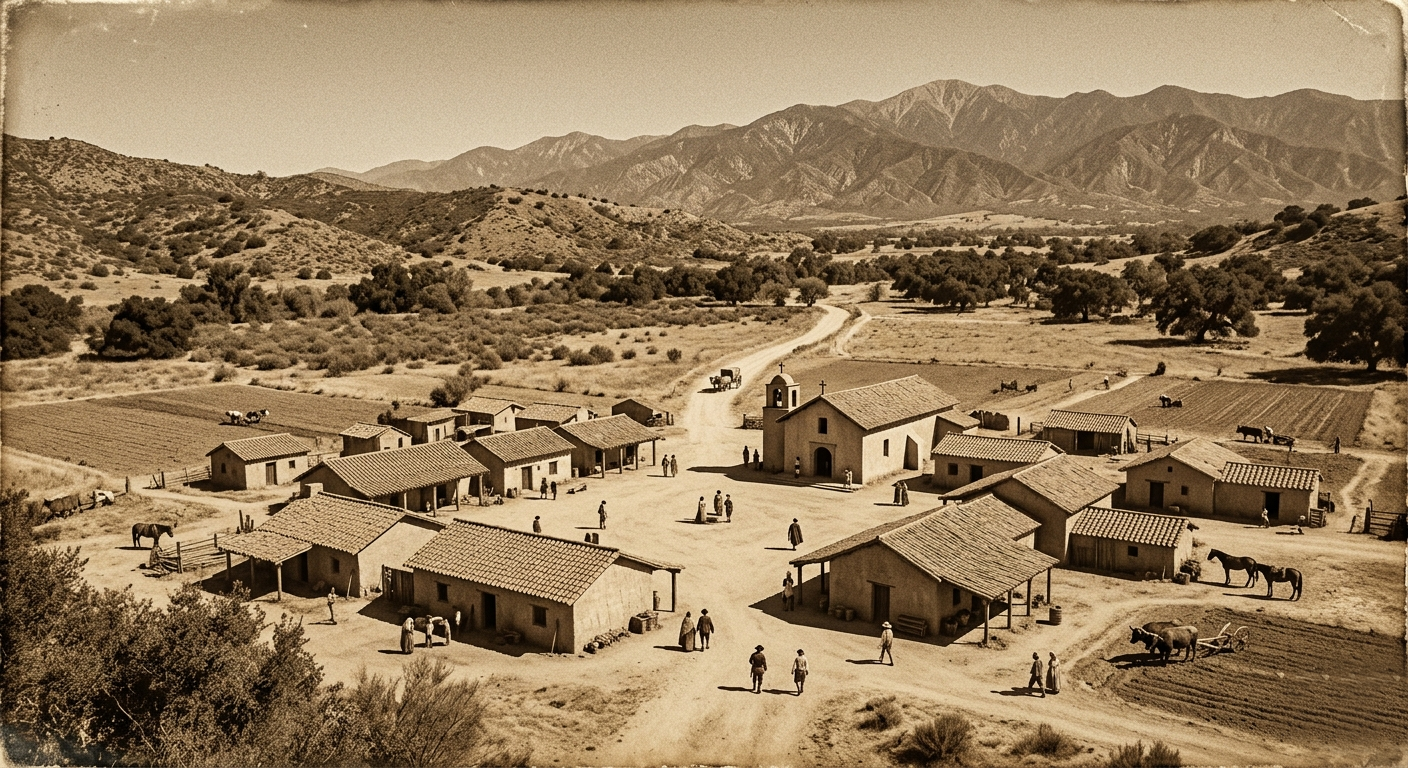
How Spanish Settlers Founded Los Angeles, California on September 4, 1781
On September 4, 1781, a small procession of men, women, and children made its way along a dusty trail from the Mission San Gabriel Arcangel to a fertile riverside plain nine miles to the west. They numbered just forty-four people in eleven families, accompanied by four Spanish soldiers and two Franciscan priests, and they carried with them the ambitions of an empire. At the banks of a river that a Spanish friar had named the Rio de Nuestra Senora la Reina de los Angeles de la Porciuncula, the River of Our Lady the Queen of the Angels of the Porciuncula, they set down their belongings and began laying the foundations of a new pueblo. The settlement they established that morning bore the name El Pueblo de Nuestra Senora la Reina de los Angeles de Porciuncula, translated as The Town of Our Lady the Queen of the Angels of the Porciuncula, a name of such grandeur that the settlement itself could scarcely have seemed an appropriate match for it. It was a cluster of mud-walled huts beside a river in the wilderness.
Two hundred and forty years later, that mud-walled cluster is Los Angeles, California, the second-largest city in the United States, home to nearly four million people within its city limits and more than thirteen million in its metropolitan area, the entertainment capital of the world, one of the most economically significant urban centers on the planet. The distance between what was founded on September 4, 1781, and what exists today is almost impossible to comprehend. And yet there is a direct and traceable line from that riverside procession to the sprawling metropolis, from the forty-four pobladores to the millions of Angelenos who live in the city they built. Understanding how Los Angeles was founded requires understanding the entire context of Spanish colonial California, the people who came before the settlers, and the sweeping forces of imperial competition, religious mission, and human ambition that converged on the banks of one river in the late eighteenth century.
The First Angelenos: The Tongva People and the Los Angeles Basin Before European Contact
Long before any European set foot in the region now called Los Angeles, the land was home to one of the most sophisticated indigenous cultures in what would become California. The Tongva people, also known historically as the Gabrieleno after the Spanish mission later built on their lands, had inhabited the Los Angeles Basin and the four Southern Channel Islands for at least seven thousand years, with some estimates placing continuous Tongva occupation as far back as 6000 BC. Their traditional territory covered more than 1.5 million acres, stretching from the Santa Monica Mountains and Malibu coast in the northwest to the San Bernardino Mountains in the east, and from the Tehachapi Pass in the north to Laguna Beach in the south.
At the time of the first European contact in the sixteenth century, between five thousand and ten thousand Tongva people lived in as many as one hundred villages across the Los Angeles Basin. The Tongva organized themselves by village rather than by any overarching tribal identity, and each village was its own political and social unit with its own leadership, known as a tomyaar or chief. Their society was rich in ceremony, trade, and cultural production. The Tongva were celebrated throughout southern California for their exceptional craftsmanship in basket weaving and the construction of tomol, large ocean-going plank canoes that allowed them to trade across the waters to the Channel Islands and as far as present-day Ventura and San Diego. The Tongva trade network extended across a vast territory, linking them to the Chumash to the northwest, the Cahuilla to the east, the Luiseno to the south, and the Mohave to the northeast.
At the center of Tongva territory, near the confluence of two rivers in what is now downtown Los Angeles, sat a village called Yaanga, also written as Yangna or Yaangna, the largest Tongva settlement in the region. Yaanga was positioned precisely where the Los Angeles River and a smaller stream met, a location offering abundant fresh water, fertile alluvial soil, and ready access to the rich resources of both the coastal wetlands and the inland valleys. The Tongva of Yaanga and the surrounding villages hunted deer, elk, and bears in the hills and canyons, fished for steelhead trout and salmon in the rivers, harvested acorns, chia seeds, and other plant foods, and maintained the landscape through controlled burning that kept the grasslands productive and open. When the Spanish arrived, they did not find a wilderness. They found a carefully managed landscape shaped by thousands of years of intelligent human occupation.
European First Contact: Juan Rodriguez Cabrillo and the Bay of Smokes, 1542
The first Europeans to observe the Tongva homeland arrived not by land but by sea. On October 8, 1542, the Spanish explorer Juan Rodriguez Cabrillo, sailing north along the California coast on behalf of the Viceroy of New Spain, noted in his log that he had entered a large bay on the mainland. He named it the Baya de los Fumos, the Bay of Smokes, because of the many fires he observed burning along the shore. The smoke came from the cooking and signal fires of the Tongva villages clustered along the coast, as well as from the La Brea tar seeps that bubbled naturally from the ground and had been burning intermittently for tens of thousands of years. The bay Cabrillo observed is believed to be modern San Pedro Bay, near the present-day community of San Pedro in southern Los Angeles. Cabrillo made no landing in the area and died on his voyage north, but his observation established the first European record of what would become Los Angeles.
For more than two centuries after Cabrillo’s voyage, the Tongva people remained essentially undisturbed by European presence. Spain claimed California as part of its vast New World empire but made no serious effort to colonize or settle the region. The indigenous peoples of the Los Angeles Basin continued their lives in the patterns established over millennia, trading, fishing, farming, and maintaining their rich ceremonial traditions, with only occasional contact with distant Spanish settlements to the south in Baja California. That long period of relative isolation ended decisively in 1769, when Spain decided that the time had come to occupy Alta California in earnest.
Spain’s Strategic Vision for Alta California: King Carlos III, the Bourbon Reforms, and the Threat from Russia and Britain
The decision to colonize Alta California was not made in a vacuum of pure religious or administrative impulse. It was a strategic response to growing imperial competition in the Pacific and along the North American coast. By the middle of the eighteenth century, Spain found its Pacific coastline threatened from two directions. Russian fur traders and explorers had been pushing steadily southward down the Pacific coast from Alaska, establishing outposts and claiming territory that Spain considered its own. British naval explorers, most significantly the expeditions associated with Captain James Cook, were probing the Pacific with increasing boldness. King Carlos III of Spain, a reforming monarch of the Bourbon dynasty who governed Spain from 1759 to 1788, recognized that without a visible and populated Spanish presence in California, the claim to the territory was a legal fiction that any rival power could challenge.
Carlos III authorized the Sacred Expedition to Alta California in 1769, a joint military and religious enterprise designed to establish a chain of missions, presidios, and eventually civilian pueblos along the California coast. The missions would convert and settle the indigenous peoples. The presidios would provide military garrisons to defend the territory. The pueblos, or civilian towns, would in time produce the agricultural surplus necessary to feed the presidios and make California economically self-sufficient, so that Spain would not have to ship supplies all the way from Mexico along a supply chain of terrifying length and vulnerability. The founding of Los Angeles was the direct product of this strategic vision, conceived at the highest levels of the Spanish imperial government and executed over more than a decade of planning and preparation.
The Portola Expedition of 1769 and Father Juan Crespi’s Vision for a Pueblo
The Sacred Expedition of 1769 was commanded by Captain Gaspar de Portola, the Governor of the Californias, and included the Franciscan priest Father Junipero Serra, who would go on to found the California mission chain. The land component of the expedition departed from San Diego on July 14, 1769, heading north along the coast toward Monterey. Among the party was Father Juan Crespi, a Franciscan friar who served as the expedition’s diarist and who kept meticulous notes on everything the group observed. The expedition included sixty-four people in total, among them soldiers, engineers, Franciscan priests, and indigenous Christians from Baja California missions.
On August 2, 1769, the Portola expedition reached the Los Angeles Basin and camped near the Tongva village of Yaanga, at the confluence of the rivers in what is now Elysian Park in central Los Angeles. Father Crespi was immediately struck by the fertility and beauty of the location. In his journal, he described a spacious valley well grown with cottonwoods and other trees, with much land suitable for planting. He noted the great river, which he named the Rio de Nuestra Senora la Reina de los Angeles de la Porciuncula, the River of Our Lady the Queen of the Angels of the Porciuncula, in honor of a chapel in Assisi, Italy, where Saint Francis of Assisi had experienced a vision and which was associated with the Feast of the Porciuncula, celebrated on August 2. The choice of name was significant: the date of the expedition’s arrival, August 2, happened to coincide exactly with the feast day of the Porciuncula chapel.
Father Crespi formally noted the site’s potential for a mission settlement, writing that the valley had all the requirements for a large settlement. He was not the only one who recognized its promise. The soldiers and other members of the expedition also noted the abundance of water, the fertility of the soil, the plentiful wildlife, and the large and apparently friendly indigenous population. The expedition continued north, but the site Crespi had identified on August 2, 1769 would not be forgotten. Over the following decade, it would be visited, surveyed, and planned for until it became the location of the pueblo that is now Los Angeles.
Mission San Gabriel Arcangel: The Spiritual Anchor of Early Los Angeles
Before a civilian pueblo could be established in the Los Angeles area, the Spanish colonial system required a mission presence to evangelize the local indigenous population and to provide the institutional infrastructure of labor, food production, and religious authority that the pueblo would depend on. Father Junipero Serra, responding to Father Crespi’s notes from the Portola expedition, commissioned two Franciscan missionaries to establish the Mission San Gabriel Arcangel in September 1771. The mission was first built near the Whittier Narrows section of the San Gabriel River, a location that proved susceptible to flooding. After a flood damaged the original site in 1776, the mission was moved and rebuilt at its present location in the town of San Gabriel, about nine miles from the eventual site of the Los Angeles pueblo.
The establishment of Mission San Gabriel on the edge of Tongva territory was a transformative and deeply disruptive event for the indigenous people of the region. The Spanish quickly conscripted Tongva people to provide the labor that built the mission and worked its fields and workshops. Those who were baptized into the Catholic faith became neophytes, subject to the authority of the Franciscan fathers and prohibited from leaving the mission. The Spanish began calling the baptized Tongva people Gabrielenos, after the mission, a name that would persist alongside the indigenous name Tongva into the twenty-first century. The mission became one of the most productive agricultural establishments in Alta California, growing wheat, barley, corn, and grapes, and raising cattle, sheep, and horses. It would provide the crucial logistical support base from which the founding party of Los Angeles would depart on September 4, 1781.
Governor Felipe de Neve: The Architect of Los Angeles
The man most directly responsible for the founding of Los Angeles was Don Felipe de Neve y Padilla, the fourth Governor of the Californias, who served from 1775 to 1782. De Neve was born in 1724 in Bailen, a town in the Andalusian region of southern Spain, and had spent his career as a military officer serving in various parts of Europe and then in New Spain. He arrived in California in 1774 as acting governor and was confirmed in the position in 1777. He was, by all historical accounts, an unusually capable and thoughtful colonial administrator, combining strategic ambition with practical organizational skill and a genuine concern for the welfare of the indigenous people under Spanish authority that was rare among colonial officials of his era.
De Neve was deeply influenced by the Enlightenment philosophy that permeated the Bourbon reforms of Carlos III, and he approached the governance of California as an exercise in rational planning and systematic development. He recognized immediately that the fundamental weakness of the California colony was its complete dependence on supply ships from San Blas in Mexico, which brought food, equipment, and soldiers along a sea route of terrifying unreliability. Storms, delays, and shortages meant that the California presidios were frequently hungry and undersupplied. The solution, as de Neve conceived it, was to establish self-sufficient civilian agricultural settlements, or pueblos, that could produce the food necessary to sustain the military garrisons and reduce California’s dependence on external supply. In 1777, he founded San Jose de Guadalupe, California’s first civilian pueblo, on the Santa Clara plain, and immediately began planning for additional settlements at Los Angeles and Santa Barbara.
De Neve personally drew the plans for the Los Angeles pueblo, making him what historians have described as one of the first urban planners in the region. His planning document, the Reglamento para el gobierno de la Provincia de Californias, or Regulations for the Government of the Province of the Californias, was issued in 1781 and represented the first formal governance framework for secular pueblos in Alta California. The Reglamento specified in precise detail how the pueblo was to be laid out, governed, and developed, drawing on the Spanish Laws of the Indies promulgated by King Philip II in 1573, which had established universal standards for Spanish colonial town planning. De Neve’s plans called for an open central plaza surrounded by a church, administrative buildings, and a grid of streets set at forty-five degrees from the cardinal directions, a layout that is still visible in the street pattern of downtown Los Angeles today.
Under the Reglamento, the new pueblo was granted a territory of four square leagues, measured one league in each direction from the town center. The town limits were marked at what are now Hoover Street in the west, Indiana Street in the east, Fountain Avenue in the north, and Exposition Boulevard in the south. Each settler family received individual house lots for residential use, along with suertes, planting fields of approximately seven acres each, with two irrigated plots and two dry ones. Common lands for grazing cattle, horses, and mules surrounded the individual plots. The pueblo was designed not as a trading post or a mission but as a functioning agricultural community intended to produce corn, wheat, beans, and livestock for sale to the nearby presidios, eventually making California agriculturally self-sufficient.
The Strategic Context: Viceroy Bucareli, Commandant de la Croix, and the Imperial Authorization
De Neve’s plans for the Los Angeles pueblo could not proceed without authorization from the highest levels of the Spanish colonial administration. In December 1777, Viceroy Antonio Maria de Bucareli y Ursua and Commandant General Teodoro de Croix jointly approved the founding of a civilian municipality at Los Angeles and a new presidio at Santa Barbara. This authorization set in motion the process of recruiting settlers, planning the journey, and making the physical preparations for the new settlement. The actual recruitment of settlers was assigned to Fernando Rivera y Moncada, the Lieutenant Governor of California, who was charged with traveling through the provinces of Sinaloa and Sonora in northwestern Mexico to find willing families.
Rivera y Moncada’s recruiting mission was by all accounts extremely difficult. Despite the considerable incentives offered by the Spanish government, including free land, livestock, tools, a house, and an annual cash stipend for five years, finding families willing to make the long and dangerous journey to the remote northern frontier of Alta California proved nearly impossible. Rumors circulated, with some basis in truth, that soldiers serving in California were not being paid regularly. The journey itself was known to be arduous and dangerous, crossing hundreds of miles of desert through terrain inhabited by hostile indigenous groups. The destination, deep in the California wilderness, was regarded with a mixture of curiosity and dread. After months of exhausting recruitment in Sonora and Sinaloa, Rivera y Moncada was able to assemble only twelve settler families rather than the sixteen that de Neve had planned for, along with the soldiers needed to escort them north.
The Journey from Sonora: The Expedition of 1781 and the Road to Los Angeles
The founding expedition of Los Angeles is sometimes called the Expedition of 1781, and it represents one of the longest and most arduous journeys in the early history of the American West. The settlers and soldiers who would eventually found Los Angeles departed from their starting point in Sonora, Mexico, on February 2, 1781, beginning a northward trek of approximately one thousand miles across some of the most challenging terrain on the continent. They crossed the Sonoran Desert, forded rivers, climbed mountains, and traveled through territories that offered every kind of natural danger, from drought to flooding to hostile indigenous groups. The journey would take them through the entire summer of 1781 before the last of the founding families arrived at their destination.
Tragedy struck the expedition before it had fully left Mexico. The settlers were forced to cross the territories of the Quechan people, also known as the Yuma, who controlled the crucial crossing of the Colorado River at the confluence of the Gila River. In July 1781, the Quechan rose in what became known as the Yuma Massacre, killing ninety-five settlers and soldiers, including Rivera y Moncada himself, the expedition’s organizer and leader. The violence effectively closed the overland route from Sonora to California for several years, leaving the party that had already crossed the Colorado as the founding group of the Los Angeles pueblo. The thirty-five soldiers and thirty families who had already arrived safely at the Mission San Gabriel by July 14, 1781, were the ones who would ultimately make the new settlement.
The settlers spent several weeks at the Mission San Gabriel recovering from their journey and making final preparations for the establishment of the pueblo. One group had arrived at the mission as early as July 14, 1781. A second group, commanded by Jose Zuniga, arrived on July 18, though some members had to be quarantined a short distance from the mission because of smallpox. Over the following weeks, the various settler families assembled at San Gabriel and received their land assignments and farming tools. Some families were probably already working on their assigned plots at the future pueblo site during the summer months, making the official founding date of September 4 more a moment of ceremonial formalization than the literal first day of settlement.
September 4, 1781: The Official Founding of El Pueblo de Los Angeles
According to the historical tradition that has been honored in Los Angeles for more than two centuries, on September 4, 1781, the forty-four founding settlers gathered at the Mission San Gabriel, assembled into a formal procession, and set out under escort for the site nine miles to the west that Father Juan Crespi had identified a dozen years earlier. The procession included the eleven settler families, their forty-four members ranging in age from one-year-old Cosme Damien Vanegas to sixty-seven-year-old Maria Regina Navarro, four Spanish soldiers who served as military escort, and two Franciscan priests from Mission San Gabriel. They walked the nine miles to the banks of the Los Angeles River, arriving at the site of the Tongva village of Yaanga.
Governor Felipe de Neve was present for the founding ceremony. The new pueblo was formally proclaimed under his authority, and he gave it the name El Pueblo de la Reina de los Angeles, The Town of the Queen of the Angels, the name recorded on a contemporary map dated 1785. There is some scholarly debate about the precise form of the name originally given at the founding: historian Doyce B. Nunis argued for El Pueblo de la Reina de los Angeles as the original name, while diocesan archivist Frank Weber maintained that the founders’ intended name was El Pueblo de Nuestra Senora de los Angeles de Porciuncula. The full ceremonial name typically given today is El Pueblo de Nuestra Senora la Reina de los Angeles del Rio de Porciuncula, The Town of Our Lady the Queen of the Angels on the Porciuncula River. Whatever the precise form chosen at the founding ceremony, the settlement was established, and the work of building a city had begun.
The Forty-Four Pobladores: Who Were the Founders of Los Angeles?
The forty-four founding settlers of Los Angeles, known as the pobladores, represent one of the most remarkable founding communities in the history of any major American city. They were not a group of English Protestant farmers from the British Isles, nor a company of wealthy Spanish hidalgos from Castile or Andalusia. They were a multiracial, multilingual community of working people from the northwestern Mexican provinces of Sonora and Sinaloa, shaped by generations of cultural mixing between Spanish colonizers, indigenous Mexicans, and Africans who had been brought to New Spain as enslaved laborers. Their racial and ethnic composition, which was largely suppressed or ignored by later Anglo-American historians but has been fully documented by scholars since the 1970s, is one of the most important facts about the founding of Los Angeles.
Of the forty-four original pobladores, only two were classified as Espanol, or ethnically Spanish, in the official 1781 Spanish census. The overwhelming majority of the founders carried mixed heritage. Twenty-six of the forty-four had some degree of African ancestry, classified variously in the census as Mulato, meaning mixed African and European heritage, or Negro, meaning primarily African ancestry. Sixteen were classified as Indio or Mestizo, meaning indigenous or mixed indigenous and Spanish heritage. The historian William M. Mason, writing in 1975, summarized the census data concisely: of the forty-four original colonists who founded Los Angeles, only two were white, twenty-six had some degree of African ancestry, and sixteen were Indians or mestizos of mixed Spanish and Indian blood.
The specific names of the founding families have been preserved in the official Spanish census of 1781 and are commemorated today on the Los Pobladores plaque at the Los Angeles Plaza Historic Monument in downtown Los Angeles. Among the founding men were Manuel Camero, classified as Mulato and aged thirty; Antonio Mesa, classified as Negro and aged thirty-eight; Jose Moreno, classified as Mulato and aged twenty-two; Luis Quintero, classified as Negro and aged fifty-five; Jose Fernando de Lara, classified as Espanol and aged fifty; Antonio Villavicencio, classified as Espanol and aged thirty; Pablo Rodriguez, classified as Indio and aged twenty-five; Jose Vanegas, classified as Indio and aged twenty-eight; Basilio Rosas, classified as Indio and aged sixty-seven, the oldest of the founding settlers; Alexandre Rosas, classified as Indio and aged nineteen; and Jose Antonio Navarro, classified as Mestizo and aged forty-two. Each man was accompanied by his wife and children, bringing the total to forty-four men, women, and children.
The four Spanish soldiers who escorted the settlers from Mission San Gabriel to the new pueblo, and who served as the initial military garrison of the settlement, are also recorded in the historical annals. They were Corporal Jose Vicente Feliz, whose name lives on in the Los Feliz neighborhood of present-day Los Angeles; Private Roque Jacinto Cota; Private Antonio Cota, brother of Roque; and Private Francisco Salvador Lugo. Corporal Feliz later became the first comisionado, or commissioner, of the pueblo, the civilian supervisor appointed by the commander of the Presidio of Santa Barbara to oversee the alcalde and council members. He thus served as both the military escort and the first government official of the new settlement.
The Racial Diversity of the Founding Community and Its Historical Significance
The multiracial composition of the Los Angeles founding community was for many decades suppressed or minimized in popular historical accounts. The Anglo-American historians who dominated California historiography in the nineteenth and early twentieth centuries were generally uncomfortable with the reality that the city’s founders were overwhelmingly of African and indigenous descent, and the multiracial origins of Los Angeles were dismissed as rumors or treated as embarrassing anomalies rather than celebrated facts. This suppression began to be corrected in the 1970s when historian Don Hata and others located explicit census documents in the Archive of the Indies in Seville, Spain, that definitively confirmed the racial composition of the founding families. The Seville documents ended all serious historical debate about the matter.
The multiracial origins of Los Angeles reflect the broader demographic reality of northwestern New Spain in the eighteenth century. The provinces of Sonora and Sinaloa, from which the founding settlers were recruited, had for generations been populated by communities shaped by the intermixture of Spanish colonists, indigenous Mexicans of dozens of different nations, and Africans who had been brought to New Spain as enslaved workers in the sixteenth and seventeenth centuries. By the late eighteenth century, the descendants of these groups had formed a genuinely mixed population in which clear ethnic or racial boundaries had largely dissolved in the practical realities of daily life, intermarriage, and shared culture. The settlers recruited by Rivera y Moncada were simply representative of this population.
The historian Dr. Antonio Rios-Bustamante has written that the original settlers of Los Angeles were racially mixed persons of Indian, Spanish, and African descent, and that this mixed racial composition was typical of both the settlers of Alta California and of the majority of the population of the northwest coast provinces of Mexico from which they were recruited. The founding families of Los Angeles did not consider themselves to be of different races in any sense that would have been meaningful to Anglo-Americans a century later. They were Sonorans and Sinaloans, Catholics, farmers, and soldiers, and they shared a culture and language regardless of the racial categories that Spanish colonial bureaucrats assigned them in census documents. Their descendants, the Californios, would develop their own distinctive culture and identity over the following decades, shaped by the unique conditions of life on the California frontier.
Building the Pueblo: Infrastructure, Governance, and Daily Life in Early Los Angeles
The founding settlers arrived at the site of the new pueblo to find a landscape of extraordinary natural abundance. The Los Angeles River flowed year-round at a time before the groundwater table had been depleted by urban development and agriculture. The river’s floodplain was heavily wooded with willows and cottonwood trees, oaks, and other native vegetation. Wildlife was plentiful: deer, elk, bears, and even occasional grizzly bears inhabited the surrounding hills and valleys. The wetlands and marshes of the coastal plain teemed with birds and fish. Steelhead trout and salmon ran in the river. The alluvial soils of the river plain were among the richest in all of California, deposited by centuries of flooding. The settlers had come from a dry and often difficult environment in Sonora and Sinaloa, and they found the Los Angeles Basin to be, by comparison, a land of remarkable richness.
Within days of their arrival, the settlers began the practical work of establishing the pueblo. Their most urgent need was water for the fields and households, and they addressed it with engineering skill. The first settlers dammed the Los Angeles River and built an irrigation canal, or zanja, that carried water from a point upstream through the center of the settlement and out to the farming plots. This zanja madre, or mother ditch, became the backbone of the pueblo’s agricultural water system and continued to function as the city’s primary water supply for decades. Each family received its assigned planting fields and residential lots, and the work of building homes, planting crops, and establishing the infrastructure of the settlement proceeded simultaneously.
The first buildings in the pueblo were modest in the extreme. A census taken in November 1781, just two months after the official founding, described the new settlement as a village of earthen-roofed huts made of willow branches laced with tule, the flat rushes that grew in the nearby wetlands. The doors were made of rawhide; the windows had no glass. The narrow streets between the huts became pools of mud in winter and clouds of dust in summer. These were not the dwellings of comfortable colonists but the shelters of hardworking frontier farmers building a settlement from scratch in an unfamiliar land. The crops they planted in those first fields included corn, beans, and wheat, the staple grains that would form the basis of the pueblo’s agricultural output and its commercial value to the nearby presidios.
The governance of the new pueblo was established in conformity with the Laws of the Indies and de Neve’s Reglamento. The first municipal officers, the regidores or council members and the alcalde or municipal magistrate, were appointed directly by Governor de Neve. Subsequent officers were elected annually by the settler families, the vecinos pobladores. Because the California colonial government had a strong military orientation in this early period, the civilian council was supervised by a comisionado, a commissioner appointed by the military commandant of the Presidio of Santa Barbara. The first comisionado was Corporal Jose Vicente Feliz, one of the four soldiers who had escorted the founding party from Mission San Gabriel. The first recorded alcalde, or mayor, was Jose Vanegas, who served in the office in 1786 and again in 1796.
The Relationship Between the Pueblo and the Tongva: Labor, Trade, and Displacement
The new pueblo could not have survived its early years without the labor of the Tongva people who inhabited the surrounding land. The pueblo was, from its very beginning, almost entirely dependent on indigenous labor. Tongva workers were employed to haul fresh drinking water from a special pool upstream from the zanja intake. They worked on the construction of the pueblo’s buildings, the maintenance of its irrigation systems, and the tending of its fields. The settlers, numbering just forty-four people in eleven families, were simply too few and too unfamiliar with the specific conditions of the California landscape to maintain the settlement alone. The relationship between the pueblo and the surrounding Tongva villages was complex, involving elements of trade, coercion, and mutual dependency.
The pobladores traded regularly with the Tongva of the surrounding rancherias, bartering for prized sea-otter and seal pelts, as well as for the finely woven baskets, mats, and other goods that Tongva craftspeople produced. This commerce, according to historical accounts, greatly contributed to the economic success of the young pueblo and attracted additional indigenous laborers to the settlement. Governor de Neve had planned a formal role for the Tongva in the new pueblo’s social structure, envisioning that newly baptized indigenous people would become full members of the civic community. These plans met immediate and strong resistance from the Franciscan missionaries at Mission San Gabriel, who viewed the pueblo’s claim on indigenous labor as a threat to the mission system’s own labor supply.
The Tongva village of Yaanga, which had occupied the site near the pueblo since time immemorial, was gradually displaced as the pueblo grew and claimed more land. The village was moved and relocated multiple times as the settlement expanded around it, losing successive plots of land to the growing agricultural fields and residential areas of the Spanish settlement. Yaanga was finally abandoned in 1836 after more than fifty years of displacement and contraction, by which time the Tongva people who had once inhabited the Los Angeles Basin in the thousands had been reduced by disease, dispossession, and forced labor to a fraction of their former population. A large sacred sycamore tree, El Aliso, that had stood near the village as a central gathering and ceremonial site for the Tongva, was cut down for firewood in 1891.
The Early Growth of the Pueblo: From 44 Settlers to a Self-Sufficient Community
The growth of El Pueblo de los Angeles in its first decades was slow but steady. By 1785, Governor de Neve’s plan to make California agriculturally self-sufficient had succeeded: California no longer needed to import its grain from Mexico, a transformation largely attributable to the productive output of the Los Angeles and San Jose pueblos. The pueblo’s initial agricultural success attracted additional settlers, and new families arrived from the mission system, from the presidios, and from Mexico as news of the pueblo’s fertility spread. By 1790, the population of the pueblo had grown from the original forty-four to approximately 315 people living in thirty adobe dwellings. By 1800, there were twenty-nine buildings surrounding the Plaza, flat-roofed, one-story adobe structures with thatched roofs of tule.
In 1784, just three years after the founding, a simple adobe chapel was built on the original Plaza, providing the pueblo with its first permanent place of Catholic worship. The original Plaza was located a block north and west of the present-day Plaza, its southeast corner roughly at the former intersection of what would later become Main Street and Marchessault Street. The chapel was expanded over the following decades and eventually replaced by a more substantial church building. The pueblo’s civic infrastructure was equally modest in these early years, including a town hall, guardhouse, army barracks, and grain storehouses surrounding the central plaza. The rancho period of Los Angeles history began in 1784, when some retired soldiers received the governor’s permission to graze their livestock on lands outside the pueblo’s common lands, beginning the pattern of large-scale cattle ranching on the surrounding hills and valleys that would define the economy of the region for the following half-century.
The first alcalde, Jose Vanegas, who served in 1786, represented in his person the complex social dynamics of the early pueblo. Vanegas had been classified as Indio, indigenous, in the 1781 census, but by the 1790 census he was reclassified as Mestizo, a change that reflected the fluid racial categories of Spanish colonial California and the upward social mobility that some members of the founding community achieved through civic service and landholding. The descendants of the original forty-four founders gradually assimilated into the growing Californio community, intermarrying with arriving soldiers, traders, and settlers from throughout New Spain and forming the backbone of the landed gentry that would eventually own the great ranchos of the Los Angeles Basin.
The Toypurina Rebellion and Indigenous Resistance to Spanish Colonial Power
The growth of the Spanish pueblo and the expansion of the mission system was not accepted passively by the indigenous peoples of the region. In October 1785, just four years after the founding of Los Angeles, a young Tongva medicine woman named Toypurina organized the most significant act of indigenous resistance in the early history of the Los Angeles area. Toypurina was approximately twenty-five years old, from the village of Jachivit in the San Gabriel Valley, and was known and respected throughout the region as a healer and spiritual leader. She had observed with anger the way in which the Mission San Gabriel had expropriated Tongva land, conscripted Tongva labor, and suppressed the traditional ceremonies, particularly the annual Mourning Ceremony in which the Tongva honored their dead.
When a mission convert named Nicolas Jose approached Toypurina seeking allies for a rebellion against Mission San Gabriel, she agreed, bringing eight Tongva villages into the conspiracy. The plan called for warriors from the allied villages to attack the mission on the night of October 25, 1785. Spanish soldiers were alerted to the plan in advance, however, possibly through an informant, and were waiting when the rebels arrived. At least twenty-one Tongva were captured, including Toypurina herself. Governor Pedro Fages came to San Gabriel to conduct the trial, and twelve of the captured rebels were punished with fifteen lashes each before being released. Five others received twenty-five lashes. Toypurina herself was tried and sentenced to exile in the northern missions. Before her sentence was pronounced, she reportedly told the Spanish court that she hated the Franciscans and all those who came to despoil her land. Toypurina’s rebellion failed militarily, but her defiance has made her one of the most celebrated figures in the history of indigenous resistance in California.
From Spanish Pueblo to Mexican City: Los Angeles After 1821
For forty years after its founding, El Pueblo de los Angeles existed as a modest but growing agricultural settlement on the northern frontier of the Spanish Empire. It sent corn, wheat, livestock, and hides to the nearby presidios and traded with the mission system. Its population grew slowly, reaching approximately 650 people by 1820. The political struggles between Mexico and Spain during the early nineteenth century had relatively little direct effect on the daily life of the pueblo, although they reduced the supply of trade goods and created periodic uncertainty about governance and authority.
In 1821, Mexico won its independence from Spain after a decade of revolutionary struggle, and California, including the Pueblo de los Angeles, became part of the newly independent Mexican nation. The transition from Spanish to Mexican authority was accepted in Los Angeles without significant protest or upheaval. The Catholic Church maintained its authority, the ranchos continued their operations, and the fundamental social structure of the Californio community remained intact. What changed was the economic and political context: the new Mexican government opened California to foreign trade, ending the restrictive Spanish commercial policies that had prohibited commerce with non-Spanish ships, and the rancheros were quick to find new markets for their hides and tallow among the American and British trading vessels that now visited the California coast legally.
In 1835, the Mexican Congress formally elevated Los Angeles to the status of a city, ciudad, giving it a more complete form of self-governance through an ayuntamiento, or city council. The city was briefly declared the capital of California in 1835, though this provision was not consistently enforced and was eventually withdrawn. Between 1845 and 1847, Los Angeles served as the actual capital of California under the governorship of Pio Pico. By 1836, the population of Los Angeles had grown to approximately 1,675 gente de razon, plus 555 indigenous residents, a total of over 2,000 people. The rancho period reached its height in the 1840s, with approximately thirty-five large cattle ranches covering the hills and valleys surrounding the city, worked by Tongva and other indigenous vaqueros. Los Angeles was the commercial center of a flourishing hide-and-tallow trade, its hides exported to the shoe factories of New England and its tallow to the candle manufacturers of South America.
The American Conquest and the Transformation of Los Angeles, 1846 to 1850
The Mexican-American War, which began in May 1846, brought the political existence of Mexican California to an abrupt end. On August 13, 1846, Commodore Robert F. Stockton of the United States Navy, accompanied by the army officer and explorer John C. Fremont, seized Los Angeles. Governor Pio Pico had already fled to Mexico. American military occupation was initially resisted: within weeks of Stockton’s departure, a force of three hundred local residents drove the small American garrison from the city in an uprising that ended the first phase of the Battle of Los Angeles. Stockton regrouped in San Diego and marched north with six hundred troops while Fremont marched south from Monterey with four hundred, and the combined forces retook Los Angeles after further skirmishes.
The Treaty of Guadalupe Hidalgo, signed on February 2, 1848, formally ended the Mexican-American War and transferred California, along with a vast territory of the American Southwest, to the United States. All residents of the former Mexican territory were theoretically guaranteed the protection of their property rights, civic rights, and religious practices under the treaty. In practice, the transition to American governance proved deeply disruptive for the Californio community, many of whom lost their ranchos and their political influence over the following decades through legal disputes, drought, debt, and the overwhelming demographic transformation wrought by the Gold Rush.
Los Angeles was incorporated as an American municipality on April 4, 1850, five months before California was admitted to the Union as the thirty-first state on September 9, 1850. The new city had a population of approximately 1,600 people, making it for a brief period the largest settled community in California. It was a rough frontier town in those early American years, with a well-deserved reputation for violence, lawlessness, and the rough justice of a community in transition between two legal systems and two cultures. The Plaza, which had been the heart of the Spanish and Mexican city, became the center of a growing Latino barrio as Anglo-American newcomers pushed the old Californio community toward the margins of the city they had founded.
The Railroad Era and the Explosion of Growth: Los Angeles Becomes a City
For the first three decades of American statehood, Los Angeles grew slowly and remained a relatively small regional center. The population in the 1850s was fewer than two thousand people, and the city lacked many of the basic amenities of American urban life, including schools, newspapers, a reliable water supply, and connections to the national transportation network. The arrival of the railroad transformed all of this with stunning speed. In 1876, the Southern Pacific Railroad completed a line connecting Los Angeles to San Francisco and, through San Francisco, to the transcontinental railroad network. The connection was modest in its initial impact, but it established the infrastructure that made the transformative growth of the following decade possible.
The decisive transformation came in 1885, when the Atchison, Topeka and Santa Fe Railway completed a second line connecting Los Angeles directly to the eastern United States, creating competition with the Southern Pacific that drove ticket prices down to historic lows. In 1886, the rate war between the Santa Fe and Southern Pacific reduced the fare from Kansas City to Los Angeles to one dollar, a price so low that it triggered a massive migration from the Midwest. Tourists poured into Los Angeles by the thousands every week, and many who came to visit decided to stay and resettle. Real estate promoters, including Harrison Gray Otis, the founder of the Los Angeles Times, aggressively marketed Southern California as a paradise of climate, agriculture, and opportunity, and the population of Los Angeles exploded from approximately eleven thousand in 1880 to over fifty thousand by 1890, a growth of more than four hundred percent in a single decade.
The subsequent decades brought further transformations that consolidated Los Angeles as a major American city. The discovery of oil in the 1890s, with production centered initially in the hills around the city and later at Signal Hill and other sites, brought industrial wealth and further population growth. The completion of the Los Angeles Aqueduct in 1913, engineered by William Mulholland and financed by the city, brought water from the distant Owens Valley in eastern California and removed the most fundamental constraint on the city’s growth. The film industry, which relocated from New York to Hollywood in the early twentieth century in part to escape the patents of Thomas Edison and in part to take advantage of the Southern California climate and varied landscapes, made Los Angeles world-famous and attracted a continuous stream of dreamers, artists, and entrepreneurs from across the nation and around the world.
The Legacy of the Founding: El Pueblo de Los Angeles Historic Monument and the Memory of September 4, 1781
The original site of the founding of Los Angeles has been preserved as El Pueblo de Los Angeles Historic Monument, a state historic park in the heart of downtown Los Angeles. The monument encompasses the original plaza area, Olvera Street, and several of the oldest surviving buildings in the city. A bronze statue of Felipe de Neve, created by sculptor Henry Lion and dedicated in 1932, stands in the Plaza Park of the monument, mounted on a four-foot boulder with a bronze plaque commemorating his role in founding the city. The plaque reads, in part: Felipe de Neve, 1728 to 1784, Spanish governor of the Californias. In 1781, on the orders of King Carlos III of Spain, Felipe de Neve selected a site near the river Porciuncula and laid out the town of El Pueblo de la Reina de Los Angeles.
The founding families are honored by the Los Pobladores plaque, which was originally placed at the Plaza in 1981 for the city’s bicentennial celebrations and updated in 1990. The plaque lists all forty-four founding settlers by name, race, sex, and age as recorded in the official Spanish census of 1781, formally acknowledging for the first time in official city commemoration the multiracial nature of the founding community. The initiative to create this comprehensive plaque was proposed by Miriam Matthews, a member of the Los Angeles 200 Committee, who chaired a special history task force for the bicentennial celebration. The 1981 bicentennial was the occasion when Los Angeles formally and officially embraced its diverse founding heritage after more than a century of partial historical amnesia.
Since 2011, the Queen of Angels Foundation, with the support of the Archdiocese of Los Angeles and various civic leaders, has revived the tradition of an annual procession and Mass in honor of Nuestra Senora de los Angeles to commemorate the founding of the city. Each year, on or near September 4, descendants of the original pobladores and others who honor the founding walk from the Mission San Gabriel to downtown Los Angeles, tracing the same nine-mile route that the forty-four founders walked on the morning of September 4, 1781. This procession is a continuation of a practice that began on the first anniversary of the founding in 1782 and continued for nearly a century before lapsing and being revived in the twenty-first century.
The founding of Los Angeles on September 4, 1781, is a story of remarkable complexity and layered significance. It is the story of an imperial strategy articulated in the courts of Madrid and Mexico City and executed in the desert borderlands of Sonora. It is the story of a visionary administrator, Felipe de Neve, who planned with extraordinary care for a settlement that he could not have imagined would become one of the largest cities on earth. It is the story of forty-four working people of African, indigenous, and European descent who walked a thousand miles across a desert to build a new life on the edge of the known world. And it is, inescapably, the story of the Tongva people, who had built their civilization on this land for seven thousand years before the Spanish arrived, who were displaced and diminished by colonization, and whose names, words, and bloodlines nevertheless persist in the city that was built upon their homeland.
Key Dates, Stakeholders, and Facts: The Complete Historical Reference for the Founding of Los Angeles
The following provides a comprehensive chronological reference to every major event, person, and date in the founding history of Los Angeles. The Tongva people have inhabited the Los Angeles Basin since at least 6000 BC, over seven thousand years of continuous occupation. On October 8, 1542, Spanish explorer Juan Rodriguez Cabrillo observed the region from the sea and named the bay Baya de los Fumos, the Bay of Smokes, establishing the first European written record of the area. From 1542 to 1769, approximately 227 years elapsed during which the Tongva continued their civilization without significant European contact or interference.
In 1769, King Carlos III of Spain authorized the Sacred Expedition to Alta California to counter Russian and British encroachment from the Pacific coast. Captain Gaspar de Portola led the land expedition that departed San Diego on July 14, 1769, including Franciscan Father Juan Crespi as diarist and Engineer Miguel Costanso. On August 2, 1769, the Portola expedition reached the Los Angeles Basin, camped near the Tongva village of Yaanga, and Father Crespi named the river the Rio de Nuestra Senora la Reina de los Angeles de la Porciuncula, laying the conceptual foundation for the name Los Angeles. In September 1771, Father Junipero Serra commissioned the establishment of Mission San Gabriel Arcangel, approximately nine miles from the future pueblo site.
In 1774, Felipe de Neve y Padilla, born in Bailen, Spain in 1724, was named acting Governor of the Californias. In December 1777, Viceroy Antonio Maria de Bucareli y Ursua and Commandant General Teodoro de Croix approved the founding of a pueblo at Los Angeles and a presidio at Santa Barbara. In 1777, de Neve founded San Jose de Guadalupe as California’s first civilian pueblo on November 29, establishing the template he would follow for Los Angeles. In December 1779, de Neve sent Fernando Rivera y Moncada into Sonora and Sinaloa to recruit settlers. The recruitment proved difficult: only twelve families could be found willing to make the journey, rather than the sixteen originally planned. On February 2, 1781, the settler party departed from their starting point in Sonora, beginning the thousand-mile journey north.
In July 1781, the Quechan Massacre killed ninety-five settlers and soldiers, including Rivera y Moncada, effectively closing the overland route. The party that had already crossed the Colorado River continued north. The first group arrived at Mission San Gabriel on July 14, 1781. The second group, led by Jose Zuniga, arrived July 18, 1781, with some members quarantined due to smallpox. By August 1781, eleven of the twelve settler families had arrived at San Gabriel. On September 4, 1781, the forty-four pobladores, accompanied by four soldiers and two priests, processed from Mission San Gabriel to the site on the Los Angeles River and officially founded El Pueblo de la Reina de los Angeles, later known as Los Angeles. Governor Felipe de Neve was present and proclaimed the founding.
The four founding soldiers were Corporal Jose Vicente Feliz, namesake of the Los Feliz neighborhood; Private Roque Jacinto Cota; Private Antonio Cota; and Private Francisco Salvador Lugo. Of the forty-four founding settlers, only two were classified as Espanol. Twenty-six had African ancestry. Sixteen were indigenous or mestizo. Luis Quintero, aged sixty-seven and classified as Negro, was the oldest male founder. Maria Regina Navarro, aged sixty-seven and classified as Mulata, was the oldest female founder. Jose Vanegas, classified as Indio and later as Mestizo, became the first recorded alcalde of the pueblo in 1786. In 1784, the first adobe chapel was built on the Plaza. In 1785, California became agriculturally self-sufficient, vindicating de Neve’s founding strategy. By 1790, the pueblo population had grown to 315. By 1800, there were 29 buildings around the Plaza. Felipe de Neve died on November 3, 1784, in Chihuahua, Mexico, before seeing the full fruit of his creation. He had been promoted to Commander General of the Internal Provinces in 1783. In 1821, California became part of independent Mexico. In 1835, the Mexican Congress elevated Los Angeles to the status of a city. In 1846, American forces under Commodore Stockton and Captain Fremont seized the city. The Treaty of Guadalupe Hidalgo on February 2, 1848 transferred California to the United States. Los Angeles was incorporated as an American municipality on April 4, 1850. California was admitted to statehood on September 9, 1850. The Southern Pacific Railroad reached Los Angeles in 1876. The Santa Fe Railroad opened its second line in 1885, triggering explosive population growth. The Los Angeles Aqueduct was completed in 1913 under engineer William Mulholland. Today, Los Angeles is the second-largest city in the United States with a population of approximately 3.88 million people in the city proper and over 12.9 million in the metropolitan area.