
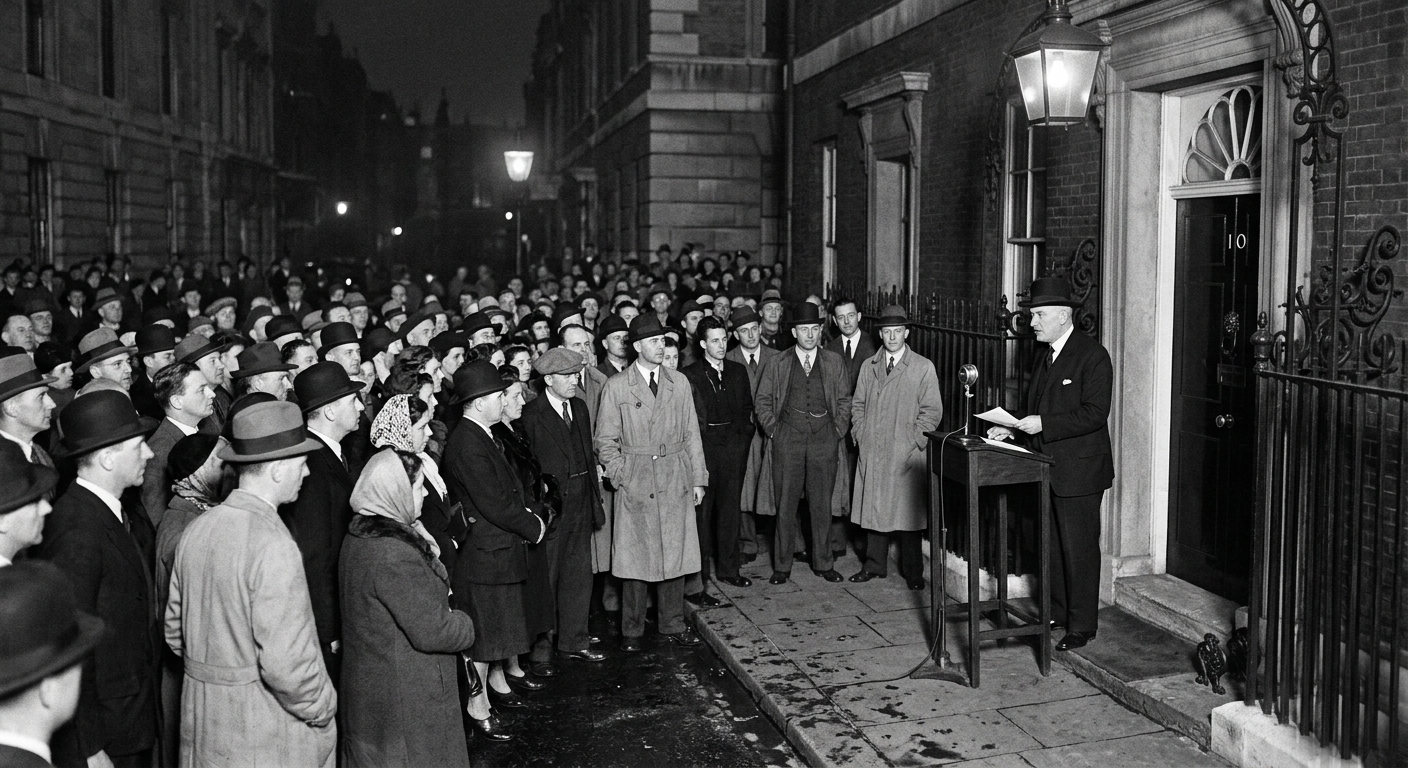
Britain Declares War on Germany
How Britain and France Declared War on Germany and Changed the Course of History
On the morning of Sunday, September 3, 1939, the world changed forever. At 11:15 a.m. British Summer Time, Prime Minister Neville Chamberlain stepped before a microphone in the Cabinet Room at 10 Downing Street and delivered what would become one of the most consequential radio addresses in modern history. He informed the British people, and the world, that Germany had ignored an ultimatum requiring the withdrawal of its troops from Poland, and that consequently, the United Kingdom was now at war with Germany. Hours later, at 5:00 p.m., French Prime Minister Edouard Daladier made a parallel announcement from Paris. The two great Western democracies had kept their promise to Poland, and the Second World War, the most catastrophic conflict in human history, had formally begun.
This moment did not arrive suddenly or without warning. It was the product of decades of unresolved grievances, a failed diplomatic order built on the ruins of the First World War, the rise of Adolf Hitler and the Nazi Party, and the steady unraveling of a peace that had never truly taken hold. Understanding why Britain and France declared war on Germany requires understanding the entire arc of European history from 1919 onward, the men who shaped it, the decisions they made, and the consequences that flowed from each of those choices.
The Seeds of War: Europe After the First World War and the Treaty of Versailles
The roots of the Second World War lie buried deep in the rubble of the First. When the Great War ended on November 11, 1918, with the signing of the Armistice, Germany was a nation in political and economic turmoil. The Kaiser, Wilhelm II, had abdicated on November 9, 1918, and a fragile new government led by the Social Democrats had taken power amid what became known as the German Revolution of 1918 to 1919. The country that went to the peace table in Paris in 1919 was not the confident empire that had gone to war in 1914. It was broken, humiliated, and resentful.
Negotiations for the postwar settlement began on January 18, 1919, in the Salle de l’Horloge at the French Foreign Ministry on the Quai d’Orsay in Paris. Seventy delegates from 27 nations participated, though the most critical decisions were made by what became known as the Big Four: British Prime Minister David Lloyd George, French President Georges Clemenceau, American President Woodrow Wilson, and Italian Prime Minister Vittorio Orlando. Germany and the other defeated powers were deliberately excluded from the negotiations.
The Treaty of Versailles, signed on June 28, 1919, imposed severe punitive terms on Germany. The country lost approximately 13 percent of its territory and 10 percent of its population. It was stripped of its colonies, forced to limit its army to 100,000 men, prohibited from maintaining an air force, and constrained in its naval capabilities. Most controversially, Article 231, the so-called War Guilt Clause, assigned sole responsibility for the war to Germany and its allies, providing the legal basis for demanding enormous financial reparations.
The economic consequences were devastating. Germany was required to borrow heavily from the United States to pay its war debt. By January 1922, one US dollar was worth 191 German Marks. By November 1923, that same dollar was worth over four trillion Marks, as Germany experienced one of history’s worst episodes of hyperinflation. Savings were wiped out overnight. The middle class was destroyed. Trust in the democratic Weimar Republic was shattered before it had even been properly established. This economic despair and national humiliation created the fertile ground in which extremist politics, and ultimately Adolf Hitler, would take root and grow.
The Rise of Adolf Hitler and the Nazi Party
Adolf Hitler was born in Braunau am Inn, Austria, on April 20, 1889. He served as a corporal in the German Army during the First World War and was twice awarded the Iron Cross for bravery. Like millions of Germans, he refused to accept that Germany had been defeated on the battlefield. Instead, he embraced and propagated the Dolchstosslegende, or stab-in-the-back myth, which held that Germany had been betrayed from within by Jews, communists, and socialists who had undermined the war effort. This deeply conspiratorial and antisemitic worldview formed the ideological core of his political vision, which he articulated in his autobiographical manifesto Mein Kampf, written while imprisoned after a failed coup attempt in 1923.
Hitler joined the fledgling German Workers’ Party in 1919 and quickly rose to dominate it, renaming it the National Socialist German Workers’ Party, or NSDAP, from which came the shorthand Nazi. After the failed Beer Hall Putsch of November 1923 in Munich, during which he attempted to seize control of the Bavarian government, Hitler was imprisoned, but his subsequent trial gave him a national platform. He used his time in Landsberg Prison to dictate Mein Kampf, in which he laid out with remarkable frankness his plans for Germany: the undoing of the Treaty of Versailles, the unification of all German-speaking peoples, the conquest of Lebensraum, or living space, in Eastern Europe, and the elimination of Jewish influence from German life.
The Great Depression that swept the world after the Wall Street Crash of October 1929 provided the political opening Hitler had been waiting for. Unemployment in Germany soared past six million by 1932. The Weimar Republic, already discredited, appeared incapable of managing the crisis. The Nazi Party, which had won a mere 2.6 percent of the vote in 1928, captured 37.4 percent in the July 1932 elections, making it the largest single party in the Reichstag. On January 30, 1933, German President Paul von Hindenburg appointed Adolf Hitler as Chancellor of Germany. Within months, Hitler had used emergency decrees, legislative manipulation, and political violence to transform the democratic republic into a one-party totalitarian state. The Weimar Republic was dead.
German Rearmament and the Dismantling of the Versailles Order
Once in power, Hitler moved swiftly to dismantle the restrictions imposed by the Treaty of Versailles. In March 1935, he publicly announced the reintroduction of military conscription and the existence of the Luftwaffe, Germany’s new air force, both explicitly forbidden by Versailles. A year later, on March 7, 1936, German troops marched into the Rhineland, the demilitarized zone on Germany’s western frontier with France and Belgium. This was a direct violation of both the Treaty of Versailles and the Locarno Treaties of 1925. France and Britain protested but took no military action, a decision that emboldened Hitler enormously. He later admitted that if France had intervened, Germany would have been forced to withdraw immediately, as the Wehrmacht was not yet strong enough to resist.
On March 12, 1938, German troops crossed into Austria in what became known as the Anschluss, the annexation of Austria into the German Reich. Despite the Treaty of Saint-Germain-en-Laye and the Treaty of Versailles both explicitly prohibiting such a union without League of Nations consent, the Western powers again acquiesced. Austria ceased to exist as an independent state and became a province of Germany. Hitler was greeted in Vienna by cheering crowds, and the event was presented to the world as the peaceful reunion of German-speaking peoples.
The next target was the Sudetenland, the ethnically German-speaking border regions of Czechoslovakia. Hitler demanded their cession to Germany, claiming Czech authorities were persecuting ethnic Germans. In September 1938, as Europe teetered on the brink of war, Chamberlain made three separate trips to Germany to negotiate with Hitler personally, a level of personal diplomacy unprecedented for a sitting British Prime Minister. The culmination was the Munich Conference of September 29 to 30, 1938.
The Munich Agreement: Appeasement and Its Limits
The Munich Conference brought together the leaders of Britain, France, Germany, and Italy. Prime Minister Neville Chamberlain, French Premier Edouard Daladier, Adolf Hitler, and Italian dictator Benito Mussolini gathered in Munich and agreed to hand the Sudetenland to Germany without the consent or even the presence of Czechoslovakia at the negotiations. The Czechoslovak government was presented with a fait accompli and forced to accept terms that destroyed its strategic defenses and left the rest of the country exposed.
Chamberlain returned to Britain triumphant, waving a piece of paper and declaring famously that he had achieved peace with honour and peace for our time. He was greeted as a hero at Heston Airport. The British public, still haunted by the memory of the 1914 to 1918 war in which over 700,000 British soldiers had died, welcomed any agreement that seemed to keep Europe from another catastrophe. The policy of appeasement, of making concessions to Hitler’s demands in the hope that satisfying his grievances would lead to stability, appeared to have succeeded.
But appeasement had its critics, and the most prominent and prescient of them was Winston Churchill. On October 5, 1938, Churchill addressed the House of Commons in one of his most famous speeches, condemning the Munich Agreement as a total and unmitigated defeat for Britain and Europe. He warned that Britain had been given the choice between war and dishonour, had chosen dishonour, and would still get war. The speech was met with hostile silence from Chamberlain’s supporters. Most of the country still hoped Churchill was wrong.
He was not. On March 10 to 16, 1939, German forces occupied the remainder of Czechoslovakia, including Prague, in direct violation of the Munich Agreement that had been signed barely five months earlier. The Czech lands were absorbed into what Hitler called the Protectorate of Bohemia and Moravia. Slovakia became a nominally independent puppet state. Czechoslovakia had ceased to exist. This was the moment that decisively ended the era of appeasement. Hitler had demonstrated beyond any reasonable doubt that his ambitions were not limited to uniting ethnic Germans but extended to the conquest and subjugation of non-German peoples. Chamberlain felt personally betrayed. He repudiated the policy of appeasement publicly and with a rapidity that surprised many observers.
The Anglo-French Guarantee to Poland
With Czechoslovakia consumed and Poland clearly in Germany’s sights, Britain and France moved urgently to deter further aggression. On March 31, 1939, Chamberlain stood in the House of Commons and announced that Britain and France had given Poland a formal guarantee of military assistance in the event of any German attack on Polish independence. It was the most explicit security commitment Britain had made to any European country since the alliance system that had precipitated the First World War. In April 1939, Britain introduced peacetime military conscription for the first time in its history, signaling the seriousness of its intent.
Germany’s next target was indeed Poland. Hitler’s designs centered on the Polish Corridor, a strip of territory given to Poland by the Treaty of Versailles that separated the German mainland from the exclave of East Prussia, and the Free City of Danzig, a predominantly German-speaking port city placed under League of Nations administration. Hitler demanded the return of Danzig to Germany and the construction of an extraterritorial highway through the Corridor. Poland, having watched how easily Czechoslovakia had been stripped of its defenses through negotiation, categorically refused.
On April 28, 1939, Hitler withdrew from both the German-Polish Non-Aggression Pact of 1934 and the Anglo-German Naval Agreement of 1935. Diplomatic contact between Germany and Poland effectively ceased. Meanwhile, Germany pursued a startling diplomatic coup: on August 23, 1939, Germany and the Soviet Union signed the Molotov-Ribbentrop Pact, a non-aggression treaty that publicly shocked Europe and secretly included protocols to divide Poland and Eastern Europe between the two powers. For Hitler, the pact meant he could wage war on Poland without fear of Soviet intervention on Poland’s behalf. He was betting, correctly as it turned out, that Britain and France, despite their guarantee, would not mount a meaningful military response in time to save Poland.
Operation Fall Weiss: The German Invasion of Poland on September 1, 1939
The German military plan for the invasion of Poland was codenamed Fall Weiss, or Case White. Its strategic origins stretched back to 1928, but the German military high command finalized operational orders on June 15, 1939. The plan was primarily developed by Generals Gunther Blumentritt and Erich von Manstein while serving under General Gerd von Rundstedt with Army Group South in Silesia. It called for a three-directional assault: a primary attack from the German mainland across Poland’s western border, a secondary attack from East Prussia in the north, and a tertiary attack by German and Slovak units from the south through Slovakia.
But before the invasion could begin, Hitler needed a pretext. He was determined to make it appear that Poland, not Germany, had been the aggressor. SS Reichsfuhrer Heinrich Himmler and Reinhard Heydrich, chief of the Reich Security Main Office, were tasked with staging false-flag operations along the Polish-German border under a scheme called Operation Himmler. The most notorious of these fabrications was the Gleiwitz incident on the night of August 31, 1939. SS officer Alfred Naujocks and a team of operatives, dressed in Polish uniforms, seized a German radio station near the Polish border in the German town of Gleiwitz. To make the scene appear authentic, a local Silesian German farmer named Franciszek Honiok, who was known to be sympathetic to Poland, was arrested by the Gestapo, drugged, dressed in a Polish uniform, and shot at the radio station. His body was left as fabricated evidence of Polish aggression.
Joseph Goebbels’s propaganda machine immediately broadcast accounts of the Polish attack, and by the early morning hours of September 1, Hitler was already citing the Gleiwitz incident in his address to the Reichstag as justification for what he called a defensive war. It was a lie from beginning to end, and the world largely knew it, but Germany had its pretext.
At approximately 4:45 a.m. on September 1, 1939, the German pre-dreadnought battleship Schleswig-Holstein, which had been anchored in the port of the Free City of Danzig under the guise of commemorating the anniversary of the Battle of Tannenberg, opened fire on the Polish military garrison at Westerplatte. Simultaneously, German forces crossed into Poland from three directions. Germany deployed 60 divisions and nearly 1.5 million men in the initial assault, supported by more than 2,000 tanks, nearly 900 bombers, and over 400 fighter planes. Army Group South, commanded by Colonel General Gerd von Rundstedt, conducted the primary attack from the west over Silesia. General Johannes Blaskowitz’s 8th Army drove toward Lodz. General Wilhelm List’s 14th Army advanced on Krakow, while General Walter von Reichenau spearheaded the thrust toward Warsaw.
The German military demonstrated a new form of warfare that foreign observers would come to call Blitzkrieg, or lightning war. The approach combined devastating air bombardment to destroy enemy air capacity, communications, railways, and supply depots with a massive, fast-moving ground invasion by tanks, motorized infantry, and artillery operating in close coordination. Polish defenses, though courageous, were overwhelmed by the speed and force of the assault. Poland mobilized late, and political considerations forced its army into a strategically disadvantageous deployment. Only about a third of Polish forces were equipped and in position on September 1, partly because France had pressured Poland not to fully mobilize for fear of provoking Hitler.
The British and French Ultimatums: The 48 Hours That Preceded the Declaration
When news of the German invasion of Poland reached London in the early morning hours of September 1, 1939, the British government faced the moment of truth for which the Anglo-Polish guarantee had been made. At 9:00 a.m., British Ambassador to Germany Sir Nevile Henderson delivered a formal note to the German government in Berlin stating that unless Germany suspended all aggressive action against Poland and indicated its willingness to withdraw its forces, Britain would fulfill its obligations to Poland. The note was described by Lord Halifax, the British Foreign Secretary, as a warning rather than an ultimatum, reflecting a residual reluctance in some quarters to abandon diplomacy entirely.
That evening, at 7:30 p.m., Prime Minister Chamberlain addressed the House of Commons. The assembled Members of Parliament expected a declaration of war, or at minimum a firm ultimatum. Instead, Chamberlain spoke in vague terms of seeking a German response and suggested that if Hitler withdrew, a conference might still be possible. The reaction from the chamber was one of shock and barely concealed fury. Members from across the political spectrum were dismayed. Even within Chamberlain’s own Cabinet, senior ministers including Lord Halifax made clear that further delay was politically untenable.
The French government under Edouard Daladier was simultaneously wrestling with intense internal divisions. Foreign Minister Georges Bonnet, representing a strongly pacifist faction, urged renewed diplomatic overtures, including acceptance of an Italian mediation proposal put forward by Benito Mussolini on September 1. Daladier rejected Bonnet’s approach and pushed the cabinet toward a coordinated action with Britain. U.S. Ambassador William Bullitt later reported on the depth of Daladier’s frustration with those cabinet members who sought to delay or avoid an ultimatum. By the afternoon of September 2, after Daladier addressed the Chamber of Deputies affirming France’s commitment to its alliance with Poland, the French cabinet reached consensus to issue a joint ultimatum with Britain.
On the morning of September 3, 1939, British Ambassador Sir Nevile Henderson appeared at the German Foreign Ministry in Berlin at 9:00 a.m. and handed a final ultimatum to the German government, demanding that all German military operations against Poland cease and that Germany commit to an immediate withdrawal of its forces. The ultimatum expired at 11:00 a.m. No reply was received from the German side. At 11:15 a.m., Neville Chamberlain went on BBC radio and addressed the nation.
Chamberlain’s Radio Address: The Words That Declared War
Speaking from the Cabinet Room at 10 Downing Street, Chamberlain told the British people that this morning the British Ambassador in Berlin had handed the German government a final note stating that unless it was heard from them by 11 o’clock that they were prepared at once to withdraw their troops from Poland, a state of war would exist between us, and that no such undertaking had been received. Consequently, he said, this country is at war with Germany.
The broadcast was one of personal anguish as much as formal announcement. Chamberlain acknowledged that it was a bitter blow that all his long struggle to win peace had failed, and declared his belief that Hitler had decided to dominate the world by force. He framed the conflict not merely as a defense of Poland but as a struggle against the principles of brute force, bad faith, injustice, oppression and persecution. He told the nation that it was evil things that Britain was fighting against, and expressed confidence that right would prevail. The broadcast, carried across the British Empire and around the world, marked the definitive end of the era of appeasement.
Just six hours later, at 5:00 p.m. on September 3, French Prime Minister Edouard Daladier delivered France’s declaration of war to the nation by radio. France’s ultimatum had been presented in Berlin at 12:30 p.m., with a deadline of 5:00 p.m. for Germany to respond. No response came. Daladier invoked the memory of France’s sacrifices in the First World War and framed the declaration not as an act of aggression but as a fulfillment of duty. His tone was somber and heavy, reflecting the burden of a nation about to go to war for the second time in a generation. France had made countless efforts to safeguard peace, he told the French people, and had no alternative.
The Dominions, the Empire, and Global Responses to the Declaration
Britain’s declaration of war carried with it profound implications for the entire British Empire. Within days of September 3, 1939, the Dominions of the British Empire followed suit, though not uniformly. Australia and New Zealand declared war on Germany almost immediately, on September 3, 1939. South Africa followed on September 6 after a parliamentary vote that split the country, with Prime Minister Jan Smuts narrowly defeating former Prime Minister J.B.M. Hertzog, who had favored neutrality. Canada declared war on September 10, 1939, in a deliberate decision to exercise its own independent declaration rather than automatically following Britain.
The Irish Free State, under Taoiseach Eamon de Valera, declared neutrality, a position it maintained throughout the war, in a deliberate assertion of its independent sovereign status and a reflection of its complex historical relationship with Britain. India, then under British rule with no independent voice in foreign policy, was declared at war by the Viceroy, Lord Linlithgow, without consultation with Indian political leaders, a decision that caused significant political tensions within India and complicated the relationship between the Indian National Congress and the British war effort.
The United States, under President Franklin D. Roosevelt, declared its neutrality on September 5, 1939. Roosevelt had expressed sympathy with the Allied cause but faced strong isolationist sentiment at home, reinforced by the Neutrality Acts. When the German submarine U-30 sank the British ocean liner SS Athenia on September 3, 1939, just hours after the British declaration of war, killing 112 of the more than 1,100 passengers aboard, including 28 Americans, Roosevelt’s response was carefully measured. He declared that no one was to thoughtlessly or falsely talk of America sending its armies to European fields. American entry into the war would not come for more than two years.
The Phoney War: September 1939 to May 1940
Despite the declarations of war, the expected massive military confrontation on the Western Front did not materialize immediately. The period from September 1939 through May 1940 became known as the Phoney War, called the drole de guerre, or joke war, by the French, and Sitzkrieg, or sitting war, by the Germans. For the British and French publics, who had steeled themselves for immediate air bombardment and ground assault, the silence on the Western Front was deeply confusing.
The reasons for the inaction were partly military and partly political. Germany’s armies were fully committed in Poland and were not immediately in a position to launch a major western offensive. Hitler, moreover, made a calculated bet that Britain and France, having declared war, might nonetheless be persuaded to make peace once Poland was defeated. On October 6, 1939, he made a peace offer to the Western powers in a speech to the Reichstag, offering to respect Britain’s empire in exchange for a free hand in Central and Eastern Europe. The offer was rejected. On October 9, he issued Fuhrer Directive Number 6, ordering preparation for an offensive in the west, but the operation was repeatedly postponed through the autumn and winter due to weather and logistical concerns.
For France, the primary military strategy centered on the Maginot Line, a vast system of fortifications that French engineers had constructed along the border with Germany at enormous cost throughout the 1930s. The line incorporated bunkers, underground barracks, artillery emplacements, anti-tank obstacles, and concrete walls up to 11 feet thick in some places, stretching for nearly 280 miles along the Franco-German border. French military leadership placed enormous faith in its defensive strength. Premier Daladier’s government adopted an essentially passive strategy, trusting that the Maginot Line would prevent any direct German assault while Allied economic power, reinforced by a British naval blockade of Germany, gradually weakened the Nazi war machine.
The Royal Navy had indeed moved swiftly after the declaration. On September 4, 1939, the day after the declaration, Britain initiated a comprehensive naval blockade of Germany, designed to cut off supplies and strangle the German economy. The battle at sea began immediately and intensely. On September 3, 1939, hours after the declaration of war, the German submarine U-30 torpedoed the SS Athenia. On September 17, 1939, the German submarine U-29 sank the British aircraft carrier HMS Courageous with the loss of 519 crew members. The Battle of the Atlantic had begun in earnest.
The French army did mount one brief ground offensive. Beginning on September 7, 1939, French forces under General Maurice Gamelin conducted the Saar Offensive, advancing approximately five miles into German territory in the Saarland region. They encountered little resistance from the thin and undermanned Siegfried Line, as most German forces were still engaged in Poland. However, on September 17, the same day the Soviet Union invaded Poland from the east, Gamelin ordered a withdrawal to the starting positions. The French forces left German territory entirely by the end of September, and the Saar Offensive was abandoned. For Poland, the limited French action had come too late and meant too little to alter the course of events.
Poland’s Fate: The Dual Invasion and the Soviet Question
While Britain and France deliberated and debated, Poland was being annihilated. On September 17, 1939, just sixteen days after Germany’s invasion from the west, the Soviet Union invaded Poland from the east under the secret protocols of the Molotov-Ribbentrop Pact. The Polish government, under President Ignacy Moscicki and Marshal Edward Rydz-Smigly, the commander-in-chief, had already fled the country and crossed into Romania. Warsaw fell to German forces on September 27, 1939, after weeks of relentless bombing and artillery bombardment. The last operational Polish military unit surrendered on October 6, 1939. Poland had been crushed in just over a month.
The destruction of Poland raised an awkward and painful question for the British and French governments: if their guarantee to Poland obligated them to declare war on Germany for invading from the west, why did the same guarantee not require them to declare war on the Soviet Union for invading from the east? Polish Ambassador Edward Bernard Raczynski contacted the British Foreign Office directly to point this out, noting that the alliance terms referenced aggression by a European power on Poland, which the Soviet invasion clearly was. Britain and France never declared war on the Soviet Union, a decision that reflected both pragmatic military calculation and the hope that the Soviet-German alliance might eventually fracture, as indeed it did when Germany invaded the USSR in June 1941.
The End of the Phoney War: Germany’s Western Offensive in May 1940
The Phoney War came to a sudden and violent end on May 10, 1940, when Germany launched its long-anticipated offensive in the west. Under Fall Gelb, or Case Yellow, German armored units under Generals Erich von Manstein and Heinz Guderian executed a stunning strategic masterstroke by advancing through the Ardennes Forest, a region the French had considered impassable by tanks and therefore only lightly defended. The German Panzer divisions crossed the Meuse River near Sedan and then raced north and west to the English Channel, cutting off the Allied forces, including the bulk of the British Expeditionary Force, which had advanced into Belgium to meet the German northern thrust.
The speed and audacity of the German breakthrough stunned Allied commanders. The British Expeditionary Force, numbering approximately 338,000 British and Allied troops, found itself cut off and surrounded near the port of Dunkirk on the Belgian coast. Between May 26 and June 4, 1940, Operation Dynamo, a massive improvised naval evacuation using hundreds of Royal Navy vessels and civilian boats, rescued most of these troops from the beaches of Dunkirk, an operation that Churchill would memorably describe as a miracle of deliverance, though he simultaneously insisted that wars are not won by evacuations.
The fall of France followed rapidly. German forces entered Paris on June 14, 1940. France signed an armistice with Germany on June 22, 1940, in the same railway carriage in the Compiegne Forest where Germany had signed its armistice in November 1918, a deliberate staging chosen by Hitler to maximize the symbolism of French humiliation. France was divided between a German-occupied zone in the north and a nominally independent collaborationist government, the Vichy regime under Marshal Philippe Petain, in the south.
Churchill Replaces Chamberlain and Britain Fights Alone
The failures of the Norway campaign in April 1940, where British forces had been unable to prevent German occupation, had already undermined Chamberlain’s political position. On May 10, 1940, the same day Germany launched its western offensive, Chamberlain resigned as Prime Minister after losing the confidence of Parliament. He died just months later, on November 9, 1940, of bowel cancer, carrying the historical weight of appeasement to his grave, though historians continue to debate whether his policies, by buying Britain time to rearm, ultimately served the Allied cause in ways that more confrontational diplomacy might not have.
Chamberlain was succeeded by Winston Churchill, who on May 10, 1940, became Prime Minister of the United Kingdom. Churchill, who had spent the 1930s as a political exile warning against Hitler and the dangers of appeasement, was the man the moment demanded. His first speech to the House of Commons as Prime Minister, delivered on May 13, 1940, set the tone for what followed: I have nothing to offer but blood, toil, tears, and sweat. He told the House, and through it the British people, that the nation’s policy was to wage war, by sea, land and air, with all our might and with all the strength that God can give us; to wage war against a monstrous tyranny never surpassed in the dark, lamentable catalogue of human crime.
With France fallen and the United States still neutral, Britain stood essentially alone against Nazi Germany through the summer and autumn of 1940. The Battle of Britain, fought between July and October 1940, saw the Royal Air Force, under Air Chief Marshal Sir Hugh Dowding, defeat the Luftwaffe’s attempt to achieve air superiority as a prelude to invasion. The Blitz, the German bombing campaign against British cities that began in September 1940 and continued through May 1941, killed tens of thousands of British civilians but failed to break British morale or force a surrender. It was one of history’s most dramatic examples of a civilian population enduring strategic bombing without yielding.
The Long Road to Allied Victory: How the Declaration Set Events in Motion
The declarations of war by Britain and France on September 3, 1939, while they came too late to save Poland, set in motion a chain of consequences that would ultimately determine the war’s outcome. By keeping Britain in the fight through 1940 and 1941, even as continental Europe fell under German domination, the Allied powers maintained a base from which the liberation of Europe would eventually be launched. The Anglo-French declaration also signaled to the world that the era of unchecked German expansion was over and that some powers would fight.
The global context shifted further when Germany invaded the Soviet Union on June 22, 1941, in Operation Barbarossa, transforming Stalin’s USSR from a de facto German partner into an ally of Britain. The most decisive transformation came on December 7, 1941, when Japan attacked the American naval base at Pearl Harbor, Hawaii. The United States declared war on Japan on December 8, and on December 11, Germany and Italy declared war on the United States, bringing the world’s largest industrial economy fully into the conflict on the Allied side. The war that had begun with Chamberlain’s declaration on September 3, 1939, had become truly global.
Victory in Europe came on May 8, 1945, with the unconditional surrender of Nazi Germany, celebrated as Victory in Europe Day. Adolf Hitler had died by suicide in his Berlin bunker on April 30, 1945, as Soviet forces closed in on the city. The war had cost the lives of an estimated 70 to 85 million people worldwide, making it by far the deadliest conflict in human history. Europe lay in ruins. The map of the continent had been redrawn. Empires had collapsed. The world that emerged from 1939 to 1945 was fundamentally different from the one that had existed before.
The Legacy and Historical Significance of Britain’s Declaration of War
The British and French declarations of war on September 3, 1939, have been analyzed, debated, and reinterpreted by historians ever since. The central controversy has always been whether more could have been done, earlier, to prevent the war from beginning at all. The policy of appeasement, so closely associated with Neville Chamberlain, has become one of history’s most cautionary tales, a synonym for the dangers of accommodating aggression and mistaking tactical concessions for genuine peace. Churchill’s withering verdict, that Britain had been offered the choice between war and dishonour and had chosen dishonour and would still get war, has echoed through decades of diplomatic history and shaped how Western governments have approached potential aggressors ever since.
Yet the historical picture is more complex than the simple morality tale appeasement has become. Chamberlain and his contemporaries were men shaped by the trauma of the First World War, a conflict that had killed over 17 million people and left a generation of survivors determined that such a catastrophe must never be allowed to happen again. British public opinion in the mid-1930s was strongly anti-war. The British military was unprepared for a major conflict. The economy was strained. The Dominions were uncertain. France, Britain’s primary European ally, was weakened by political division and economic crisis. Appeasement also bought Britain crucial time to rearm, develop radar technology through the Chain Home network, and expand the Royal Air Force, capabilities that would prove decisive in the Battle of Britain in 1940.
The declarations of war also had profound constitutional and imperial significance. The question of whether the Dominions would automatically follow Britain into war, or whether they would exercise their independent sovereign judgment, had been a live issue since the Statute of Westminster of 1931. The different timelines and conditions of the Dominions’ declarations in September 1939 demonstrated that the British Empire had evolved into something more genuinely voluntary, a Commonwealth of Nations in which each member made its own decision, even if most ultimately made the same one.
For France, September 3, 1939, marks the beginning of what would become a nine-month period of suspense followed by the catastrophe of 1940. The fall of France in June 1940 shattered the confidence of a nation that had considered its military one of the finest in the world and its defensive fortifications impregnable. The armistice with Germany, the Vichy regime’s collaboration with the occupiers, and the resistance movement led by General Charles de Gaulle from London all flow from the decisions and events set in motion on that September morning.
Perhaps most profoundly, the declarations of war on September 3, 1939, established the moral and legal framework of the Second World War as a conflict fought in defense of international law, national sovereignty, and ultimately human dignity against a regime that had demonstrated its contempt for all three. The Nuremberg Trials of 1945 to 1946, which prosecuted Nazi leaders for crimes against peace, war crimes, and crimes against humanity, drew directly on the principle that aggressive war itself is a criminal act, a principle that Britain and France had upheld when they declared war on Germany in fulfillment of their treaty obligations to Poland. That principle, enshrined in the United Nations Charter of 1945 and in subsequent international law, is one of the enduring legacies of September 3, 1939.
Key Dates and Timeline of Britain’s Declaration of War on Germany
June 28, 1919: Germany signs the Treaty of Versailles, ending the First World War but planting the seeds of resentment that will fuel the next one. January 30, 1933: Adolf Hitler is appointed Chancellor of Germany by President Paul von Hindenburg. March 7, 1936: German forces remilitarize the Rhineland in violation of the Treaty of Versailles. March 12, 1938: Germany annexes Austria in the Anschluss. September 29 to 30, 1938: The Munich Conference results in Britain and France ceding the Sudetenland to Germany, representing the high point of appeasement. March 10 to 16, 1939: Germany occupies the remainder of Czechoslovakia, decisively ending the policy of appeasement. March 31, 1939: Britain and France issue a formal guarantee to defend Polish independence. August 23, 1939: Germany and the Soviet Union sign the Molotov-Ribbentrop Pact, with secret protocols dividing Eastern Europe between them. August 31, 1939: SS operatives stage the Gleiwitz incident as a false-flag pretext for the invasion of Poland. September 1, 1939: Germany launches Operation Fall Weiss, invading Poland from three directions with 1.5 million troops, over 2,000 tanks, and more than 1,300 aircraft. September 3, 1939, 9:00 a.m.: British Ambassador Sir Nevile Henderson delivers a final ultimatum to Germany in Berlin with an 11:00 a.m. deadline. September 3, 1939, 11:15 a.m.: Prime Minister Neville Chamberlain announces on BBC radio that Britain is at war with Germany. September 3, 1939, 5:00 p.m.: French Prime Minister Edouard Daladier announces France’s declaration of war on Germany. September 4, 1939: The Royal Navy initiates a naval blockade of Germany. September 17, 1939: The Soviet Union invades Poland from the east. September 27, 1939: Warsaw surrenders to German forces. October 6, 1939: The last Polish military unit surrenders, ending organized Polish resistance. May 10, 1940: Germany launches its western offensive; Chamberlain resigns and Churchill becomes Prime Minister. June 22, 1940: France signs the armistice with Germany. May 8, 1945: Germany surrenders unconditionally; the Second World War in Europe ends.