
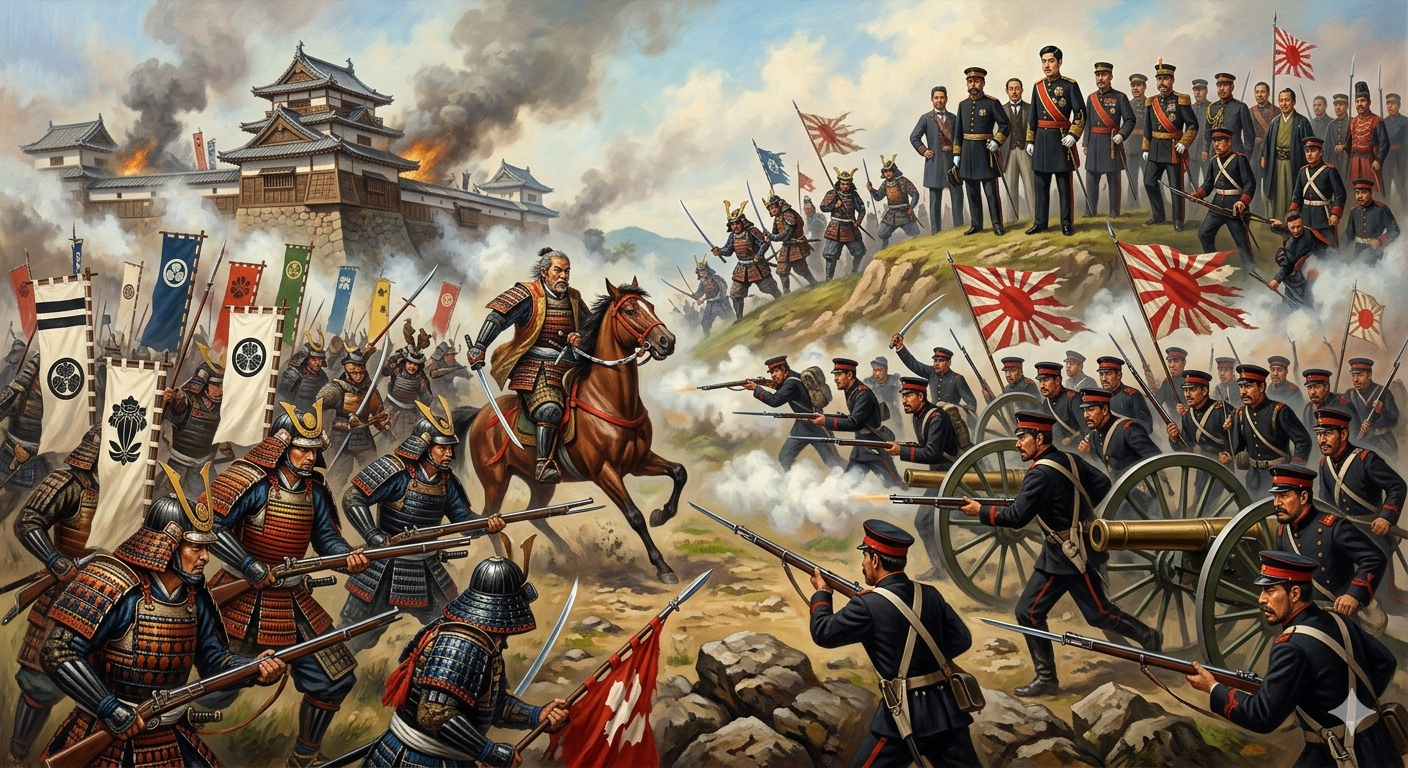
In the early hours of January 3, 1868, troops from the southwestern domains of Satsuma and Choshu seized control of the Imperial Palace in Kyoto. Their leader, the court noble Iwakura Tomomi, simultaneously received formal approval from the fifteen-year-old Emperor Mutsuhito for their actions. A proclamation was issued in the emperor’s name declaring the restoration of imperial rule, an event the Japanese called osei fukko. The office of shogun was abolished. The Tokugawa family, which had ruled Japan as its military government for more than two and a half centuries, was stripped of its authority. The era of the Meiji Restoration had begun.
The coup of January 3, 1868, is the central event of the Meiji Restoration, but the Restoration itself was far more than a single day’s political maneuvering. It was the culmination of fifteen years of internal crisis triggered by the appearance of American warships in Japanese waters in 1853, and the beginning of a transformation that would remake Japan in a single generation from a feudal agricultural society almost entirely closed to the outside world into an industrialized nation with a modern military, a constitutional government, and the capacity to compete on equal terms with the great powers of the West. Japan’s journey from the shogun’s resignation in November 1867 to the proclamation of the Meiji Constitution in 1889 remains one of the most rapid and comprehensive national transformations in modern history.
The Tokugawa Shogunate and Two and a Half Centuries of Feudal Rule
To understand the Meiji Restoration, it is necessary to understand what the Tokugawa shogunate was and how it had shaped Japan for 265 years before its fall.
The Tokugawa system of government was established by Tokugawa Ieyasu following the Battle of Sekigahara in 1600, in which he defeated his rivals and secured control of Japan. In 1603, the imperial court appointed him shogun, the military ruler of Japan, a title that would remain in the Tokugawa family until 1868. The emperor, residing in Kyoto, retained his ceremonial and religious significance but was effectively excluded from political power. Real authority rested with the shogun in Edo, the city that would later become Tokyo.
The Tokugawa system was designed above all else to preserve stability and the dominance of the shogunate. Japan was divided into approximately 270 domains, each ruled by a daimyo or feudal lord. The daimyo were required to spend alternating years in Edo and in their home domains, a system called sankin-kotai that served to keep them under surveillance, drain their resources through the cost of maintaining two residences and the travel between them, and prevent them from accumulating the power needed to challenge the shogunate. Society was rigidly divided into four hereditary classes: samurai, farmers, artisans, and merchants. Mobility between classes was severely restricted.
The shogunate also pursued a policy of near-total isolation from the outside world, a policy known as sakoku. From the 1630s onward, Japanese were forbidden to travel abroad, foreign merchants were excluded from Japan with the exception of a small Dutch trading post on the artificial island of Dejima in Nagasaki harbor, and the import of foreign books and ideas was tightly controlled. The policy preserved the Tokugawa order from external disruption but also prevented Japan from developing the technological and institutional capacities that European and American industrial civilization was building during these same centuries.
By the mid-nineteenth century, the Tokugawa shogunate was showing clear signs of internal stress. The merchant class had grown wealthy despite its low social status, and the contradiction between economic reality and social hierarchy was generating resentment. Many samurai domains in the west of Japan, particularly Satsuma, Choshu, Tosa, and Hizen, chafed under Tokugawa control and harbored ancient grievances against the family’s dominance. Confucian scholars and ideologues increasingly argued that the emperor, not the shogun, should be the true center of Japanese political authority. The intellectual movement known as sonno joi, meaning “revere the emperor, expel the barbarians,” was gathering strength in samurai intellectual circles.
Commodore Perry, the Black Ships, and the Opening of Japan
The crisis that brought these internal tensions to a head arrived from across the Pacific. On July 8, 1853, Commodore Matthew Perry of the United States Navy sailed into what is now Tokyo Bay with a squadron of four warships, two of them steam-powered paddle frigates whose black hulls and billowing smoke the Japanese called the Black Ships. Perry carried a letter from President Millard Fillmore demanding that Japan open its ports to American trade and supply American ships with coal and provisions. The message was backed by the obvious implication of overwhelming military force.
The shogunate’s reaction to Perry’s arrival revealed how thoroughly the policy of isolation had left Japan unprepared to deal with the modern world. Japanese coastal defenses were incapable of resisting the American warships. The shogunate could not effectively resist Perry’s demands and had to negotiate. In March 1854, Perry returned with a larger fleet and the shogunate signed the Convention of Kanagawa, opening the ports of Shimoda and Hakodate to American ships. Further treaties followed with other Western powers, and in 1858 the Harris Treaty with the United States opened additional ports, established American consulates, and granted American citizens extraterritorial legal rights in Japan.
These unequal treaties were a humiliation that galvanized opposition to the shogunate across Japan. The government that had justified its authority for 265 years on the basis of its ability to maintain order and protect Japan had been forced to capitulate to foreign demands without even attempting military resistance. The rallying cry of sonno joi spread rapidly through the samurai class. Emperor Komei himself, unusually for a Japanese emperor, expressed strong opposition to the treaties and the opening of Japan to Western influence. His opposition gave the anti-shogunate movement imperial legitimacy that it would exploit with increasing effectiveness.
The Wikipedia article on the Meiji Restoration provides the comprehensive political and social account of the forces that brought the Tokugawa order to an end and the specific events of January 3, 1868, that completed the transfer of power.
The Three Heroes of the Meiji Restoration: Saigo, Kido, and Okubo
The Meiji Restoration did not happen spontaneously. It was engineered by specific men with specific goals, most of them younger samurai from the domains that had historically been most antagonistic to the Tokugawa. History has designated three figures as the central architects of the Restoration, known as the Three Heroes or the Three Great Men: Saigo Takamori, Kido Takayoshi, and Okubo Toshimichi.
Saigo Takamori, born in 1828 in the Satsuma domain in southwestern Kyushu, was the most charismatic and most complicated of the three. He was physically imposing, of enormous personal courage, and deeply committed to traditional samurai values. He became the dominant military figure of the anti-shogunate coalition and commanded the Satsuma forces that would prove decisive in the Boshin War that followed the Restoration. His later life would take him in a radically different direction: he became the leader of the Satsuma Rebellion of 1877, the last great samurai uprising against the Meiji government, and died by ritual suicide after its defeat. His story was later fictionalized as the basis of the film The Last Samurai.
Kido Takayoshi, born in 1833 in the Choshu domain, was the principal political strategist of the early Restoration period. He was instrumental in forging the Satsuma-Choshu alliance in 1866 that created the military partnership capable of challenging the shogunate. He later served in the Meiji government as one of its leading statesmen and participated in the Iwakura Mission of 1871, the diplomatic and fact-finding expedition to the United States and Europe that helped shape Japan’s modernization program.
Okubo Toshimichi, born in 1830 in Satsuma, was the most powerful politician of the Meiji period and the dominant figure in the new government after the Restoration. His organizational ability and political ruthlessness were central to the consolidation of Meiji power. He implemented the abolition of the feudal domains in 1871 and their replacement with centrally administered prefectures, the single most important structural reform of the early Meiji period. He was assassinated in 1878 by samurai who opposed his policies.
The coup of January 3, 1868, was made possible by the prior work of these men and their collaborators, particularly Iwakura Tomomi, the court noble who served as the crucial bridge between the anti-shogunate samurai and the imperial court. Iwakura had spent years cultivating influence at court and coordinating with Satsuma and Choshu to create the political and military conditions for the seizure of power.
January 3, 1868: The Coup and the Collapse of the Shogunate
Tokugawa Yoshinobu, the fifteenth and final Tokugawa shogun, was not unaware that his position was untenable. He had become shogun in January 1867 in circumstances of deep uncertainty and had attempted to reform the Tokugawa system from within to make it more competitive with the Western-style government that his enemies were proposing. On November 9, 1867, he took the remarkable step of tendering his resignation to Emperor Meiji, who had succeeded to the throne earlier that year after the death of Emperor Komei, and placing his prerogatives at the emperor’s disposal. He formally stepped down on November 19.
But Yoshinobu’s resignation was not the total surrender the anti-Tokugawa faction required. He hoped to remain influential in the new government as the leading figure in a council of domain lords. This was precisely what Satsuma and Choshu were determined to prevent. If Yoshinobu retained influence, the Tokugawa family would remain a political force capable of reversing the reformers’ agenda.
In the early hours of January 3, 1868, Satsuma and Choshu troops seized the gates of the Imperial Palace in Kyoto. Iwakura Tomomi, who had been waiting for this moment, secured Emperor Meiji’s formal approval of the action after the fact. A council of imperial representatives, deliberately constructed to exclude Tokugawa representation, met that evening and issued the edict of imperial restoration. The shogunate was formally abolished. Yoshinobu’s lands were confiscated. The court of young samurai reformers who would govern Japan for the next generation had taken power.
The Boshin War followed. Tokugawa loyalists refused to accept the coup and fought back. The war lasted from January 1868 to June 1869, when the last holdouts in the northern island of Hokkaido at the Battle of Hakodate finally surrendered. The conflict was decisive and relatively brief. The new government’s forces, equipped with modern firearms purchased from Western suppliers and organized in Western military formations, proved clearly superior to the traditional Tokugawa forces. Yoshinobu himself chose not to fight, surrendering his Edo castle in April 1868 without resistance, an act that almost certainly saved countless lives and enabled the peaceful transfer of the capital.
The Britannica article on the Meiji Restoration covers the political revolution of 1868 in detail, including the wider era of economic, social, and political transformation that the Restoration set in motion throughout the Meiji period from 1868 to 1912.
The Meiji Reforms: Dismantling Feudalism and Building a Modern Nation
The speed and comprehensiveness of the reforms that followed the Restoration were extraordinary. The new Meiji government understood that Japan’s survival as an independent nation depended on its ability to match Western industrial and military power, and it pursued this goal with remarkable single-mindedness.
The Five Charter Oath, promulgated in April 1868, announced the foundational principles of the new government: deliberative assemblies would be established, all classes would participate in state affairs, social mobility would be permitted, evil customs would be abolished, and knowledge would be sought from throughout the world to strengthen imperial rule. The fifth provision, the commitment to seeking global knowledge, encapsulated the entire spirit of the Meiji project.
In 1869, the major daimyo of Satsuma, Choshu, Tosa, and Hizen voluntarily returned their domains to the emperor in a symbolic gesture, and in 1871 the government formally abolished all domains and replaced them with prefectures administered by centrally appointed governors. This abolition of the han system was the structural foundation of the centralized modern state. The samurai class lost its monopoly on military service in 1873, when universal military conscription was introduced, creating a modern national army open to all classes. The following year, the wearing of swords in public, the most visible symbol of samurai status, was banned.
The government sent delegations abroad to study Western institutions and bring back what was useful. The Iwakura Mission of 1871 to 1873, led by Iwakura Tomomi himself and including Kido Takayoshi, Okubo Toshimichi, and the young Ito Hirobumi, visited the United States, Britain, France, Belgium, the Netherlands, Germany, Russia, Denmark, Sweden, Italy, Austria, and Switzerland over twenty-one months. The mission studied legal systems, educational systems, factory production, military organization, and government structure, sending back detailed reports that directly shaped Japan’s modernization program.
The government built railways, telegraph lines, and lighthouses. It established a national postal service, a banking system, and the Bank of Japan in 1882. It founded universities and sent thousands of students abroad. It invited Western experts to teach in Japan and brought modern production techniques to Japanese industry. It adopted Western dress codes for official occasions, a Western calendar, and Western legal principles. The speed of transformation was deliberate and total.
The Meiji Constitution of 1889 and Japan’s Emergence as a Great Power
The culminating institutional achievement of the Meiji period was the Constitution of 1889. Ito Hirobumi, who had traveled to Europe specifically to study constitutional systems, modeled the Meiji Constitution primarily on the Prussian model, creating a system in which the emperor held supreme authority but exercised it through ministers who were responsible to him rather than to the elected legislature. The constitution established a bicameral parliament, the Imperial Diet, with an elected lower house and an appointed upper house. It guaranteed fundamental rights to subjects while preserving imperial sovereignty.
The constitution was promulgated on February 11, 1889, the anniversary of the legendary founding of Japan by its first emperor, a date chosen with deliberate symbolic care. Emperor Meiji, now thirty-six years old and a very different figure from the fifteen-year-old boy in whose name the coup of January 3, 1868, had been conducted, granted the constitution to his people in a ceremony of imperial magnificence. Japan now had the formal institutions of a modern nation-state.
The History.com article on the Meiji Restoration covers the full arc of the Meiji period from the shogunate’s fall through the constitutional settlement of 1889 and Japan’s subsequent emergence as a military power that astonished the world by defeating China in 1895 and Russia in 1905.
The proof of what the Meiji reforms had accomplished came in dramatic military form. In 1895, Japan defeated China in the First Sino-Japanese War, demonstrating that the former student of Western military technology had mastered it. In 1905, Japan defeated Russia in the Russo-Japanese War, becoming the first Asian nation in the modern era to defeat a European great power in a major conflict. The world that had watched Commodore Perry’s Black Ships force open a feudal Japan in 1853 now confronted a Japan that had, in barely fifty years, transformed itself into an industrial and military power that could challenge the most formidable nations on earth. The Meiji Restoration had accomplished something without precedent in history: a voluntary, rapid, and largely successful transformation of an entire civilization from within.
Emperor Meiji died on July 30, 1912, having reigned for forty-four years. He had been fifteen years old when troops seized the Imperial Palace in his name in 1868, a boy emperor in whose name a revolution was conducted by determined men who understood that Japan’s survival required a complete reinvention of Japanese society. The era that bore his name left Japan permanently changed, and its consequences for the modern world, including the path that eventually led Japan to both imperial expansion and catastrophic defeat in the twentieth century, stretched far beyond anything its architects could have imagined on that January night in Kyoto in 1868.