
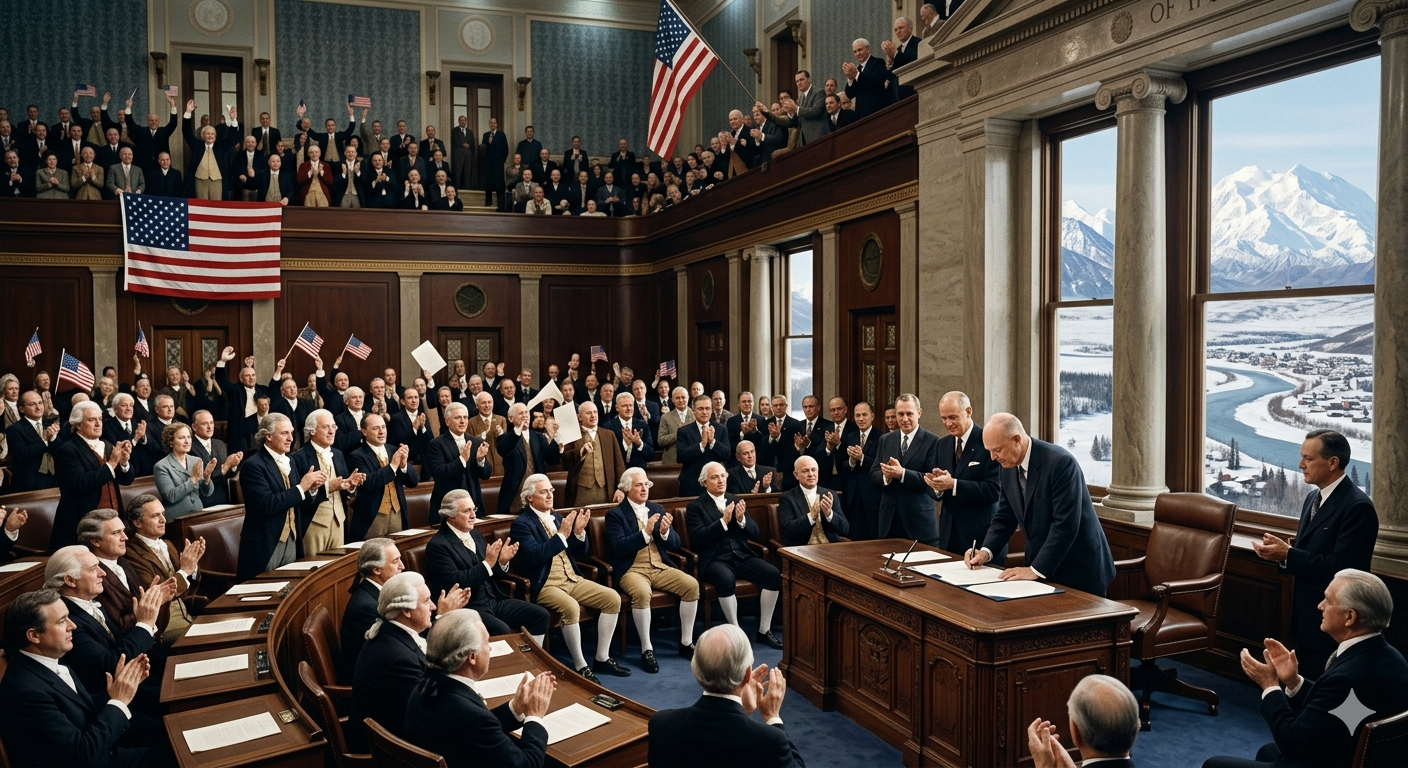
On January 3, 1959, President Dwight D. Eisenhower signed Proclamation 3269, formally admitting the Territory of Alaska into the United States as the 49th state. In Juneau, crowds gathered in the streets to celebrate. In communities across the vast territory stretching from the Arctic Ocean to the Gulf of Alaska, people who had spent decades arguing, lobbying, and organizing for this moment finally had their answer. The land that Secretary of State William Seward had purchased from Russia for $7.2 million in 1867, and which skeptics had mocked for generations as “Seward’s Folly,” was now a full and equal member of the American Union.
Alaska’s admission was not merely the addition of a new name to the map. It was the culmination of a forty-year political struggle that had involved territorial delegates, senators, newspaper publishers, World War II veterans, constitutional convention delegates, and ordinary Alaskans who believed their territory deserved the same rights and representation as every other part of the country. It fundamentally changed the shape of the United States, adding 586,412 square miles of territory that more than doubled the nation’s land area, and it demonstrated that the process of admission was still alive and consequential nearly a century after the last continental state had joined the Union in 1912.
Alaska Before Statehood: From Russian America to Seward’s Folly
Alaska’s history as a human homeland stretches back at least twenty thousand years, when the first peoples are believed to have crossed the Bering land bridge from Asia into North America. The indigenous nations that developed across the territory over those millennia included the Inupiat of the far north and west, the Yupik to their south, the Aleuts of the Aleutian Islands and Alaska Peninsula, and the Tlingit and Haida of the southeastern coastal regions. Each developed distinctive cultures, languages, and subsistence systems adapted to vastly different environments across the territory’s enormous geographical range.
Russian exploration of Alaska began in earnest in 1741, when Danish navigator Vitus Bering, sailing in the service of Russian Tsar Peter the Great, sighted the Alaskan mainland. Russian fur traders and hunters followed, establishing increasingly permanent footholds in the territory. The first permanent Russian settlement was established by Grigory Shelikhov on Kodiak Island in 1784. The Russian-American Company was chartered in 1799 to manage trade and colonization, and Russian settlements eventually extended down the North American Pacific coast as far south as Fort Ross in California.
By the 1860s, however, Russia’s enthusiasm for its distant North American possession had faded. The territory was expensive to administer and defend. The sea otter population that had driven the fur trade had been drastically reduced by overhunting. The Crimean War had exposed Russian vulnerability in distant territories. Tsar Alexander II decided to sell. Secretary of State William Seward, a committed expansionist who had long believed the United States should extend its reach across the Pacific, negotiated the purchase treaty in 1867. The price was $7.2 million, approximately two cents per acre. The Senate ratified the treaty on April 9, 1867, and the formal transfer ceremony took place at Sitka on October 18, 1867.
The American public’s reaction was mockery. Critics called the purchase “Seward’s Folly,” “Seward’s Icebox,” and “Walrussia.” Congress was slow to appropriate the purchase funds and even slower to establish any meaningful government for the new territory. For more than a decade after purchase, Alaska had no civil government whatsoever. It was administered loosely as a military district and then as a customs collection district. The indigenous peoples who had lived there for thousands of years had no voice in these arrangements.
Gold, World War II, and the Forces That Transformed Alaska
Three forces transformed Alaska from an overlooked frozen territory into a place that Americans could imagine as a state: the gold rush, World War II, and the discovery of oil.
The gold rush era began in 1896 in the Klondike region of Canada’s Yukon Territory, just across the border from Alaska, and spilled over into Alaska itself with major strikes near Nome in 1899 and Fairbanks in 1902. Hundreds of thousands of people poured into Alaska and the Yukon over the following decade, transforming outposts into towns and creating the first substantial permanent American settler population in the territory. The influx created pressure for better governance, and in 1912 Congress passed the Second Organic Act, establishing the Territory of Alaska with an elected legislature and a capital at Juneau. Alaska’s governor, however, was still appointed by the President in Washington, and the federal government retained control over fishing, mining, and other natural resources. Alaskans paid federal taxes but had no voting representation in Congress.
World War II was the second transformative force. Japan’s attack on the Aleutian Islands in June 1942, when Japanese forces invaded and occupied the islands of Attu and Kiska in the only enemy occupation of American soil during the war, demonstrated Alaska’s strategic vulnerability and its critical importance to American Pacific defense. The federal government poured resources into Alaska throughout the war, building the Alaska Highway in 1942 as an overland supply route from the continental United States, constructing military bases throughout the territory, and stationing hundreds of thousands of soldiers there. Alaska’s population grew substantially, and the men and women who served there or who moved there for wartime work became an important constituency for the territory’s postwar development.
The veterans who returned from Alaska after the war brought with them a democratic sensibility shaped by their wartime service. They had fought for American values and American democracy in a territory that had no voting representation in the government that had sent them to fight. The injustice struck many of them forcefully, and the postwar statehood movement drew heavily on their energy and moral authority.
Ernest Gruening, Bob Bartlett, and the Long Fight for Statehood
The individuals who drove Alaska toward statehood form a compelling cast of politicians, publishers, and advocates who spent decades working against enormous institutional resistance.
James Wickersham, who served as Alaska’s non-voting delegate to Congress from 1909 to 1921 and again from 1931 to 1933, was the first to formally introduce an Alaska statehood bill, doing so in 1916. His proposal attracted little attention, but it established the legislative precedent that future advocates would build upon. Wickersham had come to Alaska as a federal judge in 1900 and had grown increasingly convinced that the territory’s resources were being exploited for the benefit of outside corporate interests, particularly the Guggenheim-Morgan mining syndicate, while Alaskans themselves had no effective means of governing their own affairs.
Ernest Gruening was appointed Territorial Governor of Alaska by President Franklin D. Roosevelt in 1939 and served until 1953. He was the most persistent and most eloquent advocate for Alaskan statehood over the decades-long fight. Gruening had been a journalist, editor, and author before entering government, and he brought a writer’s skill for persuasion and a political organizer’s understanding of coalition-building to the statehood cause. He argued relentlessly that denying statehood to Alaska was a form of colonial exploitation that was inconsistent with American democratic principles. He testified before congressional committees, organized Alaskans, and kept the statehood issue alive during years when congressional indifference made progress nearly impossible.
Edward Lewis “Bob” Bartlett served as Alaska’s non-voting congressional delegate from 1945 to 1959, and he was the central figure in the legislative fight for statehood in Washington. Bartlett was a masterful legislative tactician who understood exactly how to navigate the complexity of congressional politics. He built the coalitions needed to get statehood bills through committees, maintained relationships with key legislators across party lines, and applied sustained pressure over more than a decade when the issue repeatedly stalled. When the Senate finally voted 64-20 in favor of statehood on June 30, 1958, Bartlett’s decade-long effort was a central reason why.
Bob Atwood, the publisher of the Anchorage Daily Times, provided the press advocacy that was essential to building public and political support. Atwood used his newspaper relentlessly over more than a decade to make the case for statehood, reporting on the economic costs of territorial status, exposing the ways in which outside interests benefited from Alaska’s lack of self-governance, and maintaining public enthusiasm for statehood when the cause seemed stalled in Congress.
Ted Stevens worked within the executive branch as a young attorney in the Department of the Interior, where he served as Solicitor and worked with Interior Secretary Fred Seaton to build administration support for statehood. Stevens authored significant portions of the Alaska Statehood Act and reportedly wrote approximately ninety percent of the speeches delivered in favor of the bill. He would later become one of Alaska’s first two United States Senators and would serve for forty years, becoming one of the longest-serving senators in American history.
The Wikipedia article on the Alaska Statehood Act provides the comprehensive legislative history of the statehood effort, from Wickersham’s 1916 bill through the final passage in 1958 and the formal admission on January 3, 1959.
The Alaska Constitutional Convention and the Tennessee Plan
The decisive turn in Alaska’s statehood campaign came in 1955 and 1956, when Alaska’s territorial leaders decided to stop waiting for Congress to act and to demonstrate that Alaska was ready for statehood through its own initiative.
In November 1955, fifty-five delegates elected from across the territory gathered at the University of Alaska in Fairbanks to draft a state constitution. The Alaska Constitutional Convention produced a document widely praised by constitutional scholars as a model of modern democratic governance. The convention drew deliberately on the Model State Constitution of the National Municipal League and incorporated lessons from the constitutional experience of other states, creating a strong executive, a bicameral legislature, and a unified court system. The constitution was submitted to Alaskan voters in April 1956 and approved by a wide margin.
The territorial legislature then implemented the so-called Tennessee Plan, a strategy derived from the precedent set by Tennessee when it had applied for statehood in 1796. Alaska’s legislature elected a shadow congressional delegation as if Alaska were already a state: Ernest Gruening and William Egan as shadow United States Senators, and Ralph Rivers as the shadow United States Representative. This shadow delegation went to Washington and presented themselves at the Capitol, arguing by their very presence that Alaska was ready and deserving of statehood. The symbolism was powerful and the attention it attracted was useful, even if Congress did not immediately seat the delegates.
William Egan, who had been a delegate to the constitutional convention and served as its president, would become Alaska’s first elected governor when statehood was formally achieved. He was a Valdez merchant who had been born in Alaska and who embodied the self-made Alaskan character that statehood advocates pointed to as evidence that the territory could govern itself. He served two terms as governor from 1959 to 1966.
Congressional Opposition, the Alaska-First Strategy, and the Path to Passage
Alaska’s path to statehood was blocked for years by a combination of opposition forces in Congress. Southern Democrats, who dominated key Senate committees through the seniority system, opposed Alaska statehood because they feared it would add two Democratic senators who would support civil rights legislation and undermine their bloc’s power. Some northern conservatives opposed statehood for Alaska and Hawaii simultaneously, fearing that two new Democratic states would shift the Senate balance. Business interests tied to the fishing and mining industries that operated in Alaska without state taxation or state regulation opposed statehood because it would subject them to state authority.
The breakthrough came through a political strategy devised by John Anthony Burns, the territorial delegate from Hawaii. Burns was a protégé of House Speaker Sam Rayburn and Senate Majority Leader Lyndon B. Johnson, and he recognized that joint Alaska-Hawaii statehood bills invited opposition from detractors of both territories simultaneously. He devised the Alaska-first strategy: admit Alaska first, on its own merits, and then use that precedent and momentum to push Hawaii’s admission immediately afterward. Burns reasoned that Hawaii’s cause would be irresistible once Alaska had been admitted. He was right. Alaska’s statehood opened the door, and Hawaii followed on August 21, 1959, just seven months later, as the 50th state.
President Eisenhower’s support was also decisive. Eisenhower had initially been cautious about Alaska statehood, but by 1957 and 1958 he had become a genuine advocate. He understood Alaska’s strategic importance in the Cold War context, particularly its proximity to the Soviet Union across the Bering Strait. He worked to reassure Republican legislators who worried that Alaska would reliably send Democrats to Congress, and his personal advocacy helped bring several key votes into the statehood column. The House passed the statehood bill 210-166. The Senate followed with the 64-20 vote on June 30, 1958. Eisenhower signed the Alaska Statehood Act into law on July 7, 1958.
The Britannica article on the history of Alaska covers the full sweep of Alaska’s history from its indigenous peoples through the Russian period, the purchase, and the long road to statehood.
January 3, 1959: Statehood Proclaimed and a New Flag Ordered
Between July 7, 1958, when Eisenhower signed the Alaska Statehood Act, and January 3, 1959, when he signed the formal proclamation of admission, Alaska conducted the elections required to complete the transition to statehood. On August 26, 1958, Alaskans voted overwhelmingly to ratify the Statehood Act in a referendum. They elected William Egan as the first governor and chose their first two United States Senators, Ernest Gruening and Bob Bartlett, both of whom had spent decades working for this moment. Ralph Rivers won election as Alaska’s first United States Representative. The territorial legislature confirmed these choices and established the transition mechanisms for the new state government.
On January 3, 1959, Eisenhower signed Proclamation 3269, formally admitting Alaska as the 49th state. He simultaneously signed an executive order directing the creation of a new design for the United States flag, adding a 49th star. The 49-star flag flew over the country for less than a year, however: Hawaii was admitted on August 21, 1959, requiring a 50th star, and the 50-star flag that has flown ever since became official on July 4, 1960.
Alaska’s admission changed the United States in ways that went beyond the formal addition of a new state. The sheer scale of Alaska was staggering to comprehend. At 586,412 square miles, it was more than twice the size of Texas, which had held the title of largest state since its admission in 1845. Alaska’s admission more than doubled the total land area of the United States. Its 6,640-mile coastline exceeded that of all the other lower forty-eight states combined. Its fisheries were among the richest in the world. Its mountain ranges, including Denali at 20,310 feet, the highest peak in North America, were without rival in the continental United States.
The full economic transformation of Alaska came later. When massive oil reserves were discovered at Prudhoe Bay on the Arctic coastal plain in 1968, Alaska gained the resource wealth that would make it financially independent of federal subsidies. The Trans-Alaska Pipeline, completed in 1977, carried this oil south to the port of Valdez for shipment to refineries, and the royalty revenues it generated funded state government and eventually created the Alaska Permanent Fund, which distributes annual dividends to every Alaskan resident.
The History.com article on Alaska’s admission to the Union covers the January 3, 1959 proclamation and the significance of Alaska’s statehood for American expansion and Cold War strategy.
The men and women who had worked for Alaska statehood for decades understood that what they had achieved on January 3, 1959 was more than a change in political status. It was the recognition that Alaskans were full Americans, entitled to the same representation, the same rights, and the same voice in their own governance that every other American citizen possessed. The territory that had been dismissed as worthless frozen wasteland when Seward purchased it in 1867 had, through the determination of its people and the slow working of democratic politics, become the forty-ninth star on the American flag.