
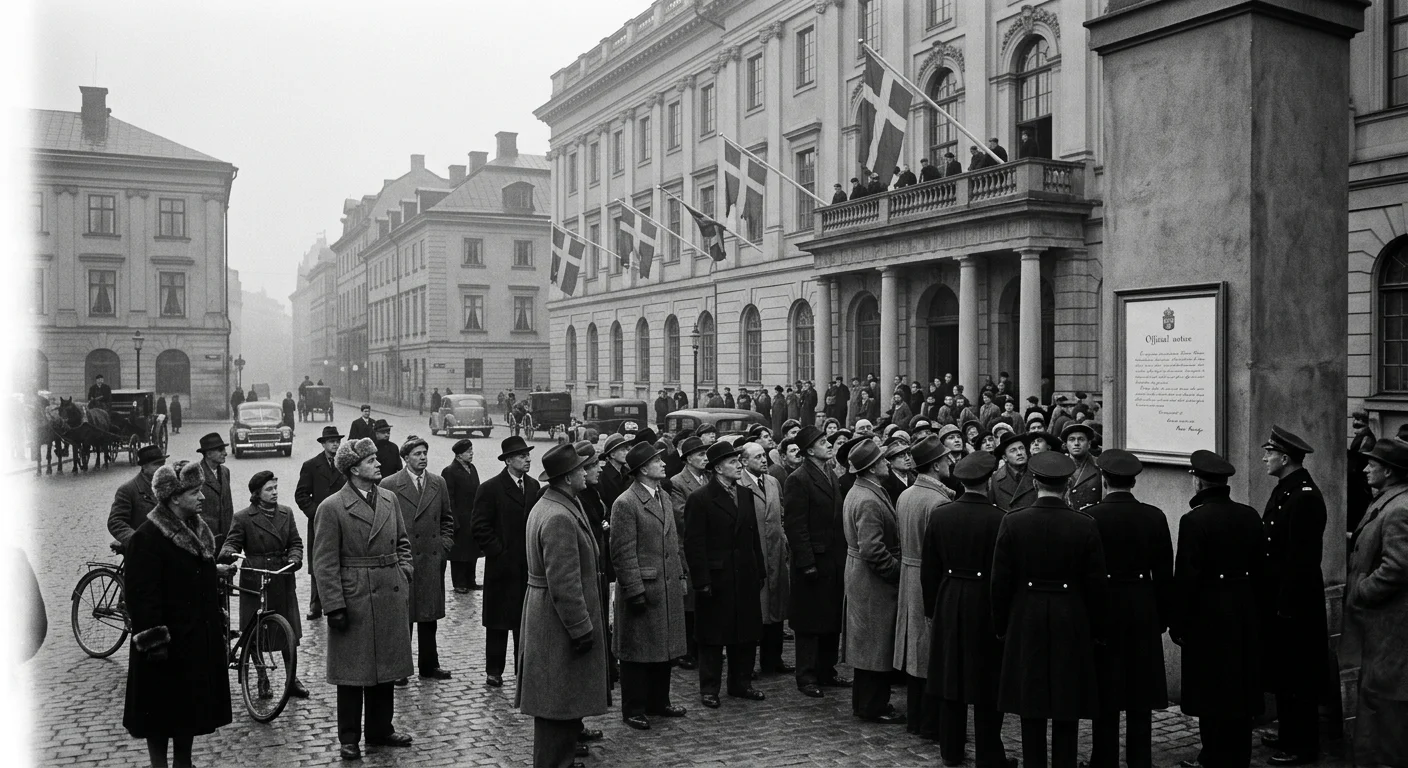
How Sweden Switched from Left-Hand to Right-Hand Traffic on Dagen H, September 3, 1967
At exactly 4:50 in the morning on Sunday, September 3, 1967, every vehicle on the roads of Sweden came to a complete stop. Drivers sat still in the pre-dawn darkness, engines idling, waiting. Then, at 5:00 a.m., they did something no Swedish motorist had ever done before: they pulled their vehicles to the right-hand side of the road and drove on. In a matter of ten minutes, one of the most meticulously prepared logistical operations in Scandinavian history had been executed. Sweden had switched from left-hand traffic to right-hand traffic, ending a tradition that had lasted for more than two centuries and aligning the country with the rest of continental Europe.
This event, known in Swedish as Dagen H, derived from the word “Högertrafik,” meaning right-hand traffic, was not merely a change in road rules. It was the culmination of decades of political debate, a national referendum in which the public had overwhelmingly voted against the very change that the government would ultimately impose, years of painstaking infrastructure preparation, a massive public awareness campaign, and a feat of national coordination that has since been studied as a model of large-scale logistical transformation. To understand why Sweden changed sides, one must understand where it had come from, what pressures it faced, and what it was ultimately trying to become.
The Origins of Left-Hand Traffic in Sweden: A Tradition Two Centuries in the Making
Sweden’s tradition of driving on the left side of the road was not born from any single royal decree or moment of deliberate national policy. Like most road customs in pre-modern Europe, it evolved organically from centuries of equestrian and carriage culture. The general rule across much of medieval and early modern Europe was to keep to the left when traveling on horseback or in a carriage. This convention was practical for right-handed riders, who preferred to pass oncoming travelers on their own right side so that their sword arm remained free and ready. When mounted travelers passed to the left, they kept their weapon hand toward the potential threat of the oncoming stranger.
Sweden formally codified left-hand traffic, known in Swedish as “vanstertrafik,” through a series of royal decrees in the eighteenth century. The country had in fact experienced some local variation before standardization, with different cities and provinces maintaining their own customs. Stockholm and a few other areas briefly adopted right-hand rules before the rest of the country was directed to follow. Ultimately, the left-hand convention prevailed nationwide and was fixed in law around the year 1734, a standard that would endure for well over two centuries. By the time the first automobiles appeared in Sweden in the early twentieth century, the left-hand tradition was deeply embedded in the national driving culture and the physical infrastructure of Swedish roads.
The American Car Paradox: Why Swedish Drivers Sat on the Wrong Side
The great irony at the heart of Sweden’s pre-1967 traffic system was that while the country drove on the left, almost all of its cars were designed for driving on the right. This peculiar contradiction had its roots in the dominance of American automobiles in the Swedish market during the early decades of the twentieth century. When cars first became commercially available in Sweden, the domestic automobile industry was in its infancy. Swedish consumers and businesses turned overwhelmingly to imported American vehicles, built by manufacturers such as Ford, General Motors, and Chrysler, all of which placed the steering wheel on the left side of the car, the standard for right-hand-traffic countries.
As Volvo founder Assar Gabrielsson explained in his 1936 sales handbook, American cars were always delivered with their steering wheels on the left side, and for such a small market as Sweden the manufacturers were reluctant to build a special right-hand-drive variant. Swedish salespeople and dealers adapted to this reality and, over time, the left-hand-drive car became so normalized in Sweden that even as Volvo grew to dominate the Swedish market after 1948, it continued to produce left-hand-drive vehicles for domestic consumption. The result was a deeply anomalous situation: Sweden drove on the left but its drivers sat on the left side of their cars, meaning they were positioned on the far side of the road, away from the traffic they needed to see most clearly.
The practical consequences of this arrangement were significant and dangerous. When a Swedish motorist in a left-hand-drive car attempted to overtake a slower vehicle on a narrow two-lane road, the driver had to pull out into the opposing lane almost completely blind, unable to see oncoming traffic until it was dangerously close. The driver’s side of the car was nearest to the far edge of the road, not to the center line where visibility of oncoming traffic was most critical. Swedish traffic authorities increasingly recognized that this mismatch between car design and road convention was a direct contributor to head-on collisions and overtaking accidents. By the 1950s, with car ownership growing rapidly, the accident toll was rising with it.
Neighboring Countries and the Border Problem: Norway, Finland, and Continental Europe
The danger created by left-hand-drive cars on left-hand roads was not the only pressure building on Sweden’s traffic system. There was also the increasingly awkward reality of Sweden’s position within a continent that had, over the preceding century and a half, overwhelmingly standardized on right-hand traffic. The spread of right-hand driving across mainland Europe had its origins in the revolutionary era. Napoleon Bonaparte, who standardized right-hand traffic in France by law in 1792 and later extended this rule to the territories under French control and influence, was the primary architect of the continental standard. As French influence spread and as newly industrializing nations built road networks, most of Europe adopted right-hand traffic as the norm.
By the mid-twentieth century, the major holdouts for left-hand traffic in Europe were the United Kingdom, Ireland, and Sweden, the latter flanked on its long land borders by countries that had long since switched to the right. Norway, which shares Sweden’s western land border, drove on the right. Finland, which shares Sweden’s long eastern border, drove on the right. Denmark, Sweden’s southern neighbor connected by ferry routes, drove on the right. This meant that every land border crossing between Sweden and its neighbors required every driver to switch sides of the road, an experience described by contemporaries as deeply disorienting and, at certain border crossings, genuinely hazardous.
Approximately five million vehicles crossed Sweden’s land borders with Norway and Finland each year by the early 1960s. Every one of those crossings required a driver accustomed to left-hand traffic to immediately adapt to right-hand traffic, or vice versa. This was not merely inconvenient; it created real collision risks at border zones where vehicles were transitioning between the two systems. Swedish trucking and transport companies doing international business faced constant complications. Tourists entering Sweden from the Continent had to make the mental adjustment at the border, and returning Swedes had to remember to switch back. The cumulative toll of confusion and error at these transition points was a persistent public safety problem.
The 1955 Referendum: When the Swedish Public Said No
By the early 1950s, the question of whether Sweden should follow its neighbors and switch to right-hand traffic had become a recurring topic in parliamentary debate. The issue had first been formally raised in the Swedish Riksdag as early as 1927, though it never advanced to legislation. A series of subsequent parliamentary discussions through the 1930s and 1940s kept the question alive without resolving it. Road safety advocates, transport professionals, and Scandinavian integration enthusiasts argued with increasing urgency for the switch. The automobile clubs, the trucking industry, and many traffic safety experts were broadly in favor. The public, however, was a different matter entirely.
On October 16, 1955, Sweden held a national referendum on whether to switch from left-hand to right-hand traffic. The outcome was decisive and unambiguous. A total of 82.9 percent of voters cast their ballots against the change, demanding that Sweden retain its left-hand traffic system. Only roughly 15 percent voted in favor of switching. The referendum revealed just how deeply attached ordinary Swedish citizens were to the familiar system they had grown up with. The emotional arguments deployed by those opposed to the switch resonated far more powerfully with the public than the technical arguments advanced by safety experts and traffic engineers. Campaigners against the change appealed directly to habit, sentiment, and fear, with slogans that posed stark questions about the risks of disruption.
The referendum result was, legally speaking, advisory rather than binding. The Swedish government was not constitutionally required to honor the outcome as an absolute mandate. Nevertheless, the scale of the rejection made it politically impossible to proceed with a switch in the immediate aftermath. For several years, the question was set aside. The traffic continued on the left. The accident toll continued to mount. The border confusion continued at every frontier. And the arguments for change continued to accumulate weight.
Why the Government Overrode the Public: The Case for Switching Despite Opposition
The years between the 1955 referendum and the eventual parliamentary decision to switch in 1963 saw a dramatic transformation in the conditions that made the change necessary. The number of registered vehicles in Sweden tripled during this period, rising from approximately 500,000 cars to 1.5 million by the early 1960s. Traffic engineers projected that this figure would reach 2.8 million vehicles by 1975. The more cars there were on Swedish roads, the more dangerous the combination of left-hand traffic and left-hand-drive vehicles became. Overtaking accidents, in particular, were becoming an increasingly prominent cause of serious injury and death.
There was also a technical and economic argument that the Riksdag found compelling. The standard headlamps fitted to most vehicles in Sweden at the time were inexpensive, round, standardized units that could be replaced relatively easily. However, automobile manufacturers in continental Europe were increasingly moving toward model-specific, asymmetric headlamp designs that were much more expensive and not interchangeable across different traffic systems. The longer Sweden waited to make the switch, the more costly the vehicle adaptation component of the changeover would become. Switching in 1967, while cars still largely used the old standardized round headlamps, was estimated to be far cheaper than waiting until the late 1960s or 1970s, when custom headlamp designs would have become universal.
There was further pressure from the logic of regional integration. Sweden was increasingly oriented toward its European neighbors economically, politically, and culturally. The idea that Sweden’s road system should conform to a European standard was gaining acceptance even among those who had previously been skeptical. Prime Minister Tage Erlander, the long-serving Social Democratic leader who had governed Sweden since 1946, threw his personal authority behind the proposal to switch. On May 10, 1963, the Riksdag approved Erlander’s proposal and passed legislation mandating the introduction of right-hand traffic in 1967. Sweden had four years to prepare.
Building Statens Hogertrafikkommission: The State Commission That Organized the Impossible
The passage of the 1963 legislation immediately triggered the creation of a dedicated governmental body to oversee the transition. This body, known as the Statens Hogertrafikkommission, or HTK, translated as the State Right-Hand Traffic Commission, was established to coordinate every aspect of the changeover from conception through execution. The scale of its mandate was extraordinary. Sweden in 1963 was a country of roughly eight million people, with approximately 1.5 million registered vehicles, a road network tens of thousands of kilometers long, hundreds of thousands of road signs, thousands of signalized intersections, an extensive bus network, a tram system in several cities, and a population that had just four years previously voted by a massive majority to do exactly the opposite of what was now required of it.
The HTK immediately began consulting psychologists, traffic engineers, communications professionals, educators, and logistics specialists. One of the commission’s central insights, informed by the psychological consultants it engaged, was that the success of the changeover would depend not merely on physical infrastructure changes but on the mental preparation of the Swedish public. Changing the roads was a logistical challenge. Changing the driving habits of a nation required a different kind of effort entirely. The commission devised a comprehensive four-year public education program designed to gradually shift the mental framework of Swedish drivers before the actual day arrived.
The Dagen H Public Awareness Campaign: Milk Cartons, Underwear, and a Hit Song
The Statens Hogertrafikkommission launched one of the most extensive and creative public awareness campaigns in Swedish history. The central visual identity of the campaign was the Dagen H logo, a distinctive hexagonal emblem featuring a bold H for Hoger, meaning right in Swedish, set against a yellow and black background. This logo became ubiquitous in Swedish daily life during the four years leading up to September 3, 1967. It appeared on milk cartons delivered to every home. It was printed on men’s shorts, women’s underwear, gloves, stickers, and virtually any surface that could carry a printed image. Stockholm department stores sold garments and novelty items bearing the H logo. The commission understood that normalization required saturation, that the idea of driving on the right needed to feel familiar before it was real.
The campaign extended into schools, where educational programs introduced children to the new traffic rules years before the change took effect. Media advertising ran continuously as the date approached. Approximately 130,000 reminder signs bearing a large H for Hoger were erected across Sweden’s roads and streets, serving as a constant visual prompt. Inside vehicles, HTK distributed H-stickers for placement on the dashboard directly in front of the driver, providing a physical reminder in the moment of driving. The psychological strategy was to make the idea of right-hand driving so thoroughly familiar that on the day itself, switching would feel less like a shocking novelty and more like the completion of a long-anticipated transition.
Swedish national television even held a songwriting contest to find the best popular song about driving on the right. The winning entry, performed by the band The Telstars and written by journalist Peter Himmelstrand, was a catchy tune entitled Holl dig till hoger, Svensson, which translates as Keep Right, Svensson. The song became something of an unofficial anthem of the entire Dagen H project, playing on radio stations and in public spaces as the date approached. It captured the spirit of a nation attempting to turn a disruptive obligation into a shared national experience, even a source of collective humor and pride.
Rebuilding the Roads: 360,000 Signs Changed in a Single Night
While the public awareness campaign addressed the psychological dimension of the changeover, the physical transformation of Sweden’s road infrastructure was an equally monumental undertaking. Every aspect of the road environment that depended on or indicated the direction of traffic had to be changed, moved, or replaced. The statistics are staggering. Over the course of the four-year preparation period and in the final overnight effort before September 3, approximately 360,000 road signs across Sweden were replaced or modified to reflect right-hand traffic conventions. This included directional signs, warning signs, lane markings, and all the other visual information that drivers rely upon to navigate safely.
Traffic signals at thousands of intersections across the country were replaced with new units correctly positioned for right-hand traffic. In many cases, the new signals were installed in advance but kept covered in black plastic wrapping, waiting for the moment of changeover. Road markings, the white and yellow lines that define lanes, junctions, pedestrian crossings, and road edges, were repainted throughout Sweden. The new lines were sometimes laid down in advance and covered with black tape, to be removed on the day. Workers across the country spent months repositioning bus stops from the right-hand side of the road to the left-hand side, as the appropriate boarding side for right-hand traffic buses.
Intersections posed particular challenges. The geometry of a road junction designed for left-hand traffic is subtly different from one optimized for right-hand traffic, and many intersections across Sweden had to be physically reshaped to allow safe merging and turning under the new system. One-way streets were an especially complex puzzle; a street designated one-way for left-hand traffic would need its signage and direction reconsidered entirely, and in some cases the physical flow of traffic through urban grids had to be redesigned. The cities of Stockholm and Malmo, with their dense networks of streets, junctions, and complex urban intersections, faced the greatest challenge and were given extended preparation time.
Buses, Trams, and the Transit Challenge
Among the most expensive and complicated elements of the transition was the transformation of Sweden’s public transit fleet. City buses had been designed with doors positioned to serve passengers boarding from the left-hand side of the road, which was the appropriate position under left-hand traffic rules. When traffic switched to the right, the boarding side would become the right side, meaning the door positions on the vast majority of the existing bus fleet would be wrong. The HTK and Sweden’s transport operators faced a choice between purchasing entirely new buses and retrofitting the existing fleet.
The solution adopted was a combination of both approaches. More than 1,000 entirely new buses were purchased with doors positioned correctly for right-hand traffic service. An additional 8,000 older buses were retrofitted to provide doors on both sides, making them functional regardless of traffic direction. Some cities, including Gothenburg and Malmo, found more economical solutions for certain portions of their fleets by exporting left-traffic buses to countries that still needed them: Gothenburg sent its surplus left-traffic buses to Pakistan, while Malmo sent theirs to Kenya, both countries that drive on the left. The total financial and logistical effort involved in transforming the bus fleet alone represented a massive component of the overall cost of Dagen H.
The tram systems in Sweden’s major cities presented an even more complex challenge. Trams run on fixed tracks and cannot simply be redirected to the other side of the road. In cities where tram lines ran along streets that would change traffic direction, the physical infrastructure of the tram system conflicted irreconcilably with the requirements of right-hand traffic. The practical outcome was that tram networks in central Stockholm, in Helsingborg, and most lines in Malmo were withdrawn entirely and replaced with buses. Sweden’s tram systems were dramatically reduced as a direct consequence of Dagen H. Only the tram systems in the cities of Norrkoping and Gothenburg survived largely intact, along with three suburban rail lines in the Stockholm area, the Nockebybanan and Lidingobanan among them. Stockholm’s decision had been partly pre-determined, as the city was already replacing its trams with the new underground metro system, a decision taken independently of Dagen H but which aligned conveniently with its requirements.
One important exception to the traffic changeover was Sweden’s railway network. The national rail system, including the Stockholm metro, did not switch to right-hand operation on Dagen H. Rail networks, with their fixed infrastructure and established signaling systems, represented a far greater engineering challenge for any switch than road traffic, and the decision was made to leave the railways on their existing left-hand operating convention. Swedish railways thus continue to operate on the left to this day, a curious historical footnote that makes Sweden’s railway network an anomaly within a country that otherwise drives on the right.
The Final Days Before Dagen H: Black Tape, Covered Signs, and a Nation Holding Its Breath
As September 3, 1967 approached, the physical transformation of Sweden’s road environment was largely complete but deliberately hidden. New road signs stood wrapped in black plastic at thousands of locations across the country, their right-hand-traffic directions concealed until the moment of changeover. Freshly painted road markings lay under strips of black tape, ready to be revealed when the old system was extinguished. Traffic signals waited in their new positions behind plastic covers. The country looked, to observers of the roads, like a stage set awaiting the lifting of a curtain. The metaphor was apt: what was about to happen had been scripted, rehearsed, and prepared for four years, and now only the performance remained.
In the largest cities, Stockholm and Malmo, authorities imposed an extended traffic ban not merely during the overnight hours of Dagen H but from 10:00 a.m. on Saturday, September 2, extending all the way through to 3:00 p.m. on Sunday afternoon. This longer window gave work crews the time they needed to remove plastic covers, peel back black tape, reconfigure complex urban intersections, reposition temporary barriers, and verify that every element of the new traffic environment was correctly installed and functional. Other cities and towns imposed bans from 3:00 p.m. on Saturday through to 3:00 p.m. on Sunday. The nationwide minimum ban was from 1:00 a.m. to 6:00 a.m. on Sunday the 3rd. During all these periods, no non-essential traffic was permitted on the roads.
Speed limits were dramatically reduced for the day itself. In built-up areas, the maximum speed on Dagen H was set at 30 kilometers per hour. On all other roads, the limit was 50 kilometers per hour. These restrictions were designed both to reduce the severity of any accidents that might occur and to give drivers the time and mental space to adapt to the new rules in real conditions. The government also permanently abolished the unlimited speed rules that had previously applied on Swedish roads outside built-up areas, introducing permanent speed limits as part of the broader Dagen H package of road safety reforms.
The Moment of Change: 4:50 a.m. on September 3, 1967
When the clock reached 4:50 a.m. on the morning of September 3, 1967, all vehicles still on Sweden’s roads came to a complete stop. Police officers, military personnel, and traffic wardens had been stationed at key intersections across the country. Drivers stopped where they were, on the left-hand side of the road, engines running, in the darkness before dawn. Work crews were in their final moments of removing covers from signs and peeling tape from road markings. The nation was suspended in a brief, strange stillness.
At 5:00 a.m., traffic was permitted to resume. Drivers moved carefully to the right-hand side of the road and stopped again briefly, waiting for others to complete the same transition and avoiding any head-on collision that might result if vehicles switched at different moments. Then, slowly and tentatively, traffic began to move. Cars crept along Sweden’s streets and highways at cautious speeds, headlights blazing in the pre-dawn light, drivers hyper-aware of the unfamiliar landscape now unfolding on their left rather than their right. Thousands of Swedes had stayed awake or risen early specifically to witness the moment, congregating at busy intersections in cities and towns to watch history happen.
The scene in Stockholm was described by observers as simultaneously mundane and surreal. Traffic lights showed green. Cars moved in their new directions. The familiar streets of the Swedish capital looked the same and yet fundamentally different, the flow of vehicles reversed, the bus stops on unexpected sides, the direction of one-way streets altered. Teenagers in high-visibility uniforms had been stationed at key intersections to direct traffic with large flags, one yellow and one black. Drivers, by unanimous account, were extraordinarily cautious. They crept along. They checked and rechecked. They waved others through junctions with excessive politeness. The atmosphere was tense but cooperative, a shared civic effort in which the population’s natural desire not to be the first person to cause an accident on Dagen H served as a powerful safety mechanism.
The Immediate Outcome: Fewer Accidents, Cautious Drivers, and a Nation Surprised
The results of the first day were, to virtually everyone’s surprise, remarkably good. Despite the fears of chaos and widespread collision that had circulated in the months and years before September 3, the actual accident toll on Dagen H was minimal. Across all of Sweden on the day of the switch, only 157 minor traffic accidents were reported. Of these, only 32 involved personal injury, and the number of serious injuries was low. There were no fatalities directly attributable to the changeover itself. For a country with nearly two million registered vehicles, this was an extraordinary result. Traffic engineers, safety officials, and international observers who had predicted disaster were forced to revise their assessments.
The Monday following Dagen H provided further encouraging news. Normally, Monday mornings on Swedish roads produced between 130 and 198 reported accidents. On the Monday after the switch, only 125 accidents were reported, a figure below even the lower end of the normal range. Not a single one of the Monday accidents was fatal. Motor insurance claims in the weeks following the switch dropped by approximately 40 percent compared to the same period in previous years. Fatal car-to-car accidents declined sharply. Fatal car-to-pedestrian accidents also fell. The traffic safety statistics for 1967 as a whole were lower than for preceding years, a pattern that experts attributed both to the residual caution of drivers newly unfamiliar with their road environment and to the genuine safety benefit of aligning the driver’s field of vision with the correct side of the road for overtaking.
Traffic safety experts offered a dual explanation for the surprisingly positive early results. The first was the inherent safety benefit of the switch itself: with left-hand-drive cars now driving on the right-hand side of the road, drivers were seated at the correct position to see oncoming traffic when overtaking on two-lane roads. The mismatch that had been causing dangerous blind-spot overtaking was eliminated. The second explanation was psychological: the change created a heightened sense of risk and unfamiliarity in every driver, producing uniformly cautious behavior. People were acutely aware that they were doing something new and potentially error-prone, and they drove accordingly. A visiting British traffic safety expert, quoted by the Associated Press on the day of the switch, captured the provisional nature of the early optimism precisely. He observed that Sweden had only seen the bride and groom brought to the altar, and that it was too early to judge the results. The nation had just embarked on its honeymoon.
The Return to Normal: Accident Rates After the Initial Honeymoon Period
The British expert’s caution proved well-founded. The improvements in accident rates that had been so dramatic in the first days and weeks after Dagen H were not permanent. Over the following six weeks, motor insurance claims gradually returned toward their previous levels as drivers became more comfortable with the new system and abandoned the extreme caution of the immediate post-switch period. By 1969, accident rates in Sweden had returned to essentially the same levels as before the change. The long-term safety dividend of Dagen H was, in the assessment of most analysts, modest rather than transformative. The short-term improvement had been real but was primarily a product of heightened caution rather than any lasting structural improvement in road safety.
The broader conclusion drawn from Dagen H’s safety record was that aligning car design with traffic direction was a meaningful safety improvement for overtaking specifically, but that road accident rates are determined by a complex interaction of many factors including road quality, vehicle technology, speed limits, driver education, and enforcement. Changing traffic sides addressed one specific and significant mismatch but could not by itself fundamentally alter the overall accident environment. Sweden’s subsequent journey toward better road safety would require many additional interventions, culminating in the country’s landmark Vision Zero program launched in 1997, which committed Sweden to eliminating traffic fatalities and serious injuries entirely through systematic road design, vehicle safety regulation, and behavioral change.
The Total Cost of Dagen H: What It Took to Change a Nation’s Direction
The final cost of the Dagen H transition was calculated at 628 million Swedish kronor, a figure that, while substantial, was considered by many economists and transportation officials to be remarkably modest given the scale of the undertaking. At the prevailing exchange rates of the time, this sum was equivalent to roughly 316 million US dollars when later adjusted for inflation, though estimates vary depending on the calculation methodology. Economic historian Lars Magnusson subsequently described the cost as relatively cheap in a sense, noting that it was not a very big sum even by the standards of the time. The judgment reflected the fact that Sweden had deliberately chosen a moment for the change, the mid-1960s, when the physical infrastructure and vehicle fleet were still relatively straightforward to adapt.
The major cost components included the procurement of more than 1,000 entirely new buses with right-side doors, the retrofitting of 8,000 existing buses with doors on both sides, the replacement and repositioning of approximately 360,000 road signs, the reconfiguration of thousands of signalized intersections and traffic signals, the repainting of road markings across the entire national road network, the reconstruction of numerous intersections and road junctions, the relocation of hundreds of thousands of bus stops, and the four-year public education and awareness campaign that underpinned the entire effort. The transition also necessitated the replacement of vehicle headlamps across the national fleet, a cost borne partly by individual vehicle owners and partly absorbed into the general preparation budget.
Transportation planners in the decades since Dagen H have consistently noted that the cost, while large in absolute terms, was manageable precisely because Sweden moved when it did. Sweden’s current transportation strategists have noted that an equivalent switch today would be many times more expensive, potentially by a factor of ten or more, given the far greater complexity of modern road infrastructure, the massive increase in vehicle numbers, the sophistication of current vehicle technology, and the much higher cost of any disruption to the modern economy. The window in which a nation can execute such a switch with reasonable cost and manageable disruption is narrow, and Sweden happened to act during that window.
Iceland Follows Sweden’s Lead: H-Dagurinn on May 26, 1968
Sweden’s successful execution of Dagen H had an almost immediate influence beyond its own borders. Iceland, an island nation in the North Atlantic that had also maintained left-hand traffic as a legacy of its historical ties to Britain and Denmark, had been debating a similar switch for several years. Iceland’s parliament, the Althingi, had formally urged the government to begin research into switching to right-hand traffic as early as May 13, 1964. A law was passed in 1965 mandating a switch, and Sweden’s smooth transition in September 1967 provided both inspiration and a practical model for the Icelandic planning process.
On May 26, 1968, Iceland made the switch to right-hand traffic in an event known as H-dagurinn, or Haegri dagurinn, meaning the right day. The change was executed at 6:00 a.m. Iceland’s version of the event was smaller in scale than Sweden’s but followed the same essential approach of advance infrastructure preparation, public education, and a precisely timed moment of changeover. The cost of Iceland’s transition amounted to over 33 million Icelandic kronur for modifications to buses and 12 million kronur for infrastructure changes. Across Iceland on the night before the switch, 1,662 road signs were changed, bringing the total number of signs modified during the preparation period to 5,727. The only injury directly resulting from Iceland’s changeover was a boy on a bicycle who broke his leg, a remarkably benign outcome for an event of such national scale.
The sequence of Sweden in 1967 and Iceland in 1968 completed the standardization of Scandinavian traffic systems, leaving only the United Kingdom and Ireland among the major European nations still driving on the left. The British government, in the late 1960s, did in fact seriously consider whether to follow Sweden’s example and switch to right-hand traffic. Studies were commissioned, costs were estimated, and the political will was tentatively explored. The conclusion reached by the British Department for Transport was that the United Kingdom’s far denser population, more complex urban road networks, longer motorway system, and vastly larger vehicle fleet made a switch prohibitively expensive and logistically unsafe. Britain remained on the left, as it does to this day.
The Cultural Legacy of Dagen H: A National Memory and a Global Case Study
In the more than five decades since September 3, 1967, Dagen H has become an integral part of Swedish national memory and cultural identity. It is remembered not as a source of national embarrassment or as a demonstration of government overreach over public opinion, but as a remarkable achievement of collective organization and civic discipline. The images from that morning, cars stopped in the pre-dawn darkness, then cautiously moving to the right, work crews removing black tape from road markings, teenagers directing traffic with colored flags, have been reproduced in countless books, documentaries, exhibitions, and digital archives. They capture something particular about the Swedish national character: a capacity for systematic preparation, a willingness to accept rational argument even against instinct, and a deep commitment to orderly collective behavior.
The fact that the Swedish government overrode a democratic referendum in which 83 percent of citizens had voted against the switch has occasionally been raised as a political question about the relationship between expert judgment and popular will. The standard defense offered by historians and political scientists is that the referendum of 1955 was advisory rather than binding, that the conditions which made the switch necessary became dramatically more compelling in the years after the vote, and that the Riksdag’s decision in 1963 reflected a reasonable exercise of representative democratic judgment about a long-term national interest that the public, understandably focused on habit and immediate disruption, was not well-positioned to evaluate. Most Swedes today, surveys suggest, consider Dagen H to have been the right decision.
Internationally, Dagen H has become a standard reference point in urban planning, public administration, and logistics management as an example of how even the most disruptive and unpopular large-scale changes can be successfully implemented through systematic preparation, comprehensive public communication, and precise execution. Business schools and public policy programs use it as a case study in change management. Transportation departments in countries around the world have studied the HTK’s methods when contemplating major infrastructure transitions. The lesson drawn is consistent: no change of this magnitude can succeed on logistics alone. The mental and cultural preparation of the affected population is at least as important as the physical rearrangement of the infrastructure.
Dagen H and the Origins of Vision Zero: Sweden’s Road Safety Legacy
The story of Dagen H does not end on September 3, 1967. The experience of managing a national traffic transformation gave Sweden’s transportation authorities and policymakers a depth of institutional knowledge and public credibility on road safety issues that shaped the country’s approach to traffic for decades afterward. The permanent speed limits introduced as part of Dagen H represented the beginning of a more systematic national approach to road safety as a policy priority rather than an engineering afterthought.
In 1997, Sweden launched Vision Zero, an ambitious and internationally influential road safety initiative premised on the simple but radical principle that no loss of life on the roads is acceptable. Vision Zero holds that the road transport system should be designed such that no single human error should be able to result in death or serious injury. This requires a fundamental reorientation of road design, vehicle safety standards, speed limit policy, and infrastructure investment away from mere convenience and toward the elimination of fatal outcomes. The program introduced low urban speed limits, pedestrian zones, barriers separating oncoming traffic lanes, and the distinctive Swedish 2+1 road system, in which a two-lane road periodically expands to three lanes to allow safe overtaking before returning to two lanes, effectively separating vehicles moving in opposite directions during the most dangerous moments of overtaking.
Sweden’s road death rate today is among the lowest in the world, a statistic that reflects the cumulative impact of decades of systematic safety policy of which Dagen H was both a precursor and a catalyst. The country that once accepted the inherent danger of mismatched car design and road convention as an unavoidable fact of life has become, through Vision Zero, a global leader in the argument that road deaths are not inevitable accidents but preventable failures of system design. The journey from the confused streets of left-hand-drive cars in left-hand traffic to that cautious, careful morning of September 3, 1967 to the Vision Zero philosophy of the twenty-first century is a coherent arc of national commitment to the idea that roads can and should be made safe for everyone who uses them.
Key People, Dates, and Facts: Sweden Changes Sides — A Complete Historical Reference
The following is a comprehensive chronological reference to the key events, individuals, and statistics behind Sweden’s switch from left-hand to right-hand traffic. Sweden formally adopted left-hand traffic by royal decree around the year 1734, codifying a convention that had been practiced in most of the country since the early eighteenth century. The question of switching to right-hand traffic was first formally raised in the Swedish Riksdag in 1927, though no action was taken at that time. The first national referendum on the question was held on October 16, 1955, with 82.9 percent of Swedish voters rejecting the switch to right-hand traffic and only approximately 15 percent voting in favor. Despite this outcome, Parliamentary debate continued and the arguments for change continued to accumulate.
Prime Minister Tage Erlander, who had governed Sweden as leader of the Social Democratic Party since 1946, formally proposed the switch to the Riksdag, which approved the legislation on May 10, 1963, setting September 3, 1967 as the date of changeover. The Statens Hogertrafikkommission, or HTK, the State Right-Hand Traffic Commission, was established immediately following the parliamentary vote to coordinate every aspect of the transition. The HTK engaged psychologists to advise on the public education strategy and launched a four-year national awareness campaign built around the Dagen H logo. Journalist Peter Himmelstrand wrote the winning Dagen H song contest entry, Holl dig till hoger, Svensson, performed by The Telstars.
In the four-year preparation period between 1963 and 1967, approximately 360,000 road signs were replaced or modified across Sweden. Over 1,000 new buses were purchased with right-side doors. Some 8,000 existing buses were retrofitted with doors on both sides. Tram systems in Stockholm, Helsingborg, and most of Malmo were withdrawn and replaced by buses. On Saturday, September 2, 1967, an extended traffic ban began in Stockholm and Malmo from 10:00 a.m. At 1:00 a.m. on Sunday, September 3, all non-essential traffic was banned from Sweden’s roads nationwide. At exactly 4:50 a.m. on September 3, 1967, all remaining vehicles came to a complete stop. At 5:00 a.m., traffic resumed on the right-hand side of the road. The total cost of the transition was 628 million Swedish kronor.
On Dagen H itself, only 157 minor accidents were reported across all of Sweden, of which 32 involved personal injury and none were fatal. On the following Monday, 125 traffic accidents were reported, below the normal range of 130 to 198 for a typical Monday, and none were fatal. Motor insurance claims fell by approximately 40 percent in the weeks following the switch. Accident rates returned to pre-switch levels within approximately six weeks as cautious post-switch driving behavior normalized. By 1969, accident rates had returned to the levels seen before the change. Iceland followed with its own switch to right-hand traffic on May 26, 1968, in an event known as H-dagurinn. Sweden launched its Vision Zero road safety initiative in 1997, going on to achieve one of the world’s lowest per-capita road death rates.