
The Beslan School Massacre: Three Days of Terror That Ended with 334 Dead, Including 186 Children
On the morning of September 1, 2004, children in the small Russian town of Beslan woke up excited. It was Knowledge Day, the traditional first day of the school year in Russia, a celebration filled with flowers, ribbons, and first-day ceremonies. Parents walked with their sons and daughters to School Number One in the North Ossetian town of roughly 35,000 people. Grandparents came. Teachers assembled. Approximately 1,100 people gathered in the school grounds that morning, the vast majority of them children starting a new academic year. At 9:00 a.m., thirty-two heavily armed militants stormed the school, firing into the air, screaming at the crowd, and within minutes had herded more than 1,100 people, including 777 children, into the gymnasium at gunpoint. What followed over the next fifty-two hours would become the deadliest school siege in recorded history.
When the crisis finally ended in fire, explosion, and gun battle on September 3, 2004, 334 people lay dead. Of those, 186 were children. More than 700 others were wounded. Thirty-one of the thirty-two attackers were killed. The one survivor, a twenty-three-year-old Chechen man named Nur-Pashi Kulayev, was nearly lynched by a furious crowd before being taken into custody. The town of Beslan, North Ossetia, Russia, and the watching world were left in a state of traumatized disbelief. The Beslan school siege remains, two decades later, one of the most horrifying acts of terrorism ever carried out against children, and a defining moment in the history of post-Soviet Russia, the Chechen conflict, and the global response to mass hostage-taking.
The Background: Chechnya, North Ossetia, and the Roots of the Beslan Massacre
To understand the Beslan massacre, it is essential to understand the decades of conflict and ethnic tension that produced it. Chechnya, a small republic in the North Caucasus region of Russia, had been fighting for independence from Russian rule since the collapse of the Soviet Union in 1991. The Chechen people, predominantly Muslim, had a long history of resistance to Russian imperial and later Soviet control, having been forcibly conquered by Tsarist Russia in the mid-nineteenth century after decades of brutal warfare and having been collectively deported by Stalin in 1944 in one of the most catastrophic episodes of the Soviet era. When the Soviet Union dissolved, a Chechen independence movement under General Dzhokhar Dudayev declared the Chechen Republic of Ichkeria independent in 1991.
Russia refused to accept Chechen independence. The First Chechen War, fought between December 1994 and August 1996, ended in a humiliating Russian military defeat and the Khasavyurt Accord, which effectively gave Chechnya de facto independence while postponing the question of formal legal status until 2001. The capital Grozny, reduced to rubble by Russian bombardment, was rebuilt under the government of Chechen President Aslan Maskhadov, elected in January 1997. However, Chechnya descended into lawlessness, kidnapping, and competing warlord power, and in August 1999 a militant Islamist force commanded by the Chechen warlord Shamil Basayev invaded the neighboring Russian republic of Dagestan, triggering the Second Chechen War.
Vladimir Putin, who became Russian Prime Minister in August 1999 and President in March 2000, built his early political career on the prosecution of the Second Chechen War with a ferocity that shocked international observers. Russian forces retook Grozny in 2000 after a siege that the United Nations would later describe as the most destroyed city on Earth. Tens of thousands of Chechen civilians died. Hundreds of thousands were displaced. The human rights organizations Amnesty International and Human Rights Watch documented systematic torture, extrajudicial killings, and forced disappearances by Russian federal forces. Shamil Basayev, who had emerged as the most dangerous and ideologically radicalized of the Chechen commanders, responded to Russia’s military campaign with an escalating wave of terrorism directed at civilian targets inside Russia itself.
Shamil Basayev: The Man Who Ordered Beslan
Shamil Salmanovich Basayev was born in 1965 in the Chechen village of Dyshne-Vedeno and became, in the words of terrorism analysts, the most dangerous militant in Russia’s post-Soviet history. His trajectory from Chechen nationalist to terrorist mastermind was shaped by profound personal loss. In May 1995, a Russian bombing raid on his home village killed eleven members of his immediate family, including his wife, his brother, and two of his daughters. In retaliation, he led a force of more than 130 fighters to the Russian city of Budennovsk in Stavropol Krai in June 1995, where they seized a local hospital and took over 1,000 people hostage. After two failed Russian assault attempts, Basayev negotiated his own safe passage and the release of hostages in a live television exchange with then-Prime Minister Viktor Chernomyrdin, returning to Chechnya a hero to some and a monster to others.
Over the following decade, Basayev orchestrated a campaign of violence that included the 2002 Moscow theater hostage crisis, in which Chechen militants took 850 people hostage in the Dubrovka Theater. The Russian government responded to that siege by pumping an aerosol anaesthetic into the theater’s ventilation system, killing approximately 130 hostages from the gas, plus all of the approximately 40 militants. Basayev claimed responsibility. He also claimed responsibility for the assassination of Akhmad Kadyrov, the pro-Moscow President of Chechnya, in a bomb attack in May 2004. On August 24, 2004, just days before Beslan, two female suicide bombers from Basayev’s network simultaneously brought down two Russian passenger aircraft, killing all eighty-nine people on board. And the day before Beslan, on August 31, another suicide bomber killed at least ten people outside a Moscow subway station. Beslan was thus the culmination of a summer of terror, not an isolated event.
Basayev later stated that he had originally planned to seize a school in either Moscow or Saint Petersburg but had been unable to fund an operation in those better-defended cities. He described the Beslan attack as costing only 8,000 euros. He also said he had selected North Ossetia specifically because he considered it, in his own words, the Russian garrison in the North Caucasus. North Ossetia, unlike Chechnya and Ingushetia, was predominantly Christian Orthodox and had maintained closer ties with Russia. The choice of target thus carried an additional message of ethnic and regional destabilization beyond the direct political demands.
The Attackers: Who Were the Beslan Terrorists?
The thirty-two individuals who stormed School Number One on September 1, 2004 were members of Basayev’s organization Riyad-us Saliheen, translated as Gardens of the Righteous, a militant group that he described as a brigade of martyrs. The on-the-ground commander was identified as Ruslan Tagirovich Khuchbarov, aged thirty-two, an ethnic Ingush man from Galashki in Ingushetia, who went by the nickname Polkovnik, the Russian word for Colonel. According to the testimony of the only surviving attacker, Nur-Pashi Kulayev, the group also included a North Ossetian local named Vladimir Khodov, who had knowledge of the school and the town. The composition of the group was more ethnically mixed than initial Russian government statements suggested: most of the attackers were Ingush rather than Chechen, with a smaller number of Chechens, and at least one ethnic Arab and possibly one or two individuals of Slavic appearance whose identities were never definitively established.
Russian authorities announced in November 2004 that twenty-seven of the thirty-two attackers had been identified. By September 2005, prosecutors in the Kulayev trial stated that only twenty-two had been conclusively identified, leaving the full picture incomplete. Among those identified, most were aged between twenty and thirty-five. Eight of the attackers were known to have been previously arrested by Russian authorities and then released, in some cases shortly before the Beslan attack. At least five had been declared dead by Russian authorities before the siege, a deeply troubling fact that raised serious questions about the competence and integrity of Russian security services. Two of the thirty-two militants were women, who wore suicide bomb belts. The leader, Polkovnik Khuchbarov, was believed by some investigators to have escaped in the chaos of September 3 and to remain at large. Basayev identified him but Russian authorities never confirmed his fate.
The attackers had, according to multiple witness accounts, made advance preparations for the assault. There were reports that men disguised as repairmen had smuggled weapons and explosives into the school gymnasium during July 2004, two months before the attack. Russian authorities denied this, but several witnesses later testified that they were forced by their captors to help remove weapons from caches hidden within the school building itself, strongly suggesting pre-positioned materiel. A document obtained by the Russian newspaper Novaya Gazeta suggested that Russian Interior Ministry officials in Moscow had received information four hours in advance on September 1, 2004 that an attack on a Beslan school was planned that day. The information came from an arrested man named Arsamikov in the Chechen city of Shali. The intelligence was not acted upon.
Day One: The Storming of School Number One, September 1, 2004
School Number One in Beslan was not an imposing institution. It was one of seven schools in the town, located next to the district police station, and housed approximately sixty teachers and more than eight hundred students. Its gymnasium, a relatively recent addition measuring ten meters wide and twenty-five meters long, was where the school held its assembly ceremonies. On the morning of September 1, 2004, students were gathered on the school grounds in their best clothes, many carrying flowers as was traditional on Knowledge Day. Parents and grandparents stood among them. The mood was festive.
At approximately 9:00 a.m., the attack began. A military truck pulled up outside the school and thirty-two heavily armed militants, including two women in suicide bomb belts, jumped out and rushed the grounds. During the initial confusion, approximately fifty people managed to flee and raise the alarm. The remaining crowd, stunned and terrified, was driven at gunpoint into the gymnasium. During the initial assault, eight people were killed. Immediately afterward, ten male hostages, those judged by the attackers to be the most physically capable of resistance, were singled out, shot, and killed. Their bodies were thrown from the windows. A physical education teacher named Yanis Kanidis, a Caucasus Greek originally from Georgia, sacrificed his own life during these moments to shield children from the militants’ bullets, saving an unknown number of young lives. One of the new schools subsequently built in Beslan was later named in his honor.
Within the gymnasium, the attackers spent the first hours transforming the space into a fortress and a killing ground simultaneously. Beginning at approximately 10:00 a.m., militants began mining the gymnasium with improvised explosive devices packed with nuts, bolts, and nails, designed for maximum personnel damage. Bombs were strapped to the basketball goals. Trip wires were strung at child height throughout the space. The explosives were rigged in a daisy chain, with at least one terrorist maintaining constant physical contact with a book that served as the triggering switch: if his foot lifted from the book, detonation would occur. Hostages were forced to sit cramped on the gymnasium floor, surrounded on all sides by explosive devices and armed men. Children and adults alike were trapped in a small, hot, badly ventilated space with bombs at close range. The gymnasium quickly became insufferably hot and airless. The attackers refused all offers of food and water for the hostages, a decision that would prove lethal over the coming days.
The Hostage Conditions: Heat, Thirst, and Terror Over 52 Hours
The conditions inside the gymnasium during the fifty-two hours of the siege were deliberately designed to weaken and demoralize the hostages. From the very first afternoon, the attackers denied all food and water to more than one thousand people, many of them children between the ages of six and seventeen. The late summer heat in North Ossetia in early September was intense, and the gymnasium, packed with over a thousand bodies and sealed against ventilation, became an oven. Children stripped to their underwear in a desperate attempt to stay cool. Some were reduced to drinking urine. Others licked condensation from walls. The younger children wept continuously. Older children and adults tried to comfort them. Teachers attempted to maintain calm and protect the youngest hostages.
On multiple occasions during the first two days, the attackers threatened mass execution. The leader, Polkovnik, was heard telling a children’s doctor who came to negotiate that if any of the hostage-takers were killed, they would shoot fifty hostages to pieces; if any were injured, twenty would be killed; and if five of them died, the entire building would be blown up. These were not empty theatrical threats in a building rigged with explosives and surrounded by armed militants willing to die. One hostage, Ruslan Betrozov, was shot after translating the terrorists’ directions into Ossetian, the local language of Beslan, suggesting he had been too helpful to the hostages. Some hostages were subsequently forced to stand in the school windows as human shields, exposed to the security forces positioned outside.
The ordeal of the hostages produced acts of extraordinary courage alongside the suffering. Children comforted one another and helped adults who were in worse condition. Liza Tsirikova, who would have turned eight years old on September 15, 2004, was taken hostage alongside her mother. Throughout the ordeal she reportedly did not cry or complain, carefully folding her school uniform and keeping it under her arm with her slippers, saying she would leave nothing for those bad people. She died in her mother’s arms during the rescue effort when a fragment struck her head. Her mother survived but recalls nothing after the moment of her daughter’s death. Stories like Liza’s, of children facing unimaginable terror with a composure that humbled the adults around them, were told and retold in the weeks and months following the siege, each one both a tribute and an indictment.
Russian Authorities and the Crisis Response on Day One
President Vladimir Putin was on vacation in Sochi when the siege began. At 10:20 a.m. on September 1, his office announced he was canceling the vacation and returning to Moscow. The President of North Ossetia, Alexander Dzasokhov, arrived at the school shortly after 11:30 a.m. Russian security forces, including federal troops, police, and special forces units from the Alfa and Vympel anti-terrorist groups, established a cordon around the school. Early official estimates of the number of hostages were grotesquely understated: at 11:10 a.m., officials were stating publicly that there were between two hundred and four hundred hostages and fifteen to twenty terrorists. By 8:00 p.m. on the first evening, officials had revised that figure upward to more than a thousand, an error of such magnitude that it either reflected catastrophic intelligence failure or deliberate obfuscation.
The Federal Security Service, the FSB, which was the successor agency to the Soviet KGB and had primary responsibility for counterterrorism within Russia, established its own crisis headquarters from which it effectively excluded Dzasokhov, the regional president. According to the account later given by Hudson Institute analyst David Satter and investigators for the newspaper Novaya Gazeta, the FSB even threatened to arrest Dzasokhov if he attempted to go to the school. This bureaucratic power struggle between federal and regional authorities would have deadly consequences for the negotiations that followed. Leonid Roshal, a well-known Russian pediatric surgeon who had previously negotiated during the Moscow theater siege of 2002, arrived in Beslan at 9:30 p.m. on September 1 and attempted to engage the hostage-takers in dialogue. He offered safe passage to Ingushetia and Chechnya and offered to exchange adult hostages for the children. Both proposals were rejected. The negotiations produced no agreement.
Day Two: The Demands, the Secret Note, and Ruslan Aushev’s Partial Success
The second day of the siege, September 2, 2004, brought the most significant diplomatic development of the entire crisis. Through an intermediary, Russian authorities received a letter from the hostage-takers at approximately 12:40 p.m. Former President of Ingushetia Ruslan Aushev, a respected retired Soviet Army general with credibility among both the militants and the local population, had approached the school and was permitted to enter by the hostage-takers. His entry was a singular act of personal courage. Aushev negotiated face to face with the attackers and succeeded in securing the release of twenty-six hostages: fifteen babies and their eleven nursing mothers. One mother refused to leave without her older children. Aushev personally carried her youngest child out of the school while the mother remained inside with her other children. Of the twenty-six released, all were female or infant. The women’s older children were left behind.
Before leaving the school, Aushev was given two items by the hostage-takers that would become the center of a significant political controversy. The first was a videotape recorded inside the school. The second was a handwritten note from Shamil Basayev himself, written in Russian and addressed directly to President Putin. The note, written on a quad-ruled notebook sheet, began with the Islamic phrase bismillah and carried the header: From Allah’s slave Shamil Basayev to President Putin. In it, Basayev proposed a peace framework based on mutual benefit under the principle of independence in exchange for security. He offered formal independence for the Chechen Republic of Ichkeria within the Commonwealth of Independent States framework, and in exchange pledged that an independent Chechnya would not conclude any military or political treaties directed against Russia, would not host foreign military bases, and would remain within the ruble zone. The tone, while framed in religious language, was substantively negotiable.
Russian federal authorities made the decision to suppress this information entirely. The existence of the Basayev note was not disclosed to the public. The videotape was declared to be empty, a claim later proved false when the tape’s content became known. Authorities told the press and the public that the hostage-takers had made no demands at all, a statement that was categorically untrue. This decision to conceal the existence of demands foreclosed any public discussion of negotiated solutions and framed the situation exclusively as one requiring a security response. Dzasokhov, the North Ossetian president, who had been trying to arrange contact with the Chechen resistance in London through a representative named Akhmed Zakayev, was shut out of the process. The Russian government’s position, driven by the FSB and ultimately by Putin, was that there would be no negotiation with terrorists.
Meanwhile, inside the gymnasium, the condition of the hostages continued to deteriorate. The hostage-takers had denied all food and water for more than twenty-four hours. Children were collapsing from heat and dehydration. Medical workers who attempted to approach the school on September 2 to retrieve the bodies of previously killed hostages, which had been lying outside the building since the first day, were fired upon by the terrorists. At 3:30 p.m. on September 2, the militants fired two rocket-propelled grenades at the security forces outside, demonstrating that they were armed with heavy weapons and willing to use them. Negotiations through intermediaries continued through the night of September 2 to 3 but produced no breakthrough on the delivery of food, water, or medicine to the hostages.
Day Three: The Explosions, the Assault, and the Death Toll, September 3, 2004
The catastrophic end of the Beslan siege on September 3, 2004 began not with a planned security operation but with an unexpected series of events whose precise triggering cause remains disputed to this day. At approximately 1:00 p.m. local time, local authorities received permission from the hostage-takers to allow medical workers to approach the school and remove the bodies of those killed in the first day and left in front of the building. Two Emergency Situations Ministry trucks drove toward the school for this purpose. A few minutes later, at approximately 1:05 p.m., two massive explosions ripped through the gymnasium.
The origin of the first explosion is the central factual dispute of the Beslan tragedy. Multiple competing accounts were offered in the years following the siege, none conclusively verified. One account, supported by several surviving hostages and the testimony of Nur-Pashi Kulayev, held that a Russian sniper positioned outside the school fired on a militant whose foot was resting on the dead man’s switch detonator book, causing the detonation. Another account suggested that a militant inside the building accidentally triggered one of the explosives. A third account proposed that armed civilians, some of them fathers of the hostages who had gathered outside the school perimeter despite official orders, began firing at the building after the official trucks approached, causing the militants to believe an assault had been launched and triggering the explosions deliberately. Igor Senin, president of the Alfa veterans association, suggested that a hand grenade inside the school may have been set off accidentally. The official Russian government position, articulated in the December 2006 parliamentary commission report, blamed the hostage-takers for initiating the explosions, but this account was rejected by survivors and independent investigators.
Whatever the triggering cause, the effects were catastrophic. The first explosion partially destroyed a wall of the gymnasium and blew out its windows. The roof of the gymnasium partially collapsed under the force of the blasts. Children and adults trapped inside were killed instantly by the explosions themselves, by the collapsing roof structure, by flying fragments of the nail-packed bombs, and by fire that broke out within the building. Those who survived the initial blasts rushed toward the shattered windows and walls, desperate to escape. As they fled, both the surviving militants and Russian security forces outside the building opened fire. Some hostages, including children, were caught directly in crossfire between the two sides.
The Russian Security Forces’ Assault: Tanks, Grenades, and Heavy Weaponry
The chaotic battle that unfolded over the following hours was not a precision counterterrorism operation. Russian special forces from the Alfa and Vympel units, which are among Russia’s most elite anti-terrorist commandos, entered the school compound and engaged the surviving militants in close-quarters combat throughout the afternoon of September 3. But the overall response by Russian security forces also involved tanks firing on the school building, the use of grenade launchers, and other heavy military weaponry in an environment where surviving hostages were still attempting to flee. Critics, including the European Court of Human Rights in its eventual 2017 ruling, found that Russian authorities failed to coordinate the use of these weapons in a manner designed to minimize civilian casualties.
Some surviving hostages who had been moved from the gymnasium to the cafeteria before the explosions were forced by the militants to stand at the cafeteria windows as human shields, where they were caught in the crossfire as the Russian assault progressed. The fighting continued for hours. By 2:30 p.m. local time, Russian commandos had taken control of most of the school and were freeing hostages room by room. By 3:17 p.m., hostages were being evacuated in numbers. But sporadic fighting continued into the evening, with crisis center reports at 9:50 p.m. still noting ongoing combat. The last terrorist confirmed killed in the basement fighting died at approximately 6:50 p.m. At 8:15 p.m., the school crisis coordination center reported that all attackers had been suppressed.
The human cost of the operation on the Russian security forces themselves was severe. Ten members of the special forces died in the assault: seven from the Vympel unit and three from Alfa. The fatalities included all three commanders of the assault groups, Colonel Oleg Ilyin and Lieutenant Colonel Dmitry Razumovsky of Vympel and Major Alexander Perov of Alfa. At least thirty commandos suffered serious wounds. One commando, Vyacheslav Bocharov, was initially reported killed but regained consciousness and managed to write his own name, surviving with severe facial injuries. The operation became the bloodiest in the history of Russian anti-terrorist special forces. Putin confirmed in the early hours of September 4 that the storm on the school had not been a planned operation, acknowledging that events had unfolded beyond the control of the authorities.
The Final Death Toll: 334 Dead, 186 of Them Children
When the last echoes of gunfire died away in Beslan on the evening of September 3, 2004, the scale of the catastrophe slowly became clear. The official final death toll was 334 people, including 186 children. More than 700 others had been wounded, many of them severely. By 9:00 p.m. on September 3, hospitals across North Ossetia had admitted 646 people, including 227 children. By 9:20 p.m., confirmed deaths had already surpassed 200. The morgue in the regional capital Vladikavkaz was overwhelmed. Families converged on it in desperate search of their relatives. The photographs from those hours, parents searching lists of the dead, people collapsed in grief outside hospitals, the ruins of a gymnasium that had contained over a thousand living people two days before, were broadcast around the world.
Forensic identification of the victims proved enormously challenging. Many bodies had been severely damaged by explosions, fire, or both. Traditional identification methods were insufficient for many of the remains. Forensic scientists employed DNA analysis to process the severely damaged remains, comparing samples from the deceased with samples provided by their families. Forensic examinations of the attackers’ bodies also revealed that several had high levels of narcotics in their systems at the time of death, suggesting that drugs had been used to maintain the operatives’ resolve during the siege. Of the thirty-two attackers, thirty-one died. The sole survivor, Nur-Pashi Kulayev, twenty-three years old and born in Chechnya, attempted to pass himself off as a wounded hostage while escaping the school. He was recognized and nearly lynched by an enraged crowd before being taken into protective custody by authorities at approximately 5:35 p.m. on September 3.
The Only Survivor Among the Attackers: The Trial of Nur-Pashi Kulayev
The criminal prosecution of Nur-Pashi Kulayev was the only legal proceeding to arise directly from the actions of the attackers themselves, since all other members of the group died during or immediately after the siege. The trial opened on May 18, 2005, before a court in the Republic of North Ossetia-Alania. Kulayev testified that he had been recruited by his older brother Khan-Pashi Kulayev, a former bodyguard of Shamil Basayev who had himself lost a hand in Russian captivity and had been released from Russian prison before the attack. Nur-Pashi described being taken to a training camp in the woods in Ingushetia where the group rehearsed the operation for weeks. He testified that during the preparation period, there had been an internal dispute within the group about whether certain members were informants for Russian security services. He and another man were taken to an isolated location and told to dig their graves. When neither confessed to working for the Russians, they were reprieved and returned to the group.
During the trial, Kulayev provided testimony about the internal organization of the attack group, identifying the leaders as Polkovnik and Vladimir Khodov. He also described how the two female suicide bombers in the group had objected to the mission targeting children, and that the leader Polkovnik had responded by shooting one of them and detonating the other’s suicide belt to prevent any wavering. This testimony, if accurate, suggested violent internal discipline within the group and a degree of reluctance among some participants. The prosecution’s questioning of Kulayev revealed the difficulty of establishing a complete picture: at one point the prosecutor asked what nationality the thirty-two group members were, and Kulayev responded that they were Ingush, with one Arab, one Ossetian, and one Tatar among them.
On May 16, 2006, Nur-Pashi Kulayev was found guilty of terrorism, hostage-taking, and murder by the North Ossetian court. On May 26, 2006, he was sentenced to life imprisonment. He remained the only person ever convicted in direct connection with the Beslan attack. No federal official, security service officer, or military commander was ever charged in relation to the siege, neither for the failure to prevent it nor for any decisions made during the assault that may have contributed to the death toll.
The Immediate Aftermath: Putin’s Response and Russia’s Political Transformation
President Vladimir Putin’s personal response to the Beslan tragedy was a subject of immediate controversy. In the hours following the end of the siege, Putin flew to Beslan and visited local hospitals in the early morning hours of September 4, though he was widely criticized for making only a brief appearance and for failing to meet directly with the families of victims or with the broader community of Beslan. Back in Moscow, he ordered a two-day period of national mourning on September 6 and 7. In a nationally televised speech, he addressed the Russian people with words that were simultaneously an admission of weakness and a call to arms. We showed ourselves to be weak, he said. And the weak get beaten. On the second day of mourning, an estimated 135,000 people joined a government-organized rally against terrorism in Red Square in Moscow. In Saint Petersburg, approximately 40,000 gathered in Palace Square.
Putin’s framing of the Beslan crisis was significant for what it chose to emphasize and what it deliberately omitted. Although virtually all independent analysts identified the hostage-takers as primarily Ingush and Chechen, and the siege as an outgrowth of the Second Chechen War and the long conflict over Chechnya’s status, Putin consistently avoided linking Beslan directly to that conflict. Instead, he blamed what he called the direct intervention of international terrorism, connecting the attack to the broader global war on terror framing deployed by the United States after September 11, 2001, and accusing unnamed foreign powers and Western liberal organizations of indulging terrorism. Russian officials began describing Beslan as Russia’s equivalent of September 11, a framing that served to internationalize and de-politicize a crisis that had specific and historically rooted domestic causes.
The political consequences of Beslan within Russia were swift and far-reaching. Using the crisis as justification, Putin proposed and secured the passage of legislation that abolished the direct election of regional governors throughout the Russian Federation. Under the new system, regional governors, including those of North Ossetia and Chechnya, would no longer be chosen by popular vote but would instead be nominated by the President of Russia and approved by regional legislatures, which the president could dissolve if they rejected his nominees twice. This was an extraordinary centralization of executive power and a significant reversal of the federalist devolution that had occurred in Russia since the early 1990s. Critics described it as a democratic rollback executed under the cover of a security crisis. The legislation was approved by overwhelming majorities in both houses of the Russian national legislature.
The Kremlin also consolidated its control over Russian national media, moved against non-governmental organizations, and expanded the powers of law enforcement agencies under new counterterrorism legislation. A 16 September 2004 poll by the Levada Center found that 58 percent of Russians supported stricter counterterrorism laws and the death penalty for terrorism. Thirty-three percent said they would support banning all Chechens from entering Russian cities, a figure that illustrated the raw ethnic hostility the crisis had generated. More than 10,000 people without proper documents were detained by Moscow police in what was described as a terrorist hunt in the days following Beslan. Colonel Magomed Tolboyev, a cosmonaut and Hero of the Russian Federation, was attacked and brutally beaten by a Moscow police patrol because of his Chechen-sounding name.
The Mothers of Beslan and the Demand for Accountability
Among the survivors and families of victims, a group called the Mothers of Beslan emerged as the most persistent and courageous voice demanding accountability. The group’s members included women who had survived the siege themselves or who had lost children, spouses, or other family members in the massacre. They rejected the official Russian government narrative, challenged the conclusions of the parliamentary investigation, and demanded an independent inquiry into what had happened. Putin personally promised the group an objective investigation. That promise was not kept in any meaningful sense.
In November 2004, the Russian parliament convened a commission headed by Aleksandr Torshin to investigate the siege. The commission’s work was conducted over two years and its report, released on December 22, 2006, concluded that authorities had made no mistakes whatsoever in their handling of the crisis. The report placed all responsibility for the death toll on the attackers and absolved the federal authorities of any blame for the decisions made during the assault. The families of victims and independent investigators characterized the report as a whitewash. Its conclusions contradicted numerous witness testimonies and were disputed in detail by the Kesayev Report of 2005, produced by Stanislav Kesayev, deputy speaker of the North Ossetian parliament, which estimated that approximately fifty militants had taken part in the siege based on witness accounts and the number of weapons recovered at the scene, a figure significantly higher than the official thirty-two.
The European Court of Human Rights: Russia’s Accountability Established in 2017
The quest for justice for the victims of Beslan took on an international dimension when, in November 2007, a group of more than 350 Beslan family members and survivors filed a civil suit against the Russian government before the European Court of Human Rights in Strasbourg, the judicial organ of the Council of Europe. A second suit was filed in 2011 by an additional fifty-five survivors. The two cases together represented one of the most significant human rights claims ever brought against Russia before an international body.
On April 13, 2017, nearly thirteen years after the massacre, the European Court of Human Rights issued its ruling. The court found that Russia had violated the European Convention on Human Rights on multiple counts. It found that Russian authorities had ignored concrete intelligence that indicated an attack on the school was imminent, constituting a failure of the state’s obligation to protect the right to life under Article 2 of the Convention. It found that Russia had used disproportionate force during the assault, deploying heavy weapons including tanks and thermobatic rocket launchers in an environment where hundreds of civilians were present and alive, without adequate regard for minimizing civilian casualties. It found that Russian authorities had failed to adequately coordinate medical and rescue teams during and after the assault. And it found that the domestic investigations into the massacre had been inadequate, denying victims and their families an effective remedy.
The court ordered Russia to pay 2,955,000 euros, equivalent to approximately 3.1 million US dollars, in compensatory damages to 409 relatives of victims, plus an additional 88,000 euros in legal costs. The Russian government immediately condemned the ruling as unacceptable and announced its intention to appeal. Kremlin spokesman Dmitri Peskov rejected the court’s assessment, arguing that it failed to understand the gravity of the situation and the complexity of the security response. In December 2015, Putin had already signed legislation creating a mechanism by which Russia could disregard rulings from the European Court of Human Rights if they were deemed to contravene the Russian Constitution, a move that effectively removed the most significant external accountability mechanism available to Russian citizens. The Beslan families received their award of symbolic financial compensation, but no Russian official was ever held criminally responsible for any decisions made before, during, or after the siege.
The Death of Shamil Basayev: July 10, 2006
Shamil Basayev, the man who ordered the Beslan massacre, did not survive to face justice in any court. On July 10, 2006, he was killed in the Republic of Ingushetia when a truck loaded with explosives detonated while he was nearby. Russian security authorities claimed credit for a special operation that deliberately caused the explosion. Basayev’s own organization, the Chechen separatist movement, claimed the explosion was an accident involving the group’s own munitions being transported for another planned operation. The truth of the circumstances remains disputed. Basayev was forty years old at the time of his death. He had spent the previous decade as the architect of the most lethal terrorist campaign in Russian post-Soviet history, personally responsible for events at Budennovsk, Budyonnovsk, Kizlyar, the Moscow theater, the assassination of Akhmad Kadyrov, the August 2004 aircraft bombings, and Beslan. His death was greeted with relief in Russia but did not resolve the underlying political conflict from which he had emerged.
The Lasting Legacy of Beslan: Memory, Trauma, and Global Impact
The town of Beslan, North Ossetia, was permanently altered by the events of September 1 to 3, 2004. In a community of approximately 35,000 people, the siege killed or wounded nearly one in every hundred residents. Virtually every family in the town had a direct connection to the school through a child, a parent, a teacher, or a neighbor. The psychological trauma was profound and pervasive. Teams of psychiatrists from Moscow’s Serbsky State Centre of Social and Forensic Psychiatry and its Federal Centre for Disaster Psychiatry arrived in Beslan on the first day of the siege and continued working in the town for months afterward, under the leadership of Zurab Kekelidze. International aid organizations offered assistance, though Russian authorities were selective in what foreign help they accepted.
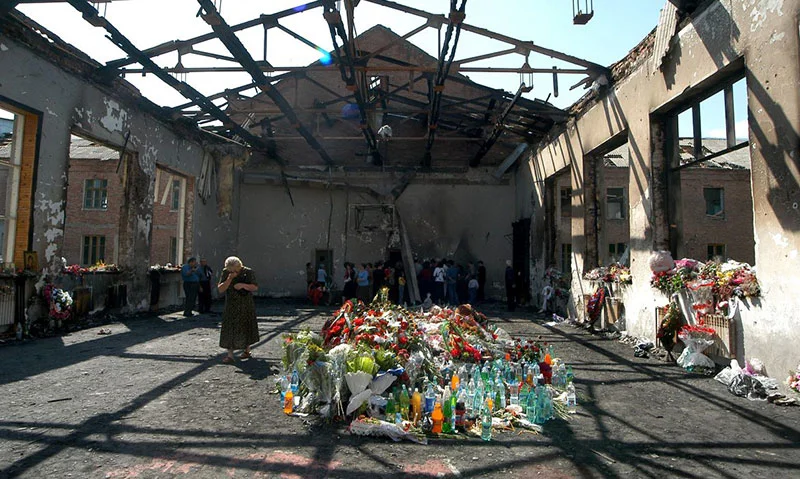
The ruins of School Number One’s gymnasium were preserved as a memorial. The space where over one thousand people were held hostage for fifty-two hours, where bombs hung over children’s heads, where the roof collapsed in an inferno, stands today as an open-air monument to the dead. The walls bear photographs, flowers, toys, and personal remembrances. The gymnasium’s remains are covered by a transparent roof that allows visitors to look down on the memorial space. The cemetery where the Beslan dead are buried has become a place of national and international pilgrimage. On the first anniversary in September 2005, and on each subsequent anniversary, thousands of people gather to remember. The fifth anniversary in September 2009 drew more than 2,500 people to the school memorial.
Internationally, Beslan produced significant shifts in counterterrorism doctrine, hostage negotiation methodology, and school security planning. The siege demonstrated with terrible clarity that terrorist organizations were willing and able to plan operations targeting children as primary victims, not merely incidental casualties, and that the conventional assumption that hostage-takers would ultimately prefer to negotiate rather than die had catastrophically failed in this case. Security agencies across the world reviewed their protocols for responding to mass hostage situations in schools and other civilian buildings. The question of when and how to use force in a hostage crisis, and what level of risk to rescuers is acceptable versus the risk to hostages of inaction, became the subject of intense study in counterterrorism and crisis management communities.
Beslan also had a profound effect on how the broader international community understood the Chechen conflict and Russia’s response to it. For many Western observers, Beslan was unambiguously an act of monstrous terrorism that deserved the condemnation of the civilized world. The deliberate targeting of children as primary victims placed the event beyond any political justification. At the same time, human rights advocates and experts on the North Caucasus region argued that the seizure had not occurred in a political or historical vacuum, that it was the product of a decade and a half of warfare, mass atrocity, and the denial of political rights to the Chechen people, and that the Russian government’s own conduct in Chechnya had helped generate the extremism that culminated in Beslan. These two perspectives were not mutually exclusive, but they were often treated as such in the political debate that surrounded the aftermath.
North Ossetia, Ingushetia, and the Ethnic Dimensions of Beslan
The Beslan massacre took place within a complex web of ethnic tensions that extended beyond the Chechen conflict. North Ossetia, where Beslan is located, and neighboring Ingushetia had been locked in a bitter territorial dispute since the early 1990s over the Prigorodny District, a conflict inflamed by the 1944 Stalinist mass deportations of the Ingush people and by a brief but bloody war in 1992 to 1993 in which Ingush were ethnically cleansed from North Ossetia with assistance from Russian military forces. The fact that a significant majority of the Beslan attackers were identified as ethnic Ingush, not Chechen, introduced this older layer of regional grievance into the analysis of the attack’s motivations. Basayev, who was Chechen, had recruited heavily from Ingush communities in planning the operation, and the choice of a North Ossetian school as the target carried a message aimed at the Ossetian-Ingush dimension of North Caucasus politics as much as at Moscow itself.
The immediate aftermath of Beslan brought real danger of retaliatory ethnic violence. The Russian public and the North Ossetian community were consumed by fury, and there was widespread expectation that the massacre would trigger a spiral of inter-ethnic killing in the already volatile North Caucasus. That catastrophe, at least, did not materialize. As researcher Debra Javeline of the University of Notre Dame documented in her extensive survey of Beslan victims and survivors, the massacre instead triggered an unexpected wave of non-violent political activism among Beslan families. Rather than seeking revenge through violence, the community channeled its anger into political pressure, legal challenge, and organized civic advocacy, producing the Mothers of Beslan movement and the European Court of Human Rights litigation. This outcome, remarkable given the scale of the trauma and the pressure toward ethnic retribution, became itself an important subject of study in the fields of post-conflict recovery and transitional justice.
A Complete Historical Timeline of the Beslan School Siege
The following provides a comprehensive chronological record of the key dates and events of the Beslan school siege and its aftermath. On June 21, 2004, Shamil Basayev personally commanded an attack by more than 200 fighters on the Ingushetian capital of Nazran, killing nearly 100 people including several government ministers, in what was the largest Chechen operation since 1999. On August 24, 2004, two female suicide bombers from Basayev’s network simultaneously brought down two Russian passenger aircraft, Volga-AviaExpress Flight 1353 and Siberian Airlines Flight 1047, killing all eighty-nine passengers and crew on board. On August 31, 2004, a suicide bomber killed at least ten people outside a subway station in Moscow. On September 1, 2004, at approximately 9:00 a.m., thirty-two armed militants stormed School Number One in Beslan, North Ossetia, taking more than 1,100 people hostage, including 777 children. Eight people were killed in the initial assault and ten male hostages were executed immediately afterward.
On September 1, 2004, at approximately 4:40 p.m., twelve children and one adult escaped after hiding in a school boiler room. At 9:30 p.m., pediatric surgeon Leonid Roshal arrived and attempted to negotiate, offering safe passage and an exchange of hostages. The offers were refused. On September 2, 2004, former Ingushetian President Ruslan Aushev entered the school and secured the release of twenty-six hostages, comprising fifteen babies and eleven nursing mothers. He brought out a note from Basayev addressed to Putin, which Russian authorities suppressed and denied existed. On the night of September 2 to 3, negotiations through intermediaries continued without producing agreement. On September 3, 2004, at approximately 1:05 p.m., two massive explosions ripped through the gymnasium. The gymnasium roof collapsed. Russian commandos from Alfa and Vympel stormed the school. Fighting continued for hours. By 2:30 p.m. commandos had taken control of most of the building. By 3:17 p.m. hostage evacuation was underway. By 6:50 p.m. all terrorists were killed except one. By 8:15 p.m. all attackers were confirmed suppressed.
On September 3, 2004, at 5:35 p.m., Nur-Pashi Kulayev, the sole surviving attacker, was captured after nearly being lynched. Final casualty figures: 334 dead including 186 children, more than 700 wounded, 31 of 32 attackers killed, 10 Russian special forces commandos killed. On September 4, 2004, Putin flew to Beslan and visited hospitals briefly before returning to Moscow. On September 6 and 7, a two-day national mourning period was observed across Russia, with 135,000 attending a rally in Red Square. On September 17, 2004, Shamil Basayev publicly claimed responsibility for the attack, stating it cost 8,000 euros. On November 2004, Russia announced that twenty-seven of the thirty-two attackers had been identified. The Riksdag-equivalent Russian parliament convened the Torshin Commission to investigate. On May 18, 2005, the trial of Nur-Pashi Kulayev opened before a North Ossetian court. On May 16, 2006, Kulayev was found guilty of terrorism, murder, and hostage-taking. On May 26, 2006, Kulayev was sentenced to life imprisonment. On July 10, 2006, Shamil Basayev was killed in Ingushetia when a truck loaded with explosives detonated. On December 22, 2006, the Torshin Commission released its report, absolving Russian authorities of all blame. On November 2007, more than 350 Beslan family members filed suit against Russia at the European Court of Human Rights. On September 1, 2009, more than 2,500 people gathered for the fifth anniversary memorial at the school ruins. On April 13, 2017, the European Court of Human Rights ruled that Russia had violated human rights law and ordered Russia to pay approximately 3.1 million US dollars in damages to 409 victim families. Russia condemned the ruling as unacceptable and declined to implement it fully.