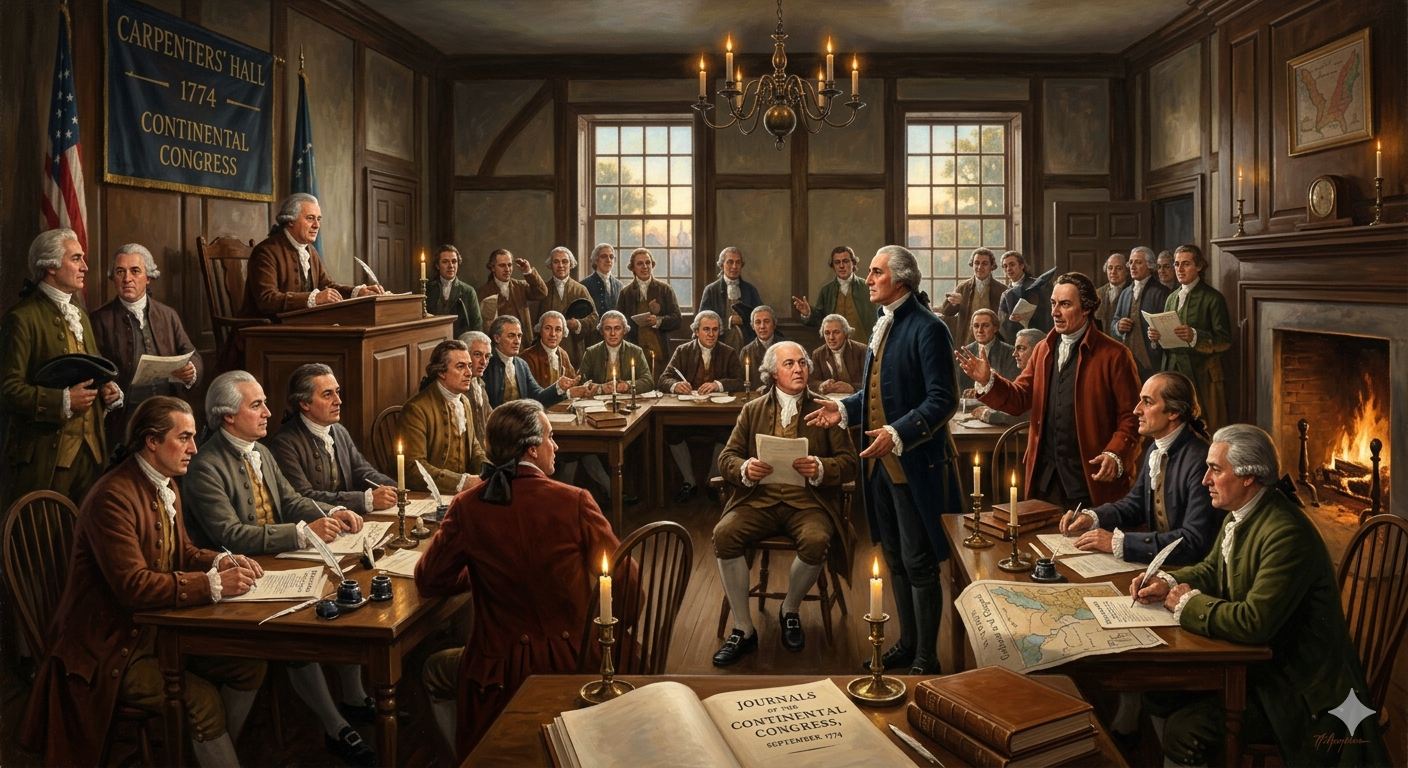
On the morning of September 5, 1774, fifty-six delegates from twelve of Britain’s thirteen American colonies gathered at Carpenters’ Hall in Philadelphia, Pennsylvania. They had come from as far north as New Hampshire and as far south as South Carolina, traveling by carriage and on horseback over roads that tested both man and animal. They were lawyers, merchants, planters, and politicians, bound together not by a shared vision of what America should become but by a shared outrage at what Britain had done. What they assembled to address was a constitutional crisis that had been building for more than a decade. What they created, without fully intending it, was the first governing body of what would become the United States of America.
The First Continental Congress convened in response to the Intolerable Acts, a series of punitive laws passed by the British Parliament in the spring of 1774 to punish Massachusetts for the Boston Tea Party and to restore British authority over the increasingly restive colonies. The Congress met from September 5 to October 26, 1774, fifty-one days of debate, negotiation, and document drafting that produced the Continental Association, the Declaration and Resolves, and a direct petition to King George III. None of these documents achieved their immediate aim of persuading Britain to rescind its coercive legislation. But the act of convening, the experience of colonies sitting together and speaking with one voice, created the institutional foundation on which independence and nationhood were eventually built.
The Intolerable Acts and the Road to Philadelphia
The chain of events that brought fifty-six delegates to Carpenters’ Hall in September 1774 began in the early morning hours of December 16, 1773, when a group of colonists dressed as Mohawk Indians boarded three ships in Boston Harbor and dumped 342 chests of East India Company tea into the water. The Boston Tea Party, organized by the Sons of Liberty in response to the Tea Act’s grant of a monopoly to the East India Company, was an act of direct political resistance that the British government under Prime Minister Lord North could not ignore without appearing to yield to colonial lawlessness.
Parliament’s response was the series of laws that colonists immediately branded the Intolerable Acts. The Boston Port Act closed the port of Boston to all commerce until the destroyed tea was paid for, immediately strangling the economic life of a city that depended entirely on maritime trade. The Massachusetts Government Act effectively suspended the colony’s charter, replacing elected local government with Crown appointees and restricting town meetings to one per year without royal permission. The Administration of Justice Act allowed British officials accused of crimes committed in the course of enforcing British law to be tried in Britain or in another colony rather than in Massachusetts, where local juries could not be trusted to convict them. The Quartering Act required colonists to provide housing for British soldiers in buildings other than their homes, but the practical effect was still the billeting of troops at colonial expense. Parliament simultaneously passed the Quebec Act, which extended the territory of Quebec southward into lands claimed by several colonies and granted religious rights to French Catholics, inflaming Protestant sensibilities throughout British America.
The critical insight that drove colonial leaders to call a continental congress was that the Intolerable Acts, though aimed primarily at Massachusetts, threatened every colony. As John Adams later wrote, what was done to Massachusetts today could be done to any colony tomorrow. If Parliament could revoke a colonial charter and suspend self-government in one colony, it could do so in all of them. The shared threat of arbitrary power provided the common ground that made the First Continental Congress possible.
Virginia’s Committee of Correspondence is credited with issuing the first call for a general congress of the colonies, and the idea spread rapidly through the colonial networks of communication. By the summer of 1774, nine colonies had already called for such a gathering. Connecticut was the first colony to formally respond to the call and elect delegates. Philadelphia, as the largest and most central city in British North America, was the obvious venue. Benjamin Franklin, who had put forward the idea of a colonial congress the year before, was in England and would not attend, but he worked from London to advance the colonial cause in British political circles.
Carpenters’ Hall, Peyton Randolph, and the Opening of the Congress
The delegates gathered on the morning of September 5 at Philadelphia’s City Tavern, near Benjamin Franklin’s home, before walking together to Carpenters’ Hall. The choice of venue was itself a political statement. Carpenters’ Hall had just been completed and was the home of the Carpenters’ Company, the guild of Philadelphia’s skilled craftsmen. Pennsylvania’s delegation had been expected to offer the Pennsylvania State House, the larger and more prestigious building that would later become Independence Hall, but the State House was occupied by the Pennsylvania provincial assembly. The delegates inspected Carpenters’ Hall and voted to hold their sessions there, a choice that signaled both the practical and symbolic character of the gathering: this was not yet the official business of established government but the extraordinary action of a people asserting their rights.
On the opening day, Peyton Randolph of Virginia was unanimously elected president of the Congress, establishing both the title “president” and the title “Congress” in American political usage. Randolph was an eminent Virginia lawyer and planter, a former speaker of the Virginia House of Burgesses, and a man of the moderate conservative temperament that made him a unifying choice. His distant cousin Thomas Jefferson had written an essay for the Virginia delegation that was published as A Summary View of the Rights of British America, but Jefferson himself was not a delegate. The Virginia delegation was considered the most eminent group of men from any single colony, including as it did Patrick Henry and George Washington alongside Randolph.
Charles Thomson, a leader of the Philadelphia Committee of Correspondence, was elected secretary of the Congress and would continue in that role through the fifteen-year life of the Continental Congress, eventually serving as secretary to the new nation itself until 1789. The rules adopted on the opening days were designed to protect the equality of participants and encourage free debate: each colony would have one vote regardless of its size or population, and delegates were encouraged to speak their minds without partisan constraint.
The Wikipedia article on the First Continental Congress covers the full proceedings of the Congress, the debates among delegates, and the documents produced between September 5 and October 26, 1774.
The Delegates: A Gallery of Founding Figures
The fifty-six men who attended the First Continental Congress included some of the most significant figures in American history. Their gathering in Philadelphia in 1774 constituted an extraordinary concentration of talent and conviction.
From Massachusetts came Samuel Adams, the veteran political agitator who had organized colonial resistance to British taxation for more than a decade, and his second cousin John Adams, a thirty-eight-year-old lawyer of formidable intellectual gifts who would later become the second president of the United States. John Adams’s diary from the Congress records his impressions of the other delegates with characteristic precision and occasional acidity, providing one of the most vivid firsthand accounts of the gathering.
Virginia sent a delegation of exceptional distinction. George Washington, then forty-two years old and already one of the most respected figures in colonial America for his service in the French and Indian War, attended as a delegate alongside Patrick Henry, whose oratorical powers were legendary in Virginia. Henry, who had electrified his colony with his speeches against the Stamp Act nearly a decade earlier, arrived in Philadelphia already convinced that armed conflict was likely and that preparation was necessary. Washington, characteristically more reserved in public expression, left Philadelphia having quietly purchased muskets and military equipment before returning to Mount Vernon, a private signal of his own assessment of where events were heading.
From New York came John Jay, who was thirty-eight years old and already a prominent New York lawyer, and who would later serve as the first Chief Justice of the United States and as a key negotiator of the Treaty of Paris that ended the Revolutionary War. From Pennsylvania came John Dickinson, who had achieved colonial fame with his Letters from a Farmer in Pennsylvania, written in the late 1760s, and Joseph Galloway, who represented the conservative wing of colonial politics and who would eventually remain loyal to the Crown. Richard Henry Lee of Virginia and Roger Sherman of Connecticut rounded out a remarkable assembly of talent.
Georgia was the one colony entirely absent. Governor James Wright had managed to prevent Georgia from sending delegates, in part because Georgia depended on British military support against Creek Indian raids on its frontier settlements and could not afford the rupture with the Crown that participation in the Congress might imply. The British government took careful note of Georgia’s abstention. As a practical political matter, it changed little: the Congress still represented the overwhelming majority of the colonial population.
The Suffolk Resolves and the First Signal of Radical Intent
One of the First Continental Congress’s most consequential early actions revealed the underlying mood of the gathering with striking clarity. On September 16, 1774, just eleven days after the Congress convened, Paul Revere arrived in Philadelphia carrying a document drafted in Suffolk County, Massachusetts, home of Boston. The Suffolk Resolves, as the document was called, were among the most radical political statements produced anywhere in the colonies since the beginning of the constitutional crisis.
The Resolves declared the Intolerable Acts unconstitutional and therefore not binding on Massachusetts citizens. They called for a complete boycott of British goods. They urged Massachusetts citizens to form their own militia and prepare for the possibility of armed resistance. They effectively declared that Massachusetts would not obey laws it regarded as tyrannical. The document had been written by Dr. Joseph Warren, one of the most gifted and committed leaders of the Massachusetts Patriots, who would die at the Battle of Bunker Hill less than a year later.
Congress’s endorsement of the Suffolk Resolves, achieved by a vote on September 17, was an extraordinary act. The most radical elements of the Massachusetts position, including the call for militia preparation and the declaration of the Intolerable Acts as unconstitutional, had been adopted as the position of all twelve represented colonies. Joseph Galloway, who was working to steer the Congress toward a plan for reconciliation that would have created a new American parliament within the British Empire, was devastated by the endorsement of the Suffolk Resolves. His own Plan of Union, presented several days later, proposed exactly the kind of structural compromise that many hoped could prevent rupture. It was defeated by a single vote and its proceedings were expunged from the record, an indication of how close the moderate position had come to prevailing and how decisively the radical faction had carried the day.
The George Washington’s Mount Vernon account of the First Continental Congress describes how the delegates organized their work, the key debates over strategy, and Washington’s own preparations during and after the Congress that indicated his personal assessment of likely military conflict.
The Continental Association and the Declaration and Resolves
The two most important documents produced by the First Continental Congress were the Continental Association, adopted on October 20, and the Declaration and Resolves, which stated the colonists’ constitutional position in comprehensive terms.
The Continental Association was a compact among the twelve colonies to impose a coordinated economic boycott on British goods. Nonimportation of British goods would take effect on December 1, 1774. If the Intolerable Acts had not been repealed by September 1775, nonexportation of American products to Britain would also begin. The Association also prohibited the importation of enslaved persons beginning December 1, a provision that would have functionally ended the slave trade in the colonies thirty-three years before it was actually abolished if the Association had been sustained. Critically, the Association established enforcement mechanisms: local committees of inspection were to be organized in every county and town to monitor compliance and publicly name violators, creating a system of social and economic pressure that reached into every community.
The Declaration and Resolves articulated the constitutional case for colonial rights in terms that drew on both English common law and natural rights philosophy. It asserted that the colonists were entitled to life, liberty, and property, that they had the rights of Englishmen including trial by jury and freedom from taxation without representation, and that Parliament’s recent legislation had violated these rights in numerous specific ways. It affirmed loyalty to the Crown while challenging the authority of Parliament over the colonies’ internal affairs. It listed fourteen specific acts of Parliament since 1763 that the Congress declared objectionable, including the Stamp Act, the Townshend Acts, the Tea Act, and all four of the Intolerable Acts.
The Congress also adopted a formal Petition to the King on October 26, the final day of the session. The petition addressed George III directly, carefully avoiding any criticism of the King himself while cataloguing the grievances caused by Parliament’s legislation. The decision not to petition Parliament directly reflected the colonists’ view that Parliament was the aggressor: petitioning the body that had offended them would have implied its legitimacy over them, which was precisely the point at issue. Benjamin Franklin delivered the petition to the King in London in late 1774. The petition received no formal reply.
The Constitution Center’s account of the First Continental Congress describes the debates among delegates, the choice of Carpenters’ Hall over Independence Hall, and the full range of documents produced between September 5 and October 26, 1774.
The Congress Adjourns and Plans for a Second Meeting
When the First Continental Congress adjourned on October 26, 1774, its work was framed as a conditional achievement rather than a final one. The delegates had agreed to reconvene on May 10, 1775, if Britain had not satisfactorily responded to their grievances by that time. This provision, almost certainly expected by most delegates to be triggered, built into the First Congress’s action a mechanism for escalation that acknowledged the likely inadequacy of petitions and boycotts alone.
The British government’s response was predictably inadequate. On November 30, 1774, King George III opened Parliament with a speech condemning Massachusetts and the Suffolk Resolves. Parliament took no official notice of the Congress’s petitions and addresses. Prime Minister Lord North’s government debated possible concessions but ultimately offered nothing that the colonial leadership could accept, making the second Congress inevitable and the continuation of the constitutional crisis certain.
George Washington returned to Mount Vernon from Philadelphia having quietly purchased muskets and a book on military discipline during his stay, private preparations that said more about his assessment of British intentions than any speech he made on the Congress floor. Patrick Henry, more openly, told his fellow Virginians on the way home that war was coming. Samuel Adams, who had spent years preparing Massachusetts for exactly this confrontation, arrived home convinced that the boycott would not be enough and that only force would resolve the question. John Adams, more analytical, spent the autumn and winter writing under the pseudonym “Novanglus” to rebut Loyalist arguments about the constitutional relationship between Parliament and the colonies.
The Britannica article on the Continental Congress covers the full institutional history of the Continental Congress from its convening in 1774 through the ratification of the Articles of Confederation and the creation of the framework that governed the United States until the Constitution replaced it.
The battles of Lexington and Concord on April 19, 1775, transformed the constitutional crisis into a military conflict before the Second Congress convened. When delegates gathered in Philadelphia on May 10, they were not coming to negotiate but to organize a war. They formed the Continental Army, appointed George Washington as its commander, and set in motion the sequence of events that produced the Declaration of Independence in July 1776. The First Continental Congress had not called for independence. Most of its delegates in September 1774 genuinely hoped for reconciliation within the British Empire. But by creating the institutional framework for collective colonial action, by establishing the precedent that the colonies could act together as a single political unit, and by developing the documents and arguments that defined American rights in terms Parliament would not accept, it had made independence not inevitable but entirely possible.
The National Archives Pieces of History account of the First Continental Congress provides the archival context for the Congress’s documentary record, including the Articles of Association and the records preserved in the National Archives that constitute the official legacy of the gathering.
What assembled in Carpenters’ Hall on September 5, 1774, was not a revolutionary body in its own self-understanding. It was a collection of British subjects exercising their right to remonstrate against their government’s transgressions. It became revolutionary not by intent but by circumstance, not because its members planned independence but because Britain gave them no alternative. The fifty-six men who gathered in Philadelphia that September day did not know they were founding a nation. They thought they were defending one.