
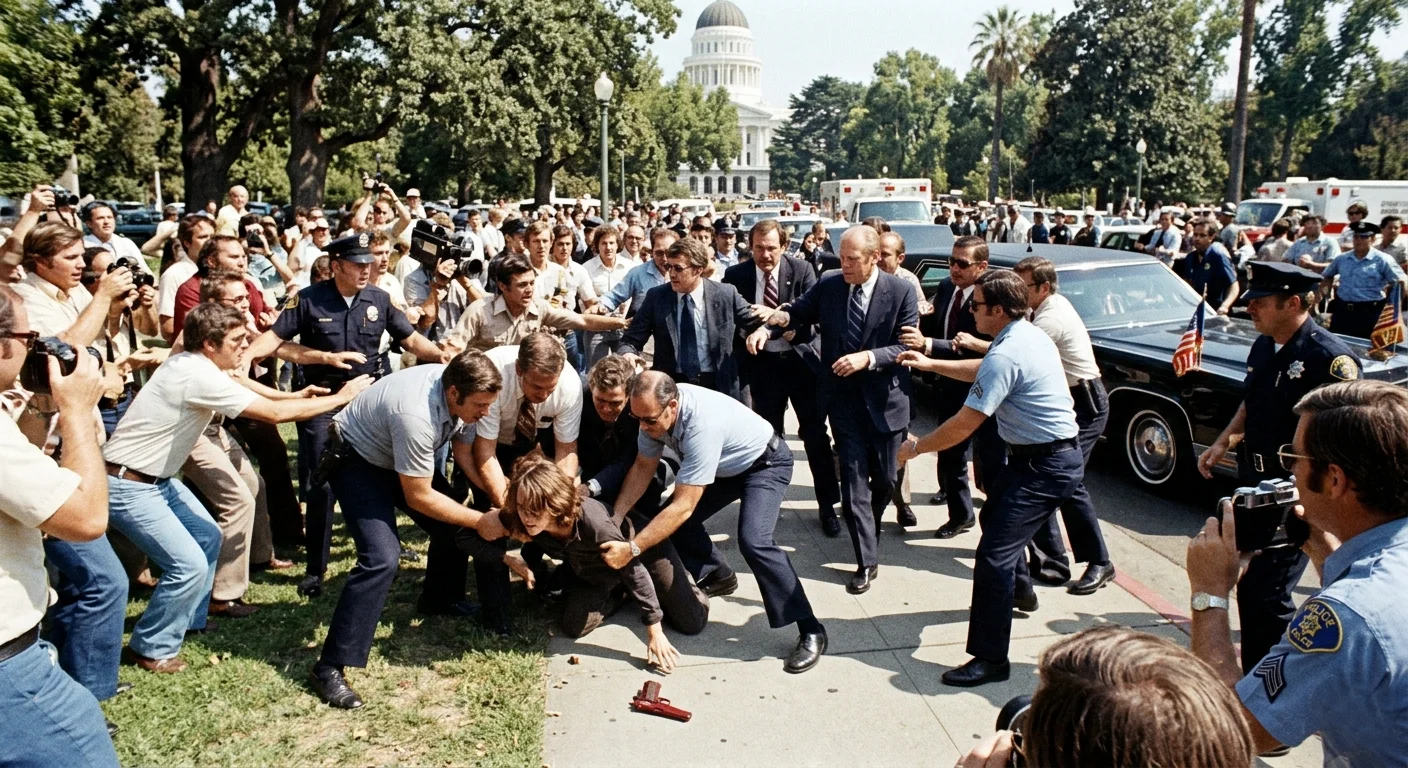
On the morning of September 5, 1975, President Gerald R. Ford stepped out of the Senator Hotel in Sacramento, California, and began walking the two blocks to the nearby California State Capitol building. He was there to meet with Governor Jerry Brown and to address the California state legislature. It was a crisp September morning, and the sidewalks were lined with citizens who had come out to see the president. Ford, characteristically accessible and good-natured with the public, moved along the crowd shaking hands. He later recalled the moment with characteristic plainness: “I went to shake a hand, looked down, and instead of a hand to be shaken, it was a gun pointed directly at me.”
The gun was a Colt M1911 semi-automatic .45-caliber pistol. The woman holding it was Lynette Alice Fromme, twenty-six years old, a member of the Charles Manson Family cult, dressed in a red robe and wearing her red hair in braids beneath a white cap. She had attached the holstered weapon to her leg that morning, joined the crowd gathering around Ford, and raised the gun toward him from a distance of approximately two feet. Before she could fire, Secret Service agent Larry Buendorf grabbed the weapon, physically inserting the membrane of skin between his thumb and forefinger between the gun’s hammer and the firing pin, preventing any possibility of discharge. Other agents tackled Fromme and wrestled her to the ground. The weapon had four rounds in the magazine but none in the chamber. Fromme had not loaded a round before raising the gun.
President Ford was unhurt. He continued to the Capitol, met with Governor Brown, and delivered his address to the legislature. The main topic of his speech was crime.
Gerald Ford: An Accidental President in a Nation Under Stress
To understand the context that produced two assassination attempts against Gerald Ford in September 1975, it is necessary to understand the extraordinary circumstances of his presidency and the fractured state of the American political landscape in those years.
Gerald Rudolph Ford had never been elected to a national office. He had served for twenty-five years as the Republican congressman from Michigan’s Fifth Congressional District, becoming House Minority Leader in 1965. In October 1973, following the resignation of Vice President Spiro Agnew over bribery and tax evasion charges, Ford was nominated by President Richard Nixon and confirmed by Congress as Vice President under the provisions of the recently ratified Twenty-Fifth Amendment, the first person in American history to become Vice President through that process.
On August 9, 1974, Nixon himself resigned from the presidency in the wake of the Watergate scandal, making Ford the only person in American history to serve as both Vice President and President without having been elected to either office. Ford was a genuinely decent and modest man who was popular with colleagues across party lines, and his first weeks in office brought a wave of goodwill relief after the toxic drama of Watergate. That goodwill evaporated on September 8, 1974, when Ford granted Nixon a full, unconditional pardon for all crimes he might have committed during his presidency. The pardon was politically devastating. Ford’s approval rating dropped twenty-one points in a single week.
The America Ford governed was a nation in deep institutional distress. Vietnam remained an open wound. The economy was suffering through a severe recession and soaring inflation simultaneously. The Watergate revelations had destroyed public confidence in government on a fundamental level. The counterculture of the 1960s had unleashed social forces that the political mainstream had not absorbed, and in the spaces between those forces, radical and eccentric movements flourished. The Manson Family was the most notorious product of the darker end of that counterculture.
Lynette Fromme, the Manson Family, and the Path to Sacramento
Lynette Alice Fromme was born on October 22, 1948, in Santa Monica, California. She had a difficult relationship with her father, a military man with strict standards, and as a teenager she drifted away from home. At seventeen, she was living on the streets of Venice Beach when she encountered Charles Manson, then recently released from prison, who approached her with the practiced empathy of a skilled manipulator and offered her a sense of belonging she had not found elsewhere. She became one of his most devoted followers, earning the nickname “Squeaky” from Manson because of the sound she made when he tickled her.
Fromme was one of the female members of the Manson Family who remained loyal to Manson after the conviction of the group’s leaders for the 1969 Tate-LaBianca murders. Those murders, in which Manson’s followers killed actress Sharon Tate, coffee heiress Abigail Folger, hairstylist Jay Sebring, aspiring screenwriter Wojciech Frykowski, and Steven Parent in one night at Tate’s Los Angeles home, and then killed grocery store owner Leno LaBianca and his wife Rosemary the following night, were among the most sensational crimes in American history. Manson and several followers were sentenced to death, commuted to life imprisonment when California briefly abolished the death penalty in 1972.
After Manson’s imprisonment, Fromme and other female followers continued to demonstrate their devotion to him in various ways, including literally camping outside the courthouse during the trial and carving X-marks into their foreheads as Manson had done. By 1975, Fromme was living in Sacramento with Sandra Good, another long-time Manson Family member, in an attic apartment at 1725 P Street. The two women had established what they called the International People’s Court of Retribution, an organization they claimed was dedicated to threatening corporate executives and political leaders who harmed the environment.
Fromme’s specific grievance that brought her to Sacramento’s Capitol grounds on September 5, 1975, was an intense concern about the giant coastal redwood trees of California, which she believed were being killed by automobile smog reaching their rural locations. She had traveled to San Francisco to plead with government officials to save the trees and had been ignored. When she returned home to Sacramento and learned from news coverage that President Ford was coming to the city, she made a decision. As she later explained: “My original thought was ‘I’ll go and talk to him,’ but then I realized you don’t get attention for that.”
The Wikipedia account of the attempted assassination of Gerald Ford in Sacramento provides the detailed reconstruction of Fromme’s planning and movements in the weeks leading up to September 5, including her acquisition of the gun from retired federal employee Harold “Zeke” Boro and her stated environmental motivations.
How Fromme Got the Gun and Planned the Attack
The weapon Fromme carried on September 5, 1975, had come from Harold Elbert “Zeke” Boro, a sixty-five-year-old retired federal government engineering draftsman who had attached himself to the Manson Family circle in Sacramento and supplied the group with money and favors in a relationship of pathetic dependency. Boro had befriended Fromme in 1974 in a Sacramento park, lent her his car, bought her a red Volkswagen after she wrecked the first car, and generally served as the kind of exploited benefactor that charismatic cult personalities naturally attract.
When Fromme told Boro she needed a gun for protection from Manson’s enemies, he showed her his M1911 pistol and explained how to operate it. She walked out with the gun, the magazine, and approximately twenty-five rounds of ammunition over his protests. A month before the assassination attempt, she had also been arrested and then released after police received a tip that she possessed a firearm and had made threatening statements. The investigation did not result in charges that would have prevented what followed.
On the morning of September 5, Fromme dressed in a long red robe that covered the holstered weapon strapped to her leg. She later said she was ambivalent about her plan as Ford approached, initially not wanting to follow through, but deciding at the last moment to proceed. Ford himself noticed her in the crowd before the confrontation: “I couldn’t help but notice a lady in a very vivid red dress who kept following me,” he recalled afterward. When he turned to shake her hand, she raised the pistol directly toward him from a distance of roughly two feet.
Secret Service agent Larry Buendorf’s intervention was immediate and precise. By inserting his hand between the gun’s hammer and the firing pin, he made the weapon physically incapable of discharging even if Fromme had pulled the trigger. Other agents tackled her. She was arrested on the spot. The entire incident lasted only seconds.
Ford’s Reaction and the Immediate Aftermath
President Ford’s composure in the immediate aftermath of the attempt has been noted by historians as characteristic of the man. He continued his scheduled activities, walking to the Capitol, meeting Governor Jerry Brown, and delivering his address to the legislature. He did not mention the attempt during his meeting with Brown. Only later, when he returned to Washington, did Ford and his family gather in the White House residence to watch television coverage of what had happened.
First Lady Betty Ford later recalled that when she learned of the attack, her anxiety deepened profoundly. She described worrying about her husband’s safety every time he attended a public event afterward, a constant background fear that would have seemed alien just weeks earlier. The attack imposed a psychological burden on the Ford family that the public composure they maintained could not entirely conceal.
The Secret Service’s public response was notably understated. Officials announced “no major changes” would be made to presidential security protocols following the attempt, a statement that may have reflected genuine institutional assessment or may have been a deliberate effort to avoid projecting vulnerability. Behind the scenes, discussions between security personnel and political aides grew contentious over a scheduled Ford appearance at an AFL-CIO convention in San Francisco, and modified protocols were quietly adopted.
The History.com article on Gerald Ford’s two assassination attempts in 1975 covers both the Sacramento and San Francisco incidents, the security implications of both attempts, and the broader political context of Ford’s vulnerable presidency during one of the most turbulent periods in modern American history.
The Trial, the Conviction, and a Life Sentence
Lynette Fromme was charged with attempted assassination of the President of the United States under the terms of a federal statute making such an attempt a crime regardless of whether any shot was fired or any actual harm was done to the president. The trial was held in Sacramento. Fromme was a difficult defendant: she was disruptive in the courtroom, insisted on her right to speak without being represented by an attorney, and used her public platform to make statements about environmental destruction and the redwoods rather than addressing the charge she faced.
President Ford provided a taped deposition for the prosecution rather than appearing in person, describing the moment when he had looked down and seen a gun rather than a hand. The jury deliberated and returned a conviction on November 26, 1975. Fromme was sentenced to life in prison, to be served at the Federal Correctional Institution at Alderson, West Virginia.
Fromme remained a committed Manson devotee throughout her incarceration. In 1979, she escaped from Alderson after learning that Manson was reportedly ill with cancer, attempting to reach him. She was captured within two days, about two miles from the prison, and her parole eligibility was set back significantly by the escape. Her behavior during the prison years was generally cooperative otherwise, and she maintained her devotion to environmental causes and to the memory of the Manson Family’s philosophical framework.
On August 14, 2009, more than thirty-four years after the Sacramento incident, Fromme was released on parole. Gerald Ford had died on December 26, 2006, nearly three years before her release, and had been buried with full honors at the Gerald R. Ford Presidential Museum in Grand Rapids, Michigan. The Colt M1911 pistol she had aimed at him was donated to the Museum and placed on display, one of the more unusual artifacts in any presidential museum’s collection.
Seventeen Days Later: Sara Jane Moore and the Second Attempt
The Ford assassination attempt of September 5, 1975 is remarkable enough on its own terms, but it gains an additional dimension from what happened just seventeen days later. On September 22, 1975, in San Francisco, California, a forty-five-year-old woman named Sara Jane Moore raised a .38-caliber revolver and fired at President Ford as he was leaving the St. Francis Hotel. A former Marine and Vietnam veteran named Oliver Sipple, standing in the crowd, instinctively grabbed Moore’s arm as she raised the gun, deflecting her aim. The bullet missed Ford by approximately five feet.
Sara Jane Moore was a very different figure from Fromme. She was a former FBI informant who had been embedded in San Francisco radical circles, a woman with a history of mental instability and ideological confusion who had apparently decided to prove her radical credentials by attempting to kill the president. Moore was charged, convicted, and sentenced to life in prison. She was paroled in 2007 after serving more than thirty years. Ford personally thanked Oliver Sipple publicly three days after the San Francisco incident, though Sipple’s life was complicated by the public attention the event brought him.
The fact that Gerald Ford, an accidental president who had never sought the office and who brought to it nothing but decent intentions and a genuine desire to help the country recover from Watergate, survived two assassination attempts in seventeen days by two women in California remains one of the stranger episodes in American presidential history.
The Britannica account of Lynette Fromme and her connection to the Manson Family covers Fromme’s background, her relationship with Charles Manson, her actions at Sacramento, and her subsequent incarceration and eventual release on parole.
The Legacy of the Fromme Attempt and Its Place in American Security History
The Fromme assassination attempt at Sacramento was not the product of any organized political movement or conspiracy. It came from the intersection of a deeply disturbed individual, a cult that had weaponized alienated young people, and a political moment in which American institutions had lost credibility and social bonds were frayed. Fromme’s stated motivation, protecting redwood trees from automotive smog, was so obliquely connected to any presidential action that it underscored how far her reasoning had separated from conventional political cause and effect.
What the attempt did accomplish, paradoxically, was to demonstrate the effectiveness of the Secret Service protection that the less formal side of Ford’s public engagement style had been testing. Agent Buendorf’s intervention was precisely the kind of trained instinctive response that presidential security is designed to produce, and it worked. The protocols that followed, modest though the public announcements were, shifted Ford’s engagements toward less informal public contact, reducing the opportunities for future incidents.
The National Archives Gerald R. Ford Presidential Library resources on the September 1975 assassination attempts preserve the primary documents, photographs, and physical artifacts from both attempts, including the M1911 pistol used by Fromme and the bulletproof trench coat issued to Ford by the Secret Service in October 1975 following the two attempts.
Gerald Ford served the remainder of his term without further incident and lost the 1976 presidential election narrowly to Jimmy Carter. He retired to Grand Rapids and then to Rancho Mirage, California, and lived a long and quietly distinguished post-presidential life until his death at ninety-three, remaining the longest-lived former president in American history at the time of his death. He never appeared to harbor bitterness about either assassination attempt. He had, as his security team observed at the time, refused to live in fear, and that refusal was as characteristic of the man as anything else in his public record.