
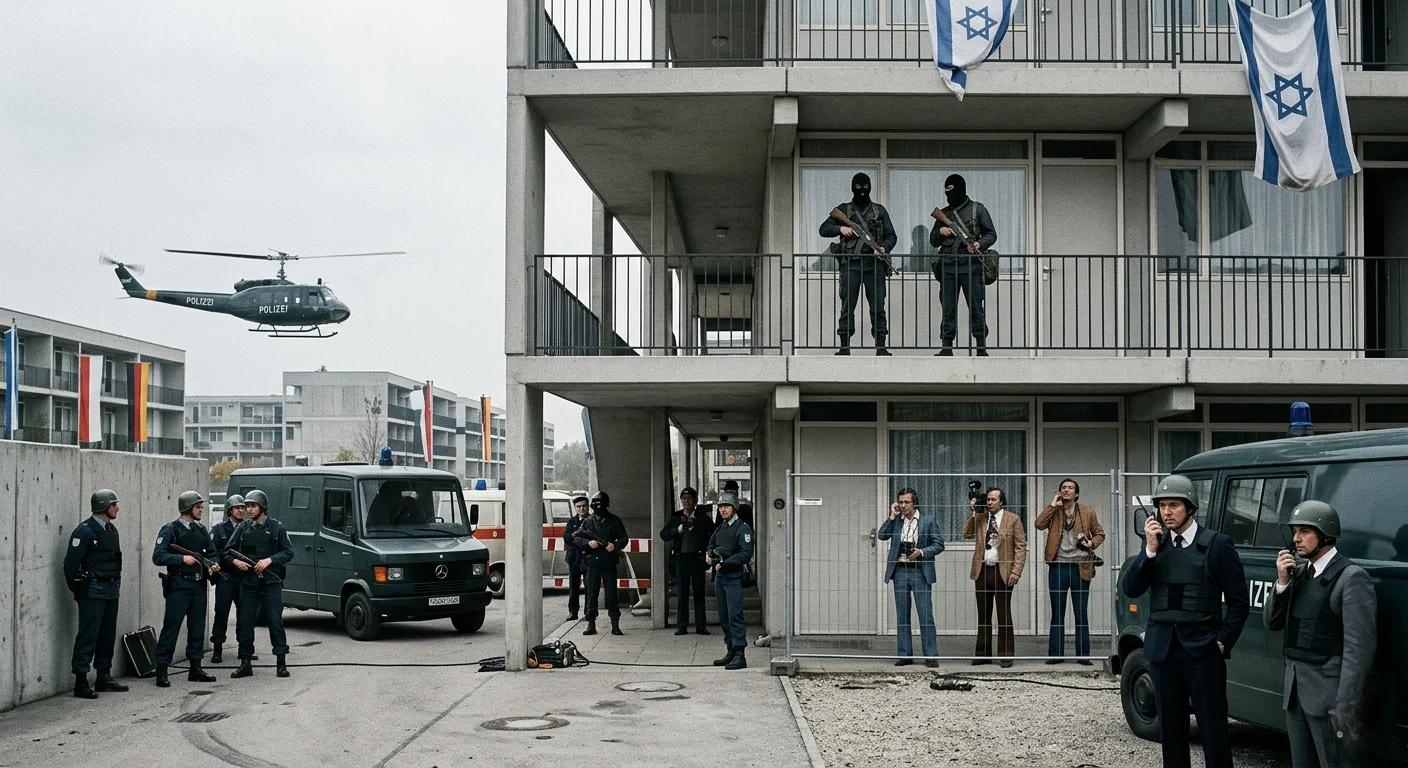
In the early hours of Tuesday, September 5, 1972, eight men in tracksuits climbed over the two-meter chain-link fence surrounding the Olympic Village in Munich, West Germany. They were carrying duffel bags packed with AKM assault rifles, Tokarev pistols, and hand grenades. They had been living in Munich for months, had carefully scouted the Olympic Village, and knew exactly which building and which apartments housed the Israeli Olympic team. They were members of Black September, a Palestinian terrorist organization affiliated with the Palestine Liberation Organization. Their operation had a name: “Iqrit and Biram,” after two Palestinian Christian villages whose inhabitants had been expelled in 1948. What they were about to do would be watched live by an estimated 900 million people, shock the world, and change international security and counterterrorism forever.
By the time the twenty hours of hostage crisis and failed rescue operation came to a catastrophic end early on September 6, eleven members of the Israeli Olympic team were dead, one West German police officer had been killed, and five of the eight terrorists had been shot. Germany’s attempt to present these Games as a redemptive celebration of peaceful internationalism, carefully designed to erase the memory of the propaganda spectacle the Nazis had staged at the 1936 Berlin Olympics, lay in ruins. The Munich massacre remains the most devastating terrorist attack in the history of the Olympic Games.
The 1972 Munich Olympics: The Happy Games and Their Security Contradictions
The 1972 Summer Olympics opened on August 26, 1972, and were deliberately planned as a statement of transformation. West Germany had been awarded the Games in 1966, and the organizing committee had consciously rejected the martial aesthetic of the Nazi Olympics in favor of an atmosphere they called the “Happy Games.” Security was deliberately kept low-key and visible. Police were unarmed and wore light blue uniforms rather than the darker, more authoritarian dress of German police. The fencing around the Olympic Village was minimal and, as events would prove, easily scaled. The absence of the kind of heavy security presence that might have deterred the attack was itself a political choice, a determination not to let Germany’s Nazi past cast its shadow over a celebration intended to announce a different, better Germany.
The paradox was that West Germany in 1972 was acutely aware of terrorism as a threat, but it had not adequately anticipated this specific form. The Red Army Faction, the leftist terrorist group led by Andreas Baader and Ulrike Meinhof, had been conducting bombings and bank robberies across West Germany throughout 1971 and 1972. Far-right nationalist groups were also considered threats. Palestinian terrorism against Israeli targets was known to exist in Europe, but intelligence services had not identified a specific threat to the Munich Games.
The Israeli Olympic team arrived in Munich with no foreknowledge of what was being planned against them. On the evening of September 4, the night before the attack, the Israeli athletes had attended a performance of Fiddler on the Roof, starring Israeli actor Shmuel Rodensky, and had dined with the cast before returning to the Olympic Village. They were relaxed, enjoying the atmosphere of international athletic competition. On the team bus home, wrestling coach Moshe Weinberg’s thirteen-year-old son asked permission to spend the night in the athletes’ apartment. Weinberg denied him. The boy’s life was saved by his father’s decision.
Black September and the Planning of the Attack
Black September was formed in 1970 in the immediate aftermath of the events Palestinians call Black September: the month in which King Hussein of Jordan launched military operations against PLO forces on Jordanian territory, killing thousands of Palestinian fighters and civilians and driving the PLO leadership into exile in Lebanon. The organization took its name from that catastrophe and was dedicated to violent attacks against Israeli and Western targets as a means of forcing international attention onto the Palestinian cause.
The planning for the Munich operation was authorized by Abu Iyad, also known as Salah Khalaf, who was the PLO’s intelligence chief and one of the founders of Fatah. In spring 1972, several planning meetings were held in Beirut. The main aim, as Abu Iyad framed it, was to force the release of Palestinian prisoners from Israeli jails and to force the world to pay attention to the Palestinian cause. The PLO organ that later commented on the attack captured the political logic with chilling clarity: “It was like painting the name ‘Palestine’ on a mountaintop visible from all corners of the globe.”
The operation’s commander was Luttif Afif, who used the cover name “Issa.” His deputy was Yusuf Nazzal, who called himself “Tony” and also used the alias “Che Guevara.” Issa and Tony had been living in Munich for months before the attack, using the cover of construction workers to scout the Olympic Village and map the Israeli team’s location at Connollystrasse 31. The other six team members from various countries arrived only days before the attack and learned the details of the plan only at the last moment. The eight attackers included Adnan Al-Gashey and his cousin Jamal Al-Gashey, Afif Ahmed Hamid, Khalid Jawad, Ahmed Chic Thaa, and Mohammed Safady.
The Wikipedia article on the Munich massacre provides the comprehensive account of Black September’s planning, the identities of all eight attackers, and the political context within the Palestinian liberation movement that produced the attack.
4:10 a.m., September 5, 1972: The Attack on Connollystrasse 31
At 4:10 in the morning, the eight Black September operatives scaled the perimeter fence of the Olympic Village. In an irony that became infamous, a group of American athletes returning late from an evening out were themselves climbing over the fence at the same time and unwittingly helped the attackers over it, assuming they were fellow athletes sneaking back after curfew. The terrorists went directly to Connollystrasse 31, the building housing the Israeli team.
Israeli wrestling referee Yossef Gutfreund was the first to hear the door of Apartment 1 being forced. He threw himself against the door with all his weight, buying enough time for his roommate Tuvia Sokolsky, a Holocaust survivor, to escape through a back window. Gutfreund’s effort was not enough to stop the attackers, and he was quickly overwhelmed. Several other Israeli athletes managed to escape in the initial confusion: race walker Shaul Ladany and his roommates fled from Apartment 2, and wrestler Gad Tsabari made a desperate run down a stairway toward an underground parking garage and escaped. In total, six of the team’s members managed to get away.
The athletes who did not escape faced the immediate consequences of resistance. Wrestling coach Moshe Weinberg fought the attackers furiously, first attempting to block their access with a fruit knife as hostages were being gathered, and later seizing an opportunity to grab for a terrorist’s gun. He was shot and killed. Weightlifter Yossef Romano was also shot and killed when he grabbed an attacker’s weapon. Both men died resisting, attempting to protect their teammates. Their deaths were the first casualties of what would become one of the worst days in Israel’s history.
With the initial assault complete, Black September held nine living hostages bound at the wrists and ankles at Connollystrasse 31. The hostages were Yossef Gutfreund, the wrestling referee who had fought to hold the door; Eliezer Halfin and Mark Slavin, wrestlers; Andre Spitzer, the Israeli Olympic fencing coach; Amitzur Shapira, the track and field coach; Kehat Shorr, the shooting team coach; David Berger, a dual American and Israeli citizen and weightlifter; Ze’ev Friedman, also a weightlifter; and Yakov Springer, the weightlifting judge.
The Demands, the Negotiations, and a Botched Rescue Attempt
At around 5:00 in the morning, Black September delivered their demands. In exchange for the hostages, they demanded the release of 234 Palestinians held in Israeli prisons, plus Kozo Okamoto, a Japanese Red Army member who had carried out a massacre at Israel’s Lod Airport four months earlier, and the two founders of West Germany’s Red Army Faction, Andreas Baader and Ulrike Meinhof. They also demanded transport to an Arab country.
The Israeli government’s position was immediate and unequivocal. Prime Minister Golda Meir authorized Hans-Dietrich Genscher, the West German Federal Minister of the Interior who was on scene, to inform the terrorists that Israel would not negotiate for the release of prisoners. Meir told the Germans she trusted them to do everything possible to save the hostages, but Israel’s refusal to trade prisoners for hostages was absolute. It was a policy forged from the conviction that any accommodation would encourage further hostage-taking.
The West German crisis team was led by Genscher and Munich police chief Manfred Schreiber, with Bavarian Interior Minister Bruno Merk also present. They offered the terrorists unlimited sums of money to release the hostages. The Tunisian and Libyan ambassadors to Germany attempted to mediate. Genscher and Schreiber both personally offered to take the place of the hostages. All these offers were rejected. Issa, who held a hand grenade throughout the negotiations and repeatedly extended the group’s stated deadlines, kept the German authorities off-balance while the hours passed.
A series of proposed rescue operations were considered and mostly abandoned. One plan involved sending police dressed as kitchen staff to deliver food in hope of being admitted to the building, but Issa insisted on carrying in the boxes himself. Operation Sunshine involved deploying police sharpshooters to the rooftops surrounding Connollystrasse 31, but when television cameras broadcasting live to the world focused on the roof positions, the terrorists inside their apartment watched the preparations on television. Issa shouted out a warning from the balcony, and the operation was called off.
The Britannica article on the Munich massacre covers the sixteen hours of negotiations at Connollystrasse 31, the failed German rescue attempts, and the decision to transfer the terrorists and hostages to Fürstenfeldbruck airbase.
The Fürstenfeldbruck Disaster: The Rescue That Killed Everyone
At approximately 10:00 p.m., with negotiations having failed for nearly eighteen hours, the German authorities agreed to the terrorists’ demand for transportation to Cairo. Two military helicopters transported the eight terrorists and their nine bound hostages from the Olympic Village to Fürstenfeldbruck military airbase, twenty miles outside Munich. A Boeing 727 aircraft, ostensibly chartered for the flight to Egypt, was waiting on the tarmac. German authorities intended to ambush the terrorists at the airbase and rescue the hostages.
The rescue plan at Fürstenfeldbruck was a catastrophe on multiple levels. The original German proposal had been to deploy thirty-one trained police officers for the ambush, but this was subsequently reduced to a force of five volunteer sharpshooters. These five men had no specialized sniper training. They lacked helmets, bulletproof vests, night-vision equipment, and long-range scopes. They had no communication system linking them to each other. They had been told there were five terrorists when there were actually eight. And in one of the most inexplicable failures of the entire episode, the undercover German police officers who had volunteered to pose as the aircraft’s flight crew and overpower the terrorists when they boarded the plane held a vote among themselves after the helicopters took off and decided to abandon their posts. When the terrorists arrived, the plane was empty.
Two terrorists boarded the aircraft to confirm it was genuine and found it unmanned. They sprinted back toward the helicopters. At that moment, with the careful plan entirely collapsed, the German sharpshooters opened fire. The ensuing gun battle in the darkness of the tarmac was chaotic. Both sides fired at each other. Issa, the operation commander, was shot and killed as he fired at police. A German police officer in the control tower was also shot and killed.
The hostages, still bound inside the two helicopters on the tarmac and unable to escape, had no protection. Just past midnight of September 6, one of the surviving terrorists opened fire into one of the helicopters, killing Ze’ev Friedman, Eliezer Halfin, and Yakov Springer. He then threw a grenade into the helicopter, which exploded and incinerated it. David Berger, wounded in the leg by gunfire, died of smoke inhalation in the fire. In the second helicopter, the remaining survivors, Yossef Gutfreund, Kehat Shorr, Mark Slavin, Andre Spitzer, and Amitzur Shapira, were shot and killed by the other surviving terrorist.
All nine hostages were dead. Five of the eight terrorists were dead. Three terrorists, two of them wounded, were captured by German police. At 3:17 a.m., Reuters issued the bulletin: “Flash: All Israeli hostages seized by Arab guerrillas killed.”
The History.com account of the Munich Olympics massacre covers the full twenty-hour timeline of the attack, the negotiations, the helicopter transfer to Fürstenfeldbruck, and the catastrophic failure of the German rescue operation.
The World Watches: Television and the First Live Broadcast of Terrorism
The Munich massacre was the first major terrorist attack broadcast live to a global television audience. The 1972 Munich Olympics were themselves the most extensively televised Games in history to that point. ABC, BBC, and other networks had full production units in place. When the attack began on the morning of September 5, cameras that had been capturing the athletic events were redeployed to the Olympic Village, and broadcasters began transmitting live coverage of the hostage crisis.
ABC Sports anchor Jim McKay anchored American coverage for seventeen consecutive hours, staying on air through the night as events unfolded. When the final confirmation of the hostages’ deaths came through early on September 6, McKay delivered the line that became the verbal monument of the tragedy: “They’re all gone.” An estimated 900 million people had watched some portion of the coverage. The crisis also revealed a devastating irony: the German police’s live-broadcast preparations for Operation Sunshine had been visible to the terrorists through the televisions in their apartment, forcing the operation’s cancellation.
The spectacle of terrorism staged on a global platform fundamentally shaped how subsequent terrorist organizations thought about publicity, media, and the tactical use of international events. The PLO’s own assessment that the attack had “painted the name Palestine on a mountaintop visible from all corners of the globe” was a frank acknowledgment of what had been achieved in media terms, whatever the moral cost.
IOC President Avery Brundage made the controversial decision to continue the Olympic Games after a twenty-four-hour suspension and a memorial service attended by 80,000 people in the Olympic Stadium on September 6. His speech at the memorial service outraged many survivors and families by devoting more language to praising the Olympic movement than to mourning the murdered athletes, and by appearing to equate the terrorist attack with disputes over professionalism and Rhodesia’s participation in the Games. The decision to continue the Games was widely criticized as an insult to the dead and their families, though Brundage and the IOC defended it as a refusal to let terrorism dictate the terms of international athletic competition.
The NPR retrospective on the Munich massacre at its fiftieth anniversary covers the media dimension of the attack, the lasting trauma for the survivors and families, and West Germany’s formal apology fifty years later for failing to protect the athletes.
Operation Wrath of God: Israel’s Response to Munich
The Israeli government’s response to Munich was Operation Wrath of God, an assassination campaign organized by Mossad and personally authorized by Prime Minister Golda Meir, with the objective of hunting down and killing every individual who had participated in or organized the Munich massacre. The operation took years and ranged across Europe and the Middle East. Most of the individuals identified as responsible were eventually killed, though the campaign was not without its own terrible errors, including the 1973 killing of a Moroccan waiter in Lillehammer, Norway, who was mistakenly identified as a Black September operative.
The three Black September members who had been captured at Fürstenfeldbruck did not remain in German custody for long. On October 29, 1972, just weeks after the massacre, Lufthansa Flight 615 was hijacked by Black September operatives who demanded the release of the three Fürstenfeldbruck survivors. The West German government agreed and released them, a decision that the Israeli government regarded as a betrayal and that intensified Israeli cynicism about German willingness to confront Palestinian terrorism.
On September 5, 2022, exactly fifty years after the massacre, the German government formally apologized to the victims’ families for failing to protect the athletes and for the failures of the Fürstenfeldbruck rescue. Germany agreed to pay additional compensation of twenty-eight million euros, bringing the total German payment to the families to approximately thirty-six million euros. Ankie Spitzer, the widow of fencing coach Andre Spitzer and the most prominent family member advocate for decades, called it “fifty years too late” but accepted the acknowledgment. For fifty years, the families had been fighting for this moment of formal governmental recognition of German responsibility.
The USC Shoah Foundation and associated historical resources on Operation Wrath of God and its consequences cover the Israeli government’s decision to authorize targeted assassinations in response to Munich and the political and moral debates that Operation Wrath of God generated both within Israel and internationally.
The Eleven Victims and Their Lasting Memory
The eleven Israelis who died at Munich were: Moshe Weinberg, a wrestling coach; Yossef Romano, a weightlifter; Yossef Gutfreund, a wrestling referee; Eliezer Halfin, a wrestler; Mark Slavin, a wrestler who had immigrated to Israel from the Soviet Union just five months before the Games; Andre Spitzer, the fencing coach who had survived the Holocaust as a child; Amitzur Shapira, the track and field coach; Kehat Shorr, the shooting team coach; David Berger, an American-Israeli weightlifter; Ze’ev Friedman, a weightlifter; and Yakov Springer, the weightlifting judge.
For forty-four years, the International Olympic Committee declined to hold an official moment of silence for the Munich victims during Olympic opening ceremonies, citing what it described as the political nature of such a commemoration. The families, led by Ankie Spitzer, campaigned repeatedly for this recognition. In 2016, at the Rio Olympics, the IOC finally commemorated the eleven victims for the first time at the Olympic Village. In 2020, a moment of silence was observed at the Tokyo Olympics opening ceremony, the first time this had occurred in the opening ceremony itself.
The Munich massacre transformed international security practices for sporting and political events. Every subsequent Olympic Games has operated with security measures vastly more comprehensive than those at Munich. The concept of dedicated international counterterrorism units, most prominently Germany’s own GSG-9 special police unit established directly in response to Munich’s failures, is part of the direct institutional legacy of September 5, 1972.
What happened at Munich also changed the nature of terrorism itself. The spectacle of 900 million television viewers watching a terrorist crisis unfold in real time demonstrated that international sporting events, broadcast globally, offered terrorists a platform of incalculable value. The template established at Munich, seize a highly visible target, make demands, use the media as a weapon, hold the world’s attention for hours, remained the standard model for international terrorism for decades afterward.