
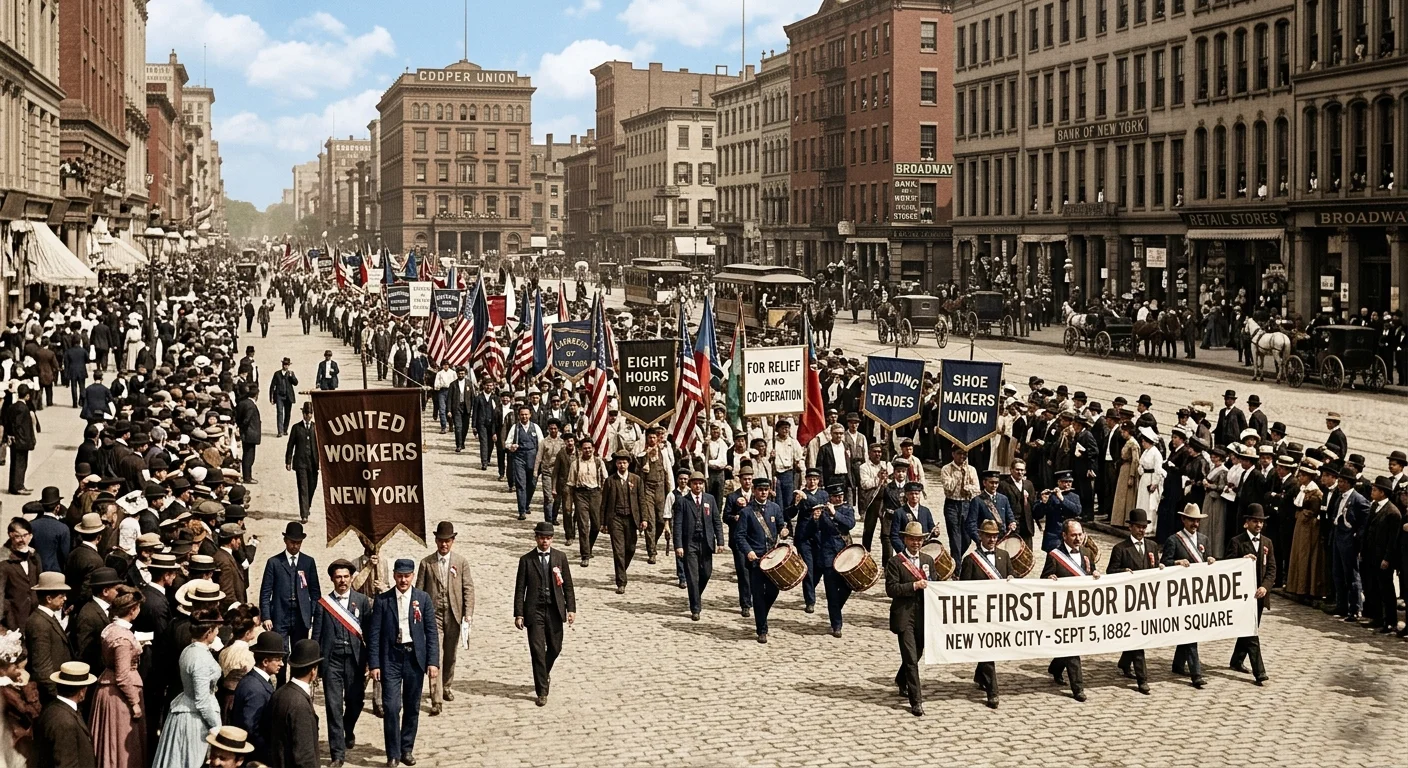
On the morning of Tuesday, September 5, 1882, a crowd of spectators packed the sidewalks of lower Manhattan near City Hall and along Broadway. They had arrived early to claim the best positions for viewing something that had never happened before in the United States: a parade organized entirely by workers, for workers, as a declaration of labor’s dignity and political power. The police were out in force, wary of disorder. The Grand Marshal of the parade, a printer named William McCabe, was stationed near City Hall with his aides and his police escort. There was only one problem. It was nearly 10 in the morning, and almost none of the marchers had arrived.
What happened next was chaotic, improvised, and ultimately triumphant in a way that captured the spirit of the day perfectly. Matthew Maguire, the secretary of the Central Labor Union of New York and probably the single most important figure in creating Labor Day as a concept, ran across the lawn to tell McCabe that two hundred workers from the Jewelers Union of Newark had just crossed the ferry from New Jersey and that, crucially, they had a band. Just after 10 a.m., the jewelers turned onto lower Broadway playing “When I First Put This Uniform On” from the Gilbert and Sullivan opera Patience. The police escort fell in. McCabe and his aides followed. Spectators left the sidewalks and joined the march. By the time the parade reached Union Square, somewhere between 10,000 and 25,000 workers were marching through the streets of New York in the first Labor Day parade in American history.
The World That Made Labor Day Necessary: Industrial America in 1882
The first Labor Day parade did not emerge from prosperity or contentment. It emerged from the grinding reality of industrial labor in the Gilded Age, a world in which most workers had no protection against exploitation and no voice in the conditions of their employment.
In 1882, the average American worker labored six days a week, ten to twelve hours a day. Sunday was the only guaranteed day of rest. There were no paid vacations, no sick days, and no mandatory breaks during shifts. Child labor was widespread: children as young as eight or nine worked in factories, mines, and mills for wages that supplemented their families’ meager incomes. Workplace safety was entirely at the employer’s discretion, and accidents that maimed or killed workers were an accepted cost of industrial production. Workers who complained or organized could be fired on the spot, blacklisted from their industries, or physically intimidated by company-hired enforcers. Immigration from Europe was flooding American cities with workers desperate enough to accept almost any terms of employment, giving employers enormous leverage over wages and conditions.
New York City was both the largest and the most industrially diverse city in the country, with a workforce of hundreds of thousands engaged in printing, garment manufacture, construction, metalworking, food processing, transportation, and dozens of other trades. The city was already a center of labor organizing, with individual trade unions having operated in the city for decades. But those unions worked largely in isolation from one another, limiting their power to negotiate with employers and their ability to present a united front on political demands.
The specific conditions of the early 1880s sharpened the sense of urgency in the labor movement. The years following the Civil War had seen enormous concentrations of wealth accumulate in the hands of industrial capitalists, men like John D. Rockefeller, Andrew Carnegie, Jay Gould, and Cornelius Vanderbilt, whose fortunes made them almost incomprehensibly richer than the workers who labored in their enterprises. The contrast between the visible luxury of the wealthy and the grinding poverty of the working class was a daily, unavoidable fact of urban life, and it generated both resentment and determination among the workers who organized the first Labor Day.
Matthew Maguire, Peter McGuire, and the Founding Debate
The precise origin of Labor Day as a concept has been debated for more than a century, with two men making compelling claims to the title of founding father.
Matthew Maguire was the secretary of the Central Labor Union of New York in 1882, later becoming the secretary of Local 344 of the International Association of Machinists in Paterson, New Jersey. According to the New Jersey Historical Society, after President Grover Cleveland signed the legislation making Labor Day a federal holiday in 1894, the Paterson Morning Call published an opinion piece stating that “the souvenir pen should go to Alderman Matthew Maguire of this city, who is the undisputed author of Labor Day as a holiday.” The minutes of a CLU meeting on May 14, 1882, at Science Hall at 141 East Eighth Street in Manhattan, record a proposal “by a delegate for holding a monster labor festival in which all workingmen could take part early in September.” Most historians believe Maguire was that delegate.
Peter J. McGuire, the secretary of the Brotherhood of Carpenters and Joiners and a co-founder of the American Federation of Labor, also claimed credit. According to McGuire’s account, on May 8, 1882, he proposed to the Central Labor Union that a day be set aside as a “general holiday for the laboring classes.” He claimed to have suggested that the event begin with a street parade as a public demonstration of organized labor’s solidarity and strength, followed by a picnic to which participating unions could sell tickets as a fundraiser. McGuire said he proposed the first Monday in September as the ideal date, owing to the good weather and the date’s position midway between the Fourth of July and Thanksgiving. McGuire also pointed to a visit to Toronto where he had seen Canadian workers hold labor parades in May, which inspired him to propose something similar for New York.
Both men attended the first parade. Both were involved in its organization. The historical consensus has shifted somewhat over time, with recent scholarship tending to favor Maguire as the more likely originator of the specific Labor Day proposal, while acknowledging McGuire’s broader contributions to the labor movement. The United States Department of Labor notes on its official history page that “recent research seems to support the contention that Matthew Maguire proposed the holiday in 1882 while serving as secretary of the Central Labor Union.”
The US Department of Labor’s official history of Labor Day covers the founding debate between Maguire and McGuire, the creation of the first parade, and the progression from a local New York celebration to a federal holiday recognized across the country.
The Central Labor Union, the Knights of Labor, and the Parade’s Organization
The organizational structure that made the first Labor Day possible was the Central Labor Union of New York, Brooklyn, and Jersey City, formed in January 1882 through a coalition that included the Knights of Labor and the Tailors’ Union. The CLU was established on the principle that “the emancipation of the working classes must be achieved by the working classes themselves as no other class has any interest in improving their conditions.” It served as a coordinating body for individual trade unions, giving them a common platform and a common voice.
By May 1882, the CLU had grown to encompass fifty-six member organizations representing approximately 100,000 workers in the New York metropolitan area. The proposal for a Labor Day celebration was adopted quickly after it was first made. On May 21, 1882, a committee of five was appointed to find a site for the post-parade picnic. Within two weeks, the committee had reserved Elm Park, at Ninth Avenue and Ninety-Second Street in Manhattan, for September 5. Elm Park was the biggest beer garden in the city, owned by Louis Wendel, a saloonkeeper and politician who contributed money for the printing of fifty thousand notices advertising the event.
The deliberate choice to hold the parade on a Tuesday, a regular workday, was politically significant. Workers who participated were giving up a day’s pay, a genuine financial sacrifice that signaled the seriousness of their commitment to the cause. The CLU saw this as an essential part of the demonstration’s message: that workers valued their dignity and their collective rights more than a day’s wages. The last-minute proclamation issued by the Central Labor Committee declared the day a holiday in the name of all fifty-six member organizations.
The Sixth National Assembly of the Knights of Labor was also meeting in New York City that week, and Terence Powderly, the organization’s Grand Master Workman and the most prominent labor leader in the country at the time, was present in Union Square to review the parade. Powderly’s presence gave the event a national dimension it might otherwise have lacked, signaling that what was happening in New York had significance beyond the city’s own labor community.
September 5, 1882: The Parade Marches Through Manhattan
The route of the first Labor Day parade took the marchers from City Hall northward along Broadway, past the reviewing stand at Union Square, and then continuing north along Fifth Avenue to Reservoir Park, which is today Bryant Park. The New York Tribune reported that “the windows and roofs and even the lamp posts and awning frames were occupied by persons anxious to get a good view of the first parade in New York of workingmen of all trades united in one organization.”
The parade was organized into three divisions representing different sectors of the labor movement. The Jewelers Union of Newark led the march, its members dressed in dark suits and derby hats, their band providing the music that got the whole procession moving. Behind them came the bricklayers in their white aprons. Then came approximately 700 members of Typographical Union No. 6, known as “The Big Six,” one of the oldest and most powerful trade unions in New York. Other marchers included painters, dock builders, cigar makers, and workers from dozens of other trades, each union carrying its own banners and regalia.
The banners carried by the marchers made their political message explicit. Among the most prominent were “No Money Monopoly” and “Labor Built This Republic and Labor Shall Rule It,” declarations that positioned the labor movement not as a fringe interest but as the backbone of American civilization. Grand Marshal McCabe, his earlier anxiety forgotten, rode at the head of the procession “on a fine horse” according to The New York Times, saluting the assembled dignitaries at the reviewing stand before joining them to watch the parade continue past.
The New York Times, which buried its coverage of the event on its last page, noted that “nearly all were well-clothed, and some wore attire of fashionable cut. The great majority smoked cigars, and all seemed bent upon having a good time.” The Times considered the event unremarkable at the time. History would disagree.
The Wikipedia article on Labor Day provides the comprehensive account of the first parade’s origin in connection with the Knights of Labor’s General Assembly, the competing claims of Maguire and McGuire, and the development of Labor Day from a local New York celebration to an internationally recognized day of workers’ rights.
From Union Square to Reservoir Park: The Parade’s End and the Celebration
At noon, the marchers arrived at Reservoir Park, the northern terminus of the parade route. Most continued immediately to Elm Park at Ninety-Second Street and Ninth Avenue for the post-parade celebration that the CLU had organized as the second major component of the day’s festivities. Even unions that had not participated in the parade itself sent members to the park celebration.
From 1 p.m. until 9 p.m., the park was the site of a celebration that mixed political seriousness with genuine festivity. Speeches were delivered by labor leaders on the importance of solidarity, collective action, and the political recognition of workers’ rights. A picnic offered food to thousands of workers and their families. Cigars were distributed liberally. And Lager beer, in the words of one newspaper account, was “mounted in every conceivable place.” The combination of political purpose and social celebration was entirely deliberate: the CLU wanted to demonstrate that workers’ organization was not a threatening or revolutionary force but a normal, decent, and thoroughly American expression of citizens asserting their rights.
The History.com article on the history of Labor Day covers the 1882 parade and the subsequent development of the holiday, including the role of the Pullman Strike in accelerating federal recognition and the eventual establishment of Labor Day as a national institution.
The New York Sun’s coverage on September 6 was more sympathetic than the Times, noting the orderly and good-natured character of the marchers and the significance of workers from dozens of different trades marching together under a common banner for the first time. Frank Leslie’s Weekly Illustrated Newspaper published an illustration of the march in its September 16 issue, providing the visual record that confirmed the event’s place in history.
From New York to National Holiday: The Path to Federal Recognition in 1894
The success of the first parade in 1882 was enough to establish the celebration as an annual event. The CLU organized a second Labor Day parade on September 5, 1883, again on the anniversary date. In 1884, the CLU went further, declaring the first Monday in September to be an annual holiday in honor of wage workers, shifting from a specific date to a floating Monday that would ensure the holiday always fell on a non-working day.
Municipal ordinances recognizing Labor Day as a local holiday were passed in several cities in 1885 and 1886, reflecting the spread of the holiday concept beyond New York. New York State introduced the first state-level bill to recognize Labor Day as an official holiday in 1885. But Oregon moved faster: on February 21, 1887, Oregon became the first state to pass a law making Labor Day a legal holiday. During 1887, four more states followed: Colorado, Massachusetts, New Jersey, and New York. By the end of the decade, Connecticut, Nebraska, and Pennsylvania had also enacted Labor Day legislation. By 1894, twenty-three additional states had adopted the holiday.
The event that finally triggered federal action was not celebration but tragedy. In the summer of 1894, workers at the Pullman Palace Car Company near Chicago went on strike over wage cuts and the high rents they paid to live in the company-owned town of Pullman, Illinois. Eugene V. Debs, leader of the American Railway Union, organized a national sympathetic strike that paralyzed railroad traffic across much of the country. President Grover Cleveland sent federal troops to break the strike, a decision that resulted in the deaths of at least thirteen strikers and the arrest of Debs himself. The brutal suppression of the Pullman Strike generated enormous sympathy for the labor movement and political embarrassment for the Cleveland administration.
Congress moved with unusual speed. Within days of the strike’s end, both houses passed legislation designating the first Monday in September as a federal holiday called Labor Day. President Cleveland, widely blamed for the violence at Pullman, signed the bill into law on June 28, 1894, in what many observers noted was a transparent attempt to repair his damaged relationship with American workers. The irony was complete: the man who had used the Army to crush a labor strike became the president who made Labor Day a national holiday.
The National Labor Relations Board’s historical account of American labor history provides the broader context of the labor movement’s evolution from the 1882 parade through the development of the legal and institutional protections for workers that followed over the subsequent century.
The Legacy of September 5, 1882: What the First Labor Day Meant and Still Means
The twenty-five thousand workers who marched through Manhattan on September 5, 1882, did not know they were creating a national holiday. They were making a public demonstration of collective power, asserting that the people who built the country’s railroads, assembled its manufactured goods, constructed its buildings, and processed its food were not simply factors of production but citizens with rights and dignity that deserved political recognition.
The specific demands those workers carried on their banners in 1882, an eight-hour workday, the abolition of child labor, safe working conditions, and fair wages, were not won quickly. The eight-hour workday did not become the national standard until the Fair Labor Standards Act of 1938. Child labor was not federally regulated until the same law. Workplace safety remained largely unregulated until the Occupational Safety and Health Act of 1970. The workers who marched in 1882 were fighting for things that the people who celebrate Labor Day today take for granted, improvements that required not years but generations of continued organizing, striking, and political pressure to achieve.
The Britannica article on Labor Day’s origins and significance places the first parade in the context of American labor history, tracing the movement from the 1882 celebration through the major legislative achievements of the twentieth century that translated labor’s moral victories into legal protections.
What William McCabe, Matthew Maguire, Peter McGuire, Terence Powderly, and the tens of thousands of workers who joined them in the streets of New York on that September Tuesday created was more than a holiday. They created a permanent institutional acknowledgment that labor, collective action, and the dignity of workers were not threats to American society but foundations of it. The banners that read “Labor Built This Republic and Labor Shall Rule It” were not revolutionary threats. They were a statement of democratic principle that the country would spend the next century slowly, imperfectly, and incompletely learning to honor.