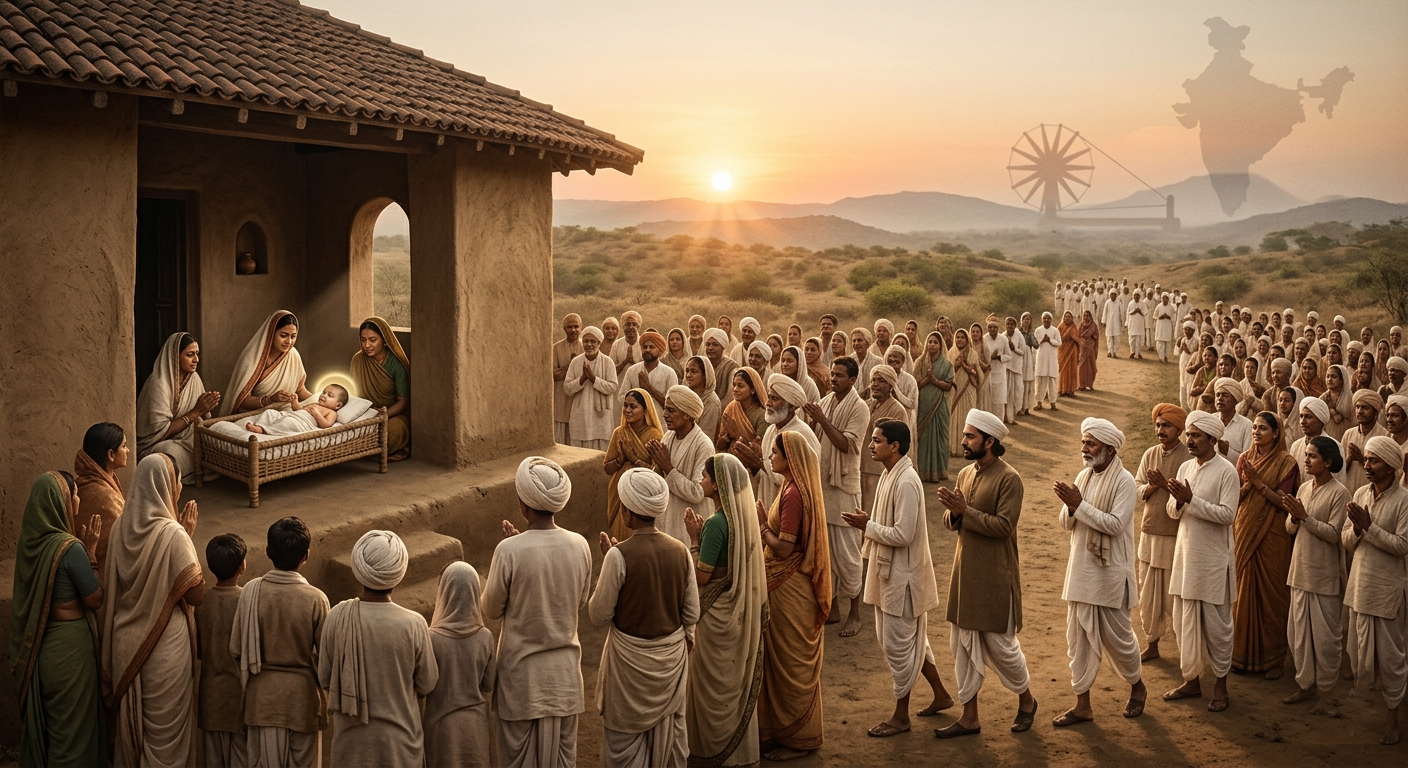
On October 2, 1869, a boy was born in Porbandar, a small coastal town on the Kathiawar Peninsula in the present-day Indian state of Gujarat. His parents named him Mohandas Karamchand Gandhi. At his birth, no one could have predicted that this child of a local administrator and a deeply religious Hindu mother would grow up to lead the largest nonviolent independence movement in history, that his methods of civil disobedience would inspire generations of freedom fighters from Martin Luther King Jr. in the American South to Nelson Mandela in South Africa, or that the name the world would eventually give him, Mahatma, meaning “Great Soul,” would become one of the most recognized honorifics in human civilization.
The world into which Mohandas Gandhi was born was one of profound contrasts. Porbandar, also known as Sudamapuri after the legendary figure of Hindu scripture, sat on the shores of the Arabian Sea, a trading town whose port connected the Kathiawar Peninsula to the commerce of the wider Indian Ocean world. The British had consolidated their control over most of the Indian subcontinent following the rebellion of 1857, and the Indian princes who governed the small states of Kathiawar did so under British paramountcy, their authority real in local terms but ultimately dependent on British goodwill. Into this layered world of local culture, Hindu tradition, and British imperial oversight, the man who would one day challenge and ultimately dismantle that imperial order was born on an October morning in 1869.
The Family That Shaped the Father of the Nation
Mohandas Gandhi was the youngest of the four children of his father Karamchand Uttamchand Gandhi and his mother Putlibai. Karamchand was on his fourth marriage when Mohandas was born, his three earlier wives having died young. With Putlibai, who came from the Pranami Vaishnava tradition of Hinduism, Karamchand had four children: an older son Laxmidas, born around 1860; a daughter Raliatbehn, born in 1862; another son Karsandas, born around 1866; and finally Mohandas, the youngest.
Karamchand Gandhi served as the dewan, or chief minister, of Porbandar state, a position of considerable local prestige. He was not a formally educated man, having had only an elementary education, but he proved himself a capable administrator and was eventually transferred to serve as dewan of Rajkot and then of Vankaner, two neighboring princely states on the Kathiawar Peninsula. His family belonged to the Modh Bania caste within the broader Vaishya varna of the Hindu social hierarchy, a community of merchants and traders. The Gandhis were not wealthy by any national standard, but they occupied a position of local respectability that gave Mohandas access to education and opportunities that would have been unavailable to lower-caste or poorer children.
Putlibai was the parent whose influence marked Mohandas most deeply and most lastingly. She was, by every account, a woman of profound personal faith and ascetic self-discipline. She observed regular religious fasts and personal vows with complete consistency, and her approach to religion was practical rather than merely ceremonial. Her devotion to the Hindu form of Vaishnavism was inflected with the influence of Jainism, the ancient Indian philosophical tradition that places ahimsa, or nonviolence and non-harm to all living things, at the center of ethical life. Vegetarianism, regular fasting, tolerance of other faiths, and the belief that all living creatures deserve protection from harm were the values that Putlibai modeled for her youngest son from his earliest years. Gandhi later wrote that his mother left on him “an indelible impression,” and the values she embodied, nonviolence, self-discipline, religious tolerance, and compassionate action, became the foundations of the philosophy he would one day apply to the liberation of an entire nation.
Porbandar, Early Childhood, and the Rudimentary Education of a Future Leader
The Porbandar in which Mohandas spent his earliest years was a modest place with limited educational infrastructure. The primary school he attended was basic enough that, as the Britannica account of Gandhi’s early life records, children wrote the alphabet in the dust with their fingers rather than on paper or slates. When his father was transferred to Rajkot, Mohandas moved there with the family and received his primary and secondary education in that town’s schools.
By his own later accounts, and by the reports of his teachers, Mohandas was not a remarkable student. His school reports describe him as good at English, fair at arithmetic, weak at geography, with very good conduct but bad handwriting. He was a shy, introverted child who felt more comfortable on solitary walks than in classroom competition or on the sports field. He showed none of the charisma that would characterize his public presence as an adult. He was, however, deeply honest from childhood in a way that already reflected the influence of his mother’s values. He later wrote about an incident from childhood in which a schoolmate urged him to copy the spelling of a word from a neighbor’s paper during an inspection by a visiting education official. Mohandas refused. His teacher was displeased that only Mohandas had gotten the word wrong, but the boy considered copying cheating and would not do it.
One incident from his adolescence made a lasting impression on Gandhi’s own understanding of his character. He had, as a teenager, gone through a period of petty rebellion, secretly eating meat with a friend who argued that the British were physically stronger than Indians because of their meat diet, secretly smoking cigarettes, and once pilfering a small piece of gold from his brother’s arm bracelet to pay off a debt. The theft haunted him. Instead of confessing directly, he wrote a note to his father acknowledging what he had done and asking for punishment. Karamchand read the note, shed tears, and then said nothing more about it. The sight of his father’s tears was more punishing to the young Mohandas than any beating could have been, and he attributed to that moment of his father’s silent, grief-stricken response his own understanding of the power of moral appeal and the lasting effectiveness of moral suffering over physical punishment.
Child Marriage and the Personal Life of Mohandas Gandhi
In 1883, when Mohandas was thirteen years old, his family arranged his marriage to Kasturba Makhanji, who was of the same age. Child marriage was customary in the Gujarat of the period, and the Gandhi family followed this convention without particular reflection. Kasturba, who would be known throughout her married life as Kasturba or Ba, meaning “Mother” in Gujarati, was the daughter of a merchant family of similar social standing from Porbandar.
The marriage brought Mohandas a year’s interruption in his schooling. He wrote later in his autobiography, “The Story of My Experiments with Truth,” about the jealousy and possessiveness he felt as a young husband and the ways in which those feelings conflicted with the spiritual values he was simultaneously developing. Kasturba was not submissive to him in the way he initially expected, and their early relationship was characterized by arguments and misunderstandings that Mohandas later identified as formative experiences in his understanding of the difference between control and love. The couple would eventually develop a relationship of profound mutual respect and shared purpose. Kasturba bore Gandhi four sons: Harilal, born in 1888; Manilal, born in 1892; Ramdas, born in 1897; and Devdas, born in 1900. She died in February 1944 while they were both imprisoned at the Aga Khan Palace in Pune, in British custody during the Quit India movement.
The Wikipedia article on Mahatma Gandhi covers the full arc of Gandhi’s personal life, his evolving philosophy of nonviolence, and the major campaigns of his independence movement from the South African years through the Salt March and the Quit India Movement.
London, the Bar, and the Transformation That Began with Vegetarianism
Karamchand Gandhi died in 1885, when Mohandas was sixteen years old. His death left the family in difficult circumstances and put the question of Mohandas’s future in sharp focus. A Brahmin family friend named Mavji Dave Joshiji advised the family that Mohandas should go to London to study law, which would qualify him for the kind of administrative positions his father had occupied. The decision was not easy. Gandhi’s caste community, the Modh Banias of Bombay, warned him that traveling to England would expose him to the temptations of Western life and compromise his religious principles. He was formally excommunicated from his caste for making the journey. Gandhi’s mother extracted from him a solemn promise, which he kept faithfully, to abstain from wine, women, and meat while in England.
Gandhi sailed from Bombay on September 4, 1888, at the age of eighteen, leaving behind his wife Kasturba and their infant son Harilal. He arrived in London and enrolled at University College, London, before transferring to the Inner Temple, one of the four Inns of Court through which qualification to the English bar was obtained. He passed his bar examination in June 1891 and was called to the bar, qualifying as a barrister, at the age of twenty-one.
The three years in London were intellectually transformative in ways that went well beyond legal study. Gandhi’s commitment to vegetarianism, originally maintained as a promise to his mother, became a conscious philosophical position after he encountered the London Vegetarian Society and read Henry Salt’s “A Plea for Vegetarianism,” which provided an ethical and philosophical framework for a dietary practice he had until then followed for purely traditional reasons. Through the Vegetarian Society he met people who took ideas seriously in ways that broadened his intellectual world. He read the Bible for the first time, including the Sermon on the Mount, which he found deeply resonant with his own developing values. He read the Bhagavad Gita in English translation, an irony he himself later noted, becoming deeply engaged with a text central to his own tradition that he had not previously studied closely.
These London years were the beginning of Gandhi’s formation as a thinker, though the full development of his philosophy was still decades away. He returned to India in 1891 to discover that his mother had died while he was abroad, a grief his family had concealed from him to prevent his distraction from his studies.
South Africa, the Natal Train Incident, and the Making of a Moral Revolutionary
Gandhi’s attempt to establish a law practice in Bombay failed. He lacked both confidence in court and sufficient knowledge of Indian law to compete effectively. He returned to Rajkot to do clerical legal work and was struggling professionally when an offer arrived from a merchant named Dada Abdulla, who needed legal representation for a commercial case in South Africa. Gandhi accepted, intending to stay for one year.
He arrived in Durban, Natal, in 1893 and began working for Dada Abdulla’s firm. The South Africa he found was a place of explicit and institutionalized racial segregation in which Indians were subjected to systematic discrimination across all areas of public and commercial life. The experience that transformed Gandhi from a cautious young lawyer into a committed activist occurred in June 1893, when Dada Abdulla asked him to travel by rail from Durban to Pretoria in the Transvaal. Gandhi purchased a first-class ticket and boarded the train at Pietermaritzburg. A white passenger objected to his presence in the first-class compartment, and when Gandhi refused to move to the third-class car, railway officials removed him from the train entirely and deposited him on the platform at Pietermaritzburg station in the cold night air.
Gandhi sat through that cold night on the Pietermaritzburg platform, contemplating whether to abandon his principles or to fight. He chose to fight. He completed the journey to Pretoria and stayed in South Africa for twenty-one years rather than one. During those years he organized the Natal Indian Congress to advocate for Indian rights, developed his philosophy of nonviolent resistance, which he named satyagraha, meaning truth-force or soul-force, and led campaigns against discriminatory legislation including the registration laws that the South African government attempted to impose on the Indian community. The title of Mahatma was first applied to him in South Africa in 1914 or 1915, according to some sources at a ceremony in Jetpur, India, hosted by Nagar Sheth Nautamlal B. Mehta, and this honorific traveled with him as he returned to India.
The Britannica biography of Mahatma Gandhi provides a detailed account of Gandhi’s South African years, the development of satyagraha as a political and philosophical concept, and Gandhi’s leadership of the Indian community’s resistance to discriminatory legislation.
Return to India and the Leadership of the Independence Movement
Gandhi returned to India permanently in 1915, at the age of forty-five. He was already known throughout the subcontinent from his South African activism, and the Indian National Congress welcomed him as a figure of major political significance. He spent his first years in India traveling extensively, listening carefully, and learning the country’s contemporary conditions before assuming leadership roles. His first major campaigns were in specific local contexts: Champaran in Bihar in 1917, where he supported indigo farmers being exploited by British planters, and Kheda in Gujarat in 1918, where he organized farmers facing famine to resist tax collection.
By 1919, Gandhi had become the dominant figure in India’s independence movement. The Jallianwala Bagh massacre of April 13, 1919, in which British General Reginald Dyer ordered soldiers to open fire on an unarmed crowd gathered in an enclosed garden in Amritsar, killing between 379 and 1,000 people and wounding more than a thousand others, converted Gandhi from a supporter of cooperation with the British to an uncompromising opponent of British rule. He launched the Non-Cooperation Movement in 1920, calling on Indians to boycott British goods, resign from British-appointed positions, withdraw from British-run schools and courts, and refuse to cooperate with the colonial administration. The movement brought British India to an extraordinary degree of paralysis and demonstrated for the first time the potential of mass civilian nonviolent resistance to bring a colonial government to negotiation.
The most iconic action of Gandhi’s independence campaign was the Salt March of March to April 1930. The British Salt Acts imposed a tax on salt and made it illegal for Indians to produce or sell salt outside of British government channels. The tax was one of the most widely resented instruments of colonial extraction because it affected even the poorest Indians. On March 12, 1930, Gandhi left his Sabarmati Ashram near Ahmedabad with seventy-eight followers and walked approximately 240 miles to the coastal village of Dandi on the Arabian Sea. On April 5, he picked up a small lump of salt from the beach, deliberately breaking British law. The Salt March galvanized the entire country, triggered a wave of civil disobedience across India, and brought the Indian independence movement international attention that the British government found increasingly difficult to manage.
The History.com account of Mahatma Gandhi’s life and campaigns covers the complete arc of Gandhi’s Indian campaigns from the Non-Cooperation Movement through the Salt March, the Quit India Movement, and the final years leading to independence.
Independence, Partition, and the End of a Life in Service
India finally achieved independence on August 15, 1947, a moment that Gandhi had spent his entire adult life working toward and that he experienced with profound ambivalence because of the accompanying partition of the subcontinent into India and Pakistan. The partition, which Gandhi had opposed but ultimately accepted as the only way to prevent civil war between Hindus and Muslims, was accompanied by violence of catastrophic scale as millions of Hindus and Muslims moved across newly created borders, with estimates of deaths ranging from several hundred thousand to over a million. Gandhi fasted repeatedly in the final months of his life to protest the violence between communities and demand that Hindus and Muslims treat each other with the tolerance and respect he had preached throughout his career.
On January 30, 1948, at the age of seventy-eight, Gandhi was walking to an evening prayer meeting in the garden of the Birla House in New Delhi. Nathuram Godse, a Hindu nationalist who believed Gandhi had betrayed Hinduism by accommodating Muslim interests, stepped forward through the crowd and shot Gandhi three times at close range. Gandhi died within minutes. The man who had been born in a modest home in Porbandar on October 2, 1869, who had learned to write in the dust of a schoolroom floor, who had been thrown from a train in South Africa on a cold night in 1893, who had walked 240 miles to pick up a lump of salt by the sea, and who had freed a subcontinent through the power of his moral conviction, was gone.
The National Archives of India resources on Mahatma Gandhi and Indian independence hold the primary documents of Gandhi’s political career, including the correspondence, petitions, and official records that trace the development of the independence movement from his early campaigns to the achievement of freedom in August 1947.
October 2 is now celebrated as Gandhi Jayanti, a national holiday in India and an international day of observance designated by the United Nations as the International Day of Non-Violence. The boy born in Porbandar on that October morning in 1869 gave his name to a date that the world observes in recognition of the idea that the most powerful force in human affairs is not the force of arms but the force of truth.