
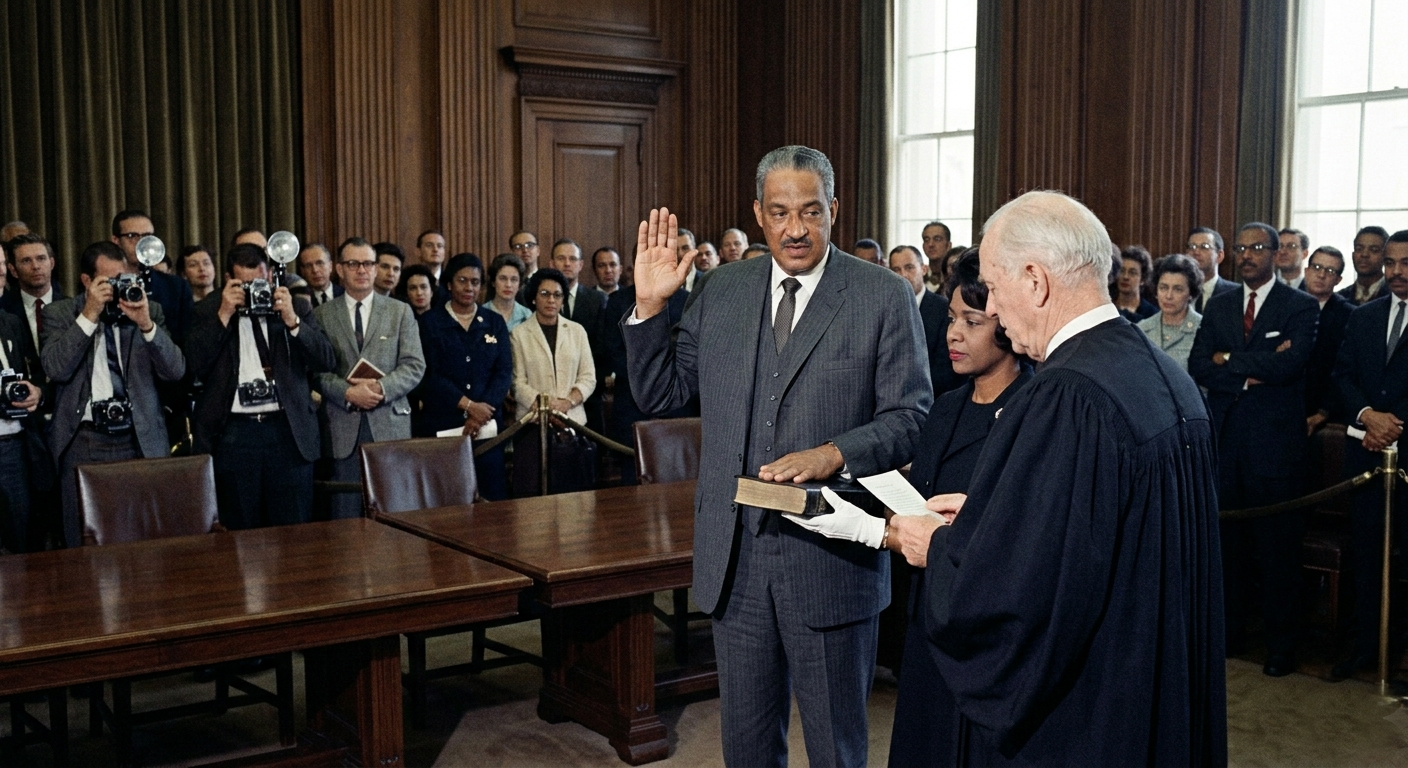
On the morning of October 2, 1967, in the chamber of the United States Supreme Court in Washington, D.C., Chief Justice Earl Warren administered the constitutional oath of office to Thurgood Marshall. When Marshall placed his hand on the Bible and repeated those words of obligation, he became the ninety-sixth justice in the Court’s 178-year history, and the first African American ever to hold that office. He was fifty-nine years old. The great-grandson of an enslaved man, the son of a railroad porter, the lawyer who had been rejected from law school because of the color of his skin, and the legal strategist who had dismantled the constitutional foundations of American segregation across two decades of courtroom battles, had reached the summit of American law.
President Lyndon B. Johnson, who had nominated Marshall to the Court on June 13, 1967, described his decision simply: “The right thing to do, the right time to do it, the right man, and the right place.” Marshall’s presence on the Court was more than a symbolic milestone. It was the culmination of a life dedicated to the proposition that the Constitution of the United States meant what it said when it promised equal protection under the law, and that the country had failed to keep that promise for the better part of a century. For twenty-four years, as an Associate Justice of the Supreme Court, Marshall would continue the argument that had defined his entire career.
Baltimore, Bondage, and the Making of a Lawyer
The story of Thurgood Marshall’s journey to the Supreme Court begins not in a courthouse but in a slave quarter. His grandfather, Thoroughgood Marshall, had been born into slavery in the American South. After gaining his freedom, Thoroughgood moved north, and the family eventually settled in Baltimore, Maryland, where his son William Canfield Marshall became a railroad porter and caterer, and his daughter-in-law Norma Arica Williams taught in Baltimore’s segregated public schools.
Thurgood Marshall was born on July 2, 1908, in Baltimore. His parents had named him Thoroughgood after his grandfather, but Marshall shortened the name to Thurgood in grade school because he found the full version too cumbersome to write. Baltimore in the early twentieth century was a thoroughly segregated city, and Marshall grew up in direct daily contact with the system his career would later dismantle. He attended Frederick Douglass High School, Baltimore’s segregated school for Black students, where he was a good student and a competitive debater, developing the forensic skills that would later make him one of the most effective oral advocates in American legal history.
Marshall enrolled at Lincoln University in Oxford, Pennsylvania, a historically Black college that also educated Langston Hughes and Kwame Nkrumah during those years. Marshall graduated with honors in 1930, intending to apply to the University of Maryland School of Law. The school rejected him on the basis of his race. He was denied admission to his state’s own flagship law school because of the color of his skin, a fact he would not forget, and one whose legal implications he would address in court just a few years later.
Instead, Marshall enrolled at Howard University School of Law in Washington, D.C., a historically Black institution that had produced many of the most important African American lawyers and judges of the twentieth century. Howard was where Marshall’s career was shaped in its most fundamental form, because Howard was where he encountered Charles Hamilton Houston.
Charles Hamilton Houston, Howard University, and the Education of Mr. Civil Rights
Charles Hamilton Houston was one of the most consequential figures in American legal history, and for a period of several years he was Thurgood Marshall’s mentor, teacher, and inspiration. Houston had graduated from Amherst College, earned his law degree from Harvard, and become one of the first African Americans to win a place on the Harvard Law Review before joining the Howard Law faculty and eventually becoming the school’s vice dean. He transformed Howard Law from an institution of modest academic standing into what he described as a “social engineering” enterprise, a school whose explicit purpose was to train lawyers who would use the law as a tool to dismantle the system of legalized racial inequality that had been constructed in the decades since Reconstruction.
Houston’s theory of constitutional litigation was precise and strategic. The legal infrastructure of American segregation rested on the Supreme Court’s 1896 decision in Plessy v. Ferguson, which had upheld the constitutionality of “separate but equal” facilities on the reasoning that racial separation did not by itself imply the inferiority of Black citizens. Houston’s insight was that the separate-but-equal standard could be attacked from within: if you could demonstrate in case after case that the separate facilities provided to Black Americans were systematically unequal to those provided to white Americans, you could force either genuine equality of resources (which was economically impossible for most Southern states to provide) or the abandonment of segregation altogether. He selected higher education as the strategic target, because the inequality of graduate and professional schools was most easily demonstrated and most embarrassing to states that preferred to maintain that their separate systems were genuinely equivalent.
Marshall graduated at the top of his class from Howard in 1933. He joined the National Association for the Advancement of Colored People in 1936, initially as a staff attorney and then, in 1938, as director-counsel of the NAACP Legal Defense and Educational Fund, succeeding Houston himself in the organization’s top legal position. Over the following years, Marshall implemented and extended the strategic litigation campaign that Houston had conceived, traveling between 50,000 and 75,000 miles per year to oversee as many as 450 cases simultaneously across the country. He argued his cases before hostile Southern judges, in courtrooms where Black attorneys were routinely treated with contempt, in communities where his physical safety was sometimes genuinely at risk. He won more often than not.
The Wikipedia biography of Thurgood Marshall covers the full arc of his legal career from his Howard years through his NAACP litigation campaigns, his appointment to the Second Circuit, his tenure as Solicitor General, and his twenty-four years on the Supreme Court.
The NAACP Campaigns and the Road to Brown v. Board of Education
Marshall’s record of courtroom victories against racial discrimination was extraordinary by any standard. He argued thirty-two cases before the Supreme Court and won twenty-nine of them, a winning percentage that prompted President Johnson to describe it as a “batting average of .900.” Among his most significant pre-Brown victories were several that systematically dismantled Houston’s “attack from within” strategy by establishing that specific graduate and professional schools were so unequal that they could not survive equal protection scrutiny.
In Sweatt v. Painter (1950), Marshall argued that the University of Texas Law School’s admission of white students while refusing Black applicants violated the Equal Protection Clause. The state of Texas had hastily created a separate law school for Black students, which Marshall demonstrated was thoroughly inferior to the white school in every measurable dimension: library holdings, faculty, facilities, and the professional networks available to graduates. The Supreme Court unanimously agreed and ordered Sweatt admitted to the University of Texas. In McLaurin v. Oklahoma State Regents (1950), decided the same day, the Court struck down the University of Oklahoma’s practice of admitting a Black graduate student but requiring him to sit in a designated area apart from white students and use separate library tables and cafeteria hours.
These victories were significant, but they addressed specific inequalities at specific institutions. The foundational case that Marshall had been building toward was one that would strike at the premise of Plessy v. Ferguson itself, the claim that separate could ever be equal. Beginning in the early 1950s, Marshall consolidated five separate NAACP-sponsored lawsuits filed by parents of Black children in Kansas, South Carolina, Virginia, Delaware, and Washington, D.C. Each lawsuit challenged the constitutionality of racially segregated public elementary and secondary education. The combined cases were argued before the Supreme Court under the name Brown v. Board of Education of Topeka.
Among the most effective elements of Marshall’s strategy in Brown was his use of social scientific evidence to demonstrate that segregation caused measurable psychological harm to Black children, independent of any physical inequality in facilities. Psychologists Kenneth Clark and Mamie Phipps Clark had conducted studies in which Black children, when shown both white and Black dolls and asked which were “nice” and which were “bad,” consistently attributed positive characteristics to the white dolls and negative ones to the Black dolls. Marshall used this research to argue that the “equal” in separate-but-equal was a constitutional fiction: separate was inherently unequal because it communicated to Black children that they were inferior, a message that no amount of equal resources could neutralize.
On May 17, 1954, Chief Justice Earl Warren delivered the unanimous opinion of the Supreme Court in Brown v. Board of Education. “We conclude,” Warren wrote, “that in the field of public education, the doctrine of ‘separate but equal’ has no place. Separate educational facilities are inherently unequal.” The decision overturned Plessy v. Ferguson, invalidated the legal infrastructure of American school segregation, and fundamentally changed American constitutional law. It had been accomplished through twenty years of patient, dangerous, and brilliant legal work, most of it directed by Thurgood Marshall.
From the Second Circuit to the Solicitor General’s Office
After the victory in Brown, Marshall continued his work with the NAACP and argued the follow-up case of Cooper v. Aaron (1958), in which the Court unanimously rejected Arkansas Governor Orval Faubus’s attempt to use state authority to delay the desegregation of Little Rock’s public schools.
In 1961, President John F. Kennedy appointed Marshall to the United States Court of Appeals for the Second Circuit, one of the most prestigious federal appellate courts in the country. Marshall served on the Second Circuit for four years, writing over 100 opinions that were subsequently affirmed by the Supreme Court without reversal, a record that spoke to the precision and soundness of his legal reasoning.
In 1965, President Johnson appointed Marshall as United States Solicitor General, the government lawyer responsible for representing the United States before the Supreme Court and arguing the federal government’s position in the most significant cases. As Solicitor General, Marshall won fourteen of the nineteen cases he argued before the Court. He defended the constitutionality of the Voting Rights Act of 1965 in South Carolina v. Katzenbach (1966) and Katzenbach v. Morgan (1966), winning both. The job gave Marshall extraordinary exposure to the inner workings of the Court and demonstrated to Johnson and to the Senate that he was as skilled an advocate in his government role as he had been in his civil rights role.
LBJ’s Nomination and the Senate Confirmation Battle
When Justice Tom C. Clark announced his retirement from the Supreme Court in February 1967, his departure created the vacancy that President Johnson immediately identified as the opportunity to make history. Clark’s retirement had been prompted by Johnson’s nomination of Clark’s son, Ramsey Clark, as Attorney General: the father felt it would be improper to sit on the Court while his son headed the Justice Department.
Johnson’s decision to nominate Marshall was both a statement of principle and a strategic calculation. He wanted to cement his civil rights legacy after having signed the Civil Rights Act of 1964 and the Voting Rights Act of 1965 into law. He also recognized, as EBSCO Research historians have noted, that by choosing a man with Marshall’s unimpeachable legal qualifications, he had made it nearly impossible for civil rights opponents to object on any ground other than Marshall’s race itself, which would expose those opponents to the full weight of public moral judgment.
The Senate Judiciary Committee held five days of hearings in July 1967. The opposition was led by Southern Democrats who had fought every piece of civil rights legislation for decades. Senator Strom Thurmond of South Carolina asked Marshall more than sixty questions about obscure constitutional history in what Time magazine described as a “Yahoo-type hazing,” an attempt to embarrass Marshall by tripping him on minor technical details of legal history. Senator James O. Eastland of Mississippi, Senator Sam Ervin Jr. of North Carolina, and Senator John McClellan of Arkansas were also among the vocal opponents. Marshall handled the hearings with patience and precision, answering every question with the forensic skill of a man who had spent decades arguing before hostile audiences.
The committee recommended confirmation by a vote of 11 to 5 on August 3. On August 30, after six hours of debate on the Senate floor, the full Senate confirmed Marshall’s nomination by a vote of 69 to 11. Only one senator from outside the South voted against him, and the scale of the confirmation vote made clear that, despite the Southern opposition, the overwhelming consensus of the Senate accepted Marshall as fully qualified and his appointment as appropriate.
The National Geographic account of how Thurgood Marshall became the first Black Supreme Court Justice covers Marshall’s path to the Court in detail, including the political context of Johnson’s nomination and the significance of the appointment for American civil rights history.
October 2, 1967: The Oath, the Court, and the New Chapter
On October 2, 1967, the opening day of the Supreme Court’s new term, Chief Justice Earl Warren administered the constitutional oath of office to Thurgood Marshall. Warren was the same Chief Justice who had delivered the Brown decision in 1954, the ruling that Marshall’s advocacy had produced. The symmetry of Warren swearing in Marshall was not lost on observers: the judge who had written the opinion that Marshall had argued for was now formalizing Marshall’s place on the Court that had issued it.
Johnson, observing the moment, offered a characterization of Marshall that captured his significance: “Thurgood Marshall symbolizes what is best about our American society: the belief that human rights must be satisfied through the orderly processes of law. It is a cause of profound satisfaction to me that in Judge Marshall we shall have an advocate whose lifelong concern has been the pursuit of justice for his fellow man.”
Marshall was assigned to the seat vacated by Tom Clark and joined a Court that included some of the most distinguished jurists of the twentieth century: Chief Justice Warren, Justice William O. Douglas, Justice Hugo Black, Justice William J. Brennan Jr., Justice Potter Stewart, and others. His closest intellectual ally on the Court quickly became Brennan, and the two justices voted together in the vast majority of cases over the following years, forming a reliable liberal bloc as the Court navigated the civil rights, criminal procedure, and First Amendment questions of the late 1960s.
Twenty-Four Years on the High Court: Dissent, Principle, and Perseverance
Marshall’s twenty-four years as an Associate Justice of the Supreme Court were defined by two distinct eras. In the late 1960s and early 1970s, the Warren Court and then the early Burger Court still maintained a roughly liberal orientation, and Marshall’s views frequently aligned with majority decisions. He joined the majority in Roe v. Wade (1973), supporting abortion rights. He contributed to the expansion of First Amendment protections in cases like Stanley v. Georgia (1969), which established the right to possess obscene material in one’s own home. He argued consistently for a broad interpretation of equal protection that covered not only racial discrimination but sex discrimination and discrimination against the economically disadvantaged.
But as Republican presidents, beginning with Richard Nixon and continuing through Gerald Ford, Ronald Reagan, and George H.W. Bush, reshaped the Court through their appointments, Marshall found himself increasingly on the dissenting side of decisions that he believed were dismantling the equal protection framework that Brown had established and that he had spent his career building. He and Justice Brennan dissented together in more than 1,400 cases in which the majority declined to review a death sentence, reflecting Marshall’s absolute opposition to capital punishment, which he considered cruel and unusual punishment prohibited by the Eighth Amendment.
His most distinctive jurisprudential contribution was what scholars called the “sliding-scale” or “flexible balancing” approach to equal protection analysis. Rather than applying the rigid two-tier framework of ordinary rational basis review and strict scrutiny, Marshall argued that courts should calibrate the intensity of review to both the importance of the interest at stake and the degree of disadvantage experienced by the group being treated unequally. This approach, which drew directly on his experience representing clients at every level of the legal system, never became the Court’s official doctrine but significantly influenced subsequent equal protection jurisprudence.
The Britannica biography of Thurgood Marshall covers his Supreme Court jurisprudence in detail, including his major majority opinions, his dissenting positions on capital punishment, and his contribution to constitutional doctrine through the sliding-scale approach to equal protection.
Retirement and Legacy: The Justice Who Changed America
By 1991, Marshall was eighty-two years old, in poor health, and increasingly frustrated by the direction of the Court he served. He retired in June 1991, replaced by Clarence Thomas, whom President George H.W. Bush nominated specifically as a Black justice who held conservative rather than liberal views. The contrast between Marshall and Thomas, in both judicial philosophy and personal history, was stark. Thomas’s confirmation hearings became one of the most contentious in Supreme Court history, overshadowed by Anita Hill’s testimony about sexual harassment.
When asked at his retirement press conference whether he was being replaced by a comparable justice, Marshall replied simply: “There’s no difference between a Black snake and a white snake. They’ll both bite.” His characteristic directness had not diminished.
Thurgood Marshall died on January 24, 1993, at Bethesda Naval Medical Center in Maryland. He was eighty-four years old. His body lay in state in the Great Hall of the Supreme Court, where tens of thousands of Americans came to pay their respects over two days. He was buried at Arlington National Cemetery.
The History.com account of Thurgood Marshall’s swearing in on October 2, 1967 covers the significance of the occasion and Marshall’s career both before and after his appointment to the Court.
The legacy of Thurgood Marshall resists reduction to any single case, any single decision, or any single role. He was the lawyer who proved that the Supreme Court could be made to honor the Constitution’s promise of equal protection, and then the justice who sat on that Court and tried to ensure that the promise, once acknowledged, was not forgotten. His name appears on the federal courthouse in Baltimore, on Thurgood Marshall International Airport at Baltimore-Washington, and on the law schools and public buildings of a country that owes a substantial portion of its constitutional democracy to his life’s work. He was, as President Johnson recognized, the right man for the right time, and his swearing in on October 2, 1967, was one of the defining moments of twentieth-century American history.