
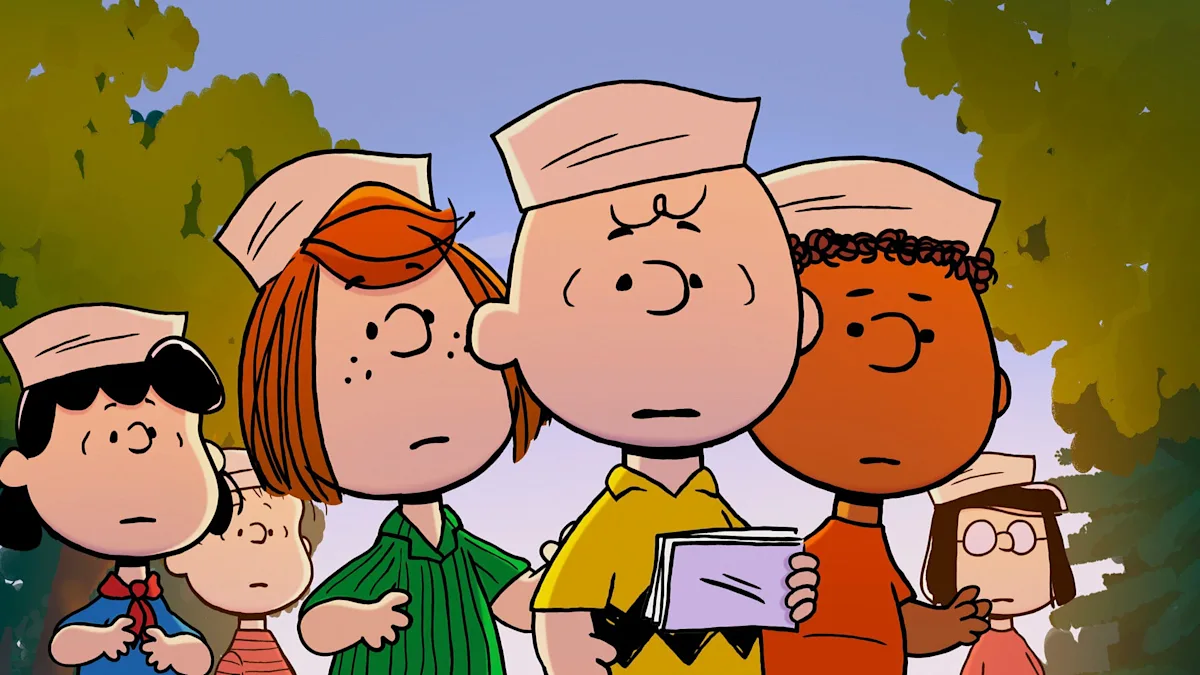
On the morning of October 2, 1950, readers of seven American newspapers turned to their comics pages and encountered something they had never seen before. In a row of four equally sized panels, a small round-headed boy named Charlie Brown was walking down a sidewalk. Two other children watched him pass. “Well! Here comes ol’ Charlie Brown!” said one. “Good ol’ Charlie Brown… How I hate him!” The boy being discussed continued smiling and walking, blissfully unaware of the contempt being expressed behind his back. In those four panels, in newspapers from the Minneapolis Tribune to The Washington Post to the Chicago Tribune, the Peanuts comic strip had made its debut, and American popular culture had acquired one of its most enduring and deeply felt characters.
The name of the strip was not one its creator had chosen. Charles Monroe Schulz hated the name Peanuts from the day it was assigned to him and would continue to resent it for the rest of his career. He had submitted his strip to United Feature Syndicate under the name Li’l Folks, the title it had carried since 1947. The syndicate changed it to Peanuts, a name derived from the “peanut gallery” section of the popular Howdy Doody children’s television show, where young children sat. A friend of Schulz’s visited a Minneapolis newsstand on the first day of publication and asked the dealer if any papers carried Peanuts. “No,” the dealer reportedly replied, “and we don’t have any with popcorn either.” The response confirmed Schulz’s worst fears about a title that, as he said in a 1987 interview, was “totally ridiculous, has no meaning, is simply confusing, and has no dignity.” Despite his feelings about its name, over the following fifty years the strip would become one of the most widely read, most deeply loved, and most culturally influential works in the history of American popular culture.
Charles Schulz: From Saint Paul to the Saturday Evening Post
Charles Monroe Schulz was born on November 26, 1922, in Minneapolis, Minnesota, the only child of Carl Friedrich August Schulz, a German immigrant who worked as a barber, and Dena Bertina Halverson, who was of Norwegian descent. The family moved to Saint Paul, where Charles grew up. His uncle gave him the nickname “Sparky” after Spark Plug, the horse in the popular Billy DeBeck comic strip Barney Google, a nickname that followed him his entire life and that he encouraged friends and colleagues to use in preference to his given name.
Schulz’s desire to become a cartoonist was established in childhood. He devoured the Sunday funny papers and was captivated by the art of communicating through sequential images and minimal text. When he was fifteen years old, he made his first published appearance in print: his sketch of the Schulz family dog, Spike, a thin and frequently bedraggled mutt, was submitted to Robert Ripley’s enormously popular “Believe It or Not!” newspaper feature and was published in 1938. It was a modest debut, but it was recognition from the wider world, and for a shy, introverted teenager it meant a great deal.
Schulz attended Saint Paul Central High School, where he was, by his own description, a shy and somewhat isolated student. He skipped two half-grades in elementary school, which meant he was consistently the youngest in his class, a position that reinforced rather than relieved his social awkwardness. He later acknowledged that much of Charlie Brown’s character, including the lovable inadequacy, the constant small defeats, and the inability to connect with the girl he liked, drew directly on his own adolescent experience. In 1940, at the end of his senior year, he enrolled in a correspondence course at the Federal School of Applied Cartooning in Minneapolis.
He was drafted into the United States Army in 1942, trained as a machine gunner at Fort Campbell, Kentucky, and eventually deployed to Europe, where he served in the 20th Armored Division, rising to the rank of staff sergeant and earning the Combat Infantryman Badge for fighting in active combat against Nazi forces before being discharged on January 6, 1946. His mother, Dena, had died of cancer while he was overseas, a loss that he carried for the rest of his life and that he later cited as a deepening of the sense of loss and melancholy that gives even the most humorous Peanuts strips their distinctive emotional undertone.
Li’l Folks, the Art Instruction Schools, and the Road to Syndication
When Schulz returned to Saint Paul after his discharge, he was hired to do lettering for Timeless Topix, a Catholic comic magazine. He also became an instructor at the Art Instruction Schools, the correspondence school where he had studied cartooning. It was at Art Instruction that Schulz met several colleagues who would become direct inspirations for Peanuts characters. Linus Maurer, a fellow instructor, gave his first name to the philosophical, blanket-clutching Linus. Sherman Plepler gave his first name to the character of Shermy, who was one of the original cast in the earliest strips. Charlie Brown’s unrequited love for the Little Red-Haired Girl was inspired directly by Schulz’s real and deeply felt love for Donna Mae Johnson, an accountant at Art Instruction who had red hair and whom Schulz fell in love with through the late 1940s. In June 1950, just months before Peanuts debuted, Schulz finally proposed to Johnson. She turned him down and married another man. The wound went deep, and the Little Red-Haired Girl, Charlie Brown’s perpetually unreachable object of affection, appeared in the strip for years afterward, always offscreen, always impossibly distant, as a direct expression of what that rejection had felt like.
In early 1947, Schulz began contributing a weekly single-panel cartoon to the St. Paul Pioneer Press under the title Li’l Folks, published under the byline of his nickname “Sparky.” The cartoon appeared every Saturday and featured small children in situations that were simultaneously funny and unexpectedly melancholy. It introduced the name Charlie Brown for the first time, though Schulz applied the name inconsistently to different characters in different panels during Li’l Folks’s three-year run. A small dog that bore a clear resemblance to the early Snoopy also appeared.
In 1948, Schulz sold his first single-panel cartoon to The Saturday Evening Post, then one of the most widely read magazines in the United States and a genuine cultural prestige venue for a cartoonist to appear in. Over the following two years, a total of seventeen of his untitled single-panel cartoons were published in the Post. By 1950, he was confident enough in his four-panel strip format to approach United Feature Syndicate directly, taking not his existing Li’l Folks panels but a selection of new four-panel strips he had developed specifically for syndication consideration.
The syndicate’s response was enthusiastic. They preferred the four-panel format that Schulz had developed to the single-panel version that Li’l Folks had used. But they required a title change. Tack Knight, who had authored a 1930s strip called Little Folks, objected to the similarity of Li’l Folks, and the syndicate, wanting a clean legal situation, renamed the strip. Schulz was not consulted in any meaningful way about the choice of Peanuts, and when he expressed his unhappiness with the name to the syndicate’s production manager, he was told that it was simply the title under which the strip would run.
The Wikipedia article on the Peanuts comic strip covers the full fifty-year run of the strip, from its debut in seven newspapers on October 2, 1950, through the final installment on February 13, 2000, the day after Schulz’s death.
October 2, 1950: The First Strip and Its Original Cast
The seven newspapers that carried Peanuts on its opening day were the Minneapolis Tribune, The Washington Post, the Chicago Tribune, The Denver Post, The Seattle Times, the Evening Chronicle of Allentown, Pennsylvania, and the Globe-Times of Bethlehem, Pennsylvania. The strip was formatted in four equally sized panels so that newspaper editors could run it horizontally in a single row, vertically in a column, or in a two-by-two square arrangement, maximizing its flexibility for different page layouts.
The original cast of the strip was small and significantly different from the characters that would become world famous over the following decades. Charlie Brown was present from the very first strip, establishing immediately the defining characteristic that would follow him for fifty years: he was an object of contempt or indifference from his peers, but he persisted in his small hopeful way regardless. Shermy was one of the two children watching Charlie Brown walk by in that first strip, providing the famously dismissive “Good ol’ Charlie Brown… How I hate him!” Patty, an original character who was completely distinct from the later Peppermint Patty, was also part of the earliest cast.
Snoopy did not appear until October 4, 1950, two days after the strip launched, and he appeared then simply as a small dog, unnamed in that strip, wet from the rain. He had none of the anthropomorphic complexity, the fantasies of World War I flying ace heroics, or the iconic relationship with his doghouse that would define him in later years. The character of Schroeder, the piano-obsessed boy who would become Lucy’s unrequited love interest, was not introduced until May 30, 1951. Lucy Van Pelt, the bossy, psychiatry-dispensing older sister who would become one of the strip’s most distinctive voices, appeared on March 3, 1952. Her younger brother Linus Van Pelt, with his security blanket and his philosophical depth, appeared on September 19, 1952.
The strip’s Sunday page edition debuted on January 6, 1952, at which point Peanuts was running in approximately forty newspapers. By October 1951, just a year after its debut, the strip was already in thirty-six newspapers. Schulz had been watching his competition carefully: Pogo, a politically sophisticated strip by Walt Kelly that was widely admired by other cartoonists, was running in approximately eighty newspapers. Nancy, by Ernie Bushmiller, was in two hundred. Schulz was determined that Peanuts would eventually surpass both.
What Made Peanuts Revolutionary: Failure, Philosophy, and Emotional Honesty
The reason Peanuts became something far more significant than an ordinary comic strip lay in what Schulz was doing with the form. The dominant tradition of the newspaper comic strip in 1950 was physical comedy, adventure, or the kind of gentle domestic humor associated with strips like Blondie and Dagwood. Children’s characters in comic strips had typically been depicted as cute, mischievous, and fundamentally uncomplicated. Schulz broke all of these conventions.
Charlie Brown was not cute in the conventional sense, and he was certainly not successful. He missed every fly ball, had his kite stolen by the kite-eating tree, was abandoned by his baseball team in the rain, and could never bring himself to speak to the Little Red-Haired Girl. His failures were not funny in a slapstick way. They were funny in a way that made readers recognize themselves, and that recognition was accompanied by a genuine emotional pang that distinguished Peanuts from virtually every comic strip that had come before it. Cultural historian M. Thomas Inge identified Charlie Brown’s lineage as including James Thurber’s inadequate heroes, Charlie Chaplin’s Tramp character, and Buster Keaton’s deadpan screen persona, all figures whose comedy was grounded in dignity maintained under conditions of constant defeat.
Schulz was also doing something philosophically ambitious within the constraints of a four-panel newspaper strip. Linus, holding his security blanket, would deliver fully developed theological or philosophical positions in the space of a few small panels. Lucy’s psychiatric booth, at which Charlie Brown paid five cents for advice that invariably made his situation worse, offered commentary on mid-century American therapy culture. Schroeder’s obsessive devotion to Beethoven on a toy piano was a study in the relationship between artistic passion and social isolation. The children of Peanuts spoke to adults as much as to children because they were addressing, through the metaphor of childhood, the fundamental anxieties and disappointments of adult experience: loneliness, failure, unrequited love, the search for meaning, and the gap between aspiration and reality.
The Britannica article on Charles M. Schulz covers Schulz’s artistic development, his techniques and themes, and the cultural significance of the Peanuts strip as an expression of mid-twentieth-century American psychology and philosophy.
A Charlie Brown Christmas and the Expansion into American Culture
The strip grew slowly in its first years, and Schulz acknowledged that it took time to find the rhythm and the characters that would make it extraordinary. By the late 1950s, Peanuts had achieved wide national distribution and genuine cultural recognition. Books collecting the strips began appearing in 1952, and they sold steadily. Schulz relocated his family to Sonoma County, California in 1958.
The event that transformed Peanuts from a successful comic strip into a phenomenon of American culture was the 1965 television special A Charlie Brown Christmas. The special was produced on an extremely limited budget of $76,000, equivalent to approximately $766,000 today, by Lee Mendelson and Bill Melendez in partnership with Schulz, who wrote the screenplay himself. CBS was initially reluctant to broadcast it, worried by its unconventional qualities: it used real children’s voices rather than adult actors mimicking children, it featured actual jazz music composed by Vince Guaraldi rather than the conventional orchestral score, its animation was deliberately simple and handmade in style, and it included a full minute-long reading by the character of Linus from the Gospel of Luke, a direct religious message that the network feared would alienate audiences.
A Charlie Brown Christmas aired on December 9, 1965, and was watched by approximately 15 million American households on its first broadcast. It won both a Peabody Award and an Emmy Award the following year. It has aired every year since and remains one of the most watched holiday television specials in American history. The Vince Guaraldi jazz soundtrack, featuring the piece “Linus and Lucy,” became one of the most recognizable pieces of music in American popular culture, instantly evocative of the Peanuts universe for anyone who heard it.
Subsequent television specials followed: It’s the Great Pumpkin, Charlie Brown in 1966, You’re in Love, Charlie Brown in 1967, and dozens more over the following decades. A stage musical, You’re a Good Man, Charlie Brown, premiered off-Broadway in 1967 and has been produced thousands of times since in schools, community theaters, and professional productions worldwide.
The History.com account of Peanuts and Charles Schulz covers the debut of the strip on October 2, 1950, and the full arc of its development into one of the most influential cultural properties of the twentieth century.
The Final Strip and the Legacy of Fifty Years
Charles Schulz was diagnosed with colon cancer in November 1999, and he announced his retirement from the strip on December 14, 1999. He drew his final new strip not long after the announcement, and when he finished it, he looked up from his drawing table and said, with characteristic simplicity: “I just realized that poor little boy is never going to kick that football.” The reference was to one of the strip’s most enduring recurring gags: Lucy’s ritual of holding a football for Charlie Brown to kick and then pulling it away at the last second, leaving Charlie Brown to fall. It had happened dozens of times over fifty years. Charlie Brown had never kicked the ball. He never would.
Schulz died on February 12, 2000, at his home in Santa Rosa, California. He was seventy-seven years old. The final new Peanuts strip was published the following morning, February 13, in newspapers across the world. Snoopy sat at his typewriter atop his doghouse and composed a farewell to readers. On the same morning, the world learned that Charles Schulz was gone.
At the time of his death, Peanuts was running in over 2,600 newspapers in seventy-five countries, had been translated into twenty-one languages, and had a readership of approximately 355 million people. Over the nearly fifty years of its original run, Schulz had drawn 17,897 published strips, every single one of them by himself, without any assistants or ghost artists. The complete collection was subsequently republished in a twenty-six-volume set by Fantagraphics Books. The strip itself has continued in reruns since Schulz’s death, reaching new readers and new generations.
The Charles M. Schulz Museum in Santa Rosa, California, opened in 2002 and preserves the archive of Schulz’s work alongside displays dedicated to the history of Peanuts and its creation. It stands near the Redwood Empire Ice Arena, the skating rink that Schulz built in 1969 out of his own lifelong love of ice hockey and figure skating, and that remains a community facility as well as a monument to its founder.
The Charles M. Schulz Museum’s account of the creation and history of Peanuts documents the full story of the strip’s creation, from the early Li’l Folks panels through the fifty-year run, preserving the original drawings and the archival materials that record how one man’s childhood in Saint Paul, Minnesota became a story the world has never stopped reading.
What appeared in seven newspapers on October 2, 1950, in four panels that showed a small round-headed boy walking past two children who disliked him, launched one of the most honest, most melancholy, and most enduring conversations between a cartoonist and his readers in the history of popular art. Charlie Brown never kicked the football. He also never stopped trying. That combination of persistent failure and unkillable hope is why, more than seven decades after that first strip appeared, the world still knows his name.