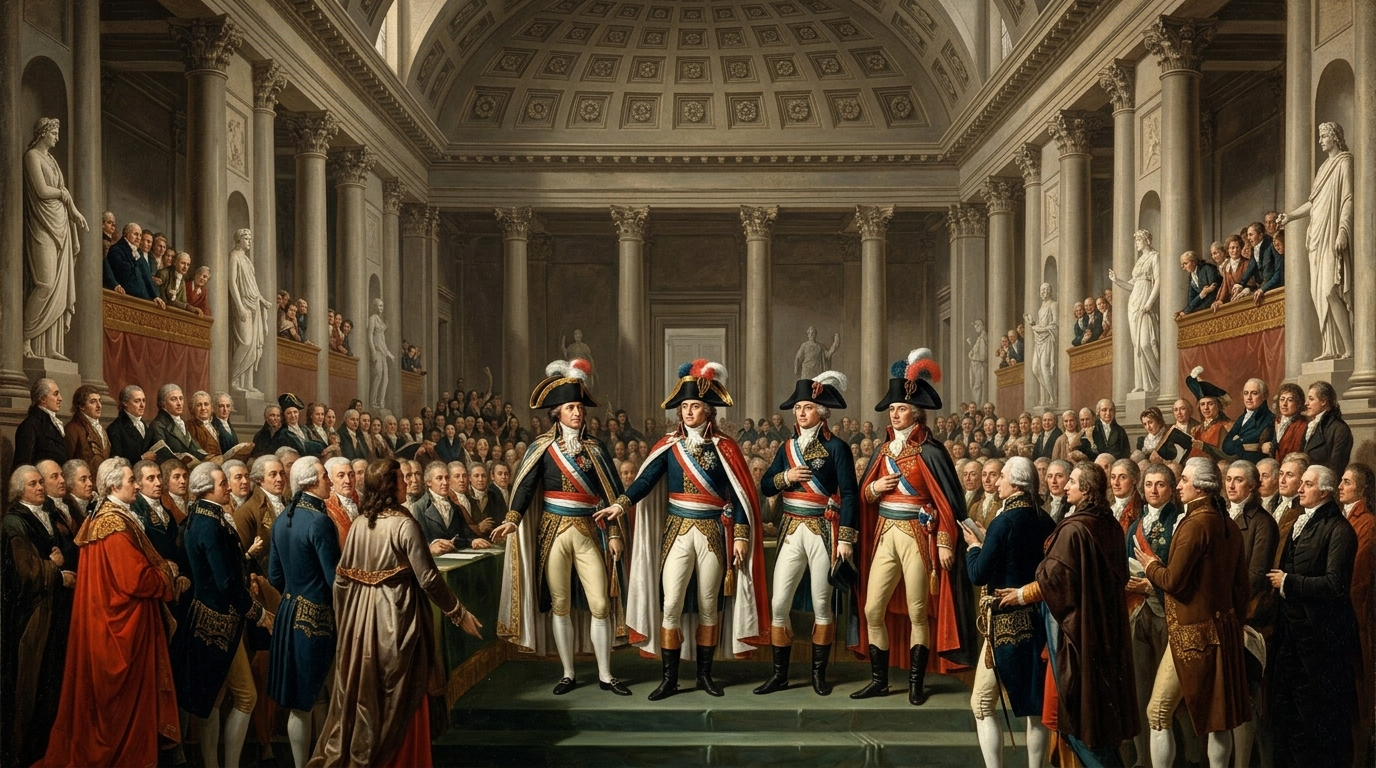
On November 2, 1795, the French Directory formally assumed power in Paris, inaugurating a new phase in the French Revolution that would last four years and transform France from the bloodied exhaustion of the Reign of Terror to the threshold of Napoleonic rule. The Directory, known in French as the Directoire, replaced the hated Committee of Public Safety that had presided over thousands of executions and established itself as the governing executive of the French Republic under the terms of a new constitution. Five men, called Directors, would exercise collective executive power over the French state, sharing authority in a way that was specifically designed to prevent any single person from accumulating the dictatorial power that Maximilien Robespierre had wielded so catastrophically in the preceding years.
The inauguration of the Directory on November 2, 1795, was both an ending and a beginning. It ended the most radical phase of the French Revolution, the period of mass executions and ideological terror that had consumed thousands of lives in the name of defending republican virtue. And it began a new chapter of French political life that was, in its own way, almost equally troubled: a period of chronic economic crisis, repeated coups, constitutional manipulation, and eventually the arrival of a general whose military genius would make republican government obsolete. The story of the Directory is the story of how France tried and failed to find stable self-government in the aftermath of revolution, and of how that failure created the conditions for Napoleon Bonaparte.
The Terror, the Thermidorian Reaction, and the Crisis That Produced the Directory
The French Revolution had begun in 1789 with the optimistic conviction that reason, liberty, and the will of the people could create a just and stable government. What it produced instead was a decade of accelerating radicalism, violence, and political instability that left France exhausted and desperate for order. Understanding why the Directory took power in November 1795 requires understanding the specific catastrophe that preceded it.
Maximilien de Robespierre, the lawyer from Arras who dominated the Committee of Public Safety from the summer of 1793 onward, had constructed a system of revolutionary justice in which accusation was nearly equivalent to conviction and in which the definition of counterrevolutionary activity expanded continuously to encompass anyone who might conceivably threaten the Republic’s survival. Between September 1793 and July 1794, approximately 16,000 people were executed by the guillotine after sentences from the Revolutionary Tribunal, and many thousands more died in prison or were killed without formal trial in the provincial massacres of the period. The Reign of Terror, as contemporaries called it, consumed not only the Revolution’s enemies but many of its most dedicated servants: Georges Danton, who had helped found the Committee of Public Safety, was guillotined on Robespierre’s orders in April 1794, accused of insufficient zeal.
The mechanism that ended the Terror was not a popular uprising but a conspiracy within the Convention itself. On 9 Thermidor Year II of the Revolutionary calendar, corresponding to July 27, 1794, a coalition of deputies who feared they would be the Terror’s next victims organized Robespierre’s arrest during a Convention session. He was guillotined the following day along with his closest allies, including Louis Antoine de Saint-Just and Georges Couthon. The Thermidorian Reaction, as the aftermath was called, systematically dismantled the Terror’s machinery: the Revolutionary Tribunal was reorganized, the radical Paris Jacobin Club was closed, and many of the most aggressive revolutionary measures were reversed.
The problem facing the Thermidorians was that having dismantled Robespierre’s system, they needed to replace it with something stable. The Constitution of 1793, which had granted universal male suffrage and established a powerful unicameral legislature, had never actually been implemented, suspended immediately after adoption by the emergency of war and internal rebellion. A new constitutional framework was required, one that would prevent both the radical democracy the Thermidorians feared and the royal absolutism that had triggered the Revolution in the first place.
The Constitution of Year III and the Architecture of the Directory
The constitutional solution that the Thermidorian-dominated National Convention produced in August 1795 was a deliberate attempt to build structural barriers against both popular radicalism and executive tyranny. The Constitution of Year III, formally adopted on August 22, 1795, was the document that created the Directory and defined its powers and limitations.
The constitution replaced universal male suffrage with a property-based franchise, restricting voting rights to approximately 30,000 electors who met minimum property requirements. This was an explicit rejection of the democratic radicalism of 1793 and a statement that the propertied classes, not the general population, should hold ultimate political authority. Women had no political rights under any of the revolutionary constitutions.
The legislative body, called the Corps Legislatif, was divided into two chambers rather than the single powerful assembly that had characterized the revolutionary years. The lower house was the Council of Five Hundred, containing 500 deputies who had to be at least 30 years old and who were responsible for proposing legislation. The upper house was the Council of Ancients, containing 250 deputies who had to be at least 40 years old and who were either married or widowed, reflecting the constitution’s preference for mature stability over youthful radicalism. The Ancients could approve or veto legislation proposed by the Five Hundred but could not initiate legislation themselves.
The executive was the five-member Directory itself, chosen by a specific process designed to insulate it from popular pressure. The Council of Five Hundred proposed a list of fifty candidates for the five Director positions, and the Council of Ancients selected five from that list. Directors had to be at least forty years old and either currently serving or formerly serving as ministers or legislators. Each Director served a five-year term, with one Director replaced annually by rotation, ensuring both continuity and gradual change. No single Director could issue orders alone; all significant executive actions required majority agreement.
A specific provision in the constitution, known as the “Law of Two-Thirds,” required that two-thirds of the seats in the new legislative bodies be filled by existing members of the National Convention. This measure, transparently self-interested, was designed to prevent royalist resurgence by ensuring that the men who had voted for the execution of Louis XVI would retain legislative power. It provoked the Vendemiaire uprising of October 5, 1795, when Parisian sections supported by royalist sentiment rose in rebellion against the Convention. The uprising was suppressed by military force under General Napoleon Bonaparte, who ordered artillery to fire on the rebels in what became known as the “whiff of grapeshot” that first brought Napoleon to political prominence.
The Wikipedia article on the French Directory provides the comprehensive account of the Directory’s constitutional foundations, its five original members, and the political crises that defined its four-year existence from 1795 to 1799.
November 2, 1795: The Five Directors Take Power
The five men who constituted the first French Directory and took office on November 2, 1795, were a varied group united mainly by their survival through the revolutionary years and their identification with the Thermidorian wing of French politics. Each had been an active participant in the Revolution and each had navigated the dangerous currents of the Terror.
Paul Barras was the most politically dominant of the five original Directors and arguably the most significant figure of the entire Directory period. Born in 1755 into a minor noble family in Provence, he had served in the French army and colonial service before the Revolution. He sat in the National Convention as a regicide, having voted for the execution of Louis XVI, and had distinguished himself militarily by leading the operations against Toulon in 1793, during which a young artillery officer named Napoleon Bonaparte had caught his attention. Barras had been among the conspirators of 9 Thermidor who overthrew Robespierre, and it was Barras who had given Napoleon the command of the troops that suppressed the Vendemiaire uprising weeks before the Directory took power. He would serve continuously as a Director throughout the entire four-year period, the only one to do so, and his personal connections with Napoleon and his cultivation of the general as a political asset would eventually help seal the Directory’s fate.
Emmanuel-Joseph Sieyes was another of the five original Directors, though he resigned almost immediately, to be replaced by Lazare Carnot. Sieyes was one of the most important political theorists of the Revolution, the author of the famous 1789 pamphlet “What is the Third Estate?” which had helped crystallize the revolutionary demand for representative government. He was known for his political intelligence and his survival instincts, having passed through the Terror by maintaining as low a profile as possible, famously responding when asked what he had done during that period: “I survived.” Sieyes would return to power later and play a crucial role in the coup that ended the Directory.
Lazare Carnot, who replaced Sieyes, brought military administrative genius to the Directory. As the “organizer of victory” during the Terror, Carnot had been responsible for the enormous logistical effort of raising and equipping the fourteen armies France had deployed in its revolutionary wars. His administrative competence was unmatched by any of his colleagues. Jean-Francois Rewbell, a lawyer from Alsace, served as the Directory’s principal expert on foreign policy, particularly regarding France’s relations with the German states and the question of the left bank of the Rhine. Louis-Marie de La Revelliere-Lepeaux, a botanist and deist who shared the anti-clerical sentiments of the Revolution, completed the original five.
The Economic Catastrophe the Directory Inherited
The Directory took power in conditions of profound economic crisis that severely limited its capacity to govern effectively. The revolutionary governments since 1789 had financed their operations largely through a paper currency called the assignat, backed initially by the value of confiscated Church lands. As the Revolution continued and military expenditures mounted, the currency had been printed in increasingly reckless quantities. By November 1795, the assignat had lost more than 97 percent of its face value. Inflation was so severe that basic foodstuffs were priced beyond the reach of ordinary Parisians. Urban workers faced genuine hunger.
The winter of 1795 to 1796 was one of the harshest in memory, and food shortages became acute. The combination of unemployment, inflation, and cold generated popular unrest that the Directory struggled to contain. In February 1796, the assignat was discontinued entirely, replaced briefly by a new currency called the mandat, which also quickly collapsed. The Directory’s economic difficulties were never fully resolved during its four years in power and contributed permanently to its unpopularity with the urban population whose revolutionary energy had driven the Revolution’s earlier phases.
The financial crisis also shaped the Directory’s foreign and military policy in important ways. France’s continued wars with the European coalitions that had formed to contain the Revolution were expensive in blood and treasure, but they were also a source of revenue through the systematic extraction of resources, art, and financial contributions from conquered territories. The Directory’s encouragement of military campaigns beyond France’s borders was partly motivated by the practical need to finance the armies that could not be adequately supplied from France’s own depleted resources.
The Britannica article on the French Directory covers the Directory’s constitutional structure, the identities and roles of its five founding members, and the economic and political crises that characterized its four years in power.
Napoleon Bonaparte, the Italian Campaign, and the Directory’s Military Dependence
The Directory’s relationship with its military was the defining paradox of its four-year existence. The Directory depended on military success for revenue, for territorial expansion, and for political legitimacy in the face of domestic crises it could not otherwise address. Yet the military success it relied upon generated the very generals whose prestige and popular following eventually made them capable of overthrowing the civilian government.
Napoleon Bonaparte’s Italian campaign of 1796 to 1797 was the most spectacular demonstration of this dynamic. Napoleon had been appointed commander of the Army of Italy in March 1796, a command that Paul Barras helped arrange through his personal connections with the general. The Army of Italy was one of the weakest and worst-supplied of France’s forces, facing more numerous Austrian and Piedmontese forces in the Alpine terrain of northern Italy. In a campaign of breathtaking speed and tactical genius, Napoleon defeated his opponents in a series of engagements, forced Piedmont out of the war, and drove the Austrians from most of northern Italy.
The campaign transformed Napoleon from a promising general into a national hero. More importantly for the Directory, it generated the financial resources and political capital that made the regime temporarily more secure. But it also created a commander whose personal popularity exceeded that of any of the five Directors, who disposed of armies larger than the domestic forces available to the government in Paris, and who increasingly acted as an independent political force. The Italian campaign established the pattern that would repeat in Egypt and elsewhere: Napoleon winning victories that benefited the Directory while simultaneously accumulating the personal power that would eventually make the Directory irrelevant.
Coups Within the Directory: Fructidor, Floreal, and Prairial
The Directory’s constitutional framework proved unable to manage the political forces it faced, and the government resorted repeatedly to unconstitutional measures to maintain power. Three coups, each named for the month of the revolutionary calendar in which it occurred, defined the Directory’s political character.
The Coup of 18 Fructidor in September 1797 was the most consequential of these internal seizures. Elections in the spring of 1797 had produced a legislature increasingly dominated by royalist sympathizers who threatened to reverse the revolutionary settlement. Three of the five Directors, led by Barras and Rewbell and backed by the military force that Napoleon provided from his Italian command, staged a coup against the other two Directors and the royalist legislative majority. Over two hundred deputies were arrested or deported to French Guiana, two Directors were removed, and the elections of 49 departments were annulled. The coup demonstrated that the Directory was willing to violate its own constitution to remain in power, destroying whatever legitimacy it had derived from being a constitutional government.
The Coup of 22 Floreal in May 1798 annulled elections that had produced a legislature with too many radical Jacobin deputies for the Directory’s comfort. The Coup of 30 Prairial in June 1799 swung in the opposite direction, as the legislative councils removed three Directors and replaced them with figures more amenable to constitutional governance. With each coup and counter-coup, the credibility of the Directory as a stable government diminished further.
Emmanuel Sieyes, Napoleon, and the Coup of 18 Brumaire
By 1799, the Directory had exhausted its political credit. Military setbacks in the second coalition war had reversed the territorial gains of earlier years. The economy remained in crisis. Public opinion had cycled through support for Jacobin revival and royalist restoration and had settled into a generalized exhaustion with the entire revolutionary system. The Directory’s chronic reliance on coups had demonstrated that it could not govern through legitimate means.
Emmanuel Sieyes, now serving as a Director after his early resignation, concluded that the Directory had to be replaced by a stronger executive government. He began searching for a military figure with sufficient popular prestige to give a new governmental arrangement legitimacy. Napoleon returned from Egypt in October 1799, having abandoned his army after the Egyptian campaign proved militarily inconclusive. His return was welcomed with celebrations that underscored how completely his public stature overshadowed any of the existing political figures.
Sieyes and Napoleon began planning what became the Coup of 18 Brumaire. On November 9 and 10, 1799, using a manufactured emergency, Napoleon and Sieyes persuaded the legislative councils to move to Saint-Cloud outside Paris, ostensibly for security reasons. The following day, Napoleon appeared before the Council of Five Hundred to demand new governmental powers. The deputies resisted furiously, and Napoleon was briefly mobbed. His brother Lucien Bonaparte, who presided over the Council of Five Hundred, declared that the assembly was being terrorized by a minority of deputies and called on troops to clear the chamber. The other Directors resigned or were arrested. The French Directory had ceased to exist.
The World History Encyclopedia account of the French Directory covers the full four-year history of the Directory from its inauguration on November 2, 1795, through the coups that punctuated its existence and the final collapse of November 1799, explaining how each crisis of the Directory’s tenure contributed to the conditions that brought Napoleon to power.
The Directory that began on November 2, 1795, has often been dismissed as a cynical and corrupt interlude between the idealism of the early Revolution and the order imposed by Napoleon. But that assessment is too simple. The Directory was a genuine attempt, however flawed, to build a constitutional republic that avoided both the royal tyranny that had started the Revolution and the republican tyranny that the Terror had produced. It failed, partly through the inherent contradictions of its constitutional design, partly through the economic conditions it inherited and could not overcome, and partly through the emergence of Napoleon, whose military genius made civilian control of the army impossible to maintain. What it accomplished, despite its failures, was to hold France together through its most dangerous years and deliver the Revolution, however battered and transformed, to the new century that Napoleon would shape.