
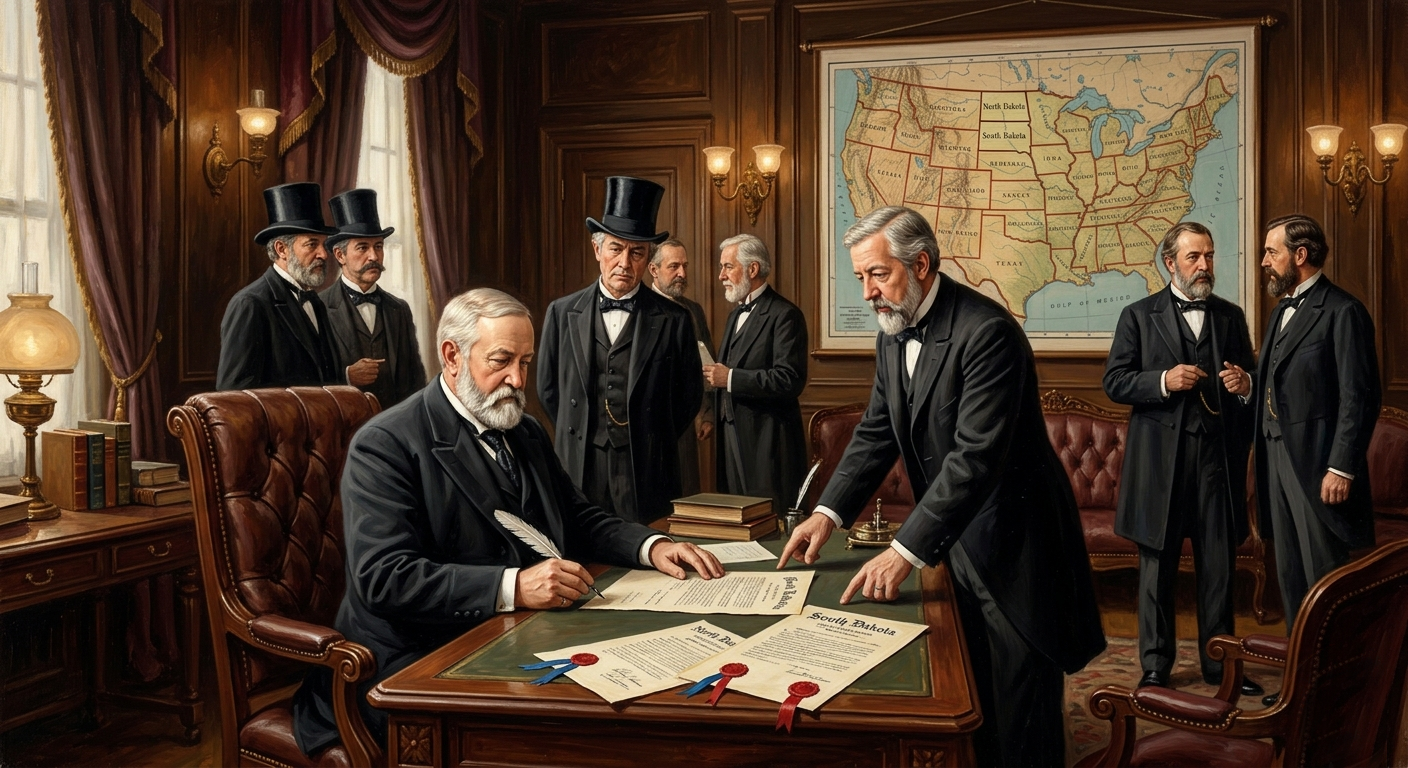
On November 2, 1889, President Benjamin Harrison sat down with two proclamations of statehood on his desk. On the table before him were the official documents admitting what had been the vast Dakota Territory to the Union as two separate states. Harrison had been told that both territories were equal in pride, equally convinced of their own primacy, and equally determined that if there was going to be a first and a second, they would be the first. So Harrison did something unprecedented in American presidential history. He directed Secretary of State James G. Blaine to shuffle the proclamations and cover the names before presenting them to him. Harrison signed them both without looking. No one watched. No record was kept. To this day, no one knows with certainty which of the two Dakotas became a state first.
Since there is no official record, both North Dakota and South Dakota hold the distinction of simultaneous admission. Because North Dakota alphabetically precedes South Dakota, its proclamation was published first in the Statutes at Large, making it the 39th state in the official record and South Dakota the 40th. November 2, 1889, was a day that added not one but two stars to the American flag. The story of how those two stars came to be placed, why they required separate documents rather than a single one, and what it cost the people who were already living on that land tells one of the most complicated chapters in the history of American westward expansion.
The Dakota Territory: One Vast Land Stretching Across the Northern Plains
The Dakota Territory that became two states on November 2, 1889, had itself only existed since March 2, 1861, when Congress organized it as an official territory of the United States. At its creation, it encompassed not just the land that would become North and South Dakota but also large portions of what would become Montana and Wyoming. The territory’s name honored the Dakota branch of the Sioux peoples who had lived across this land for centuries.
The land itself was extraordinary: the northern plains stretching from the Minnesota border in the east to the Missouri River and beyond in the west, bounded by Canada to the north and by Nebraska in the south. The Black Hills of the southwest were an ancient and sacred landscape for the Sioux. The Missouri River, running diagonally through the territory from northwest to southeast, served as a natural geographic and cultural dividing line between the plains to the east and the more arid lands to the west. The Red River Valley in the extreme northeast was some of the most fertile wheat-growing soil on the continent.
Before European Americans arrived in any significant numbers, the land was inhabited by peoples with deep and permanent roots. The Mandan, Hidatsa, and Arikara nations in the north had built permanent agricultural villages along the Missouri River for centuries, cultivating corn, beans, and squash in a sophisticated mixed farming and trading economy. The Sioux, also known as the Lakota in the west and the Dakota in the east, were the most numerous and politically powerful presence across the central and southern plains, having migrated westward from the Great Lakes region over the preceding two centuries and having built a culture centered on horse-mounted buffalo hunting that was at its height of sophistication and power when European exploration began.
Lewis and Clark, the Fur Trade, and the First American Presence
European American knowledge of the northern plains was largely secondhand before the beginning of the nineteenth century. French explorers and fur traders had pushed through the region in the late seventeenth and early eighteenth centuries, and the British North West Company had established trading relationships with the Mandan and Hidatsa villages along the Missouri. In 1803, the Louisiana Purchase transferred the entire territory from France to the United States, and the following year the Lewis and Clark Expedition traveled through what would become both Dakotas on its way to the Pacific.
Meriwether Lewis and William Clark spent the winter of 1804 to 1805 at Fort Mandan, a wooden stockade they constructed on the north bank of the Missouri River in what is now central North Dakota, near the Mandan and Hidatsa villages. It was here that they met Toussaint Charbonneau, a French Canadian fur trader, and his young Shoshone wife Sacagawea, who agreed to serve as interpreters and guides for the expedition’s western leg. The journals Lewis and Clark kept during their winter at Fort Mandan constitute some of the earliest and most detailed accounts of the northern plains environment, its peoples, and its resources.
The fur trade brought American trappers, hunters, and trading post operators into the Dakota region through the first half of the nineteenth century. The American Fur Company established Fort Pierre at the confluence of the Bad River and the Missouri in present-day South Dakota and Fort Union at the confluence of the Yellowstone and Missouri rivers in present-day North Dakota. These posts were the centers of an extensive trade network that connected the northern plains to the commercial cities of the American east. They were also the vectors through which disease spread devastatingly through indigenous communities, particularly the smallpox epidemic of 1837 that killed an estimated two-thirds of the Mandan and Hidatsa populations.
The Wikipedia article on the Dakota Territory covers the full history of the organized territory from its creation in 1861 through its division and admission as two states in November 1889, including the political disputes that led to separation and the role of the Republican Party in engineering the two-state solution.
The Homestead Act, the Dakota Boom, and the Pressure for Statehood
The demographic and political transformation that ultimately produced two states began in earnest with the Homestead Act of 1862, which offered 160 acres of public land to any citizen who settled on it and improved it for five years. The promise of free land, combined with the expanding network of railroads that made the northern plains accessible from eastern cities and from Europe, triggered waves of settlement that transformed the character of the Dakota Territory within two decades.
The Northern Pacific Railroad reached Bismarck in what is now North Dakota in 1873, opening the northern plains to agricultural settlement on an industrial scale. The Great Northern Railway, under the direction of James J. Hill, the financier known as the “Empire Builder,” pushed westward across what is now North Dakota through the 1880s, connecting the region to eastern markets and actively promoting settlement through its own land sales and immigration programs. Millions of acres that had been open grassland supporting massive buffalo herds were broken and planted within years.
The population explosion that followed was dramatic. The territory’s total population grew from fewer than 12,000 in 1870 to more than 500,000 by 1890, a transformation achieved in a single generation. The period from roughly 1878 to 1886 became known as the Dakota Boom, characterized by enormous bonanza farms, wheat production that made the territory a major exporter of grain, and towns that seemed to spring up overnight wherever a railroad surveyor planted a stake. Immigrants from Norway, Germany, Sweden, Russia, and the British Isles poured into the territory in search of the free land and fresh start that the Homestead Act promised.
By the mid-1880s, the population of the southern portion of the Dakota Territory had grown far more rapidly than the north, and southern settlers increasingly resented governing arrangements that they believed favored Yankton in the south as the territorial capital while leaving northern populations equally underrepresented. The question of where the capital would be located became the central conflict driving demands for division, since neither the north nor the south was willing to concede capital status to the other region’s preferred city.
The Political Calculation: Why Republicans Wanted Two States Instead of One
The decision to divide Dakota Territory into two states rather than admitting it as a single large state was not simply a matter of resolving regional differences about capitals. It was also a calculated political maneuver by the Republican Party that shaped American politics for generations.
By 1889, the Dakotas were reliably Republican territory. Settlement had been driven partly by the party’s own policies, including the Homestead Act and the railroad land grants. The settlers who had come to the territory were predominantly from the rural Midwest and from northern European immigrant communities that leaned heavily toward the party of Lincoln. Admitting the Dakota Territory as a single state would add two senators to the United States Senate. Dividing it into two states would add four senators, all of them expected to be Republicans. Republican Party leaders in Congress, having defeated President Grover Cleveland in the election of 1888, were in no mood to be modest about their advantage.
The Enabling Act of 1889, signed by outgoing Democratic President Cleveland on February 22, 1889, on what was deliberately chosen as George Washington’s birthday as a symbolic connection to American founding, authorized the division of Dakota Territory and the drafting of constitutions for the two new states, along with Montana and Washington. Congressional Democrats had initially proposed admitting Democratic-leaning New Mexico alongside the Dakotas in a package that would balance the Senate gains for both parties. The Republicans, having won the 1888 election, refused. They admitted the two Dakotas along with Montana and Washington, all expected to be Republican states, while leaving New Mexico out entirely.
The cynicism of the political calculation was noted even at the time. Today, there are still two Dakotas because Gilded Age Republicans wanted four senators instead of just two. The structural consequence of that political calculation has lasted nearly a century and a half.
The Sioux and the Cost of Statehood
The statehood of the Dakotas was achieved at an enormous cost to the indigenous peoples who had inhabited the land for centuries. The Great Sioux Reservation, established by the Fort Laramie Treaty of 1868, had covered all of present-day South Dakota west of the Missouri River, an area of approximately 60,000 square miles. The treaty guaranteed the Sioux permanent possession of this territory, including the sacred Black Hills.
The discovery of gold in the Black Hills in 1874, announced by Lieutenant Colonel George Armstrong Custer following a military expedition into the Black Hills in direct violation of the treaty, brought tens of thousands of gold seekers and settlers flooding onto Sioux land. The federal government’s attempt to purchase the Black Hills from the Sioux failed when the required 75 percent consent of adult male Sioux could not be obtained. Instead, Congress simply seized the territory by legislation in 1876, in a clear violation of the treaty that the US Supreme Court later acknowledged, in United States v. Sioux Nation of Indians (1980), constituted an unjust taking for which the Sioux were owed compensation.
The Indian Wars of the late 1870s included the Battle of the Little Bighorn in June 1876, in which Sioux and Cheyenne warriors under Sitting Bull and Crazy Horse destroyed Custer’s Seventh Cavalry, the most famous American military defeat of the period. But the broader outcome was determined by the systematic destruction of the buffalo herds on which plains Indian cultures depended, the confinement of the Sioux to ever-smaller reservations, and the overwhelming demographic pressure of settlement. The enormous Great Sioux Reservation was broken up by the Dawes Act of 1887 and subsequent agreements in 1889, just months before statehood, dividing the reservation into smaller individual allotments and opening the “surplus” land to white settlement. The irony that the Dakota Territory was being prepared for statehood at the same moment that the indigenous populations’ land base was being dismantled was apparent to many observers and is a fundamental part of both states’ histories.
The Britannica article on South Dakota’s history and geography covers the indigenous history of the northern plains, the impact of the Homestead Act and railroad settlement, the Black Hills gold rush and the Sioux treaty violations, and the path to statehood in 1889.
November 2, 1889: The Day Harrison Shuffled the Papers
The constitutional conventions required by the Enabling Act met through the summer of 1889. North Dakota’s convention met at Bismarck from July 4 to August 17, 1889. South Dakota’s convention met at Sioux Falls from July 4 to August 5. Voters ratified both constitutions in October 1889 and elected the first state officers and legislators.
The constitutions of both new states reflected the aspirations and anxieties of their settlers. Both prohibited polygamy, a direct reference to the ongoing conflict between the federal government and the Mormon Church in Utah. Both established prohibition of alcohol, though North Dakota would have particular success in maintaining it. Both established free public education systems and state universities. Both protected the rights of labor against the corporate power of the railroads that had done so much to build and to exploit the territories.
When President Harrison signed the proclamations on November 2, 1889, he completed the addition of four states to the Union in a single year. Montana had been admitted on November 8 and Washington on November 11 would follow, making 1889 one of the most expansive years in the history of American statehood since the Civil War era. In a single extraordinary year, the American map had been transformed across the entire northern tier of the continent.
The first governor of North Dakota was John Miller, who presided over a turbulent initial legislative session that debated prohibition, lotteries, and the relationship between the new state government and the railroad and commodity interests that dominated the state’s economy. The first governor of South Dakota was Arthur Mellette, who had served as the last governor of the Dakota Territory and who understood from long experience the tensions that would define politics in both new states.
The Early Years: Agriculture, Populism, and Prairie Identity
The states that Harrison’s shuffled papers created in November 1889 were not simply geographical units. They were communities of settlers who had come to the northern plains with ambitions, grievances, and political ideas that would find expression in the institutions their statehood enabled.
Agriculture dominated both states’ economies from the beginning, and the relationship between farmers and the railroads, banks, and grain elevator operators who controlled the marketing of their crops was the defining political tension of the early decades. Farmers who had borrowed money to buy equipment and plant crops found themselves squeezed between falling wheat prices, rising railroad freight rates, and the effective monopoly control that grain elevator operators exercised over access to the market.
The Farmers’ Alliance, a national political organization that would eventually help give birth to the Populist Party, was particularly strong in North Dakota. In 1890, North Dakota farmers organized an Independent Party that challenged the Republican establishment and captured significant legislative representation, fusing with Democrats to win state government in 1892. The insurgent tradition of North Dakota politics, which would later produce the Nonpartisan League’s state ownership of a bank and mill in 1919, the only state-owned bank in the United States, had its roots in the anger of the earliest farming communities.
South Dakota’s politics were also shaped by agricultural grievances, but the state’s greater diversity of terrain and economy, including the Black Hills mining region as well as the fertile eastern plains, produced a somewhat different political evolution. Both states would become central to the Populist Movement of the 1890s, sending representatives to Congress who challenged the financial and railroad interests that many plains farmers considered their primary oppressors.
The History.com account of North and South Dakota statehood covers the dramatic moment of Harrison’s signing, the political calculations that produced two states from one territory, and the subsequent development of both states through the agricultural and populist periods of American history.
The November 2, 1889 admission of North and South Dakota was not simply a bureaucratic act of territorial organization. It was the culmination of decades of collision between indigenous civilization and settler expansion, between regional ambition and national political calculation, between the idealism of the Homestead Act’s promise and the reality of corporate power over plains agriculture. The states that emerged from that collision are still, more than 130 years later, working through the consequences of how they came to be.