
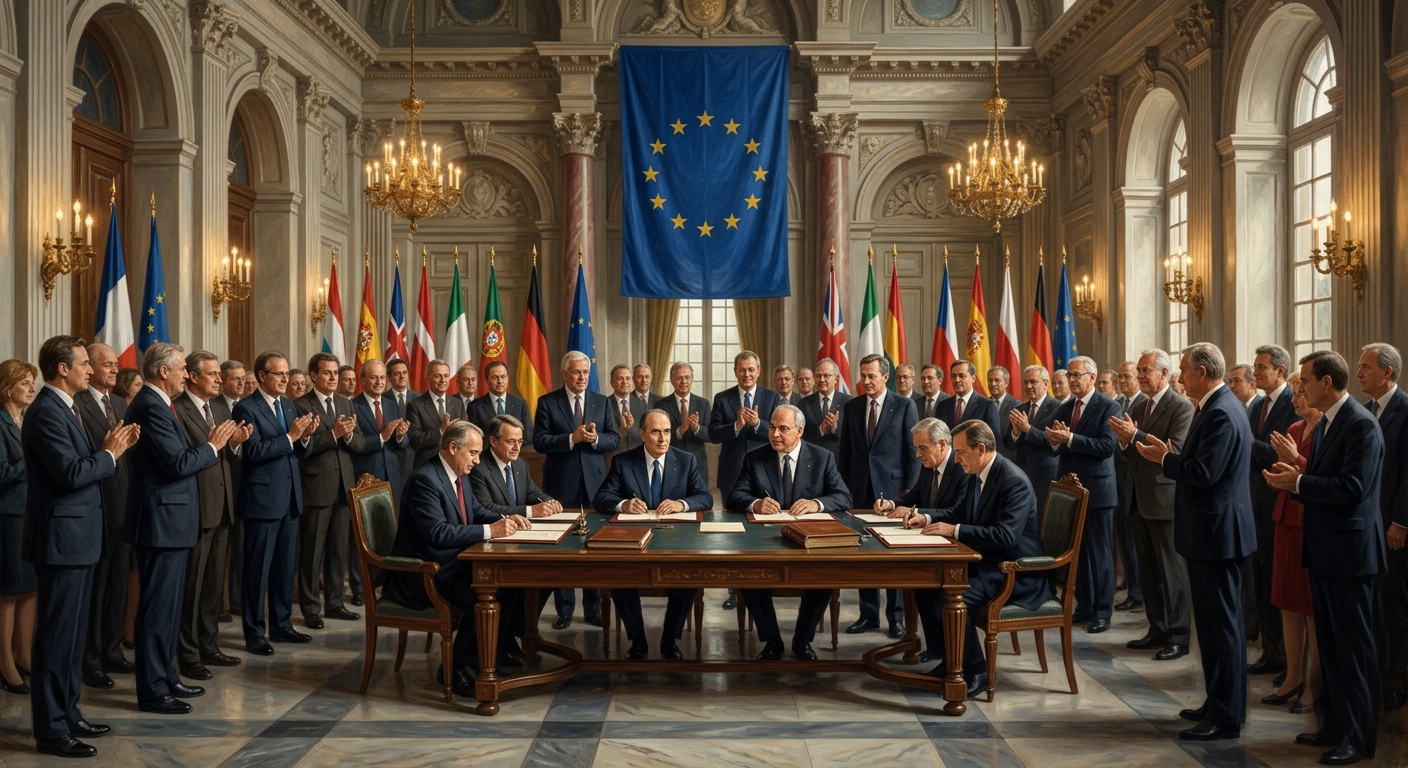
On November 1, 1993, after months of uncertainty, political drama, and narrow referendum results across twelve nations, the Maastricht Treaty officially came into force. With its entry into effect, the European Union was formally born. Twelve sovereign nations, Belgium, Denmark, France, Germany, Greece, Ireland, Italy, Luxembourg, the Netherlands, Portugal, Spain, and the United Kingdom, had committed themselves to a new kind of political and economic union without precedent in history: a union that created shared citizenship, laid the groundwork for a single currency, established a framework for common foreign policy, and brought the nations that had twice destroyed each other in catastrophic world wars into an institutional embrace designed to make such destruction permanently unthinkable.
The European Union that came into being on November 1, 1993, was not created in a single moment. It was the product of nearly half a century of incremental integration, driven by statesmen who had lived through the wars and were determined that Europe would find a different path. But November 1, 1993, was the date on which that process of integration reached its most ambitious expression to that point, transforming the European Communities of the postwar decades into something qualitatively new: a union with its own citizenship, its own currency roadmap, and its own political identity.
The Devastation That Made European Unity Necessary: From World War to the Coal and Steel Community
The impulse toward European unity that eventually produced the Maastricht Treaty was born directly from the destruction of the Second World War. By 1945, Western Europe had been devastated twice in thirty years by wars whose origin lay in the competing nationalisms of European states. More than 70 million people had died in the Second World War alone. The European continent’s cities, infrastructure, economies, and social fabric had been shattered. The political leaders who rebuilt Europe from this ruin were determined that the structural conditions that had produced two catastrophic wars must be permanently altered.
The French statesman Jean Monnet, perhaps the single most important intellectual architect of European integration, understood the problem with characteristic clarity. As long as European nations competed with each other for the same economic resources, particularly coal and steel, the materials of industrial production and military power, the conditions for conflict would persist. His solution was elegant: place the production of coal and steel under a joint supranational authority so that no nation could use those resources exclusively for its own military rearmament without the knowledge and participation of its neighbors.
Robert Schuman, the French Foreign Minister, presented this proposal in a declaration on May 9, 1950, a date now celebrated annually as Europe Day. The Schuman Declaration led directly to the Treaty of Paris, signed on April 18, 1951, establishing the European Coal and Steel Community. The founding members were six nations: France, West Germany, Italy, Belgium, the Netherlands, and Luxembourg. Germany’s former chancellor Konrad Adenauer and Italy’s Prime Minister Alcide De Gasperi were among the national leaders who gave the ECSC its political support.
The Treaty of Rome, signed on March 25, 1957, expanded this integration into a broader European Economic Community, establishing a common market among the six founding nations. The EEC created the free movement of goods, services, capital, and eventually people across member states’ borders. The phrase “ever closer union among the peoples of Europe” appeared in the treaty’s preamble, signaling an integrationist ambition that went beyond mere trade cooperation. The EEC grew steadily, adding the United Kingdom, Denmark, and Ireland in 1973, Greece in 1981, and Portugal and Spain in 1986, expanding from six members to twelve.
The Fall of the Berlin Wall and the Vision of Helmut Kohl and François Mitterrand
The specific momentum that produced the Maastricht Treaty came from two interrelated events in the late 1980s and early 1990s: the project for a single European market that Commission President Jacques Delors had championed throughout the late 1980s, and the sudden collapse of the communist regimes of Eastern Europe culminating in the fall of the Berlin Wall on November 9, 1989.
Jacques Delors, the French Socialist politician who served as President of the European Commission from 1985 to 1995, had been the driving force behind the Single European Act of 1986, which deepened the integration of the European single market and laid institutional groundwork for the currency union that Maastricht would formalize. Delors had also commissioned the Delors Report of 1989, which proposed a three-stage process for creating a European Economic and Monetary Union with a single currency. His vision and persistence were essential to the Maastricht Treaty’s eventual form.
The fall of the Berlin Wall transformed the politics of European integration overnight. German reunification, which followed with astonishing speed in 1990, doubled Germany’s size, population, and economic weight within the European Community. France, and to a lesser extent the other smaller European nations, faced an uncomfortable strategic reality: a unified Germany was by far the largest and most powerful state in Europe, with the economic and demographic weight to dominate the continent if it chose to pursue a purely national course.
The solution that French President François Mitterrand and German Chancellor Helmut Kohl developed together was to bind unified Germany more deeply into European institutions, making it structurally impossible for Germany to dominate the continent in the old way by sharing its sovereignty with its European partners. Kohl, for his part, understood that Germany needed to demonstrate to its neighbors that it remained committed to the European path even after the opportunity of reunification. The partnership between Mitterrand and Kohl, the French socialist and the German Christian Democrat who had themselves represented the two nations that had fought three wars in seventy years, became the political engine that drove the Maastricht negotiations to completion. Horst Köhler, who later became Germany’s Finance Minister and then Federal President, also played an important role in the negotiations as a senior German official.
The Wikipedia article on the Maastricht Treaty covers the full negotiating history of the treaty, the roles of the national delegations, the specific provisions of the text, and the ratification battles in each member state that preceded its entry into force.
The Negotiations and Signing: Maastricht, February 7, 1992
The formal negotiations that produced the Treaty on European Union began in December 1990, with two intergovernmental conferences running simultaneously: one on Economic and Monetary Union and one on Political Union. The conferences brought together the heads of government of all twelve European Community member states and the institutional leadership of the Community’s existing bodies.
The Dutch city of Maastricht was the site of the decisive summit of the European Council in December 1991, where the heads of state and government reached the agreements that would be formalized in the treaty. The city’s name was given to the treaty as a result of this Dutch presidency of the Council. The Treaty on European Union was signed on February 7, 1992, by the foreign ministers and finance ministers of all twelve member states in Maastricht’s city hall, in the presence of Egon Klepsch, the President of the European Parliament.
The treaty’s structure was novel in the history of European integration. It created the European Union as an overarching framework resting on three “pillars.” The first pillar was the European Communities, encompassing the existing EEC, ECSC, and Euratom institutions that had been built over decades. The second pillar was the Common Foreign and Security Policy, a new framework for coordinating the foreign and defense policies of the member states. The third pillar was Justice and Home Affairs, covering cooperation on immigration, asylum, border control, and criminal justice. This three-pillar structure was a compromise between those who wanted deeper supranational integration and those who wanted to preserve national sovereignty in sensitive policy areas.
What the Maastricht Treaty Created: Citizenship, Currency, and the Path to Union
The substantive content of the Maastricht Treaty represented the most comprehensive transfer of authority from national to European-level institutions that the integration process had yet attempted.
The creation of European Union citizenship was one of the treaty’s most symbolically significant provisions. Every person holding the nationality of a member state automatically became a citizen of the European Union, with the right to vote and stand as a candidate in local and European Parliament elections in any member state in which they resided, regardless of their national citizenship. This was a genuinely novel concept: a citizenship that supplemented rather than replaced national citizenship but that created political rights across an entire continent.
The treaty’s provisions on Economic and Monetary Union formalized the three-stage process toward a common European currency that the Delors Report had outlined. It established the European Central Bank, the European System of Central Banks, and the European Monetary Institute as the institutional foundations for monetary union. It set out the convergence criteria, sometimes called the Maastricht criteria, that member states would need to meet to qualify for membership in the common currency zone: inflation rates, interest rates, budget deficit levels, and exchange rate stability requirements that were designed to ensure that the economies joining the currency union were sufficiently aligned to function together without the option of adjusting exchange rates between them.
The United Kingdom secured a crucial opt-out from the obligation to adopt the single currency, preserving the pound sterling as an expression of British sovereignty, and was not a party to the Social Policy Protocol, which committed other member states to minimum standards in labor and social policy. Denmark secured a similar opt-out from the currency union.
The Ratification Crisis: Denmark Says No, France Barely Says Yes, Britain Fights a Battle
The ratification of the Maastricht Treaty was one of the most politically turbulent processes in the history of European integration, revealing how deeply divided public opinion was in many member states about the speed and depth of European integration.
Denmark was the first crisis point. On June 2, 1992, Danish voters rejected the treaty in a referendum by a margin of 50.7 percent to 49.3 percent. The margin was tiny but the constitutional consequence was absolute: under Danish law, the treaty could not be ratified without a positive referendum result. The rejection sent shockwaves through European capitals and threatened to kill the entire project.
Negotiations at the European Council summit in Edinburgh in December 1992 produced a set of formal clarifications and exemptions for Denmark, including the critical exemption from the obligation to adopt the single currency. With these concessions in hand, Denmark held a second referendum on May 18, 1993, and approved the modified treaty by a margin of 56.8 percent to 43.2 percent. The crisis had been navigated, though the narrowness of the original Danish vote had exposed the shallow roots of pro-European sentiment in a significant portion of the European population.
France presented a different kind of crisis. President Mitterrand, in a calculated move to demonstrate French popular legitimacy for the treaty and to force the opposition parties to take a stand, called a referendum rather than relying on parliamentary ratification. The referendum on September 20, 1992, produced an agonizingly narrow yes vote of 51.05 percent, a result so close that it was immediately described as a “petit oui.” Mitterrand had won, but the result demonstrated that a large fraction of the French public shared the Danish voters’ skepticism about surrendering sovereignty to European institutions.
In Britain, the ratification battle was parliamentary rather than popular. Prime Minister John Major had successfully negotiated the opt-out from the single currency and the Social Policy Protocol, but he faced sustained opposition within his own Conservative Party from Eurosceptic members of parliament who regarded the treaty’s remaining obligations as unacceptable infringements of British sovereignty. The parliamentary passage of the ratification bill was a prolonged ordeal. On July 22, 1993, the Conservative government actually lost a key procedural vote on the treaty, and Major was forced to call a confidence vote the following day, tying the government’s survival to the treaty’s passage. The confidence vote narrowly passed, the treaty was ratified, and Major survived.
Germany was the last member state to complete ratification. The German Federal Constitutional Court had received legal challenges arguing that the Maastricht Treaty’s transfer of sovereign powers to European institutions violated the German Basic Law’s core democratic principles. On October 12, 1993, the court delivered its judgment, ruling the treaty compatible with the Basic Law but with an important condition: the European Union could not extend its own powers without specific authorization from the Bundestag. Germany’s ratification was complete, and the treaty could at last enter into force on November 1, 1993.
The Britannica article on the Maastricht Treaty provides the authoritative account of the treaty’s provisions, the ratification processes in each member state, and the formal establishment of the European Union on November 1, 1993.
November 1, 1993: The Day the European Union Was Born
When the Maastricht Treaty entered into force on November 1, 1993, it did so not with a ceremony of the kind that had marked the signing in February 1992 but as a technical legal act: the formal deposit of Germany’s last ratification instrument triggered the treaty’s entry into force, and the European Union came into existence. A union of twelve nations with a combined population of approximately 370 million people and a collective GDP that made it one of the largest economic units in the world had been created.
The formal name change that the treaty brought was also significant. The European Economic Community, which had been the central institution of the postwar integration project since 1957, became the European Community, shedding the word “economic” to signal that the project was now explicitly about political as well as economic union.
The institutional structure that November 1, 1993 created was more complex than any international organization that had preceded it. The European Commission, whose president was appointed by the member state governments but who served the interests of the union as a whole, retained the exclusive right to propose legislation. The Council of Ministers, representing the member state governments, was one of the two legislative chambers. The European Parliament, directly elected by citizens of the member states since 1979, was the other, with the Maastricht Treaty significantly expanding its powers through the new co-decision procedure that gave it genuine legislative equality with the Council in a wide range of policy areas.
From Maastricht to the Euro and Beyond: The Deepening of European Integration
The European Union that was born on November 1, 1993, continued to deepen and expand rapidly in the years that followed. Austria, Finland, and Sweden joined in 1995, bringing membership to fifteen. The Treaty of Amsterdam, signed in 1997 and entering into force in 1999, added sex discrimination protections, transferred asylum and immigration policy to Community competence, and strengthened the Parliament’s role further. The Treaty of Nice, signed in 2001, prepared the institutions for the largest expansion in the EU’s history.
The most concrete expression of the Maastricht Treaty’s monetary ambition came on January 1, 1999, when eleven member states formally adopted the euro as their currency for financial transactions, with exchange rates irrevocably fixed between their national currencies. On January 1, 2002, euro banknotes and coins entered circulation in twelve countries, physically replacing the francs, marks, lire, pesetas, escudos, and other national currencies that had been in use for generations. The euro became the second most widely held reserve currency in the world.
The EU’s most dramatic expansion came in 2004, when ten new members, mostly former communist states of Central and Eastern Europe, joined simultaneously. Bulgaria and Romania followed in 2007, bringing membership to twenty-seven. Croatia joined in 2013, bringing the total to twenty-eight. The UK’s decision to leave the EU, formalized through Brexit in 2020, reduced the membership back to twenty-seven.
The History.com account of the European Union’s official establishment covers the November 1, 1993 entry into force of the Maastricht Treaty, the political context that had made European union both possible and contentious, and the trajectory of the EU’s development in the years that followed its founding.
On November 1, 1993, the leaders who had negotiated and ratified the Maastricht Treaty could look at what they had created with justifiable pride. They had built, on the foundations laid by Schuman, Monnet, Adenauer, and De Gasperi four decades earlier, a union of nations that was unlike anything in history: sovereign states that had chosen to pool their sovereignty in specific areas for their mutual benefit, creating institutions through which their citizens could exercise democratic control over shared decisions. The imperfections and incompleteness of what had been created would become clearer over time. But the achievement of November 1, 1993 stands as one of the most consequential acts of political construction in the history of modern civilization.