The Moment That Changed Everything: August 6, 1991, and the Public Launch of the World Wide Web
On August 6, 1991, a British computer scientist working at CERN — the European Organisation for Nuclear Research near Geneva, Switzerland — posted a short message to a small internet newsgroup called alt.hypertext. The message was not long. It did not arrive with fanfare, press conferences, or product launches. It was a response to a query from another user who had asked whether anyone knew of development efforts involving hypertext links that could enable retrieval from multiple heterogeneous sources of information. The reply came from Tim Berners-Lee, and it described a project he called the World Wide Web. With that post, one of the most consequential inventions in the history of human communication was introduced to the world.
The post invited collaboration, explained the basic concepts behind the web — including the Hypertext Transfer Protocol, the Hypertext Markup Language, and the browser that could access and display documents stored on remote servers — and offered the code freely, with an explicit invitation to hack it, improve it, and share it. Berners-Lee even included one of the first URLs, or Uniform Resource Locators, in the post itself: http://info.cern.ch/hypertext/WWW/TheProject.html. This address, hosted on a NeXT computer in a laboratory at CERN, was the location of the world’s first website, which had been serving information about the World Wide Web project itself since December 20, 1990. As of the August 6 post, it was available to anyone on the internet. The World Wide Web had gone public.
The significance of what Berners-Lee offered on that August morning in 1991 cannot be overstated. He had not merely invented a useful piece of software. He had conceived and built the fundamental architecture of a global information system — a seamless web of interlinked documents accessible to any computer on the planet — and then chosen to give it away without patent, without royalty, and without restriction. That decision, as much as the invention itself, is what made the web what it became. Within three decades, the World Wide Web would carry more information than all the libraries in the world combined, support a global economy measured in tens of trillions of dollars, and become the primary medium through which billions of human beings communicate, learn, work, shop, and govern themselves. The story of how it came to exist begins not on August 6, 1991 but a decade earlier, in the mind of a young man building a notebook program in a CERN basement.
Tim Berners-Lee: The Man Who Invented the Web — His Origins, Education, and the Family That Shaped His Mind
Timothy John Berners-Lee was born on June 8, 1955, in London, England, into a family steeped in the earliest history of computing. His parents, Conway Berners-Lee and Mary Lee Berners-Lee (née Woods), were both mathematicians who had worked on the Ferranti Mark 1, the world’s first commercially built computer, produced by the British technology company Ferranti Ltd in 1951. His mother, born in 1924, and his father, born in 1921, were pioneers of the very industry their son would one day transform. Growing up in a household where computers were a natural topic of conversation gave the young Tim an unusual intellectual environment. He has spoken of making electronic gadgets to control a model railway he kept in his bedroom, and of his interest shifting from the trains themselves to the electronics that governed them — a transition from the mechanical to the computational that would define his professional life.
Berners-Lee attended Emanuel School in London and went on to study physics at The Queen’s College, University of Oxford, where he graduated with a First Class Honours degree in 1976. The choice of physics over computer science was characteristic: Berners-Lee has always been drawn to the intersection of abstract scientific thinking and concrete practical problem-solving. While at Oxford, he built his first computer from an old television set and a processor chip — another formative act of making that would later manifest on an enormously larger scale. After graduating, he worked for two years at Plessey Telecommunications Ltd in Poole, Dorset, writing software for message relay systems and barcode technology. He then spent time at D. G. Nash Ltd, a software company, before being engaged as an independent software engineering consultant at CERN.
CERN — the Conseil Européen pour la Recherche Nucléaire, or European Organisation for Nuclear Research — is the world’s largest particle physics laboratory, situated on the border of France and Switzerland near Geneva. At any given time, it employs more than 17,000 scientists from over 100 countries, most of whom spend only a portion of their time on the CERN campus while working primarily at universities and national laboratories in their home countries. The fundamental challenge of administering such a distributed, continuously evolving organisation — in which projects, personnel, software systems, and experimental data were in constant flux — was precisely the problem that would eventually lead Berners-Lee to invent the World Wide Web. He has described the web as an act of desperation, born of the genuine practical difficulty of keeping track of information in an environment where knowledge was scattered across hundreds of different computers, none of which talked easily to one another.
ENQUIRE: The 1980 Notebook Program That Planted the Seed of the World Wide Web
Berners-Lee’s first contact with CERN came in 1980, when he worked there as an independent software engineering consultant from June to December of that year. During this contract, inspired by a Victorian household reference book called Enquire Within upon Everything — a compendium of practical advice on everything from etiquette to medicine that he had encountered as a child — Berners-Lee wrote a personal software program he called ENQUIRE. The name was a nod to the book’s promise of finding any kind of information within a single connected source. ENQUIRE was a simple but conceptually radical program: it allowed a user to store snippets of information on separate pages, or nodes, and to connect related pieces of information through typed links. Each new page had to be linked to at least one existing page. Navigation happened through links rather than through any hierarchical filing structure.
ENQUIRE ran on Norsk Data machines under the SINTRAN-III operating system at CERN, and Berners-Lee used it to keep track of people, software modules, documents, and hardware devices he was working with during his contract. He described its operation as similar to the old text adventure game in which a player moves through rooms by following passageways: one progresses via links from one sheet to another rather than through any pre-imposed hierarchy. The system was crude, had no graphical interface, and existed only on a single machine at CERN — it was never designed for general consumption, and Berners-Lee did not retain a copy of it when he left CERN at the end of 1980. But ENQUIRE demonstrated, in miniature, the core principle that would eventually underlie the World Wide Web: that information could be made navigable and discoverable through a web of associations rather than a tree of categories, and that the network of links was potentially more powerful than the information itself.
After leaving CERN, Berners-Lee worked at Image Computer Systems Ltd in Bournemouth, where he served as the company’s technical lead, gaining experience in real-time graphics, communications software, and computer networking — experience that would prove essential when he later needed to think about how documents could be transmitted across a global network. He returned to CERN as a Fellow in 1984, this time in a permanent capacity, and immediately began confronting the information management problem on a much larger scale than he had in 1980. By 1989, CERN had grown into the largest internet node in Europe, with TCP/IP protocols running on Unix machines and a scientific community of thousands whose need to share data, experimental results, software documentation, and personnel records across borders and machine types was growing faster than any conventional document management system could accommodate.
Information Management: A Proposal — The March 1989 Document That Gave Birth to the Web
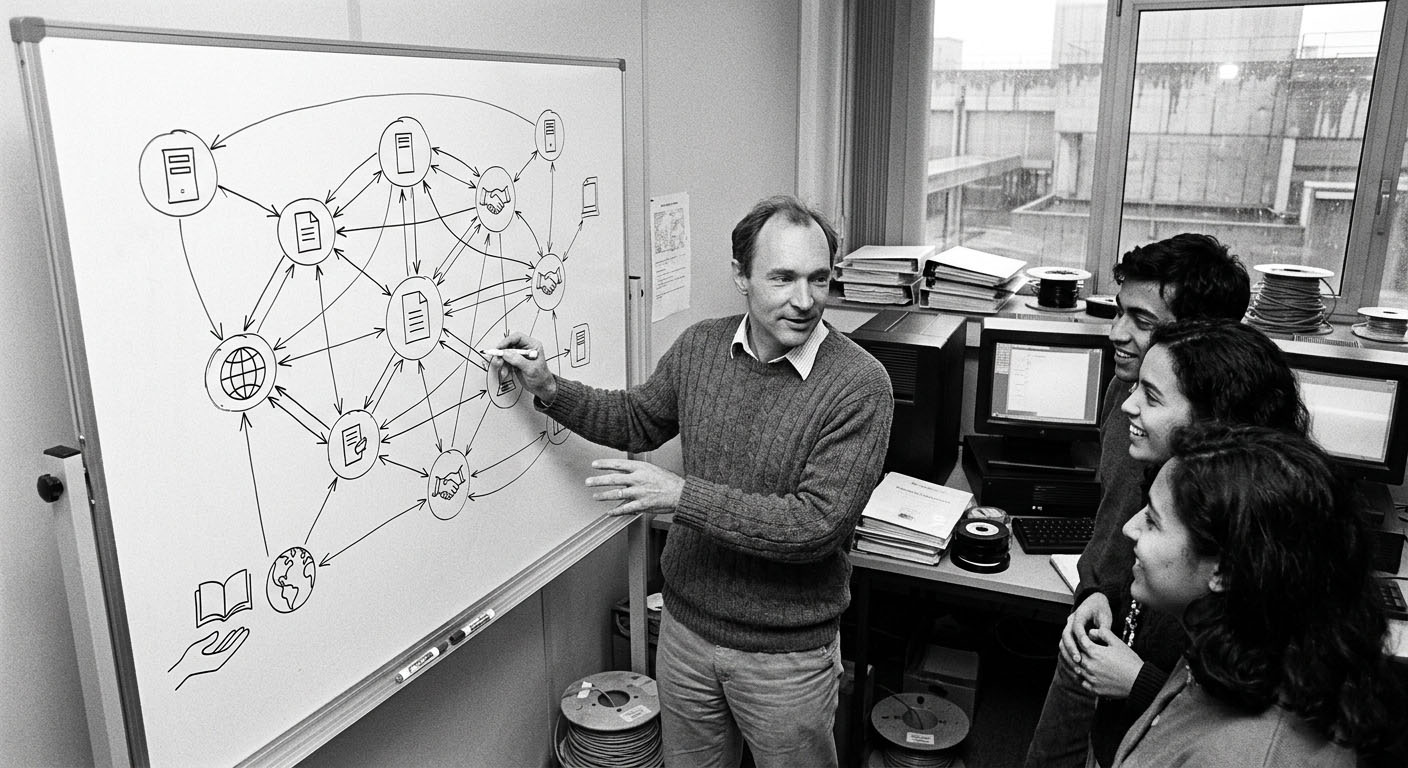
On March 12, 1989 — a date that Berners-Lee later revealed was his mother’s birthday — he submitted to CERN management a document titled Information Management: A Proposal. The document ran to approximately 15 pages and described a system he then called Mesh, based on a large hypertext database with typed links. The core insight of the proposal was elegantly simple: imagine, Berners-Lee wrote, the references in a document all being associated with the network address of the thing to which they referred, so that while reading the document you could skip to them with a click of a mouse. A document on the network that contained hypertext links to other documents on the network, served by a server and read by a browser — this was the essential vision. The document described the problem of information loss at CERN specifically but argued that the proposed solution would have much broader application.
The proposal was circulated to CERN management and met with a famous response. Berners-Lee’s direct supervisor, Mike Sendall, wrote in the margin of the proposal’s cover page the words: Vague but exciting. The phrase has become one of the most celebrated understatements in the history of technology. Sendall did not approve the proposal as an official CERN project — the web was never formally a CERN project in the budgetary sense — but he did encourage Berners-Lee to continue developing his ideas and eventually allocated him time to work on them. In September 1990, Sendall purchased a NeXT computer workstation, a machine built by the company Steve Jobs had founded after leaving Apple, and gave it to Berners-Lee to use for his prototype. The NeXT’s development environment was extraordinarily powerful for its time, and Berners-Lee would later say that without it, the prototype could not have been built as quickly as it was.
In May 1990, Berners-Lee circulated a revised version of his proposal. By this point he had attracted an important collaborator: Robert Cailliau, a Belgian systems engineer and fellow hypertext enthusiast who worked in the European Laboratory for Particle Physics at CERN. Cailliau, born in 1947 in Tongeren, Belgium, had independently proposed a project to develop a hypertext system at CERN and immediately recognised the potential of Berners-Lee’s vision when the two men began discussing it. Cailliau became an invaluable partner: he rewrote the project proposal in a form designed to appeal to CERN management, lobbied energetically for funding, helped recruit programmers, collaborated on papers and conference presentations, and was instrumental in organising the first international World Wide Web conference in 1994. On November 12, 1990, Berners-Lee and Cailliau published the formal management proposal under the title WorldWideWeb: Proposal for a HyperText Project. This document introduced the three fundamental technologies — HTTP, HTML, and the URL — that remain the technical foundation of the web to this day.
HTML, HTTP, and the URL: The Three Technologies That Built the World Wide Web
The architecture of the World Wide Web rests on three core technologies, each invented by Tim Berners-Lee as part of the same integrated vision, and each solving a distinct but related problem. Together they constitute the minimum technical vocabulary necessary to create a universal linked information system accessible from any computer on any network anywhere in the world. That none of the three required new hardware, new physical infrastructure, or any modification of the underlying internet protocols that already existed was a crucial part of their genius: the web was built on top of the internet like a service layer, using the existing plumbing of TCP/IP networks while adding the dimensions of interlinked documents, universal addressing, and a transfer protocol specifically designed for hypermedia.
The Hypertext Markup Language, or HTML, is the document format of the web. It is a text-based language in which a document’s content is annotated with tags that specify how the content should be displayed and, crucially, which portions of the text serve as hypertext links to other documents. The idea of marking up text with tags was not new — it drew on the Standard Generalised Markup Language, or SGML, that had been in use in technical publishing for years. What Berners-Lee added was the specific concept of the hypertext link as a navigational bridge between documents, and the simplification of the tagging system to make it practical for non-specialists to create and read web pages. HTML also allowed the embedding of images and later other media types within documents, transforming a text-only information system into a multimedia environment. Berners-Lee deliberately kept the initial HTML specification simple enough that anyone with basic technical knowledge could write a web page without specialised training.
The Hypertext Transfer Protocol, or HTTP, is the communication protocol that governs how a web browser and a web server talk to each other. When a user clicks a hypertext link or types a URL into a browser, the browser sends an HTTP request to the server identified by the address, asking for the document located at that address. The server responds with the document in HTML format, and the browser renders it for the user to read. HTTP is an application-level protocol built on top of TCP/IP, stateless in its basic design — each transaction between browser and server is independent, with the server not retaining memory of previous transactions — and deliberately simple. Berners-Lee designed it to be lightweight and flexible, capable of delivering any type of document regardless of the hardware or operating system at either end of the connection.
The Uniform Resource Locator, or URL — originally called the Universal Document Identifier, or UDI, and then the Universal Resource Identifier — is the addressing system of the web. Each document, image, or resource on the web has a unique URL that specifies both where on the network the resource is located and which protocol should be used to retrieve it. The URL format combines an access method or namespace with a hostname and a path: the familiar structure beginning with http:// or https:// followed by a domain name and a file path is the direct descendant of Berners-Lee’s original design. The URL system transformed the problem of finding information on the internet from a task requiring specialised knowledge of arcane server names and command-line protocols into a simple act of clicking a link or typing an address. Before URLs, navigating the internet meant knowing specific protocols like Telnet or FTP and the precise machine names of servers — knowledge that was inaccessible to all but technical specialists. After URLs, anyone could find any document on the network.
Building the First Web: The NeXT Computer, the First Server, the First Browser, and the First Website
In the autumn of 1990, working primarily on his newly acquired NeXT workstation at CERN, Berners-Lee began writing the code that would bring his vision to life. The NeXT machine, whose operating system was NeXTSTEP, provided a sophisticated development environment that allowed rapid prototyping of complex software. Berners-Lee has credited the quality of the NeXT platform with enabling him to build, in a matter of months, a prototype that demonstrated the full vision of the web rather than merely sketching parts of it. By October 1990 he had chosen the name World Wide Web for the project — preferring it over earlier alternatives he had considered, including Information Mesh, The Information Mine, and Mine of Information — and had begun implementing both the web server software and the first web browser simultaneously.
The first web server software, which Berners-Lee called CERN httpd — an acronym for Hypertext Transfer Protocol daemon — was the programme that served documents to browsers on request. It ran on Berners-Lee’s NeXT computer and constituted the backbone of the first web server at CERN. The machine itself, a black NeXT cube, is preserved in the Microcosm exhibit at CERN to this day, still bearing a hand-written label in red ink: This machine is a server. DO NOT POWER IT DOWN. The server’s address was info.cern.ch — the domain that would become the location of the world’s first website and that Berners-Lee included in his August 1991 post to alt.hypertext.
The first web browser, which Berners-Lee called WorldWideWeb, was also written on the NeXT machine and was remarkable for its time. Far from being a passive, read-only display programme, it was a combined browser and editor — a WYSIWYG, or What You See Is What You Get, application that allowed a user not only to read hypertext documents but to create and modify them directly within the browser interface. This capability — the ability to both consume and produce web content through a single application — was a central part of Berners-Lee’s original vision for the web as a collaborative, participatory medium rather than a one-way broadcast system. Later browsers, focused on accessibility and ease of use, sacrificed this editing capability, and the web of the 1990s and 2000s evolved primarily as a publishing and consumption medium rather than the read-write environment Berners-Lee had envisioned.
On December 20, 1990, Berners-Lee published the world’s first website at info.cern.ch, making it available on the CERN network. The site described the World Wide Web project itself: what the web was, how to use a browser, how to set up a web server, and how to create a webpage. There are no screenshots of this original page — changes were made daily as the project evolved — but a copy from 1993 has been preserved and gives a sense of the spare, text-heavy design of the earliest web. Robert Cailliau was communicating with the web server at info.cern.ch on December 25, 1990, making the two men the first users of the web on Christmas Day of that year. The first project Berners-Lee and Cailliau tackled together was to put the CERN telephone directory online, making the web immediately useful to the institution and helping secure its acceptance within the organisation.
Nicola Pellow and the Line-Mode Browser: Making the Web Accessible Beyond NeXT Machines
A critical limitation of the first WorldWideWeb browser was that it ran only on NeXT computers, which were rare and expensive machines owned by very few people or institutions outside the technology sector. To make the web accessible to the much wider population of computer users who worked on different platforms — the various Unix systems, the VMS machines, and the early personal computers that populated laboratories and universities — a second, simpler browser was needed. Berners-Lee recruited Nicola Pellow, a mathematics student who was on a work placement at CERN in 1991, to write this programme. Pellow, whose contribution is often overlooked in popular histories of the web, wrote what became known as the Line-Mode Browser: a basic text-only programme that could run on virtually any computer capable of connecting to the internet, regardless of its operating system or processing power.
The Line-Mode Browser lacked the sophisticated graphical interface and editing capabilities of the WorldWideWeb browser, but its portability was its defining virtue. It could display web pages on old terminals, on simple text-based displays, and on machines that had no graphical interface at all. By March 1991, the Line-Mode Browser had been made available to users of CERN’s central computers, meaning that for the first time, the web was accessible to a significant community of users beyond the handful who owned NeXT machines. This March 1991 availability marks the first time the web was accessible to colleagues beyond its two primary creators. The August 6, 1991 post to alt.hypertext, which described the web to the global internet community and invited anyone to download the software and participate, followed from this foundation. The combination of the powerful NeXT browser for advanced users and the portable Line-Mode Browser for everyone else gave the web its first real user community.
In August 1991, when Berners-Lee announced the WorldWideWeb project to the broader internet via the newsgroup post, the software he released included the Line-Mode Browser, the web server software, and a library of developer tools. The announcement spread quickly through the internet’s technical communities, which in 1991 consisted primarily of researchers, academics, and engineers at universities and national laboratories who communicated through Usenet newsgroups, mailing lists, and file transfer protocols. The response was enthusiastic. Developers at institutions across Europe, the United States, and beyond began downloading the code, setting up their own web servers, and experimenting with the technology. Within weeks of the announcement, the first web servers outside CERN were being switched on.
The First Web Server Outside Europe: Paul Kunz, Louise Addis, and SLAC in December 1991
The first web server outside of Europe was installed on December 12, 1991, at the Stanford Linear Accelerator Center, known as SLAC, a particle physics laboratory in Menlo Park, California operated by Stanford University under contract with the US Department of Energy. The story of how SLAC came to host the first American web server is a characteristically human tale of personal enthusiasm overcoming institutional inertia. Paul Kunz, a physicist at SLAC, had visited CERN in September 1991 — a month after Berners-Lee’s public announcement — and was shown the WorldWideWeb system by Berners-Lee himself. Kunz was captivated. He brought the NeXT software back to California and, working with SLAC librarian Louise Addis, adapted it to run on the IBM mainframe systems that SLAC used to operate its SPIRES-HEP database — a catalogue of scientific publications in high-energy physics that was widely used by particle physics researchers around the world.
Louise Addis, whose contribution as one of the earliest web pioneers is often underrecognised, was central to making the SLAC server practical. She adapted the NeXT software for the VM/CMS operating system running on SLAC’s IBM mainframes, making it possible for SPIRES-HEP — and therefore a large and practically useful database of scientific literature — to be accessible via the web for the first time. When the SLAC web server came online on December 12, 1991, it provided physicists with a genuinely valuable service: the ability to search for and retrieve bibliographic records from SPIRES-HEP through a web browser. This practical utility accelerated the adoption of the web in the high-energy physics community, which became one of the web’s earliest and most active user constituencies, creating what can fairly be called the web’s first killer application before the term had been coined.
By early 1992, the WorldWideWeb software at CERN had matured from its prototype origins into a reliable service, and CERN was distributing information about the web through its Computer Newsletter to thousands of scientists who could now learn how to access a growing set of useful resources. The web was spreading through the global particle physics community — a network of researchers already accustomed to sharing information electronically and predisposed to appreciate a system that made cross-institutional document retrieval frictionless. Several early browsers had also been developed by independent programmers responding to Berners-Lee’s invitation to collaborate: MIDAS, created by Tony Johnson at SLAC; ViolaWWW, created by Pei Wei at the technical publisher O’Reilly Books; and Erwise, created by students at the Helsinki University of Technology in Finland. Each brought the web to new platforms and new users.
CERN Releases the Web as Royalty-Free Technology: April 30, 1993 and the Decision That Unleashed Everything
The decision that transformed the World Wide Web from a growing academic and scientific resource into a global phenomenon affecting every human being was not a technical breakthrough but a legal and philosophical one. On April 30, 1993, CERN’s directors signed a declaration making the World Wide Web source code — including the web server software, the basic browser, and the underlying protocols — freely available to anyone in the world, with no fees payable to CERN, no licences required, and no royalties due. The code was released into the public domain. It was free software in the fullest sense: free to use, free to modify, free to redistribute, free to sell, free to incorporate into commercial products. As Berners-Lee wrote in his book Weaving the Web: CERN agreed to allow anybody to use the Web protocol and code free of charge, to create a server or browser, to give it away or sell it, without any royalty or other constraint.
The significance of this decision is difficult to overstate. By April 1993, the web was already demonstrably useful and demonstrably growing — there were approximately 50 known web servers in operation at the time of the royalty-free declaration. But the web faced a genuine competitive threat from other internet information systems that had been developed in parallel, most notably Gopher, a menu-based document retrieval system created at the University of Minnesota that had achieved a substantial following in the early 1990s and was, by some measures, more widely used than the web at the moment of CERN’s announcement. Gopher was also freely available, but in September 1993 the University of Minnesota announced that it would charge licensing fees for certain uses of the Gopher server software. This decision was catastrophic for Gopher’s adoption. Developers and institutions that had been weighing the relative merits of Gopher and the web now had a clear incentive to choose the web, whose underlying technology CERN had explicitly committed to making free forever. Gopher rapidly declined and was effectively obsolete within two years. The web, unconstrained, exploded.
Had Berners-Lee chosen to patent his invention — as he was entirely capable of doing, and as CERN initially encouraged him to consider — the history of the internet would have been profoundly different. A patented web would have generated enormous licensing revenues for whoever held the patents, but it would almost certainly have fragmented into proprietary implementations, slowed the pace of adoption, and concentrated the benefits of the technology in the hands of those with the resources to pay licensing fees. The open web, by contrast, invited every programmer, every institution, and every entrepreneur in the world to build on it without asking permission or paying rent. Berners-Lee has spoken about this choice with characteristic directness: Had the technology been proprietary and in my total control, it would probably not have taken off. You can’t propose that something be a universal space and at the same time keep control of it.
Mosaic: Marc Andreessen, Eric Bina, and the Graphical Browser That Brought the Web to the World
The technical foundation of the web — the royalty-free protocols, the growing library of servers, the steadily expanding catalogue of online documents — was in place by early 1993. What was missing was a browser that could make the web genuinely accessible to ordinary people who were not physicists, computer scientists, or Unix command-line specialists. That browser was created at the National Center for Supercomputing Applications, or NCSA, at the University of Illinois at Urbana-Champaign, by a team led by a 21-year-old undergraduate named Marc Andreessen and a full-time salaried programmer named Eric Bina. The browser they created was called Mosaic, and it was released on January 23, 1993, in an initial version for the X Window System on Unix computers.
Marc Lowell Andreessen was born on July 9, 1971, in Cedar Falls, Iowa, and raised in New Lisbon, Wisconsin. He was working as a part-time programmer at NCSA while studying computer science at the University of Illinois when, in late 1992, he encountered the existing WorldWideWeb browser through a colleague’s demonstration. Andreessen saw immediately that the web had extraordinary potential but that realising it required a browser that could run on the computers most people actually used — Windows PCs and Apple Macintoshes — and that could display images inline with text rather than requiring images to be opened in separate applications. He recruited Eric Bina, a full-time NCSA programmer with exceptional coding skills, and the two began work in February 1993. Within weeks they had a working prototype. Bina, whose contribution has often been overshadowed by Andreessen’s subsequent celebrity, wrote a large portion of the core code; Andreessen focused heavily on user feedback, monitoring newsgroups continuously, incorporating feature requests, and releasing new versions with extraordinary frequency to keep pace with users’ growing expectations.
Mosaic was graphical in a way that earlier browsers were not. It displayed images embedded directly in the text of a web page, rather than as separate files that had to be opened individually. It provided the familiar back and forward navigation buttons that have been a feature of every browser since. It supported bookmarks. It used multiple fonts and typefaces, giving web pages an aesthetic quality that had been entirely absent from text-only predecessors. Version 1.0 was released on April 21, 1993, for Unix. By September 1993, versions for Microsoft Windows and Apple Macintosh had been released, bringing the web within reach of the vast majority of personal computer users who had no knowledge of Unix. Mosaic was free to download and use. By December 1993, when it appeared on the cover of the New York Times business section, more than 5,000 copies of the browser were being downloaded every month and NCSA was receiving hundreds of thousands of email inquiries per week.
The National Science Foundation subsequently awarded NCSA a large grant specifically to support Mosaic’s development. Marc Andreessen’s description of the growth curve remains vivid: the surprising thing was that every time you expected it to calm down and level off, it just kept increasing. Marc Andreessen’s realization of Mosaic is generally recognised as the beginning of the web as it is popularly known — the graphical, multimedia, point-and-click environment that became synonymous in the public imagination with the internet itself. Less than eighteen months after Mosaic’s release, it had become the browser of choice for more than a million users and had set off an exponential growth in the number of web servers and users worldwide. Andreessen left NCSA in 1994 to co-found Mosaic Communications Corporation — soon renamed Netscape Communications — with Jim Clark, the founder of Silicon Graphics, and released Netscape Navigator in October 1994, which became the dominant browser for much of the mid-1990s.
The World Wide Web Consortium: Tim Berners-Lee, MIT, and the Governance of the Open Web
As the web grew from a research tool into a global phenomenon in 1993 and 1994, it became clear that the technology needed a governance structure — an organisation that could develop technical standards, ensure interoperability between different implementations, and prevent the fragmentation of the web into incompatible proprietary systems. This concern was not hypothetical: commercial pressures were already producing browser-specific extensions to HTML that worked in one browser but not another, threatening to balkanise the web into separate, incompatible territories. Berners-Lee believed passionately that the web’s universality — its ability to work across any hardware, any operating system, any language, and any national boundary — was its most valuable property, and that this universality required coordinated, open standards development.
In October 1994, Berners-Lee left CERN and moved to the Massachusetts Institute of Technology to found the World Wide Web Consortium, known as W3C, in collaboration with CERN and with the support of the US Defense Advanced Research Projects Agency (DARPA) and the European Commission. The consortium was established at MIT’s Laboratory for Computer Science, with European operations managed by INRIA, the French National Institute for Research in Computer Science and Control, which took over from CERN as the European partner. W3C comprised technology companies and institutions that agreed to develop open, royalty-free technical standards for the web. Its founding principle, which Berners-Lee has maintained throughout his leadership of the organisation, is that the standards produced by W3C must be available to anyone without payment and implementable without permission. By the end of 1994 — W3C’s first year of operation — the web had 10,000 servers, approximately 2,000 of which were commercial, and 10 million users. Traffic on the web was equivalent, by one contemporary estimate, to transmitting the complete works of Shakespeare every second.
W3C has subsequently overseen the development of the full stack of web standards, from HTML and CSS to XML, SVG, and the accessibility guidelines that have guided the web’s design for people with disabilities. Berners-Lee has served as the organisation’s director from its founding until 2023, when he transitioned to the role of chief technology officer while a new governance structure was established. His consistent advocacy throughout this period has been for the web as a universal, open, neutral, and accessible medium — a position that has brought him into public disagreement with governments that seek to censor or surveil web traffic, with corporations that seek to create proprietary closed systems, and with internet service providers that seek to discriminate between types of traffic in ways that undermine net neutrality.
The Intellectual Predecessors of the Web: Vannevar Bush, Ted Nelson, Douglas Engelbart, and the Idea of Hypertext
The World Wide Web did not emerge from nowhere. Its fundamental concept — a system of linked information in which any document can reference any other document through navigable connections — has a rich intellectual prehistory that stretches back to the mid-twentieth century and includes several visionary thinkers whose work Berners-Lee has freely acknowledged as formative to his own thinking, even if he was not aware of all of them when he wrote his initial proposal. Understanding these predecessors is essential to understanding what Berners-Lee actually invented: not the concept of hypertext, which had been imagined and partially implemented before him, but the specific architecture that made hypertext universal, open, and deployable at global scale.
The earliest and in many ways most prophetic vision of a hypertext-like system was articulated by Vannevar Bush, the American engineer and science administrator who served as director of the Office of Scientific Research and Development during the Second World War and coordinated the work of more than 6,000 American scientists in the war effort. In July 1945, as the war was ending, Bush published an essay in The Atlantic Monthly titled As We May Think, in which he described a hypothetical device he called the memex — a mechanised personal library and filing system, based on microfilm, that would allow a user to store books, records, and communications and to create associations between stored items by linking them in trails. The user could navigate any trail at any time, and could share trails with others. Bush’s memex was never built — the technology of 1945 did not allow it — but the conceptual vision of an associative, non-hierarchical information system that augmented human memory and intellectual capability was extraordinarily prescient.
Ted Nelson, an American philosopher and computer scientist born in 1937, coined the term hypertext in the mid-1960s and spent decades developing his vision of a global hypertext system he called Project Xanadu, which he conceived as a single, universal store of all human knowledge in which every document was permanently preserved and every quotation was always linked to its source. Nelson’s vision was more radical and more complex than Berners-Lee’s eventual implementation: Xanadu would have required bidirectional links — in which each link knew about both its source and its destination — and a copyright micropayment system that would compensate authors every time their work was quoted. Berners-Lee made the practical decision to implement one-directional links — a link from document A to document B does not require the owner of document B to know about or approve the link — which was technically simpler and far more scalable, even at the cost of losing Nelson’s more elegant solution to intellectual property questions. Nelson has criticised the web’s design on multiple grounds and has continued to work on Xanadu, but his vision of universal hypertext unquestionably informed the broader intellectual culture in which the web was born.
Douglas Engelbart, the American engineer born in 1925 who led the Augmentation Research Center at Stanford Research Institute, demonstrated at the famous Mother of All Demos on December 9, 1968 — arguably the most consequential technology demonstration in history — a working hypertext system running on a time-shared computer. Engelbart showed a live audience of approximately a thousand computer professionals a system that included hypertext links between documents, a graphical user interface with windows and menus, collaborative real-time editing, and a pointing device he called a mouse. The demonstration influenced every major development in personal computing that followed, including the graphical interfaces of the Apple Macintosh and Microsoft Windows, and its hypertext concepts directly prefigure the web. Berners-Lee, aware of Engelbart’s work by the time he refined his own ideas, found it helpful to confirm the validity of his concept — a validation that he has generously acknowledged throughout his career.
The Internet vs. the Web: Understanding the Crucial Distinction Between Two Different Things
One of the most persistent confusions in popular understanding of the history of the internet is the conflation of the World Wide Web with the internet itself. The two are related but fundamentally distinct. The internet is a global network of computers and the communication infrastructure that connects them — the physical cables, wireless signals, and routing protocols that allow digital information to travel from one machine to another anywhere in the world. Its origins date to the ARPANET, a network funded by the US Department of Defense’s Advanced Research Projects Agency that connected a handful of American universities and research institutions in 1969, and its fundamental protocols — TCP/IP, the Transmission Control Protocol and Internet Protocol developed principally by Vinton Cerf and Robert Kahn in 1973 and deployed in 1983 — form the backbone of all internet communication. Email, file transfer, chat, remote computing, and many other services all run on the internet’s infrastructure. The internet was already more than twenty years old when the World Wide Web was invented.
The World Wide Web is a service that runs on top of the internet — one application among many that uses the internet’s infrastructure to deliver its specific function. What the web added to the existing internet was a specific system for creating, linking, addressing, and serving documents: HTML for the documents themselves, HTTP for the protocol governing their transfer, and URLs for their addresses. Before the web, accessing information on the internet typically required knowing the specific address of a server and using specialised command-line tools like Telnet or FTP — knowledge available only to technical specialists. The web abstracted this complexity behind a navigable surface of clickable links and readable documents, making the internet’s information resources accessible for the first time to non-specialists. It was this accessibility — the transformation of a technical infrastructure into a navigable information space — that allowed the web to become the dominant form of internet use within a few years of its public introduction.
Berners-Lee has been careful and consistent in maintaining this distinction. He has described his invention as combining three existing technologies — the internet’s infrastructure, the emerging development of hypertext, and the personal computer — into a new system that was greater than the sum of its parts. In his words: I just had to take the hypertext idea and connect it to the TCP and DNS ideas and ta-da — the World Wide Web. Creating the web was really an act of desperation, because the situation without it was very difficult when I was working at CERN later. Most of the technology involved in the web, like the hypertext, like the internet, multifont text objects, had all been designed already. I just had to put them together. This characteristically modest self-description understates the creative synthesis involved, but it correctly identifies the nature of the invention: a new architecture built from existing components, whose value lay in the connections between them rather than in any single novel technology.
The Explosive Growth of the Web: From Fifty Servers in 1993 to a Global Medium Reshaping Civilisation
The growth of the World Wide Web from its public launch in August 1991 to its establishment as the dominant medium of global communication is one of the most rapid technology adoptions in human history. In January 1991, there was one web server in the world, running at CERN. By August 1991, when Berners-Lee made his public announcement, the web was accessible through that single server and a handful of others that early adopters had already set up. By early 1993, there were approximately 50 known web servers. The release of Mosaic in April 1993 and the royalty-free declaration by CERN on April 30, 1993 transformed this modest community into an explosion. By late 1993 there were over 500 known servers. By the end of 1994, there were 10,000 servers, 2,000 of them commercial. By 1995, this had grown to 100,000. By 1997, there were millions of websites.
The commercial implications of the web’s growth became apparent with extraordinary speed. In 1994, Jerry Yang and David Filo, two Stanford University graduate students, created a hand-edited directory of websites they called Yahoo! — one of the first attempts to impose navigable structure on the rapidly proliferating web. Jeff Bezos launched Amazon in July 1995, selling books from a garage in Bellevue, Washington. Pierre Omidyar launched eBay in September 1995. Netscape’s initial public offering in August 1995 — a company that had been in existence for barely a year — raised $140 million in a single day and gave the then-24-year-old Marc Andreessen a paper net worth exceeding $50 million, announcing to Wall Street and the broader business world that the web was a commercial frontier of potentially unlimited scale. The subsequent years brought the dot-com boom, an investment frenzy of historic proportions, and then the dot-com crash of 2000 to 2002 — but the web itself continued to grow throughout and emerged from the crash with its fundamental position as the central medium of digital commerce unshaken.
Google, founded in September 1998 by Larry Page and Sergey Brin while they were doctoral students at Stanford, developed a search engine based on the principle of ranking web pages by the number and quality of links pointing to them — a metric that used the web’s own link structure as a proxy for the relative importance of information. Google’s PageRank algorithm transformed the problem of finding information on the web from a manual cataloguing task, as Yahoo had attempted, into an automated computational problem, and the result was a search engine of extraordinary accuracy and comprehensiveness that rapidly became the primary gateway to the web for hundreds of millions of users. The social media platforms that followed — MySpace in 2003, Facebook in 2004, Twitter in 2006, Instagram in 2010, and many others — built enormous communities on the web’s infrastructure and further transformed it from a publishing medium into a participatory social one. By 2020, the number of active websites exceeded 1.8 billion, and the number of internet users reached 4.9 billion people — more than 60 percent of the world’s population.
Tim Berners-Lee’s Legacy: The Turing Award, the 2012 Olympics, and the Fight for the Web’s Future
The honours that Tim Berners-Lee has received in recognition of his invention are commensurate with the scale of its impact. In 2004, Queen Elizabeth II knighted him for his pioneering work, making him Sir Timothy Berners-Lee. In the same year he was awarded the inaugural Millennium Technology Prize, worth one million euros, by the Finnish Technology Award Foundation — the first recipient of what is intended to be the most prestigious award in the field of applied technology. In 2007 he received the Charles Stark Draper Prize from the National Academy of Engineering, widely regarded as the engineering profession’s equivalent of the Nobel Prize. In 2016, he was awarded the Association for Computing Machinery’s Turing Award — the Nobel Prize of computer science — specifically for inventing the World Wide Web, the first web browser, and the fundamental protocols and algorithms allowing the web to scale. He was named in Time magazine’s list of the 100 Most Important People of the Twentieth Century. In 2016, a panel of 25 eminent scientists, academics, writers, and world leaders convened to identify the 80 cultural moments that shaped the world ranked the invention of the World Wide Web first.
Perhaps the most visible and emotionally resonant public recognition of Berners-Lee’s contribution came on July 27, 2012, during the opening ceremony of the Summer Olympic Games in London. The ceremony, directed by Danny Boyle, included a sequence celebrating British contributions to the world, and Berners-Lee appeared live, seated at a vintage NeXT computer — an echo of the machine on which the web had been built — typing at his keyboard while the words This is for everyone appeared in LED lights attached to the seats of 80,000 spectators in the stadium. He simultaneously tweeted the same phrase: This is for everyone. The moment captured, with theatrical concision, the essence of Berners-Lee’s philosophy: the web was not built as a commercial product, not as a national asset, not as a tool for any particular community or interest. It was built as a gift to humanity, free and universal, belonging to everyone and no one.
The web that Berners-Lee built and gave away has not always evolved in the direction he envisioned. In the decades since 1991, he has watched with increasing concern as the open, decentralised, user-controlled medium he invented has been partially colonised by centralised platforms — the vast silos of Facebook, Google, Amazon, and Apple — that concentrate data, attention, and economic power in ways that he believes fundamentally threaten the web’s core values of openness, privacy, and user autonomy. He has spoken and written extensively about the weaponisation of the web through disinformation, surveillance capitalism, and the centralisation of personal data. In 2018, he published an open letter on the web’s twenty-ninth birthday describing three sources of dysfunction — deliberate malicious uses, perverse incentives in the advertising-driven attention economy, and the unintended consequences of benign design decisions — that he believes must be addressed if the web is to fulfil its potential as an instrument of human liberation rather than a tool of manipulation and control.
In response to these concerns, Berners-Lee has spent significant portions of his later career working on a project called Solid — a technical specification for a decentralised web in which individuals store their own data in personal online datastores called pods, and applications request access to that data rather than accumulating it on centralised servers. Solid represents an attempt to re-architect the web’s relationship to personal data in a way that restores user sovereignty without abandoning the open, interlinked nature of the web that makes it valuable. Whether Solid or similar decentralised approaches can succeed against the gravitational pull of established platform monopolies remains one of the central unresolved questions of the digital age. What is not in question is that the man who built the web in a CERN laboratory in 1990 and gave it to the world for free in 1991 remains, more than three decades later, the most active and most thoughtful advocate for the kind of web he intended it to be: universal, open, and for everyone.