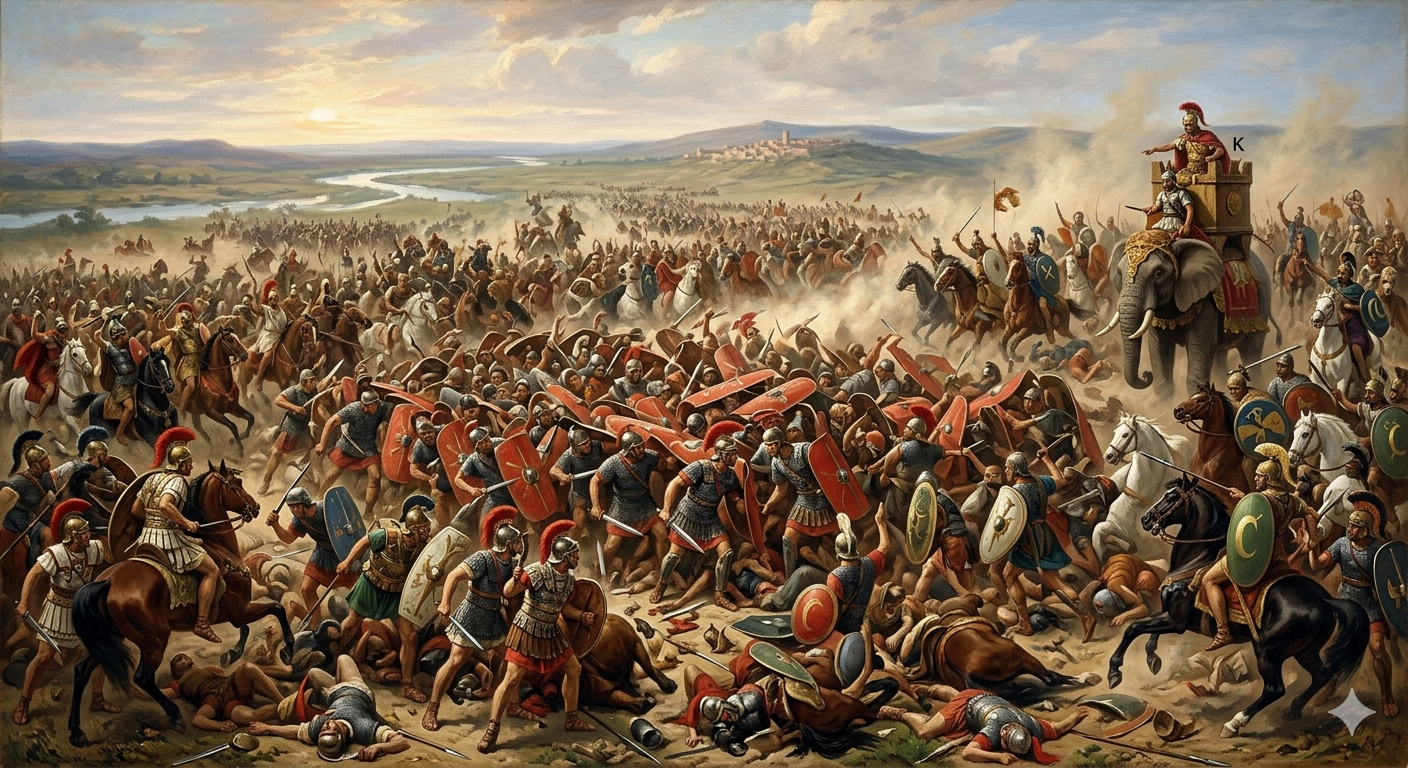
On the morning of August 2, 216 BC, the largest army the Roman Republic had ever assembled marched toward battle on the plain near the village of Cannae in Apulia, in the heel of southern Italy. They numbered approximately 86,000 men, including eight legions of heavy infantry flanked by cavalry. Their commanders were the consuls Lucius Aemilius Paullus and Gaius Terentius Varro, and their mission was simple and direct: find the Carthaginian general Hannibal Barca, engage his army in open battle, and destroy it. Rome had raised this unprecedented force with the specific purpose of ending the Carthaginian invasion of Italy that had been devastating the Italian peninsula for two years.
By late afternoon, Rome’s greatest army no longer existed. Between 50,000 and 70,000 Roman and allied soldiers lay dead on the plain, killed by a Carthaginian force that was approximately half their number. It is estimated that over 100 Romans died every minute during the height of the fighting. Among the dead were both consular quaestors, 29 military tribunes, and at least 80 men of senatorial rank. The surviving consul, Varro, escaped with perhaps fifty men. The Battle of Cannae remains, more than two thousand years later, one of the most studied military engagements in history, a masterclass in tactical encirclement that has been analyzed, imitated, and attempted by commanders from Napoleon to Erwin Rommel.
Hannibal Barca and the Origins of the Second Punic War
The Battle of Cannae grew from a conflict that had been building for generations between two civilizations competing for dominance of the Mediterranean world. Carthage, the great trading city on the north coast of Africa in what is now Tunisia, had controlled much of North Africa, Spain, and the western Mediterranean for centuries. Rome, the Latin city-state that had expanded to control most of the Italian peninsula by the third century BC, was the rising power that Carthage could no longer comfortably ignore.
The First Punic War, fought from 264 to 241 BC, ended in Roman victory and the loss of Sicily to Rome. Carthage was forced to pay a heavy war indemnity, and the humiliation burned deeply in the Carthaginian military aristocracy. Hamilcar Barca, the Carthaginian general who had fought the Romans with brilliance and ferocity throughout the First Punic War, reportedly made his young son swear on a sacred fire that he would always be an enemy of Rome. That son was Hannibal.
Hannibal Barca was born around 247 BC. He grew up in an atmosphere of military culture and Roman hatred, accompanied his father on campaigns in Spain as a boy, and demonstrated from his earliest commands an understanding of tactical maneuver that was unusual even among the gifted commanders of the ancient world. After Hamilcar’s death in 228 BC and the death of his successor Hasdrubal in 221 BC, Hannibal took command of Carthaginian forces in Spain at age twenty-five. He was admired by his troops and feared by his enemies with equal intensity.
In 219 BC, Hannibal attacked Saguntum, a Roman ally in Spain south of the Ebro River, triggering the Second Punic War. But rather than await the Roman response in Spain or in North Africa, Hannibal conceived one of the most audacious strategic gambits in military history. He would invade Italy directly, march his army over the Alps in late autumn, and carry the war into Rome’s heartland, hoping to break Rome’s alliances with its Italian partners and force the city to its knees.
In 218 BC, with an army of approximately 40,000 infantry, 8,000 cavalry, and 37 war elephants, Hannibal crossed the Pyrenees, marched through southern Gaul, and crossed the Alps in a journey that killed thousands of men and nearly all the elephants but deposited a capable and battle-hardened army in northern Italy in late autumn. The crossing of the Alps was one of the great logistical feats of the ancient world, and its success gave Hannibal the psychological advantage of having done what Roman strategists had thought impossible.
The Road to Cannae: Trebia, Lake Trasimene, and the Fabian Strategy
Once in Italy, Hannibal won two devastating victories in rapid succession that demonstrated both his tactical genius and the Roman military’s dangerous tendency toward overconfidence and direct engagement.
At the Battle of Trebia in December 218 BC, fought on a freezing winter morning when Hannibal induced the Romans to cross a frigid river before they had eaten, his cavalry and concealed infantry ambushed a Roman army of approximately 40,000 and effectively destroyed it. At the Battle of Lake Trasimene in June 217 BC, Hannibal ambushed an entire Roman army on the march along the shore of the lake, hiding his forces in the morning fog on the hills above the narrow shoreline path. The Roman consul Gaius Flaminius and approximately 15,000 men were killed in what remains the largest ambush in military history. So complete was the encirclement that some Romans drowned trying to escape into the lake while still in their full armor.
These successive disasters prompted the Roman Senate to appoint Quintus Fabius Maximus as dictator with emergency powers. Fabius recognized that Hannibal’s genius lay in open battle and refused to engage him directly. Instead, he pursued a strategy of harassment, cutting off foraging parties, shadowing the Carthaginian army from hilltops, and disrupting supply lines without ever offering the pitched battle Hannibal needed. This approach, which earned Fabius the nickname Cunctator or “the Delayer,” was strategically sound but deeply unpopular with the Roman people and with Rome’s military culture, which regarded direct confrontation as the only honorable response to invasion.
As 216 BC approached, public frustration with the Fabian strategy reached a breaking point. Rome’s allies were being plundered by Hannibal’s army with apparent impunity. There were fears that if the situation continued, Rome’s Italian allies would conclude that Carthage was winning and defect to Hannibal’s side. In the spring of 216 BC, Hannibal moved to sharpen the crisis by seizing the large Roman grain supply depot at Cannae in the fertile Apulian plain, placing himself directly between the Roman army and its most critical source of supplies. The loss of the supply depot created both practical and psychological pressure for immediate action.
The Commanders and Their Armies at Cannae
Rome’s response was to assemble the largest army in the Republic’s history and place it under the command of the two consuls elected for 216 BC. Gaius Terentius Varro was a plebeian politician who had campaigned on the promise of a quick and decisive defeat of Hannibal. He was aggressive, politically popular, and certain that overwhelming numbers would resolve the crisis. Lucius Aemilius Paullus was more experienced and considerably more cautious. He recognized that the terrain around Cannae, an open plain, was perfectly suited to cavalry operations, and that Hannibal’s cavalry was both larger in number and considerably superior in quality to Rome’s. Paullus argued for moving to broken terrain where Rome’s infantry strength could be used to advantage and Hannibal’s cavalry neutralized. Varro rejected this as cowardly.
Because the two consuls commanded on alternate days, Roman law gave each supreme authority over the combined army every other day. The battle on August 2 fell on Varro’s day of command.
Against Rome’s 86,000 soldiers stood Hannibal’s army of approximately 40,000 to 50,000 infantry and 10,000 cavalry. The infantry was a multi-ethnic force of extraordinary experience and morale: approximately 8,000 Libyan African heavy infantry, the best-equipped and most disciplined troops in the army; 16,000 Gauls from the tribes of northern Italy; and approximately 8,000 Iberian and Celtiberian infantry from Spain. The cavalry included Numidian horsemen from North Africa, among the best light cavalry in the ancient world, and heavy Iberian and Gallic cavalry. Despite being outnumbered nearly two to one in infantry, Hannibal held a decisive advantage in cavalry. And he had a plan.
The Wikipedia article on the Battle of Cannae provides the full order of battle, the tactical analysis, and the ancient source accounts from Polybius and Livy that form the historical record of the engagement.
Hannibal’s Genius: The Double Envelopment That Changed Military History
Hannibal’s tactical plan for Cannae exploited a profound understanding of how Roman tactical doctrine worked and how to use that doctrine as the instrument of Roman destruction. The Roman method was straightforward: concentrate overwhelming infantry in the center, crash it into the enemy line, and trust that superior Roman discipline and numbers would prevail. Hannibal designed his formation to take this attack, absorb it, and turn it into a trap.
He positioned his forces in a concave line facing the Roman infantry. In the center, slightly forward of the wings and bulging toward the Romans, he placed his weakest and least reliable infantry: the Gauls and Iberians, troops who would yield under pressure but who could be expected to hold long enough for the plan to work. On the two ends of the line, bent back from the advancing center, he positioned his strongest infantry, the Libyan heavy infantry, in tight disciplined formations with their flanks protected. On the cavalry wings, he placed his Numidian cavalry opposite the Roman allied cavalry on one flank, and his heavier Iberian and Gallic cavalry opposite the Roman citizen cavalry on the other. He stood in the center with his weaker troops to inspire them through personal presence. His brother Mago stood with him.
The Romans attacked in the standard formation, massing their heavy infantry in an exceptionally deep column in the center, apparently believing that sheer mass would crush through anything in front of them. Varro reduced the spacing between soldiers to pack even more men into the attacking formation, which made the attack feel overwhelming but which also reduced the Romans’ ability to maneuver.
As the battle opened, Hannibal’s heavier cavalry on his left wing engaged the Roman citizen cavalry on the Roman right and drove them from the field entirely. On the other flank, the Numidians pinned the Roman allied cavalry in a swirling, inconclusive engagement that prevented it from threatening Hannibal’s wings. The Roman infantry pressed forward against the center, and Hannibal’s Gallic and Iberian infantry gave ground steadily, as Hannibal had planned. The concave formation inverted as the center was pressed back, becoming a pocket, with the Libyan infantry on the wings now standing on the flanks of the advancing Roman column.
At the moment of maximum Roman commitment, Hannibal’s plan reached its decisive phase. The Libyan infantry on both ends of the line wheeled inward and attacked the Roman infantry on both flanks simultaneously. The heavy cavalry that had driven off the Roman citizen cavalry galloped around the battlefield and struck the rear of the Roman infantry formation. The Roman army was surrounded on four sides.
The Slaughter: 70,000 Dead in an Afternoon
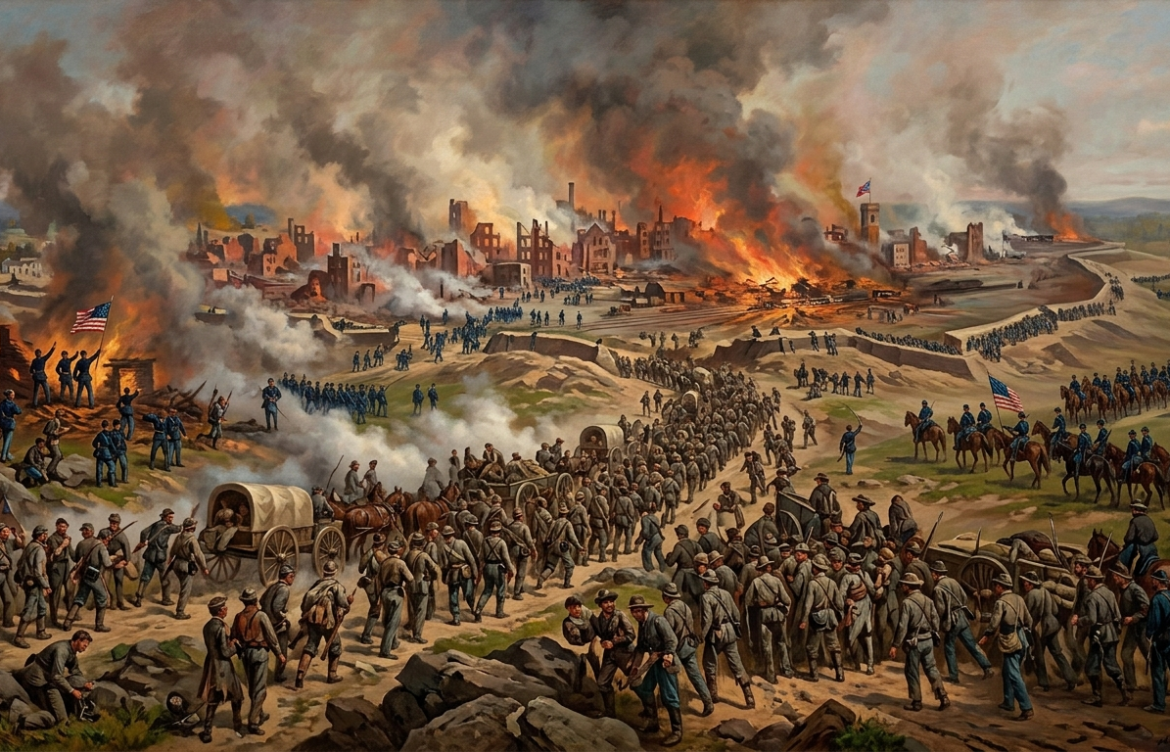
What followed was not a battle in any conventional sense. It was a systematic killing of an encircled force that had no room to maneuver, no cavalry to protect it, and no avenue of escape. Packed so tightly that many men could barely raise their sword arms, the Romans died in place. Hannibal’s troops closed inward methodically, cutting down the soldiers on the perimeter and driving the survivors into a tighter and tighter mass.
The ancient sources disagree on the exact toll but agree on its general magnitude. Polybius, writing with access to firsthand Carthaginian records, put the Roman dead at 70,000. Livy estimated 48,200 killed, with 19,300 taken prisoner. Modern historians tend toward figures in the range of 50,000 to 60,000 killed. Whatever the precise number, the rate of killing was without parallel in Western military history: Dickinson College’s commentary on the ancient sources calculates that at the battle’s peak, more than 100 Romans were dying every minute.
Among the dead was Consul Lucius Aemilius Paullus, who died fighting on foot after his horse was wounded. Both consular quaestors, 29 military tribunes, and approximately 80 senators or men of senatorial rank were killed. It was estimated that 20 percent of all Roman men between the ages of 18 and 50 died at Cannae. By comparison, in the three battles of Trebia, Lake Trasimene, and Cannae combined, Hannibal had killed as many as 150,000 men, by some estimates representing approximately one-fifth of all adult males in Rome and its allied communities. This casualty rate, measured against the total Roman male population, exceeded the proportional losses the United States suffered in Vietnam by a factor of thirty.
Hannibal’s own losses were approximately 6,000 men.
The Britannica article on the Battle of Cannae provides a thorough account of the tactical movements, the casualty figures from the ancient sources, and the political consequences that followed Rome’s catastrophic defeat.
Maharbal’s Famous Reproach and Hannibal’s Decision Not to March on Rome
The most debated decision of Hannibal’s entire Italian campaign followed immediately from his victory at Cannae. Maharbal, the commander of Hannibal’s cavalry and one of his most able lieutenants, urged Hannibal to march on Rome immediately while the city was in shock, its army destroyed, and its roads open. Livy records Maharbal’s famous reproach when Hannibal declined: “You know how to win battles, Hannibal, but not how to use the victories you win.” The exchange became one of the most quoted remarks in ancient military history, and Roman students centuries later were still assigned to debate whether Hannibal should have marched on Rome.
Hannibal’s reasons for not doing so are analyzed differently by different historians. He had no siege equipment. Rome’s walls were formidable. He still hoped that Rome’s Italian allies would defect to him in sufficient numbers to make a siege unnecessary. He was also waiting to see whether Carthage would send meaningful reinforcements, which it ultimately never did.
The decision not to march on Rome after Cannae is widely regarded as one of the great strategic mistakes in military history, and Maharbal’s words have echoed through military literature ever since. Yet it is worth noting that even with Rome in panic, even with its treasury depleted, even with several of its allies defecting to Hannibal in the months after Cannae, including Capua, the second largest city in Italy, the Romans refused to consider surrender. When a delegation arrived to negotiate the ransom of prisoners taken at Cannae, the Roman Senate refused to hear it.
The Aftermath and the Long Road to Roman Victory
Cannae was immediately devastating and ultimately transformative for Rome. In the short term, the shock was total. When news of the defeat reached the city, panic swept through the streets. Women ran to the temples to pray for husbands and sons. The Senate implemented emergency measures including the appointment of a new dictator, Marcus Junius Pera, who took the unprecedented step of enrolling freed slaves and convicted criminals into new legions. Within a month of Cannae, Rome had raised four new legions from this desperate population of recruits.
After Cannae, Rome effectively abandoned the aggressive confrontational strategy that had led to the disaster and returned to the Fabian approach of attrition and harassment. Rome stopped offering Hannibal the open pitched battles in which his genius excelled and began instead the slow, grinding work of denying him territory, supplies, and allies. Over the following years, Hannibal marched through Italy looking for the second Cannae that never came. His army, isolated from substantial Carthaginian reinforcement and unable to replace its losses, slowly diminished.
The survivors of Cannae were punished as a mark of collective shame, transferred to Sicily and forbidden from returning to Italy until the war ended. But among those survivors was a young Roman officer named Publius Cornelius Scipio, who had saved his father’s life at the Battle of Ticinus in 218 BC and who had escaped from Cannae. Scipio would spend the following years learning from both Hannibal’s example and Rome’s failures, developing the tactical flexibility and cavalry emphasis that Hannibal had used against Rome and that Rome had never previously employed. In 204 BC, Scipio, now known as Scipio Africanus, invaded North Africa with approximately 26,000 men, many of them Cannae veterans at last released from their Sicilian exile. Hannibal was recalled from Italy to defend Carthage. At the Battle of Zama in 202 BC, Scipio defeated Hannibal using tactics that owed an explicit debt to Cannae, and the Second Punic War ended with Rome’s complete supremacy over the Mediterranean.
The World History Encyclopedia article on the Battle of Cannae covers the tactical innovation of the double envelopment, the political context of the Second Punic War, and the battle’s enduring influence on military strategy from antiquity to the modern era.
The Battle of Cannae is studied at military academies to this day. The German Schlieffen Plan, which shaped the opening of the First World War, was explicitly designed as a Cannae in reverse, a massive envelopment of an entire enemy army. Alfred von Schlieffen reportedly kept a sign on his desk that read “Make the right wing strong,” a reference to the flanking cavalry at Cannae. The concept of the double envelopment that Hannibal perfected on August 2, 216 BC, on a dusty plain in southern Italy, remains the gold standard of offensive tactical thinking two thousand years later.