
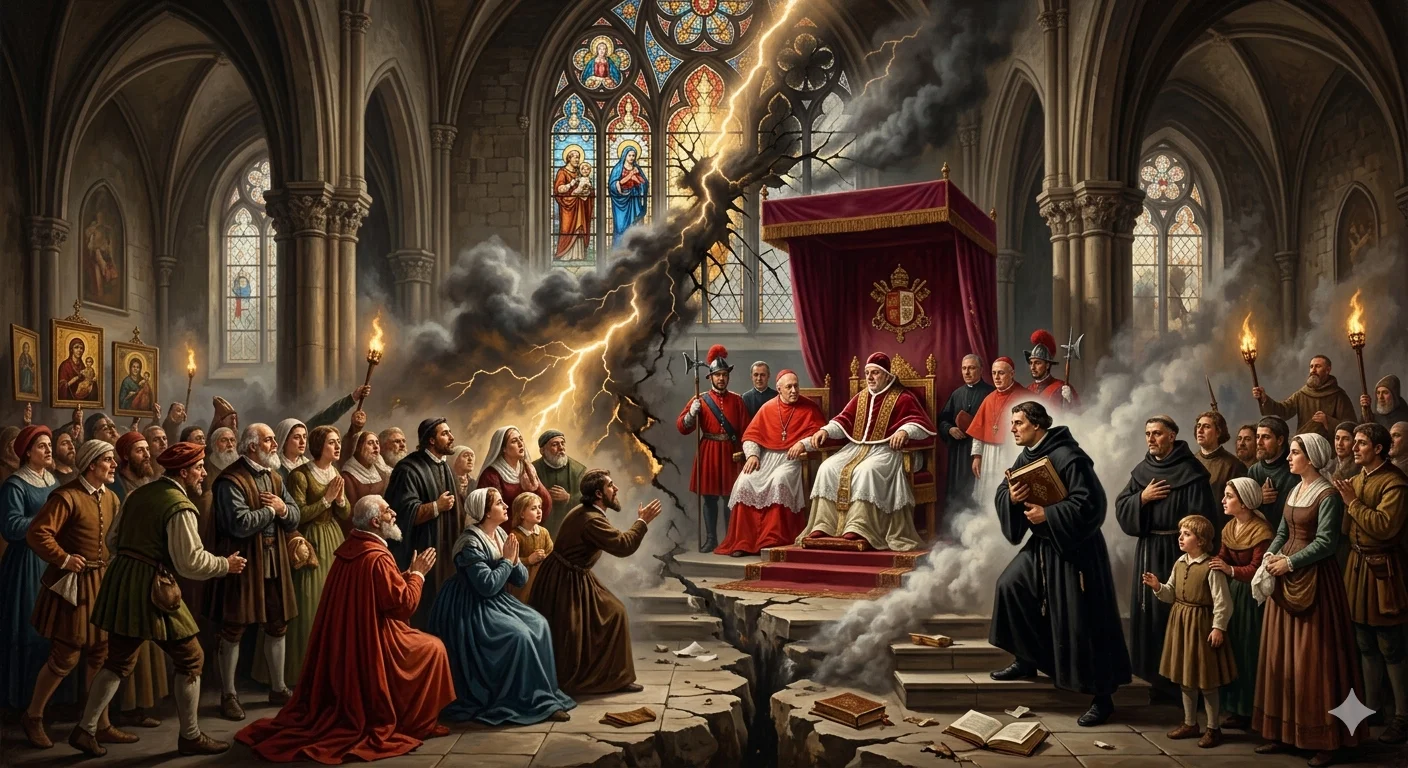
On January 3, 1521, Pope Leo X issued a papal bull titled Decet Romanum Pontificem, Latin for “It Befits the Roman Pontiff.” The document formally excommunicated Martin Luther, a German monk, priest, and professor of biblical theology at the University of Wittenberg, from the Roman Catholic Church. The excommunication was the culmination of three and a half years of escalating confrontation between Luther and Rome that had begun with a dispute over the sale of indulgences and had widened into a fundamental challenge to papal authority, the nature of salvation, and the structure of Christian faith itself.
The bull Decet Romanum Pontificem was not a surprise. It had been preceded by a warning in June 1520, public book-burnings on both sides, and Luther’s own spectacular act of defiance in which he burned the Pope’s warning in a public bonfire. What the excommunication accomplished was the final closing of the door on any possibility that Luther’s reforms could occur within the Catholic Church. In trying to silence Luther, the Church helped create the Protestant Reformation.
Martin Luther: From Monk to Reformer in Wittenberg
Martin Luther was born on November 10, 1483, in Eisleben, in the region of Saxony in the Holy Roman Empire. His father, Hans Luther, was a copper miner who had risen to modest prosperity and who harbored ambitious plans for his son, hoping Martin would become a lawyer. Luther began legal studies at the University of Erfurt, but in July 1505, caught in a violent thunderstorm and terrified by a lightning strike, he made a vow to Saint Anne to become a monk if he survived. He survived, and he kept his vow, abandoning his legal studies to enter the Augustinian Eremites monastery at Erfurt, one of the most disciplined religious orders in Germany.
Luther was ordained to the priesthood in 1507 and rose quickly within the academic world of the Church. By 1512 he had earned his doctorate in theology and been appointed professor of biblical theology at the newly founded University of Wittenberg. It was his deep engagement with Scripture, particularly with the letters of the Apostle Paul, that led him to the theological conviction that would ultimately divide Christianity: that salvation was not earned by human works, merit, or the purchase of indulgences, but was received only as the free gift of God’s grace through faith. This doctrine, known as justification by faith alone, or in Latin sola fide, stood in direct tension with the Church’s teaching that salvation was mediated through the sacraments and could be partially attained through meritorious works including the purchase of indulgences.
The Indulgence Controversy: Johann Tetzel and the Ninety-Five Theses
The immediate spark for the crisis that led to Luther’s excommunication was the sale of indulgences in Germany in 1516 and 1517. Pope Leo X, born Giovanni di Lorenzo de’ Medici in 1475 and elected Pope in 1513, needed funds to rebuild St. Peter’s Basilica in Rome. He authorized a special campaign to sell plenary indulgences, documents that the Church taught could remit the temporal punishment for sins.
The man charged with running the indulgence campaign in much of Germany was Johann Tetzel, a Dominican friar. Tetzel’s sales methods were aggressive and theologically dubious. He reportedly promoted the slogan that as soon as a coin rang in the collection box, a soul leaped from Purgatory. Archbishop Albert of Brandenburg, who held multiple ecclesiastical positions simultaneously and owed enormous sums to the banking house of the Fuggers for the fees he had paid to accumulate those positions, had arranged with Leo X to keep half the indulgence proceeds to pay off this debt.
Luther was infuriated by what he saw as a corrupt deception being practiced on ordinary German Christians who were being misled into believing they could purchase their way to salvation. On October 31, 1517, Luther sent his Ninety-Five Theses, formally titled the Disputation on the Power and Efficacy of Indulgences, to Archbishop Albert of Mainz and Magdeburg. The tradition that he simultaneously nailed a copy to the door of the Castle Church in Wittenberg, a common notice board for academic disputes, is one of the most iconic images in Christian history, though some historians question whether the door-nailing actually occurred on that date.
The Ninety-Five Theses were written in Latin, the language of academic theological debate, and Luther intended them to provoke a scholarly discussion. What happened instead was a revolution. The printing press, barely sixty years old as a technology, transformed a local academic dispute into a European-wide controversy within weeks. Copies were printed in large numbers and distributed across Germany. Luther was immediately cast in the popular imagination as the man who had dared to challenge the Pope.
The Wikipedia article on Martin Luther provides a comprehensive account of his life, his theological development, and the full course of his conflict with Rome from the Ninety-Five Theses through the excommunication and beyond.
Rome Responds: Cardinal Cajetan, Johann Eck, and the Leipzig Debate
Pope Leo X responded to Luther’s Ninety-Five Theses slowly, apparently underestimating the significance of what was happening in Germany. He reportedly dismissed Luther initially as “a drunken German who will change his mind when he is sober.” The Pope was accustomed to reformers and minor heretics, and the standard procedures for dealing with them were well established.
In 1518, Leo ordered the head of the Augustinian order to silence Luther. When that failed, he summoned Luther to Rome to answer heresy charges. Luther’s protector, Frederick III, Elector of Saxony, known as Frederick the Wise, intervened to prevent Luther from having to travel to Rome, where his safety could not be guaranteed. Instead, Luther was examined at Augsburg in October 1518, where he faced questioning over three days before Cardinal Cajetan, the papal legate and one of the leading Dominican theologians of the age. The hearings degenerated into confrontation. Cajetan demanded that Luther simply retract his views; Luther refused to retract without being shown through Scripture that he was wrong. He escaped Augsburg at night rather than face what appeared to be imminent arrest.
In June and July 1519, Luther engaged in a formal theological debate with Johann Eck, a highly skilled Catholic theologian from the University of Ingolstadt, in Leipzig. Eck skillfully maneuvered Luther into defending some of the condemned propositions of Jan Hus, the Bohemian reformer who had been burned as a heretic at the Council of Constance in 1415. By associating Luther with Hussite heresy, Eck hoped to discredit him in the eyes of German public opinion. The effect was partially the opposite: Luther left Leipzig having been pushed to make increasingly radical claims about the fallibility of popes and councils, and his popular support in Germany grew rather than diminished.
The Three Great Treatises and the Hardening of Positions in 1520
By 1520, Luther had moved far beyond the limited debate over indulgences that had begun in 1517. He published three major works in that year that together constituted a comprehensive theological program for the reformation of the Church, and which the Catholic Church regarded as irreconcilably heretical.
In To the Christian Nobility of the German Nation, Luther addressed the secular rulers of Germany directly, arguing that they had both the right and the responsibility to reform the Church since the Pope and the clerical hierarchy had failed to do so. This was an appeal to the growing German nationalist sentiment that resented Roman exploitation of German wealth, and it was enormously popular among the German nobility and increasingly among the princes who had political reasons to welcome a reduction in papal power.
In The Babylonian Captivity of the Church, Luther attacked the sacramental system of the Catholic Church at its foundations, reducing the seven sacraments to two, Baptism and the Eucharist, on the grounds that only these two were directly instituted by Christ in Scripture. The work scandalized Catholic theologians across Europe and made it clear that Luther was not seeking modest reform but a fundamental reconstruction of Christian theology and practice.
In On the Freedom of a Christian, he articulated in accessible terms his doctrine of justification by faith alone: that a Christian was simultaneously completely justified before God through faith, and completely free to serve others through love, without any dependence on the institutional Church’s mediating role.
Exsurge Domine: The Warning Bull and Luther’s Bonfire Defiance
On June 15, 1520, Pope Leo X issued the papal bull Exsurge Domine, meaning “Arise, O Lord.” The bull charged Luther with 41 instances of error or heresy drawn from his writings and gave him sixty days from its publication in his region to recant or face excommunication. The task of publishing the bull in Germany was assigned to Johann Eck and Cardinal Girolamo Aleandro. They encountered extraordinary difficulty in doing so. Luther’s popular support in Germany was so extensive that students at Erfurt threw copies of the bull into the river. Posted copies were torn down and defaced at Torgau. Even some Catholic bishops hesitated for as long as six months before publishing the bull’s contents. At Leipzig, Eck had to retreat to a cloister for his own safety when a hostile crowd threatened his life.
Luther initially suspected the bull might be a forgery or a trick manufactured by his enemies. When he became convinced it was genuine, he published a fierce response in which he called the Pope the Antichrist and defended all his condemned propositions. As the sixty-day deadline expired, on December 10, 1520, Luther organized a public gathering at the Elster Gate in Wittenberg and had a bonfire built. Into the flames went books of canon law, volumes of Catholic theology, and other Church documents. To complete his defiance, Luther himself threw his personal copy of Exsurge Domine into the fire.
It was one of the most dramatic symbolic acts in the history of Christianity, and it left Pope Leo X with no diplomatic option except to proceed with the threatened excommunication.
January 3, 1521: The Bull Decet Romanum Pontificem and Its Meaning
Pope Leo X issued the bull Decet Romanum Pontificem on January 3, 1521. The document also excommunicated Andreas Karlstadt, Luther’s colleague at Wittenberg who had been named alongside Luther in the earlier warning, along with other associates. The bull formally declared that Luther had cut himself off from the body of the Church through his persistent heresy and his burning of the papal warning.
The title of the bull was a statement of institutional authority: it befits the Roman Pontiff, as the vicar of Christ and the successor of Saint Peter, to extirpate heresy with the full power of the keys. The document charged Luther with heresy, schism, and scandal, and declared him excommunicated from the communion of the Church, stripped of any priestly functions, and subject to the secular penalties that civil authorities were expected to apply to confirmed heretics.
The Britannica article on Pope Leo X and his conflict with Luther covers the full diplomatic and theological progression from Leo’s initial dismissal of Luther through the issuance of the two papal bulls and their respective receptions in Germany and across Europe.
Protestant historian Philip Schaff later wrote that Exsurge Domine “was the last bull addressed to Latin Christendom as an undivided whole, and the first which was disobeyed by a large part of it.” The excommunication bull that followed was the moment that disobedience became permanent. With Luther formally outside the Church, the path of an internal reform movement was definitively closed. The institutional framework that would become Protestantism now had no alternative but to develop as a separate structure.
The Diet of Worms and What Came After
Luther’s excommunication by the Church did not resolve his situation with the secular authorities of the Holy Roman Empire. Emperor Charles V, who had been crowned Holy Roman Emperor in 1520, had independent reasons for dealing with Luther. A Lutheran Germany would mean a Germany in which the authority of both Pope and Emperor was challenged by German princes who might use religious reform as cover for political independence.
In April 1521, Charles V summoned Luther to appear before the Diet of Worms, the general assembly of the estates of the Holy Roman Empire, which convened from January 28 to May 25, 1521, at Worms on the Rhine. Luther’s protector, Frederick the Wise, obtained a guarantee of safe conduct for Luther to travel to and from the assembly. Luther appeared before the Diet on April 17, 1521, and was presented with a table bearing his published works and asked two questions: whether he acknowledged the works as his own, and whether he would recant their contents.
Luther asked for a day to consider. When he returned on April 18, he delivered his famous declaration: he could not and would not recant anything unless he was convicted by Scripture and plain reason, since neither popes nor councils were free from error. The words most often quoted from this moment, “Here I stand, I can do no other,” may be a later addition to the historical record, but the substance of his refusal was unequivocal and unwavering.
Charles V declared Luther an outlaw under the Edict of Worms. He was condemned as a heretic, his writings were banned, and anyone who sheltered him could be prosecuted. Frederick the Wise arranged for Luther’s apparent kidnapping as he traveled home, and had him taken in secret to the Wartburg Castle in Thuringia, where Luther spent approximately ten months in protective concealment. During this period, disguised as a knight called Junker Jorg, he translated the New Testament from Greek into German in just eleven weeks, producing one of the most influential literary works in the history of the German language and placing Scripture directly in the hands of ordinary German readers.
The World History Encyclopedia article on the 1521 excommunication of Luther provides the complete text of the bull Decet Romanum Pontificem along with historical context about why Luther’s excommunication, unlike previous heresy proceedings, failed to suppress the movement it targeted.
The Lasting Consequences: Protestant Reformation and a Divided Christianity
Pope Leo X died on December 1, 1521, less than a year after signing the excommunication bull, before the full magnitude of what he had helped set in motion was apparent. His successor Adrian VI was a reformer who acknowledged the Church’s corruption but could not stop the momentum Luther had created. The movement spread rapidly through Germany, Switzerland, and eventually into France, England, Scandinavia, and beyond.
The Catholic Church has never lifted the excommunication of 1521. In the late twentieth century, Lutheran and Catholic theologians worked together toward reconciliation and in 1999 signed the Joint Declaration on the Doctrine of Justification, in which both churches reached a substantial agreement on justification by faith, the very doctrine at the heart of Luther’s dispute with Rome. The Roman Curia responded to requests to lift the excommunication by stating that its practice is to lift excommunications only for those still living. Roland Bainton, whose biography Here I Stand remains the most widely read life of Luther in English, concluded in a 1978 preface that the excommunication ought to be lifted, writing: “He was never a heretic.”
The excommunication of Martin Luther on January 3, 1521, is among the most consequential administrative acts in the history of Western civilization. It closed the door on one future: a reformed Catholicism that retained its unity. It opened the door on another: a fractured but permanently transformed Christianity in which the Protestant churches that Luther’s defiance set in motion would eventually claim more than a billion adherents and would reshape the political, cultural, and intellectual life of the modern world.