
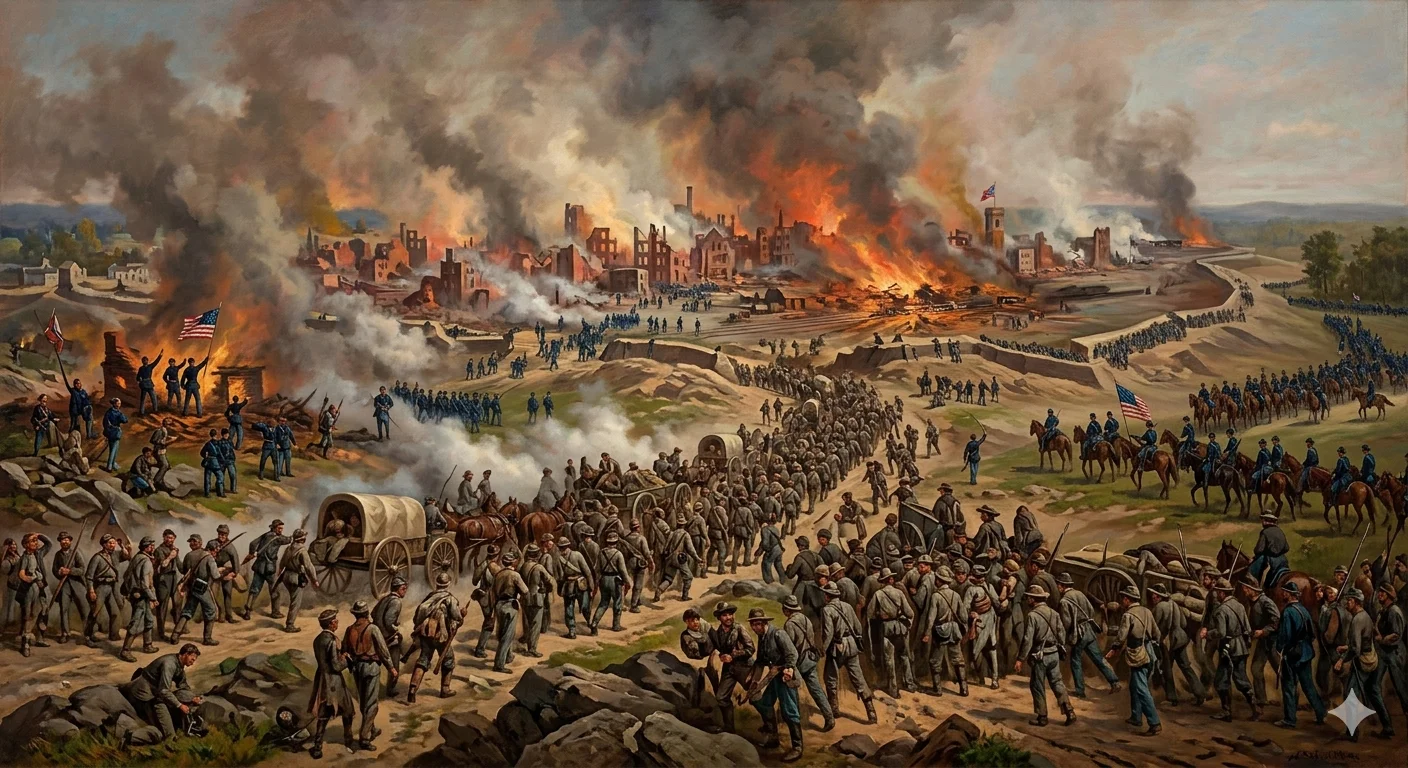
On the morning of September 2, 1864, Atlanta Mayor James M. Calhoun rode out with a small delegation to meet the advancing Union forces. He carried a formal note of surrender: “The fortune of war has placed Atlanta in your hands.” The Confederate Army under General John Bell Hood had abandoned the city the night before, destroying its ammunition trains in explosions so violent they woke Atlantans from their sleep and shook the ground for miles around. As Mayor Calhoun handed over the city, the 2nd Massachusetts Regiment entered downtown and raised the American flag over City Hall. Later that day, General William Tecumseh Sherman sent a telegram to President Abraham Lincoln from the outskirts of the city with words that would resonate across the nation: “Atlanta is ours, and fairly won.”
The fall of Atlanta on September 2, 1864, was one of the most consequential military events of the American Civil War. It ended a four-month campaign that had consumed the summer with battles, sieges, and strategic maneuvering across the mountains and valleys of northern Georgia. It saved Abraham Lincoln’s presidency at a moment when his reelection had appeared nearly hopeless. It demonstrated that the Confederacy’s industrial heartland was not invulnerable. And it opened the door to Sherman’s March to the Sea, the campaign of total war that would crack the Confederate will to fight and hasten the end of the conflict.
Atlanta’s Strategic Importance to the Confederacy
To understand why Atlanta’s fall mattered so profoundly, it is necessary to understand what Atlanta was in 1864. The city was the second-most important center of Confederate power after Richmond, Virginia, and in some respects it was more critical to the Confederate war machine. It was the great railroad hub of the Deep South, the point at which four major rail lines converged: the Western and Atlantic Railroad running north to Chattanooga and Tennessee, the Macon and Western running south toward the Gulf Coast, the Georgia Railroad running east toward Augusta and the Carolinas, and the Atlanta and West Point running southwest toward Alabama. Through these lines moved the food, weapons, ammunition, and supplies that kept Confederate armies in the field from Virginia to Mississippi.
Atlanta was also a major industrial city by Southern standards. Its munitions factories, machine shops, foundries, clothing mills, and railroad repair yards produced and distributed much of the material that sustained Confederate resistance. It was a logistical nerve center without which the Confederate armies of the western theater could not be supplied. Its loss would not only deprive the Confederacy of irreplaceable manufacturing capacity but would sever the rail connections that linked the Confederate east to the Confederate west.
Beyond its military and industrial value, Atlanta was a symbol. It represented Confederate resilience, Confederate industrial ambition, and the ability of the South to sustain a modern war. When South Carolinian Mary Boykin Chesnut learned of Atlanta’s fall, she wrote in her diary: “Since Atlanta, I have felt as if all is lost. We are going to be wiped off the earth.”
Grant’s Grand Strategy and Sherman’s Assignment
The Atlanta Campaign cannot be understood without understanding the broader strategic design conceived by General Ulysses S. Grant in the spring of 1864. On March 9, 1864, Lincoln commissioned Grant as the only Lieutenant General in the United States Army, placing him in command of all Union armies. Grant’s central insight was that the Union had been conducting the war as a series of disconnected operations, allowing Confederate armies to shift forces from one threatened front to another. He proposed to end this by launching simultaneous offensives on multiple fronts, pressing the Confederacy everywhere at once so that no army could reinforce another.
Grant assigned his friend and trusted lieutenant William Tecumseh Sherman to command the Military Division of the Mississippi, encompassing three armies totaling approximately 100,000 men. Sherman’s mission was to move against the Confederate Army of Tennessee, destroy it if possible, and capture Atlanta, the vital railroad center and supply hub. Grant’s own Army of the Potomac would simultaneously press Robert E. Lee’s Army of Northern Virginia relentlessly in the Virginia theater, preventing any transfer of Confederate forces to Georgia.
Sherman had at his disposal three armies: the Army of the Cumberland under Major General George H. Thomas, the largest and most powerful of the three; the Army of the Tennessee under Major General James B. McPherson, a brilliant engineer and fighting general; and the smaller Army of the Ohio under Major General John M. Schofield. Together they constituted a force of considerable power and tactical flexibility.
The Atlanta Campaign: Four Months of Fighting in Northern Georgia
Sherman began his advance from Chattanooga, Tennessee, on May 4, 1864. The Confederate Army of Tennessee, defending Atlanta under General Joseph E. Johnston, numbered between 60,000 and 70,000 men and had prepared a series of fortified defensive positions across the mountains and valleys of northern Georgia. Johnston’s strategy was characteristically cautious: he would use the terrain to make any Union frontal assault enormously costly, force Sherman to maneuver around his flanks, and wear down the attacking force through attrition without risking a decisive engagement.
The resulting campaign was a chess match of flanking movements and counterpositions. Sherman repeatedly attempted to move around Johnston’s flanks, threatening his supply lines and forcing him to retreat to avoid encirclement. Johnston repeatedly fell back to new defensive positions, each one more difficult to attack than the last. The campaign produced a series of engagements: Resaca in May, Pickett’s Mill and New Hope Church in late May, and the Battle of Kennesaw Mountain on June 27, where Sherman abandoned his flanking approach and launched a costly frontal assault that Confederate defenders repulsed with heavy Union losses.
Despite Kennesaw Mountain’s setback, Sherman returned to flanking movements and forced Johnston back toward Atlanta through July. Johnston’s persistent retreating without offering battle exasperated Confederate President Jefferson Davis, who believed the general was surrendering Georgia without adequate resistance. On July 17, 1864, Davis made a decision that would prove fateful for the Confederacy: he replaced Joseph Johnston with Lieutenant General John Bell Hood.
Hood was a different kind of general. He had earned a reputation for aggressive offensive fighting in Virginia, where he had commanded Texas troops under Robert E. Lee with conspicuous courage, losing the use of an arm at Gettysburg and a leg at Chickamauga. He was known as a fighting general who would not simply retreat. Within days of assuming command, Hood launched two major attacks on Sherman’s forces. On July 20, he struck at Peach Tree Creek, attempting to destroy George Thomas’s Army of the Cumberland as it crossed that stream. The attack failed with heavy Confederate casualties. On July 22, he launched a massive flanking assault on the Union left, the engagement known as the Battle of Atlanta.
The Battle of Atlanta on July 22, 1864, was one of the bloodiest days of the entire campaign. Hood sent Lieutenant General William Hardee’s corps on a night march around the Union left flank, with Major General Joseph Wheeler’s cavalry moving against Sherman’s supply lines and Major General Benjamin Cheatham’s corps attacking the front. The battle produced fierce fighting that resulted in a critical loss for the Union: Major General James B. McPherson, the commander of the Army of the Tennessee, was killed by Confederate soldiers while riding near his lines. McPherson was the second-highest-ranking Union officer killed in action during the entire war. Sherman, on receiving the news, reportedly wept. Despite McPherson’s death, the Union lines held and Hood’s attack was repulsed.
The American Battlefield Trust’s account of the Battle of Atlanta provides detailed maps and accounts of the July 22, 1864 battle and the subsequent operations that led to Atlanta’s fall.
The Siege, Jonesboro, and the Railroad That Saved Atlanta Until It Didn’t
After the failures at Peach Tree Creek and the Battle of Atlanta, Hood settled into a defensive posture inside Atlanta’s formidable fortifications, which consisted of a ring of earthworks, artillery positions, and fortified structures surrounding the city. Sherman, unwilling to risk the casualties of a direct assault on well-prepared defenses, settled in for a siege through August. His artillery bombarded the city regularly, forcing civilians to shelter in basements and cellars while Sherman’s engineers and officers debated how to cut Atlanta’s final remaining lifeline.
The key was the Macon and Western Railroad, the last rail line feeding Atlanta from the south. As long as this line remained open, Hood could receive supplies and reinforcements that allowed him to hold the city indefinitely. Sherman had cut or disrupted the other rail approaches, but the Macon and Western still ran.
On August 25, Sherman made his decisive move. He pulled most of his force away from the siege lines and swept his armies west and then south in a wide arc around Atlanta, aiming to cut the Macon and Western. Hood, initially confused about Sherman’s intentions, believed he might be retreating entirely. The Confederate mood briefly lifted. But by August 31, Sherman’s forces reached Jonesboro, Georgia, a town approximately twenty miles south of Atlanta, and struck the railroad. The Battle of Jonesboro on August 31 and September 1 broke Confederate resistance at that point. The Macon and Western was cut. Atlanta had no more supply lines.
Hood had no choice. With the last railroad severed and Sherman’s armies south of him blocking any retreat along that route, remaining in Atlanta was impossible. He ordered his forces to evacuate. On the night of September 1, Confederate troops began withdrawing southward. To prevent their enormous stockpiles of ammunition and war supplies from falling into Union hands, they blew up eighty-one carloads of ammunition, setting off explosions that shook the city throughout the night. Atlantans described the scene as apocalyptic: flame, smoke, and the thunder of successive detonations in the darkness.
The Surrender and Sherman’s Famous Telegram
On the morning of September 2, Mayor Calhoun rode out to surrender the city. The formal note he carried captured both the resignation and the dignity of the moment: “The fortune of war has placed Atlanta in your hands.” The 2nd Massachusetts Regiment was first to enter downtown, raising the Stars and Stripes over City Hall. Union soldiers moved through the streets of a city that had been partially evacuated and heavily damaged by Confederate demolitions and Union artillery.
Sherman entered the city on September 3 and established his headquarters. His telegram to Lincoln on September 2 became one of the most celebrated dispatches of the Civil War: “Atlanta is ours, and fairly won.” The simple declarative confidence of the message communicated something beyond the military victory: it told the northern public that the Union was winning, that the enormous cost of the war was producing results, and that the end of the Confederate rebellion was within reach.
The political impact in the North was immediate and transformative. Through the summer of 1864, the enormous Union casualties in Grant’s Overland Campaign and the apparent failure to capture Richmond had devastated northern morale. The Democratic Party, meeting in late August, had nominated former General George B. McClellan on a platform that effectively called for a negotiated peace acknowledging Confederate independence. Lincoln himself privately believed he would lose the November election. He had written a memorandum to himself in August acknowledging that it was likely he would lose and that he would therefore need to work with his successor before inauguration to prosecute the war to the best conclusion possible.
Atlanta’s fall reversed this political dynamic almost overnight. The historian James McPherson wrote that with the capture of Atlanta, Lincoln was “now a victorious leader instead of a discredited loser.” Northern morale surged. McClellan’s peace platform lost much of its appeal. Lincoln won the election of November 8, 1864, with 55 percent of the popular vote and 212 electoral votes to McClellan’s 21. The soldiers who had fought for Atlanta voted overwhelmingly for Lincoln, many of them re-enlisting precisely because they believed they were close to victory. The political and military consequences of September 2, 1864, were inseparable.
The Britannica article on the Atlanta Campaign covers the full campaign from Sherman’s departure from Chattanooga in May through the fall of Atlanta in September, including the role of the campaign in the 1864 presidential election.
Sherman’s Occupation, the Civilian Evacuation, and the March to the Sea
Sherman spent approximately six weeks in Atlanta preparing for his next operation. He ordered the evacuation of some 3,000 remaining civilians from the city, seizing their homes for his soldiers’ quarters and headquarters. The order generated outrage in the South and a bitter correspondence between Sherman and Hood over the treatment of civilians. Sherman’s reply to Hood’s protests was characteristically blunt. He told General Henry Halleck, the Army Chief of Staff, on September 4: “If the people raise a howl against my barbarity and cruelty, I will answer that war is war, and not popularity seeking. If they want peace, they and their relatives must stop war.”
Sherman spent the following weeks dealing with Hood’s Confederate Army, which had moved northwest to threaten his supply lines along the Western and Atlantic Railroad. He chased Hood through northern Georgia and into Alabama through October before concluding that pursuing Hood was an unproductive use of his forces and that a greater strategic blow could be struck by marching through the heart of Georgia to the sea.
On November 15, 1864, Sherman ordered the destruction of Atlanta’s remaining military infrastructure before departing: munitions factories, machine shops, railroad yards, and clothing mills. The fire spread beyond its intended targets and consumed much of the city that Confederate demolitions had not already destroyed. Sherman then led 60,000 men on the March to the Sea, marching southeast through Georgia in two wings approximately thirty miles apart, living off the land and systematically destroying everything of military value. The march reached Savannah on December 21, 1864, when the city’s Confederate defenders evacuated. Sherman presented Savannah and its 25,000 bales of cotton to President Lincoln as a Christmas gift.
The History.com article on the Atlanta Campaign covers Sherman’s military career before Atlanta, the summer’s fighting, the fall of the city, and the march to the sea that followed its capture.
Atlanta recovered from the war with striking speed, becoming the capital of Georgia in 1868 and a symbol of the New South in the decades that followed. But in September 1864, it had been the pivot on which the Civil War turned: the city whose fall secured Lincoln’s reelection, broke the Confederate industrial heart, and opened the pathway for Sherman’s devastating march that carried the logic of total war to its most systematic and consequential expression.