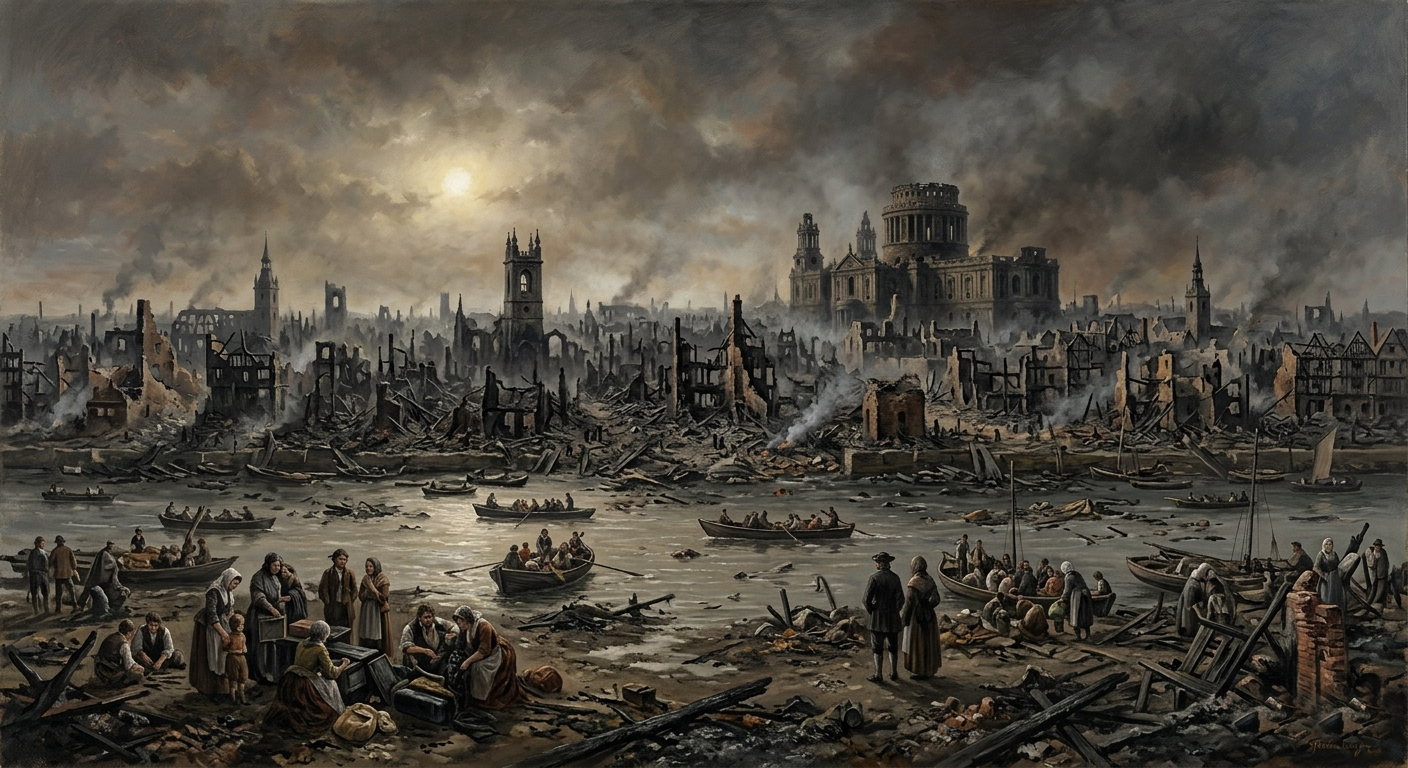
On Thursday, September 6, 1666, the last flames of the Great Fire of London were finally extinguished. Four days and four nights of catastrophic burning had consumed the medieval city from London Bridge to the Temple, from the Thames riverfront to the old Roman city walls and beyond. When Londoners at last picked their way back through the smoldering ruins, the scale of what the fire had destroyed was almost incomprehensible. Over 436 acres inside and outside the city walls had been reduced to ash and charred timber. Approximately 13,200 houses had been destroyed. Eighty-seven parish churches lay in ruins. The Royal Exchange, the Guildhall, forty-four livery company halls, the Custom House, the city’s prisons, and scores of other public buildings were gone. The medieval St. Paul’s Cathedral, which had stood at the heart of the city for centuries, was a smoldering shell.
The death toll, officially recorded as somewhere between six and sixteen people, was startlingly low given the scale of the destruction. But the human cost was measured in homelessness and ruin rather than bodies. Between 70,000 and 100,000 Londoners had been driven from their homes. The ground across the burned area was so hot that it could not be walked on for several days. Smoke hung over the city for weeks. The city that had grown organically over sixteen centuries of continuous habitation, that Roman engineers had laid out, Saxon traders had expanded, Norman conquerors had fortified, and Tudor merchants had filled with the commerce of a growing empire, had ceased to exist. A new London would rise from the ashes, built in brick and stone, planned by the greatest architect England ever produced. But first, Londoners had to understand what had happened and why.
The Four Days That Consumed a City: Sunday Through Wednesday
The fire that ended on September 6 had begun in the early hours of Sunday, September 2, 1666, in the bakery of Thomas Farriner on Pudding Lane, a narrow street near London Bridge. The summer of 1666 had been exceptionally dry and hot, and months without rain had left every timber building in the city as combustible as seasoned firewood. A strong east wind blew from the beginning and continued driving the flames westward throughout the fire’s duration.
When Lord Mayor Sir Thomas Bloodworth arrived in the early hours of Sunday morning and dismissed the fire with contempt, refusing to authorize the demolitions of adjoining buildings that might have stopped it in its first hour, he sealed the city’s fate. By Sunday morning, the fire had spread from Pudding Lane to the riverside warehouses on Thames Street, stocked with oil, tallow, pitch, tar, and other inflammable commodities. Once those warehouses caught, the fire had all the fuel it needed to become unstoppable.
On Sunday and into Monday, September 3, the fire consumed the neighborhoods immediately north and west of London Bridge, moving through the densely packed lanes of the City at terrifying speed. King Charles II, who had been told of the fire early on Sunday morning by Samuel Pepys, had immediately ordered demolitions and dispatched his brother James, Duke of York, to organize firefighting operations in person. Charles himself was repeatedly seen working alongside firefighters, passing buckets of water and directing operations, but the fire was moving faster than any manual bucket brigade could pursue it.
By Monday, the fire had advanced westward to the point where it was threatening the commercial heart of the city. The Royal Exchange, the centerpiece of London’s financial life, burned on Monday night. The Guildhall, the seat of civic government, followed. The parishes of Bread Street, Milk Street, Wood Street, and Cheapside, dense with the shops and dwellings of London’s merchant class, were consumed. The sky over London was visible as an orange glow from miles away, and refugees streaming out of the city along every road formed rivers of desperate people dragging what they could carry.
Tuesday, September 4, brought the fire to the threshold of St. Paul’s Cathedral. The booksellers who had stored their stock in the Cathedral’s vault, believing its stone walls would protect the books from the advancing fire, were catastrophically wrong. When the cathedral’s lead roof melted, the superheated lead poured down the interior walls, the vault contents caught fire, and the books and manuscripts stored there added fuel to a conflagration that consumed the building entirely. John Evelyn, watching from the other side of the Thames, wrote that the stones flew like grenades, that the lead from the roof ran down the streets in a stream, and that the very pavement glowed. St. Paul’s, the tallest building in London, collapsed in fire visible across the entire metropolitan area.
The Wikipedia article on the Great Fire of London provides the comprehensive account of the fire’s progress through the city, day by day, with the eyewitness accounts of Samuel Pepys and John Evelyn that form the primary historical record.
How the Fire Was Finally Stopped: Wind, Gunpowder, and the Duke of York
The fire that burned four days was stopped by a combination of factors: the critical importance of gunpowder demolitions that created firebreaks too wide for the wind-driven flames to leap, and the decisive shift in the wind itself that occurred in the early hours of Wednesday, September 5.
Throughout the fire’s progression, the primary firefighting tool was demolition. The principle was straightforward: if you could pull down enough houses downwind of the fire to create a gap wider than the fire could jump, the flames would run out of fuel and burn themselves out. The problem was speed. With a strong east wind driving the fire westward, the fire moved faster than men with hooks and ropes could clear buildings. Every attempt at creating a firebreak was overtaken before it was complete.
The breakthrough came when Charles II authorized the use of gunpowder to demolish whole blocks of buildings simultaneously. The Navy supplied the powder. Controlled explosions could bring down structures far more quickly than hand tools, and the Duke of York coordinated teams using gunpowder to create wide clearings around the fire’s advancing edges, particularly on its eastern and northern sides. The concussive sounds of the explosions could be heard for miles and triggered widespread rumors among frightened Londoners that the Dutch or French were attacking the city.
On the eastern side of the fire, the garrison of the Tower of London used their own gunpowder to demolish the buildings immediately to the Tower’s west, creating a firebreak that protected the Tower and its enormous stored armaments. Had the Tower’s magazine ignited, the explosion would have devastated whatever of the city the fire had not already reached.
Late on Tuesday night and into the early hours of Wednesday, September 5, the east wind that had driven the fire for four days finally began to drop. The change was decisive. Without the wind’s constant pressure pushing fresh air into the fire and carrying burning embers ahead of the flames to ignite new structures, the firebreaks created by the gunpowder demolitions began to hold. The fire, deprived of both wind and new fuel, began to burn itself out. By Wednesday afternoon, the main body of the fire was contained. Small blazes and hotspots continued through Thursday, September 6, and that evening a fresh outbreak in the Temple, the legal district west of the City, was suppressed by another gunpowder demolition. By the end of Thursday, September 6, the fire was out.
The Scale of Destruction: What Four Days of Fire Left Behind
When contemporaries and officials compiled the reckoning of what the fire had taken, the figures were staggering. The surveyor of the city’s ruins confirmed that 373 acres within the city walls, approximately 85 percent of the walled city’s area, had been burned, along with a further 63 acres outside the walls to the west. The medieval city of London, the city of Richard II and Henry V and the Elizabethan merchants, had been erased.
The human and material accounting was equally devastating. The 13,200 houses destroyed housed most of the population of the walled city. The housing stock alone was valued at approximately three million pounds, with total losses estimated by the Oxford historian Neil Hanson and others at between eight and ten million pounds, against a total annual national revenue at the time of perhaps one million pounds. The financial shock was comparable to a modern economy losing several times its annual GDP in a single catastrophe.
The civic infrastructure that burned represented centuries of institutional investment. The forty-four livery company halls that were destroyed were the homes of the guilds that organized London’s trades and crafts. The Custom House, burned on Monday, was the center of England’s import-export revenue collection. The Guildhall, damaged but eventually salvageable, was the seat of the City of London’s self-governing corporation. The Royal Exchange, the grand building erected by Sir Thomas Gresham in the 1560s as the center of London’s international financial dealings, was entirely destroyed.
The eighty-seven parish churches that burned were not merely buildings but the organizational centers of London’s neighborhoods, the registrars of births, marriages, and deaths, the repositories of community history, and the physical expression of London’s Christian culture. Their loss represented not just religious but social and archival catastrophe, as the parish registers that documented the lives of ordinary Londoners were destroyed along with the buildings.
The Britannica article on the Great Fire of London gives the authoritative account of the fire’s total losses, the immediate humanitarian consequences, and the political and social context in which the rebuilding was planned and executed.
The Aftermath: Refugees, Scapegoats, and Robert Hubert’s Confession
In the days immediately following the fire’s end, approximately 100,000 Londoners were without homes. They camped in open spaces across the metropolitan area, in Moorfields to the north of the city walls, on the hills of Islington and Highgate, in Hyde Park and Paddington Fields. King Charles II visited the refugee camps in Moorfields on September 7, riding among the displaced Londoners and ordering that food supplies be organized and brought to the camps. He issued proclamations directing that the city’s surrounding towns should provide temporary housing and that markets should be established at specific locations outside the burned area so that commerce could continue.
The psychological shock of the fire was compounded by the atmosphere of the moment. England was at war with both France and the Dutch Republic, and the combination of these foreign wars with the recent memory of the Plague of 1665, which had killed approximately 100,000 Londoners just the year before, created an atmosphere in which supernatural interpretation and conspiracy theory flourished. Many Londoners believed the fire had been deliberately set by Catholic agents of France, the Netherlands, or the Pope. Foreigners in London were attacked in the streets, and French and Dutch residents were imprisoned for their own protection.
A parliamentary committee of inquiry was established to investigate the fire’s origins. It found no evidence of deliberate arson. Nevertheless, a mentally disturbed French watchmaker named Robert Hubert confessed to having started the fire deliberately as an agent of the Pope. Hubert’s account was incoherent and internally inconsistent: he originally claimed to have thrown a fireball through a ground-floor window at Farriner’s bakery, but the bakery had no ground-floor window at that location, and the story changed several times in the telling. Most significant of all, it was eventually established that Hubert had been at sea on a ship when the fire started and had not arrived in London until two days after it began. None of this prevented him from being tried, convicted on his own confession, and hanged at Tyburn on October 29, 1666, in one of the most shameful miscarriages of justice in English legal history.
The History.com article on the Great Fire of London covers the fire’s full course from Pudding Lane to its extinction, the refugee crisis that followed, and the scapegoating that produced Robert Hubert’s wrongful execution.
Christopher Wren and the Rebuilding of London After the Fire
The destruction wrought by the Great Fire created a unique opportunity that the greatest architectural mind of the age seized with both hands. Sir Christopher Wren, a thirty-three-year-old professor of astronomy at Oxford who had recently turned his formidable intellect toward architecture, submitted a plan for the complete replanning of London within days of the fire’s end. His proposal would have replaced the medieval tangle of lanes and alleys with a rational grid of wide streets and grand public spaces centered on St. Paul’s Cathedral and the Royal Exchange. John Evelyn submitted a competing plan with similar ambitions. Robert Hooke, a polymath colleague of Wren’s, submitted a third.
None of these grand replanning proposals was adopted. The urgent need to restore London’s commercial function, combined with the intractable disputes over property boundaries in the burned area, made any wholesale replanning legally and practically impossible. London was rebuilt largely on its existing street plan, but with crucial new standards for materials and construction. The Rebuilding of London Act of 1666 prohibited the use of wood for external building surfaces and required brick and stone for all new construction. It prescribed minimum widths for different categories of street and standardized building heights by street type. It established a system of fire courts to resolve the property disputes that threatened to delay rebuilding indefinitely.
The most lasting architectural consequence of the fire was the career it gave to Wren. He was given the commission to design the replacement for St. Paul’s Cathedral and to redesign fifty-one of the eighty-seven burned parish churches. The new St. Paul’s, begun in 1675 and completed in 1711, became not only the greatest building in England but one of the supreme works of European architecture. Its dome, rising 365 feet above the street, dominated the London skyline for three centuries, until the glass towers of the late twentieth century grew to challenge it. The fifty-one Wren churches that dotted the rebuilt city transformed its architectural character, bringing to the dense urban fabric a succession of elegant towers and spires that made Wren’s London one of the most architecturally coherent cities in Europe.
The Monument to the Great Fire of London, designed jointly by Wren and Robert Hooke and completed in 1677, was erected near the location of Farriner’s bakery on Pudding Lane. Standing exactly 202 feet tall and positioned exactly 202 feet from the fire’s origin point, it served as a permanent record of the disaster, with a bilingual inscription in English and Latin recounting the fire’s statistics: the number of houses destroyed, the area burned, and the years required for rebuilding. A later inscription also blamed the fire on a Catholic conspiracy, a calumny that remained on the monument for nearly two centuries until it was finally removed in 1831.
The Royal Museums Greenwich resource on the Great Fire of London covers the fire’s day-by-day progression, the role of Samuel Pepys and John Evelyn as primary witnesses, and the architectural transformation that Christopher Wren accomplished in rebuilding the burned city.
The Legacy of the Great Fire: Insurance, Urban Planning, and Fire Safety
The Great Fire of London transformed not just the physical fabric of one city but the institutions and practices by which urban risk is managed across the modern world.
Before the fire, there was no insurance against property loss by fire anywhere in the common law world. The devastating experience of seeing homes and livelihoods consumed without any mechanism for recovery or compensation created powerful demand for exactly such a product. Nicholas Barbon, an economist and property developer who played an important role in the rebuilding of London after the fire, established the first fire insurance company in London in 1681, offering policies that compensated property owners for losses due to fire. Within years, several competing fire insurance companies were operating in London, each maintaining its own brigade of firefighters who would only attend fires at properties insured with that company. The fire mark, a metal plate fixed to insured buildings bearing the company’s emblem, became a feature of London facades. By the nineteenth century, the insurance industry had grown from these post-fire beginnings into one of the central institutions of the modern financial system.
The requirement for brick and stone construction in the Rebuilding Act not only made London’s rebuilt fabric more fire-resistant but pioneered the concept of building codes as instruments of urban safety. The idea that government could prescribe minimum standards for construction materials and methods in the interest of public safety, which the Rebuilding Act embodied for the first time in English law, became the foundation for the building regulations that govern construction in every modern city.
The Historic UK account of London after the Great Fire describes the human and institutional transformation that followed the fire’s end, from the immediate refugee crisis through the decades of rebuilding that produced the distinctive character of Restoration London.
The Great Fire of London ended on September 6, 1666, but its consequences extended for generations. It took approximately fifty years to fully rebuild the burned area. The last of Wren’s churches was completed in 1717. The insurance industry it prompted, the building regulations it inspired, the architectural masterpieces it made possible, and the annual commemoration of it that still marks September 2 in English civic life all stand as evidence of how thoroughly one disaster shaped the society that survived it. “London was, but is no more,” John Evelyn wrote as he surveyed the ruins. He was right about the old London. The new one that rose from its ashes was, in nearly every respect, better.